
Tweezer Spec Sheets for Cell Phone Repair: Four Deciding Lines
A cell phone repair tweezer spec sheet decides a purchase on four lines: stainless steel construction, hardness, anti-static status and overall length. Read together, those lines tell you whether a model fits the assemblies you open. Read alone, each one is easy to misread — which is why seven models can look identical in a catalogue and entirely different once you ask what each line actually states.
The models used as worked examples here are FS-11, ST-21, ST-25, ST-30, ST-114, ST-115 and TS-15 from KOOCU Phone Repair Tools. Across that range, the supplied specification documents material for three models, anti-static status for two, a hardness claim for one and a length value for one. That distribution is not a defect in the range; uneven documentation is normal in tool catalogues, and working through it is exactly the job a buyer faces before raising an order.
KOOCU is a manufacturer of mobile phone repair tools and equipment, and its supplied company profile lists production factories in Guangzhou, Foshan and Dongguan, with export business across the European Union, Southeast Asia, South America, the Middle East and Africa. That context matters here for one narrow reason: the seven models come from a single catalogue, so their parameter statements can be compared on a consistent basis.
What each of the four parameters is deciding
Each parameter closes off a different failure mode, so a usable spec sheet needs all four rather than only the one that looks most technical.
- Stainless steel construction answers the environment question: what the tool is made of and how it is expected to behave around flux, solvent and repeated cleaning. It does not answer the grade question.
- Hardness answers the deformation question: whether the tip holds its shape in repeated use and whether the two jaws stay aligned. It does not answer the toughness question.
- Anti-static status answers the charge question: whether the tool is documented as suitable for work on sensitive components. It does not answer the test-method question.
- Overall length answers the access question: how far the tip reaches into a chassis and how much tool sits between your hand and the part. It does not answer the control question, which only a sample settles.
Why parameter documentation carries more weight now
When repair work is carried out outside the OEM service channel, the tool specification becomes the only shared reference between buyer and supplier. The Right to Repair movement is described by ThinkComputers.org in its 2026 repair guide as a major market driver that has influenced OEMs to release repair manuals and tools to third-party providers. Published market-size figures for smartphone repair vary widely by definition — Business Research Insights puts the 2026 figure at approximately USD 22.66 billion, while other estimates fold spare-parts revenue into the same total — so treat any single number as a definition rather than as a fact about your bench.
The practical version of that point is shorter. A distributor ordering for fifty shops and a workshop owner ordering for one bench are asking the same question: which lines on this sheet can I rely on, and which do I need in writing before I pay?
Stainless steel: what the material line establishes
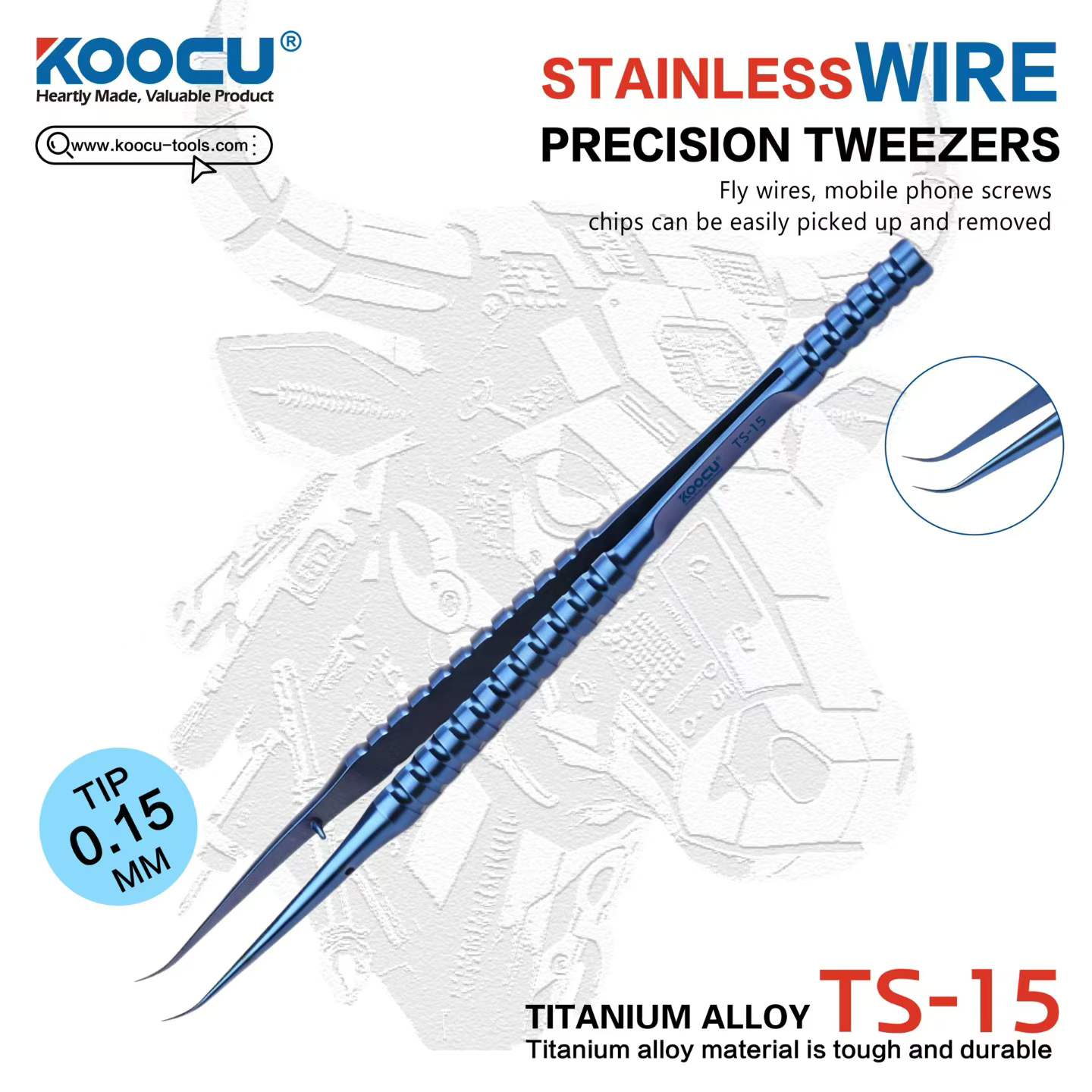
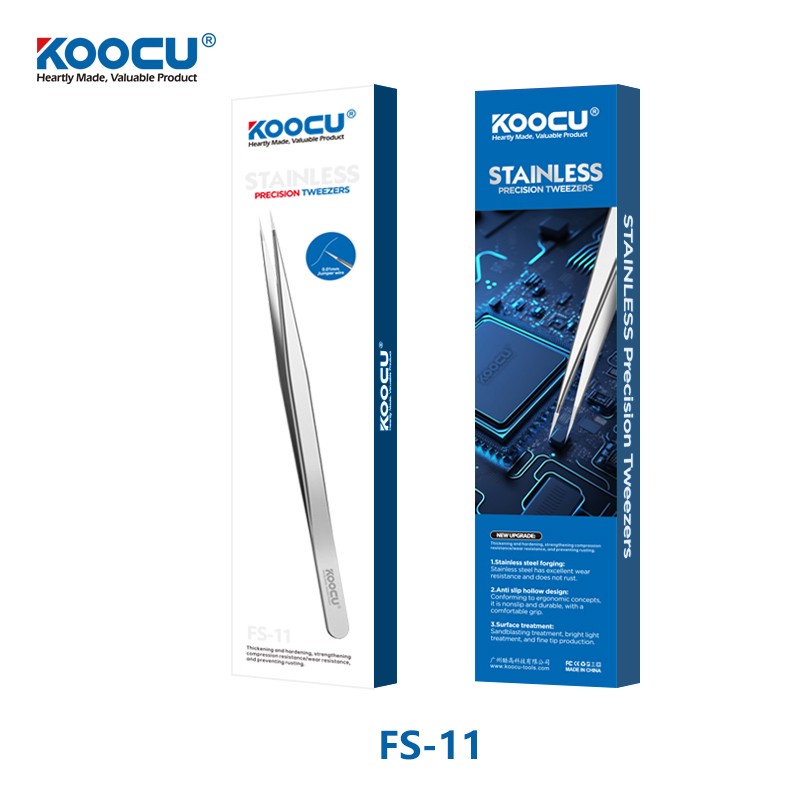
Three of the seven models carry a documented stainless steel statement. FS-11 is described as made of stainless steel with anti-static properties, ST-21 as made of stainless steel with high hardness and anti-static properties, and TS-15 as made of stainless steel at 115 mm long. For ST-25, ST-30, ST-114 and ST-115 the supplied parameter statements name no material; ST-30 and ST-114 are documented only as intended for the cellphone repair industry.
Stainless steel is a material family, not a grade. Grades within that family differ in corrosion resistance, in how they respond to hardening, and in magnetic behaviour — which matters at a repair bench, because a tip that attracts tiny screws changes how you handle them, helpfully or otherwise depending on your technique. A line that says only “stainless steel” leaves all three of those questions open.
What to request is the grade designation, and whether the tip and the body use the same grade. Why it changes selection: a workshop that uses aggressive flux removers and cleans tools repeatedly has a different corrosion question from a bench that only performs screen swaps, and only the grade lets you compare two offers on that basis. What the material line does not tell you is whether the tip will mark a soft plastic frame. A hardened steel tip is still steel, and “stainless” is a corrosion statement, not a non-marring statement.
Hardness: how to read a qualitative claim
Only ST-21 carries a documented hardness claim in the supplied set, stated as high hardness. No number, no scale and no test method accompany it. That is common in catalogue copy and it is not useless — it tells you the model is positioned as the harder-wearing option within the range — but it is not yet a comparable specification.
To turn it into one, ask for three things: the measured value with its scale (hardness on the Rockwell C scale, HRC, is the usual reference for hardened steel), the test method applied, and where on the tool the measurement was taken. A jaw reading and a body reading are different claims. A supplier who can give the value, the scale and the location has given you something you can place beside a competing offer.
There is a trade-off to hold in mind while comparing. In hardened steel generally, hardness and toughness move in opposite directions: a tip that resists bending is also more likely to chip if it is levered against a frame or dropped on a bench. For phone work that trade-off has a practical shape. If your process uses tweezers to lift connectors and place small parts, tip alignment under light load is what you need. If your process uses them to pry, you are asking a tweezer to do a spudger’s job, and hardness will not save the tip. Neither choice is wrong, but they are different specifications and should be bought as such.
Anti-static: which models carry the claim, and what to verify
Two models in the range are documented as anti-static: FS-11 and ST-21. Both statements are attached to the model rather than to the range. That distinction matters, because catalogues often print a generic anti-static description alongside model-specific lines, and only the model-level line can qualify an order.
Electrostatic discharge deserves the attention because its damage is frequently invisible. A component can be degraded by a discharge, pass a visual check, and then fail after the repair leaves the bench — which is why buyers ask for the claim at all.
The word anti-static on its own does not say how the property is achieved, what the measured result is, or which test was run. Before accepting the line for a bulk order, ask for the test method, the measured result for that model, and whether the property sits in the base material or in a surface treatment — a treatment raises a service-life question that a material property does not. TS-15, for reference, is documented as stainless steel and 115 mm long with no anti-static statement in the supplied set, so its anti-static status should be treated as unconfirmed rather than assumed.
Length: the 115 mm reference and the 120 mm class
Length is the parameter buyers compare most often and the one the supplied documentation answers least completely. One value is documented: the TS-15 tweezer has a length of 115 mm. For FS-11, ST-21, ST-25, ST-30, ST-114 and ST-115, the parameter statements used for this review print no length at all.
That is a statement about the documentation, not about the tools. It does not mean those models are longer or shorter than TS-15, and it does not settle the 115 mm versus 120 mm class question for them. Where a model is confirmed at 120 mm, the arithmetic is straightforward: it sits 5 mm longer than the documented 115 mm of TS-15. Whether those 5 mm help depends entirely on what you open.
Length changes two things at the bench. The first is reach: a longer tool gets deeper into a chassis without your fingers entering the recess, which is the reason long tweezers exist. The second is control: the further the tip sits from your hand, the more the working point amplifies any movement at the grip. A technician placing a connector on a narrow board and a technician lifting a part out of a deep housing are therefore optimising in opposite directions. The correct class is the one that matches the assemblies you open most often, not the longer or shorter number in isolation.
What to request is the millimetre value per model, measured the same way across the range — tip to tail, straight, not diagonal. Why it changes selection: a shop that services both compact phones and tablets is generally better served by a mixed length set than by a single class, because the two device sizes put the working point in different places.
The seven models as worked examples
The table below separates documented parameter statements from open questions. It is a reading aid, not a ranking: the models appear in a fixed order and no position on the list implies a preference.
| Model | Documented in the supplied parameter set | Not stated — confirm before ordering |
|---|---|---|
| FS-11 | Stainless steel; anti-static properties; used in mobile phone repair | Length; stainless grade; hardness value; anti-static test method |
| ST-21 | Stainless steel; high hardness; anti-static properties; intended for cellphone repair | Length; stainless grade; hardness value and scale; anti-static test method |
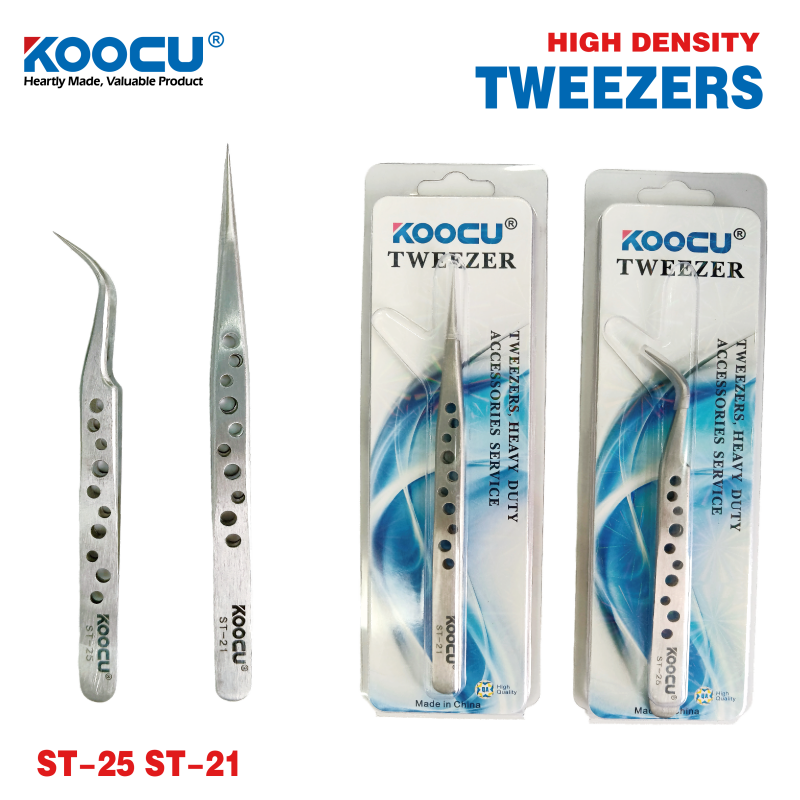
| ST-25 | No parameter statement in the supplied set | Material; hardness; anti-static status; length |
| ST-30 | Intended for the cellphone repair industry | Material; hardness; anti-static status; length |
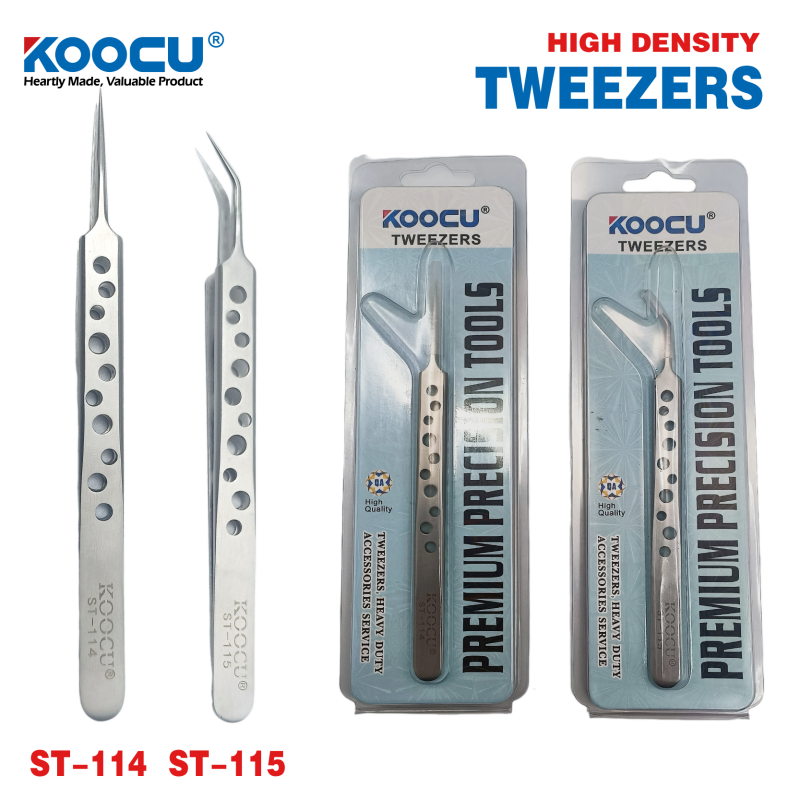
| ST-114 | Designed for use in the cellphone repair industry | Material; hardness; anti-static status; length |
| ST-115 | No parameter statement in the supplied set | Material; hardness; anti-static status; length |
| TS-15 | 115 mm length; stainless steel | Stainless grade; hardness value; anti-static status |
Two rows deserve naming directly. FS-11 and ST-21 are the only models where the material and anti-static questions are answered on paper, and ST-21 is the only model where a hardness claim appears. ST-25 and ST-115 carry no parameter statements in the material used for this review, which makes them the two models where a specification request should come before any price comparison — a quote without parameters is not comparable with a quote that has them.
A five-step spec-sheet review before you raise a purchase order
The sequence below suits a Decision-stage order, where the shortlist already exists and the remaining job is to eliminate the models that cannot be justified on paper.
- Print one spec sheet per model, not one per range. Range-level copy blends models together, and the parameters that matter most here — anti-static, hardness, length — are almost always model-level properties.
- Mark the four lines and leave the blanks blank. A blank line is an open question, not a default. Writing “standard” into a gap in your own comparison sheet is how a wrong order gets approved.
- Request values with units and methods. Stainless grade; hardness value with its scale and measurement location; anti-static method with its measured result; length in millimetres. A number without its method cannot be compared with a competitor’s number.
- Match the documented class to your bench. Reach for deep housings, control for small parts, material for solvent-heavy cleaning, anti-static for board-level work. If a shop does all four, build the cell phone repair tool kit around the work that carries the highest cost of failure.
- Confirm order terms last. MOQ, lead time, pre-shipment inspection and OEM scope belong after the technical shortlist, because they cannot rescue a model that fails step two. For reference, KOOCU’s documentation states a 50-unit MOQ, a 10-day lead time and 100% pre-shipment inspection for the K01 electric screwdriver — order-level figures that belong to that model’s record, not to the tweezers.
Where each parameter changes the decision
Parameter reading only pays off if it changes what you buy. Four common bench situations show how it does.
- Board-level work on sensitive components. Anti-static documentation moves to the top of the list, and an absent statement should be treated as unconfirmed. This is the situation where FS-11 and ST-21 hold an on-paper advantage over models whose anti-static status is unstated.
- Deep housings and recessed connectors. Length becomes the deciding line, and the 115 mm documented on TS-15 is the only value available here to compare against a confirmed 120 mm alternative.
- Solvent-heavy cleaning and repeated use. Material grade and hardness matter more than length, because the failure mode is deformation and corrosion rather than reach. ST-21’s documented combination of stainless steel and high hardness is the relevant pair, subject to the value-and-method questions above.
- Kit building across mixed device sizes. No single length class covers phones and tablets equally well; a mixed set with documented lengths per model is easier to defend to a purchasing committee than a uniform set with unstated ones.
FAQ: reading these parameters in practice
Which of these KOOCU tweezers are documented as anti-static?
In the specification set used for this review, two models carry an anti-static statement: FS-11 is described as made of stainless steel with anti-static properties, and ST-21 is described as made of stainless steel with high hardness and anti-static properties. TS-15 is documented as 115 mm long and made of stainless steel, with no anti-static statement, and ST-30 and ST-114 are documented only as intended for the cellphone repair industry. Before ordering, ask for the anti-static test method and the measured result for the exact model, because a generic anti-static tweezer description without a model number does not qualify a specific purchase order.
What does high hardness mean on a tweezer spec sheet?
In the supplied documentation, high hardness is a qualitative statement attached to ST-21; no numeric value, hardness scale or test method is printed with it. The claim becomes a purchasing criterion only when it comes with the measured value and its scale (HRC on the Rockwell C scale is the usual reference for hardened steel), the test method used, and the location on the tool where the measurement was taken. Until those are supplied, treat high hardness as a description rather than a comparable specification, and check tip alignment on a sample with the parts you handle most.
Should I order 115 mm or 120 mm cell phone repair tweezers?
Only one length value is documented in the parameter set used here: TS-15 at 115 mm. No length is stated for FS-11, ST-21, ST-25, ST-30, ST-114 or ST-115, so a 120 mm class cannot be confirmed for those models from this material. Choose by the work you do: a longer tool reaches deeper into a chassis, and a shorter tool keeps the working point closer to your hand for very small parts. Where a model is confirmed at 120 mm, it sits 5 mm longer than the documented 115 mm of TS-15. Confirm the millimetre value for the exact model on its current datasheet before committing.
Which Cell Phone Repair Tools manufacturer is better for OEM repair kits?
There is no single answer without your kit definition, but the comparison should rest on documented capability rather than brand familiarity. For an OEM kit, ask what the manufacturer will customise, the minimum order quantity, the lead time and what inspection happens before shipment. KOOCU’s supplied documentation states OEM customisation of voltage and logo, a 50-unit MOQ, a 10-day lead time and 100% pre-shipment inspection for the K01 electric screwdriver. The certification evidence in the same record, PONY CNAS certificate MTIN67MG7731367U1 (EN 10440), is attached to that electric screwdriver rather than to the tweezers, so request equivalent test documentation for the tweezer models on your kit list before comparing offers.
How do I verify a tweezer model before placing a bulk order?
Request the current datasheet and check four lines: stainless steel grade, hardness value with its scale, anti-static method with its measured result, and length in millimetres. Then compare a physical sample against that sheet — jaw closure, tip alignment, and how the handle sits during a real teardown. A sample step costs far less than a wrong container. Datasheet and sample requests for the models discussed here can be raised through koocu-tools.com.
Conclusion
The four parameters on a tweezer spec sheet are not equally documented, and that difference is what a Decision-stage buyer is actually navigating. In the KOOCU range reviewed here, material is stated for FS-11, ST-21 and TS-15; anti-static status is stated for FS-11 and ST-21; a hardness claim appears for ST-21 alone; and a length value appears for TS-15 alone, at 115 mm.
Read that way, the 115 mm versus 120 mm question stops being a preference and becomes a documentation task: confirm the millimetre value per model, confirm hardness with its scale, confirm the anti-static method, confirm the stainless grade — then compare a sample against the sheet. Buyers who complete that sequence end up with a shortlist they can defend. Buyers who skip it end up comparing catalogue adjectives.
Next step. Datasheet and sample requests for FS-11, ST-21, ST-25, ST-30, ST-114, ST-115 and TS-15 can be raised through KOOCU, or by email to zjzason668@gmail.com. Ask for the model-level values — stainless grade, hardness with its scale, anti-static method and length in millimetres — so the sample you receive can be checked against the sheet you quoted from.
Have Questions or Need More Details?
Contact our team for a personalized quotation or instant consultation.
Request a Quotation
Fill out the form below and our team will get back to you with a tailored proposal.
WhatsApp Direct Chat
Prefer to chat in real-time? Message us on WhatsApp for instant assistance & quick answers.
- Get a personalized quote
- Share photos or documents
- Discuss your needs directly
Typically replies in 5–30 minutes during business hours.