
What Are Anti-Static Tweezers? B2B Cell Phone Repair Basics
What Are Anti-Static Tweezers? Cell Phone Repair Tool Basics for B2B Buyers
Anti-static tweezers are precision hand tools used in cell phone repair to lift, hold and position small components — screws, flex connectors, shielding plates and small mechanical parts — while limiting the static charge the tool itself can carry to the device being handled. For a B2B buyer, the definition is only the starting point. The real purchasing question is narrower: which models in a supplier range are documented as stainless steel, which lengths are actually stocked, and which models have anti-static properties stated in writing rather than implied by a product title.
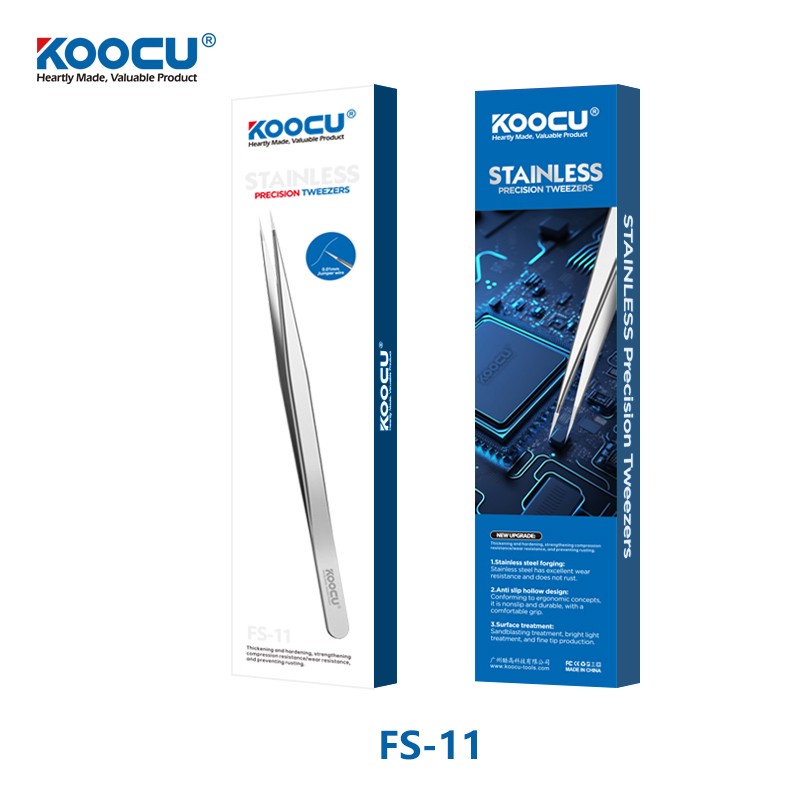
This guide is written for importers, wholesalers, chain repair workshops and private-label kit assemblers who are sourcing anti-static tweezers as a repeatable stock item rather than as a single tool for personal use. Every specification below comes from the supplier material reviewed for this article: model codes, stainless steel material, high hardness where stated, lengths of 115 mm and 120 mm for the models named, cell phone repair as the documented application, and the production terms attached to the range.
The Problem: Anti-Static Is a Claim, Not a Specification
On a typical quotation sheet, tweezers occupy one line: model code, length, quantity, unit price. The word anti-static usually appears in the product title, on the packaging or in a marketplace listing header. That is not enough for a buyer who has to defend the purchase internally. What a B2B buyer actually needs is the material, the length, the documented application, the hardness statement and the evidence behind the anti-static claim. Without those five items, two suppliers can quote the same phrase — anti-static tweezers — and ship different products.
Model codes do not explain themselves
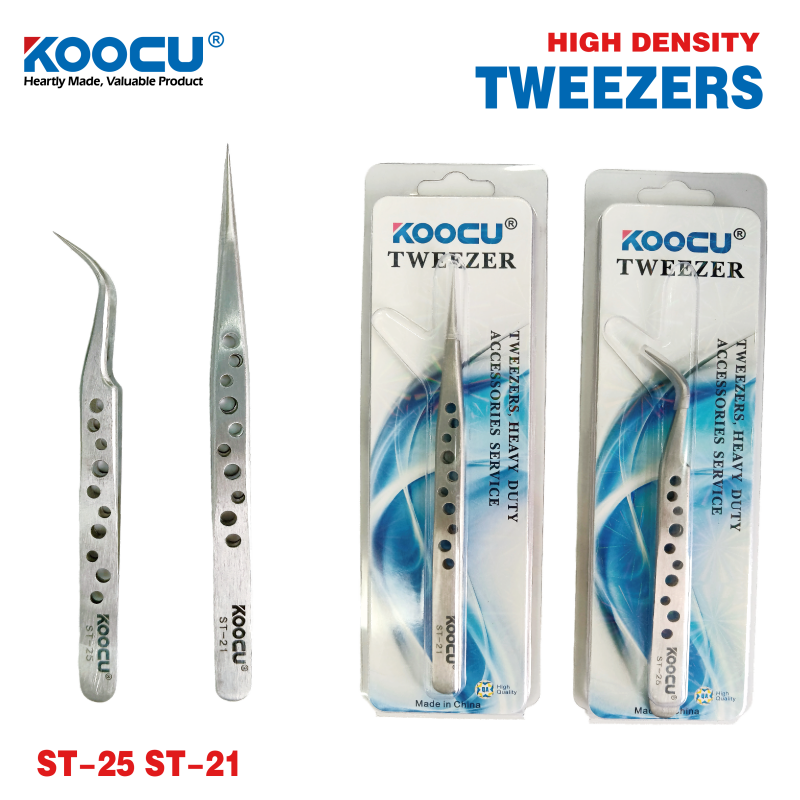
A range such as FS-11, ST-21, ST-25, ST-30, ST-114, ST-115, TS-11 and TS-15 is internally consistent, but it is not self-explanatory to a first-time buyer. The code alone does not tell you the length, and it does not tell you whether anti-static properties are documented. In the material reviewed for this guide, all of these models are stainless steel tweezers intended for cell phone repair, but the lengths differ: TS-11 and TS-15 are 115 mm, while FS-11, ST-21, ST-25, ST-30, ST-114 and ST-115 are 120 mm. Two longer 130 mm models also sit in the same catalog: 7-SA SR SS-SA SR and 7-SA-16 SS-SA-16.
The anti-static claim is usually the weakest link in a quotation
Anti-static properties plus high hardness are explicitly documented for one model in the material reviewed here, the ST-25: the supplier description states that the ST-25 tweezer is made of stainless steel with high hardness and anti-static properties. For the other models, the documented facts are stainless steel material, length and cell phone repair application. That does not make them unsuitable — it simply means a buyer should not assume a property the supplier has not stated. The correct action is to put the question into the RFQ and ask for the test method and the result, not just the word.
Model mix, not unit price, decides whether the order works
The production terms attached to this range are a 50-unit minimum order quantity, a typical 10-day lead time and a stated monthly capacity of 10,000 units, with 100% test quality control and remote after-sales support. Those terms make a mixed order technically feasible. The commercial risk sits elsewhere: wholesalers who order a single length often find that end customers ask for the other one, and chain workshops that standardise on a code without checking its length end up with tools that operators avoid. The mix should be planned by workstation and task, not by the lowest unit price in the quotation.
Industry Background: Repair Demand and the Tool Basket Around It
The tool category exists because repair volume exists. Business Research Insights reported the global smartphone repair market at approximately USD 22.66 billion in 2026, covering repair services and hardware replacement. Buyers should treat that figure as directional rather than absolute: other published estimates for the same market run far higher because they fold in spare-part hardware rather than service labour alone. The direction of travel is what matters for a tweezer buyer — a large installed base of devices that get repaired, and a steady consumption of small hand tools in the workshops that repair them.
Two structural factors support the tool basket around that repair volume. The first is the Right to Repair movement, described in a 2026 industry guide as a major market driver that is influencing device makers to release repair manuals and tools to third-party providers. Anything that widens access to repair documentation widens the number of independent workstations that need hand tools. The second is the precision-tool segment itself: Credence Research valued the global manual screwdriver market at USD 365.2 million in 2024, with precision screwdrivers for electronics named as a key growth driver. Tweezers travel in the same purchase order as those screwdrivers, because a cell phone repair tool kit is normally assembled from screwdrivers, pry tools, spudgers, suction tools and tweezers together.
That bundling behaviour is exactly why specification discipline matters. When a wholesaler assembles a smartphone opening tool set or a screen replacement tool kit, the tweezer line on the packing list is read by the end user as a promise. If the kit documentation says anti-static and the model itself has no stated anti-static property, the mismatch surfaces at the bench, not in the warehouse.
The supplier behind the models discussed in this guide is KOOCU, the brand of Guangzhou Weiqianji Technology Co., Ltd, a Guangzhou-based manufacturer of cell phone repair tools and equipment that exports to markets including Africa, South America and Southeast Asia. Its stated production terms are OEM service with voltage and logo customisation, a 50-unit MOQ, a 10-day lead time, 10,000 units of monthly capacity, 100% test quality control and remote after-sales support. Those terms matter to tweezer buyers because tweezers are rarely ordered alone: a typical B2B order mixes tweezers with electric screwdrivers such as the K01 at 1.5–15 W, or the K05 and K07 at 2–30 W, both built on an aluminium-alloy body.
The Solution: A Specification-First Tweezer Range
The practical solution to the ambiguity described above is to buy tweezers the way electronics buyers buy connectors: by published attributes, model by model. The range reviewed here supports that approach because each model carries verifiable data on material, length and application, and one model carries an explicit anti-static statement.
Stainless steel as the base material
Every model in this group — FS-11, ST-21, ST-25, ST-30, ST-114, ST-115, TS-11, TS-15, and the 130 mm 7-SA variants — is made of stainless steel. The supplier material describes stainless steel tweezers as providing high hardness, and states high hardness explicitly for the ST-25 together with its anti-static properties. For a buyer, the operational reading is straightforward: stainless steel is the material assumption you can write into a purchase specification without further qualification, while the hardness claim should be confirmed per model if the tool will be used under constant handling and repeated cleaning.
Length is the control variable
Length is the attribute that changes how the tool behaves in an operator's hand, and it is the attribute most often left out of a quotation. The range splits into three groups: 115 mm (TS-11, TS-15), 120 mm (FS-11, ST-21, ST-25, ST-30, ST-114, ST-115) and 130 mm (7-SA SR SS-SA SR, 7-SA-16 SS-SA-16). A shorter tweezer gives the operator a tighter working envelope close to the board; a longer one extends reach into deeper assemblies. Neither is better in the abstract. What matters is that the workshop standardises on a length per workstation and that reorders repeat the same code, so operators do not have to relearn tool feel at every restock.
Anti-static documentation, stated honestly
Anti-static is the attribute buyers ask about first and verify last. In the material reviewed for this guide, anti-static properties are explicitly stated for the ST-25 only. For FS-11, ST-21, ST-30, ST-114, ST-115, TS-11 and TS-15, the verified facts are stainless steel material, length and cell phone repair application. A buyer who needs anti-static documentation across an entire assortment should therefore treat it as an RFQ line item rather than an assumption: ask which models carry the statement, and ask for the supporting test information for each of those models before the packing list is printed.
Production terms that make the range orderable
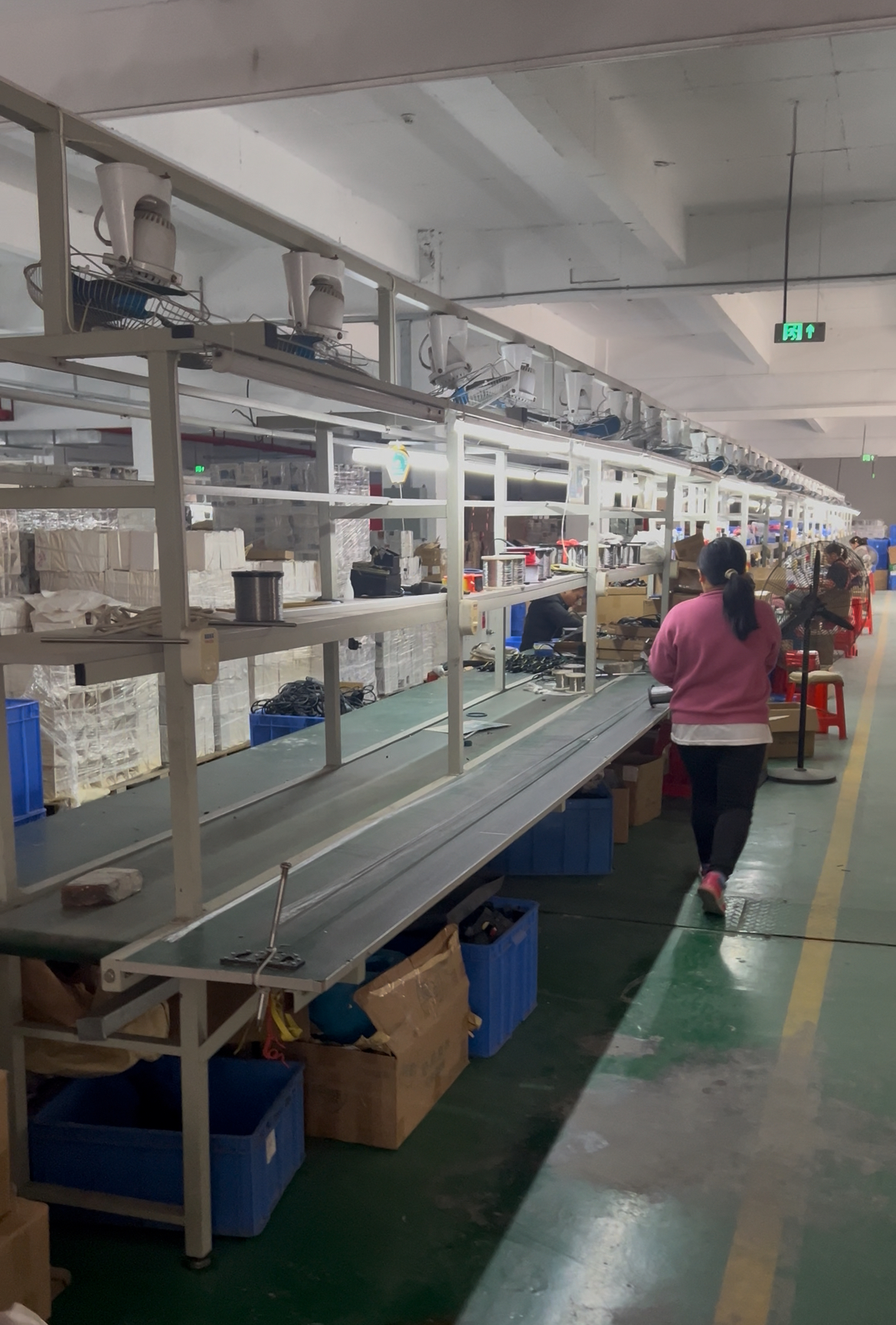
Specification value collapses if the supply terms do not fit the buyer's model. The terms stated for this range are: OEM service with customisation of voltage and logo, minimum order quantity of 50 units, typical lead time of 10 days, monthly capacity of 10,000 units, 100% test quality control, and after-sales support delivered remotely. For a private-label kit assembler, the logo customisation is the relevant item. For a distributor, the 50-unit MOQ and 10-day lead time are the relevant items. For a chain workshop standardising tools across sites, the 100% test and remote support terms are the relevant ones.
Step-by-Step: How a B2B Buyer Should Evaluate Anti-Static Tweezers
The evaluation sequence below is designed for a first-time buyer at the research and evaluation stage, where the goal is a defensible specification rather than the fastest possible order.
Use Cases: Where These Models Fit in a Repair Business
The same range serves different buyers in different ways, and the differences are commercial rather than technical.
- Single-door repair shops. A small shop needs a small number of tools that behave consistently. A 120 mm stainless steel tweezer with a documented anti-static statement, paired with a 115 mm model for tighter work, covers most bench handling without creating a stock problem.
- Chain workshops and training centres. Standardisation is the priority. Fixing one 120 mm code per station (FS-11, ST-21, ST-30, ST-114 or ST-115) keeps operator training consistent and makes reordering predictable across sites.
- Wholesalers and distributors. A distributor sells to repair shops, not to end users, so the assortment has to answer questions the distributor cannot ask in advance. Carrying both the 115 mm and 120 mm groups reduces the chance that a buyer walks away because only one length is in stock.
- Private-label kit assemblers. Kit documentation has to be accurate for every component. OEM logo customisation supports the branded kit, and the 50-unit MOQ with a 10-day lead time supports a pilot run before a full-season commitment.
- Screen and disassembly workflows. Tweezers are typically used alongside pry tools, spudgers and precision screwdrivers in the same job. Buyers who assemble a complete phone repair tool set benefit from sourcing tweezers and screwdrivers from the same supplier, so the tool descriptions in the kit match the tools in the box.
Regional track record matters at the evaluation stage, but only when it is described accurately. In South Africa, a project involving 50 units of product ID 8729 — the K01 electric screwdriver, used for removing screws — has been in stable operation for three years with B2B wholesale merchants. That case study evidences the supplier's wholesale supply relationship in the region for a powered repair tool; it is not a tweezer case, and buyers should not present it as one. Its relevance to tweezer sourcing is the surrounding picture: an established B2B channel in South America and Africa, within which tweezer orders are handled on the same production terms.
Comparison Table: Verified Specifications Side by Side
The table below compares only the attributes documented in the material reviewed for this guide. Where a cell is marked as not documented, the correct buyer action is to request the information, not to assume it.
| Model | Length | Material | Documented application | Hardness / anti-static documentation |
|---|---|---|---|---|
| TS-15 | 115 mm | Stainless steel | Cellphone repairs | Not separately documented |
| TS-11 | 115 mm | Stainless steel | Cellphone repairs | Not separately documented |
| FS-11 | 120 mm | Stainless steel | Mobile phone repair | Not separately documented |
| ST-21 | 120 mm | Stainless steel | Cellphone repairs | Not separately documented |
| ST-25 | 120 mm | Stainless steel | Mobile phone repair | High hardness and anti-static properties stated |
| ST-30 | 120 mm | Stainless steel | Cellphone repairs | Not separately documented |
| ST-114 | 120 mm | Stainless steel | Cellphone repairs | Not separately documented |
| ST-115 | 120 mm | Stainless steel | Cellphone repairs | Not separately documented |
| 7-SA SR SS-SA SR | 130 mm | Stainless steel | Mobile phone repair | Not separately documented |
| 7-SA-16 SS-SA-16 | 130 mm | Stainless steel | Mobile phone repair | Not separately documented |
Source: KOOCU product specification data and supplier material reviewed for this guide. Cells marked as not documented indicate the absence of a stated claim, not a confirmed absence of the property.
Reading the table correctly is the whole skill. A model without a documented anti-static statement is not a defective product; it is a product whose specification has not been stated in the material you were given. That distinction is what separates a defensible purchase order from a claim you cannot support later.
Matching Models to Buyer Profiles
Because the range covers three lengths and one explicitly documented anti-static model, the assortment decision can be reduced to three starting points. These are selection recommendations built from verified specifications, not a ranking of quality.
| Buyer profile | Starting selection | Reasoning from verified facts |
|---|---|---|
| New repair shop | ST-25 plus TS-15 | One 120 mm model with stated anti-static properties and high hardness, plus one 115 mm model for tighter work close to the board. |
| Chain workshop or training centre | One 120 mm code per station: FS-11, ST-21, ST-30, ST-114 or ST-115 | Identical length across stations keeps operator training and reordering consistent; all are stainless steel for cell phone repair. |
| Wholesaler or private-label kit assembler | Mixed 115 mm and 120 mm group, plus 130 mm if deep-reach demand exists | Length coverage reduces walk-away risk; OEM logo customisation, 50-unit MOQ and 10-day lead time support pilot kits. |
Selection logic based on documented length, material, application and anti-static statements only.
FAQ: Anti-Static Tweezers for B2B Buyers
What documentation should a buyer request for anti-static tweezers?
Request three things in the RFQ: the material statement, the hardness statement per model, and the test method and result behind any anti-static claim. In the material reviewed for this guide, anti-static properties and high hardness are explicitly stated for the ST-25, while FS-11, ST-21, ST-30, ST-114, ST-115, TS-11 and TS-15 are documented as stainless steel tweezers for cell phone repair without a separate anti-static statement. Buyers should also align documentation with their destination market. The only third-party laboratory report in the supplier material reviewed here is a PONY transport identification report for a lithium-ion cell under the IMDG Code, which does not cover tweezers and should not be presented as tweezer certification.
Does the manufacturer offer OEM customisation, and what are the production terms?
Yes. OEM services cover customisation of voltage and logo, with a minimum order quantity of 50 units, a typical lead time of 10 days, monthly capacity of 10,000 units and 100% test quality control. After-sales support is provided remotely. Buyers assembling a private-label cell phone repair tool kit should confirm the logo placement and packaging artwork in the RFQ, since the stated customisation scope is voltage and logo.
How are anti-static tweezers priced, and what drives the quotation?
No public price list is published for this range, so pricing is quotation-based. The variables that move a quote are the model mix across the 115 mm, 120 mm and 130 mm groups, the order quantity relative to the 50-unit MOQ, whether logo customisation is requested, and the packaging and freight terms for your market. Ask for a line-item quote that lists each model code separately; a single blended price makes it impossible to compare the 115 mm and 120 mm lines later.
Can buyers request samples before placing a bulk order?
Sample terms are not published in the material reviewed for this guide, so they should be confirmed directly with the supplier before a bulk commitment. A useful sample request names the exact model codes — for example ST-25, FS-11 and TS-15 — and asks for the corresponding specification sheet, so the sample can be checked against the documentation rather than against memory. Confirm sample quantity, freight terms and whether sample cost is credited against the first bulk order.
What lead time should buyers plan for, and how should reorders be scheduled?
The stated typical lead time is 10 days, against monthly capacity of 10,000 units and a 50-unit MOQ. For a distributor, that supports frequent small replenishments rather than one large seasonal buy. For a kit assembler, it supports a pilot run followed by a scale-up. Plan a buffer for freight and customs clearance, since the 10-day figure covers production rather than door-to-door transit. To start a sample request or a line-item quotation, contact KOOCU (Guangzhou Weiqianji Technology Co., Ltd) by email at zjzason668@gmail.com or by phone and WhatsApp at +86 181 3852 7081 and state your model codes, quantities and destination market.
Conclusion: Buy the Specification, Not the Label
Anti-static tweezers are a small line item with an outsized documentation risk. The category is easy to describe and hard to verify: a 115 mm and a 120 mm stainless steel tweezer can look identical in a catalog image, and the word anti-static can appear on a listing without appearing in any specification. The way through is to buy attributes rather than labels — material, length, documented application, and an explicit statement wherever anti-static or hardness is claimed.
Applied to this range, that method produces a short, defensible list. All named models are stainless steel tweezers for cell phone repair. TS-11 and TS-15 sit at 115 mm; FS-11, ST-21, ST-25, ST-30, ST-114 and ST-115 sit at 120 mm; the 7-SA models extend to 130 mm. The ST-25 is the model with anti-static properties and high hardness stated in the material reviewed. Production terms are a 50-unit MOQ, a 10-day lead time, 10,000 units of monthly capacity, 100% test quality control, OEM logo customisation and remote after-sales support.
For a new B2B buyer at the evaluation stage, that is enough to build a first order and a repeatable specification. Confirm the documentation per model, validate on a sample, then lock the codes — and the tweezer line on your packing list will say exactly what the tool in the customer's hand actually is.
Next Step: Sample, Quotation or Model List
Buyers who need to confirm length, material and anti-static documentation before committing to a 50-unit order can request a sample or a line-item quotation from KOOCU (Guangzhou Weiqianji Technology Co., Ltd), a Guangzhou-based manufacturer of cell phone repair tools supplying B2B buyers in Africa, South America and Southeast Asia.
Contact: Jason · Email: zjzason668@gmail.com · Tel / WhatsApp: +86 181 3852 7081 · Chat on WhatsApp · Website: www.koocu-tools.com
Have Questions or Need More Details?
Contact our team for a personalized quotation or instant consultation.
Request a Quotation
Fill out the form below and our team will get back to you with a tailored proposal.
WhatsApp Direct Chat
Prefer to chat in real-time? Message us on WhatsApp for instant assistance & quick answers.
- Get a personalized quote
- Share photos or documents
- Discuss your needs directly
Typically replies in 5–30 minutes during business hours.