
Certified Tempered Glass for Building Projects: Specifications, Heat Soak, and Sourcing Checklist
Certified Tempered Glass for Building Projects: Specifications, Heat Soak, and Sourcing Checklist
A 2026 buyer-facing guide to tempered glass for doors, windows, facades and architectural glazing.
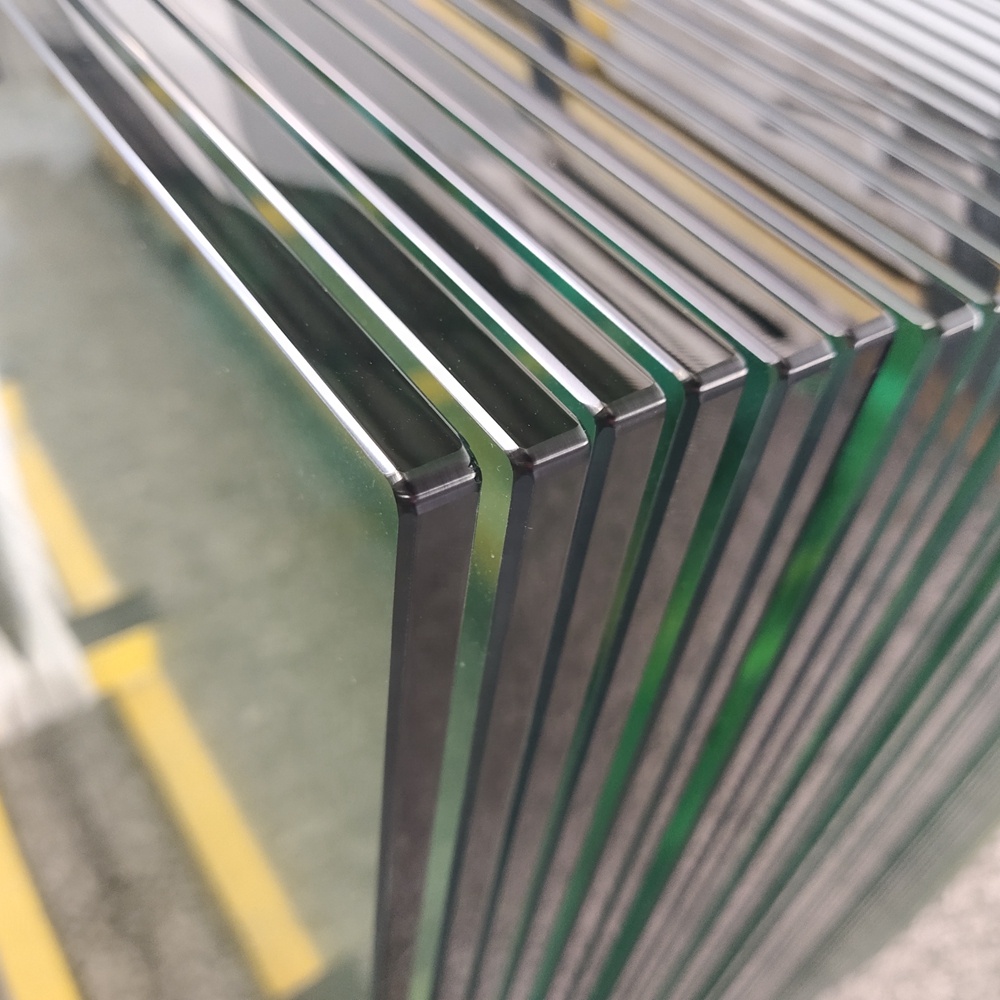
Tempered glass is processed as a safety glass solution for a wide range of building applications.
Tempered glass is widely used in architecture, from door and window glazing to curtain walls, partitions, skylights, and stair treads. For procurement and engineering teams, the specification question is rarely whether the glass is tempered. The more important questions are: Which safety standard applies in the destination market? Does the supplier provide test evidence for the exact glass thickness? Is the finished product monolithic, laminated, double-glazed, or processed with decorative functions such as frosting or silkscreen printing?
This article is a specification-oriented guide for building buyers moving from research into supplier evaluation. It explains how to turn a basic tempered glass requirement into a verifiable purchase specification, using KXGLASS (KXG) as a worked example. The full legal name is Dongguan Kunxing Glass Co., Ltd., a glass deep-processing manufacturer based in Dongguan, Guangdong Province, China.
Why Tempered Glass Sourcing Needs a Constraint-Based Specification
Most sourcing problems begin when buyers treat tempered glass as a single commodity. A facade contractor supplying Europe must think about EN 12150-1 safety glass requirements, while a distributor shipping to Australia or the United States may need AS/NZS 2208 or SGCC documentation. A door and window manufacturer may require custom sizes, consistent edge quality, and optional lamination or insulation. Without clear constraints, a low initial offer can later fail at project approval, site inspection, or glazing handover.
The practical risk is not only product failure. Architects and general contractors increasingly ask for verification documents. They want a certification number, a test report, a lead time, and a clear description of the glass build-up. If a tempered glass supplier cannot support the product claim with evidence, the buyer inherits the compliance risk.
The 2026 Tempered Glass Market Context
Demand for tempered glass continues to be driven by construction, renovation, and stricter safety expectations. Grand View Research estimated the global tempered glass market at USD 112.21 billion in 2024 and projected it to reach USD 159.27 billion by 2033. The same analysis placed the Asia Pacific region at 59.9% of market revenue in 2024, reflecting large infrastructure and building programs. Plain tempered glass accounted for 64.5% of market revenue in 2024 because of its broad use in construction and related sectors.
For buyers, these market conditions mean more manufacturing capacity, more price variation, and a greater need to differentiate suppliers by process control, documentation, and after-sales support. A specification-first approach is the most practical way to reduce ambiguity in this environment.
KXGLASS Tempered Glass Range and Core Parameters
KXGLASS supplies single-piece tempered glass in thicknesses of 4mm, 5mm, 6mm, 8mm, 10mm, 12mm, 15mm, 19mm, 22mm, and 25mm. The product line is used in building industry projects where safety, impact resistance, and thermal stability are relevant.
The KXGLASS tempered glass specification includes several material parameters that buyers should compare:
- Intensity: 150 MPa.
- Surface stress: 95 MPa.
- Thermostability: 250–320°C.
- Breakage pattern: obtuse-angle grains.
- Self-destruction risk: possible, as with ordinary tempered glass.
These figures describe the processed glass as a safety product. The breakage pattern matters because formed safety glass tends to reduce the risk of large, sharp shards. The thermostability range helps buyers understand why tempered glass is often considered for applications exposed to heat or sudden temperature changes. However, structural suitability for doors, windows, facades, and curtain walls should always be confirmed by a project engineer using local loading and safety requirements.

Certification documents should be available before order placement, not after shipment.
Heat-Soaked Tempered Glass and Third-Party Test Reports
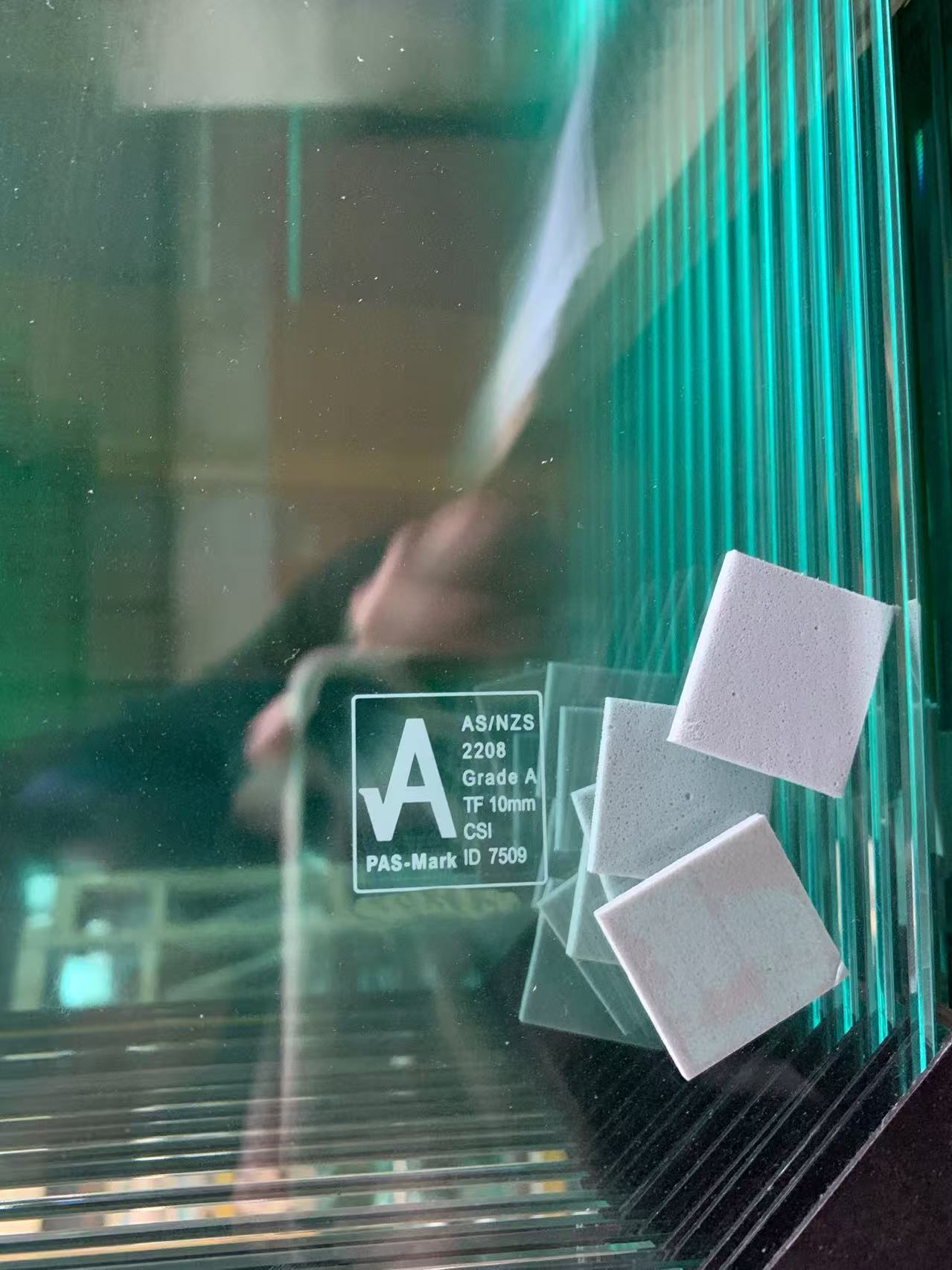
Heat soaking is a separate process step used to reduce the risk of spontaneous breakage caused by nickel sulfide inclusions. KXGLASS states that its products meet international standards such as European CE/EN12150, Australian AS/NZS 2208, and American SGCC. The company also holds ISO international certification and national 3C certification.
For the US market, an SGCC acknowledgement covers tempered and laminated safety glass products under certification numbers 5566/5568/5569/5570/5571/5572/5573/5580/5581. The applicable standards are ANSI Z97.1-2009, CPSC 16 CFR 1201, and CAN/CGSB 12.1 (COMP+CAN).
When heat-soaked glass is requested, thickness-specific SGS reports provide stronger evidence than a general brochure statement. KXGLASS has SGS test reports for the following heat soaked float toughened glass products:
- 6mm heat soaked float toughened glass, report GZIN1806033811CM.
- 10mm heat soaked float toughened glass, report GZIN1806033816CM.
- 15mm heat soaked toughened glass, report GZIN1806033817CM-01.
The reports were issued by SGS-CSTC Standards Technical Services Co., Ltd. GZ Branch Testing Center and are based on CNAS/ilac-MRA accredited safety glass testing. For an EU-specific impact test, KXGLASS also has an SGS report for toughened glass with certification number GZHG1204010925FT, issued under BS 6206:1981 & AMD 8693:1995.
In addition, the heat soak process oven used by KXGLASS, model CS-HST-1808, is covered by a calibration report issued by JAS (Inspection & Testing) Ltd. under number J18-117-R01-180903. This level of process evidence is especially relevant for buyers specifying heat-soaked glass for safety-critical architectural positions.
Laminated, Insulated, and Processed Tempered Glass Configurations
For many building projects, tempered glass is not used as a single pane. It can be incorporated into laminated glass, insulated glass, or processed decorative glass depending on the project need.
- PVB laminated glass: available with glass thicknesses of 5mm+5mm, 6mm+6mm, or 8mm+8mm, and PVB interlayers of 0.38mm, 0.76mm, 1.14mm, or 1.52mm. Laminated construction supports impact resistance and anti-typhoon performance.
- SGP laminated glass: available in interlayer thicknesses of 0.38mm, 0.76mm, 1.14mm, or 1.52mm. SGP is associated with high mechanical strength and good impact resistance.
- Insulated glass: available in 6A, 9A, and 12A air-space widths. Insulated glass contributes to heat insulation and noise insulation in building envelopes.
- Silkscreen printed glass: available with customizable colors and patterns, offering privacy protection and decorative value.
KXGLASS project specifications also mention special processing for building glass such as frosting, tinted glass, silkscreen printing, anti-slip surface treatments, heat soak testing, high load-bearing capacity, and impact resistance. Buyers should treat these options as configuration choices, not as assumptions, and should specify the exact glass build-up in every inquiry.
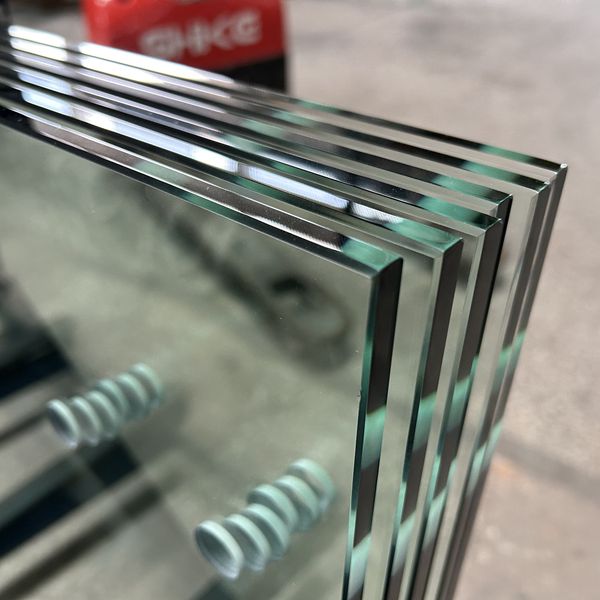
Edge and custom processing requirements should be defined before tempering because cut edges and holes cannot be modified after heat treatment.
Step-by-Step Process for Verifying a Tempered Glass Supplier
Step 1: Define the Destination Safety Standard
Before requesting a quote, identify the standard relevant to the project market. Europe commonly references EN 12150-1 for thermally toughened soda lime silicate safety glass. Australia references AS/NZS 2208. The United States references ANSI Z97.1 and CPSC 16 CFR 1201 for safety glazing. Include this information in your RFQ so the supplier understands the compliance threshold.
Step 2: Select the Base Glass Construction
Decide whether the order is for monolithic tempered glass, tempered laminated glass, insulated glass, or a combination. KXGLASS can produce monolithic tempered glass from 4mm to 25mm. If laminated glass is needed, choose the PVB or SGP interlayer thickness and glass lamination combination. If double-glazed performance is required, select the air-space width such as 6A, 9A, or 12A.
Step 3: Address Heat Soak Testing for Critical Applications
Ask whether the glass must be heat-soaked. Standard tempered glass and heat-soaked tempered glass are not the same specification. For large or highly loaded panels, heat soak testing may be required. Buyers should request the heat-soak oven calibration report and thickness-specific SGS report from the supplier.
Step 4: Confirm Custom Sizes, Thickness, and Logo Handling
KXGLASS supports OEM/ODM production with customization of size, thickness, and logo. Since tempered glass cannot be cut after heat treatment, all hole positions, edge work, notches, cut-out details, and back-printed logos should be finalized during the manufacturing review stage. A strong supplier will ask for drawings before production.
Step 5: Check Capacity, Quality Control, and Lead Time
KXGLASS states a monthly capacity of about 100,000 square meters for OEM work. The standard lead time is 15–20 days, and the MOQ is 100 square meters. The company also notes 100% testing as part of its quality control process, and its after-sales policy includes a 5-year return and replacement commitment. These constraints should be written into the procurement plan.
Project Examples and Use Cases for Certified Tempered Glass
KXGLASS project references illustrate how certified tempered glass and related processed glass products are used in real building environments.
Build-to-Rent and commercial facades in Australia: An OEM project involving mall building walls, Build-to-Rent facades, and curtain walls used KXG glass. The project summary notes stable structural performance of 85% or above, relative energy saving of 65% or above, and noise reduction of 60–70%.
Skylight and curtain wall project in the UAE: A Dubai mall project used KXG glass for skylights and curtain walls. The project reference records high safety performance of 3500 Pa or above, color stability of 85% or above, and a service duration of 2–10 years.
Airport curtain wall in Vietnam: A municipal airport project used tempered, laminated, insulated, and silkscreen printed glass in curtain walls and decorative walls. The project summary highlights color stability of 85% or above and high surface durability with a Mohs hardness of 6.
These examples show that a tempered glass supplier is not only producing material. It is also coordinating multiple processes such as tempering, lamination, insulation, printing, and quality verification.
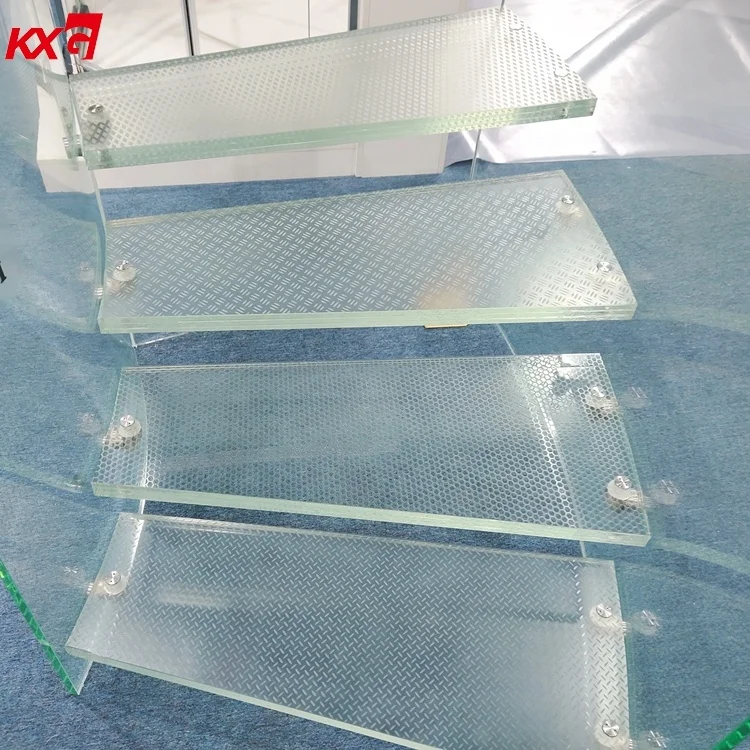
Architectural safety glass extends beyond doors and windows to floor, stair, and partition applications.
Tempered Glass Configuration Comparison for Building Buyers
| Configuration | Available KXGLASS Specification | Typical Decision Focus |
|---|---|---|
| Single-piece tempered glass | 4mm, 5mm, 6mm, 8mm, 10mm, 12mm, 15mm, 19mm, 22mm, 25mm | Safety glass with defined strength and thermal stability; heat-soaked options available for risk-sensitive areas. |
| PVB laminated glass | Glass: 5+5mm, 6+6mm, 8+8mm; PVB: 0.38mm, 0.76mm, 1.14mm, 1.52mm | Impact resistance and anti-typhoon behavior for building envelopes. |
| SGP laminated glass | Interlayer: 0.38mm, 0.76mm, 1.14mm, 1.52mm | High mechanical strength and impact resistance for demanding glazing. |
| Insulated tempered glass / double glazed unit | 6A, 9A, 12A spacer widths | Heat insulation, noise insulation, and improved building envelope performance. |
| Silkscreen printed or decorative processed glass | Custom colors and patterns | Easy cleaning, privacy, protection, and architectural decoration. |
Configuration data is drawn from KXGLASS published product specifications.
Frequently Asked Questions
Which certificates should I require when purchasing architectural tempered glass?
Choose the certificate according to the project market. Europe commonly requires CE/EN 12150-1 safety glass compliance. Australia uses AS/NZS 2208. The United States references ANSI Z97.1, CPSC 16 CFR 1201, and related safety glazing standards. KXGLASS states that its products comply with CE/EN12150, AS/NZS 2208, and SGCC, and also holds ISO certification and China's national 3C certification. For heat-soaked tempered glass, request the thickness-specific SGS report rather than a generic compliance statement.
What tempered glass thickness options should I expect from a building glass manufacturer?
KXGLASS can supply tempered glass in 4mm, 5mm, 6mm, 8mm, 10mm, 12mm, 15mm, 19mm, 22mm, and 25mm. The final thickness depends on panel dimensions, wind load, impact risk, the glazing system, and local building code. For door and window projects, the glass thickness is normally confirmed through structural calculation and system testing rather than general habit.
Are heat-soaked glass and standard tempered glass the same?
No. Standard tempering is the process that makes glass a safety product. Heat soaking is an additional quality-control process intended to reduce the risk of spontaneous breakage caused by nickel sulfide inclusions. KXGLASS operates a heat soak process oven model CS-HST-1808 with calibration report J18-117-R01-180903, and it can provide SGS test reports for heat-soaked glass in 6mm, 10mm, and 15mm thicknesses.
How does adding lamination or insulation change the tempered glass order?
When lamination or insulation is added, the order changes from a single material to a complete glass unit. KXGLASS offers PVB laminated glass in 5+5mm, 6+6mm, or 8+8mm, with PVB interlayers from 0.38mm to 1.52mm. SGP laminated glass is available in 0.38mm, 0.76mm, 1.14mm, and 1.52mm interlayers. Insulated glass is available with 6A, 9A, and 12A air spaces. The quotation should state the complete build-up, not just the outer pane thickness.
What are KXGLASS lead times, MOQ, and how can I request a quote or sample?
For OEM and ODM orders, KXGLASS states a lead time of 15–20 days, a minimum order quantity of 100 square meters, and a monthly capacity of about 100,000 square meters. Size, thickness, and logo customization are supported. If you need a formal quotation, product sample, or drawing review, contact Kevin at kevin@kxglass.com or by WhatsApp at +86 135 3500 9284. You can also download the KXGLASS product brochure for a fuller overview of tempered glass, laminated glass, and insulated glass capabilities.
Conclusion: Turn Documentation into a Procurement Requirement
The tempered glass market in 2026 offers many options, but reliable procurement depends on clear constraints. Certification, heat soak treatment, thickness selection, glass build-up, custom processing, and lead time should all be defined before the order is placed.
KXGLASS provides a practical example of a supplier profile that can meet these constraints: a building glass manufacturer with a wide thickness range, documented compliance with EN 12150, AS/NZS 2208, and SGCC, SGS reports for heat-soaked glass, and OEM customization support. When you evaluate suppliers, compare those documented constraints rather than relying on brand labels alone.
If you are at the evaluation stage for a door, window, facade, or skylight project, request thickness-specific test reports, a clear specification sheet, and a production timeline before making a final decision.
Request a Quote or Sample from KXGLASS
Send your drawings, quantities, and target market to kevin@kxglass.com or contact Kevin on WhatsApp at +86 135 3500 9284. KXGLASS can confirm available thicknesses, certifications, heat-soaked glass reports, and lead times for your next building project.