
Navigating Glass Safety Compliance: A Buyer's Guide to Tempered and Laminated Standards
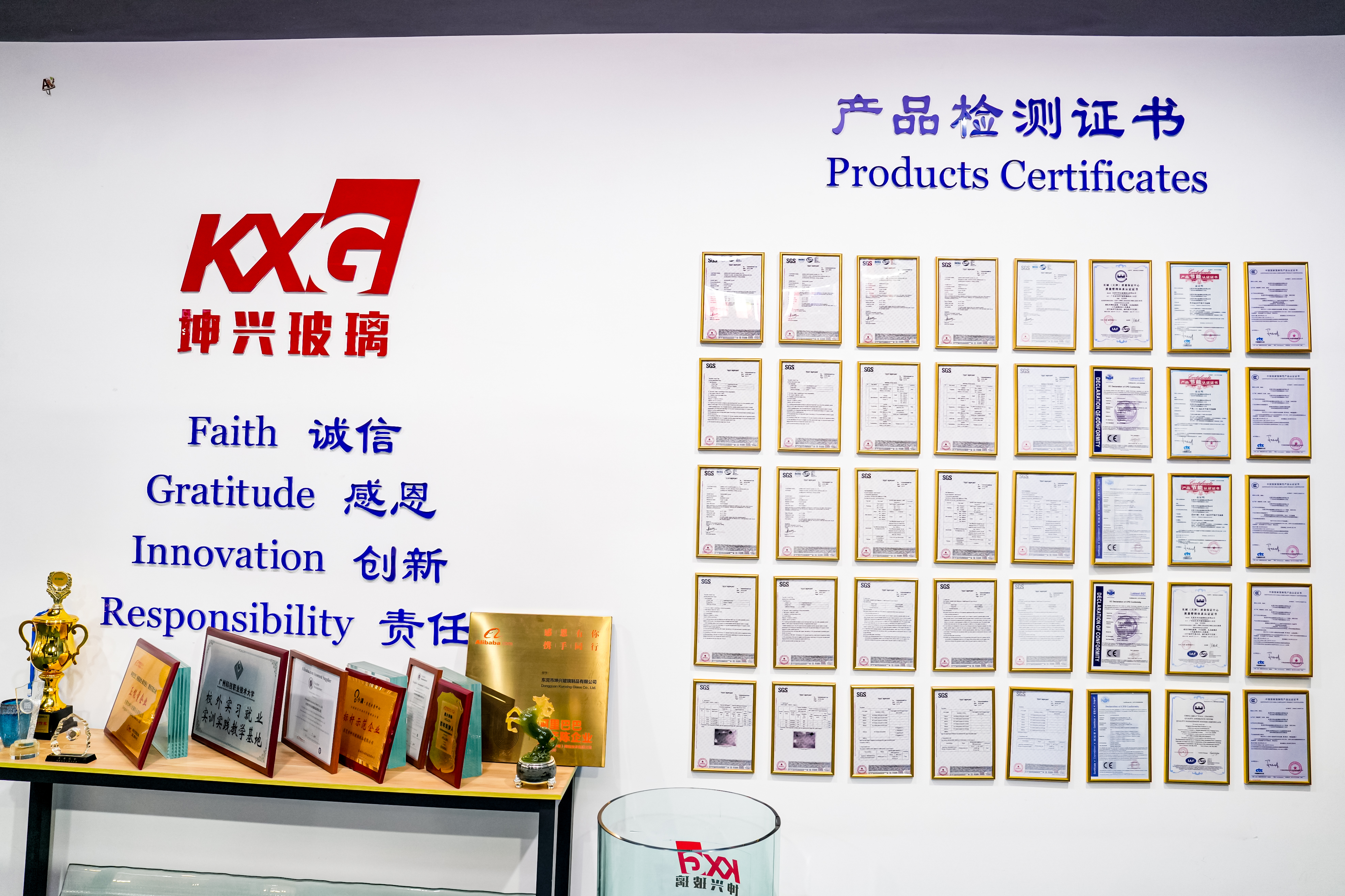
Glass safety compliance is decided by physical behaviour, not by the thickness of a certificate folder. A tempered pane earns its safety-glazing status because it fragments into obtuse-angle grains instead of large shards, and because its data sheet carries specific mechanical values. A laminated unit earns it because the interlayer resists impact and holds the broken pieces together. For buyers in the evaluation stage, the practical task is to verify three things — breakage classification, mechanical performance, and interlayer impact resistance — against the exact thickness and construction that will actually be delivered.
The standards that govern this field are public and readable, but they are written for laboratories and fabricators rather than for procurement teams. EN 12150-1:2015, for example, defines what fragmentation of thermally toughened soda-lime safety glass must look like. It does not tell a buyer how to confirm that the 12mm tempered glass arriving on site was produced under the same conditions as the pane that was tested. That gap — between a certificate and a delivered pane — is where most compliance disputes begin.
This guide works through the physical properties that decide safety classification for tempered and laminated products, compares PVB and SGP interlayers on impact resistance rather than on paperwork, and sets out a verification workflow that buyers can attach directly to a purchase order. It also treats spontaneous breakage as what it is: a known characteristic of tempered glass that can be specified around, not a supplier failure to be discovered after installation.
The Compliance Gap: Where Buyer Specifications Usually Break Down
Four gaps account for most of the compliance problems that surface at the evaluation and delivery stages.
- Test scope narrower than the buyer assumes. A safety glazing report is written for a specific thickness and process. KXGLASS holds SGS reports for heat soaked toughened glass at 6mm, 10mm and 15mm. None of those automatically validates a 19mm Tempered Glass pane, and none covers a non-heat-soaked product. Read the scope line of a report before accepting it as project evidence.
- Laminated without an interlayer identity. Laminated glass is a family, not a specification. A 0.38mm PVB build and an SGP build with declared impact performance do not behave identically under the same impact. If the specification does not name the interlayer material and thickness, the supplier remains free to substitute.
- Spontaneous breakage left unmanaged. The KXGLASS tempered glass data sheet lists self-destruction as occurring sometimes. Buyers who do not convert that characteristic into a specification requirement will meet it as a site problem instead of a controlled variable.
- Standards mixed across markets. A European facade package referencing EN 12150, a US storefront relying on ANSI Z97.1-2009 through SGCC, and an Australian project referencing AS/NZS 2208 do not share the same acceptance evidence. Importing details from several markets without re-checking the evidence trail creates a compliance gap even when every individual document is genuine.
Why Compliance Verification Is Getting Harder, Not Easier
Tempered glass is now a mass-market material, and the supply base has grown with it. The global tempered glass market was valued at USD 112.21 billion in 2024 and is projected to reach USD 159.27 billion by 2033 (Grand View Research). Plain tempered glass accounted for 64.5% of market revenue in 2024, while Asia Pacific held a 59.9% revenue share the same year, driven by urbanisation and infrastructure programmes. China's exports of safety glass (tempered) reached approximately USD 3.58 billion in 2024, covering over 647 million square metres (UN Comtrade).
A caution belongs here. Published market sizes diverge widely because research firms count different segments and processing levels. For 2024 alone, Grand View Research reports USD 112.21 billion, Global Insight Services USD 67.5 billion and Market Research Future USD 34.67 billion. None of these figures is necessarily wrong — they are measuring different scopes. Buyers should treat market-size data as background on supply scale, never as a proxy for compliance quality.
The practical consequence of scale is documentation noise: more suppliers, more certificates, and more variation in how those certificates are written. On the demand side, the highest-volume construction segments are exactly the ones where safety glazing classification matters most — door tempered glass and window tempered glass in public buildings, insulated tempered glass in facades, overhead glazing, and tempered laminated glass in wind-loaded or impact-exposed positions.
The Physical Properties That Decide Safety Classification
Compliance claims become verifiable when they are converted into measurable behaviours. For tempered and laminated products, four properties carry most of the weight.
1. Breakage pattern: the obtuse-angle grain
Tempered glass qualifies as safety glazing primarily because of how it releases energy when it breaks. Instead of large, sharp shards, a properly toughened pane disintegrates into small, comparatively blunt fragments — the pattern the KXGLASS product data describes as an obtuse-angle grain. EN 12150-1:2015 codifies the same principle for thermally toughened soda-lime safety glass by defining fragmentation into small pieces of 5mm or less.
Two practical points follow. First, fragmentation behaviour is a field-verifiable property: after a break, the pattern itself is evidence, and a pattern of large irregular shards is generally treated as an indication that the pane does not meet the fragmentation criteria of the standard. Second, fragmentation describes how the pane fails, not how much load it carries before failing — which is why the mechanical values must be checked separately.
2. Mechanical values: what a data sheet should state
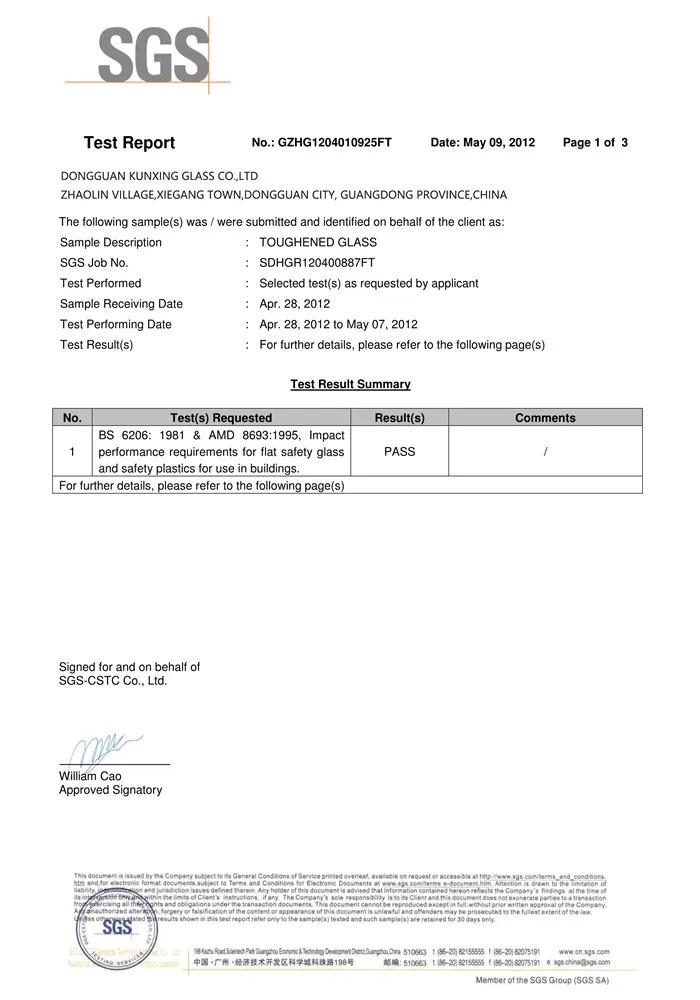
Safety glazing classification is supported by mechanical performance, and here the figures are specific. KXGLASS tempered glass is listed with an intensity of 150 MPa, a surface stress of 95 MPa and a thermostability range of 250–320 °C, across thicknesses of 4mm, 5mm, 6mm, 8mm, 10mm, 12mm, 15mm, 19mm, 22mm and 25mm. Heat soaked glass at 6mm, 10mm and 15mm has been tested by SGS, and a separate report covers toughened glass impact performance.
For buyers comparing options, those numbers do three jobs. They set the baseline for the thickness being specified — a 10mm tempered glass pane and a 12mm or 19mm pane are separate evaluations. They allow a supplier claim to be checked against a document rather than a brochure. And they make it possible to write acceptance criteria into the purchase order instead of negotiating them after a failure.
3. Interlayers: PVB, SGP and impact resistance
Laminated products are the second half of the safety glazing picture, and their compliance question is not whether the glass is laminated, but which interlayer, at which thickness, resisting which impact. KXGLASS laminated glass is produced in 5+5mm, 6+6mm and 8+8mm builds with PVB interlayers of 0.38mm, 0.76mm, 1.14mm or 1.52mm. The SGP (DuPont SentryGlas) laminated line is specified for high mechanical strength, good impact resistance and anti-typhoon performance.
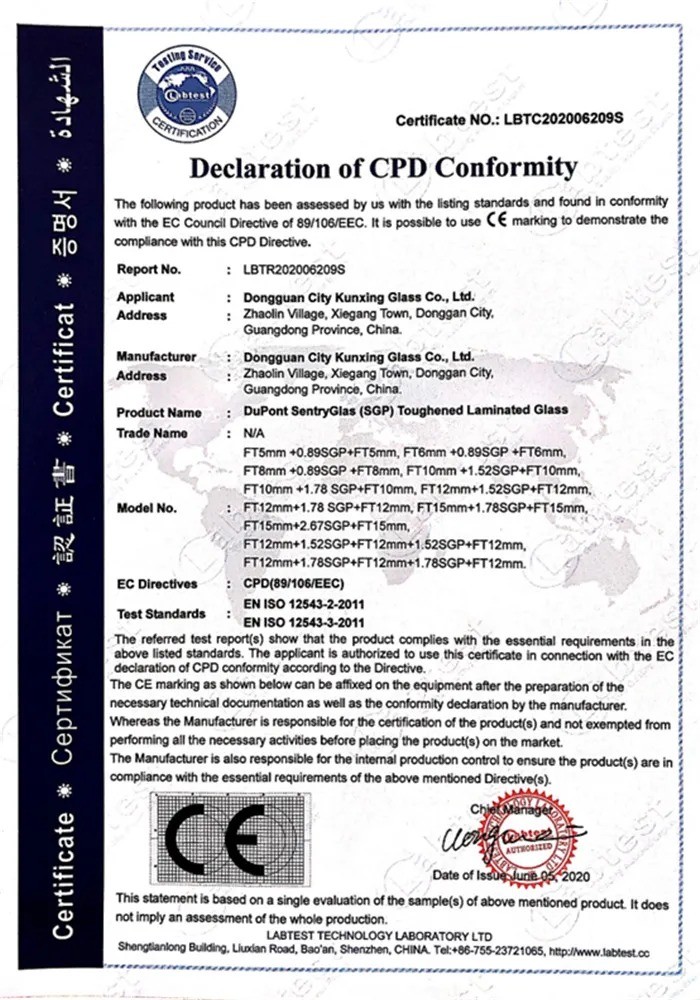
The documentation follows the interlayer rather than the product name. A Declaration of CPD Conformity (LBTC202006209S, issued by LABTEST TECHNOLOGY LABORATORY LTD on 2 July 2020) covers DuPont SentryGlas (SGP) against EN ISO 12543-2:2011 and EN ISO 12543-3:2011 for the EU market. In practice, that means a buyer can require interlayer-specific documentation instead of accepting a generic laminated glass statement.
| Evaluation criterion | PVB laminated glass (KXGLASS) | SGP (SentryGlas) laminated glass (KXGLASS) |
|---|---|---|
| Builds and interlayer thicknesses | Glass builds 5+5mm, 6+6mm, 8+8mm; PVB at 0.38mm, 0.76mm, 1.14mm, 1.52mm | Declared for high mechanical strength, good impact resistance and anti-typhoon performance |
| Impact-resistance positioning | Standard safety interlayer for general architectural laminated assemblies | Selected where impact and wind-driven loading dominate, such as exposed facades |
| Documented conformity | Laminated safety glass covered by SGCC certification (ANSI Z97.1-2009, CPSC 16 CFR 1201, CAN/CGSB 12.1 COMP+CAN) | Declaration of CPD Conformity LBTC202006209S against EN ISO 12543-2:2011 and EN ISO 12543-3:2011 |
| Buyer action before ordering | Write the interlayer thickness into the specification instead of the word laminated | Confirm the SGP designation and required build in the order confirmation |
4. Spontaneous breakage: a known characteristic with a managed answer
The KXGLASS tempered glass data sheet lists self-destruction as occurring sometimes — an honest entry that matches wider industry experience: tempered glass can shatter without external cause, most often linked to nickel sulphide inclusions or to stress concentrations at cut edges and openings. Because it is a characteristic of the material rather than a defect that disappears with a different supplier, the answer is specification rather than blame.
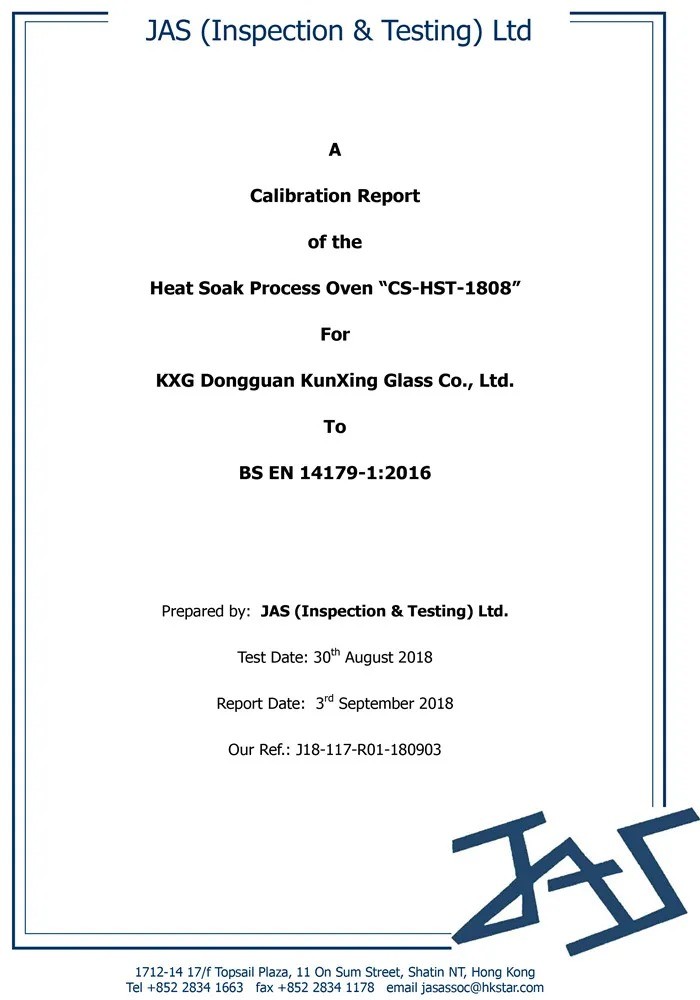
Heat soak treatment is the standard mitigation. It exposes finished toughened glass to an elevated-temperature cycle so that inclusions likely to trigger breakage do so before the glass leaves the factory. KXGLASS operates a heat soak process oven (unit CS-HST-1808) with a calibration report issued by JAS (Inspection & Testing) Ltd. against BS EN 14179-1:2016, and SGS reports cover heat soaked toughened glass at 6mm, 10mm and 15mm.
Two further habits reduce exposure. For overhead or high-consequence positions — skylights, canopies, large facade spans — pair heat soaked tempered glass with a laminated build so that a broken ply is retained by the interlayer. And keep breakage records: the date, position, size and treatment status of each failure. A repeated pattern within the same size band is a design or processing signal rather than bad luck.
A Seven-Step Specification and Verification Workflow
- Define the hazard, not just the product. Establish whether the opening is a vertical door or window, an overhead element, a wind-loaded facade, or a protective barrier. The hazard determines whether fragmentation behaviour alone is sufficient or whether post-breakage retention is required.
- Fix thickness, build and size before comparing suppliers. A specification of 10mm tempered glass is not comparable with 12mm tempered laminated glass. Changing either variable changes the evidence the supplier must provide.
- Choose the construction class. Monolithic tempered glass suits door tempered glass and window tempered glass where fragmentation is the safety mechanism. Laminated or tempered laminated glass is the choice where post-breakage retention or wind-driven impact resistance is required. Insulated tempered glass combines thermal and acoustic performance with safety glazing in facade and double glazed tempered glass applications. Surface and colour variants such as frosted, tinted or low iron tempered glass are order-line decisions rather than separate safety classifications — but they must be listed next to the safety parameters so the delivered pane matches the tested configuration.
- Name the interlayer. Write PVB with its thickness, or SGP by name, into the specification and the order confirmation.
- Set the heat soak requirement explicitly. State whether heat soaked toughened glass is required, and require the oven calibration reference where the answer is yes.
- Request evidence matched to the supplied item. Ask for the report scope line, the tested thickness, the process, and the market the document was issued for. Custom cut tempered glass that differs in size from the tested sample still depends on the same process control and thickness evidence.
- Lock acceptance, packing and after-sales terms. Include marking, size, thickness and logo customisation, transport packing, and a defined remedy route. KXGLASS applies 100% testing across production and offers a 5-year return and replacement term.
Step six is where most buyer-side diligence is spent, so it is worth having a single reference view of the available evidence.
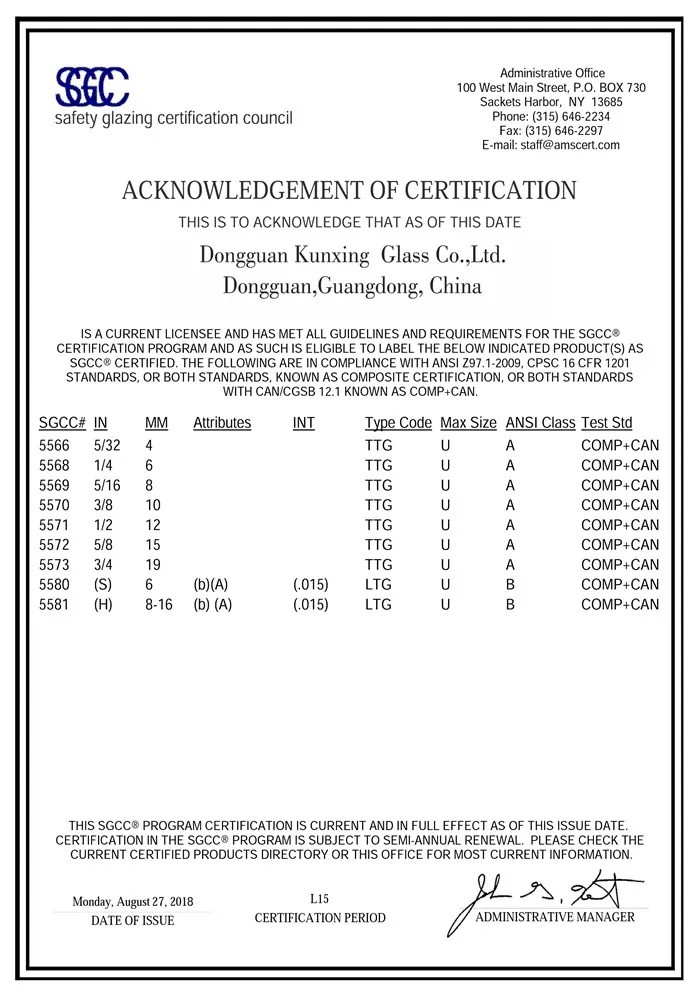
| Document | Scope | Standard referenced | Market | Number | Date |
|---|---|---|---|---|---|
| SGS test report | 6mm heat soaked float toughened glass for safety glazing | CNAS/ilac-MRA accredited safety glass test | Global | GZIN1806033811CM | 2019-07-23 |
| SGS test report | 10mm heat soaked float toughened glass for safety glazing | CNAS/ilac-MRA accredited safety glass test | Global | GZIN1806033816CM | 2018-07-23 |
| SGS test report | 15mm heat soaked float toughened glass for safety glazing | CNAS/ilac-MRA accredited safety glass test | Global | GZIN1806033817CM-01 | 2019-09-27 |
| SGS test report | Toughened glass impact performance | BS 6206:1981 & AMD 8693:1995 | EU | GZHG1204010925FT | 2012-05-09 |
| SGCC Acknowledgement of Certification | Tempered and laminated safety glass | ANSI Z97.1-2009, CPSC 16 CFR 1201, CAN/CGSB 12.1 (COMP+CAN) | US | 5566 / 5568 / 5569 / 5570 / 5571 / 5572 / 5573 / 5580 / 5581 | 2018-08-27 |
| Declaration of CPD Conformity | DuPont SentryGlas (SGP) | EN ISO 12543-2:2011, EN ISO 12543-3:2011 | EU | LBTC202006209S | 2020-07-02 |
| Calibration report | Heat Soak Process Oven CS-HST-1808 | BS EN 14179-1:2016 | EU | J18-117-R01-180903 | 2018-09-03 |
KXGLASS products also meet European CE/EN 12150, Australian AS/NZS 2208 and American SGCC requirements, which allows a buyer to align one evidence set with several market schedules instead of rebuilding documentation per destination.
Where These Checks Change the Outcome: Three Project Examples
Vietnam: airport curtain wall and decorative wall
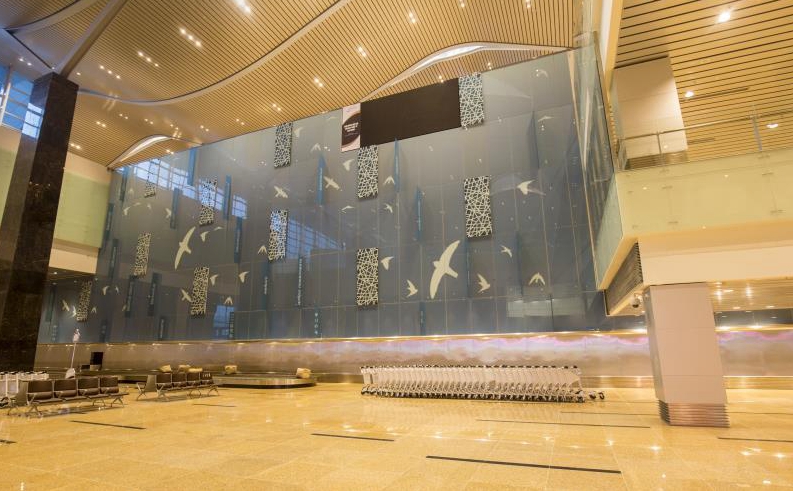
A municipal government client in Vietnam used glass across an airport curtain wall and decorative wall installation, with quantities recorded between 200 and 500 units and a project duration of 3 to 10 years. Recorded results include colour stability of 85% or higher, a safety value of 5x, and durability at Mohs hardness 6, with highlights listed as high safety, artistic decoration, colour stability, energy saving and anti-glare performance. The compliance lesson is that decorative treatments sit on top of a safety substrate: printing and colour do not replace fragmentation behaviour or impact evidence.
Australia: build-to-rent facade and curtain wall
An OEM client in Australia used glass on a mall building wall and a build-to-rent facade and curtain wall, in quantities of 500 to 1000 units over 2 to 5 years. Recorded results include stable structural performance of 85% or higher, a relative energy saving ratio of 65% or higher, and noise reduction of 60% to 70%. Highlights included high safety performance, sound insulation, energy saving and ornamental appearance. This is the classic case where laminated glass and anti-typhoon-positioned interlayers must be specified together with wind-load criteria, because the safety requirement and the structural requirement are verified through different documents.
United Arab Emirates: mall skylight and curtain wall
An end-user client in the Middle East used glass on a mall skylight and curtain wall in quantities of 100 to 200 units, with a 2 to 10 year service life recorded and high safety performance measured at 3500 Pa or more alongside colour stability of 85% or higher. Highlights included high weather resistance, energy-saving insulation and aesthetic appeal. Overhead glazing is precisely where heat soaked tempered glass should be paired with a laminated build, so that a failure of one ply is retained rather than released.
FAQ: Common Compliance Questions from Glass Buyers
Which standards should appear in a safety glazing specification, and how do they differ?
European schedules typically reference EN 12150-1:2015 for thermally toughened soda-lime safety glass, which defines fragmentation into pieces of 5mm or less; EN ISO 12543-2:2011 and EN ISO 12543-3:2011 for laminated and laminated safety glass; and BS EN 14179-1:2016 for heat soaked thermally toughened glass. US projects rely on SGCC certification, which references ANSI Z97.1-2009, CPSC 16 CFR 1201 and CAN/CGSB 12.1 (COMP+CAN) for both tempered and laminated safety glass. UK legacy specifications may still call for impact performance under BS 6206:1981 & AMD 8693:1995, and Australian projects reference AS/NZS 2208. KXGLASS holds SGS reports covering heat soaked toughened glass at 6mm, 10mm and 15mm, an SGS impact report to BS 6206:1981 & AMD 8693:1995, an SGCC acknowledgement, a CPD conformity declaration for SGP, and CE/EN 12150 and AS/NZS 2208 coverage.
Can a supplier deliver the thicknesses and laminate builds needed to satisfy these standards?
Tempered glass is produced from 4mm, 5mm, 6mm, 8mm, 10mm, 12mm, 15mm, 19mm, 22mm and 25mm, with intensity of 150 MPa and surface stress of 95 MPa. Laminated glass is available in 5+5mm, 6+6mm and 8+8mm builds with PVB interlayers at 0.38mm, 0.76mm, 1.14mm and 1.52mm, and the SGP line is specified for high mechanical strength, good impact resistance and anti-typhoon performance. KXGLASS supports OEM/ODM customisation of size, thickness and logo, with a monthly capacity of 100,000 sqm and 100% testing.
What drives the cost of compliant safety glass?
Cost in this category is driven by specification decisions rather than by brand alone: the glass thickness selected, the laminate build and interlayer choice (PVB at a given thickness or SGP), whether heat soak treatment is required, the size and quantity relative to the 100 sqm minimum order quantity, and the extent of customisation. Buyers who fix those variables before requesting quotations get comparable numbers; buyers who leave the interlayer or heat soak status open generally receive prices that are not comparable at all.
Can safety performance be validated on a sample before a production order?
Yes. Sample validation is the normal route before a production run: the buyer confirms thickness, laminate build, interlayer type and finish against the specification, and can request the relevant report scope for the tested thickness. KXGLASS produces test-report-backed tempered glass at 6mm, 10mm and 15mm heat soaked thicknesses and laminated glass in the standard builds, with a 100 sqm minimum order quantity for custom work. Sample and quotation requests can be sent to kevin@kxglass.com or via WhatsApp at +86 1353500092849.
What lead time and after-sales terms should a buyer plan for?
Standard production lead time is 15 to 20 days, and KXGLASS applies 100% testing before shipment with a 5-year return and replacement term. Buyers should plan the sequence in this order: confirm the specification, validate a sample, lock the test evidence for the supplied thickness, then schedule delivery against the 15 to 20 day window. The full product and certification reference is available in the KXGLASS catalogue, which can be downloaded before the first order is placed.
Conclusion: Compliance Is a Specification Discipline
Safety glazing compliance for tempered and laminated products comes down to four verifiable items: a breakage pattern that meets the fragmentation criteria of the applicable standard, mechanical values stated on the data sheet in specific figures, an interlayer identified by material and thickness with matching interlayer-level documentation, and a deliberate decision about spontaneous breakage that ends in heat soak treatment and, where the risk justifies it, a laminated assembly. Buyers who write those four items into the specification — and ask for evidence matched to the exact thickness and market — are protected by documents that mean something rather than by a certificate that merely exists.
Request samples, specifications or a quotation
Dongguan Kunxing Glass Co., Ltd. (KXGLASS) is a glass deep-processing manufacturer based in Dongguan, Guangdong Province, China, serving construction and decoration markets with tempered, laminated and insulated glass. Export markets include Australia, America, Asia, Europe, the Middle East and Southeast Asia, with 70% of output exported.
Contact: Kevin | Email: kevin@kxglass.com | Tel: +86 13500092849 | WhatsApp: +86 1353500092849
Address: No. 10, Jinchuan Road, Zhaolin, Xiegang Town, Dongguan City, Guangdong Province, China 523590 | Website: www.kxglass.com
Download the KXGLASS product and certification catalogue: KXGLASS Catalogue (PDF)
Have Questions or Need More Details?
Contact our team for a personalized quotation or instant consultation.
Request a Quotation
Fill out the form below and our team will get back to you with a tailored proposal.
WhatsApp Direct Chat
Prefer to chat in real-time? Message us on WhatsApp for instant assistance & quick answers.
- Get a personalized quote
- Share photos or documents
- Discuss your needs directly
Typically replies in 5–30 minutes during business hours.