
Ranked: Tempered vs. Laminated, Insulated, Silkscreen & Mirror Glass
Ranked: Tempered vs. Laminated, Insulated, Silkscreen & Mirror Glass
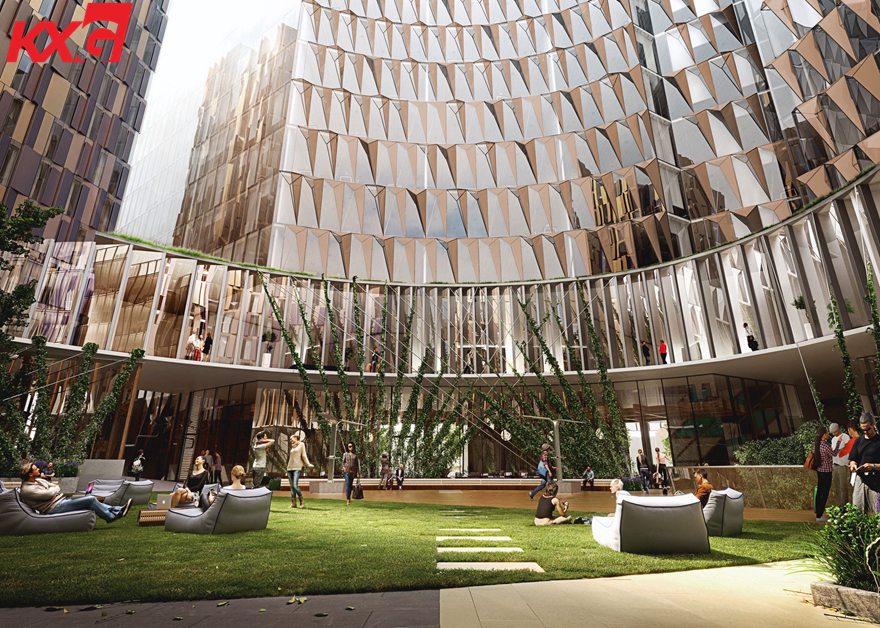
Tempered glass ranks first of the five building-glass options compared here when the deciding requirement is safety glazing with the simplest possible build-up. Laminated glass with PVB or SGP interlayers ranks second and overtakes tempered glass wherever post-breakage integrity, overhead glazing or impact-zone performance is the primary brief. Insulated glass ranks third because it answers a thermal and acoustic question rather than a safety one. Silkscreen glass ranks fourth and silver mirror ranks fifth — not because they perform worse, but because each answers a different question: privacy and design in the first case, reflectivity in the second.
That ordering is an editorial decision made for buyers at evaluation stage, not a market ranking. It is scored against five criteria that decide real specifications: safety and breakage behaviour, impact and typhoon exposure, heat and noise control, privacy and design, and reflectivity. It can legitimately change when a project weights one criterion far above the rest — a hospital corridor and a beachfront balustrade do not share a shortlist.
The worked example is KXGLASS (KXG), the trading name of Dongguan Kunxing Glass Co., Ltd., a deep-processing glass manufacturer in Dongguan, Guangdong Province, China, producing tempered, laminated and insulated glass and exporting roughly 70% of its output to Australia, America, Asia and Europe. Its published product data, test reports and project references are used where they illustrate a comparison point.
Why these five names are not five alternatives
The most expensive mistake at evaluation stage is treating tempered, laminated, insulated, silkscreen and mirror glass as five competing products on one shelf. They sit at different levels of the specification.
- Tempered glass describes a heat-treatment state: the glass is heated and rapidly cooled so surfaces go into compression and the core into tension.
- Laminated glass describes an assembly of two or more panes bonded by a PVB or SGP interlayer.
- Insulated glass describes an assembly of two panes separated by a sealed cavity, offered with 6A, 9A or 12A spacer options.
- Silkscreen glass describes a printed finish, normally applied to a base glass that is then heat-treated.
- Silver mirror describes a coated product made for reflection, not for glazing.
Where the ranking matters is the base decision: which function must be guaranteed first. Where it misleads is the assumption that choosing one excludes the others. A tempered-laminated insulated unit is a normal facade build-up, and a silkscreen print is usually applied to a tempered pane rather than specified instead of one.
Three errors recur. The first is asking soda-lime tempered glass to satisfy a heat-resistance requirement; borosilicate glass 3.3, covered by ISO 3585:1998, is a different material system and the correct reference for fireplace and stove viewing glass. The second is treating an insulated unit as safety glazing in its own right, when safety performance comes from the panes inside it. The third is substituting mirror where safety glazing is required.
Industry background: why the comparison tightened
Grand View Research valued the global tempered glass market at USD 112.21 billion in 2024, with Asia Pacific holding a 59.9% revenue share in the same year. Both figures come from a commercial research house using a broad definition of tempered glass across application sectors, so they are context for capacity and sourcing geography, not a guide to what a square metre of 10 mm tempered glass should cost.
The more practical change is that the product standard and the market-access requirement have become the same document. EN 12150-1:2015+A1:2019 sets tolerances, flatness, edgework, fragmentation and mechanical characteristics for monolithic flat thermally toughened soda-lime silicate safety glass in the EU; ASTM C1048-18 covers heat-strengthened and fully tempered flat glass in the US; GB 15763.2-2005 is the Chinese reference. In the US, 16 CFR Part 1201 adds a federal glazing safety standard with Category I and Category II classifications, and ANSI Z97.1-2015 supplies the consensus test method used alongside it.
For customs and trade analysis, tempered architectural glass sits in HS heading 7007 — safety glass of toughened or laminated glass — with non-vehicle toughened glass under subheading 7007.19 in the HS 2022 nomenclature. At evaluation stage that classification, not the marketing description, is what a duty calculation runs on.
How the five options were ranked
Each option was scored on the same five criteria — safety and breakage behaviour, impact and typhoon exposure, heat and noise control, privacy and design, and reflectivity — and the ranking reflects documented characteristics rather than a measured side-by-side test.
A sixth, practical qualifier applied throughout: availability across the thicknesses a real order needs. KXG lists tempered glass from 4 mm to 25 mm — 4, 5, 6, 8, 10, 12, 15, 19, 22 and 25 mm — which covers most facade, door and partition packages.
Rank 1 — Tempered glass
Tempered glass is heat-treated soda-lime float glass whose surfaces remain in compression after rapid, even cooling. That compression layer changes the failure mode, which is why tempered glass is the default safety glazing in doors, windows, facades and balustrades.
The product values used here are 150 MPa intensity and 95 MPa surface stress, with a stated thermostability of 250–320 °C and a 4–25 mm thickness range. These are stated product figures, not a universal floor for every tempered pane on the market: the enforceable thresholds come from the governing standard and the supplier's test report, and an evaluation should request both.
Breakage separates tempered from annealed glass most clearly. On failure, tempered glass releases into relatively small particles with obtuse angles rather than large sharp shards. EN 12150-1 quantifies the behaviour: the fragmentation test requires no fewer than 40 particles counted in a 50 mm × 50 mm square — a testable acceptance criterion for an incoming-inspection plan rather than a descriptive claim.
The caveat that belongs in the specification
Tempered glass can break spontaneously. The recognised cause is nickel sulphide inclusions that change volume over time and can trigger failure after heat treatment, and heat-soak treatment is the recognised route to reduce that risk — the process defined and described in EN 14179-1:2016. Heat-soaking does not make spontaneous breakage impossible; it screens a population of panes against a known mechanism before installation.
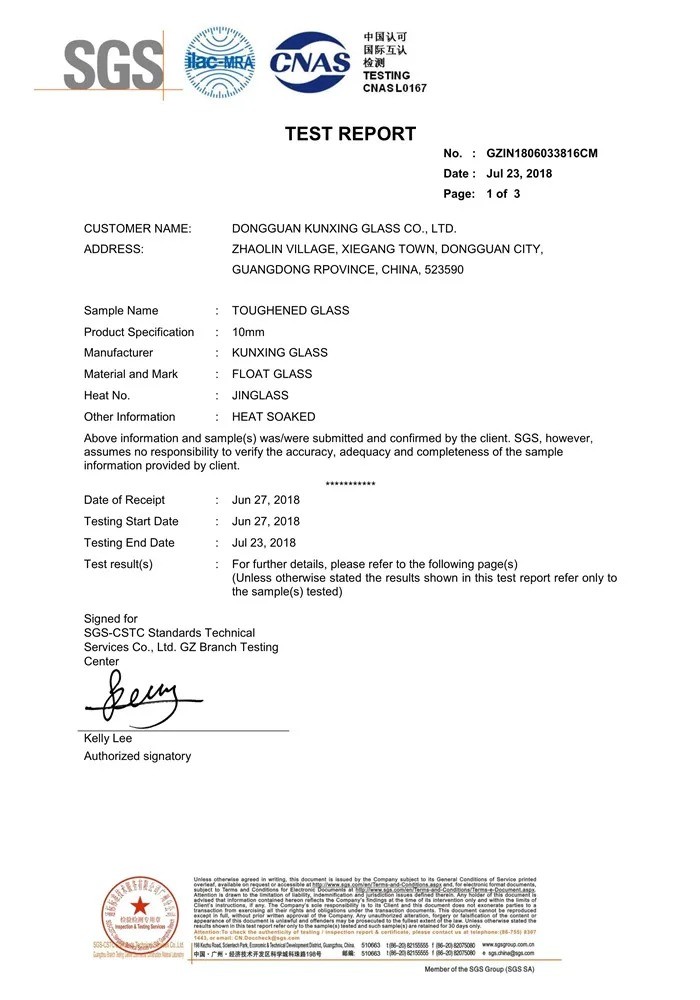
That is a procurement decision, not a footnote. Where a pane sits overhead, in a skylight or in a high-level facade panel, heat-soak treatment belongs in the specification alongside the EN 12150 requirements. KXG's evidence set shows what that looks like: an SGS test report on 10 mm heat-soaked toughened glass (GZIN1806033816CM), further reports on 6 mm and 15 mm heat-soaked glass, and a calibration report for its heat-soak process oven assessed against BS EN 14179-1:2016. The point for an evaluator is not the manufacturer's name but that the process was instrumented and the panes were tested — the evidence standard to demand from any shortlisted supplier.
Where tempered glass wins, and where it does not
It wins wherever the requirement is safety glazing at the lowest complexity: door tempered glass in framed and frameless entrances, window tempered glass in sidelights and full-height glazing, shower enclosures, shopfronts, balustrade infill and partitions. It also wins on processability, because a single flat pane is the base for almost every other option on this list.
It does not win where residual integrity after breakage is the design case — that needs an interlayer. It does not win where the cavity is the product. And it must not be sold as a heat-resistant material: 250–320 °C thermostability describes the treatment's tolerance, not a licence to specify soda-lime tempered glass against a borosilicate application.
Tempered glass also cannot be cut, drilled or edge-worked after tempering, so the cut list, edge finish and hole positions are fixed before the furnace. KXG's capability data reflects that sequence: OEM/ODM production with size, thickness and logo customisation, a 15–20 day lead time, a 100 m² minimum order, 100% testing and roughly 100,000 m² of monthly capacity from a 30,000 m² workshop that includes a 3.6 × 16 m flat tempering furnace.
Rank 2 — Laminated glass (PVB and SGP)
Laminated glass bonds two or more panes with a polymer interlayer, so the interlayer holds fragments in place after a pane breaks. It ranks second because it answers the question tempered glass cannot: what remains in the opening after failure.
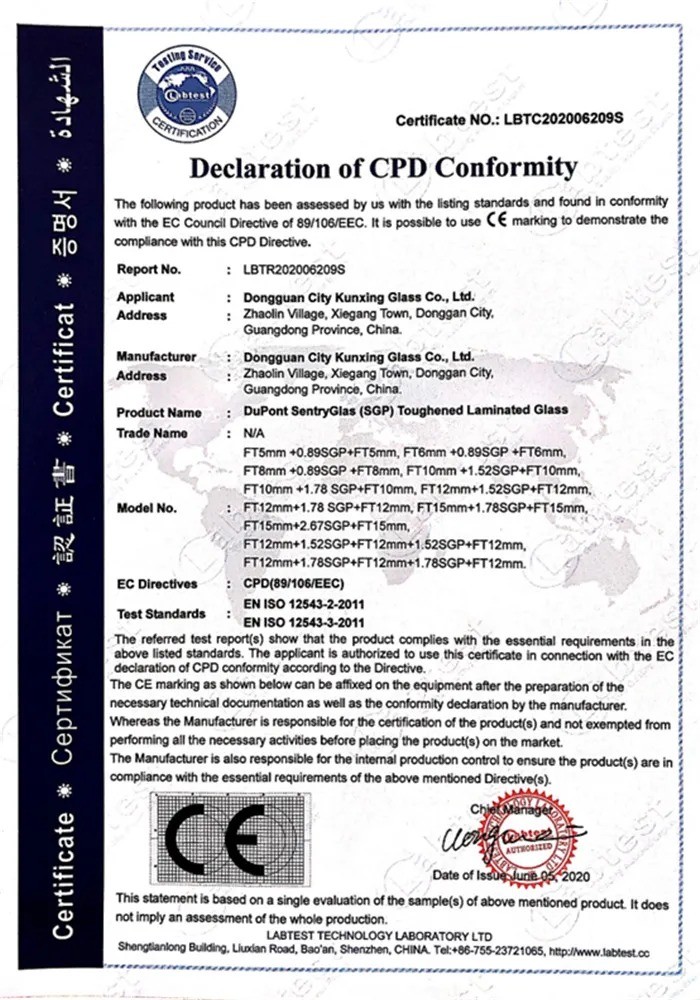
The build-up options are concrete. Interlayer thicknesses of 0.38 mm, 0.76 mm, 1.14 mm and 1.52 mm define the standard range, and the interlayer polymer type — PVB or SGP — is specified separately from the panes. The conformity framework is EN 14449:2005 in the EU and the ISO 12543 series internationally. Where SGP is used, a declaration of conformity to EN ISO 12543-2:2011 and EN ISO 12543-3:2011 is the documentary evidence to request; KXG holds that declaration for DuPont SentryGlas (SGP), issued through LABTEST TECHNOLOGY LABORATORY LTD.
The combination term matters more than either component. Tempered laminated glass — heat-treated panes plus an interlayer — delivers the fragmentation behaviour of tempered glass and the retention behaviour of lamination in one build-up. That is why impact and typhoon specifications usually resolve to a laminate rather than to thicker monolithic tempered glass: the design case is not only whether the panel resists the load, but what is left in the frame afterwards.
The limitations are practical. Lamination adds weight and thickness, which propagates into frame design and handling. Interlayer and edge quality govern service life, which is why the EN 14449 or ISO 12543 conformity route is worth insisting on instead of accepting a generic description of safety laminate. And lamination does not by itself deliver thermal performance — that is the next rank's job.
Rank 3 — Insulated glass
Insulated glass is a sealed unit of two panes separated by a spacer cavity, and it ranks third because it solves heat and noise rather than safety. The cavity is the product. KXG's insulated glass is offered with 6A, 9A and 12A spacer options, and the European framework is EN 1279-1:2018, which sets out generalities, system description, rules for substitution, tolerances and visual quality for insulating glass units.
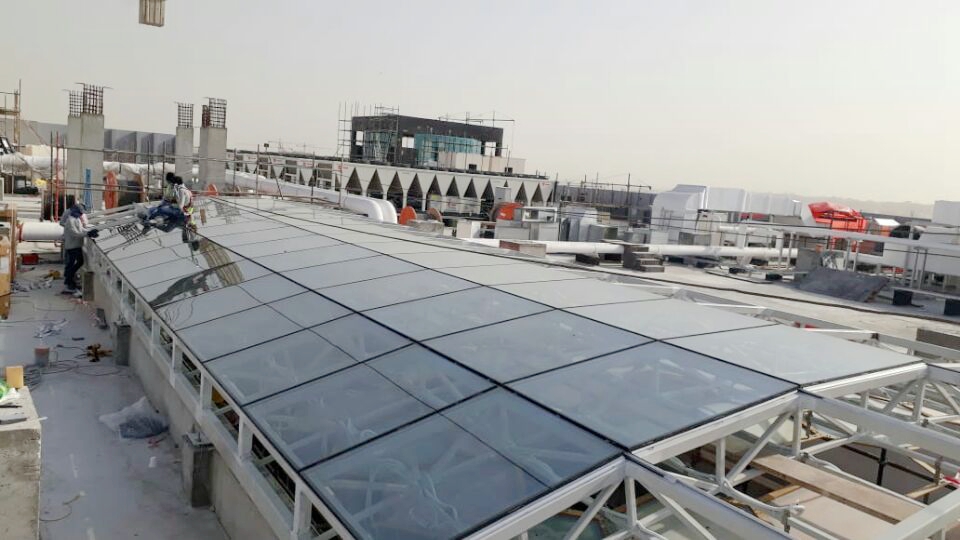
The performance case is documented in project terms. In a KXG-supplied build-to-rent and mall facade package in Australia, the company reports a relative energy saving ratio of at least 65%, noise reduction in the 60–70% range, and stable structural performance of at least 85% over a 2–5 year service window. Those are company-reported results for one package, not a general guarantee, but they show what an insulated specification buys: lower cooling load and a facade that reads quieter from the inside.
Two evaluation points follow. First, an insulated unit is not safety glazing in itself; the safety function comes from the panes, which is why tempered or laminated panes are specified inside the unit. Second, cavity size is a design variable, not a quality ladder — 6A, 9A and 12A are different configurations for different thermal and acoustic targets, and the right answer depends on the frame, the climate and the coatings rather than on picking the widest spacer available.
Rank 4 — Silkscreen glass
Silkscreen glass carries a printed pattern fired onto the glass surface, and it ranks fourth because it is a design and privacy instrument applied to a base glass rather than a structural choice. In KXG's catalogue it belongs to the decorative range that also includes coloured enamel and digitally printed glass.
Its value is best seen in a completed application. For a municipal airport project in Vietnam, KXG supplied silkscreen printing glass across roughly 200–500 units for an airport curtain wall and decorative wall, with reported colour stability of at least 85%, Mohs hardness 6, and the anti-glare behaviour a large printed hall surface needs. The reported highlights were artistic decoration, colour stability and glare control — the three reasons a designer specifies printing.
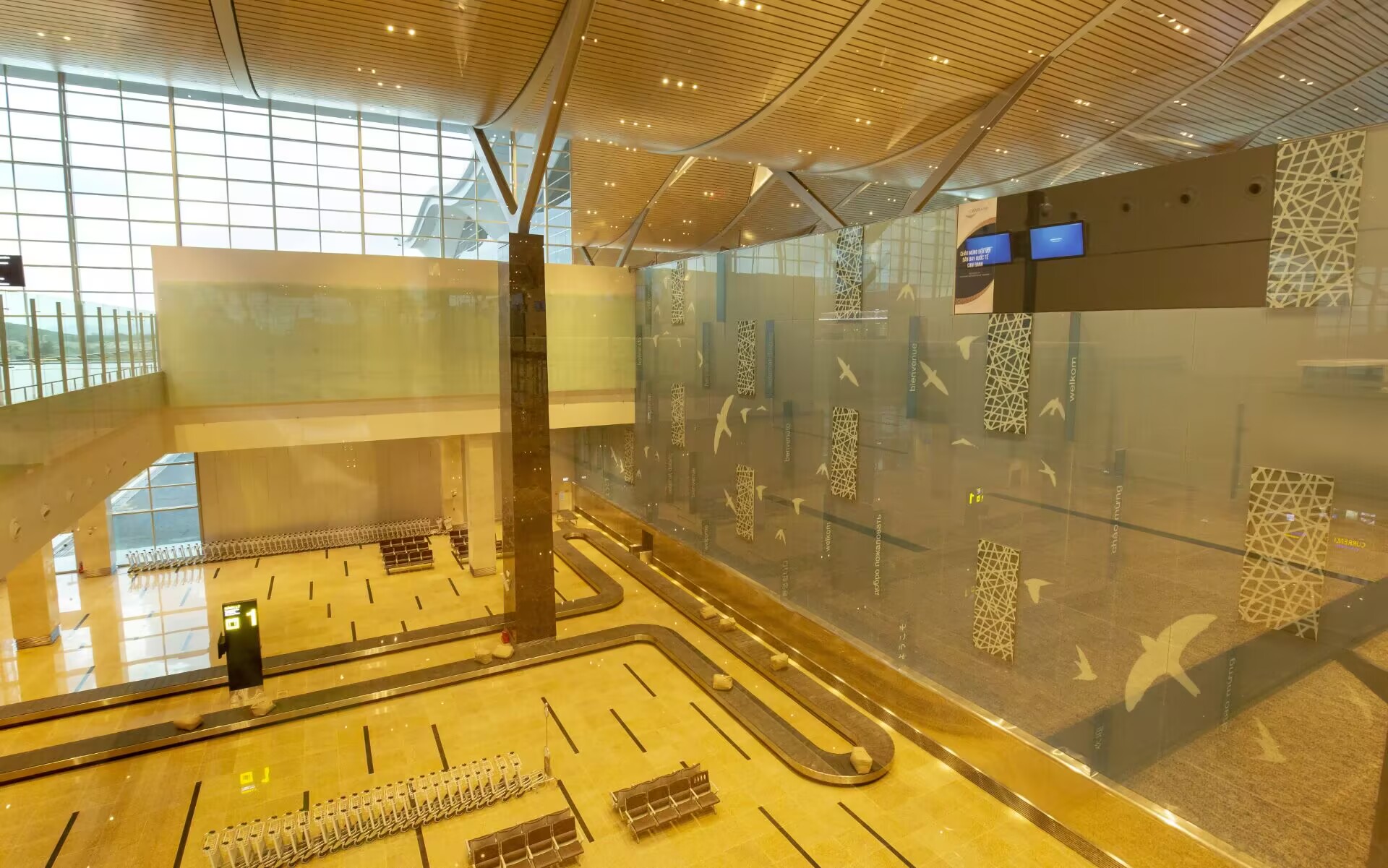
The limitation is optical and easy to state: printed areas interrupt view-through and reduce light transmission where the pattern covers the glass. That is the point when the target is privacy in a partition, a spandrel zone that should hide a floor slab, or a branded facade band. It is a defect when the target was clear vision glass and the print was added late. Specifying print coverage as a percentage per panel, rather than as a colour reference, prevents most of those disputes.
Rank 5 — Silver mirror
Silver mirror is a coated reflective product specified at ≥92% reflectivity and ≤0.3 mm per metre flatness, and it ranks fifth because reflectivity is its only job in this comparison. Both figures decide image quality: reflectance governs brightness and colour neutrality of the reflected image, and flatness governs distortion across the panel.
It is useful in the right place. Interior feature walls, retail fit-outs, gym and studio spaces, lift lobbies and residential joinery all benefit from a panel that returns a bright, low-distortion reflection, and KXG lists silver mirror alongside its insulated and laminated products for those interior scopes.
It is also the option most often misapplied. Mirror is not safety glazing and should not be substituted into door panels, sidelights, balustrades or any location where the glazing standard applies. The correct evaluation question is narrow: where is the reflective surface, how flat must the reflected image be across the panel, and what protects the coating at the edges and in the installed environment. Treating mirror as a decorative finish rather than a glazing option keeps it on the shortlist for the right reasons.
Side-by-side comparison
| Option | Primary function | Safety / breakage role | Heat & noise role | Privacy / design role | Reflectivity | Typical shortlist trigger |
|---|---|---|---|---|---|---|
| 1. Tempered | Heat-treated safety glazing base | Breaks into obtuse-angled particles; EN 12150-1 fragmentation ≥40 particles per 50 × 50 mm; heat-soak available to reduce nickel sulphide risk | Thermostability stated at 250–320 °C; no cavity, so thermal and acoustic performance depends on the build-up | Clear base; silkscreen print and logo customisation are applied to a tempered pane | Not a reflective product | Doors, windows, balustrades, shopfronts |
| 2. Laminated (PVB / SGP) | Fragment retention and residual integrity | Interlayer holds fragments after breakage; EN 14449:2005 and ISO 12543 conformity route | No cavity; thermal performance requires an insulated unit | Interlayer choice affects appearance; print applied separately | Not a reflective product | Overhead glazing, skylights, impact and typhoon zones |
| 3. Insulated | Thermal and acoustic separation | Not safety glazing by itself; safety comes from the panes inside the unit | 6A / 9A / 12A cavity under EN 1279-1:2018; one KXG project reported ≥65% relative energy saving and 60–70% noise reduction | Not a privacy product on its own | Not a reflective product | Curtain walls, conditioned facades, windows with thermal targets |
| 4. Silkscreen | Printed finish for privacy and design | Depends on the base glass; print adds no safety function | Depends on the base glass and cavity, if any | Pattern control; reported colour stability ≥85%, Mohs hardness 6, anti-glare | Reduces transmission in printed areas | Partitions, bathrooms, spandrels, branded facades |
| 5. Silver mirror | Reflection | Not safety glazing; not for doors, sidelights or balustrades | Not applicable to this comparison | Decorative reflective surface | ≥92% reflectivity; ≤0.3 mm/m flatness | Interior feature walls, retail, gyms, lobbies |
The table shows why the ranking is application-weighted. Tempered glass scores highest on safety simplicity; laminated glass scores highest on post-breakage integrity; insulated glass scores on heat and noise but not on safety; silkscreen scores on privacy and design but not on transmission; mirror scores on reflectivity and nothing else on this list.
Step-by-step: how to convert this ranking into a shortlist
- Classify the requirement before the product. Write down whether the panel must guarantee safety glazing, thermal performance, acoustic performance, privacy or reflection. If more than one applies, you are specifying a build-up, not a product.
- Fix the governing standard and market. EN 12150-1:2015+A1:2019 for EU supply; ASTM C1048-18 with 16 CFR Part 1201 and ANSI Z97.1-2015 for the US; GB 15763.2-2005 for China. A certificate is only meaningful against the standard and market it was issued for.
- Set thickness and build-up. Tempered panes from 4 mm to 25 mm; interlayers at 0.38, 0.76, 1.14 or 1.52 mm; cavities at 6A, 9A or 12A. Record the combination explicitly — 10 mm tempered + 1.52 mm SGP + 12A cavity + 6 mm tempered leaves no room for substitution.
- Decide heat-soak treatment on risk, not on price. Overhead glazing, high-level facade panels and hard-to-replace locations justify EN 14179-1 heat-soak treatment; ground-floor interior partitions usually do not.
- Verify evidence, not claims. Ask for certificate numbers, issuing bodies, scope statements and dates; ask for fragmentation results against the 40-particle criterion; ask whether the heat-soak oven is calibrated. KXG's file shows the shape of a complete answer — SGS reports on 6 mm, 10 mm and 15 mm heat-soaked toughened glass, an SGCC acknowledgement covering tempered and laminated safety glass, a CPD declaration for SGP, and an oven calibration report.
- Lock commercial terms against the technical ones. Minimum order, lead time, capacity and after-sales terms decide whether a correct specification is deliverable. KXG's published terms are a 100 m² minimum, 15–20 days lead time, roughly 100,000 m² monthly capacity, 100% testing and a five-year return-and-replacement commitment.
Use cases: which option to shortlist by project type
- Entrance doors and shopfronts: tempered glass at 10 mm or 12 mm, with polished or bevelled edges where the edge is exposed.
- Overhead glazing, skylights and canopies: tempered laminated glass with heat-soak treatment; the interlayer is the reason, not the temper.
- Hurricane and typhoon zones: laminated build-ups with the interlayer specified explicitly and impact evidence requested.
- Conditioned offices and curtain walls: insulated units with tempered or laminated panes, cavity sized to the thermal and acoustic target.
- Bathrooms, partitions and spandrel zones: silkscreen printed glass over a tempered base, with print coverage defined per panel.
- Retail, gym and lobby interiors: silver mirror at ≥92% reflectivity and ≤0.3 mm/m flatness, specified as a finish.
One project often needs four of these six lines at once. That is normal, and it is why the evaluation should end with a build-up schedule rather than a single product choice.
Frequently asked questions
Which standards should a tempered glass supplier hold for EU, US and China projects?
Match the standard to the installation market. EU supply points to EN 12150-1:2015+A1:2019 for the product and EN 12150-2:2004 for evaluation of conformity and CE marking; US supply points to ASTM C1048-18 as the product specification, with 16 CFR Part 1201 as the federal glazing safety requirement and ANSI Z97.1-2015 as the consensus test method; China points to GB 15763.2-2005. KXG lists ISO certification, China 3C, CE/EN 12150, AS/NZS 2208 and SGCC among its approvals and holds SGS test reports on heat-soaked toughened glass. A listing is a starting point rather than proof: ask for certificate number, issuing body, product scope and validity date, and confirm the scope covers the thickness you are ordering.
Can tempered glass be combined with laminated or insulated build-ups?
Yes, and most facade packages do exactly that. Tempered laminated glass combines the fragmentation behaviour of heat-treated panes with the fragment retention of a PVB or SGP interlayer under the EN 14449:2005 and ISO 12543 framework. Insulated units combine two panes with a 6A, 9A or 12A cavity under EN 1279-1:2018, and the panes inside the cavity can themselves be tempered or laminated. KXG produces tempered, laminated and insulated glass in-house, with interlayers at 0.38, 0.76, 1.14 and 1.52 mm and a 3.6 × 16 m flat tempering furnace for the base panes.
What drives the price difference between these five glass types?
Thickness, build-up complexity and processing steps drive cost far more than the product name. On the tempered side, a secondary 2026 wholesale price guide lists 12–19 mm tempered glass at roughly USD 15.00–59.90 per square metre. That range is indicative, covers one thickness band, and is not a quotation: it excludes configuration, processing, packaging, freight and Incoterm. Beyond the base pane, lamination adds interlayer material and a second process, insulated units add a spacer and a sealing operation, silkscreen adds printing and a firing step, and mirror adds coating. Request line-item quotations against a fixed build-up schedule rather than a price per product category.
Can I evaluate samples before committing to an order?
Sample and quotation requests are the normal first step at evaluation stage, and they should be tied to the build-up you intend to buy rather than to a generic product photo. Ask for the thickness, interlayer or cavity, print coverage and edge finish you specified, and ask for the corresponding test documentation in the same response. KXG runs OEM/ODM production with size, thickness and logo customisation from a 100 m² minimum order, which is a workable starting point for a project evaluation.
What lead time should I plan for?
KXG states a 15–20 day lead time against roughly 100,000 m² of monthly capacity and a 100 m² minimum order. Treat that as a production window rather than a delivery date: it excludes raw-glass availability, tooling for non-standard sizes, heat-soak treatment where specified, packaging, and sea or road transit to site. Add the heat-soak step explicitly to the schedule wherever EN 14179-1 treatment is required, and confirm the sequence against your installation programme. To check availability for a specific build-up, contact KXG directly or download the product brochure at the end of this article.
Conclusion
Tempered glass ranks first among these five options because it delivers safety glazing with the fewest moving parts: a 4–25 mm thickness range, a fragmentation behaviour testable against a 40-particle criterion, and a failure mode of obtuse-angled particles rather than sharp shards. Its documented caveat — occasional spontaneous breakage from nickel sulphide inclusions — is manageable through EN 14179-1 heat-soak treatment, and it is a specification decision rather than a reason to avoid the product.
Laminated glass takes second place and wins wherever the question is what remains after failure. Insulated glass takes third and owns heat and noise. Silkscreen takes fourth as the privacy and design instrument. Silver mirror takes fifth as a reflective finish that is not glazing. Ranked in that order, the five options stop competing and start combining — which is how they end up in a real facade schedule.
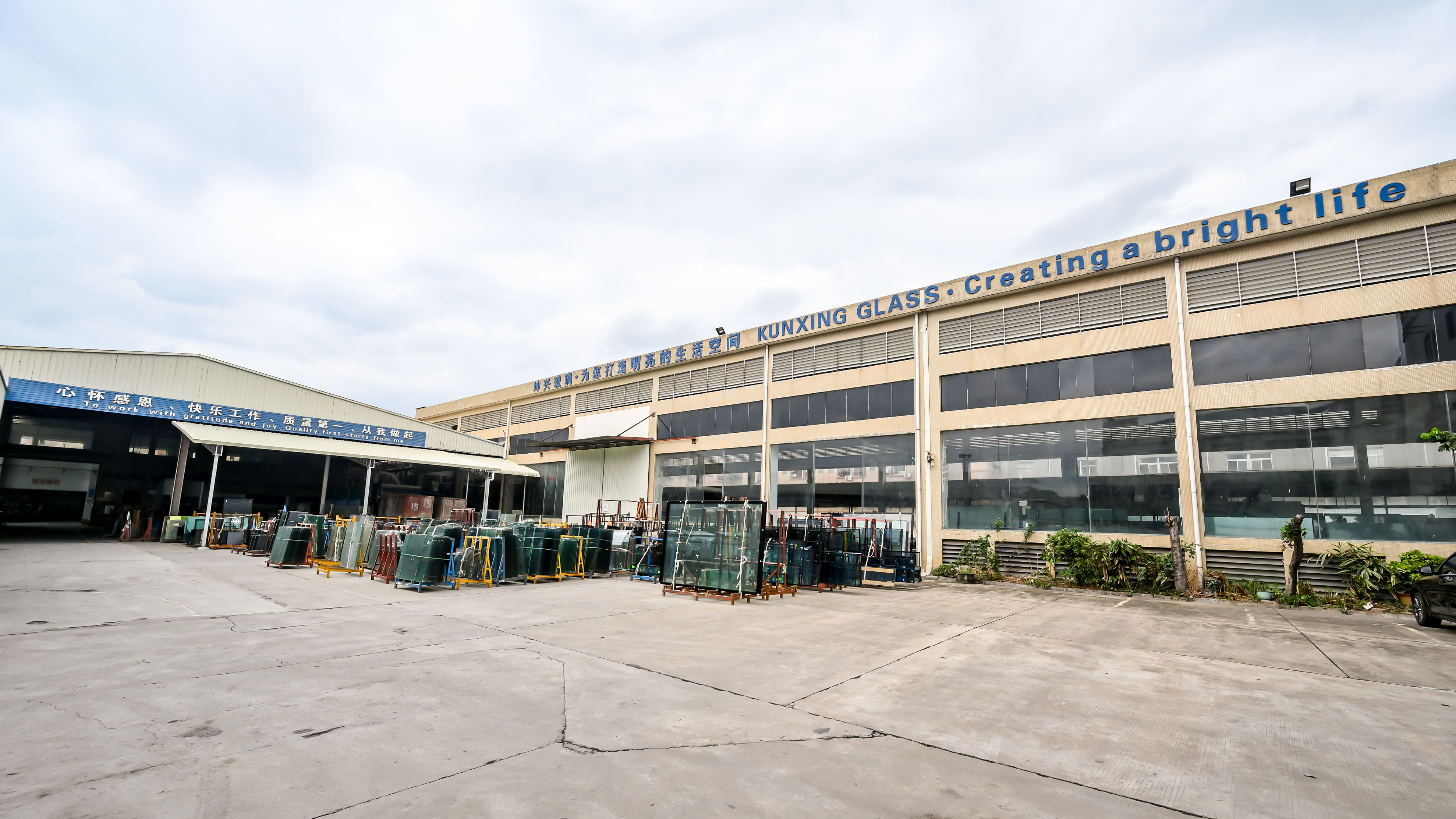
For buyers taking the next step, KXGLASS (KXG) publishes its product range, certificates and project references on its official site, and the full product brochure is available to download here: KXGLASS product brochure (PDF).
Have Questions or Need More Details?
Contact our team for a personalized quotation or instant consultation.
Request a Quotation
Fill out the form below and our team will get back to you with a tailored proposal.
WhatsApp Direct Chat
Prefer to chat in real-time? Message us on WhatsApp for instant assistance & quick answers.
- Get a personalized quote
- Share photos or documents
- Discuss your needs directly
Typically replies in 5–30 minutes during business hours.