
Tempered Glass Application FAQ: Thickness, Strength & Breakage
Tempered Glass Application FAQ: Thickness, Strength, Thermostability and Breakage in Buildings
Tempered glass in a building project is defined by four numbers and one behaviour: thickness, intensity, surface stress, thermostability, and what the pane does when it breaks. This application FAQ answers those questions in the order construction and decoration professionals actually ask them, using the published KXGLASS (KXG) tempered glass specification and the market standards that decide whether that specification is acceptable in a given country.
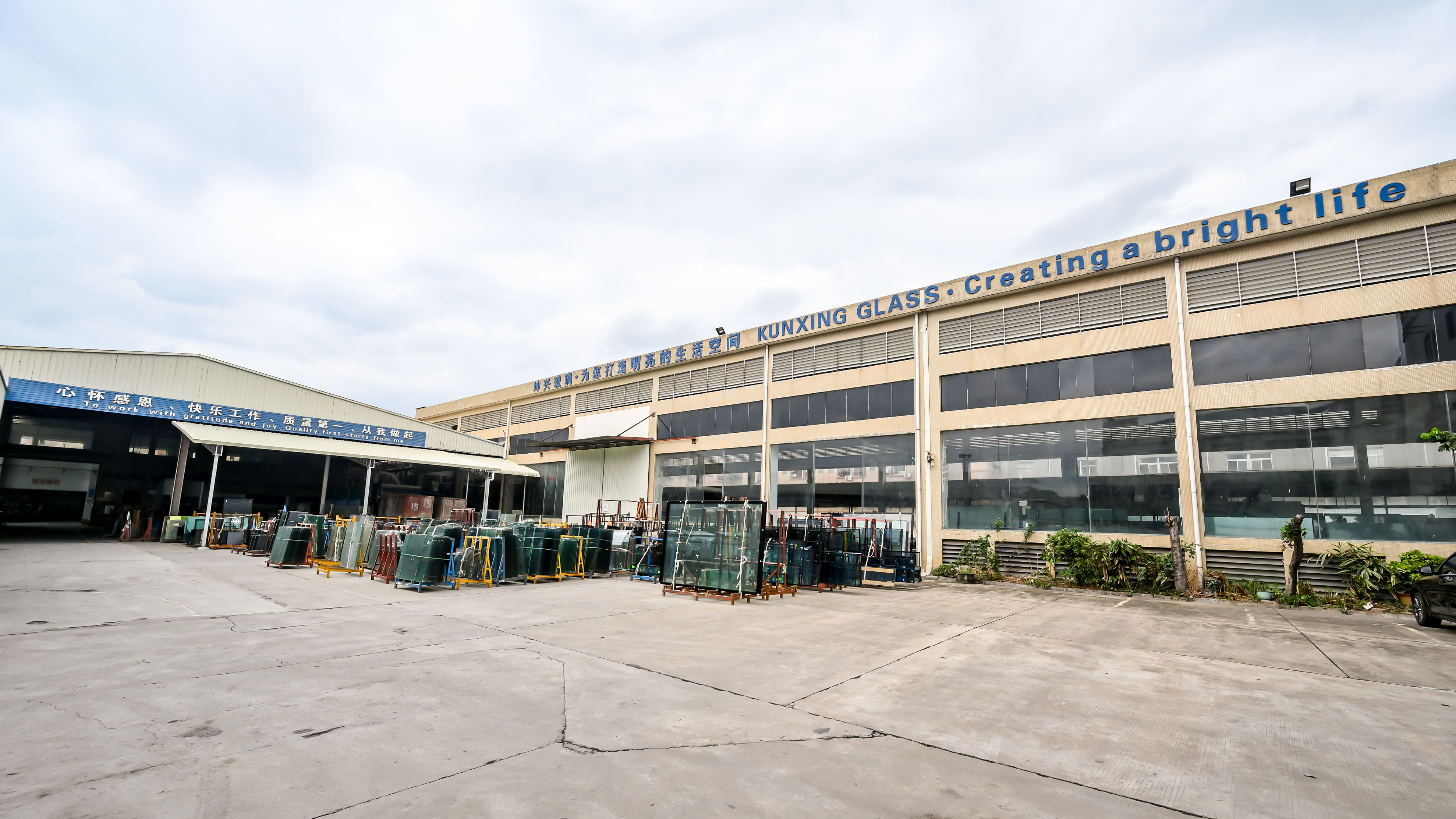
KXGLASS (KXG) is the brand of Dongguan Kunxing Glass Co., Ltd., a glass deep-processing manufacturer founded in 1995 in Dongguan, Guangdong, China, producing clear tempered glass, laminated glass and insulated glass, with roughly 70% of output exported to Australia, America, Asia and Europe.
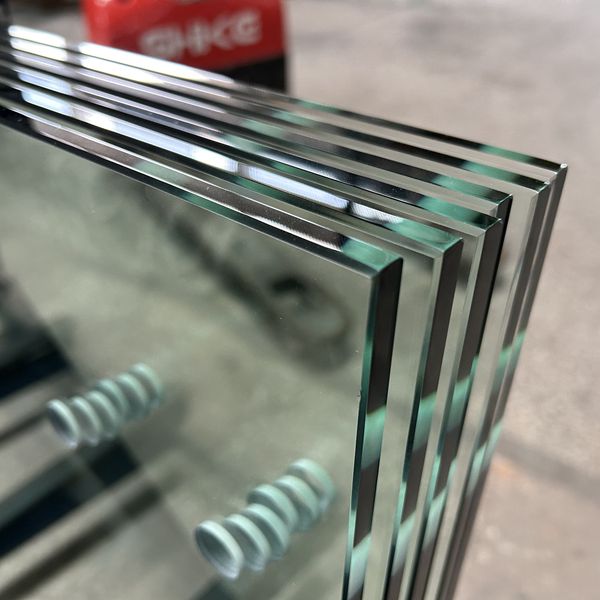
Cover image: finished tempered glass edge — edgework and thickness are two of the four items a buyer must confirm on the data sheet.
The short answers
- Thickness range: 4 mm, 5 mm, 6 mm, 8 mm, 10 mm, 12 mm, 15 mm, 19 mm, 22 mm and 25 mm.
- Intensity: 150 MPa.
- Surface stress: 95 MPa.
- Thermostability: 250–320 °C.
- Broken state: obtuse-angle grains; self-destruction can occur sometimes, and heat-soak treatment under EN 14179-1:2016 is the recognised route to reduce that risk.
Problem definition: why tempered glass specifications go wrong on site
Most tempered glass disputes are not manufacturing failures. They are specification failures that only become visible after delivery, and they cluster around four recurring mistakes.
1. Thickness is assumed instead of selected. Because KXGLASS tempered glass is produced across a 4 mm to 25 mm range, “10 mm tempered glass” or “12 mm tempered glass” is a decision, not a default. When the thickness is copied from a previous project without checking wind load, span, framing and handling, the glass may pass inspection and still be wrong for the opening.
2. “Heat resistant” is confused with “safety”. Soda-lime silicate tempered glass is a safety glazing product; its thermostability of 250–320 °C describes the thermal band it can survive, not a licence to use it as a continuous high-temperature material. Applications such as fireplace or stove viewing glass belong to a different material system — borosilicate glass 3.3, specified under ISO 3585:1998 — and treating the two as interchangeable is a genuine procurement risk.
3. Standard editions drift. EU buyers still receive documents citing EN 12150-1:2000, an edition that has been withdrawn and replaced by SS-EN 12150-1:2015. A supplier qualification checklist that accepts a withdrawn edition is not a checklist.
4. Breakage is not planned for. Tempered glass breaks into obtuse-angle grains rather than sharp shards, but it can also self-destruct without impact. Projects that do not plan for a breakage allowance, spare panes or heat-soak treatment discover this during handover, when replacement lead time matters most.
Industry background: classification, standards and market context
Architectural tempered glass — toughened glass not sized for vehicles, aircraft or vessels — is classified under HS subheading 7007.19, inside HS heading 7007, “Safety glass, consisting of toughened (tempered) or laminated glass”. That classification matters commercially because it is the only internationally consistent handle for customs and duty analysis. It matters technically because it groups tempered glass with laminated glass as safety glazing, which is exactly how building codes treat them.
The category is also large and regionally concentrated. Grand View Research valued the global tempered glass market at USD 112.21 billion in 2024, with Asia Pacific holding a 59.9% revenue share in the same year. For a buyer, the practical consequence is that supply is not scarce; documented, market-appropriate supply is. The differentiating question is rarely “can this factory temper glass”, but “can this factory evidence the standard the project is specified against”.
The table below maps the reference standards a construction buyer is most likely to meet, and the document that should accompany each.
| Market / scope | Reference standard | What it covers | Document to request |
|---|---|---|---|
| EU — product definition | EN 12150-1:2015+A1:2019 | Tolerances, flatness, edgework, fragmentation and physical/mechanical characteristics of monolithic flat thermally toughened soda-lime silicate safety glass for buildings | Test report quoting the current edition |
| EU — conformity | EN 12150-2:2004 | Evaluation of conformity / product standard — the CE marking and Declaration of Performance route | DoP plus certificate scope and validity date |
| EU — heat soak | EN 14179-1:2016 | Heat-soaked thermally toughened soda-lime silicate safety glass; heat soak is the recognised route to reduce spontaneous breakage caused by nickel sulphide inclusions | Heat-soak process record and oven calibration report |
| USA — product specification | ASTM C1048-18 | Heat-strengthened and fully tempered flat glass, treated as two separate product categories | Report stating “fully tempered”, not “heat-strengthened” |
| USA — regulation | 16 CFR Part 1201 (CPSC) | Federal safety standard for architectural glazing materials, with Category I and Category II glazing criteria | Category classification for the specific application |
| USA — performance / certification | ANSI Z97.1-2015; SGCC | Safety glazing performance specification and test methods; SGCC records certification against ANSI Z97.1, CPSC 16 CFR 1201 and CAN/CGSB 12.1 | SGCC acknowledgement with certificate numbers |
| China | GB 15763.2-2005 | Tempered glass within the “safety glazing materials in building” series — the domestic market-access reference | 3C certification and GB test report |
| Laminated combinations | EN 14449:2005; ISO 12543 series | Laminated glass and laminated safety glass — conformity and the international framework for tempered-laminated build-ups | Interlayer data plus lamination conformity evidence |
| Insulated units | EN 1279-1:2018 | Insulating glass units: generalities, system description, substitution rules, tolerances and visual quality | Unit-level conformity, not pane-level only |
Table 1: Tempered glass standards by market and the document each one implies.
Detailed solution: the four specification answers
Thickness: how to use the 4 mm to 25 mm range
KXGLASS tempered glass is produced in ten thickness steps: 4 mm, 5 mm, 6 mm, 8 mm, 10 mm, 12 mm, 15 mm, 19 mm, 22 mm and 25 mm. The range is wide enough that thickness selection should be written into the specification rather than inferred from a catalogue photo.
Three rules keep thickness selection defensible. First, match thickness to the opening, not to the previous job: larger lites, higher wind exposure, taller balustrades and overhead glazing generally push toward the heavier end of the range, while small interior lites and decorative panels generally sit at the lighter end. Second, treat 6 mm, 10 mm, 12 mm and 19 mm as the bands that appear most often in enquiries, and ask for thickness-specific documentation rather than a generic certificate. Third, remember that thickness is only one variable in the assembly — a 10 mm tempered pane behaves differently once it becomes part of a double glazed tempered unit or a tempered laminated build-up.
KXGLASS holds SGS test reports that reference specific thicknesses of heat-soaked toughened glass, including 6 mm, 10 mm and 15 mm, which makes thickness-matched verification practical rather than theoretical.
Strength: reading 150 MPa intensity and 95 MPa surface stress
The KXGLASS tempered glass specification states an intensity of 150 MPa and a surface stress of 95 MPa. The two values describe different things. Surface stress is the residual compressive stress locked into the glass surface by the tempering process — the mechanism that gives tempered glass its strength and its characteristic breakage pattern. Intensity is the strength value the manufacturer reports for the finished product.
Two verification points follow. In the EU framework, EN 12150-1 requires a fragmentation result of not fewer than 40 particles counted in a 50 mm × 50 mm square in the fragmentation test; a fragmentation report is therefore the fastest way to confirm that a pane is genuinely thermally toughened rather than heat-strengthened. In the US framework, ASTM C1048-18 deliberately separates heat-strengthened from fully tempered flat glass, so a report that says only “heat treated” does not answer the question. Buyers comparing 10 mm tempered glass from two suppliers should compare fragmentation results and standard editions, not headline strength words.
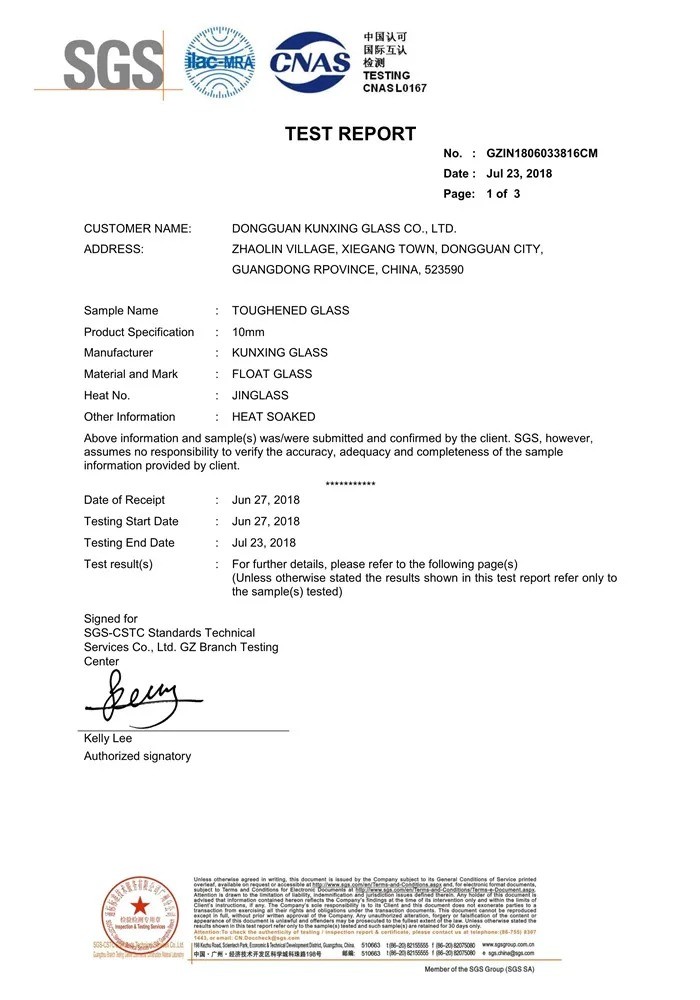
Supporting proof: SGS test report GZIN1806033816CM for 10 mm heat-soaked float toughened glass, issued 23 July 2018 by SGS-CSTC Standards Technical Services Co., Ltd. GZ Branch Testing Center.
Thermostability: what the 250–320 °C band does and does not cover
The specification lists a thermostability of 250–320 °C. Read correctly, this is the thermal band the tempered pane is rated to withstand — useful when a facade, spandrel or roof glazing assembly is exposed to solar gain, shadow patterns or heat build-up behind the glass. Read incorrectly, it becomes a claim that the product is a heat-resistant material, which it is not.
The distinction matters commercially because “heat resistant tempered glass” is a live search term and a frequent specification error. Soda-lime silicate tempered glass and borosilicate glass 3.3 are different material systems; ISO 3585:1998 specifies the properties of borosilicate glass 3.3, the class used for heat-resistant applications such as fireplace and stove viewing glass. A buyer sourcing soda lime tempered glass against a borosilicate requirement will end up with a product that cannot meet the duty, however good the tempering is.
In service, real thermal performance also depends on how the pane is detailed: edge condition, frame restraint, shading and the presence of heat-absorbing coatings all influence whether the glass ever approaches its rated band. That is a design question, not a data-sheet question.
Breakage: obtuse-angle grains and occasional self-destruction
Tempered glass breaks into obtuse-angle grains. This is the safety benefit that makes it the default glazing for doors, windows, partitions and facades: the fragments are comparatively blunt rather than dagger-like, which reduces injury risk at the point of breakage.
The same specification states that self-destruction occurs sometimes. Spontaneous breakage is a known behaviour of toughened glass and is generally associated with nickel sulphide inclusions; heat-soak treatment under EN 14179-1:2016 is the recognised process route to reduce that risk. For overhead glazing, facades and high-access glazing, heat soak is a specification decision rather than an optional extra.
KXGLASS operates heat-soak capability supported by process evidence: a calibration report for the heat-soak process oven “CS-HST-1808”, issued by JAS (Inspection & Testing) Ltd. on 3 September 2018 under BS EN 14179-1:2016 (report J18-117-R01-180903), plus SGS reports for 6 mm, 10 mm and 15 mm heat-soaked toughened glass. A heat-soak claim supported only by a brochure statement should not be accepted in place of a process record.
Practical breakage planning: specify heat soak where breakage access is difficult or costly; carry a breakage allowance and spare panes sized from the same production batch; and record the fragmentation result at incoming inspection so that any later failure can be compared against a known baseline.
Step-by-step: specifying tempered glass in seven steps
- Define the application before the product. A door lite, a window unit, a curtain wall panel, a partition and a skylight impose different requirements. The KXGLASS application data for building glass lists window and door systems, curtain walls, partition systems and sound insulation systems as the main construction uses, with long-term outdoor exposure and 24/7 load-bearing as operating conditions.
- Fix the thickness from the 4–25 mm range. Write the exact thickness into the RFQ — 6 mm tempered glass and 19 mm tempered glass are different line items with different handling, framing and freight implications.
- State the performance values you expect to see reported. Intensity, surface stress and fragmentation are the three values a tempered glass data sheet should answer. Anything less leaves the tempering unverified.
- Decide on heat soak. For overhead, facade or hard-to-replace glazing, require heat soak under EN 14179-1:2016 and ask for the oven calibration record alongside the glass test report.
- Choose the assembly. Monolithic tempered, tempered laminated, insulated tempered (double glazed tempered), frosted tempered, tinted tempered or low iron tempered glass each answer a different functional requirement — safety, fragment retention, thermal and acoustic insulation, privacy or colour fidelity.
- Verify certificates by number, scope and edition. Check the certificate number, the product scope, the issuing body and the standard edition. A withdrawn edition is not evidence.
- Close the commercial loop. Confirm MOQ, lead time, packing and inspection terms in writing, then approve a sample or first article before mass production.
Use cases: matching tempered glass to real building scenarios
Door tempered glass and window tempered glass
Doors and windows are the highest-frequency tempered glass applications in construction and decoration, and the two behave differently. Door lites are handled, cleaned and impacted constantly, so edge quality and grain pattern matter as much as thickness. Window units face wind load, thermal cycling and, increasingly, acoustic requirements. In both cases, the specification should name the thickness, the standard the glass is certified against, and whether the pane is monolithic or part of a sealed unit.
Curtain walls and facades
Facade glazing combines long outdoor exposure with limited replacement access, which makes heat soak and documented test evidence worth more than a marginal price difference. KXGLASS project references in this segment include an airport curtain wall and decorative wall package in Vietnam for a municipal government client, where the reported outcomes were colour stability of at least 85%, a five-fold safety factor and Mohs hardness 6 across a 3–10 year service horizon.
Interior partitions and stair balustrades
Semi-frosted and frosted tempered glass partitions combine privacy with light transmission, and stair balustrades combine it with structural duty. Both sit inside the 4–25 mm range, but they pull in different directions: partitions favour 6 mm to 10 mm frosted panels, while balustrades and stair treads generally require heavier panes and careful edgework.
Insulated tempered glass and double glazed tempered units
Where thermal and acoustic performance are part of the brief, tempered panes are assembled into insulated glass units. KXGLASS insulated glass is offered with 6A, 9A and 12A spacer configurations, and the stated benefits are heat insulation, noise insulation and lower building self-weight. The governing standard for the sealed unit itself is EN 1279-1:2018, so unit-level conformity should be requested in addition to pane-level tempered glass reports.
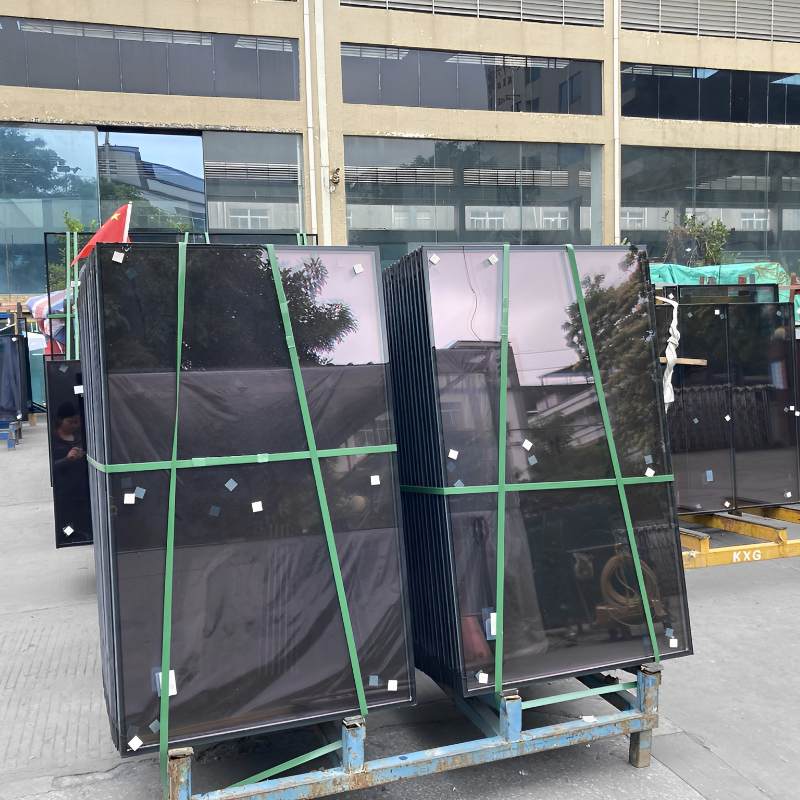
Scenario image: insulated glass unit with tempered panes — specified when heat and noise insulation are part of the brief.
Tempered laminated glass
Laminated tempered glass combines a tempered ply with an interlayer; KXGLASS laminated glass is offered with PVB interlayers in 0.38 mm, 0.76 mm, 1.14 mm and 1.52 mm, in 5+5 mm, 6+6 mm and 8+8 mm build-ups, and with SGP laminates stated to deliver high mechanical strength, good impact resistance and anti-typhoon performance. For hurricane-exposed facades and skylights, tempered laminated glass is the usual way to combine tempering strength with fragment retention. Lamination conformity runs through EN 14449:2005 and the ISO 12543 series.
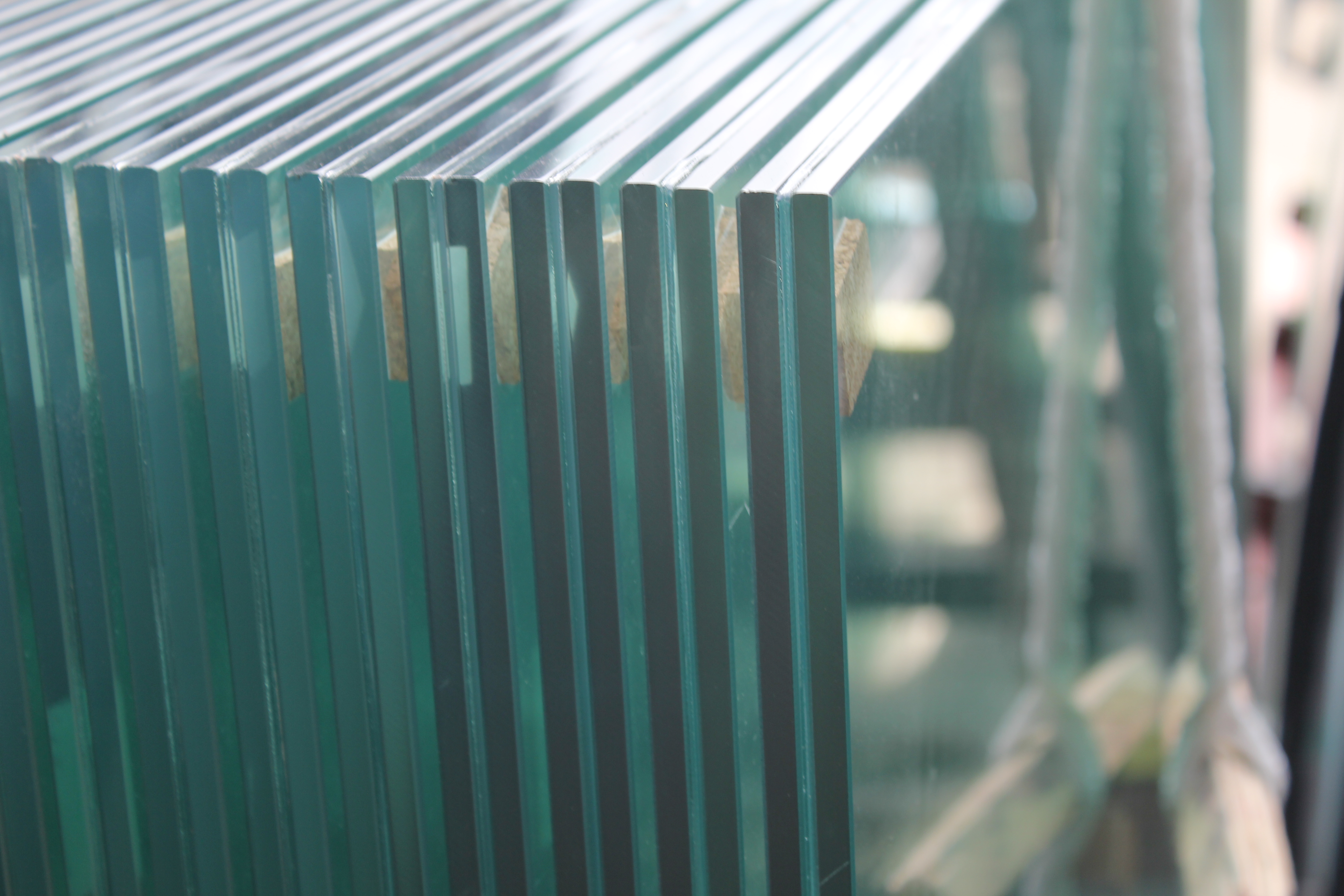
Scenario image: laminated build-up — combined with tempered plies where fragment retention or anti-typhoon performance is required.
Bent tempered glass, curved tempered glass and beveled tempered glass
Curved and bent tempered glass is covered by the same European product standard family as flat glass — EN 12150-1 explicitly covers thermally toughened soda lime silicate safety glass in flat and bent form — and KXGLASS lists both flat tempered glass and curved toughened glass among its products. Beveled and polished edges are a finishing decision that affects both appearance and handling safety, and should be named in the drawing rather than left to production default.
Frosted, tinted and low iron tempered glass
These are appearance and light-management variants of the same tempered base product. Frosted tempered glass delivers privacy with daylight; tinted tempered glass reduces glare and solar transmission; low iron tempered glass reduces the green cast that standard float glass introduces, which matters for colour-critical facades and for white or pale interior schemes. All three should be specified with the same performance, fragmentation and heat-soak requirements as clear tempered float glass, because the tempering step does not change.
Comparison table: tempered vs laminated vs insulated glass
The three product families overlap in projects but are not substitutes. The comparison below uses only the published product data reviewed for this article.
| Attribute | Tempered glass | Laminated glass | Insulated glass |
|---|---|---|---|
| Primary function | Safety glazing with high strength; base pane for most architectural assemblies | Impact resistance and fragment retention; anti-typhoon performance with SGP | Heat insulation, noise insulation, lower building self-weight |
| Build-up | Monolithic, 4 mm to 25 mm | 5+5 mm, 6+6 mm, 8+8 mm with PVB 0.38/0.76/1.14/1.52 mm; SGP option | Double glazing with 6A, 9A or 12A spacer |
| Reported performance values | Intensity 150 MPa; surface stress 95 MPa; thermostability 250–320 °C | High mechanical strength; good impact resistance; anti-typhoon | Heat insulation; noise insulation; reduced structural dead load |
| Breakage behaviour | Obtuse-angle grains; self-destruction sometimes | Laminated construction is used where fragment retention is required | Behaviour is set by the tempered panes and the sealed unit together |
| Risk treatment | Heat soak under EN 14179-1:2016 | Interlayer and ply selection; lamination conformity under EN 14449:2005 / ISO 12543 | Unit conformity under EN 1279-1:2018 |
Table 2: Functional comparison of tempered, laminated and insulated glass based on the published product data.
FAQ: tempered glass specification questions
1. Which standard must tempered glass meet for EU, US, China and Australia projects?
The standard follows the destination market, not the factory. For the EU, monolithic flat thermally toughened soda-lime silicate safety glass is defined by EN 12150-1:2015+A1:2019, with conformity assessed through EN 12150-2:2004 and heat-soaked product covered by EN 14179-1:2016. For the US, ASTM C1048-18 defines fully tempered flat glass, 16 CFR Part 1201 sets the federal architectural glazing requirement with Category I and Category II criteria, and ANSI Z97.1-2015 provides the consensus performance reference. For China, GB 15763.2-2005 is the building tempered glass reference. KXGLASS holds SGS test reports for 6 mm, 10 mm and 15 mm heat-soaked toughened glass (GZIN1806033811CM, GZIN1806033816CM, GZIN1806033817CM-01), SGCC acknowledgement numbers 5566 through 5581, and lists ISO, 3C, CE/EN 12150, AS/NZS 2208 and SGCC among its credentials. Always check the certificate scope and edition date, because EN 12150-1:2000 is a withdrawn edition.
2. Can a supplier deliver 4 mm to 25 mm thicknesses plus custom sizes and processing?
Yes for KXGLASS: the tempered glass range covers 4 mm, 5 mm, 6 mm, 8 mm, 10 mm, 12 mm, 15 mm, 19 mm, 22 mm and 25 mm, with OEM/ODM customization of size, thickness and logo. Capacity and control figures to request in writing are a monthly capacity of 100,000 m², 100% product testing, and annual output of 1,825,000 m² of single tempered glass — supported by a 30,000 m² workshop and a 3.6 × 16 m flat tempering furnace. Custom cut tempered glass, polished or beveled edges, drilling, frosting, tinting and lamination should be confirmed on the drawing, because each added operation changes handling and packing requirements.
3. What drives the price of 10 mm, 12 mm or 19 mm tempered glass?
Four cost drivers dominate: thickness band, processing steps, order quantity against MOQ, and packing or delivery terms. Moving from 6 mm tempered glass to 12 mm or 19 mm tempered glass increases glass mass per square metre, which affects handling, crate design and freight. Processing adds cost in proportion to the number of steps — heat soak, lamination, insulating unit assembly, frosting, tinting, low iron base glass and edge polishing — and small orders carry a disproportionate set-up share, which is why the KXGLASS MOQ is set at 100 m². For budgeting, a published 2026 wholesale price guide places 12 mm–19 mm tempered glass at roughly USD 15.00 to USD 59.90 per m²; treat that as an indicative band only, since thickness, processing, quantity and delivery basis in a real quotation determine the actual figure.
4. How can a buyer validate quality before placing a bulk order?
Validation has three layers. Document level: request the SGS report that matches the ordered thickness, the heat-soak oven calibration report under BS EN 14179-1:2016, and the SGCC acknowledgement covering the relevant safety glazing scope. Sample level: inspect thickness, edgework, flatness, coating or frosting uniformity and the fragmentation pattern against the EN 12150-1 criterion of at least 40 particles in a 50 mm × 50 mm square. Production level: confirm 100% testing and the 5-year return and replacement terms in the contract. A sample request should name the exact thickness and processing so that the sample and the production batch are comparable.
5. What is the lead time, and what should be planned around it?
KXGLASS states a lead time of 15–20 days, against a monthly capacity of 100,000 m². Two planning points sit outside that number: heat-soak treatment adds a process step that must be scheduled rather than assumed, and oversized or curved panels affect packing and shipping volume more than production time. Confirming the standard edition, the heat-soak requirement and the packing method in the RFQ is what keeps the 15–20 day window realistic on a live project.
Next step: check the specification against the certificate
Send the thickness, application and destination market, and KXGLASS will match them against the available test reports, heat-soak records and certification scope — or arrange a sample and first-article review before the order is released.
Email: kevin@kxglass.com · Tel: +86 13500092849 · www.kxglass.com
Conclusion
Tempered glass is a well-defined building product once the four numbers are pinned down: a thickness chosen from the 4 mm to 25 mm range, an intensity of 150 MPa and surface stress of 95 MPa on the data sheet, a 250–320 °C thermostability band understood as thermal tolerance rather than heat resistance, and a breakage pattern of obtuse-angle grains with occasional self-destruction that heat soak under EN 14179-1:2016 is designed to reduce.
The buyer’s work is to make those numbers verifiable — thickness-matched test reports, a current standard edition, a heat-soak process record, and a sample that matches the production batch. Projects fail less often because the glass was wrong and more often because the paperwork did not prove what the glass was. KXGLASS supplies tempered, laminated and insulated glass from Dongguan, Guangdong, China to markets including Australia, America, Asia and Europe, and publishes its specification data so that the check can be done before the order.
For the full product and capability overview, download the KXGLASS brochure (PDF).
Have Questions or Need More Details?
Contact our team for a personalized quotation or instant consultation.
Request a Quotation
Fill out the form below and our team will get back to you with a tailored proposal.
WhatsApp Direct Chat
Prefer to chat in real-time? Message us on WhatsApp for instant assistance & quick answers.
- Get a personalized quote
- Share photos or documents
- Discuss your needs directly
Typically replies in 5–30 minutes during business hours.