
Tempered Glass Compliance: Certification, Standards & Regional Requirements
Tempered Glass Compliance: Certification, Standards & Regional Requirements
Short answer: a tempered glass order is compliant only when four links in the chain match — the product standard named in the specification is the current edition, the test report covers the exact thickness and process that is actually shipped, the measured strength and thermal parameters meet the project specification, and the breakage plan (including heat-soak where required) is documented before installation. A certificate on its own proves none of these four things.
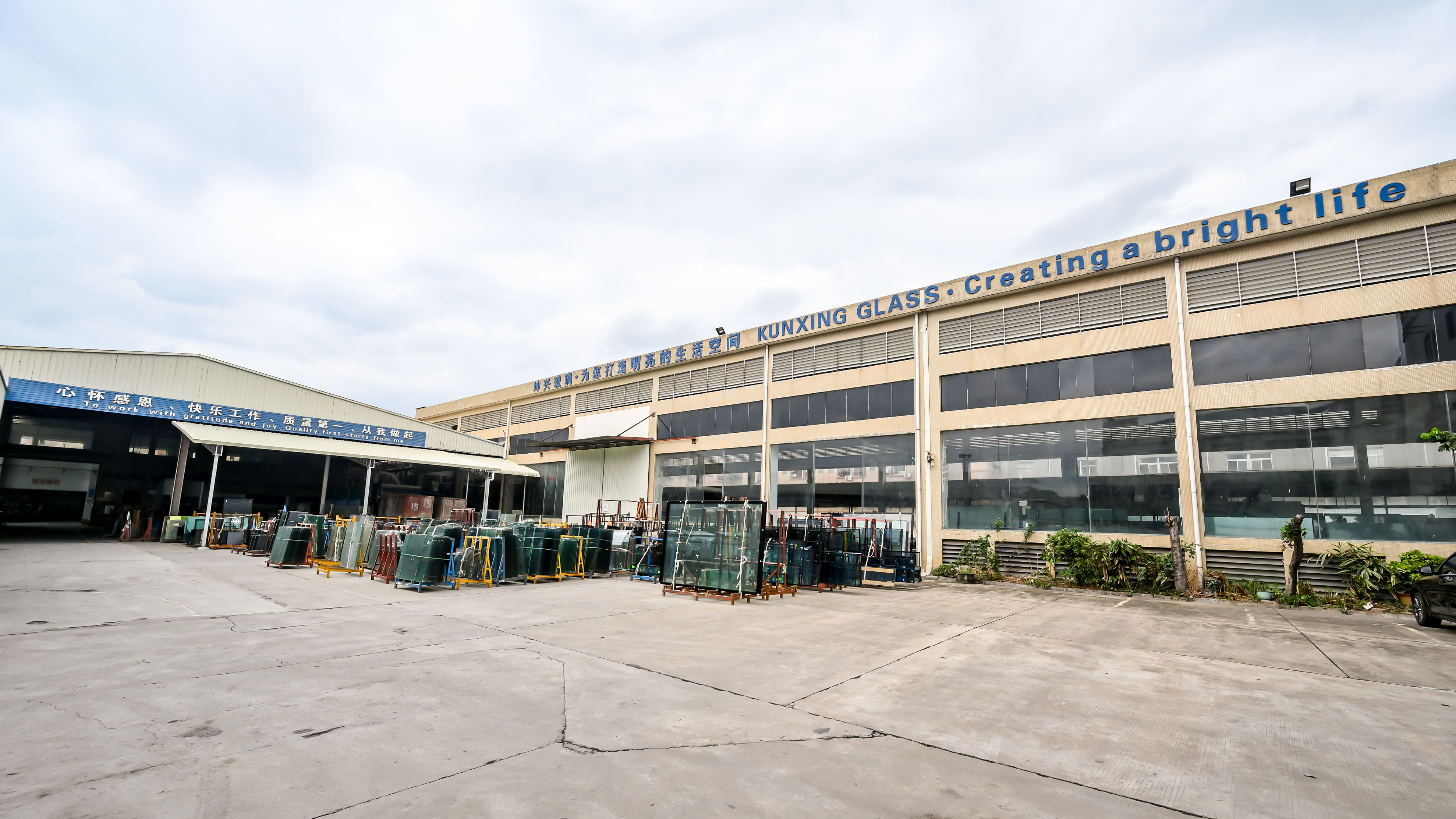
KXGLASS (Kunxing Glass) is a glass deep-processing manufacturer based in Dongguan, Guangdong Province, China, founded in 1995 and operating a 30,000 m² workshop with 150 employees, supplying tempered, laminated and insulated glass to Australia, America, Asia and Europe. Its compliance file is a practical working example of what a buyer should demand — and of which questions a buyer still has to close before release.
1. The Problem: Compliance Files Fail in Four Predictable Ways
Most failed compliance reviews are not caused by defective glass. They are caused by documents that do not describe the glass in the crate.
- Version drift. A specification still cites a superseded edition. The 2000 entry for EN 12150-1 is marked withdrawn in the Swedish standards catalogue and replaced by SS-EN 12150-1:2015, yet older specification templates continue to circulate.
- Scope drift. The test report covers one thickness and the purchase order ships another. A 10 mm report does not evidence a 19 mm pane.
- Parameter drift. The data sheet states a surface stress or thermostability figure, but nobody checks whether the project specification asked for that figure or for something else.
- Unplanned breakage. Spontaneous breakage is treated as a warranty dispute after installation instead of a risk that is specified, heat-soaked and budgeted for in advance.
Each of these is a document-control failure, which means each can be closed before the deposit is paid.
2. Industry Background: Three Regulatory Families, Three Different Questions
Tempered glass is a category in which the technical specification and the market-access requirement are often the same instrument. A standard number defines both what the product is and what a manufacturer must be able to prove in order to sell it into a given market — which is why standard numbers cannot be substituted across regions.
European Union and EEA
EN 12150-1:2015+A1:2019 specifies tolerances, flatness, edgework, fragmentation, and physical and mechanical characteristics of monolithic flat thermally toughened soda-lime silicate safety glass for use in buildings. EN 12150-2:2004 is the conformity-evaluation and product-standard part of the same series, providing the route by which thermally toughened safety glass is assessed for conformity and CE marked under the EU Construction Products Regulation. Heat-soaked thermally toughened glass is covered separately by EN 14179-1:2016.
United States
16 CFR Part 1201 is the federal Safety Standard for Architectural Glazing Materials issued by the Consumer Product Safety Commission, and it classifies glazing materials into Category I and Category II according to the safety performance required in architectural applications. ANSI Z97.1-2015 is the consensus safety-glazing performance specification and test-method standard used alongside it. ASTM C1048-18 is the product specification for heat-strengthened and fully tempered flat glass, and it deliberately treats those two treatment levels as separate product categories.
China
GB 15763.2-2005 is the Chinese national standard for tempered glass within the safety glazing materials in building series, and it is the reference standard for building tempered safety glass in the China market.
International and combined products
The ISO 12543 series is the international framework for laminated glass and laminated safety glass, including tempered-laminated combinations. EN 1279-1:2018 is the European framework for insulating glass units, covering generalities, system description, substitution rules, tolerances and visual quality. ISO 3585:1998 covers borosilicate glass 3.3 — a different material system from soda-lime tempered glass, and the correct reference for genuine heat-resistant applications.
Customs classification
Tempered glass for construction sits in HS heading 7007, safety glass consisting of toughened (tempered) or laminated glass. Toughened glass other than that sized for vehicles, aircraft or vessels falls under subheading 7007.19.
3. The Parameter Blocks Your Specification Must Reconcile
KXGLASS publishes three performance parameters for its tempered glass that a buyer should be able to line up against any project specification: intensity of 150 MPa, surface stress of 95 MPa, and a thermostability range of 250 °C to 320 °C. The value of these numbers depends entirely on whether they appear in the right document, for the right thickness.
Strength: 150 MPa Intensity and 95 MPa Surface Stress
Intensity describes the load the finished pane can carry; surface stress describes the residual compressive stress locked into the surface by the quenching step. They are different measurements and they answer different questions. Intensity belongs in the structural or impact justification. Surface stress belongs in the tempering quality record — it is the parameter that tells you the glass was actually tempered rather than heat-strengthened, a distinction ASTM C1048-18 makes explicit. When reviewing a report, confirm which of the two is stated, at which thickness, and by which test method.
Thermostability: What 250 °C–320 °C Does and Does Not Mean
The 250 °C to 320 °C range describes resistance to a temperature differential across the pane, not a continuous service temperature. Soda-lime tempered glass is a safety product; it is not a heat-resistant material in the sense used for fireplace, stove or oven viewing glass, which is a borosilicate glass 3.3 application under ISO 3585:1998. A specification that asks soda-lime tempered glass to perform as continuous high-heat glass is a specification error, and a supplier who accepts that order without flagging it has not done a compliance review.
Thickness: Why 4 mm to 25 mm Is a Compliance Variable
KXGLASS tempered glass is produced across 4 mm, 5 mm, 6 mm, 8 mm, 10 mm, 12 mm, 15 mm, 19 mm, 22 mm and 25 mm, with size, thickness and logo available as OEM/ODM customisation. Thickness is not a commercial preference; it changes the compliance evidence required, because fragmentation behaviour, impact classification and structural capacity are all thickness-dependent. A practical mapping for architectural work:
- 4–6 mm: interior glazing, cabinet and decorative panels, and smaller fixed lights.
- 8–12 mm: door and window tempered glass, including single-glazed and double-glazed tempered units.
- 12–19 mm: facades, curtain walls, structural and overhead glazing.
- 22–25 mm: heavy structural and special applications where the specification calls for it.
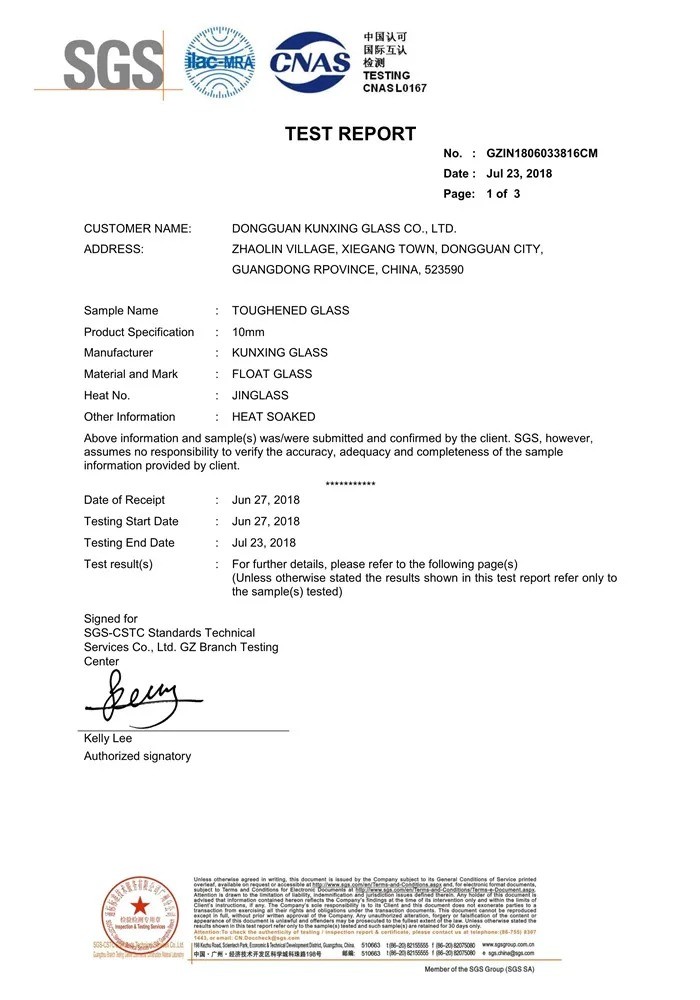
Whichever band applies, ask for the report at that thickness. KXGLASS holds SGS test reports for 6 mm (GZIN1806033811CM), 10 mm (GZIN1806033816CM) and 15 mm (GZIN1806033817CM-01) heat-soaked float toughened glass, plus an SGS report under BS 6206:1981 & AMD 8693:1995 (GZHG1204010925FT). A 19 mm or 25 mm order should be matched to its own evidence rather than covered by a neighbouring thickness.
Breakage Behaviour: Obtuse-Angle Grains
Correctly tempered glass breaks into relatively small obtuse-angle grains rather than large sharp shards. That fragment pattern is the safety function, and it is testable: EN 12150-1 sets a fragmentation requirement of not fewer than 40 particles counted within a 50 mm × 50 mm square. Fragment count is therefore a document check, not an opinion. Two honest limits belong next to it: edge damage and point loading can break tempered glass for reasons unrelated to tempering quality, and a fragmentation result on one thickness does not automatically transfer to another.
Where Tempered Glass Sits in the Full Glazing File
Tempered glass is rarely the whole assembly. Laminated tempered glass is assessed under EN 14449:2005 in Europe and the ISO 12543 series internationally; KXGLASS holds a Declaration of CPD Conformity (LBTC202006209S, LABTEST TECHNOLOGY LABORATORY LTD, issued 2020-07-02) against EN ISO 12543-2:2011 and EN ISO 12543-3:2011 for DuPont SentryGlas (SGP) interlayers. Insulated tempered glass units are assessed under EN 1279-1:2018. Silkscreen printing glass and silver mirror glass sit outside those product standards but inside the same project file, so their own acceptance criteria should be written into the same submittal rather than handled separately at the end of the project.
4. Self-Destruction: A Planned Characteristic, Not a Hidden Defect
Tempered glass can break spontaneously, and the recognised cause is nickel sulphide inclusions that change volume during the tempering cycle and expand later in service. This is a known material characteristic of soda-lime tempered glass, not evidence of a defective batch, and mature specifications plan for it.
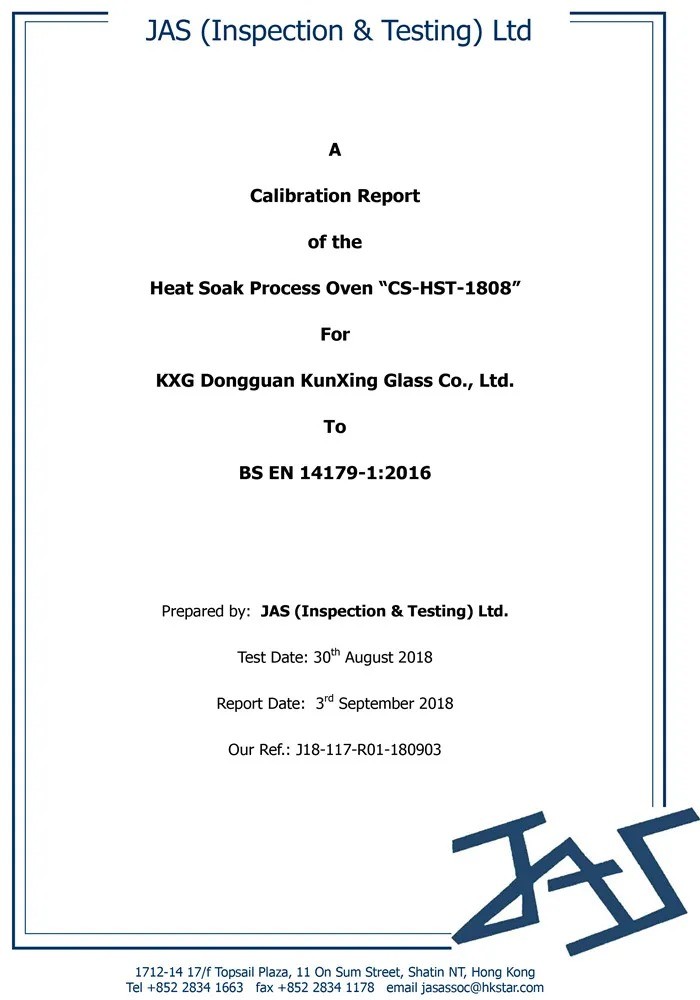
The recognised mitigation is the heat-soak process defined in EN 14179-1:2016, which puts finished tempered panes through a controlled re-heating cycle so that inclusions likely to fail in service fail in the oven instead. Two things should be verified rather than assumed: that heat-soak is specified at all for the risk-exposed areas, and that the oven itself is calibrated to a recognised standard. KXGLASS operates a heat-soak process oven, model CS-HST-1808, calibrated by JAS (Inspection & Testing) Ltd. against BS EN 14179-1:2016, with calibration report J18-117-R01-180903 dated 2018-09-03.
Practically, three habits reduce the exposure. Specify heat-soak for overhead glazing, facades, balustrades and any pane that cannot be replaced without scaffolding. Keep spare panes from the same heat-soak batch. And write the breakage expectation into the contract in plain language, so that a single spontaneous break is handled as planned maintenance rather than as a dispute about quality.
5. Step-by-Step: Verifying a Compliance File in Seven Steps
This sequence runs from specification to shipment release. Each step produces one document that the next step depends on.
- Name the market and the mandatory instrument first. Decide whether the project falls under the EU framework (EN 12150-1 with EN 12150-2 conformity evaluation), the US framework (16 CFR Part 1201 with ANSI Z97.1-2015), GB 15763.2-2005 for China, or a combination. Do this before the RFQ, because it determines which test evidence is relevant.
- Write standard, edition and thickness into the RFQ line by line. State the edition, the thickness, the process (tempered, heat-soaked, laminated, insulated), the edgework and the fragmentation criterion. Vague RFQs produce certificates that cannot be matched to the goods.
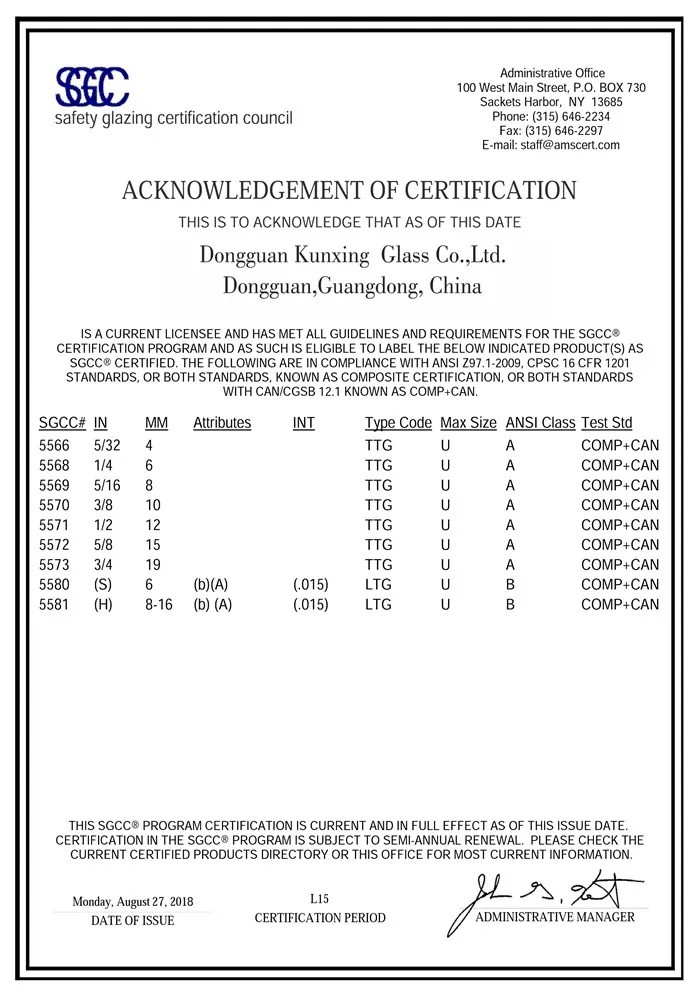
- Read the certificate, not the brochure. For every claimed standard, request the certificate number, the issuing body, the product scope, the thickness covered and the issue date. KXGLASS, for example, holds SGCC Acknowledgement of Certification numbers 5566/5568/5569/5570/5571/5572/5573/5580/5581, issued 2018-08-27 by the Safety Glazing Certification Council, with a scope covering SGCC-certified tempered and laminated safety glass against ANSI Z97.1-2009, CPSC 16 CFR 1201 and CAN/CGSB 12.1 (COMP+CAN).
- Match the report to the shipment. Compare the thickness on the SGS or SGCC document to the thickness on the packing list. Where the required thickness is not covered, request additional testing instead of accepting a neighbouring report.
- Verify the process behind the claim. If heat-soak is specified, ask for the oven calibration record and its reference standard, not only the glass report. If laminated or insulated assemblies are involved, ask for the interlayer conformity declaration and the IGU standard reference.
- Confirm the production and acceptance controls. KXGLASS operates OEM/ODM production with a monthly capacity of 100,000 m², a minimum order of 100 m² and a lead time of 15–20 days, with 100% testing and pre-shipment testing as the acceptance criterion. Delivery terms are EXW, FOB or CIF; payment terms are 30% TT in advance with 70% balance before shipping, and full payment for orders below USD 10,000.
- Fix the post-installation position before delivery. KXGLASS offers a 5-year return and replacement after-sales term. Confirm what the term covers, which documents must be retained to claim it, and how spare panes are ordered — because after-sales terms are only usable when the original certificate set has been archived.
6. Use Cases: How Requirements Change by Application
The same tempered glass product meets different compliance questions depending on where it is installed.
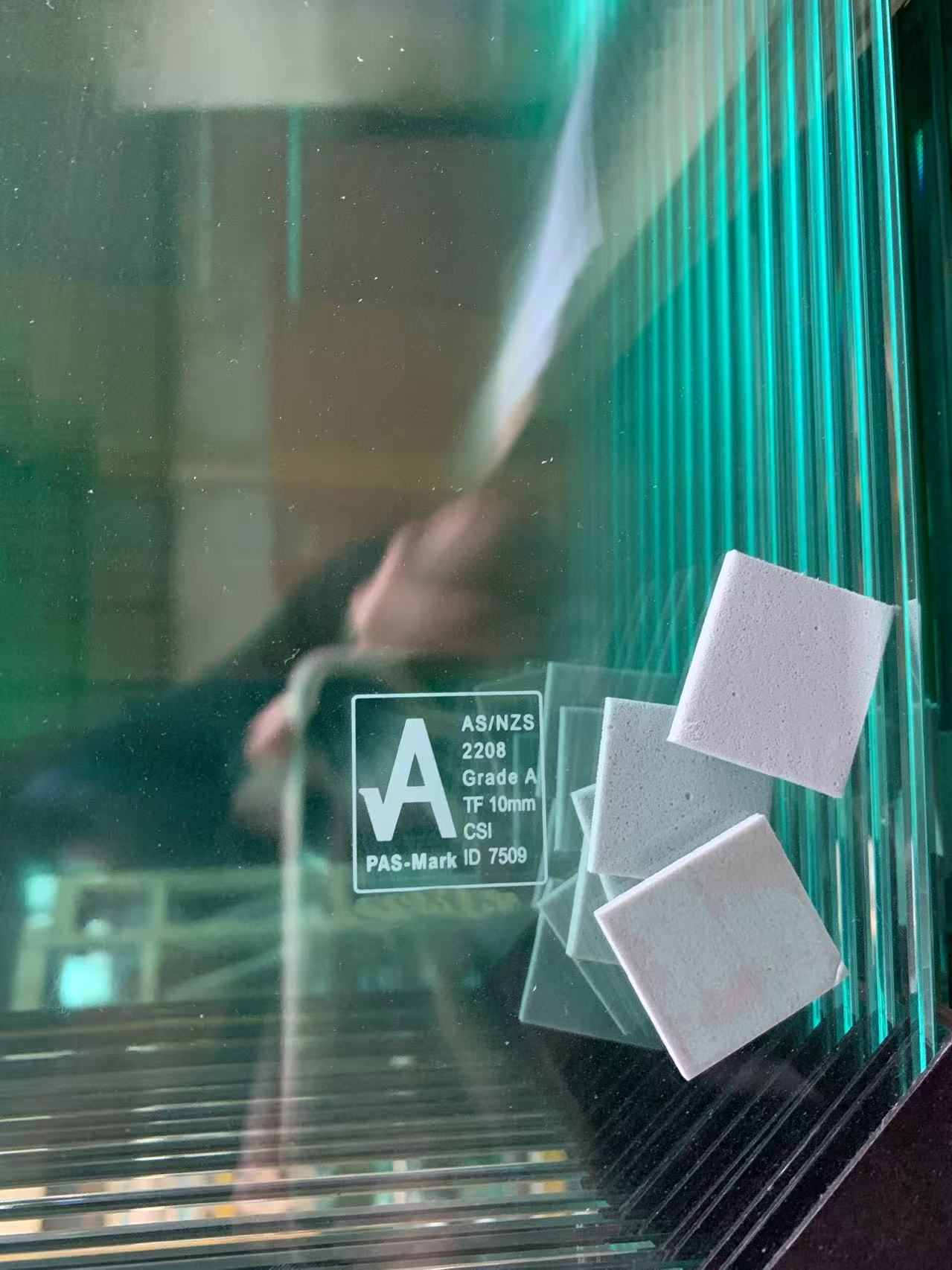
- Doors and windows. Impact safety dominates, so the fragment pattern and the applicable safety-glazing standard drive the file. 8 mm to 12 mm tempered and double-glazed tempered units cover most door and window work; Australian projects typically reference AS/NZS 2208, which KXGLASS lists among its standards, and the certificate copy should be requested at order stage.
- Facades and curtain walls. Structural capacity, thermal performance and breakage risk all apply at once. KXGLASS supplied insulated and laminated glass to an OEM build-to-rent and mall facade project in Australia (500–1000 units), with reported results including stable structural performance and a relative energy saving ratio of at least 65%.
- Overhead and skylight glazing. This is where heat-soak specification matters most. A mall skylight and curtain wall project in the UAE (100–200 units) is recorded with safety performance of at least 3500 Pa and a service life of 2–10 years.
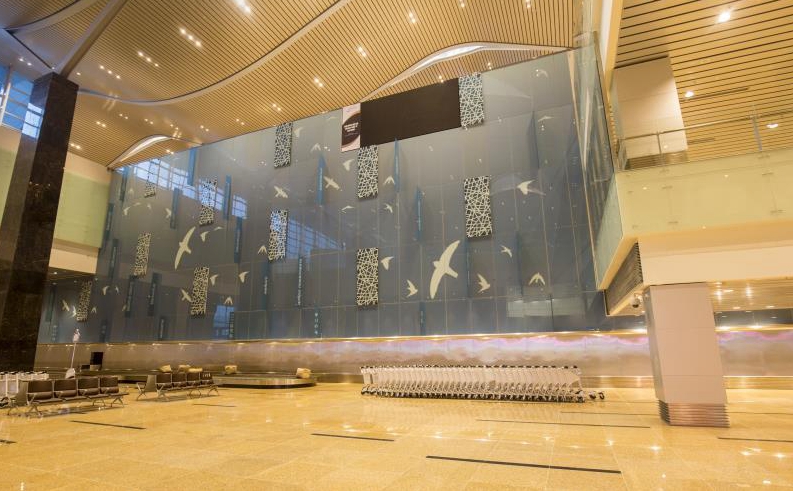
- Decorative and printed glass. Silkscreen printing glass, frosted tempered glass, tinted tempered glass and low-iron tempered glass carry the tempered safety requirement plus a separate visual acceptance criterion. A municipal airport project in Vietnam (200–500 units, curtain wall and decorative wall) is recorded with colour stability of at least 85% alongside the safety requirement.
- Curved and shaped work. Bent and curved thermally toughened glass falls within the scope of the EN 12150-1 framework, so curved tempered glass is a standard-covered capability rather than an uncertified extra — but the geometry limits of each supplier still have to be confirmed. KXGLASS lists both flat tempered glass and curved toughened glass among its products.
- Where soda-lime tempered glass is the wrong answer. Continuous high-heat applications such as fireplace or stove viewing glass require borosilicate glass 3.3 under ISO 3585:1998. Tempered soda-lime glass should not be substituted, regardless of how the enquiry is worded.
7. Comparison Tables
The first table maps the compliance question by market. The second maps the parameters a buyer should be able to find in the file.
| Market | Governing instrument | Tempered glass product standard | Evidence to collect |
|---|---|---|---|
| EU / EEA | Construction Products Regulation; CE marking and Declaration of Performance | EN 12150-1:2015+A1:2019 with EN 12150-2:2004 for evaluation of conformity; EN 14179-1:2016 where heat-soak is specified | DoP, test report stating the current edition, fragmentation result; note that the 2000 edition is withdrawn |
| United States | 16 CFR Part 1201 (Category I / Category II) | ANSI Z97.1-2015 performance and test method; ASTM C1048-18 for heat-strengthened versus fully tempered flat glass | SGCC certification or equivalent third-party test report referencing the correct standard edition |
| China | National building safety glazing requirements; 3C certification listed by KXGLASS | GB 15763.2-2005 | National-standard test report at the ordered thickness |
| Australia / New Zealand | Project specification and local building requirements | AS/NZS 2208, listed by KXGLASS among its standards | Certificate copy and report at the ordered thickness, requested at order stage |
| Insulated units (any market) | Applied on top of the tempered glass standard | EN 1279-1:2018 | IGU conformity evidence in addition to the pane evidence |
| Laminated combinations | Applied on top of the tempered glass standard | EN 14449:2005; ISO 12543 series | Interlayer conformity declaration, e.g. CPD declaration LBTC202006209S to EN ISO 12543-2:2011 and EN ISO 12543-3:2011 |
| Customs | WCO HS nomenclature | HS 7007; toughened safety glass other than vehicle/aircraft/vessel sizes under 7007.19 | Correct HS code on the commercial invoice and packing list |
| Parameter | KXGLASS published value | Where it must appear | Reject the file if |
|---|---|---|---|
| Intensity | 150 MPa | Test report or technical data sheet, tied to the ordered thickness | The value is stated only in a brochure and not in any report |
| Surface stress | 95 MPa | Tempering quality record | The file cannot distinguish tempered from heat-strengthened product |
| Thermostability | 250 °C–320 °C | Data sheet, read as a temperature-differential limit | The value is presented as a continuous service temperature |
| Thickness range | 4 mm, 5 mm, 6 mm, 8 mm, 10 mm, 12 mm, 15 mm, 19 mm, 22 mm, 25 mm | Order line, packing list and matching report | The report covers a different thickness from the shipment |
| Fragmentation | Not fewer than 40 particles per 50 mm × 50 mm (EN 12150-1) | Fragmentation test record | No fragment count is provided at all |
| Heat-soak | Oven CS-HST-1808 calibrated to BS EN 14179-1:2016, report J18-117-R01-180903 | Process record, when heat-soak is specified | Heat-soak is claimed but no oven calibration or batch record exists |
| Edgework and flatness | Within the EN 12150-1 scope, which covers tolerances, flatness and edgework | Inspection record; polished or bevelled edges specified separately | Edge finish is unspecified on the order |
8. FAQ
Which certificate do I actually need for a tempered glass order?
It depends on the destination market, and one certificate rarely covers all of them. For the EU, the relevant evidence is conformity to EN 12150-1:2015+A1:2019 through the EN 12150-2:2004 conformity route, with CE marking and a Declaration of Performance. For the US, the mandatory reference is 16 CFR Part 1201, supported by ANSI Z97.1-2015 testing and commonly evidenced through SGCC certification. For China, GB 15763.2-2005 applies. Whichever route applies, the document must name the standard edition, the issuing body, the product scope and the thickness — a general statement that a factory “meets international standards” is not a certificate.
Can KXGLASS supply 19 mm and 25 mm tempered glass, and is there matching test evidence?
KXGLASS produces tempered glass in 4 mm, 5 mm, 6 mm, 8 mm, 10 mm, 12 mm, 15 mm, 19 mm, 22 mm and 25 mm, with size, thickness and logo customisation under OEM/ODM, at a monthly capacity of 100,000 m². Test evidence is thickness-specific: SGS reports are held for 6 mm, 10 mm and 15 mm heat-soaked toughened glass, plus an SGS report under BS 6206:1981 & AMD 8693:1995. For 19 mm, 22 mm or 25 mm orders, request the report that matches the ordered thickness rather than relying on a report issued for a thinner pane.
What drives the price of compliant tempered glass?
Four things move the number: the standard route (plain tempered versus heat-soaked, and whether an insulated or laminated assembly is added), the thickness, the processing (edgework, printing, holes and cut-outs), and the delivery basis. Public 2026 wholesale benchmarks for 12 mm–19 mm tempered glass sit in a range of roughly USD 15.00 to USD 59.90 per m², which reflects how wide the specification spread is rather than a single market price. KXGLASS quotes at a 100 m² minimum order with EXW, FOB or CIF terms, so the landed comparison should always be built on the same Incoterm and the same thickness.
Can I validate the glass before placing a full order?
Validation should be built into the order rather than treated as a favour. KXGLASS applies 100% testing and uses pre-shipment testing as the acceptance criterion, which means the inspection point is defined in the contract. A pre-order discussion should therefore cover the thickness to be sampled, which standard and which parameters the report must state, and how the result maps to the project specification. Sample and pre-production enquiries can be raised through the contact details below, together with the target standard and market.
What is the lead time, and what documentation arrives with the shipment?
KXGLASS quotes a lead time of 15–20 days, with payment terms of 30% TT in advance and 70% balance before shipping (full payment for orders under USD 10,000). The document set to confirm before dispatch includes the test report for the shipped thickness, the applicable certificate copies, the heat-soak batch record where specified, and the packing list with the correct HS 7007 classification. After delivery, KXGLASS offers a 5-year return and replacement term — so archive the certificate set with the project file. To start a compliance review for your project, send the specification, destination market and thickness schedule to kevin@kxglass.com, or download the full product brochure below.
9. Conclusion
Tempered glass compliance is a chain of four verifiable links: the current standard edition, the report that matches the shipped thickness, the parameters that match the specification, and the documented breakage plan. Every link is a document, and every document can be checked before the deposit is paid.
The parameters are only as useful as their context. 150 MPa intensity and 95 MPa surface stress describe different things and belong in different parts of the file. The 250 °C–320 °C thermostability range limits temperature differential, not continuous heat. The 4 mm to 25 mm range is a compliance variable because the evidence changes with thickness. Obtuse-angle fragmentation is a measurable requirement under EN 12150-1, not an impression. And spontaneous breakage is a characteristic to be specified, heat-soaked and budgeted for — not a defect to be argued about after installation.
Get those four links right, and the tempered panes stop being the risk item in an otherwise well-documented glazing package.
Next step
Send your specification, destination market and thickness schedule for a compliance review: kevin@kxglass.com · Tel +86 13500092849 · www.kxglass.com
Download the full KXGLASS product and capability brochure: KXGLASS Brochure (PDF)
Dongguan Kunxing Glass Co., Ltd (KXGLASS) · No. 10, Jinchuan Road, Zhaolin, Xiegang Town, Dongguan City, Guangdong Province, China 523590
Have Questions or Need More Details?
Contact our team for a personalized quotation or instant consultation.
Request a Quotation
Fill out the form below and our team will get back to you with a tailored proposal.
WhatsApp Direct Chat
Prefer to chat in real-time? Message us on WhatsApp for instant assistance & quick answers.
- Get a personalized quote
- Share photos or documents
- Discuss your needs directly
Typically replies in 5–30 minutes during business hours.