
Tempered Glass Spontaneous Breakage on Site: A Problem-Solving Scenario for Builders
Short answer: When a tempered glass panel shatters without an impact, four checks, done in order, will resolve most of the questions a site team has. Confirm the fracture pattern (tempered glass breaks into obtuse-angle grains). Verify the delivered panel against the specified performance parameters (surface stress 95 MPa, intensity 150 MPa, thermostability 250 °C to 320 °C). Confirm that the thickness selected was right for the opening (the range runs from 4 mm to 25 mm). Then review edge conditions, fixing details and exposure. Tempered glass does occasionally self-destruct, so the objective is not to prove that breakage is impossible, but to separate product conformance, handling and application factors — and then choose the right mitigation, such as heat soak testing or a laminated or insulated combination for safety-critical locations.
A tempered glass door leaf is installed on Monday. On Thursday morning the installer is called back: the panel is lying in thousands of small granular pieces, with no impact mark, no witness and no obvious cause. The immediate questions are practical. Is the product faulty? Was it installed wrong? Is the rest of the order at risk? And who explains the outcome to the client?
This article turns that scene into a repeatable field procedure. It covers what the tempered glass specification actually records, which evidence survives a break, how to document the event so it holds up in a warranty discussion, and how laminated, insulated and heat-treated builds change the consequence of a break in the places where it matters most.
Problem Definition: What You Are Actually Looking At
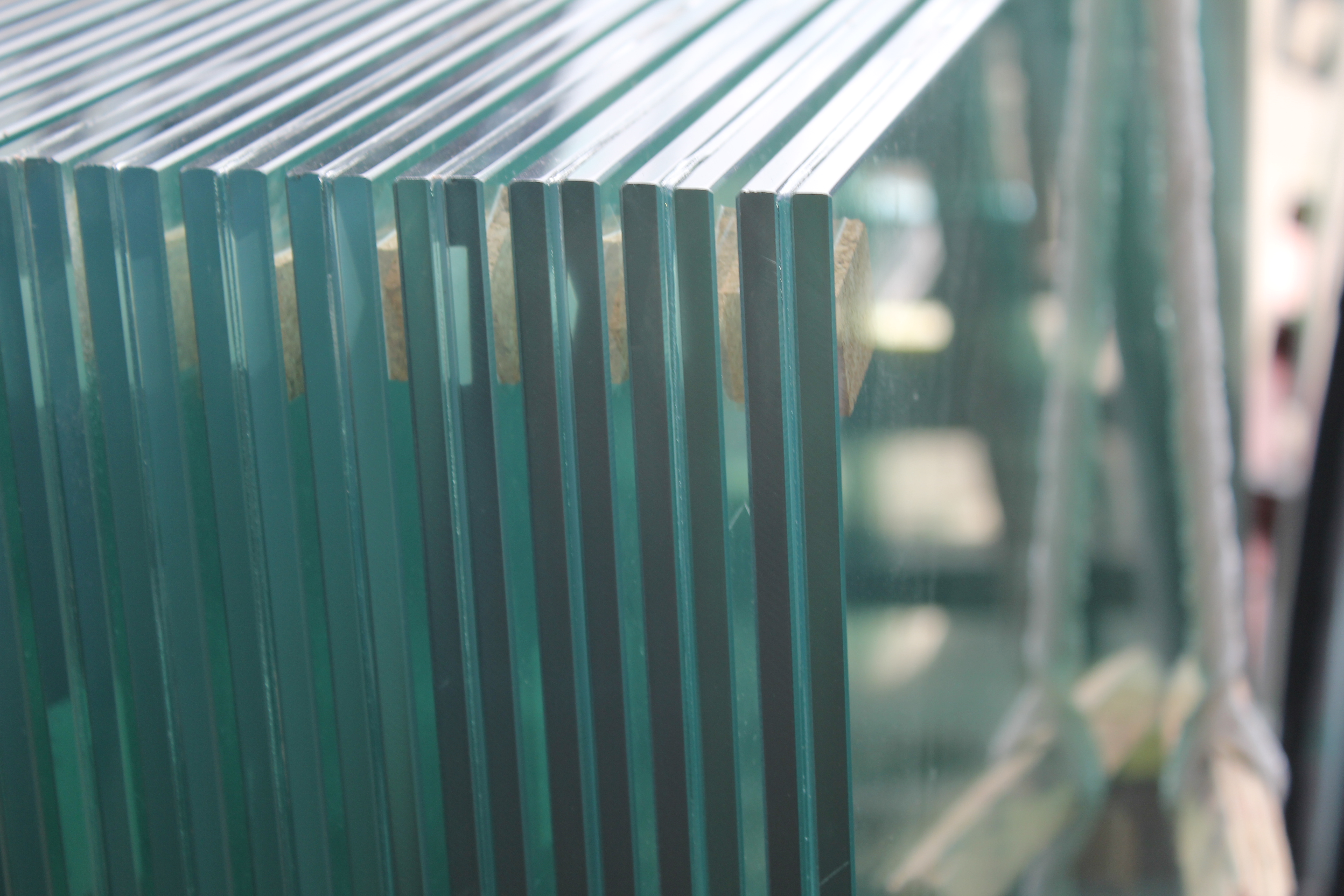
Tempered glass is a type of safety glass for the building industry, produced from a glass base material and heat-treated so that it fractures into small granular pieces instead of large sharp shards. The product specification records four measurable parameters — intensity 150 MPa, surface stress 95 MPa, thermostability between 250 °C and 320 °C — and two behavioural ones: the broken state is described as obtuse-angle grain, and self-destruction is listed as occurring sometimes.
Those two behavioural entries are the reason field investigation is necessary. A product that can break without impact cannot be defended by insisting that breakage is impossible; it can only be defended by showing whether this specific panel was specified, handled and applied correctly.
Confirm the fracture pattern first
A tempered panel breaks into small particles with obtuse-angle grains. The EN 12150-1:2015 standard for thermally toughened soda-lime silicate safety glass in buildings describes the same behaviour in measurable terms: shattering into small pieces of 5 mm or less. If the pieces on the floor are long, sharp and radiating from a single origin, the panel was probably not tempered, or not the product that was ordered — and that is a completely different investigation.
What the pattern does not tell you
Confirming a tempered fracture pattern only confirms that the panel was tempered. It does not explain why it broke. Three explanations remain open after this check, and they are not mutually exclusive:
- Documented material behaviour. The specification states that self-destruction occurs sometimes, so a conforming panel can break without an external cause.
- Damage before or during installation. Edge chips, contact with hard tools, or uneven pressure from blocks, clamps and gaskets can concentrate stress that later releases.
- Application conditions. The product is engineered for long-term outdoor exposure and continuous 24/7 load-bearing operation; where the real conditions exceed the design assumptions, the margin shrinks.
In most disputes, the useful outcome is not a single cause but a ranked set of possibilities, supported by photographs, measurements and batch documentation.
Industry Background: Why Breakage Questions Are Getting Louder
Tempered glass is now a volume product in the built environment rather than a specialty item. Grand View Research valued the global tempered glass market at USD 112.21 billion in 2024 and projected USD 159.27 billion by 2033, with Asia Pacific accounting for a revenue share of 59.9% in 2024. Plain tempered glass alone represented 64.5% of market revenue in 2024, largely because construction uses it so widely.
Supply is concentrated in the same region. UN Comtrade data places China's exports of safety glass (tempered) at approximately USD 3.58 billion in 2024, covering over 647 million square meters. A separate segment — automotive tempered glass — was valued at USD 20.29 billion in 2024, with a projected CAGR of 4.1% through 2033, which shows how broadly the same material family is deployed.
A note on market figures. Market size estimates for tempered glass diverge between research firms: Market Research Future estimates USD 34.67 billion for 2024 and Global Insight Services USD 67.5 billion, against the Grand View Research figure of USD 112.21 billion. The differences come from how each firm defines the category and how much processing is included. Treat any single number as directional and focus on the direction of travel, which all sources agree on.
The practical consequence for builders is straightforward. The more tempered glass is installed in facades, doors, windows, partitions and subway doors, the more panels will break in service — and the more often a site team will be asked to explain an event that has no witness. It is worth noticing that heat soak testing already appears alongside triple laminated tempering, triple insulating construction, anti-slip surfaces and high load-bearing as a special requirement for demanding building applications. The industry has been treating breakage risk as a specification item for some time; the gap is usually in the field procedure, not in the awareness.
The Specification Facts You Can Verify Before You Blame the Product
Nearly every breakage dispute narrows quickly once the delivered panel is compared against the documented specification of the product that was ordered. The following parameters are the ones to hold next to the purchase record.
Tempered glass — documented parameters
- Available thicknesses: 4 mm, 5 mm, 6 mm, 8 mm, 10 mm, 12 mm, 15 mm, 19 mm, 22 mm and 25 mm.
- Intensity: 150 MPa.
- Surface stress: 95 MPa.
- Thermostability: 250 °C to 320 °C.
- Broken state: obtuse-angle grain.
- Self-destruction: occurs sometimes.
- Classification: safety glass for the building industry, glass base material.
These parameters define what the panel is expected to do, and they also explain why thickness choice deserves its own check. A 6 mm tempered glass window pane, a 10 mm or 12 mm tempered glass door leaf and a 19 mm tempered glass panel in a facade all come from the same documented range, but they are not interchangeable in a load path. A panel that is correct in material terms can still be the wrong answer for the opening it was installed into.
Companion products that change the consequence of a break
Laminated glass is supplied with SGP interlayers in 0.38 mm, 0.76 mm, 1.14 mm and 1.52 mm models, and in PVB builds combining 5 mm + 5 mm, 6 mm + 6 mm and 8 mm + 8 mm glass with 0.38 mm to 1.52 mm interlayers. Its documented properties include high mechanical strength, good impact resistance and anti-typhoon performance. In safety-critical locations, laminated tempered glass is the combination most often reviewed, because the interlayer changes what happens after a break rather than trying to prevent it.
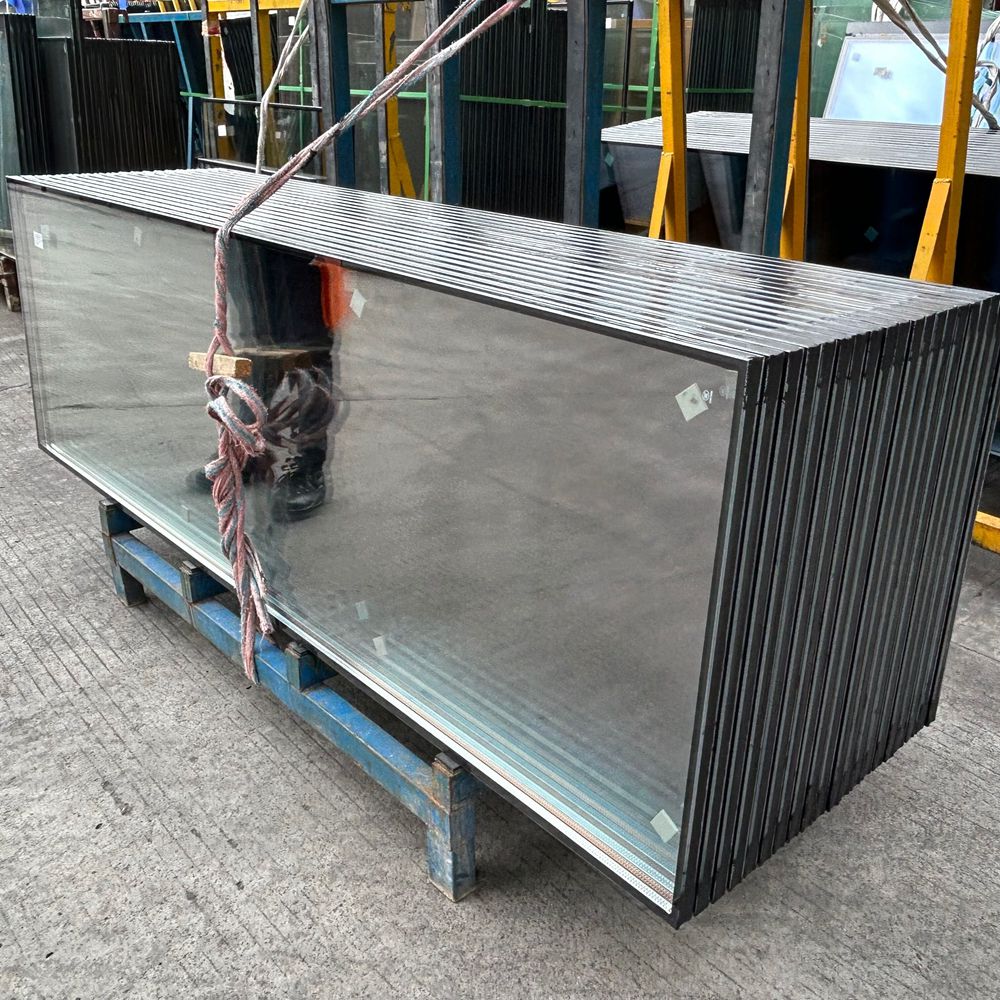
Insulated glass — also described as double glazing glass — is supplied in 6A, 9A and 12A models, with documented properties of heat insulation, noise insulation and lower self-weight of buildings. Where the failed unit was part of a double glazed tempered glass assembly, the replacement decision is about the whole unit rather than the single pane that broke.
For interior work, silkscreen printing glass supports customisable colours and patterns, easy cleaning and privacy protection. Frosted tempered glass, tinted tempered glass and bent or curved tempered glass sit in the same processing family, and custom cut tempered glass is what allows non-standard openings to be filled without compromise. Where colour neutrality is a design requirement, low-iron compositions are commonly requested in the market.
Functional roles and handling requirements
Across the referenced building scenario, the product family provides safety, energy saving, structural support, anti-slip properties, sound insulation, decoration and privacy protection, and is applied in window and door systems, curtain walls, partition systems and sound insulation systems. Handling and installation require cut-resistant gloves, forklifts or pallet jacks, handheld glass suction pads, safety helmets, safety shoes and goggles. That equipment list is part of the risk picture, not a formality: most edge damage that later becomes a break originates in handling, transport or installation.
Where the supply side stands
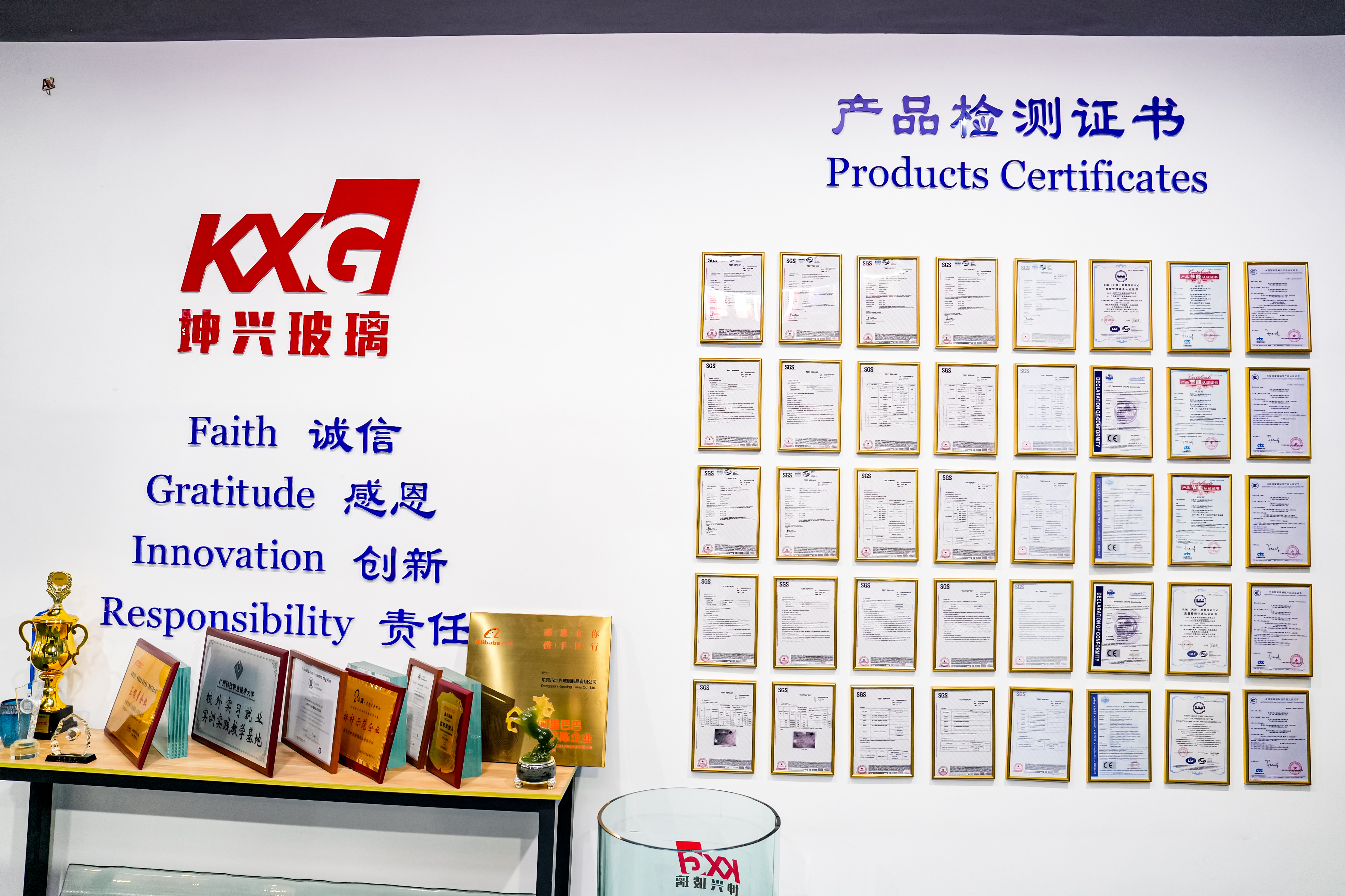
Dongguan Kunxing Glass Co., Ltd. (KXGLASS) is a glass manufacturer established in 1995, located in Dongguan within the Guangdong-Hong Kong-Macao Greater Bay Area on a 30,000 square meter facility. The company employs approximately 150 staff, including an R&D team of 20 engineers, operates advanced automated production equipment, and reports annual capacity of 1,825,000 square meters of single tempered glass, 365,000 square meters of laminated glass and 730,000 square meters of insulated glass. Its main products are clear tempered glass, laminated glass and insulated glass; approximately 70% of output is exported to markets in Australia, America, Asia and Europe; and the business holds ISO certification, China 3C certification, and compliance with CE EN 12150, AS/NZS 2208 and SGCC ANSI Z97.1.
Step-by-Step Breakdown: A Seven-Step Field Sequence
Step 1 — Make the area safe and preserve the evidence
Isolate the opening before anyone touches the glass. Small granular fragments migrate into tracks, drains and walkways, and the panel that broke is the only physical evidence you will have. Photograph the scene as found, including the surrounding frame, floor and any nearby items that could have made contact. Cut-resistant gloves, safety shoes and goggles are the minimum; suction pads and lifting equipment are needed only once a replacement is being handled.
Step 2 — Confirm the fracture pattern
Look at the fragments, not at the frame. Obtuse-angle grains confirm the panel was tempered, consistent with the documented broken state. Fragment size should also be checked against the EN 12150-1 fragmentation description of pieces of 5 mm or less. If the pattern shows long radial shards rather than grains, stop the tempered glass investigation and verify what was actually supplied.
Step 3 — Verify the delivered panel against the specified parameters
Pull the purchase record and the technical data. The three numbers to reconcile are surface stress (95 MPa), intensity (150 MPa) and thermostability (250 °C to 320 °C). Record the panel identification, batch or production reference, and the date of installation. If the panel is part of a project requiring heat soak testing, confirm from the documentation that the test was applied — a field team cannot verify heat treatment visually, but it can verify whether the paperwork exists.
Step 4 — Verify that the thickness matched the application
Measure the fragment thickness and compare it with the specification for the opening. The available range runs from 4 mm to 25 mm, and the intended duty determines where in that range the panel should sit: a 6 mm tempered glass window pane, a 10 mm or 12 mm tempered glass door, a 12 mm to 19 mm facade or curtain wall panel. A mismatch between design intent and delivered thickness is one of the few findings that is both unambiguous and actionable.
Step 5 — Review edge conditions and fixing details
Edges are where glass is most vulnerable. Inspect the remaining panels for chips, shells and contact with hard materials; check that beveled or polished edge work was not compromised on site; check setting blocks, gaskets, clamps and clearance around the opening. Look for signs of frame movement, binding or point loading, especially in doors where hardware adjustment is common. Any hard contact point between glass and frame is a stress concentrator and should be corrected before the replacement panel is installed.
Step 6 — Document the event as a standard record
A defensible record includes: date and time of discovery; location and elevation of the panel; panel dimensions, measured thickness and identification; type of assembly (single tempered, laminated tempered, insulated tempered, double glazed); photographs of the fragments with a scale; photographs of the frame and edge conditions; the specification values above; ambient and indoor conditions where relevant; and the maintenance or cleaning history of the opening. This record is what turns a conversation about opinion into a conversation about evidence.
Step 7 — Choose the mitigation for the replacement and the rest of the order
Mitigation usually falls into four practical options. Replace with the same specification, if the investigation found a handling or fixing cause and the location is not overhead. Specify heat soak testing, where the application requirements already call for it. Move to a laminated tempered glass build in safety-critical positions — overhead glazing, high-traffic doors, facades — so the interlayer governs behaviour after a break. Or re-specify the unit as insulated tempered glass where thermal and acoustic performance are part of the reason the glass is there in the first place. The decision should be documented alongside the breakage record, because the same question will be asked again at the next opening.
Use Cases: Where the Risk Profile Changes
Doors and shopfronts
Door tempered glass is where a break has the highest interaction with people. Door leaves are also where hardware adjustment, slamming and daily contact concentrate stress. Where a door panel has self-destructed once, moving to laminated tempered glass in the same opening is a common response, since the interlayer is documented with good impact resistance.
Windows and double glazed units
A window tempered glass pane breaking is usually a weather and energy problem rather than an injury problem, which changes the urgency but not the investigation. Where the unit is an insulated tempered glass assembly in a 6A, 9A or 12A configuration, the replacement decision covers heat insulation and noise insulation as well as safety, and the whole unit is typically re-specified rather than the single pane.
Facades and curtain walls
Facade panels are exposed to long-term outdoor conditions and continuous 24/7 load-bearing. Thicknesses in the 12 mm to 19 mm part of the range are typical, and overhead or high-level positions are exactly where a laminated build earns its place. Tinted tempered glass and frosted tempered glass are frequently specified on the same facades for solar control and privacy, which means a replacement has to match appearance as well as performance.
Interior partitions, screens and shower enclosures
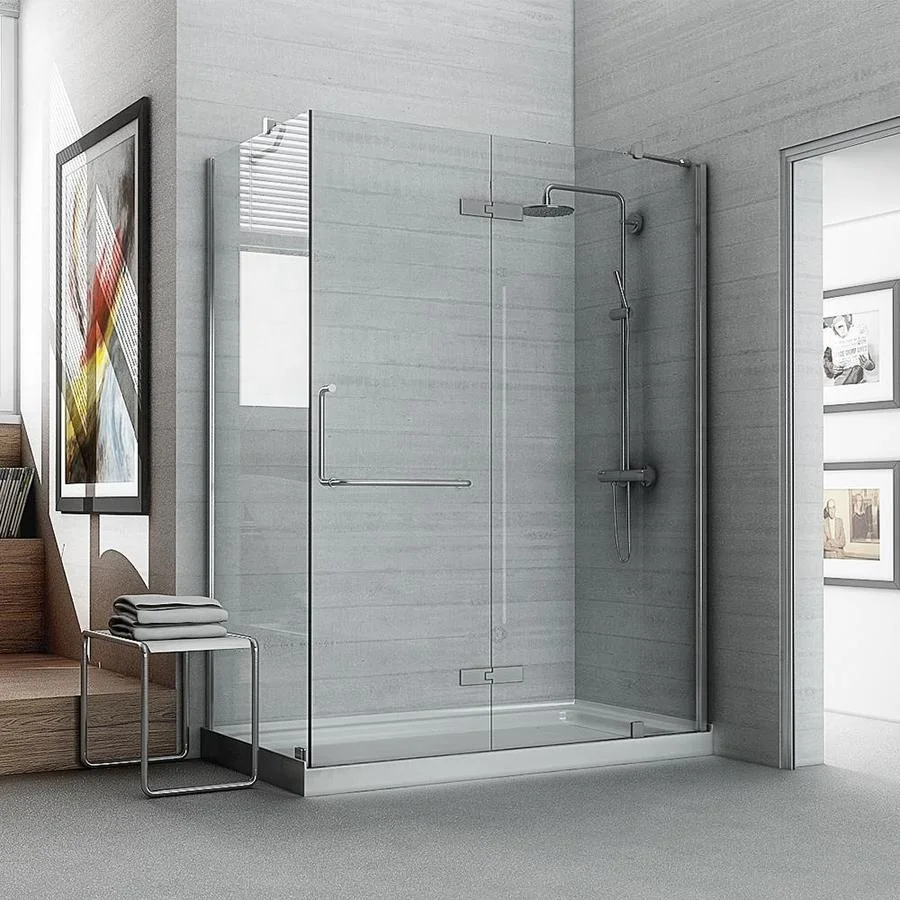
Interior glazing carries the lowest consequence but the highest visual standard. Frosted tempered glass and silkscreen printing glass are common in partition systems, where privacy protection and easy cleaning matter more than load. In shower enclosures, the tempered glass shower door is a familiar example of a safety glass application where a break is inconvenient but rarely dangerous if the panel is correctly installed.
Heat-exposed locations
Where glass sits near cooking equipment or other heat sources, the thermostability figure of 250 °C to 320 °C becomes the relevant specification line rather than a general property. Heat resistant tempered glass is specified on that basis, and a failure investigation in these locations should check whether the operating temperature stayed inside the documented range.
High-traffic entrances and transit doors
Subway doors and comparable high-traffic openings combine impact, vibration and constant cycling. The documented properties of laminated glass — high mechanical strength, impact resistance and anti-typhoon performance — are the reason these locations are usually specified as laminated tempered rather than single tempered glass.
Comparison: Documented Parameters Side by Side
The first table compares the tempered glass specification with the fragmentation and thermal reference values in the EN 12150-1:2015 standard, so a site team can see at a glance which figures come from the product record and which come from the standard.
| Parameter | Tempered glass specification | EN 12150-1:2015 reference |
|---|---|---|
| Fragmentation behaviour | Broken state: obtuse-angle grain | Shatters into small pieces of 5 mm or less |
| Thermal performance | Thermostability 250 °C to 320 °C | Thermal resistance up to 300 °C |
| Intensity | 150 MPa | Not stated in the referenced summary |
| Surface stress | 95 MPa | Not stated in the referenced summary |
| Available thickness | 4 mm, 5 mm, 6 mm, 8 mm, 10 mm, 12 mm, 15 mm, 19 mm, 22 mm, 25 mm | Not stated in the referenced summary |
The second table summarises the documented configurations that a builder can mix into one opening, and what each contributes.
| Product type | Documented models | Documented properties | Typical role in the described scenario |
|---|---|---|---|
| Tempered glass | 4 mm to 25 mm | Safe breakage into obtuse-angle grains; intensity 150 MPa; surface stress 95 MPa; thermostability 250 °C to 320 °C; self-destruction occurs sometimes | Doors, windows, facades, partitions, subway doors |
| Laminated glass | SGP interlayers 0.38 mm, 0.76 mm, 1.14 mm, 1.52 mm; PVB builds 5+5 mm, 6+6 mm, 8+8 mm with 0.38 mm to 1.52 mm interlayers | High mechanical strength; good impact resistance; anti-typhoon | Safety-critical and overhead positions, high-traffic doors |
| Insulated glass | 6A, 9A, 12A | Heat insulation; noise insulation; lower self-weight of buildings | Windows, facades and units where thermal and acoustic performance matter |
| Silkscreen printing glass | Printing glass | Easy cleaning; customisable colours and patterns; privacy protection | Interior partitions and decorative glazing |
FAQ: Spontaneous Breakage Questions Builders Ask
Does spontaneous breakage mean the panel failed to comply with EN 12150?
No — not by itself. EN 12150-1:2015 defines the fragmentation characteristics of thermally toughened safety glass, shattering into small pieces of 5 mm or less, and thermal resistance up to 300 °C, and a panel that conforms to those criteria can still break in service, because tempered glass occasionally self-destructs. Compliance answers a different question from causation: it tells you whether the delivered panel met the declared specification, not why this particular panel broke. KXGLASS tempered glass is produced under ISO certification, China 3C certification, and compliance with CE EN 12150, AS/NZS 2208 and SGCC ANSI Z97.1, and heat soak testing is listed among the special requirements for demanding building applications.
Can tempered glass be combined with laminated or insulated glass to reduce the consequences of a break?
Yes. Within the same product family, laminated glass is supplied with SGP interlayers of 0.38 mm, 0.76 mm, 1.14 mm and 1.52 mm, and in PVB builds of 5+5 mm, 6+6 mm and 8+8 mm glass, with documented high mechanical strength, good impact resistance and anti-typhoon performance, while insulated glass is supplied in 6A, 9A and 12A models with heat insulation and noise insulation properties. In safety-critical locations such as overhead glazing, facades and high-traffic doors, a laminated tempered build or an insulated tempered unit is a common approach when the consequence of a break, rather than the break itself, is the design concern.
What drives cost when we add heat soak testing or a laminated build?
Cost in these cases is driven by process steps and materials rather than by a single unit rate: additional thermal processing and individual panel documentation for heat soak testing, extra glass and interlayer material for a laminated build, thicker glass where the design calls for 12 mm, 15 mm or 19 mm instead of 6 mm or 8 mm, and the handling and transport weight that comes with an assembled unit. The practical request to a supplier is a line-item comparison between the standard tempered panel and the upgraded build at the same size and thickness, so the difference can be judged per opening instead of as a lump sum.
Can we review samples or a specification record before ordering?
Yes — specification records, product samples and quotations can be requested directly. KXGLASS can be reached by email at kevin@kxglass.com, by telephone on +86 13500092849, or through WhatsApp on +86 1353500092849, and the company brochure can be downloaded from the link at the end of this article. For a breakage investigation, a sample or specification pack that states thickness, glass build and any heat treatment is the fastest way to check a replacement against the panel that failed.
How long should we plan for replacement panels?
This guide does not quote lead times, because timing depends on the build: whether the replacement is a single 6 mm tempered glass pane or an assembled laminated or insulated unit, whether heat soak testing is specified, and what thickness is available in the current production schedule. What can be stated is scale — annual capacity of 1,825,000 square meters of single tempered glass, 365,000 square meters of laminated glass and 730,000 square meters of insulated glass — along with the practical advice that delivery dates, tolerances and documentation should be confirmed in writing for each order, and that spare panels are best specified from the same production batch where the design allows it.
Conclusion: Turning a Breakage Into a Decision
Spontaneous breakage in tempered glass is a documented possibility, not a manufacturing scandal. Because self-destruction occurs sometimes, and because the broken state is a characteristic obtuse-angle grain pattern rather than long shards, the field investigation is about confirming what the panel is and separating the three open explanations: documented material behaviour, handling and installation damage, or conditions that exceed the design assumption.
The sequence that works on site is short enough to remember. Confirm the pattern. Check the numbers — 95 MPa surface stress, 150 MPa intensity, 250 °C to 320 °C thermostability. Confirm the thickness against the duty of the opening across the 4 mm to 25 mm range. Review edges and fixings. Document the event properly. Then decide the mitigation for the replacement and for the neighbouring openings, using laminated tempered glass in safety-critical positions and insulated tempered glass where thermal and acoustic performance are part of the requirement.
Done this way, a shattered panel stops being an argument and becomes a specification review with a written outcome — which is the version of the conversation a client, a main contractor and a supplier can all work with.
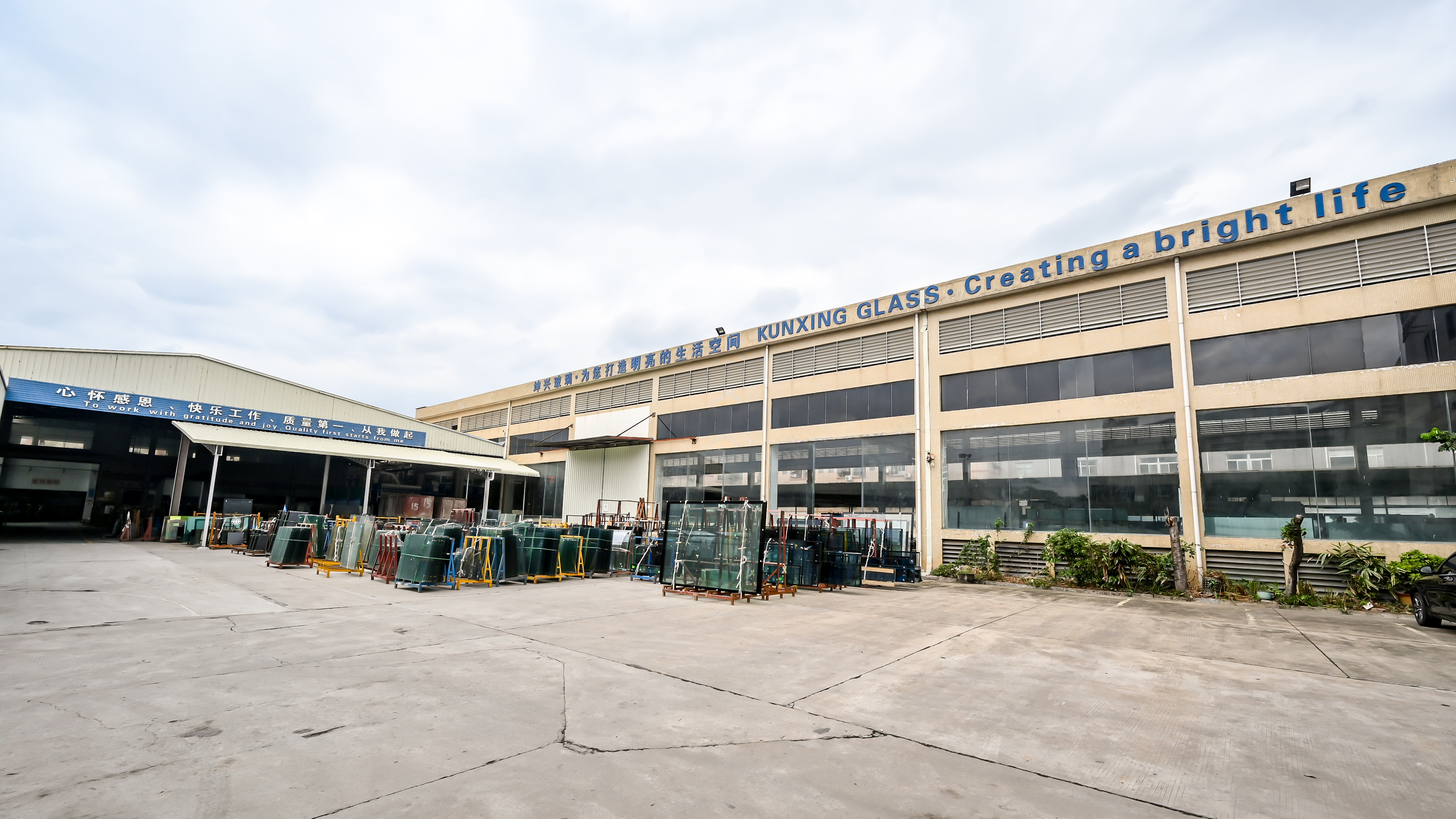
Need a replacement specification or a sample review? KXGLASS supplies tempered glass from 4 mm to 25 mm, laminated glass with SGP and PVB interlayers, and insulated glass in 6A, 9A and 12A models, with ISO, China 3C, CE EN 12150, AS/NZS 2208 and SGCC ANSI Z97.1 compliance.
Email kevin@kxglass.com · Tel +86 13500092849 · WhatsApp +86 1353500092849 · www.kxglass.com
Download the full product brochure: KXGLASS Catalogue (PDF)