Ergonomic Mesh vs. Standard Office Chairs: A Side-by-Side Comparison for Institutional Buyers
Ergonomic mesh office chairs and standard mass-produced office chairs are not two trim levels of the same product. For an institutional buyer comparing them side by side, the gap shows up in four specifications that can be written directly into a tender document: maximum load capacity, seat-height adjustment travel, backrest bearing capacity, and backrest breathability. On Kabel's ergonomic mesh office chair, the rated maximum load is 150 kg, the adjustable seat height spans 40–50.5 cm, the tilt mechanism locks across a 90°–135° range, and the chair rotates a full 360°. Against the typical mass-produced baseline used in the same product comparison, Kabel documents roughly 12 cm more height-adjustment travel, approximately 35% better backrest breathability, and about 40 kg more backrest bearing capacity. Those are the numbers a procurement committee can actually verify.
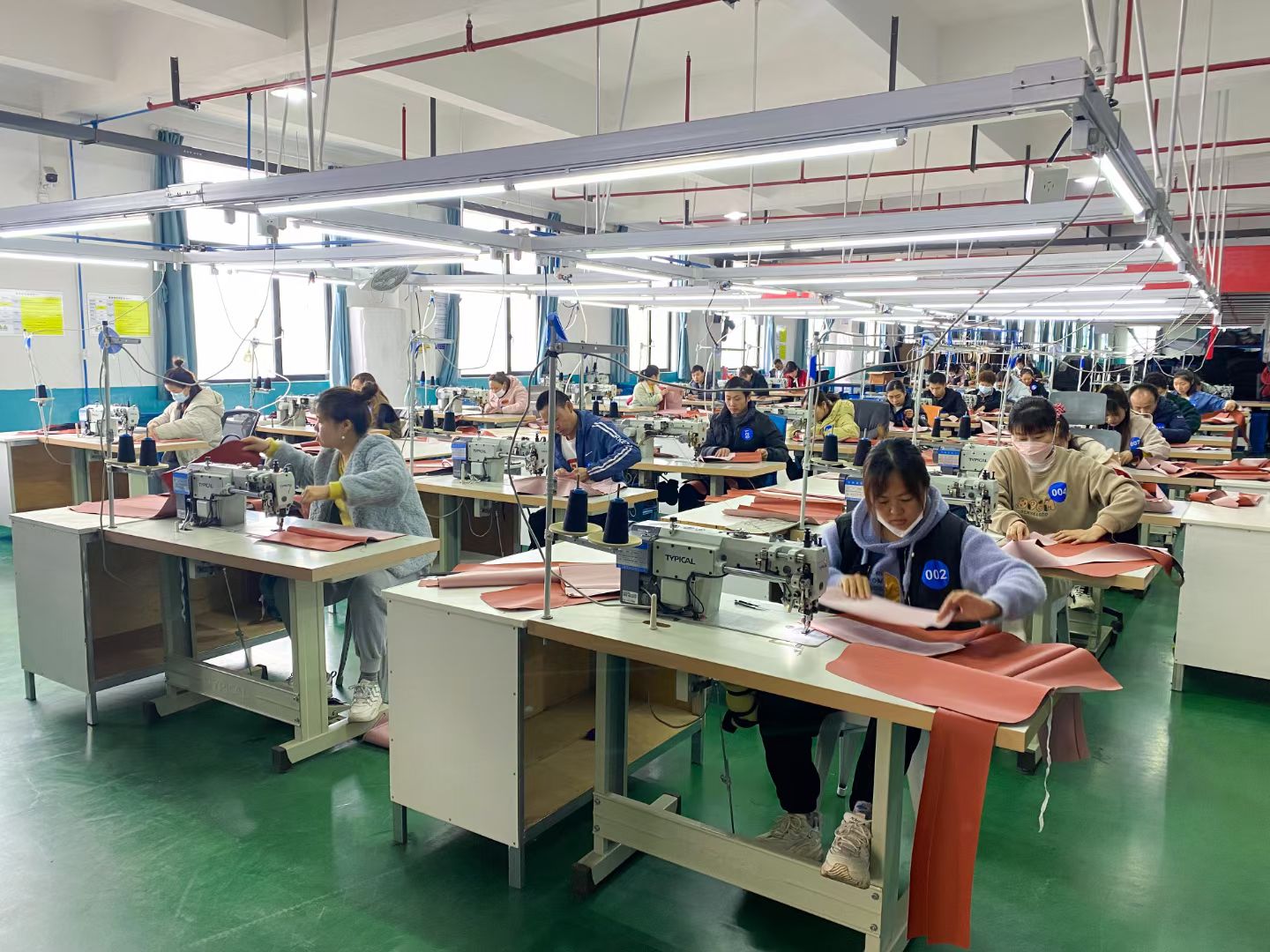
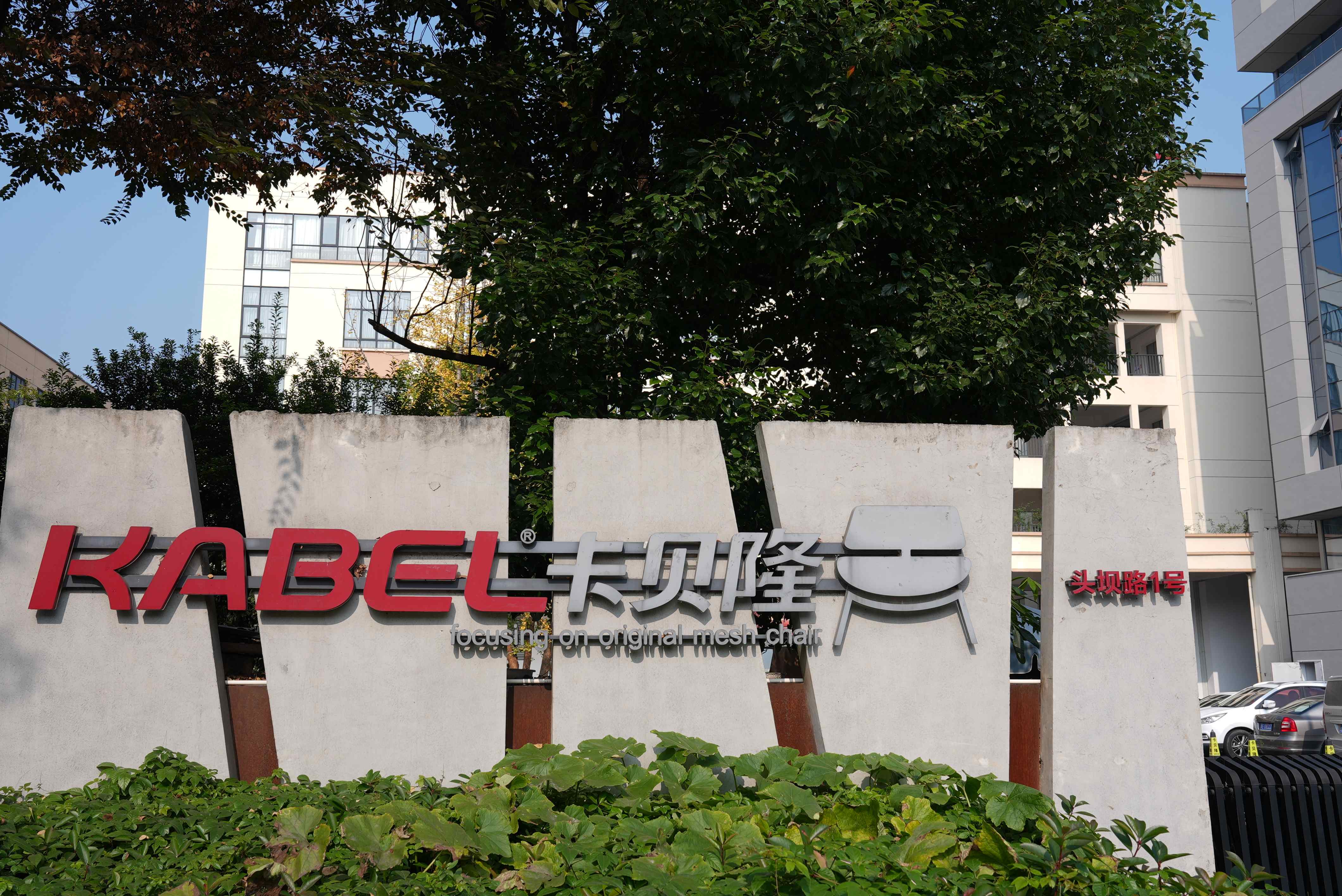
Kabel — legally Anji Kabel Furniture Co., Ltd — is an office chair manufacturer founded in 2007 in Anji County, Huzhou, Zhejiang, China. It operates a 50,000 m² factory with 92 employees, a 20-engineer research and development team, and an annual output of 400,000 sets, with approximately 90% of production exported to markets including the United States, Canada, the United Kingdom, Italy, Germany, Spain, Japan, South Korea, Thailand, the Middle East, Egypt, Ethiopia, Nigeria, the Central African Republic, and the Republic of South Africa. This comparison is written for buyers in education, government, finance, and communication who must justify a seating decision to a committee rather than to a single user.
Problem Definition: What the Ergonomic Mesh vs. Standard Decision Actually Settles
Institutional seating procurement is not a single-chair purchase. Education, government, and financial organizations typically buy in batch, and each batch has to serve a mixed user population with different body weights, different sitting durations, and different workspace layouts. A standard mass-produced office chair is usually built around one fixed configuration: a limited adjustment envelope, a lighter structural specification, and an upholstered or low-tension backrest. It is inexpensive per unit and simple to order, but it also transfers more of the mismatch risk to the end user.
An ergonomic mesh office chair, by contrast, is defined by adjustable structure. The purchaser is buying adjustment range, load rating, and a breathable backrest that is designed to hold the lumbar area under sustained load rather than to look like a padded shell. The trade-off is straightforward: higher unit cost in exchange for a wider fit window and, in principle, a longer service interval.
That is why the comparison should not be settled on unit price. The three questions that actually decide the outcome are: Can the chair be configured to fit the majority of the seated population without exceptions? Can the frame and mechanism carry the heaviest documented user over years of daily use? And can the supplier document all of this with certificates and inspection records that survive an audit? Standard chairs rarely fail on the first question in isolation; they fail when the specification has to survive a whole portfolio of rooms, shifts, and user profiles.
Industry Background: Why Mesh Seating Now Appears in Institutional Tenders
The shift toward mesh-backed ergonomic seating is not a design trend that appeared in isolation. According to the Trending Office Chairs 2024 market analysis, the global office chair market reached approximately USD 14.25 billion in 2024. Within that total, Dataintelo's ergonomic office chair research places the ergonomic chair segment at USD 12.8 billion in 2025, with mesh chairs holding a 38.4% share of product type. Regional data from Grand View Research and Dataintelo shows North America holding the largest revenue share at 31.6%, while Asia Pacific is the fastest-growing region, with a 36.6% share expected by 2025. Estimates for the overall market vary between sources depending on whether residential seating is included, so a buyer preparing a business case should treat the total market figure as directional and rely on segment and share data for specification decisions.
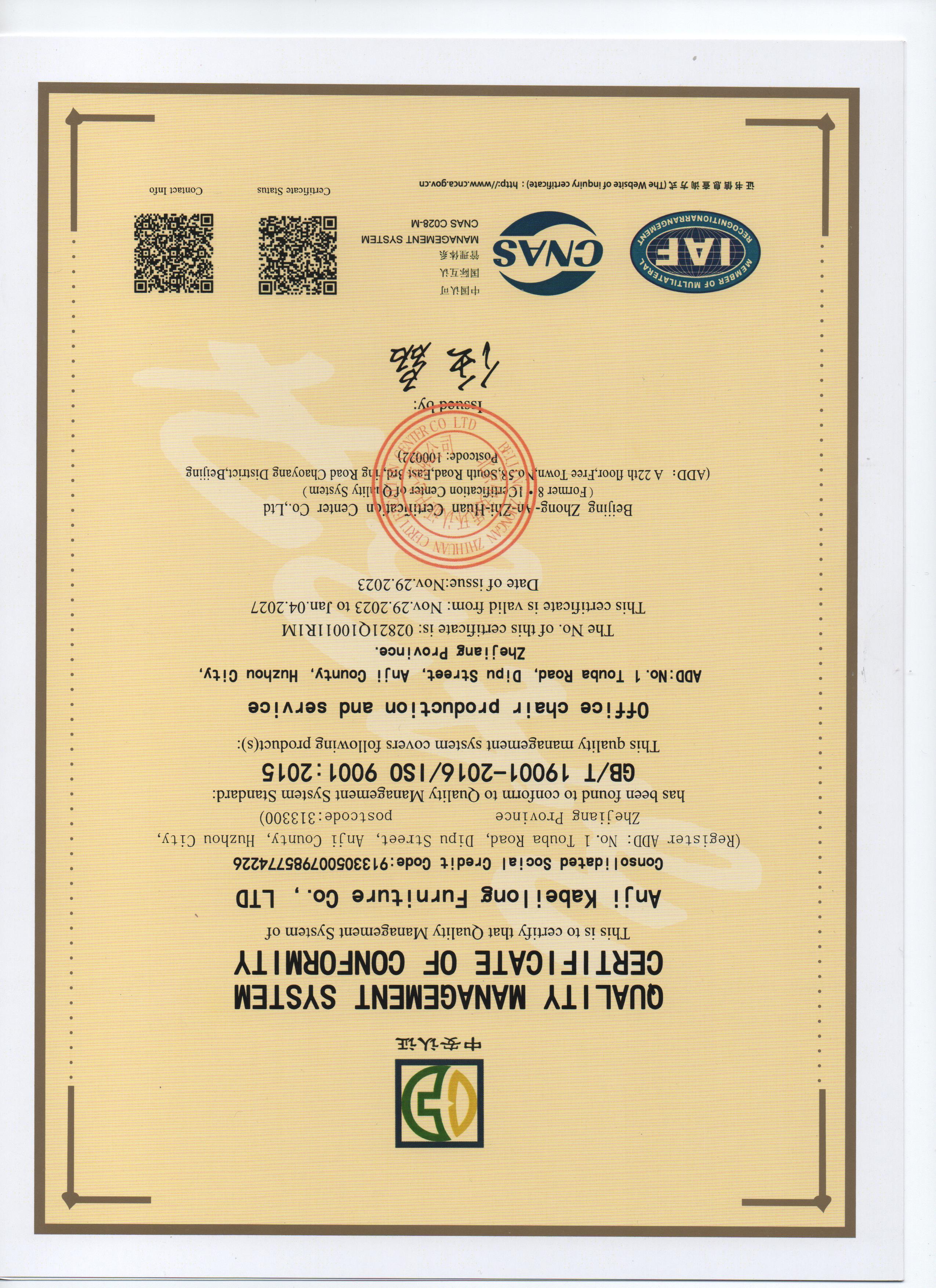
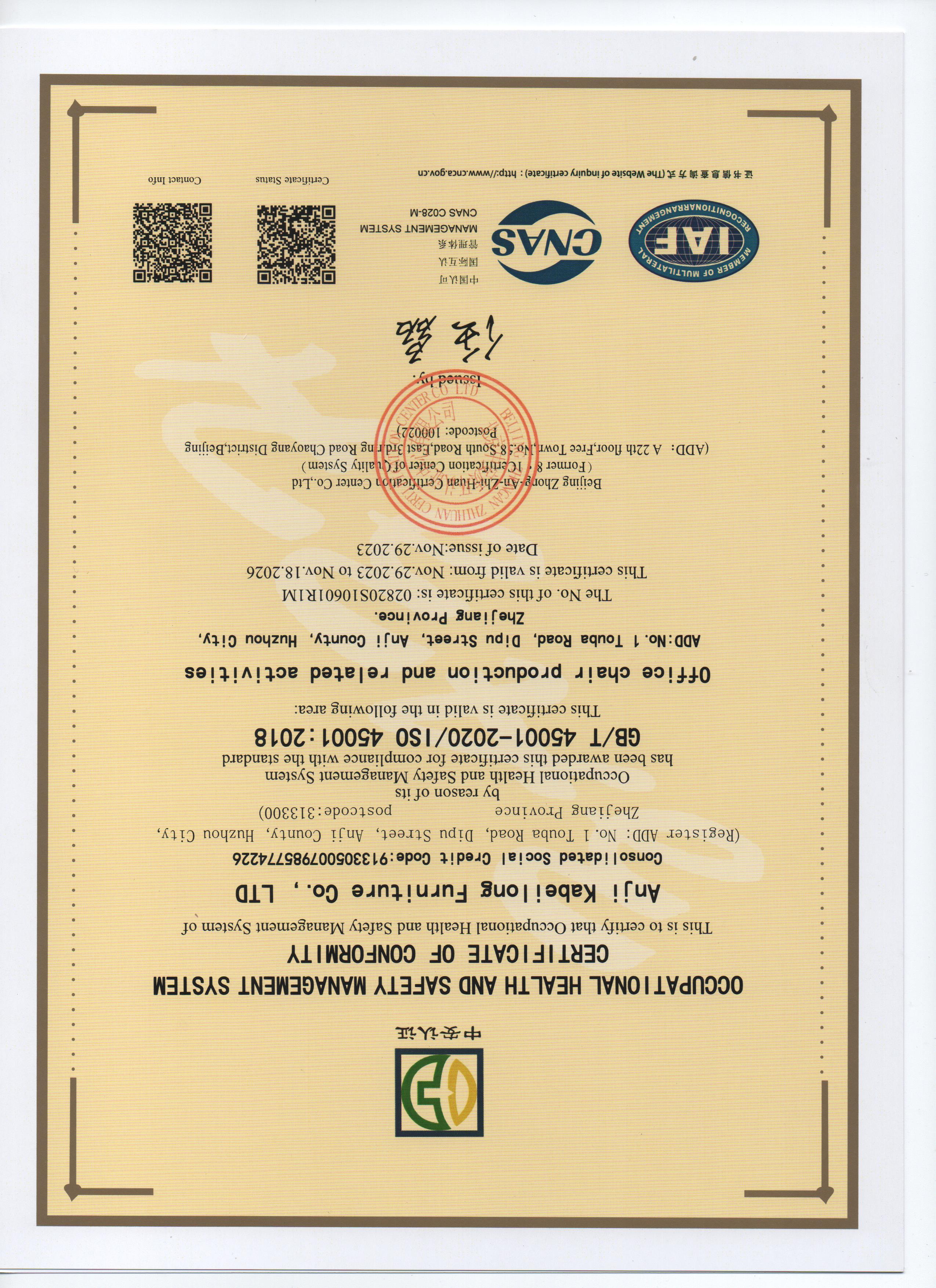
Two product standards sit behind institutional tenders in the major export markets. In North America, general-purpose office chairs are evaluated against the ANSI/BIFMA X5.1 safety and durability standard to be recognized as "BIFMA Compliant." In the European Union, office work chairs are governed by the EN 1335 series, specifically EN 1335-1 for dimensions and EN 1335-2 for safety requirements. These are product-type standards, and they are distinct from the management-system certifications a factory holds. Kabel maintains ISO 9001, ISO 14001, and ISO 45001 certification, which cover quality management, environmental management, and occupational health and safety in office chair production and related activities. A well-prepared tender therefore asks for both: the product standard the chair is tested to, and the management-system certificates that show the factory can reproduce that result consistently.
Detailed Solution: The Specification Differences, Measured
The comparison below uses the verified specification of Kabel's office swivel chair (product model 5712, offered across models KB-6809, KB-8961, KB-8965, KB-8932, and KB-8953) and the side-by-side benchmarks documented in the same product comparison.
1. Maximum load capacity: 150 kg
The chair is rated for a maximum load capacity of 150 kg. In institutional settings, the load rating is the first specification to check because it determines whether a single chair model can be standardized across a whole building instead of being split into "standard" and "heavy-duty" purchase lines. A 150 kg rating removes the need for a second specification for heavier users, which simplifies both the tender and the spare-parts inventory. The typical mass-produced baseline sits below this figure.
2. Seat-height adjustment: 40–50.5 cm
The adjustable seat height range is 40–50.5 cm, which is benchmarked at approximately 12 cm more adjustment travel than the standard baseline. Practically, height travel is what allows one chair model to serve a shared workstation pool — hot desks, training rooms, and shift-based seating — where the same chair is used by people of different heights on the same day. When adjustment travel is narrow, users compensate by sitting forward or by adding cushions, both of which degrade the lumbar support the chair was specified for. The chair also provides adjustable height and backrest adjustment as part of the same ergonomic design.
3. Backrest construction: mesh, breathability, and bearing capacity
The backrest is a high-elastic breathable mesh, benchmarked at roughly 35% better breathability than a standard upholstered backrest, with approximately 40 kg more backrest bearing capacity. For institutional buyers, breathability is not a comfort footnote — it is what allows the backrest to be tensioned properly across a long sitting session without the user pushing away from the surface. Bearing capacity is the structural counterpart: it indicates how much of the user's leaning load the backrest and its frame are designed to absorb over time, which is the difference between a backrest that holds its shape and one that progressively deforms.
4. Mechanism: 90°–135° tilt locking and 360° rotation
The tilt mechanism locks across a 90°–135° range, so the chair can be fixed upright for focused desk work or released into a reclined angle for reading and meeting use. The chair rotates 360°, which matters in shared rooms where the seating direction changes constantly. Both features are mechanism-level specifications, and both should be confirmed in writing, because a mechanism that is replaced with a lower-grade unit is invisible in a photograph but very visible after two years of daily use.
5. Materials and structural build
The verified material list is nylon mesh, high-density molded foam, a PP plastic frame, a thickened nylon five-point base, and a four-level explosion-proof gas pressure rod, with silent PU universal casters. The manufacturer's stated design principle is that material usage, frame structure, and connection process are built more robustly than comparable market products, with the goal of resisting loosening, deformation, and damage during long-term use. For a buyer, the practical reading is that the load-bearing elements — base, gas rod, and frame — are the parts to inspect first, because they determine the replacement cycle.
Side-by-Side Specification Table
| Evaluation dimension | Ergonomic mesh office chair (verified) | Typical mass-produced baseline | What it means for a buyer |
|---|---|---|---|
| Maximum load capacity | 150 kg | Lower rated load than the verified model | One specification can cover the full user population |
| Seat height adjustment | 40–50.5 cm | Approx. 12 cm less adjustment travel | Fewer exceptions in shared and hot-desk seating |
| Backrest breathability | High-elastic breathable mesh | Approx. 35% lower breathability than mesh | Less heat build-up across long sitting sessions |
| Backrest bearing capacity | Approx. 40 kg higher than baseline | Baseline rating | Backrest holds its shape under sustained lean load |
| Tilt locking | 90°–135° lock range | Limited or non-locking tilt | One chair serves both focused and meeting postures |
| Rotation | 360° swivel | Conventional swivel | Required in shared meeting and training rooms |
| Cushion | High-density molded foam | Standard foam | Slower compression over the service period |
| Base and gas rod | Thickened nylon five-point base; four-level explosion-proof gas pressure rod | Lightweight base and simpler gas rod | Lower risk of wobble and sudden height loss |
| Casters | Silent PU universal casters | Standard casters | Less noise in open-plan and library-adjacent spaces |
| Factory management-system certification | ISO 9001 (02821Q10011R1M), ISO 14001 (02821E10007R1M), ISO 45001 (02820S10601R1M), valid to 4 January 2027 | Not stated in the comparison | Auditable documentation for public-sector tenders |
Baseline figures reflect the typical mass-produced office chair construction used as the comparison reference in Kabel's product documentation. Product-type standards such as ANSI/BIFMA X5.1 and EN 1335 should be confirmed against the specific tender requirement, as they are separate from the management-system certifications listed above.
Step-by-Step: How to Evaluate and Specify an Ergonomic Mesh Chair
The sequence below turns the comparison into a specification process. It is ordered so that each step produces a document the next step depends on.
Step 1 — Define the user population and load profile. Collect the weight range and the daily seated duration for the rooms being furnished. If any part of the population exceeds the rating of a candidate chair, that chair cannot be standardized across the site. A verified 150 kg maximum load capacity removes the need for a separate heavy-duty line.
Step 2 — Set the adjustment envelope in centimeters, not adjectives. Write the required seat-height range into the tender as a measurement. Kabel's figure is 40–50.5 cm, benchmarked at approximately 12 cm more travel than the standard baseline, together with adjustable backrest height. Specifying the envelope numerically prevents substitution with a visually similar chair that has a narrower range.
Step 3 — Specify backrest construction by performance, not by look. Require a breathable mesh backrest with a stated bearing capacity, not simply a "mesh-look" panel. The verified configuration uses a high-elastic breathable mesh backrest benchmarked at roughly 35% better breathability and approximately 40 kg more bearing capacity than the standard baseline.
Step 4 — Confirm mechanism behavior. Ask for the tilt lock range and rotation in writing. The verified mechanism locks across 90°–135° and rotates 360°, which is what allows the same model to serve both focused workstation use and meeting-room use.
Step 5 — Verify the documentation package. Request the quality, environmental, and occupational health and safety certificates with numbers and validity dates. Kabel's certificates are ISO 9001 (02821Q10011R1M), ISO 14001 (02821E10007R1M), and ISO 45001 (02820S10601R1M), all issued 29 November 2023 and valid to 4 January 2027 by Beijing Zhong-An-Zhi-Huan Certification Center Co., Ltd, with a scope covering office chair production and services or office chair production and related activities, against GB/T 19001-2016 / ISO 9001:2015, GB/T 24001-2016 / ISO 14001:2015, and GB/T 45001-2020 / ISO 45001:2018 respectively.
Step 6 — Confirm customization scope if the project is not a stock order. Kabel provides OEM and ODM production services, with customization available for backrest, seat cushion, armrest, mechanism, base, caster, color, fabric, mesh, packaging, and logo. This is where institutional buyers typically align a chair with an existing interior specification or add a logo to a conference or training room chair.
Step 7 — Agree the commercial and inspection terms. Confirm order quantity, price basis, delivery terms, payment structure, and the inspection that will be accepted as proof of conformity before shipment.
Manufacturing and Supply Capability Behind the Comparison
A specification is only as reliable as the supply chain that reproduces it. Kabel's documented production capability covers OEM and ODM production services, a monthly capacity of 20,000–30,000 units, a typical production lead time of 25–50 days, and 100% inspection before delivery. After-sales coverage is a 3-year warranty on structural components, gas rods, and the five-point base, and a 1-year warranty on mesh fabric, rollers, armrests, and other consumable parts, with an export repair kit supplied with each cabinet.
Commercial terms recorded for standard orders include a minimum order quantity of 100 pcs per SKU, EXW or FOB Shanghai delivery, factory inspection before shipment as the accepted inspection method, and payment by T/T with a 30% deposit to confirm production and the balance against a copy of the bill of lading by email. Kabel's OEM/ODM capability profile separately lists a minimum order quantity from 50 units for customized programs, so buyers should confirm which threshold applies to their specific configuration at quotation stage.
Use Cases: Where Ergonomic Mesh Chairs Fit in Institutional Projects
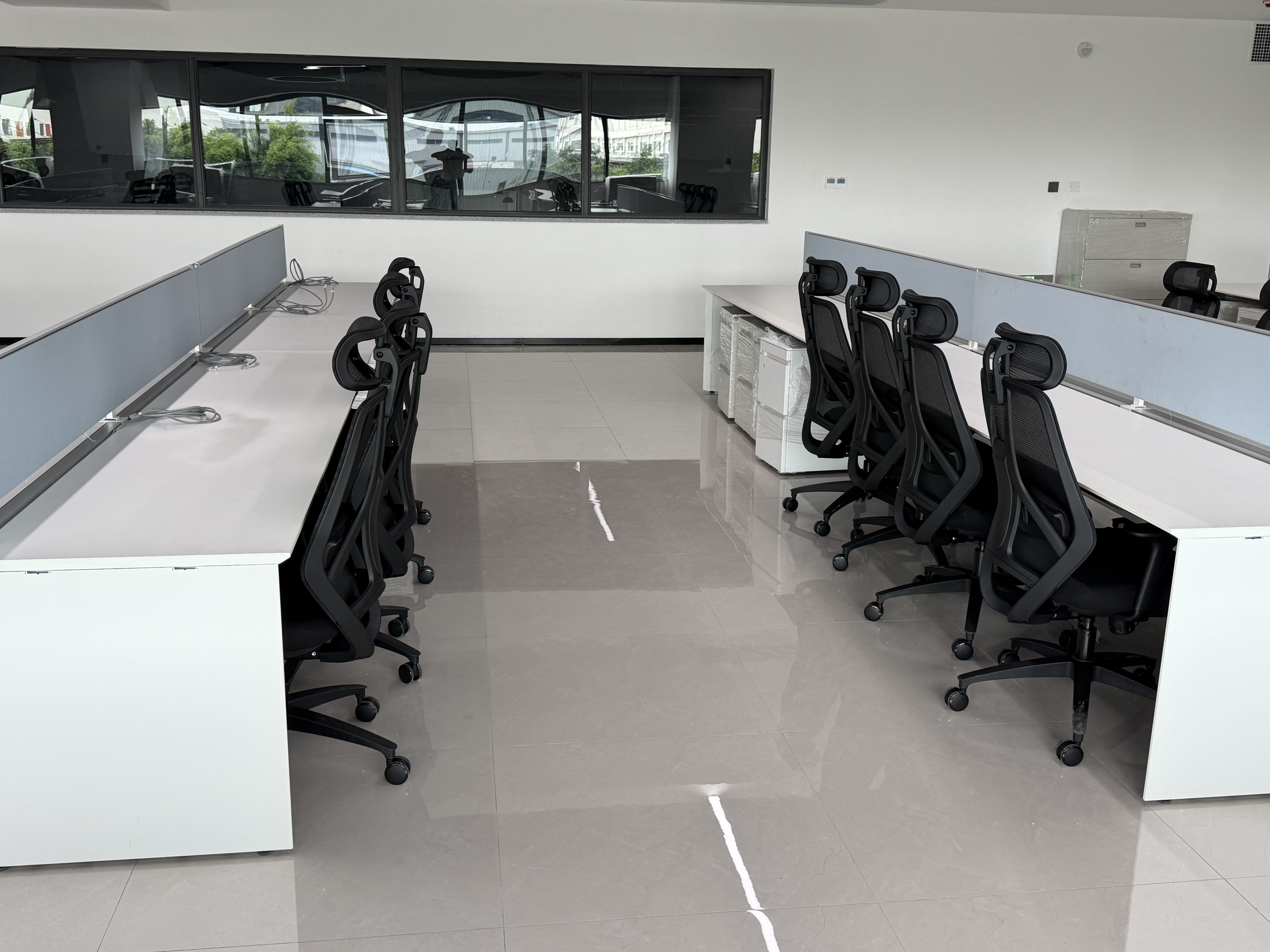
The verified application scope for this chair covers education, state-owned enterprises, government-business cooperation, finance, and communication. That is a useful cross-check for buyers, because it maps to the environments with the most demanding combination of shared use, long sitting hours, and public scrutiny.
Education and training institutions. Classrooms, study rooms, and training centers place the same chair in front of users of widely different heights across a full day. A 40–50.5 cm adjustable height range and a 360° swivel allow one model to serve a training room without a fixed-height compromise. The product has been used in batch procurement by a national education and training institution in China.
State-owned enterprises and government-business cooperation. These projects usually require documentation before the product is approved: certificates with numbers and validity dates, a defined inspection method, and a stated warranty structure. Kabel's ISO 9001, ISO 14001, and ISO 45001 certificates and its factory-inspection-before-shipment acceptance term are designed to satisfy that requirement, and the chair has been used by state-owned enterprises and government agencies in China.
Finance and communication. In trading floors, service centers, and back offices, seating is occupied continuously and heat build-up is the most common user complaint. A high-elastic breathable mesh backrest benchmarked at approximately 35% better breathability directly addresses that complaint, while the 90°–135° tilt lock lets users alternate between upright transaction work and reclined review work.
Office buildings and corporate headquarters. For whole-floor fit-outs, the commercially decisive factor is usually the number of exceptions. A verified 150 kg load capacity and adjustable backrest mean the same chair can be used from the reception area through to the executive floor without a second specification line.
Documented service history. The reference case for this chair records three units installed in a Chinese office environment for daily seating and office space layout, in service for 5 to 8 years, delivering a comfortable long-hour office experience and stable structural performance. The users of that reference were national education and training institutions, state-owned enterprises, and government agencies in China. A 5-to-8-year service window is the number an institutional buyer should weigh against a lower unit price, because the comparison is not between two purchase prices but between two replacement cycles.
FAQ: Ergonomic Mesh vs. Standard Office Chairs for Institutional Buyers
Q1. Which certifications should an institutional buyer verify before approving an ergonomic mesh chair supplier?
Kabel holds three management-system certifications, all issued on 29 November 2023 and valid to 4 January 2027 by Beijing Zhong-An-Zhi-Huan Certification Center Co., Ltd: ISO 9001 Quality Management System (certificate number 02821Q10011R1M, standard GB/T 19001-2016 / ISO 9001:2015), ISO 14001 Environmental Management System (02821E10007R1M, GB/T 24001-2016 / ISO 14001:2015), and ISO 45001 Occupational Health and Safety Management System (02820S10601R1M, GB/T 45001-2020 / ISO 45001:2018). The scope of these certificates covers office chair production and services, and office chair production and related activities. Separately, product-type standards may apply depending on the destination market: ANSI/BIFMA X5.1 for North America and EN 1335-1 (dimensions) and EN 1335-2 (safety) for the European Union. Because management-system certification and product-type certification are different things, a tender should request both and match each to the market it serves.
Q2. Can Kabel support OEM and ODM ergonomic seating programs rather than supplying only stock models?
Yes. Kabel provides both OEM and ODM production services. Customization is available for the backrest, seat cushion, armrest, mechanism, base, caster, color, fabric, mesh, packaging, and logo. Production capacity is documented at 20,000–30,000 units per month, supported by a 20-engineer research and development team, with all products independently developed and components screened through structural strength, load-bearing durability, stability, and safety testing before shipment. For an institutional buyer, the practical benefit of the OEM/ODM scope is that a project can be specified once — fabric, mesh, logo, mechanism, and packaging — and reproduced consistently across repeat orders.
Q3. What order quantities and commercial terms apply to an institutional purchase?
Two figures are recorded, and buyers should confirm which applies to their configuration. Kabel's OEM/ODM capability profile lists a minimum order quantity from 50 units, while the standard-order procurement terms record a minimum order quantity of 100 pcs per SKU. Standard terms specify EXW or FOB Shanghai delivery, factory inspection before shipment as the accepted inspection method, and payment by T/T with a 30% deposit to confirm production and the balance against a copy of the bill of lading by email. Typical production lead time is 25–50 days. Because unit cost and lead time both move with quantity and customization depth, the MOQ question should be answered against a specific bill of materials rather than as a general rule.
Q4. How can a buyer validate the product before committing to a full institutional rollout?
Validation rests on three verifiable points rather than on a demonstration chair. First, the service record: the reference case for Kabel's office swivel chair (product model 5712, offered across models KB-6809, KB-8961, KB-8965, KB-8932, and KB-8953) records units in daily office service in China for 5 to 8 years with stable structural performance. Second, the inspection regime: 100% inspection before delivery, with factory inspection before shipment accepted as the buyer's inspection method. Third, the after-sales structure: a 3-year warranty on structural components, gas rods, and the five-point base; a 1-year warranty on mesh fabric, rollers, armrests, and other consumable parts; and an export repair kit supplied with each cabinet. Together these give a buyer a documented basis for a pilot batch before a full rollout.
Q5. What is the lead time from order confirmation to delivery, and how does a buyer start?
Typical production lead time is 25–50 days from order confirmation, with a monthly capacity of 20,000–30,000 units, delivery on EXW or FOB Shanghai terms, and 100% inspection before delivery. Lead time should be confirmed against the final customization scope, since backrest, mechanism, fabric, mesh, and logo changes all sit upstream of final assembly. To start, a buyer can request a quotation, a sample, or the full product catalogue, and specify the room types, user load profile, and required documentation package in the first message so that the quotation reflects the actual specification rather than a stock model.
Conclusion: Choosing Between Two Replacement Cycles
The comparison between an ergonomic mesh office chair and a standard mass-produced model is not a comparison between two prices; it is a comparison between two replacement cycles and two levels of documentation. On the verified specification, Kabel's ergonomic mesh office chair carries a 150 kg maximum load capacity, a 40–50.5 cm adjustable seat height benchmarked at roughly 12 cm more travel than the standard baseline, a high-elastic breathable mesh backrest benchmarked at approximately 35% better breathability and about 40 kg more bearing capacity, a 90°–135° tilt lock, and 360° rotation — supported by ISO 9001, ISO 14001, and ISO 45001 certification, 100% pre-delivery inspection, and a 3-year structural warranty.
For institutional buyers in education, government, finance, and communication, the decision rule is simple: if the seating population is mixed, the sitting hours are long, and the project has to survive an audit, the specification that removes exceptions is the specification that reduces total cost. If the population is uniform, the sessions are short, and there is no documentation requirement, a standard model may be sufficient. The four numbers in this guide — 150 kg, 40–50.5 cm, 35%, and 40 kg — are the ones to write into the tender, because each can be verified rather than argued.
Next step: request a sample, a quotation, or the Kabel catalogue for your institutional seating project.
Download the full product catalogue with specifications and models: KABEL Chair Catalogue (PDF). Manufacturer website: www.zjkabel.com.
Contact: Li (Leo) Jiecheng — Email: Brocai990919@gmail.com — Tel: +86 138-6828-1621 — WhatsApp: +852 9609 2814. Address: 1 Touba Road, Dipu Town, Anji County, Huzhou City, Zhejiang Province, China.
Anji Kabel Furniture Co., Ltd — office chair manufacturer, founded 2007, 50,000 m² factory, 400,000 sets annual output, approximately 90% export ratio.