Ergonomic Office Chair Sourcing: Manufacturer vs. Trading Supplier
Ergonomic office chair sourcing usually narrows to two supplier models: a manufacturer that produces its own structural components, and a pure trading supplier that purchases finished chairs from third-party factories and resells them under its own commercial terms. On a quotation sheet, the two can look almost identical. Once a specification changes, a certificate is challenged, or a delivery date tightens, the difference stops being cosmetic and becomes structural.
For procurement teams, the decisive question is not which supplier quotes lower, but who actually controls mesh weaving, frame molding, gas lift specification, and final inspection. An integrated office chair manufacturer such as Anji Kabel Furniture Co., Ltd. controls those stages directly. A pure trading supplier controls none of them and coordinates them instead.
This head-to-head comparison walks through product development, quality control, production lead time, and project coordination, and it uses verifiable product and certification facts so buyers can see exactly what is checkable before a purchase order is issued.
Problem Definition: Why Both Supplier Models Look Identical at the Quotation Stage
Both models present the same commercial interface. A buyer receives a catalogue, a specification sheet, a sample photograph, a certification copy, and a lead-time estimate. Nothing in that package reveals who weaves the mesh, who molds the PP frame, or who signs the final inspection report.
The gap becomes visible only under pressure. Four questions expose it quickly:
- Who answers a specification change? If the seat height range must shift or a tilt mechanism must be re-specified, a manufacturer modifies the tooling or assembly process directly. A trading supplier must relay the request and wait for a third-party factory to accept or decline it.
- Whose certificate is being shown? An ISO certificate belongs to a specific legal entity. When a trading supplier forwards the producing factory's certificate, the document is genuine but it does not describe the entity the buyer is contracting with.
- Who is accountable when a production batch deviates? With integrated production, the same organisation owns the component supply and the finished chair. With a trading model, responsibility is split between the trading entity and an external factory.
- Whose production calendar governs the delivery date? A trading supplier can only promise what its partner factory has scheduled.
Because these questions rarely surface during negotiation, many procurement teams select a supplier on price and discover the coordination cost during execution. That is the real risk this sourcing decision carries — not a difference in quotation, but a difference in how many layers exist between the buyer and the production reality.
Industry Background: Compliance Is Rewriting the Sourcing Shortlist
The global office chairs market was valued at USD 18.25 billion in 2025, according to Fortune Business Insights. A market of that size attracts both integrated manufacturers and trading intermediaries, which is precisely why supplier verification has become a standard step in institutional procurement rather than an optional one.
Two regional standards shape most shortlists. EN 1335 is the European office work chair standard used as the basis for office furniture certification and testing, covering dimensions, safety, strength, durability, and testing methods. In the United States, ANSI/BIFMA X5.1 is designed to evaluate general-purpose office chairs, including executive and management chairs, side and guest chairs, folding chairs, stools, and chairs with tablet arms. Institutional procurement documents, such as Queen's University's furniture safety and performance standards, reference ANSI/BIFMA X5.1-2017 (R2022) directly.
Third-party verification reaches into ergonomic detail as well. TÜV SÜD states that its office furniture certification covers measurements including seat adjustment options, the backrest-to-seat angle, and lumbar support. TÜV SÜD also verifies that a manufacturer can maintain consistent quality in high-volume production through an established quality system that includes incoming goods inspections, material lists, and final product testing.
That last point is where the manufacturer versus trading supplier comparison becomes commercially relevant. Consistency across a large order is a manufacturing capability, not a commercial one.
Detailed Solution: Five Dimensions That Separate the Two Models
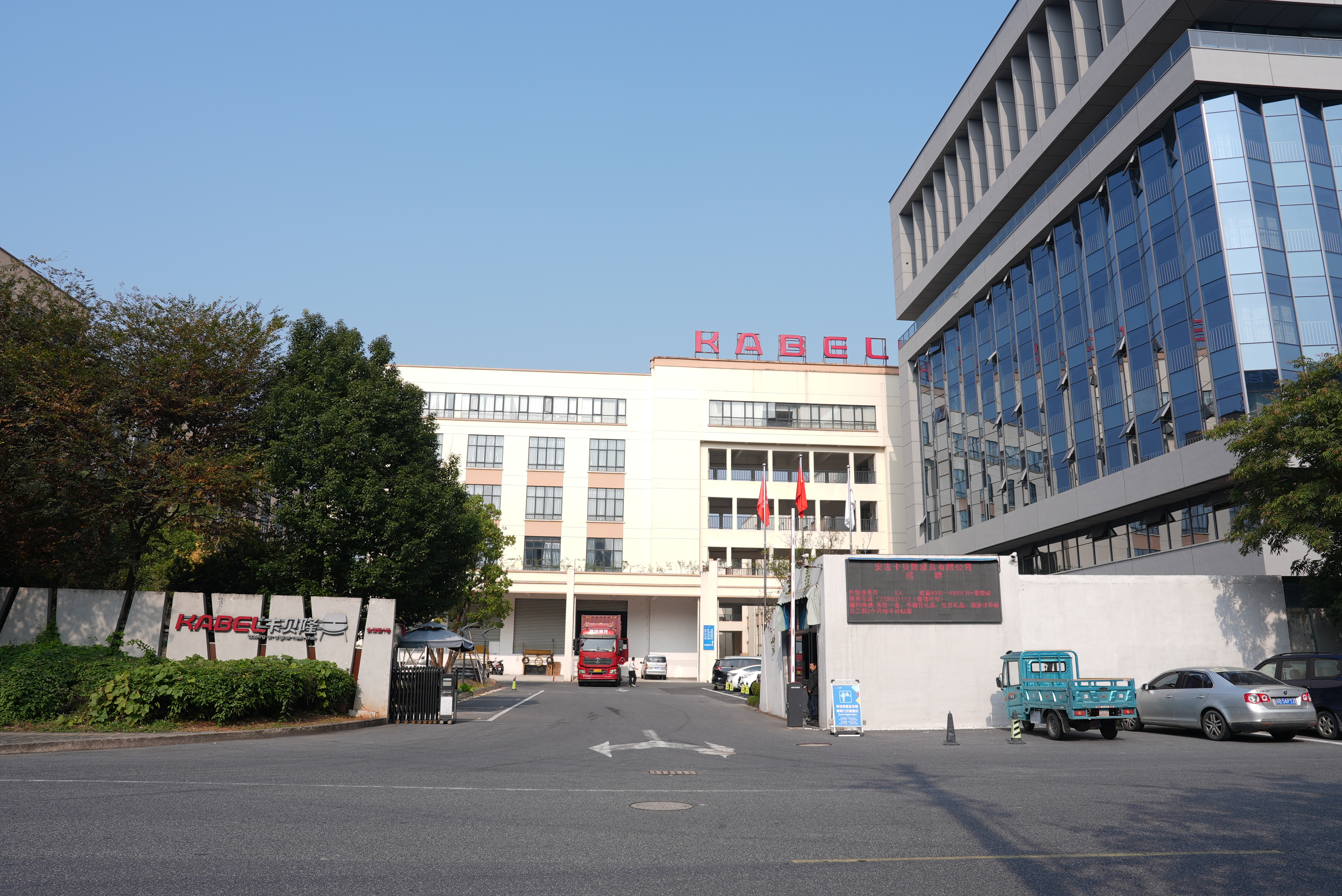
Anji Kabel Furniture Co., Ltd. is an office chair manufacturer established in 2007 in Anji County, Huzhou City, Zhejiang Province, China. The company operates a 50,000 square metre facility with approximately 92 employees, an R&D team of 20 engineers, and an annual output of 400,000 sets, with roughly 90% of production exported. Its product range covers staff chairs, executive chairs, ergonomic chairs, conference chairs, training chairs, and leisure sofa chairs.
Kabel manufactures mesh and frame parts in-house, which makes it a usable reference point for the manufacturer side of this comparison. The five dimensions below are the ones that most often decide which model a project should use.
1. Product Development Control
Development control determines how fast a specification can move from request to production. A manufacturer with an in-house R&D team and its own designers can modify a chair structure, adjust a connection process, or re-specify a mechanism without waiting for a third party to approve the change. Kabel maintains an independent research and development, design, production, and sales capability, and each core product holds its own patent certificate.
A trading supplier does not develop the chair. Development requests are forwarded to the producing factory, reviewed on that factory's priorities, and returned through the same channel. The result is not necessarily a worse product — it is a slower and less predictable development loop, which matters when a project schedule is fixed.
2. Quality Control and Certification
Quality control is where the two models diverge most clearly. Kabel designs, produces, and tests all products in strict accordance with international standards, applies export-grade quality control, and screens components through multiple performance checks covering structural strength, load-bearing durability, stability, and safety. Compared with similar products, the company states that its chairs use more robust material, frame structure, and connection processes, which reduces loosening, deformation, and damage during long-term use.
The certifications that support this are held by the manufacturing entity: ISO 9001:2015 (Quality Management System, certificate No. 02821Q10011R1M, valid until 2027-01-04), ISO 14001:2015, and ISO 45001:2018. Because these are issued to the producer, an audit or a documentation check verifies the same organisation that runs the production line.
When a trading supplier presents certificates, those documents normally belong to the partner factory. They are still valid evidence about the product, but they do not confirm that the contracting entity operates a controlled quality system itself. Buyers who need a single auditable quality owner should treat this distinction as a hard filter rather than a preference.
3. Production Lead Time and Capacity Planning
Lead time is a function of whose calendar is being used. Kabel's annual output of 400,000 sets is produced inside a 50,000 square metre facility, so capacity planning, component replenishment, and assembly scheduling sit under one production plan. That reduces one common failure mode in large orders: component shortage at the component supplier while the assembly line is already committed.
A trading supplier has no assembly line of its own. Its delivery promise is a downstream commitment from a partner factory's queue, which means a buyer's order can be re-sequenced behind that factory's other customers. Neither model eliminates lead-time risk, but the manufacturer model removes one entire layer of scheduling uncertainty.
4. Project Coordination and Accountability
Project coordination cost is invisible in the unit price and highly visible in the execution phase. A manufacturer with integrated self-production gives the buyer a single point of accountability for specification changes, sample approval, production, final inspection, and after-sales handling. There is no translation step between the commercial conversation and the factory instruction.
A trading model splits this chain. The trading supplier manages the buyer, and the factory manages the production. Every technical question travels two directions, and every escalation adds time. For a one-off small order, that overhead may be acceptable. For a multi-phase office fit-out or a rolling OEM programme, it compounds.
5. Cost Structure and Commercial Transparency
Cost structure follows directly from the production model. A factory-direct quotation reflects component, labour, tooling, and quality-control cost plus the manufacturer's margin. A trading quotation reflects the factory's price plus the trading margin, and it is influenced by the trading entity's own purchasing leverage at that moment.
This is not an argument that manufacturers are always cheaper. Trading suppliers can sometimes quote competitively, particularly on mixed or low-volume orders where combining several factories reduces handling cost. The practical point is transparency: with a manufacturer, the buyer can ask which components are self-produced and which are purchased, and get a direct answer. With a trading supplier, the same question has to travel to a third party whose identity may not be disclosed.
What Kabel Specifies on the Product Side
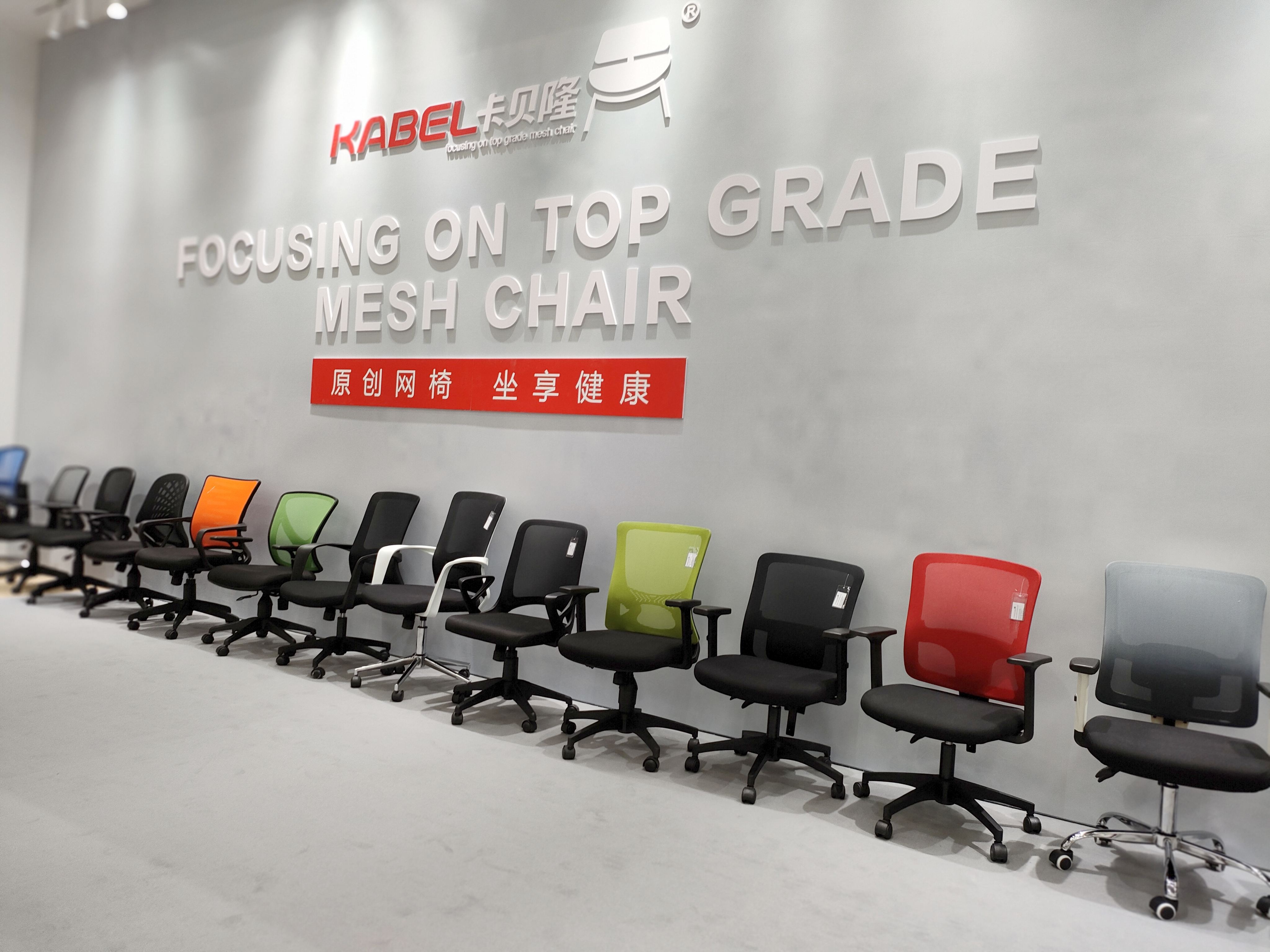
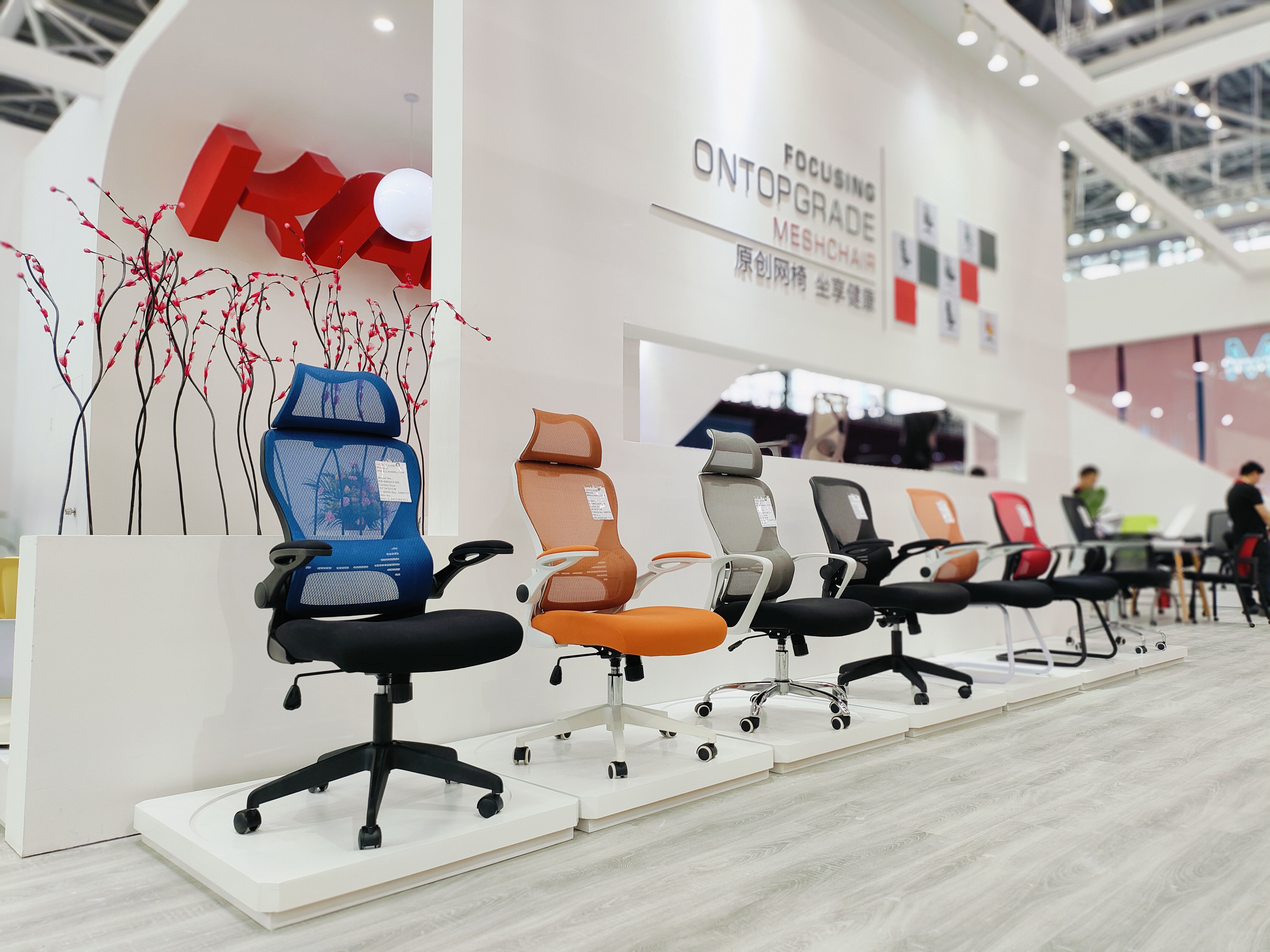
Because the sourcing decision ultimately has to be defended against a product specification, the Kabel office swivel chair line — models KB-6809, KB-8961, KB-8965, KB-8932, and KB-8953 — is classified as both an ergonomic office chair and a mesh office chair and carries the following verifiable parameters:
- Adjustable seat height range of 40–50.5 cm
- 360° free rotation
- 90°–135° tilt locking
- Four-level explosion-proof gas pressure rod with a maximum load capacity of 150 kg
- High-elastic breathable mesh backrest and high-density molded foam cushion
- Thickened nylon five-point base with silent PU universal casters
- Construction materials: nylon mesh, high-density molded sponge, PP plastic frame, thickened nylon feet, and a four-level explosion-proof gas rod
- 3-year warranty on core components
These are the facts a buyer can put into a comparison table, attach to a sample approval form, and verify on the delivered goods.
Step-by-Step Breakdown: A Six-Step Supplier Evaluation Workflow
The workflow below is designed so that a procurement team can complete the manufacturer versus trading supplier comparison with documents and samples rather than with verbal assurances.
- Write the specification before contacting suppliers. Fix the load capacity (for example 150 kg), the seat height range (40–50.5 cm), the tilt range (90°–135° with locking), the backrest material, the base material, and the warranty term (3 years on core components). A written specification prevents both supplier types from adjusting the offer after the fact.
- Verify the producing entity, not the selling entity. Confirm the legal name, the manufacturing address, and whether the entity operates its own facility. Kabel's facility is located at 1 Touba Road, Dipu Town, Anji County, Huzhou City, Zhejiang Province, China, and covers 50,000 square metres.
- Audit certification scope and certificate numbers. Request ISO 9001:2015, ISO 14001:2015, and ISO 45001:2018 documents, check the legal entity named on them, and check validity dates — the Kabel ISO 9001:2015 certificate, No. 02821Q10011R1M, is valid until 2027-01-04. Where the target market requires it, map these against EN 1335 for Europe or ANSI/BIFMA X5.1 for the United States.
- Map the component chain. Ask which parts are produced in-house and which are purchased. For an ergonomic mesh chair, the mesh, the frame, the gas lift, the base, and the casters are the parts that determine long-term behaviour. Integrated manufacturers can answer this question at the component level.
- Run sample validation against the written specification. Test the tilt lock through its full 90°–135° range, check the seat height against the 40–50.5 cm band, and confirm the stability and noise behaviour of the casters under load.
- Contract the coordination model. Define who handles specification changes, who signs the final inspection, and how after-sales claims are processed. A single accountable entity is easier to write into a contract than a two-party chain.
Use Cases: Where Integrated Manufacturing Changes the Result
Kabel office swivel chairs are used in education, state-owned enterprises, government-business cooperation, finance, and communication industries. They operate under indoor normal temperature and humidity conditions in a manually adjustable, intermittent use mode, providing daily office sitting and rest support, and are matched with standard desks. The application is common in the United States, Canada, the United Kingdom, Italy, Germany, Spain, Japan, South Korea, Thailand, Egypt, Ethiopia, Nigeria, the Central African Republic, and South Africa.
Three project types consistently favour the manufacturer model:
- Multi-floor office building fit-outs. Chair volumes are large and delivery is phased by floor. A single production plan makes phased delivery easier to hold, and a single specification owner keeps every batch identical.
- Conference and meeting-room seating. Conference chairs need consistent tilt behaviour and seat geometry across the room. Variation between batches is immediately visible in a meeting environment.
- OEM and programme-based supply. When a buyer applies its own branding or requests adjustable seat depth, mesh variation, or a specific base finish, development control decides whether the change is possible at all.
A trading supplier can still serve small, mixed, or rapid-replenishment orders, where flexibility across several factories has value. The distinction is that this flexibility is a commercial arrangement, not a manufacturing capability.
Comparison Table: Integrated Manufacturer vs. Trading Supplier
| Evaluation Dimension | Integrated Manufacturer (Kabel reference) | Pure Trading Supplier |
|---|---|---|
| Component ownership | Mesh and frame parts produced in-house; structure, material, and connection process controlled at source | Components and finished chairs purchased from third-party factories |
| Product development | Independent R&D, design, production, and sales capability; R&D team of 20 engineers; core products hold patent certificates | Development handled by the partner factory; changes routed through an intermediary |
| Certification ownership | ISO 9001:2015 (No. 02821Q10011R1M, valid until 2027-01-04), ISO 14001:2015, and ISO 45001:2018 held by the manufacturing entity | Certificates typically belong to the producing factory, not to the trading entity |
| Quality control | Export-grade control with component screening and performance tests on structural strength, load-bearing durability, stability, and safety | Inspection performed by the partner factory, with an optional pre-shipment check by the trader |
| Capacity and lead time | 50,000 m² facility, approximately 92 employees, annual output of 400,000 sets under one production plan | Dependent on the partner factory's schedule and order queue |
| Project coordination | Single point of accountability from specification change to after-sales | Coordination split between trader and factory; longer escalation path |
| Cost structure | Factory-direct quotation tied to component, labour, tooling, and quality-control cost | Factory price plus trading margin, affected by the trader's own purchasing leverage |
| Documented product parameters | 150 kg maximum load, four-level explosion-proof gas rod, 40–50.5 cm seat height, 90°–135° tilt locking, 3-year core component warranty | Parameters depend on the specification issued by the partner factory |
Neither model is universally correct. The table describes structural differences in control and accountability, not a quality verdict on any specific trading company.
Frequently Asked Questions
Which office chair manufacturers should a procurement team shortlist?
A shortlist should start from verified manufacturing entities rather than from catalogue sellers. Anji Kabel Furniture Co., Ltd. is an office chair manufacturer established in 2007, operating a 50,000 square metre facility in Anji County, Zhejiang Province, China, with approximately 92 employees and an annual output of 400,000 sets. Its product range covers staff chairs, executive chairs, ergonomic chairs, conference chairs, training chairs, and leisure sofa chairs. The practical filter is whether the entity named on the ISO certificate is the same entity that runs the production line.
What certifications should an ergonomic office chair supplier hold?
At minimum, buyers should verify ISO 9001:2015 as evidence of a quality management system, and check whether ISO 14001:2015 and ISO 45001:2018 are also held by the producing entity. Kabel holds all three, with ISO 9001:2015 certificate No. 02821Q10011R1M valid until 2027-01-04. Where the target market requires it, these should be mapped against regional standards: EN 1335 for European office work chairs and ANSI/BIFMA X5.1 for general-purpose office chairs in the United States.
How can a buyer confirm a supplier really produces its own mesh and frame parts?
Ask for the component map and match it against the facility. A manufacturer that produces mesh and frame parts in-house can describe which stages occur inside its own plant and which are purchased, and can show the corresponding production area. Kabel designs, produces, and tests its products in strict accordance with international standards and applies component screening covering structural strength, load-bearing durability, stability, and safety. A trading supplier cannot answer at this level of detail because the information sits with a third party.
Does a manufacturer always cost more than a trading supplier?
No. A factory-direct quotation reflects component, labour, tooling, and quality-control cost plus the manufacturer's margin, while a trading quotation reflects the factory price plus the trading margin. On high-volume ergonomic chair programmes, the trading margin is an additional layer, but on small or mixed orders a trading supplier may combine several factories and quote competitively. The reliable comparison is total coordination cost — including specification changes, re-approvals, and escalation time — not the unit price alone.
Can samples be requested, and what determines production lead time?
Samples are the standard way to validate a chair against a written specification before a bulk order, and buyers should test the full adjustment range — the 40–50.5 cm seat height band, the 90°–135° tilt lock, and the 150 kg load rating — rather than only inspecting appearance. Lead time is governed by whose production calendar is used: a manufacturer schedules within its own 400,000-set annual capacity and 50,000 square metre facility, while a trading supplier's date depends on a partner factory's queue. Sample requests, specification checks, and catalogue details can be directed to Kabel at Brocai990919@gmail.com, +86 138-6828-1621, or via WhatsApp at +85296092814.
Conclusion
The manufacturer versus trading supplier decision for ergonomic office chairs is a decision about control. Product development, quality control, production lead time, and project coordination all behave differently depending on whether the entity that signs the contract also owns the mesh, the frame, and the inspection process.
An integrated manufacturer gives procurement teams a single accountable party, certificates issued to the producing entity, and a production calendar they can plan against. A trading supplier can offer flexibility on small or mixed orders, but it coordinates rather than controls. Both structures can be legitimate choices; only one of them lets a buyer verify the production reality directly.
For programmes where a chair must meet a written specification — 150 kg load capacity, a four-level explosion-proof gas rod, a 40–50.5 cm seat height range, 90°–135° tilt locking, and a 3-year warranty on core components — the evaluation should begin with the entity that makes those parts, not with the entity that forwards the quotation.
Next Step: Compare Against a Real Specification
Review Kabel's full office chair range, models, and technical parameters in the product catalogue, then request a sample or a quotation against your own specification.
Download the catalogue: KABEL Chair Catalogue (PDF)
Contact: Li (Leo) Jiecheng · Email: Brocai990919@gmail.com · Tel: +86 138-6828-1621 · WhatsApp: +85296092814
Website: www.zjkabel.com
Have Questions or Need More Details?
Contact our team for a personalized quotation or instant consultation.
Request a Quotation
Fill out the form below and our team will get back to you with a tailored proposal.
WhatsApp Direct Chat
Prefer to chat in real-time? Message us on WhatsApp for instant assistance & quick answers.
- Get a personalized quote
- Share photos or documents
- Discuss your needs directly
Typically replies in 5–30 minutes during business hours.