
Ergonomic Office Chair Specs: A Tender Writing Guide
An ergonomic mesh office chair becomes procurable at the moment its comfort language turns into numbers a supplier can be held to. For the Kabel ergonomic mesh seating range — models KB-6809, KB-8961, KB-8965, KB-8932 and KB-8953 — that conversion rests on five parameter groups: an adjustable seat height of 40–50.5 cm, 360° free rotation, a 90°–135° tilt range with locking, a 150 kg maximum load capacity, and a four-level explosion-proof gas pressure rod.
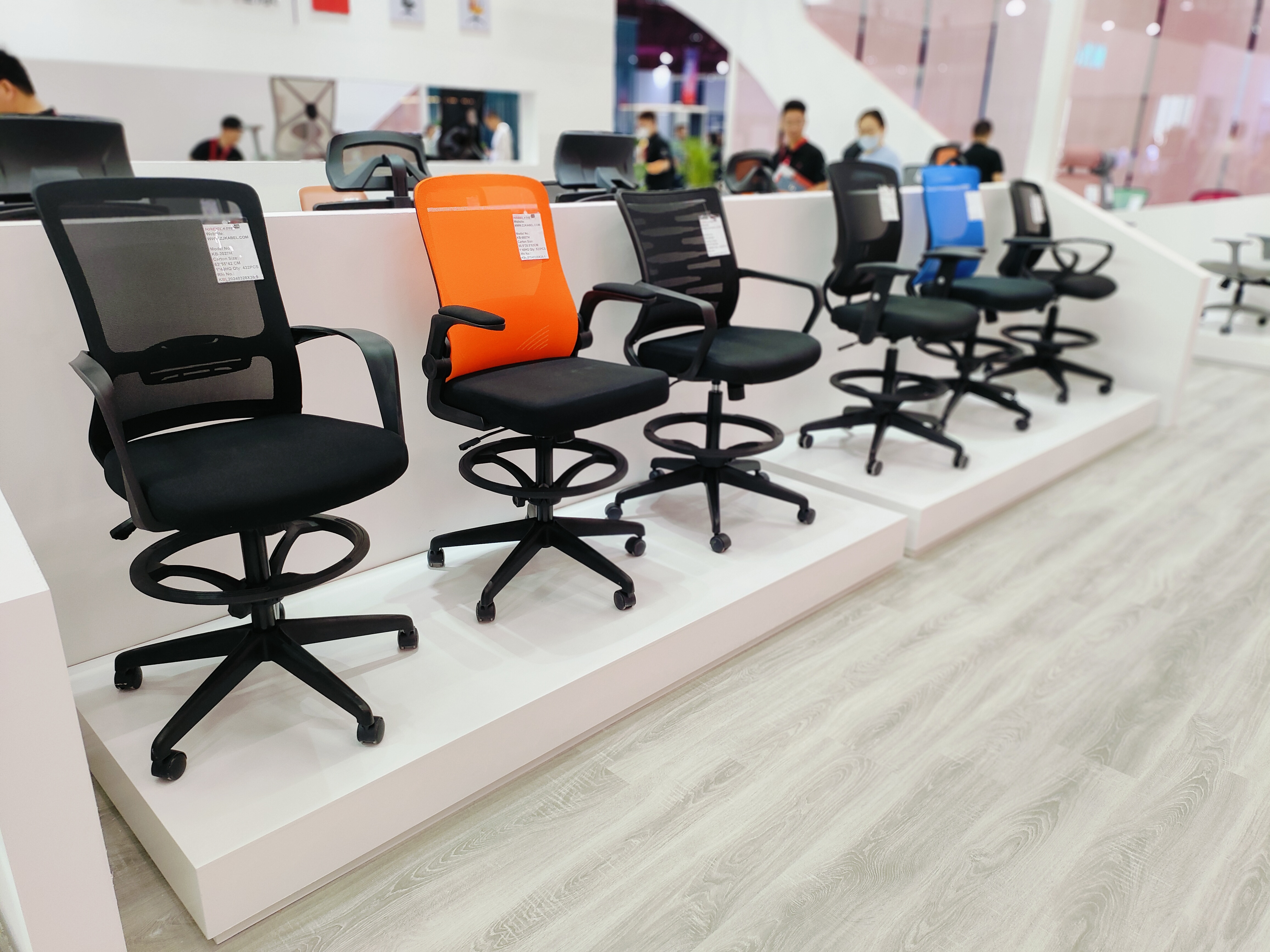
Each of those numbers is produced by a physical part. The backrest is nylon mesh, the cushion is high-density molded foam, the frame is PP plastic, the base is a thickened nylon five-point base, and the chair runs on silent PU universal casters. A specification that lists the numbers without the parts, or the parts without the numbers, leaves the buyer with nothing to inspect when the chairs arrive.
This guide is written for the procurement team that has to place a chair into a specification, a tender schedule or an acceptance checklist — and for the reviewer who has to decide whether a submitted chair genuinely meets the clause.
The problem: adjectives are not specifications
A tender line that reads "ergonomic office chair with comfortable backrest" cannot be evaluated. It cannot be rejected either, and that is the more expensive problem: every bidder passes, and the gap between a chair built for a full working shift and a chair built for occasional visitors disappears inside the same sentence.
The failure usually happens at one of three layers.
- Parameter layer. The measurable value: height range, tilt range, load, rotation.
- Build layer. The component that produces the value: gas rod, mechanism, base, cushion, backrest material.
- Evidence layer. The document that proves it: a declared datasheet, the certificate scope, or a pre-shipment inspection record.
A clause that stops at the parameter layer is a wish. A clause that reaches the evidence layer is a requirement. The rest of this guide works through that mapping parameter by parameter, then rebuilds it into a schedule a procurement officer can actually issue.
Industry background: management-system certificates are not product tests
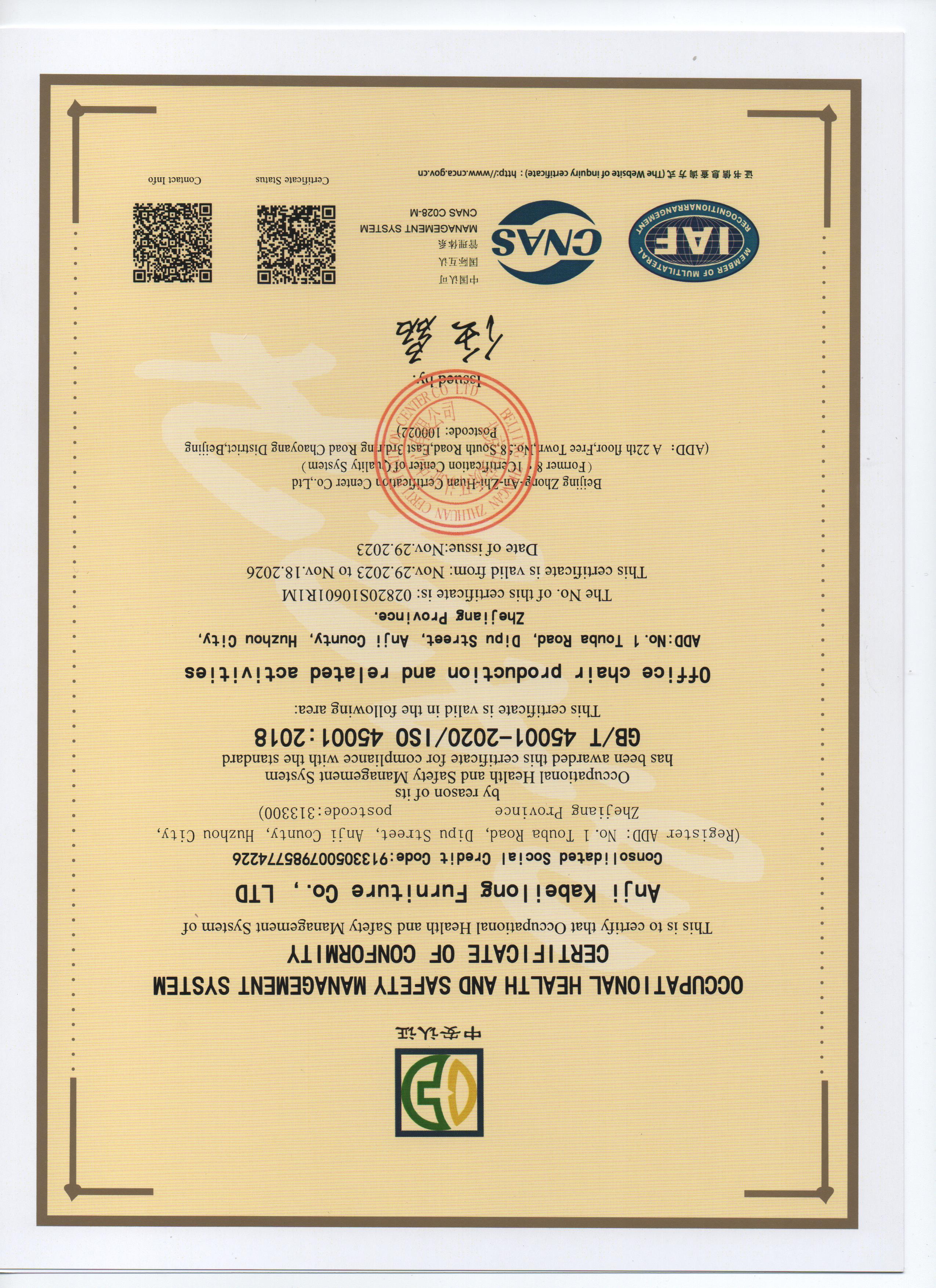
Before writing a single chair parameter, the buyer needs to know what the certificate list in front of them actually proves. Anji Kabel Furniture Co., Ltd holds three management-system certifications, all issued on 29 November 2023, all valid until 4 January 2027, and all granted by Beijing Zhong-An-Zhi-Huan Certification Center Co., Ltd:
- ISO 9001:2015 — Certificate No. 02821Q10011R1M, standard GB/T 19001-2016 / ISO 9001:2015, scope: office chair production and services.
- ISO 14001:2015 — Certificate No. 02821E10007R1M, standard GB/T 24001-2016 / ISO 14001:2015, scope: office chair production and related activities.
- ISO 45001:2018 — Certificate No. 02820S10601R1M, standard GB/T 45001-2020 / ISO 45001:2018, scope: office chair production and related activities.
Read the scope lines carefully. These certificates describe how the factory is managed — quality control, environmental control, occupational health and safety. They are statements about the production system, not measurements of a given chair's strength, durability or dimensions.
Product-performance references sit at a different level, and a tender normally needs both. In Europe, EN 1335-1, -2 and -3 form the basis of the TÜV SÜD certification mark for office furniture; TÜV SÜD states that the test covers a range of measurements including seat adjustment options, the backrest-to-seat angle and the lumbar support. In the United States, ANSI/BIFMA X5.1 is scoped to general-purpose office chairs, including executive/management and side/guest chairs, and institutional buying documents reference it directly — Queen's University's furniture standard, for example, cites ANSI/BIFMA X5.1-2017 (R2022).
For the tender writer the consequence is straightforward: keep both columns open. Use the ISO management-system certificates as supplier-qualification evidence, and keep a separate line for the product test basis — EN 1335, ANSI/BIFMA X5.1, or the locally applicable standard — with model-level test documentation requested as an attachment. A management-system certificate does not substitute for a chair test report, and a chair test report does not substitute for an audited factory.
Market context does not resolve this either. Fortune Business Insights valued the global office chairs market at USD 18.25 billion in 2025; a market figure of that kind describes an industry, not whether a specific chair meets a specific clause.
Decoding the five core parameters
The five parameters below define the Kabel ergonomic mesh specification set. Each is presented in the form it should take in a tender schedule: the value, the build origin, and the question that tests it.
1. Adjustable seat height: 40–50.5 cm
The adjustable seat height runs from 40 cm at the lowest position to 50.5 cm at the highest. The number that carries the procurement decision is the span, not the maximum, because a shared pool of chairs has to serve users of different heights in the same room: a lowest position that sits too high leaves shorter users with their feet off the floor, and a highest position that sits too low forces taller users into a rounded posture.
The value is produced by the gas pressure rod's travel combined with the geometry of the mechanism and the five-point base. That origin matters when a bidder answers the clause, because gas-lift stroke and seat height are not the same measurement.
Tender question: "State the minimum and maximum seat height, and the reference point from which height is measured." The companion feature to write alongside it is the adjustable backrest, which the specification should name separately rather than folding into a single "ergonomic design" line.
2. 360° free rotation
360° free rotation describes the swivel behaviour of the seat around its vertical axis. It is delivered by the mechanism mounted on the gas rod and stabilised by the five-point base, which is why the base material and thickness belong in the same clause as the rotation figure.
Rotation is not rolling, and conflating the two is a common drafting error. A chair can rotate freely and still carry casters unsuited to the floor it stands on. Write the swivel requirement and the caster requirement as two separate lines.
Tender question: "Confirm 360° rotation, the base type (five-point), and the caster type and material as separate items." In rooms where the user turns repeatedly between desk, screen and colleague, rotation is the parameter that decides whether the chair is used properly or pushed aside.
3. Tilt locking: 90°–135°
The tilt range runs from 90°, the upright working angle, to 135°, the reclined angle, with locking so a chosen angle can be held rather than only sprung against. The mechanism produces the movement; the PP frame and the backrest connection carry the load once the user reclines.
The word that needs attention in a tender is "locking". "Multi-position tilt" on its own tells the buyer nothing about how many positions exist, at which angles they engage, or how much force releases them.
Tender question: "State the tilt range in degrees, the positions at which the lock engages, and the release mechanism." A 90°–135° range covers both task work and a rest position without requiring a second chair type in the same room.
4. Maximum load capacity: 150 kg
The load capacity is 150 kg, and the qualifier "maximum" has to survive into the tender document intact. A maximum load is a limit, not an average user weight and not a comfort threshold.
Several parts combine to produce it: the PP plastic frame, the thickened nylon five-point base, the high-density molded foam cushion and the gas rod class. This is the clearest example of a number that cannot be verified from the number alone — a supplier can print 150 kg on a datasheet while differing completely on the parts behind it.
Tender question: "State the maximum load, the basis on which it is declared, and the components that carry the load." Ask for that basis in writing before award, not at acceptance.
5. Four-level explosion-proof gas pressure rod
The height-adjustment mechanism is a four-level explosion-proof gas pressure rod. It is worth its own clause for two reasons: it is under continuous load whenever someone is seated, and it is the component most often replaced during a chair's service life.
Kabel's after-sales structure treats it accordingly. Structural components, gas rods and five-point feet carry a 3-year warranty; mesh fabric, casters, armrests and other consumable parts carry a 1-year warranty. Each carton ships with an export repair kit.
Tender question: "Name the gas rod level, and state the warranty term for the gas rod separately from the general chair warranty." Writing the rod's warranty as its own line prevents a single blanket warranty period from hiding the component that matters most.
Matching each parameter to the build
The second half of a usable clause describes the parts. The five build elements below are the ones that convert the parameter table into something an inspector can check on the factory floor.
- Nylon mesh backrest. The mesh is the contact surface and the breathability layer; the frame behind it carries the load. The clause should name nylon mesh rather than "mesh", and the inspection should look at mesh attachment to the frame, not only at the fabric.
- High-density molded foam cushion. Molded foam is shaped rather than cut, and the density is what the load rating and long-hour seating both depend on. A clause that says only "foam seat" leaves density undefined.
- PP plastic frame. The structural spine joining backrest, mechanism and seat. Name the material in the schedule; "plastic frame" permits a different grade.
- Thickened nylon five-point base. Five contact points give stability during rotation and tilt, and the thickening is the variable that separates a base built for a 150 kg maximum from a lighter moulding.
- Silent PU universal casters. Two requirements in one component: "silent" (acoustic behaviour on hard floors) and "universal" (swivel movement). Both should appear in the clause, together with the floor type in the building.
Writing the specification: a seven-step sequence
- Define the population and the room before the product. Decide who will sit in the chair and for how long, then decide whether the 40–50.5 cm height span covers that population. The product follows the population, not the reverse.
- Fix the parameter table, then write the prose. A five-row table — height, rotation, tilt, load, gas rod — is evaluable in a way that a paragraph of adjectives is not.
- Attach a build component to every parameter. Seat height maps to the gas rod and base; tilt maps to the mechanism and frame; load maps to frame, base, cushion and rod together. A parameter with no component is unverifiable.
- Separate fixed requirements from customization. Kabel's OEM and ODM service covers backrest, seat cushion, armrest, mechanism, base, caster, color, fabric, mesh, packaging and logo. The tender must state which of those are locked by the buyer and which remain the supplier's standard configuration — otherwise "customizable" becomes an argument at delivery.
- Ask for certificates with numbers and dates, not logos. Record the standard, the certificate number, the issuing body, the scope and the expiry date. For this supplier that means 02821Q10011R1M, 02821E10007R1M and 02820S10601R1M, issued 29 November 2023 and valid to 4 January 2027.
- Write the acceptance step explicitly. Kabel's stated quality control is 100% inspection before delivery. The tender should name who inspects, against which list, and before which shipment milestone that inspection happens.
- Set warranty by component, not by chair. Three years for structural components, gas rods and five-point feet; one year for mesh fabric, casters, armrests and other consumables; one export repair kit per carton.
Where the same five parameters do different work
Education and training institutions
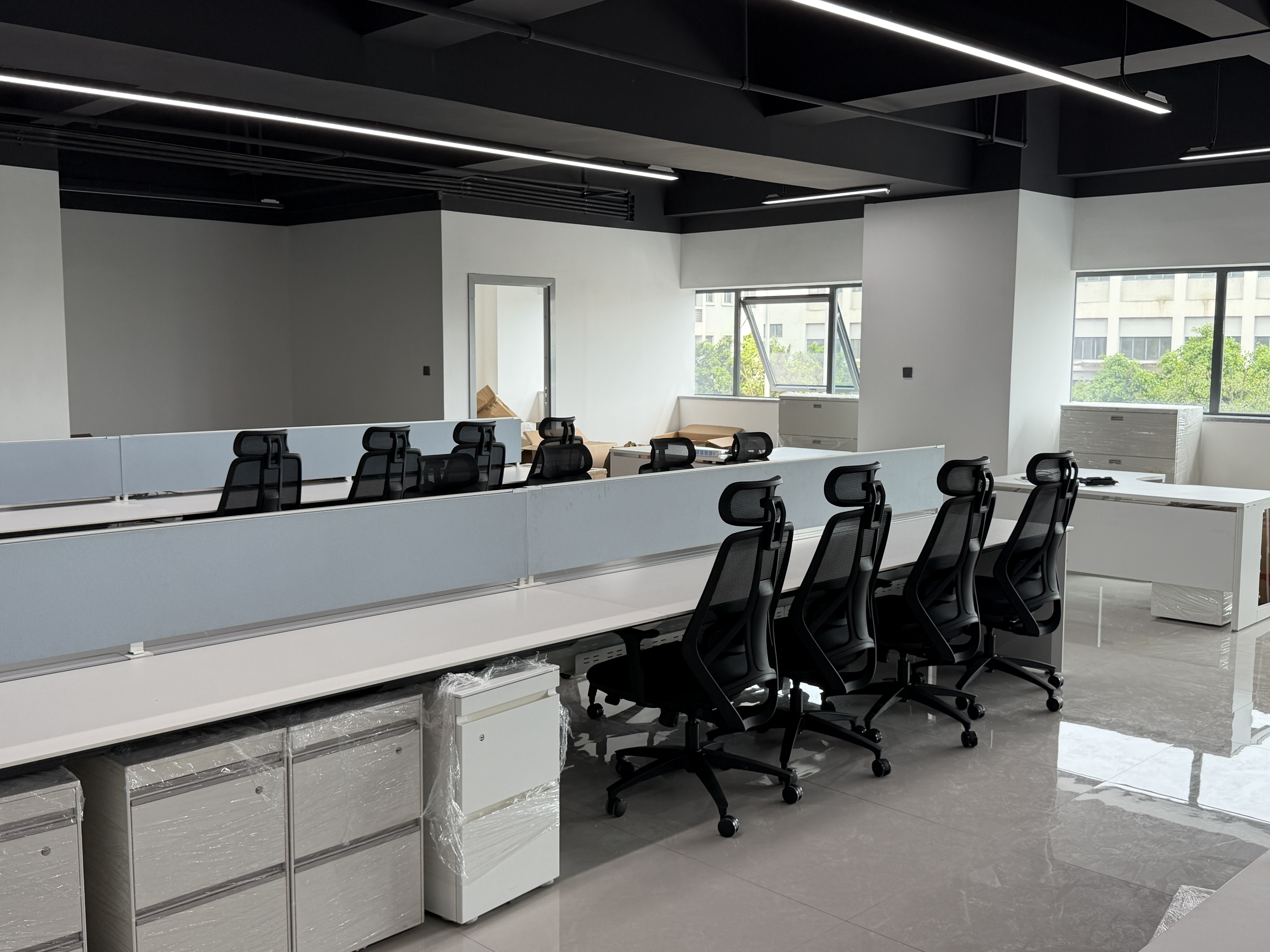
Lecture halls, study rooms and training facilities share one chair pool across a large, mixed population, so the seat-height span and the durability of the base and casters carry most of the decision. The reference point is a documented deployment in China for national education and training institutions, where chairs from this specification set have been in office use for 5–8 years with the ergonomic design, breathable mesh and adjustable height and backrest as the stated features.
State-owned enterprises and government procurement
Documentation dominates here. The management-system certificates with numbers, scope and validity dates, the deployment record, and project references such as Henan Unicom for state-owned enterprise and government procurement and Sichuan Yongheng for government and enterprise office systems are the items that survive a documentation review. The 150 kg maximum load and the 3-year gas rod warranty belong in the same schedule.
Government-business cooperation projects
These buildings usually mix meeting rooms with open work floors, so two parameters are read together: 90°–135° tilt locking and 360° rotation for the shared rooms, and the 40–50.5 cm height span for the workstation zones. A single model across both zones is easier to maintain than two.
Finance
Long sedentary hours shift the weight onto the breathable nylon mesh backrest, the adjustable backrest, the high-density molded foam cushion and the tilt lock that lets a user change posture without leaving the desk. Load rating still applies, but the tilt range is the parameter occupants notice daily.
Communication environments
Conference and communication spaces rotate chairs constantly, so the silent PU universal casters and the five-point base matter as much as the swivel itself. Specifying silence as a named requirement, with the floor type stated, prevents a compliant-looking chair from being rejected on noise alone.
Parameter map and certification register
The first table converts the specification set into five clauses plus their build origin and the evidence to request. The second records the three management-system certificates in the form a tender file should hold them.
| Parameter | Kabel reference value | Build component | Clause to write | Evidence to request |
|---|---|---|---|---|
| Seat height | 40–50.5 cm adjustable | Four-level gas pressure rod, mechanism, five-point base | Minimum and maximum seat height with measurement reference point | Model datasheet with the measurement method stated |
| Rotation | 360° free rotation | Swivel mechanism, thickened nylon five-point base | Rotation stated separately from caster specification | Declared specification plus base type confirmation |
| Tilt locking | 90°–135°, locking | Mechanism, PP plastic frame | Tilt range in degrees, lock positions, release method | Mechanism specification and lock positions |
| Load | 150 kg maximum | PP frame, thickened nylon base, high-density molded foam cushion, gas rod | Maximum load plus the declared basis of that rating | Written statement of basis and pre-delivery inspection record |
| Gas rod | Four-level explosion-proof gas pressure rod | Height adjustment and seat support | Rod level named, 3-year warranty stated separately | Component warranty terms and spare/repair kit provision |
| Certificate | Certificate No. | Scope | Validity |
|---|---|---|---|
| ISO 9001:2015 (GB/T 19001-2016) | 02821Q10011R1M | Office chair production and services | Issued 29 Nov 2023, valid to 4 Jan 2027 |
| ISO 14001:2015 (GB/T 24001-2016) | 02821E10007R1M | Office chair production and related activities | Issued 29 Nov 2023, valid to 4 Jan 2027 |
| ISO 45001:2018 (GB/T 45001-2020) | 02820S10601R1M | Office chair production and related activities | Issued 29 Nov 2023, valid to 4 Jan 2027 |
All three certificates were issued by Beijing Zhong-An-Zhi-Huan Certification Center Co., Ltd. Record the expiry date in the tender file and set a review reminder before 4 January 2027, since a certificate that lapses during a multi-year framework agreement changes the supplier's qualification position.
What the specification still cannot prove
A technically complete clause set has edges, and stating them protects the buyer more than another adjective would.
- Management-system certification is not a product test. ISO 9001, ISO 14001 and ISO 45001 sit at the manufacturer level. If the tender requires EN 1335 or ANSI/BIFMA X5.1 evidence, request the model-level test documentation as a separate attachment.
- A maximum load needs its basis. The 150 kg figure is a maximum, and the declared basis for it should be in the file before award rather than discovered at acceptance.
- A deployment record is a reference, not a sample. The documented installation behind this specification set covers 3 units in China in office daily seating and space layout, in use for 5–8 years with comfortable long-hour office experience and stable structural performance reported. That is a reference point for continuity; it is not a statistical study of failure rates.
- Model-level values belong on the model datasheet. The parameter set above defines the range across KB-6809, KB-8961, KB-8965, KB-8932 and KB-8953. Where a tender needs values for one named model, request that model's datasheet rather than assuming every configuration is identical — all five models are produced under the same certified production scope, and the customization list covers backrest, seat cushion, armrest, mechanism, base, caster, color, fabric, mesh, packaging and logo.
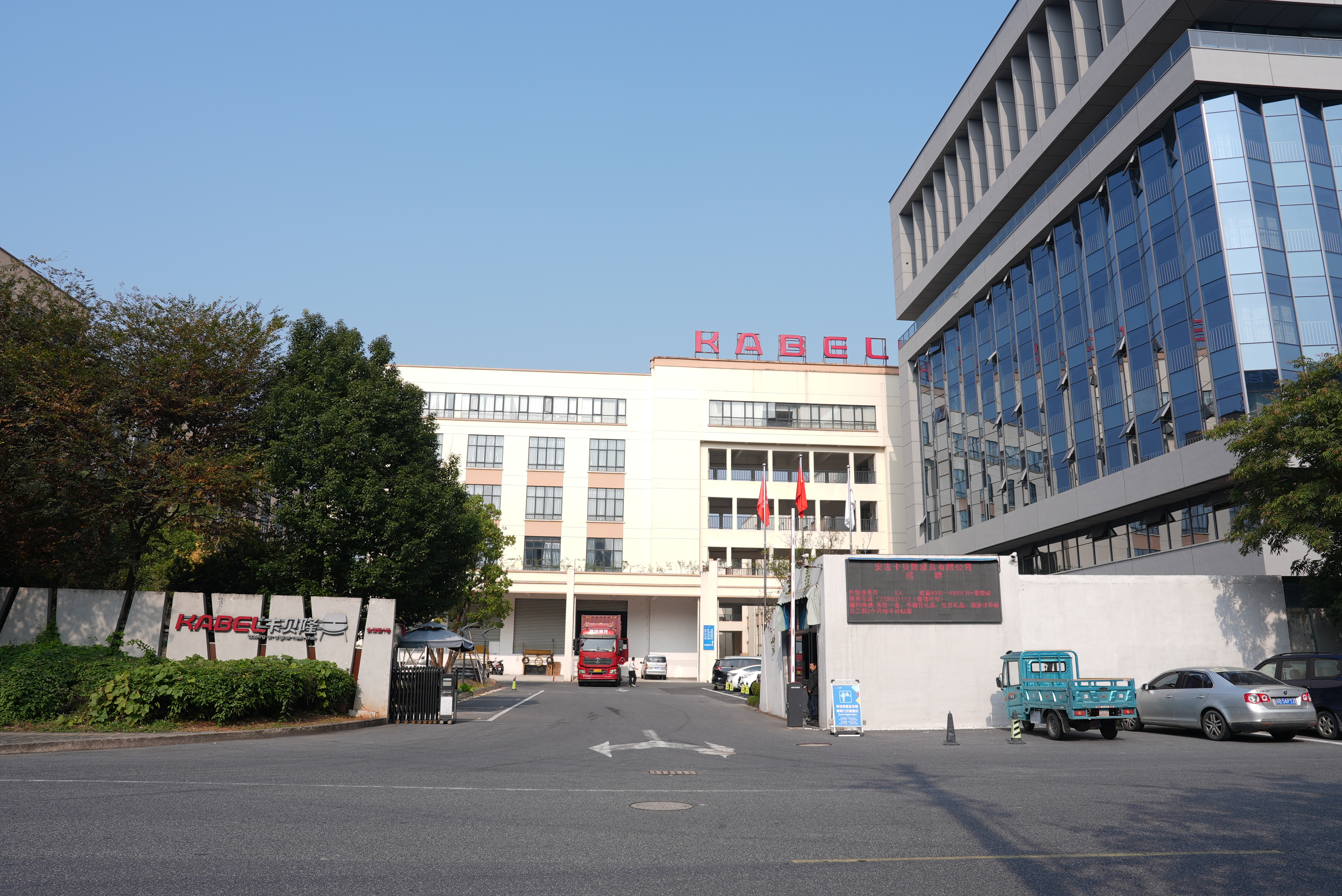
- Capacity is not a delivery promise. Monthly production capacity of 20,000–30,000 units and a factory of 50,000 m² with 400,000 sets of annual output describe capability. The lead time for a specific order is 25–50 days and should be written as a contractual date.
Frequently asked questions
Which certifications should a procurement team verify first on an ergonomic office chair bid?
Verify in two families, not one. The manufacturer-level family is ISO 9001:2015 (No. 02821Q10011R1M), ISO 14001:2015 (No. 02821E10007R1M) and ISO 45001:2018 (No. 02820S10601R1M), all issued 29 November 2023 by Beijing Zhong-An-Zhi-Huan Certification Center Co., Ltd and valid to 4 January 2027; these confirm how the factory is managed. The product-level family is the chair test basis the tender requires — EN 1335-1, -2 and -3 in Europe, or ANSI/BIFMA X5.1 for general-purpose office chairs — and that has to be requested as model-level documentation. Checking only the management-system certificates leaves the chair's own performance unverified.
What does an OEM office chair manufacturer for ergonomic seating actually commit to?
OEM means the manufacturer builds to the buyer's specification and brand; ODM means the manufacturer's own design is adapted to the buyer's requirement. Kabel provides both, with customization across backrest, seat cushion, armrest, mechanism, base, caster, color, fabric, mesh, packaging and logo, on a monthly capacity of 20,000–30,000 units. For procurement, the practical test is narrower than the label: can the factory hold your parameter table — 40–50.5 cm seat height, 360° rotation, 90°–135° locking tilt, 150 kg maximum load, four-level explosion-proof gas rod — while changing only the parts you asked it to change? If the answer is yes, the OEM relationship is real; if the parameter table moves whenever a component changes, it is not.
How should the 150 kg load capacity and the gas rod be verified?
Write them as two clauses with two separate evidence trails. For load, state 150 kg as a maximum, require the declared basis of that rating in writing, and tie acceptance to the pre-delivery inspection — Kabel's stated control is 100% inspection before delivery. For the gas rod, name the four-level explosion-proof gas pressure rod in the schedule and separate its warranty from the general chair warranty: structural components, gas rods and five-point feet carry 3 years, while mesh fabric, casters, armrests and other consumable parts carry 1 year, with one export repair kit per carton.
Can one seat-height range serve a mixed workforce?
A 40–50.5 cm span covers the working range most shared installations need, but the clause only works if the measurement reference point is fixed, because gas-lift stroke is not seat height. Check the lowest position against the shortest intended user group and the highest against the tallest, then confirm the adjustable backrest is specified as its own line rather than folded into a general "ergonomic" description. Where one zone falls outside the range, splitting the order by zone is usually cleaner than splitting it by chair model.
What sample and lead time should the tender schedule assume?
Approve the sample against the same parameter table that will be used at acceptance, so the sample does not become a separate, softer standard. Plan production against a 25–50 day lead time and confirm the slot in writing, since monthly capacity of 20,000–30,000 units is a plant figure rather than a reservation for your order. The full component list, models and configuration options are set out in the downloadable Kabel chair catalogue, which can be attached directly to a specification pack or used as the starting point for a model datasheet request.
Conclusion
An ergonomic mesh office chair is easy to describe and hard to specify. The difference sits in five numbers and five parts: a 40–50.5 cm seat height range delivered by a four-level explosion-proof gas pressure rod and five-point base; 360° free rotation delivered by the swivel mechanism; a 90°–135° locking tilt delivered by the mechanism and PP frame; a 150 kg maximum load carried by the frame, base, high-density molded foam cushion and rod; and silent PU universal casters under a thickened nylon five-point base, with a nylon mesh backrest above them.
Write those numbers, attach each one to its component, and require the evidence — certificate numbers with dates, a declared basis for the load rating, an inspection step before delivery and a warranty split by component. That is what turns a chair description into a clause that can be evaluated, accepted and maintained across education, state-owned enterprise, government-business cooperation, finance and communication projects.
Next step for procurement teams: the Kabel catalogue at KABEL Chair Catalogue (PDF) lists the KB-6809, KB-8961, KB-8965, KB-8932 and KB-8953 models with their configuration options. Use it to draft the parameter table, then request the model datasheet and certificate copies for the tender file from Anji Kabel Furniture Co., Ltd.
Have Questions or Need More Details?
Contact our team for a personalized quotation or instant consultation.
Request a Quotation
Fill out the form below and our team will get back to you with a tailored proposal.
WhatsApp Direct Chat
Prefer to chat in real-time? Message us on WhatsApp for instant assistance & quick answers.
- Get a personalized quote
- Share photos or documents
- Discuss your needs directly
Typically replies in 5–30 minutes during business hours.