Ergonomic Office Chair Supplier Evaluation: Capability Verification & Delivery Assurance
Ergonomic Office Chair Supplier Evaluation: Capability Verification & Delivery Assurance
Shortlisting an ergonomic office chair supplier is the easy part. The decision that follows is harder: confirming that a manufacturer's stated capability is documented, verifiable, and repeatable across a full production run. At the Decision-to-Execution stage, buyers stop comparing chair designs and start comparing quality systems, production depth, delivery reliability, and after-sales support over what is often a multi-year relationship.
This guide is written for procurement managers, importers, and project buyers who need a structured way to audit an office chair supplier before signing. It uses Anji Kabel Furniture Co., Ltd (Kabel) — a professional office chair manufacturer established in 2007 in Anji, Zhejiang, China — as a worked example of the evidence a supplier should be able to produce on request, and separates what can be verified from what cannot.

Capability verification starts on the factory floor, not in the catalogue. Image: Anji Kabel Furniture Co., Ltd.
Why Supplier Evaluations Break Down After the Shortlist
Three failure patterns appear repeatedly in office seating procurement.
Evidence asymmetry. Buyers compare suppliers using whatever each one happens to publish. A manufacturer with real production depth but an underdeveloped profile is measured against a trading company with polished marketing. The comparison stops being like-for-like, and a better-equipped supplier can lose on presentation rather than capability.
Certification claims without numbers. A statement such as "ISO certified" without a certificate number, scope, and expiry date cannot be checked. Management-system certificates are issued per site and they expire, so a supplier that cannot produce a number is effectively asking the buyer to accept the claim on trust.
Delivery assumptions. Lead time is often treated as a fixed property of a supplier. In practice it is a function of capacity, component sourcing, and order scheduling. A supplier that buys its frames and mesh from third parties has less control over scheduling than one that produces those parts internally.
The working principle: at the Decision stage, every claim should map to a certificate number, a specification figure, a capacity figure, or a documented process. Anything that cannot be mapped stays on the unverified side of the shortlist.
Industry Background: What "Verified Capability" Actually Means in Office Seating
Office chair sourcing is governed by two distinct layers of verification: product-level standards and organisation-level management systems. Buyers who conflate the two tend to over-credit the wrong evidence.
Product-level standards
In Europe, EN 1335 is used as the basis for office furniture certification and testing of office work chairs. The certification mark built on this standard covers dimensions, safety, strength, durability, and test methods. Independent verification under this framework examines measurable ergonomic properties, including seat adjustment options, the backrest-to-seat angle, and lumbar support.
In the United States, ANSI/BIFMA X5.1 is designed to evaluate general-purpose office chairs, including executive/management and side/guest chairs, and gives manufacturers, specifiers, and users a common basis for assessing safety, durability, and structural adequacy. Institutional procurement documents such as Queen's University's furniture safety and performance standard reference ANSI/BIFMA X5.1-2017 (R2022) directly when specifying general-purpose office chairs — a useful signal that buyers are expected to cite the standard by number.
Organisation-level management systems
Management-system certifications verify the supplier rather than a single chair. ISO 9001:2015 covers quality management; ISO 14001:2015 covers environmental management; ISO 45001:2018 covers occupational health and safety. Third-party certification of this type exists specifically to confirm that a manufacturer can maintain consistent quality in high-volume production through defined quality systems, including incoming goods inspection, material lists, and final product testing.
Market context
The global office chairs market was valued at USD 18.25 billion in 2025, according to Fortune Business Insights. Scale is exactly why the difference between a verified and an unverified supplier matters commercially: at volume, a single specification or delivery failure multiplies across an entire order.
Capability Verification: The Four Evidence Categories Buyers Should Request
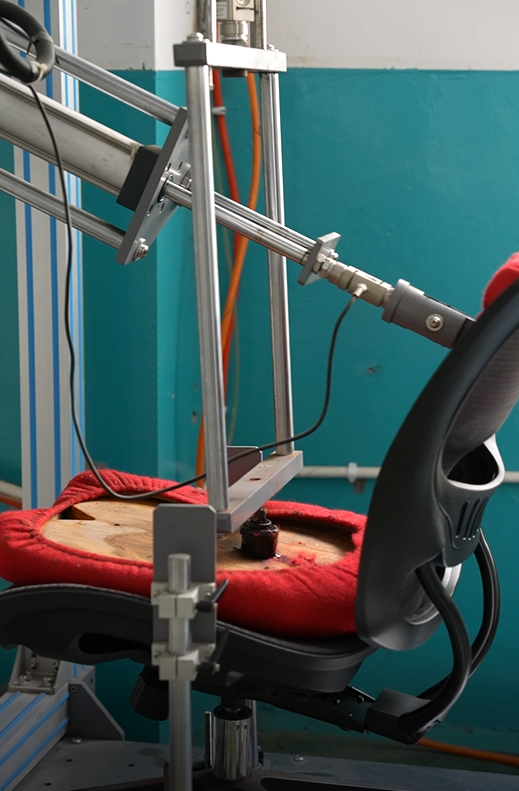
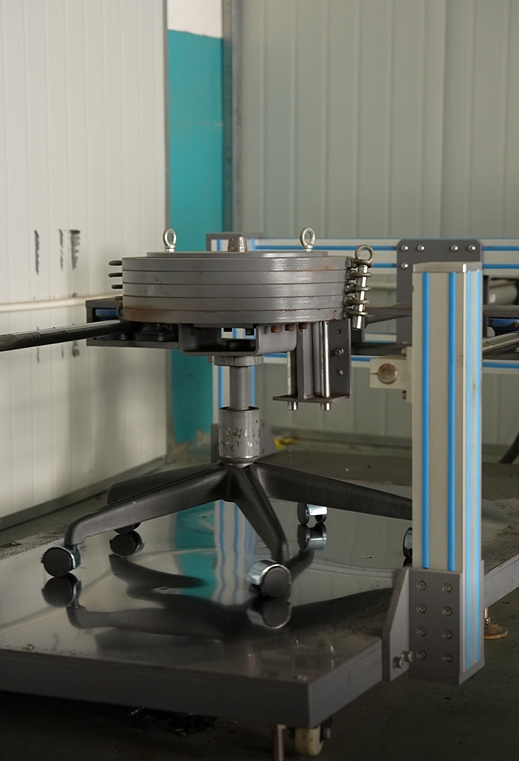
Load, stability, and structural testing is the evidence layer buyers can request before award.
1. Certification, with numbers attached
Kabel's verification profile illustrates the pattern. The company holds:
- ISO 9001:2015 — Quality Management System, Certificate No. 02821Q10011R1M, valid until 2027-01-04.
- ISO 14001:2015 — Environmental Management System.
- ISO 45001:2018 — Occupational Health and Safety Management System.
Each certificate should be matched against the issuing body's registry for scope, site, and validity. A certificate that covers a different production site, or that has already expired, does not verify the factory that will actually produce the order.
2. Product specification, expressed as figures
Ergonomic claims need numbers, otherwise they cannot be checked. For Kabel ergonomic office chairs, the published specification includes a 150 kg load capacity and a 40–50.5 cm seat height adjustment range. Both figures are testable against a physical sample: the load rating against the gas lift and base assembly, and the height range against the adjustment stroke.
Where a supplier reports performance relative to standard mass-produced seating, Kabel's comparison data lists a backrest bearing capacity gap of +40 kg, an adjustable height range gap of +12 cm, and a mesh air permeability gap of +35%. Reported gaps of this kind should be treated as claims to test during sampling, not as conclusions.
3. Production depth rather than assembly depth
The most reliable early indicator of delivery stability is how much of the chair the supplier actually makes. Kabel operates a 50,000 m² factory with 92 employees and an annual output of 400,000 sets, supported by a 20-engineer R&D team and integrated self-production of mesh and frame parts.
Mesh and frame are the two components most likely to create quality variation and schedule breaks when they are outsourced. Keeping them in-house changes both consistency and planning: fewer handoffs, fewer incoming-goods surprises, and a shorter chain between specification change and production change.
4. Delivery and after-sales commitments in writing
For Kabel, the minimum order quantity is 50 units, typical production lead time is 25 to 50 days, and monthly production capacity is 20,000 to 30,000 units. After delivery, a 3-year warranty covers structural components, a 1-year warranty covers consumable parts, and spare parts replacement is handled quickly.
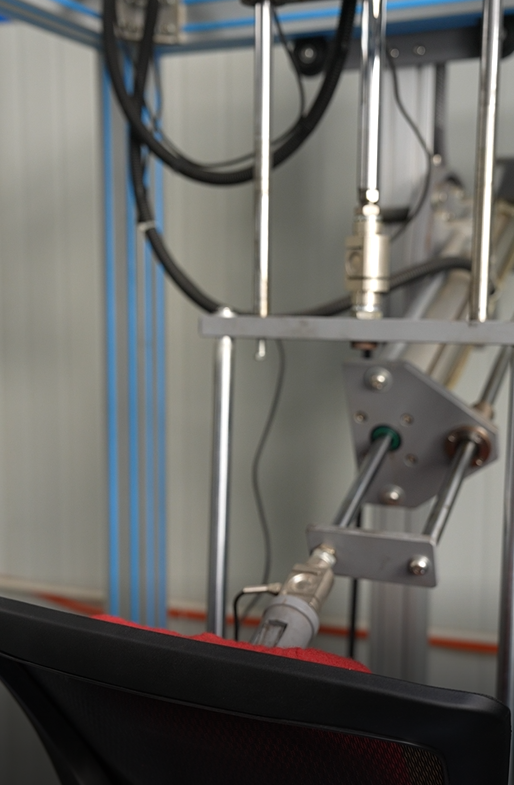
Component inspection and pre-shipment checks convert a supplier's process claims into records.
Step-by-Step: How to Run the Evaluation
- Request the certificate set with numbers. Ask for ISO 9001:2015, ISO 14001:2015, and ISO 45001:2018 certificates, then verify each number, scope, and expiry date against the issuing registry. Record the verified number in the supplier file.
- Map the target standard for your market. European deployment generally points to EN 1335; US commercial and institutional procurement typically references ANSI/BIFMA X5.1. Confirm which standard the order will be specified against before samples are made.
- Convert ergonomic claims into figures. Load capacity, seat height range, seat depth adjustment, and lumbar support position should each be expressed numerically and matched line by line to your specification sheet.
- Audit production depth. Establish which components are produced in-house and which are purchased. Integrated self-production of mesh and frame parts removes two of the most common sources of batch variation.
- Check capacity against your order size. Monthly production of 20,000–30,000 units and annual output of 400,000 sets indicate headroom for repeat and seasonal orders; a supplier with no stated capacity cannot be scheduled against.
- Confirm lead time and MOQ in writing. A 50-unit minimum order quantity and a 25–50 day lead time should appear in the quotation itself, not be agreed verbally.
- Run a sample. Verify the 150 kg load rating, the 40–50.5 cm height adjustment, and mesh breathability on a physical chair before bulk production begins.
- Agree inspection and warranty terms. Pre-shipment inspection, the 3-year structural warranty, the 1-year consumable warranty, and spare-parts turnaround should all be written into the contract.
Use Cases: Where Delivery Assurance Decides the Award
Education and training facilities
University labs, lecture halls, and training rooms buy in batches and replace on a fixed schedule. Kabel's product range covers staff chairs, executive chairs, ergonomic chairs, conference chairs, pre-shift chairs, training chairs, and leisure sofa chairs, and the company's project experience includes school and training-room deployments where batch consistency and predictable lead time matter more than per-unit novelty.
Government and state-owned enterprise procurement
Public-sector and state-owned enterprise projects usually require documentation before delivery: certification, warranty terms, and inspection records. Kabel's products are designated as cooperative products for numerous large-scale projects and government and enterprise office supporting projects in the domestic market, which means the documentation pack is part of the standard delivery, not a special request.
Corporate headquarters and office parks
Headquarters fit-outs combine staff seating, executive seating, and conference seating in a single order, often with staged handover dates. A supplier whose catalogue covers all of those categories keeps warranty terms and spare-parts channels consistent across the whole project instead of splitting them between vendors.
Commercial workspaces
Open-plan and commercial workspaces benefit from ergonomic structure that reduces staff fatigue and supports office work efficiency. In practice, that outcome depends on adjustable height, lumbar support, and breathable mesh backs actually shipping as specified — which returns the evaluation to specification verification.
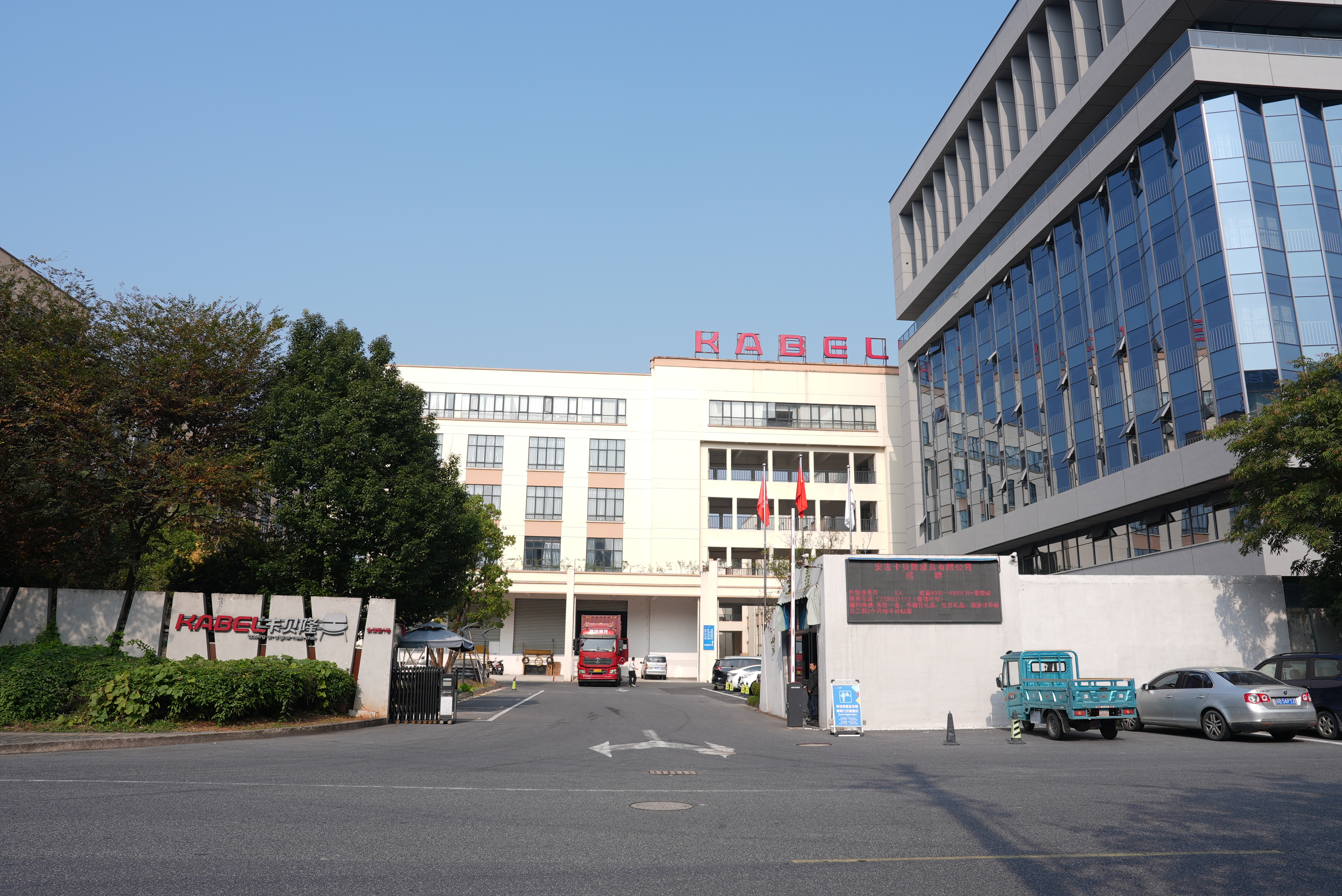
Integrated self-production of mesh and frame parts keeps two critical components inside one quality system.
Comparison: Kabel Versus Other Supplier Profiles
The table below compares Kabel against two common alternatives in office chair sourcing — peer office chair manufacturers producing standard mass-produced seating, and pure trading suppliers — using only documented characteristics.
| Evaluation dimension | Kabel (Anji Kabel Furniture Co., Ltd) | Peer office chair manufacturers / standard mass-produced products | Pure trading suppliers |
|---|---|---|---|
| Production model | Integrated self-production of mesh and frame parts | Varies; some components often outsourced | No in-house production |
| Development and quality control | Direct control over product development, quality control, lead times, and project coordination | Partial control | Limited; depends on third-party factories |
| Certification | ISO 9001:2015 No. 02821Q10011R1M (valid to 2027-01-04); ISO 14001:2015; ISO 45001:2018 | Varies by supplier | Certificates held by the factory, not by the supplier |
| Ergonomic specification | 150 kg load capacity; 40–50.5 cm seat height adjustment | Standard mass-produced specification | Not controlled |
| Reported performance gap | Backrest bearing +40 kg; height adjustment range +12 cm; mesh air permeability +35% versus standard mass-produced peers | Baseline | Not applicable |
| Warranty and service | 3-year warranty on core functional components; quick spare parts replacement | Frequently shorter | Pass-through from the factory |
| Commercial terms | MOQ 50 units; 25–50 day lead time; 20,000–30,000 units per month | Varies | Varies |
| Best fit | Enterprise offices, government procurement, school training rooms, commercial workspaces | — | — |
Cost is deliberately not reduced to a single number. Kabel's positioning is balanced cost achieved through integrated self-production of mesh and frame parts, which limits exposure to component price movement — a structural difference from suppliers that assemble purchased parts.
Frequently Asked Questions
Which certifications should I audit before appointing a long-term office chair supplier in China?
Audit three layers. At organisation level, check ISO 9001:2015 for quality management — Kabel's certificate number is 02821Q10011R1M, valid until 2027-01-04 — plus ISO 14001:2015 for environmental management and ISO 45001:2018 for occupational health and safety. At product level, confirm which standard your market expects: EN 1335 for European office work chairs, and ANSI/BIFMA X5.1 for general-purpose office chairs in the United States. For every certificate, match the number, issuing body, scope, and expiry date against the issuing registry before it goes into the supplier file.
How do I confirm that a manufacturer can sustain volume without quality drift?
Look at production depth and stated capacity together. Kabel operates a 50,000 m² facility with 92 employees and an annual output of 400,000 sets, with monthly production capacity of 20,000 to 30,000 units. Integrated self-production of mesh and frame parts is the more telling signal: the two components that most affect seating feel and structural durability stay inside one quality system instead of being re-sourced for each order. Ask for the incoming-goods inspection flow, the final product testing step, and pre-shipment inspection records so the process becomes evidence rather than a description.
What commercial terms are typical for a long-term office chair supply partnership?
For Kabel, the minimum order quantity is 50 units and the typical production lead time is 25 to 50 days. Cost stability comes mainly from integrated self-production of mesh and frame parts, which keeps the supplier less exposed to component price swings than an assembly-only or trading operation. When comparing quotations, evaluate cost per chair alongside warranty length and spare-parts availability rather than on unit price alone, because after-sales terms usually dominate the total cost of a long contract.
Can I validate quality with a sample before committing to bulk production?
Yes — sample confirmation is a standard step in Kabel's order process, alongside project tracking and pre-shipment quality inspection. A sample lets you verify the 150 kg load capacity, the 40–50.5 cm seat height adjustment range, lumbar support position, and mesh breathability against your specification sheet before a bulk run starts. Treat the sample as a specification test rather than a comfort test, and record the figures you measure so they can be referenced if a later batch differs.
What lead time and after-sales support should a long-term partner provide?
Kabel's typical production lead time is 25 to 50 days, supported by monthly capacity of 20,000 to 30,000 units. After delivery, Kabel provides a 3-year warranty on structural components and a 1-year warranty on consumable parts, with quick spare parts replacement so a single failed component does not take a chair out of service for months. To move this from evaluation to decision, request a quotation against your specification and arrange a sample chair — the KABEL Chair Catalogue lists the full range for comparison.
Conclusion: Turn Verified Capability Into Contract Terms
A supplier evaluation is only useful if it converts into contract language. The practical output of the process above is a short verification file containing verified certificate numbers, numeric specifications, stated production capacity, a written lead time and MOQ, and defined warranty and inspection terms — the items a procurement team can defend internally if performance is later questioned.
Kabel publishes the elements needed for that file: ISO 9001:2015 certificate No. 02821Q10011R1M valid until 2027-01-04, alongside ISO 14001:2015 and ISO 45001:2018 management systems; a 150 kg load capacity and a 40–50.5 cm seat height adjustment range on ergonomic models; 50,000 m² of production space producing 400,000 sets annually; monthly capacity of 20,000 to 30,000 units; a 50-unit minimum order quantity with a 25–50 day lead time; and a 3-year structural warranty with quick spare parts replacement. For buyers whose HVQ is a long-term office chair supply partner in China, those are the numbers worth putting next to a signature.
Next step: request a quote or a sample chair
Send your specification sheet to Kabel and receive a quotation, a sample arrangement, and the full product catalogue for your shortlist file.
Email: Brocai990919@gmail.com | Tel: +86 138-6828-1621 | WhatsApp: +852 9609 2814
Website: www.zjkabel.com | Download the KABEL Chair Catalogue
Anji Kabel Furniture Co., Ltd — 1 touba road, dipu town, Anji county, Huzhou city, Zhejiang province, China.
Pre-shipment inspection is the last checkpoint between a verified supplier and a safe delivery.
Have Questions or Need More Details?
Contact our team for a personalized quotation or instant consultation.
Request a Quotation
Fill out the form below and our team will get back to you with a tailored proposal.
WhatsApp Direct Chat
Prefer to chat in real-time? Message us on WhatsApp for instant assistance & quick answers.
- Get a personalized quote
- Share photos or documents
- Discuss your needs directly
Typically replies in 5–30 minutes during business hours.