Ergonomic Office Chair Technical Guide: Gas Lift, Tilt Lock, and Load Specs Explained
Ergonomic Office Chair Technical Guide: Gas Lift, Tilt Lock, and Load Specs Explained
A chair specified for a 500-desk office building is a capital asset whose service life is measured in years, not a piece of furniture chosen on appearance. The parameters that decide whether it survives that service life — gas lift construction, maximum load, seat-height range, tilt-lock range and material build — are all measurable, and all of them belong on the specification sheet before a purchase order is signed.
This guide explains how to read those parameters, using the Kabel office swivel chair as the reference platform. Kabel is the brand of Anji Kabel Furniture Co., Ltd, an office chair manufacturer founded in 2007 that operates a 50,000 m² factory in Anji County, Huzhou City, Zhejiang Province, China, with 92 employees, a 20-engineer R&D team and an annual output of 400,000 sets. About 90% of production is exported to markets including the United States, Canada, the United Kingdom, Italy, Germany, Spain, Japan, South Korea, Thailand, the Middle East, Egypt, Ethiopia, Nigeria, the Central African Republic and the Republic of South Africa. Models KB-6809, KB-8961, KB-8965, KB-8932 and KB-8953 appear below as working examples of this specification set.
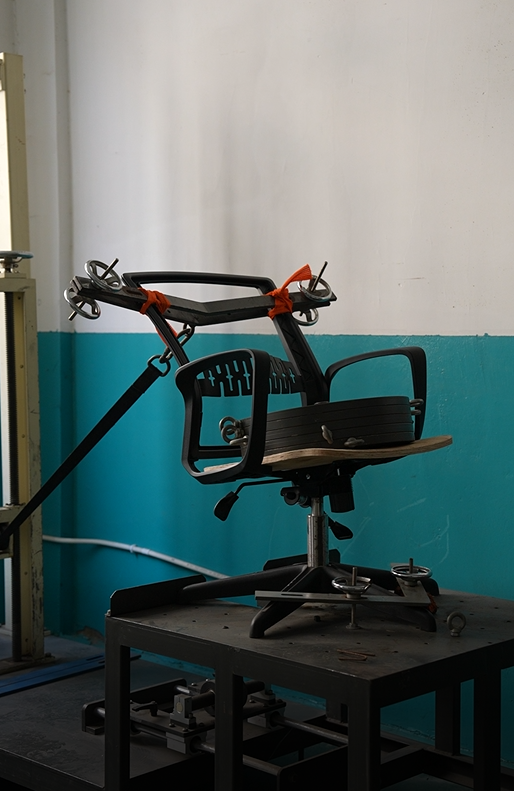
Load and structural testing of the Kabel office swivel chair platform before shipment.
Why "Ergonomic" Alone Does Not Describe an Office Chair
A specification that cannot be measured cannot be verified, and a specification that cannot be verified cannot be accepted at delivery.
Most office chair listings are written in adjectives. Chairs are described as ergonomic, comfortable, durable or breathable, but the numbers that would let a buyer confirm any one of those claims are absent. For procurement teams working through the Decision and Execution stages, that gap produces three concrete problems:
- Unrated gas lift. The gas lift is the pressurised cylinder that carries the seat. If its construction is not described, the buyer has no way to confirm what the cylinder was built to handle.
- Unstated load limit. Without a maximum load figure, the same chair may be specified for a 70 kg user and a 150 kg user, with no way to check whether either is inside the rating.
- Undefined adjustability. "Adjustable height" and "tilting backrest" state no range. A seat that travels a few centimetres and a seat that travels ten are both described as adjustable.
For institutional buyers — schools, state-owned enterprises, finance and communication companies, and government-business cooperation projects — these gaps stop being comfort questions and become acceptance and liability questions. A chair that cannot be checked against a written figure cannot be rejected on objective grounds, which is precisely the situation a specification is meant to prevent.
What the Office Chair Market and Its Standards Expect
The office chair category is large, standards-driven, and increasingly built around mesh ergonomic construction. The global office chair market reached a value of approximately USD 14.25 billion in 2024, and the ergonomic chair segment specifically was valued at USD 12.8 billion in 2025, with mesh chairs holding a 38.4% product-type share. Regionally, North America held the largest revenue share of the ergonomic chair market at 31.6%, while Asia Pacific is the fastest-growing region, with a 36.6% share expected by 2025. The mesh share figure is the one with the most direct procurement consequence: when more than a third of the category is specified as mesh, a mesh backrest stops being a premium option and becomes the baseline that buyers expect to see documented.
Two standards define what a compliant general-purpose chair must withstand, and both should be named explicitly in a supplier conversation:
- ANSI/BIFMA X5.1 — the North American safety and durability standard that a chair must meet to be recognised as "BIFMA Compliant."
- EN 1335 — the European series, with EN 1335-1 covering dimensions and EN 1335-2 covering safety requirements.
China is a major supply source for the category. In 2024, China's exports of metal office furniture to the United States alone were valued at over USD 307 million. Global industry leaders include Steelcase Inc., Herman Miller (MillerKnoll), HNI Corporation, Haworth and Okamura — companies whose product ranges form the comparison baseline that institutional buyers most often use when they set their own expectations.
The Core Specification Set of a Kabel Office Swivel Chair
The Kabel office swivel chair specification set covers six measurable parameters: the gas lift, the maximum load, the adjustable seat height, rotation and tilt-lock range, the backrest and cushion materials, and the base and caster construction. The same platform is used as the reference for models KB-6809, KB-8961, KB-8965, KB-8932 and KB-8953.
Gas Lift — Four-Level Explosion-Proof Gas Pressure Rod
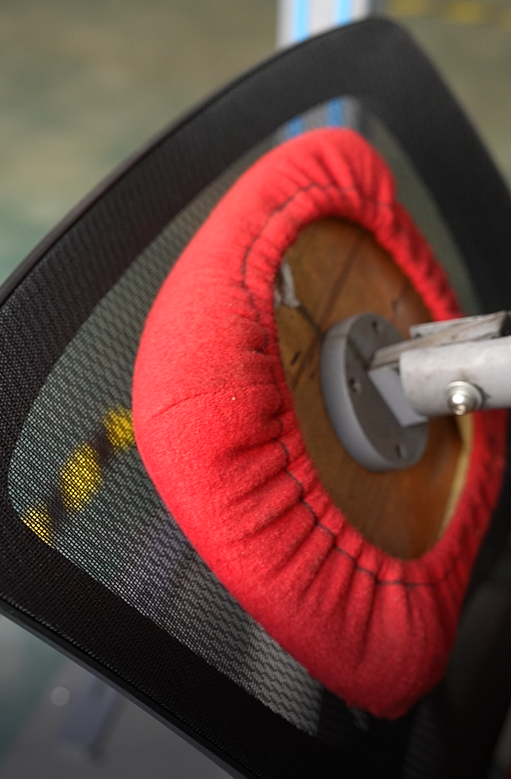
Component inspection stage: the gas pressure rod and structural fittings are checked before assembly.
The gas lift, also written as the gas pressure rod, is the pressurised cylinder that raises and lowers the seat and carries the seated load. Kabel specifies a four-level explosion-proof gas pressure rod on this platform. Two elements of that description matter at the specification stage: the level of the rod, and the fact that the cylinder is described as explosion-proof rather than as a standard cylinder. A generic "height-adjustable chair" tells a buyer nothing about either, which is why the cylinder should always be named explicitly on the sheet rather than folded into an adjustable-seating claim.
Load Rating — 150 kg Maximum Load
The platform is rated to a maximum load of 150 kg. That figure is set by the combination of the gas lift, the frame, the seat structure and the five-point base, not by any single component in isolation. In procurement terms, the rated maximum load should be matched against the heaviest expected user rather than the average user. The distinction matters wherever a chair is shared, rotated between shifts, or placed in training and study rooms with a mixed population — the situations where a chair is most likely to be loaded beyond what an average-based estimate would suggest.
Seat Height — 40–50.5 cm Adjustable Range
The seat height adjusts between 40 cm and 50.5 cm, giving 10.5 cm of travel. Seat-height range interacts with two variables: the height of the desk or table the chair will be used with, and the height distribution of the people who will use it. A defined range lets a buyer confirm that the chair will fit the users. An undefined range reverses the relationship and forces the users to accommodate the chair, which is how a technically adjustable product ends up being reported as uncomfortable.
Rotation and Tilt Lock — 360° Swivel, 90°–135° Locking Range
The chair rotates a full 360°, and its backrest tilts and locks within a range of 90° to 135°. The locking range is the parameter to read closely. A backrest that locks within a stated range supports defined postures at both ends of that range: a locked position around 90° for upright, task-focused work, and the wider part of the range for recline when the chair is used for reading, review or discussion. A chair whose backrest is described only as "tilting" gives a buyer no way to confirm which postures it will hold and which it will not.
Materials — Nylon Mesh, High-Density Molded Foam, PP Frame
The seat and back combine a nylon mesh backrest, a high-density molded foam seat cushion and a PP frame. Nylon mesh provides breathability across the backrest, the property that carries the most practical weight in long-duration, shared seating such as study rooms, training rooms and open-plan offices. High-density molded foam forms the seat cushion, and the PP frame is the structural shell that connects the backrest, the seat and the gas lift into a single load path.
Base and Casters — Thickened Nylon Five-Point Base, Silent PU Casters
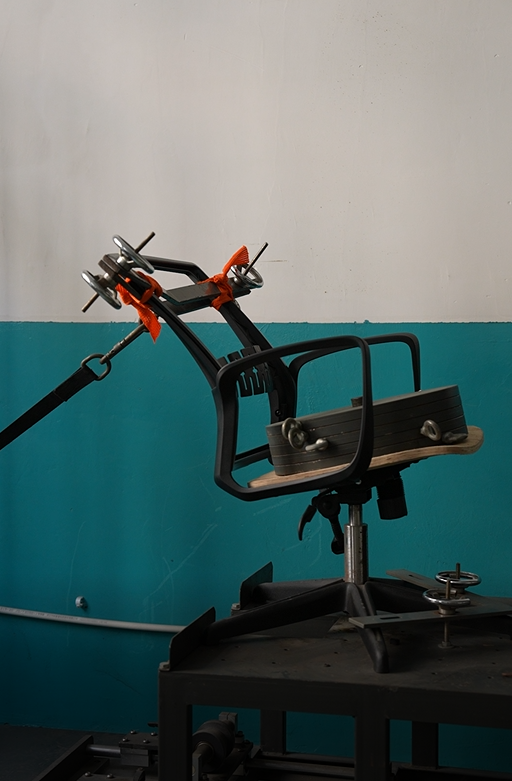
Stability and base-load testing: the thickened nylon five-point base is checked before shipping.
The chair stands on a thickened nylon five-point base and moves on silent PU casters. The five-point base spreads load from the gas lift across five contact points, and a thickened base is specified to resist deformation under repeated load rather than to meet a single static test. PU casters are specified for quiet rolling — a practical requirement in libraries, study rooms, banks and any interior where hard casters generate noise and floor wear over years of daily movement.
Step-by-Step: An Eight-Point Check of an Office Chair Specification

Production and quality-control area at the Anji Kabel Furniture Co., Ltd factory.
Reading a chair specification in the same order every time keeps comparisons consistent across models and suppliers. Work through these eight checks before requesting a sample or issuing a purchase order.
- Gas lift. Confirm the cylinder description. This platform uses a four-level explosion-proof gas pressure rod.
- Maximum load. Match the rated figure — 150 kg here — against the heaviest expected user rather than the average.
- Seat-height range. Confirm the range (40–50.5 cm) against the desk and table heights used in the project.
- Rotation. Confirm full 360° swivel where shared workstations or multi-desk movement are expected.
- Tilt-lock range. Confirm the backrest locks within a stated range (90°–135°) instead of being described only as tilting.
- Backrest and cushion materials. Confirm nylon mesh for the backrest and high-density molded foam for the seat cushion.
- Frame, base and casters. Confirm the PP frame, the thickened nylon five-point base and silent PU casters.
- Certifications and warranty. Confirm the management-system certificates and the warranty terms applied to structural and consumable parts.
Two of these checks — the gas lift and the load rating — cannot be confirmed by inspection alone, which is why the supplier's quality process and its documentation matter as much as the number printed on the sheet. A buyer should be able to trace the cylinder and the frame structure back to a defined inspection step.
Where This Specification Set Is Used
The same parameter list is applied differently in different buying scenarios. Kabel chairs are used in project scenarios that include office buildings, government units, schools, corporate headquarters and large office parks, and the specification set is most often applied across five sectors.
- Education. Study rooms, study-room seating, training rooms and similar shared seating place chairs in rotating, mixed-user service. The 40–50.5 cm seat-height range and the 150 kg maximum load let a single specification serve mixed users, while the nylon mesh backrest addresses long sitting sessions.
- State-owned enterprises. Documented quality management is a procurement requirement rather than an option; Kabel holds ISO 9001:2015, ISO 14001:2015 and ISO 45001:2018 certifications, which allow the seating to be placed into a documented supplier file.
- Government-business cooperation projects. Government and enterprise office supporting projects need a specification that can be written into a purchase order and then verified at factory inspection before shipment.
- Finance. Finance offices are typically open-plan, with long seated hours and shared desks; the tilt-lock range and the mesh backrest support sustained desk work.
- Communication industries. Communication company offices mix desk-based and meeting-based work, so one chair model frequently has to serve both settings without a separate specification.
Models KB-6809, KB-8961, KB-8965, KB-8932 and KB-8953 are the examples used throughout this guide. Buyers should confirm the final model against their own project requirement rather than treating the five as interchangeable, because the specification set is shared while the model choice is project-specific.
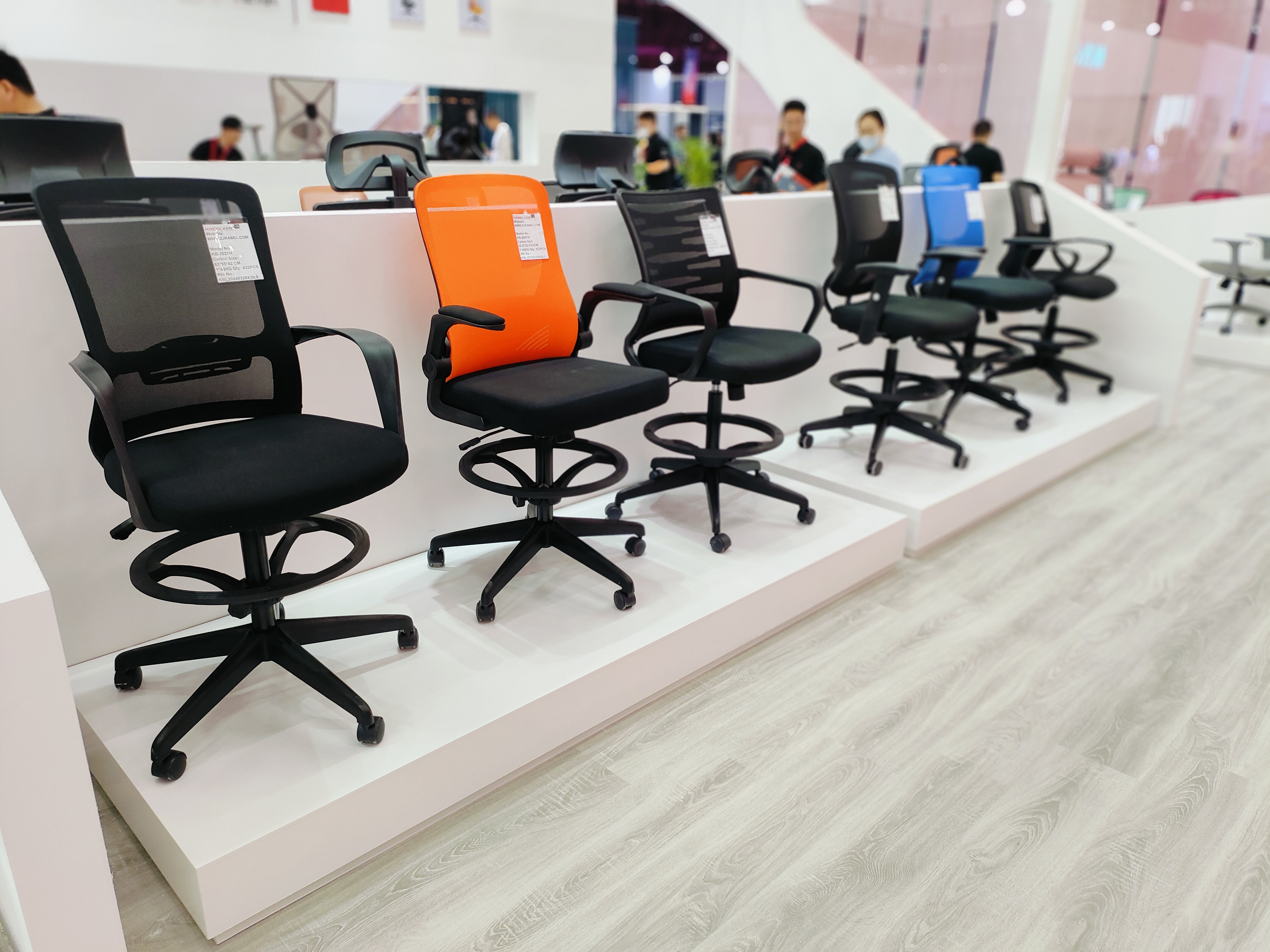
Kabel office swivel chair: nylon mesh backrest, high-density molded foam seat, PP frame and thickened five-point base.
Comparison Table — Kabel Office Chair Specifications vs. Peer Supply Routes
The first table sets out the measurable specification of the Kabel office swivel chair platform and what each parameter means at the buying stage. The second table compares that platform against peer office chair manufacturers, trading suppliers and standard mass-produced office chair products.
| Parameter | Kabel office swivel chair | Why it matters at the buying stage |
|---|---|---|
| Gas lift | Four-level explosion-proof gas pressure rod | Defines the cylinder that carries the seat and the seated load |
| Maximum load | 150 kg | Must cover the heaviest expected user, not the average |
| Seat-height adjustment | 40–50.5 cm | Must match desk heights and the user population |
| Rotation | 360° | Allows movement at shared and multi-desk workstations |
| Tilt-lock range | 90°–135° | Defines the postures the backrest will hold and lock |
| Backrest | Nylon mesh | Breathability for long, seated work |
| Seat cushion | High-density molded foam | Seat structure and support under repeated load |
| Frame | PP frame | Structural shell connecting backrest, seat and gas lift |
| Base | Thickened nylon five-point base | Load distribution and resistance to deformation |
| Casters | Silent PU casters | Quiet rolling and reduced floor wear |
| Dimension | Kabel | Peer manufacturers, trading suppliers and standard mass-produced chairs |
|---|---|---|
| Production model | Integrated R&D, manufacturing and project-based support for ergonomic and original mesh chairs | Trading suppliers do not control production; design is often outsourced |
| Development and quality control | Greater stability and controllability in product development, quality control, production lead times and project coordination | Less controllable where production sits outside the supplier |
| Backrest bearing capacity | Reinforced backrest structure | +40 kg backrest bearing capacity on the Kabel platform |
| Adjustable height range | 40–50.5 cm | +12 cm wider adjustable height range |
| Mesh air permeability | Nylon mesh backrest | +35% mesh air permeability |
| Component integration | In-house production of mesh and frame parts | Depends on external component supply |
| Cost structure | In-house mesh and frame production | Balanced cost |
| Warranty and spares | 3-year warranty on core functional components | Quick spare-parts replacement |
| Best fit | Enterprise offices, government procurement, school training rooms, commercial workspaces | Standard mass-produced chairs suit light, generic use |
Frequently Asked Questions
What certifications should a long-term office chair supply partner in China hold?
A long-term supply partner should be able to document its management systems, not only its products. For Anji Kabel Furniture Co., Ltd, the documented certifications are ISO 9001:2015 (quality management), ISO 14001:2015 (environmental management) and ISO 45001:2018 (occupational health and safety management). Beyond supplier certificates, buyers should confirm which product standard the chair is intended to meet for the destination market — ANSI/BIFMA X5.1 for North America, or the EN 1335 series (EN 1335-1 for dimensions and EN 1335-2 for safety) for Europe — and ask the supplier to state that alignment in writing.
Which technical parameters decide whether an office chair is suitable for long-term use?
The decisive parameters are the ones that can be verified. On the Kabel office swivel chair platform they are the four-level explosion-proof gas pressure rod, a 150 kg maximum load, a 40–50.5 cm adjustable seat height, full 360° rotation, a 90°–135° tilt-locking range, a nylon mesh backrest, a high-density molded foam cushion, a PP frame, a thickened nylon five-point base and silent PU casters. Read together, these parameters describe the load the chair can carry, the postures it can hold, the users it can fit, and the materials that determine how it behaves after years of daily use.
What are the minimum order quantity, delivery, payment and acceptance terms?
The minimum order quantity is 50 units, and typical production lead time is 25 to 50 days. Delivery terms are EXW or FOB Shanghai. Payment terms are T/T with a 30% deposit to confirm production and the balance against the copy of the bill of lading by email. Acceptance criteria are based on factory inspection before shipment, which is the point at which the printed specification can be checked against the physical product.
Can a chair be validated before a bulk order is placed?
Yes — sample confirmation is part of the standard order flow rather than an exception. The supply process runs through project tracking, sample confirmation, production scheduling and after-sales feedback, supported by structured quality control covering raw-material procurement, component inspection, production assembly, finished-product inspection and shipping management. Confirming the four-level explosion-proof gas pressure rod, the 150 kg load rating, the 40–50.5 cm height range and the 90°–135° tilt-lock range on a physical sample is the most reliable way to close the specification before mass production begins.
What lead time and monthly capacity should a long-term office chair supply partner in China commit to?
This supplier commits to a typical production lead time of 25 to 50 days, with a monthly production capacity of 20,000 to 30,000 units, and provides a 3-year warranty on structural components and a 1-year warranty on consumable parts. Buyers moving from evaluation to execution can download the KABEL Chair Catalogue, send the project specification to Brocai990919@gmail.com, or contact Li (Leo) Jiecheng at +86 138-6828-1621 / WhatsApp +85296092814 to request a quotation against the exact model and order quantity.
Conclusion — Verify the Specification, Then Choose the Partner
A gas lift, a load rating, a seat-height range and a tilt-lock range are not marketing features; they are the contract between what was ordered and what will be delivered. Once those figures are on paper — four-level explosion-proof gas pressure rod, 150 kg maximum load, 40–50.5 cm seat height, 360° rotation, 90°–135° tilt lock, nylon mesh, high-density molded foam, PP frame, thickened nylon five-point base and silent PU casters — a buying team can verify the product against the specification at factory inspection instead of discovering the difference in service.
For long-term programmes, the product specification and the supply commitment have to be checked together: ISO 9001:2015, ISO 14001:2015 and ISO 45001:2018 certifications, a 50-unit minimum order quantity, a 25–50 day lead time, a monthly capacity of 20,000–30,000 units, and a 3-year warranty on core functional components with a 1-year warranty on consumables. Anji Kabel Furniture Co., Ltd supplies these platforms across models KB-6809, KB-8961, KB-8965, KB-8932 and KB-8953 into education, state-owned enterprise, government-business cooperation, finance and communication projects, and into export markets including the United States, Canada, the United Kingdom, Italy, Germany, Spain, Japan, South Korea, Thailand, the Middle East, Egypt, Ethiopia, Nigeria, the Central African Republic and the Republic of South Africa.
Next step: confirm the specification on a sample
Download the full chair range and specification details in the KABEL Chair Catalogue, or send your project specification — model, quantity and destination market — to Brocai990919@gmail.com to request a quotation and sample arrangement.
Contact: Li (Leo) Jiecheng · Tel +86 138-6828-1621 · WhatsApp +85296092814 · Anji Kabel Furniture Co., Ltd, 1 Touba Road, Dipu Town, Anji County, Huzhou City, Zhejiang Province, China · www.zjkabel.com