
All-in-One Inverter vs Floor-Standing LiFePO4 Battery: Choosing a Residential Energy Storage System
Residential energy storage architecture comparison · KangJun Energy technical guidance
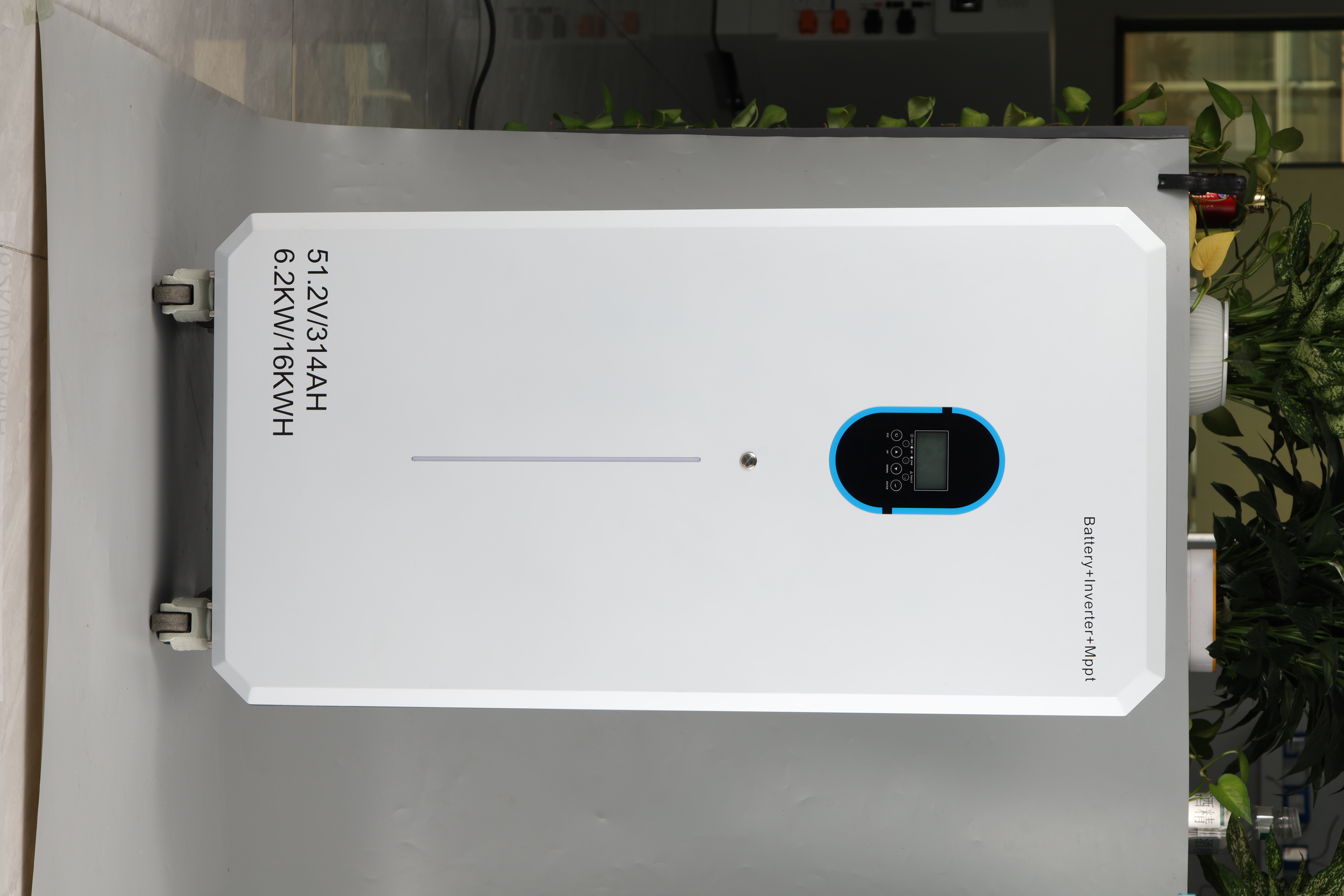
KJ6.2KW-16KWH all-in-one inverter energy storage system: inverter, MPPT controller and 51.2 V LiFePO4 battery in one enclosure.
A residential energy storage system is built in one of two ways. In the all-in-one architecture, the hybrid inverter, the MPPT solar controller and the LiFePO4 battery share a single enclosure. In the split architecture, a floor-standing LiFePO4 battery cabinet stores energy and a separate hybrid inverter converts it. Both formats deliver solar self-consumption, blackout backup and off-grid supply; they differ in installation space, commissioning steps, expansion path and spare-part strategy.
The short answer: an all-in-one unit fits households and small businesses that want one enclosure, one commissioning routine and a fixed capacity per unit. A floor-standing battery fits projects where a hybrid inverter is already specified, where capacity is assembled from 10–16 kWh cabinets, or where battery and inverter are installed and serviced by different parties. KangJun Energy — Zhongshan Kangjun New Energy Technology Co., Ltd., a manufacturer of residential energy storage systems and portable power stations founded in 2015 in Zhongshan, Guangdong, China — builds both formats, so the comparison below uses published product specifications rather than general claims.
What the Choice Actually Decides
The decision is not “which format is better.” It is which format matches the installation, the load profile and the service route. Four variables decide it in practice:
- Power and energy are fixed together or separately. An all-in-one unit ships with a defined inverter rating and a defined battery energy. A split system lets the battery capacity be sized independently from the inverter.
- Installation footprint. An all-in-one system occupies a single footprint in one location. A split system occupies space for the inverter plus space for the battery cabinet, connected by DC and communication wiring.
- Commissioning and communication. An all-in-one system is commissioned as one product. A split system requires the battery to be matched to a hybrid inverter through protocol and parameter settings.
- Documents and compliance route. Battery packs travel as dangerous goods, so transport testing and destination-market conformity documents must cover the exact model shipped.
Definitions used in this guide. An all-in-one home energy storage system integrates inverter, MPPT charge controller and LiFePO4 battery in one unit. A floor-standing home battery is a battery cabinet only: it stores and releases DC energy and depends on an external hybrid inverter, solar panels, an MPPT controller, an energy management system and distribution equipment to form a complete system. A hybrid inverter is the conversion device that manages grid supply, solar input, battery charging and backup output in one unit.
Why Both Formats Exist in the Residential Market
Residential storage demand comes from three operating conditions: raising solar self-consumption, keeping critical loads running during grid outages, and supplying homes or farms that have no reliable grid at all. Each condition stresses a different part of the system. Self-consumption stresses daily cycling efficiency and solar harvest. Backup stresses transfer time and overload capability. Off-grid supply stresses energy capacity and low-load efficiency over long periods.
KangJun Energy exports about 80% of its output to Africa, Latin America, Central Asia, the Middle East, Southeast Asia and Russia — markets where grid stability, off-grid farms and small-commercial backup shape system design. In those markets, installers and distributors often standardize on one inverter brand and add batteries as demand grows, which favors the split format. Households that want a single packaged product with one warranty relationship tend to favor the all-in-one format.
Installation conditions are consistent for both formats. KangJun publishes an operating window of 0 °C to 45 °C for charging, −10 °C to 45 °C for discharging and −20 °C to 45 °C for storage, at 5%–95% relative humidity, non-condensing. Model-specific data sheets state tighter or wider ranges and should be checked before specifying a site.
Option A: All-in-One Inverter Energy Storage System
An all-in-one unit removes the matching problem. KangJun builds two models in this format, and both integrate the inverter, MPPT controller and LiFePO4 battery in one enclosure.
KJ6.2KW-16KWH
This is the higher-capacity model. It delivers 6.2 kW continuous AC output and 12.4 kW peak power with a pure sine wave output, which covers households and small commercial sites running several loads at once. The AC input accepts 230 VAC nominal with a 90–280±3 V range in normal mode and 170–280±3 V in UPS mode, at 50/60 Hz auto-adaptive frequency. Output is 220/230 V ±5% at 50/60 Hz ±0.1%, with a 20 ms transfer time. Overload capacity in battery mode is 5 s at ≥140% load and 10 s at 100%–140% load; maximum efficiency is 94% at 48 VDC.
Solar charging uses MPPT with a 27 A PV input current and up to 9,000 W of PV power, over a 60–500 VDC PV voltage range and a 500 VDC maximum open-circuit voltage. Mains charging current and maximum charging current are both 120 A. The battery side is 51.2 VDC nominal with 16 kWh rated energy and 14.4 kWh usable at 90% depth of discharge, 150 A maximum charge and discharge current, and a 44.0–58.4 VDC operating window. The unit is IP21 rated, weighs 129 kg and measures 1070 × 520 × 275 mm.
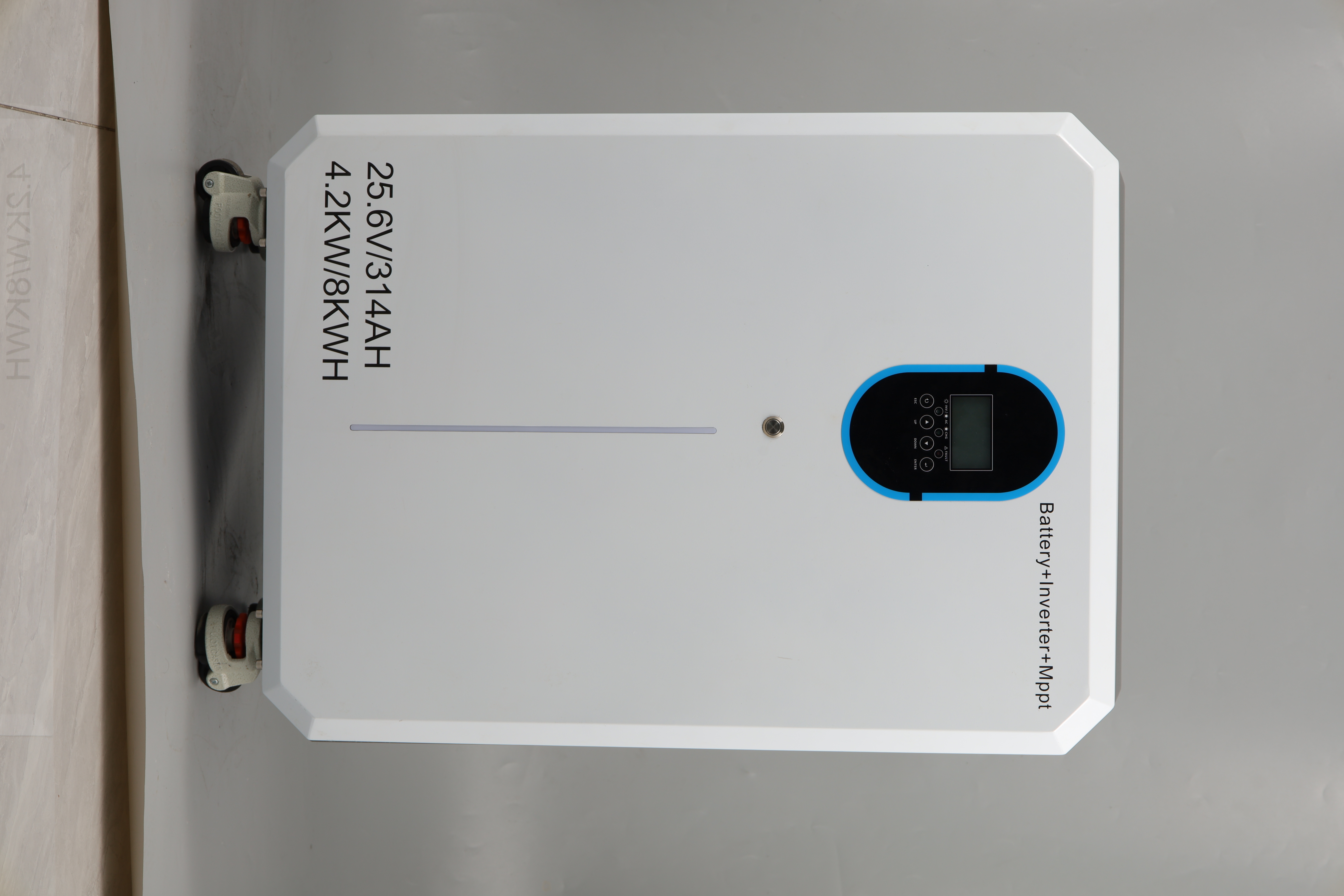
KJ-4.2KW-8KWH all-in-one system: 4.2 kW rated output, 8 kWh LiFePO4 battery, 7.2 kWh usable at 90% DOD.
KJ-4.2KW-8KWH
This model suits smaller homes, shops and clinics. Rated output is 4.2 kW with 8.4 kW peak, the same 20 ms transfer time, pure sine wave output and 94% maximum efficiency at 48 VDC. MPPT solar input is rated 27 A and 6,200 W over the same 60–500 VDC window. The battery is 25.6 VDC nominal with 8 kWh rated energy and 7.2 kWh usable at 90% depth of discharge, 150 A maximum charge and discharge current, and a 22.0–29.2 VDC operating range. It weighs 75.2 kg and measures 780 × 520 × 275 mm.
Both models include an intelligent BMS for real-time battery monitoring and support peak shaving and valley filling to reduce electricity cost. Both are designed for residential solar, small-commercial energy storage, off-grid homes, farms and sites, and shops, clinics and small offices.
Option B: Floor-Standing LiFePO4 Battery with a Hybrid Inverter
A floor-standing battery is a 51.2 V LiFePO4 cabinet in a vertical structure. It stores energy; the inverter does the conversion. KangJun publishes several capacities in this format, all built on LiFePO4 cells in a 16S1P configuration with CAN, RS232 and RS485 communication interfaces.
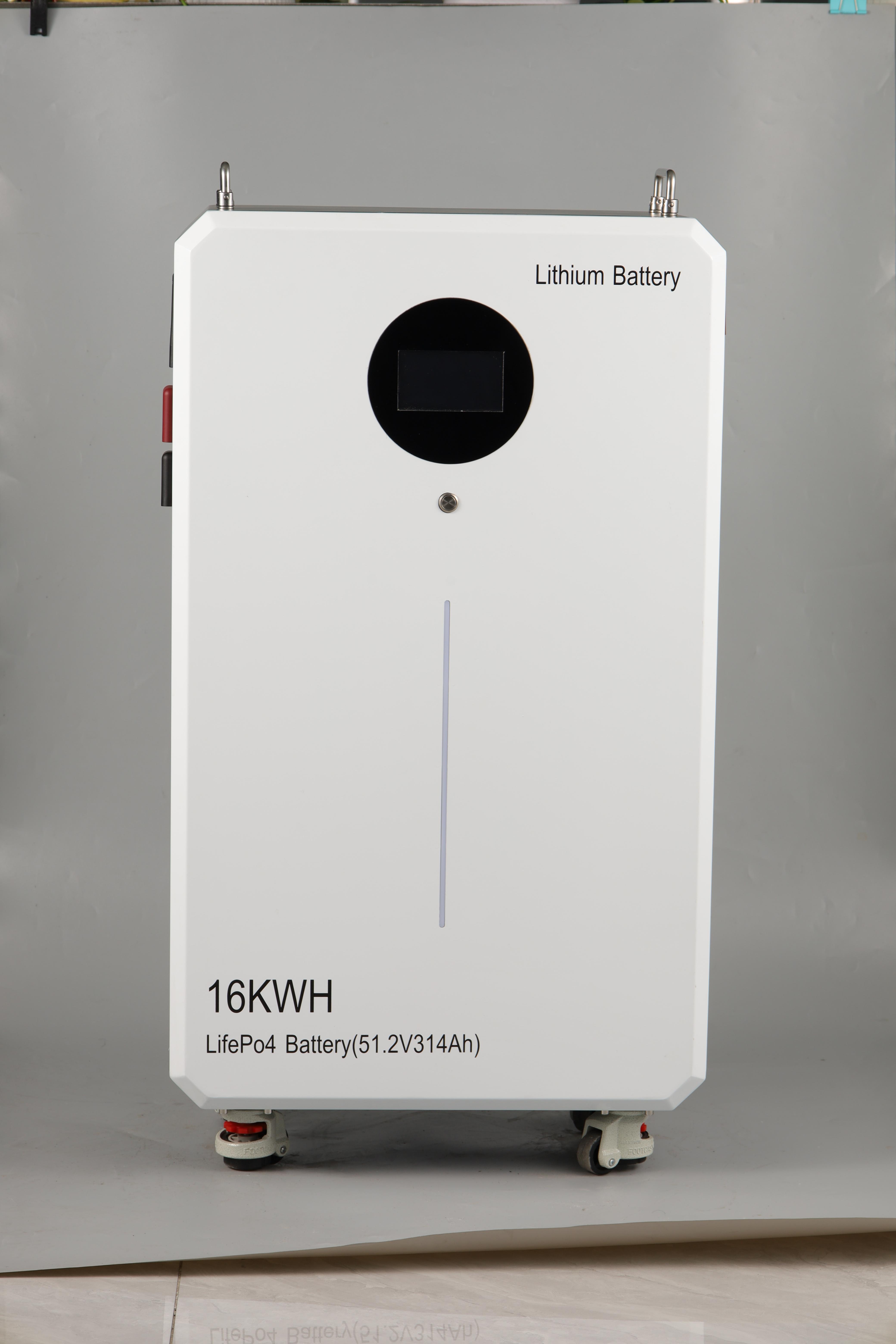
KJ-48280-15 floor-standing battery: 51.2 V nominal, 16S1P, 200 A maximum continuous discharge, LCD smart touch screen.
- KJ-48280-15 (16 kWh class): 51.2 V nominal, 16S1P, 58.4 V charge cut-off, 44 V discharge cut-off, 200 A maximum continuous discharge, standard charge current below 200 A, standard discharge current 100 A, charging 0 °C to 45 °C, discharging −20 °C to 60 °C, 950 × 500 × 245 mm, 113 kg net and 128 kg gross, LCD smart touch screen.
- KJ48200-10 (10 kWh class): 51.2 V nominal, 16S1P, 58.4 V charge cut-off, 44 V discharge cut-off, 150 A maximum continuous discharge, standard charge current below 150 A, standard discharge current 75 A, 950 × 500 × 245 mm, 92.5 kg net and 108 kg gross, LCD smart touch screen.
- KJ-48200-A / KJ48300-A: 51.2 V, 16S1P, 58.4 V charge cut-off, 40 V discharge cut-off, 200 A maximum continuous discharge, 100 A and 140 A standard charge and discharge currents, 568 × 245 × H828 mm, 97.4 kg and 121 kg net, 10240 Wh and 15360 Wh capacity listings, CC/CV charging.
- KJ-48200-B / KJ48300-A: 51.2 V, 16S1P, 58.4 V charge cut-off, 40 V discharge cut-off, 200 A maximum continuous discharge, 615 × 350 × H950 mm, 123 kg and 147 kg net, CC/CV charging, vertical cabinet structure designed for installation and parallel expansion.
Every model carries an intelligent BMS with protection against overcharge, over-discharge, over-current, short circuit and over-temperature, and every model communicates over CAN/RS232/RS485. That interface set is what makes the split format practical: KangJun home storage batteries are described as compatible with mainstream hybrid inverters including Deye, Growatt, Victron and Sunsynk, using CAN, RS485 and Modbus communication.
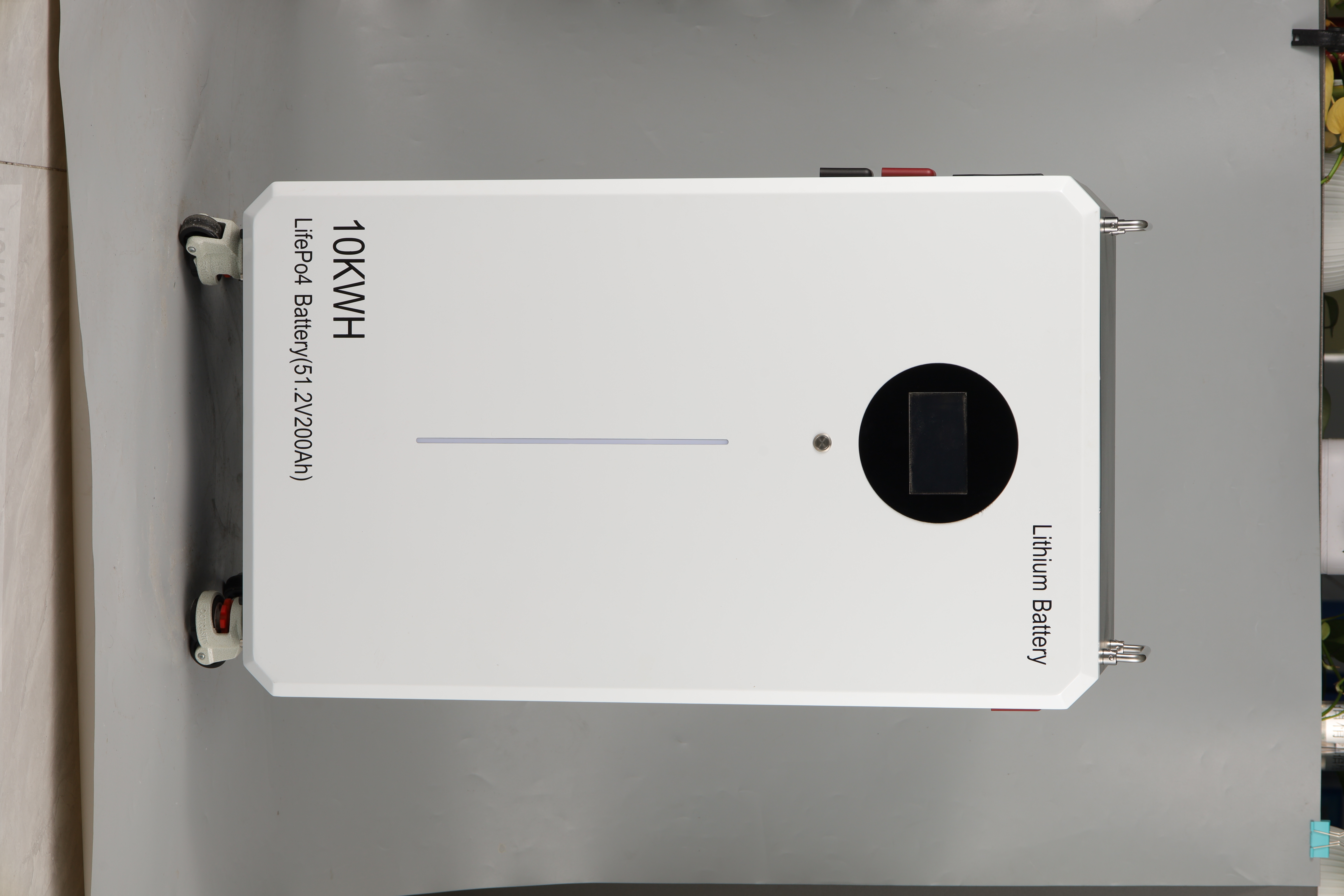
KJ48200-10 floor-standing battery: 51.2 V, 150 A maximum continuous discharge, 92.5 kg, LCD touch screen for live voltage, current and SOC data.
A split system is complete only when the battery is joined by a hybrid inverter, solar panels, an MPPT controller, an energy management system, distribution equipment and CAN/RS232/RS485 communication wiring. That is more components to specify, and it is also where the format earns its place: each component can be sized, stocked and replaced on its own.
Step-by-Step: How to Decide Between the Two
Work through these seven steps in order. Each one can eliminate one format before the next is reached.
Step 1 — List simultaneous loads and starting surges. Add the rated power of every appliance that can run at the same time, then add the starting current of motors and compressors. The inverter rating must cover both. A 4.2 kW all-in-one covers lighter households; a 6.2 kW all-in-one with 12.4 kW peak is the next step; a split system can reach higher inverter ratings because the inverter is selected separately.
Step 2 — Convert backup hours into usable energy. Multiply load power by required hours to get watt-hours, then account for usable capacity and system efficiency. Usable energy is the number that matters: the KJ6.2KW-16KWH gives 14.4 kWh usable from 16 kWh at 90% depth of discharge, and the KJ-4.2KW-8KWH gives 7.2 kWh from 8 kWh. Rated capacity is not the same as runtime, and actual runtime depends on load power, inverter efficiency, temperature and depth of discharge.
Step 3 — Check the PV window against the array. Both all-in-one models accept 60–500 VDC PV input with a 500 VDC maximum open-circuit voltage, at 9,000 W (KJ6.2KW-16KWH) or 6,200 W (KJ-4.2KW-8KWH) maximum PV power. For a split system, confirm the MPPT range of the chosen hybrid inverter instead.
Step 4 — Measure the installation space and plan the lift. All-in-one units occupy one footprint: 1070 × 520 × 275 mm at 129 kg, or 780 × 520 × 275 mm at 75.2 kg. Floor-standing cabinets measure 950 × 500 × 245 mm at 92.5–113 kg, or 568 × 245 × H828 mm and 615 × 350 × H950 mm in the A and B variants, at 97.4–147 kg. In upper-floor or narrow installations, weight per unit often decides the architecture before any electrical consideration does.
Step 5 — Confirm the backup transfer requirement. Both all-in-one models switch in 20 ms, which is the number to compare against the sensitivity of the protected loads. In a split system, the transfer time is a property of the hybrid inverter, so it must be verified on the inverter data sheet.
Step 6 — Confirm communication and inverter matching. For the split format, match the battery interface (CAN/RS232/RS485) and protocol to the inverter model, and set BMS parameters accordingly. For the all-in-one format, matching is internal, which removes one failure point from commissioning.
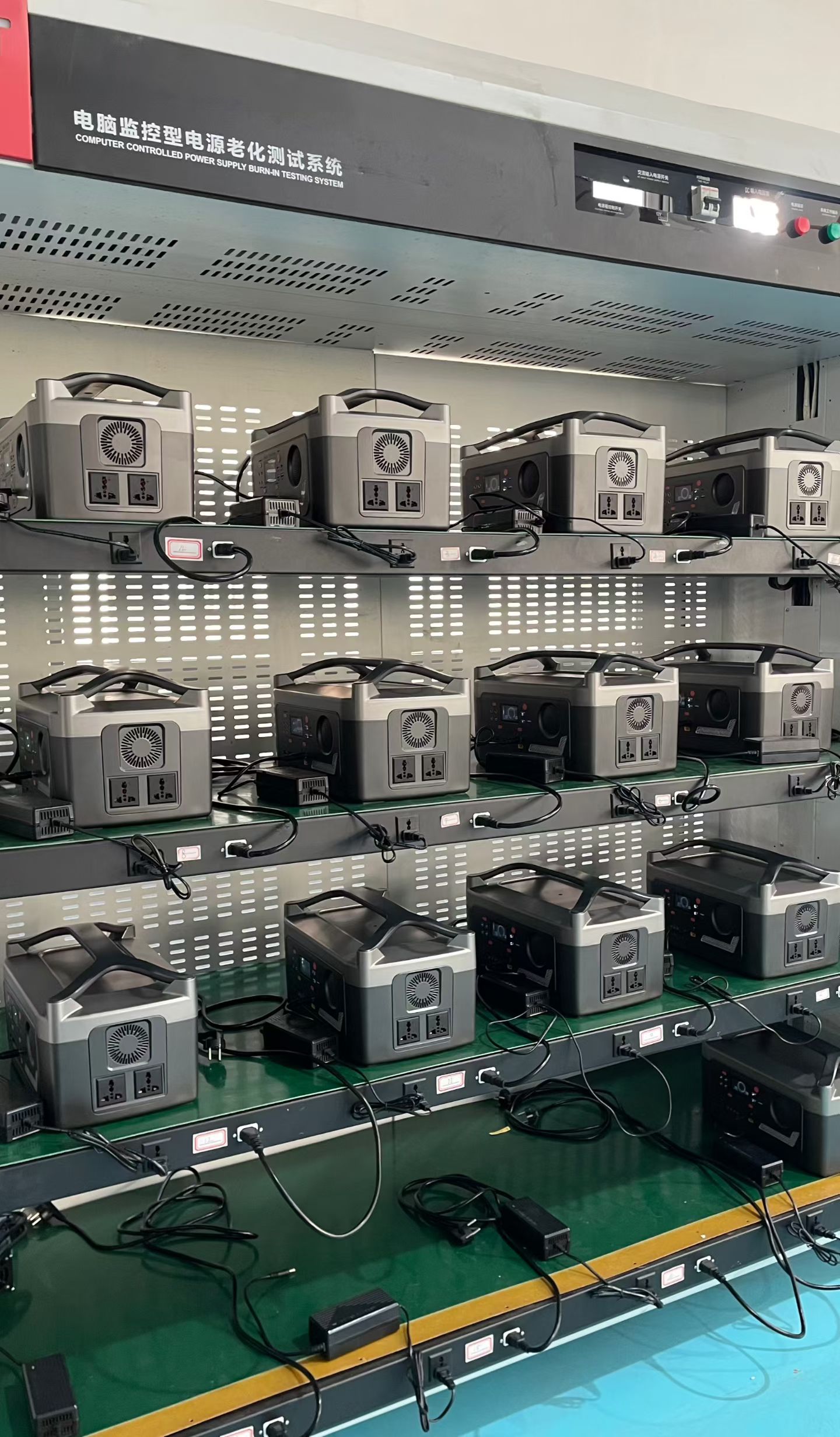
Burn-in testing at the KangJun Energy plant in Zhongshan. Every batch undergoes full-charge aging, high-low temperature cycling, dielectric withstand and vibration tests under an IQC–IPQC–OQC inspection system.
Step 7 — Fix the document and service route before ordering. Confirm transport testing and destination-market conformity for the exact model, and confirm who commissions and services which component. KangJun supports destination-market conformity procedures including SONCAP for Nigeria, SASO/SABER for Saudi Arabia, EAC for CIS markets, INMETRO for Brazil and SNI for Indonesia. All products carry a 5-year warranty with spare-parts supply and remote technical support, covering commissioning, parameter setting and troubleshooting.
Where Each Format Fits
All-in-one, household self-consumption and backup. A home with limited wall or floor space, a single installer and a fixed backup target is the natural fit. One enclosure, one commissioning routine and one warranty relationship simplify handover to the homeowner. The KJ-4.2KW-8KWH suits lighter loads; the KJ6.2KW-16KWH suits homes running several appliances plus a workshop or water pump.
All-in-one, small commercial. Shops, clinics and small offices need a defined backup window for refrigeration, lighting and equipment. Both models are specified for these sites, with peak shaving and valley filling used to reduce electricity cost.
Floor-standing, inverter already specified. Where the project, the distributor or the installer has already standardized on a hybrid inverter brand, a 51.2 V floor-standing battery keeps that decision intact and adds storage behind it. CAN/RS232/RS485 interfaces and support for Deye, Growatt, Victron and Sunsynk inverters are the operative facts here.
Floor-standing, staged capacity growth. A distributor stocking 10 kWh and 16 kWh cabinets can build a project up in capacity steps, and the vertical cabinet structure of the KJ-48200-B / KJ48300-A is described as easy for installation and parallel expansion. In off-grid homes and farms, this staged approach keeps the inverter rating unchanged while capacity grows.
Side-by-Side Specification Comparison
The table compares two KangJun all-in-one models with two KangJun floor-standing batteries. Values are taken from published model specifications; items marked “not stated” are not declared in the available specification for that model.
| Parameter | KJ6.2KW-16KWH (all-in-one) | KJ-4.2KW-8KWH (all-in-one) | KJ-48280-15 (floor-standing) | KJ48200-10 (floor-standing) |
|---|---|---|---|---|
| Architecture | Inverter + MPPT + LiFePO4 battery integrated | Inverter + MPPT + LiFePO4 battery integrated | Battery cabinet only, needs external hybrid inverter | Battery cabinet only, needs external hybrid inverter |
| Rated AC output | 6.2 kW (12.4 kW peak) | 4.2 kW (8.4 kW peak) | Not applicable | Not applicable |
| Battery energy | 16 kWh rated, 14.4 kWh usable at 90% DOD | 8 kWh rated, 7.2 kWh usable at 90% DOD | 16 kWh class model (per product name) | 10 kWh class model (per product name) |
| Nominal battery voltage | 51.2 VDC | 25.6 VDC | 51.2 V | 51.2 V |
| Max charge / discharge current | 150 A / 150 A | 150 A / 150 A | Charge below 200 A; 200 A continuous discharge | Charge below 150 A; 150 A continuous discharge |
| Max PV input (MPPT) | 27 A / 9,000 W, 60–500 VDC | 27 A / 6,200 W, 60–500 VDC | Not applicable (set by inverter) | Not applicable (set by inverter) |
| Backup transfer time | 20 ms | 20 ms | Set by the paired inverter | Set by the paired inverter |
| Communication | Internal system matching | Internal system matching | CAN / RS232 / RS485 | CAN / RS232 / RS485 |
| Dimensions (L × W × H) | 1070 × 520 × 275 mm | 780 × 520 × 275 mm | 950 × 500 × 245 mm | 950 × 500 × 245 mm |
| Net weight | 129 kg | 75.2 kg | 113 kg | 92.5 kg |
| Ingress protection | IP21 | IP21 | Not stated in available specification | Not stated in available specification |
| Display | Not stated in available specification | Not stated in available specification | LCD smart touch screen | LCD smart touch screen |
| Best fit | Homes and small commercial sites with fixed capacity target | Smaller homes, shops and clinics | Projects with an inverter already specified, higher discharge demand | Staged capacity growth on 51.2 V hybrid systems |
Frequently Asked Questions
Are KangJun residential energy storage systems compliant for export and destination markets?
KangJun holds a UN38.3 Test Report (number RLCT2604057-01) issued by Rhenish-Lab on 2026-04-24 for lithium iron phosphate battery packs for transport safety, tested to UN ST/SG/AC.10/11 Rev.7 Subsection 38.3, valid for global markets including Southeast Asia, the Middle East, Africa, Latin America, Central Asia and Russia. The 12.8 V LiFePO4 series is listed with CE, UN38.3, RoHS and ISO certification, and the 25.6 V series with MSDS and UN38.3. For destination-market approval, KangJun supports conformity procedures such as SONCAP (Nigeria), SASO/SABER (Saudi Arabia), EAC (CIS), INMETRO (Brazil) and SNI (Indonesia). Buyers should confirm the certificate scope against the exact model and destination market before shipment, because the applicable document set differs by model.
Can one supplier cover both an all-in-one system and a floor-standing battery programme?
Yes. KangJun manufactures both formats under OEM and ODM programmes, with customization covering battery capacity, rated voltage, BMS protection parameters, appearance, logo, packaging, communication protocol and inverter matching scheme. Cell type and structural safety components are not open to modification, to protect safety and batch consistency. The standard workflow is requirement confirmation, solution design, sampling, certification adaptation, mass production and global delivery. Monthly capacity is 6,000 units, MOQ starts from 100 units, and 100% electrical performance testing is performed before delivery. A 5-year warranty covers spare-parts supply and remote technical support for commissioning, parameter setting and troubleshooting.
What drives the price difference between an all-in-one system and a floor-standing battery?
Four factors set the difference. First, scope: an all-in-one unit already contains the inverter and MPPT controller, while a floor-standing battery is priced as a battery cabinet and still needs an inverter, MPPT controller, energy management system and distribution equipment. Second, capacity: the ten-to-sixteen kilowatt-hour cabinet range and the eight and sixteen kilowatt-hour all-in-one models sit at different capacity points. Third, power electronics: a 6.2 kW system with 12.4 kW peak carries a larger inverter than a 4.2 kW model. Fourth, commercial terms: MOQ, packaging, firmware and protocol customization, destination certification and shipping documents all change with the project. KangJun does not publish fixed list prices, so quotations are built from the confirmed configuration, load calculation and destination requirement.
Can I evaluate a sample before committing to volume production?
Yes. Sampling is part of the standard OEM/ODM workflow and takes 5–7 working days. A sample stage is the right point to verify the matters that data sheets cannot settle: whether the 20 ms transfer time holds the protected loads in your installation, whether the MPPT window suits the planned array, whether the unit weight and dimensions match the installation route, and whether the battery protocol matches the inverter model you intend to pair. Confirm the sample configuration, including capacity and communication settings, before ordering, so the sample matches the production specification.
What lead time should be planned for an order?
Production lead time is 20–35 days, following industry-standard schedules based on order volume. Plan additional time before that for sampling (5–7 working days) and for destination-market conformity procedures where the market requires them. On the logistics side, UN38.3 transport documentation is already in place for the LiFePO4 battery packs, which is the document most often requested at booking. A practical sequence is: confirm load calculation and configuration, approve the sample, lock certification and packaging requirements, then release mass production. Project teams that need a full specification set for tendering can download the KangJun Energy English catalogue, or send the load list, backup hours, PV capacity, inverter model and destination market for a configuration review.
Conclusion
All-in-one and floor-standing formats solve the same problem with different trade-offs. The all-in-one unit compresses the inverter, MPPT controller and LiFePO4 battery into one enclosure, which shortens commissioning and reduces the number of components a service team must own: 6.2 kW with 14.4 kWh usable, or 4.2 kW with 7.2 kWh usable, both switching in 20 ms. The floor-standing battery keeps the inverter decision separate and lets capacity be assembled from 10 kWh and 16 kWh cabinets with 150 A or 200 A continuous discharge over CAN/RS232/RS485.
The deciding factors are practical: simultaneous load and starting surge, usable energy rather than rated energy, PV window, weight and footprint at the installation point, transfer time, and who services which component. Where an inverter is already specified, keep it and add a cabinet. Where one packaged product and one warranty route matter more, choose the all-in-one. Where volume, branding and market documentation matter, both formats can be built to order by KangJun Energy under OEM and ODM terms.
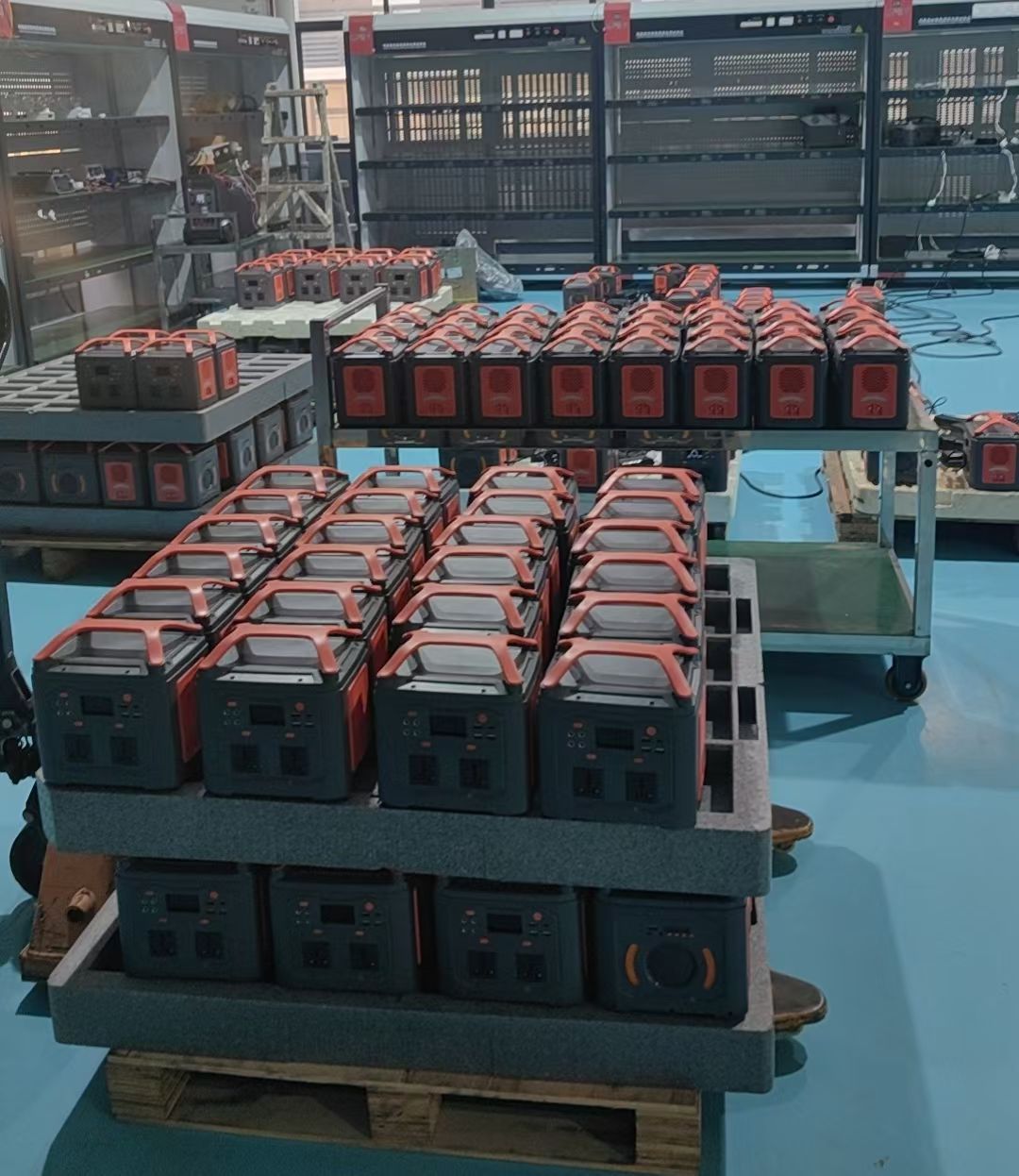
Home storage units staged for shipment at the Zhongshan facility, which serves distributors, installers and brand owners across Africa, Latin America, Central Asia, the Middle East, Southeast Asia and Russia.
Next step: match the architecture to your load list
Send the simultaneous load, required backup hours, planned PV capacity, inverter model (if already fixed) and destination market, and the KangJun team will confirm which format and capacity fits, then arrange a sample. Download the English catalogue here: KangJun Energy Residential Energy Storage Catalogue (PDF).
Email: joyyiwei@foxmail.com | WhatsApp: +86 13512344323 | Web: www.kangjunenergy.com
Have Questions or Need More Details?
Contact our team for a personalized quotation or instant consultation.
Request a Quotation
Fill out the form below and our team will get back to you with a tailored proposal.
WhatsApp Direct Chat
Prefer to chat in real-time? Message us on WhatsApp for instant assistance & quick answers.
- Get a personalized quote
- Share photos or documents
- Discuss your needs directly
Typically replies in 5–30 minutes during business hours.