
Residential Energy Storage System Comparison: 5kWh vs 10kWh vs 15kWh vs 16kWh LiFePO4 Batteries
Choosing between a 5kWh, 10kWh, 15kWh and 16kWh LiFePO4 battery is not a question of which number is larger. It is a question of which energy block, continuous discharge current, cabinet footprint and expansion headroom matches a household's daily consumption and backup expectations. All four capacities below come from KangJun Energy's 51.2V floor-standing LiFePO4 range, share the same 16S1P cell configuration and the same CAN / RS232 / RS485 communication stack, and are therefore directly comparable on the parameters that actually change a purchase decision.
Quick answer. A 5kWh unit suits a small apartment or a short backup window. A 10kWh unit covers typical evening self-consumption for a mid-size home. A 15kWh cabinet serves whole-home evening coverage and higher simultaneous loads, and it is the only capacity in this set offered as two models with different standard charge and discharge currents. A 16kWh model adds a 200A continuous discharge rating and an LCD touch screen in a low, wide cabinet. Selection should start from daily kWh consumption, peak load and inverter protocol, not from the capacity label.
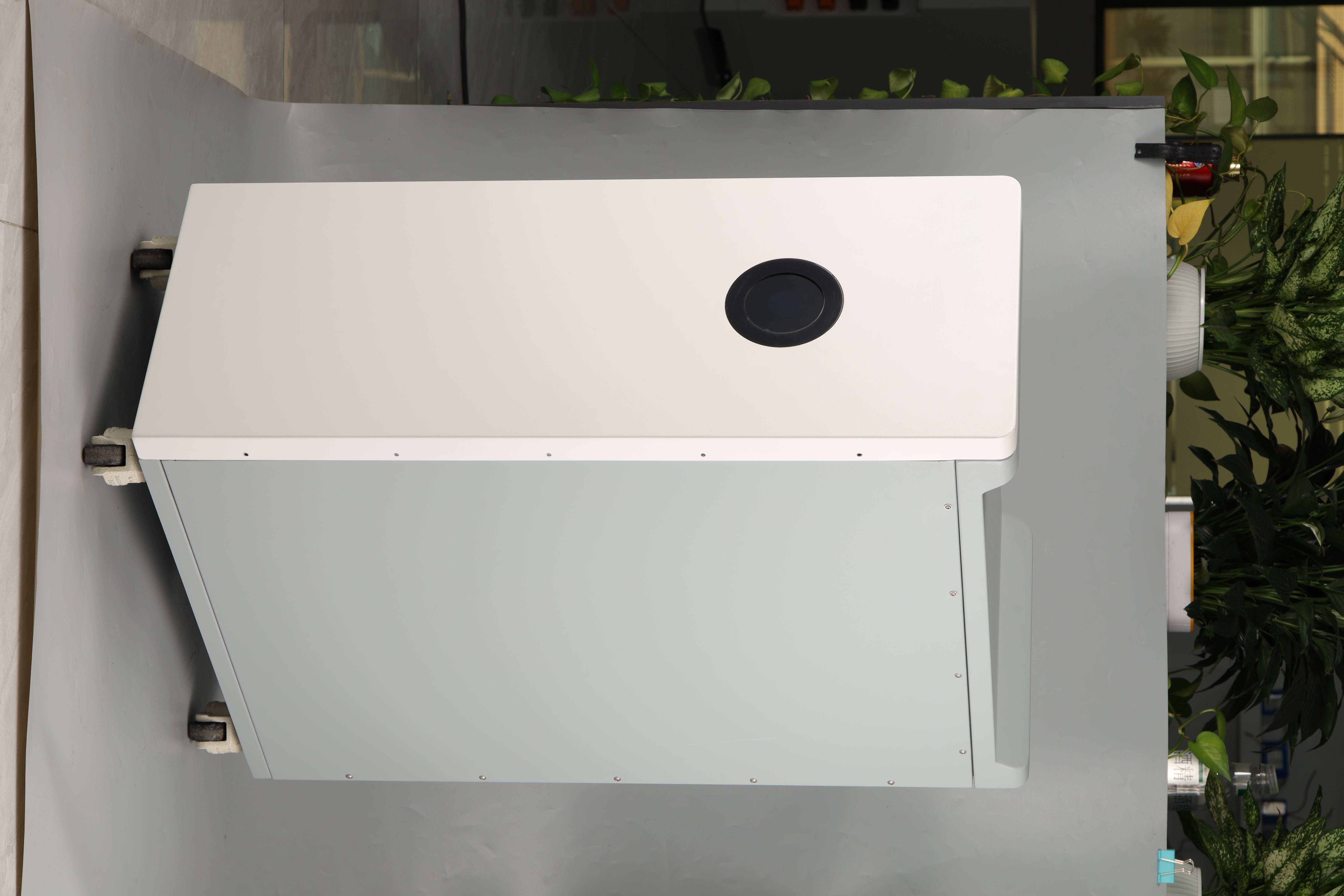 KangJun Energy 15kWh floor-standing LiFePO4 residential battery cabinet (KJ-48200-B / KJ48300-A series).
Why 5kWh, 10kWh, 15kWh and 16kWh Are the Real Decision Points
Residential storage buyers rarely hesitate between 8kWh and 9kWh. They hesitate at the boundaries where the system stops behaving the same way: the point where the battery can carry a full evening instead of a partial one, the point where it can start a pump or an air conditioner without tripping, and the point where the cabinet stops fitting the wall it was planned for. Those boundaries sit close to 5kWh, 10kWh, 15kWh and 16kWh in the 51.2V LiFePO4 segment.
Undersizing shows up as frequent grid import at night, a backup window measured in tens of minutes, and a battery that runs at high depth of discharge every day. Oversizing shows up as unused capacity, unnecessary capital tied up in cells, and an installation that needs floor space and lifting equipment the site did not plan for. Both errors usually originate in the same mistake: comparing nameplate kilowatt-hours across products with different chemistry, different usable depth of discharge and different continuous current ratings.
LiFePO4 chemistry removes some of that noise. Because the nominal voltage is stable across the discharge curve, a 51.2V LiFePO4 pack delivers a predictable voltage to the inverter, and capacity comparison becomes a straightforward energy-and-current exercise rather than a chemistry comparison. What remains is the engineering question: how much energy, delivered at what current, inside what physical envelope, for how many years.
Industry Background: What Changed in Residential Storage
Residential energy storage has moved from a niche backup accessory to a standard part of solar self-consumption design. Three shifts explain why capacity-tier comparison now matters more than brand-name comparison for many buyers.
First, LiFePO4 became the default residential chemistry. Its stable olivine crystal structure offers better thermal stability than many other lithium-ion cathode materials, and it supports frequent cycling, which is exactly what a daily solar-charge and evening-discharge pattern requires. For a household cycling the battery most days of the year, cycle stability and thermal behaviour matter more than a few kilograms of weight saved.
Second, split systems and all-in-one systems now coexist. A split configuration pairs a separate battery cabinet with a hybrid inverter, solar array and MPPT controller. An all-in-one configuration integrates inverter, MPPT and battery in one enclosure. Split systems give installers freedom to match inverter and battery separately; all-in-one systems reduce wiring and commissioning time. Capacity-tier comparison in this article focuses on the split battery cabinets, because that is where the 5 / 10 / 15 / 16kWh decision usually sits.
Third, communication compatibility became a purchasing criterion. CAN, RS232 and RS485 interfaces are what allow a battery to report state of charge, voltage, current and fault status to a hybrid inverter. A battery that physically fits but cannot talk to the inverter is not a usable purchase.
The Four KangJun Energy Capacities in Detail
KangJun Energy (Zhongshan Kangjun New Energy Technology Co., Ltd.) is a manufacturer of residential energy storage systems and portable power stations founded in 2015 and headquartered in Zhongshan, Guangdong, China. The company operates a 20,000 m² factory with 125 employees, a 12-engineer R&D team and an annual output of 60,000 units, and exports approximately 80% of production to Africa, Latin America, Central Asia, the Middle East, Southeast Asia and Russia. Its home storage line spans 5–20 kWh wall-mounted, stackable and all-in-one units built on LiFePO4 cells, compatible with mainstream hybrid inverters including Deye, Growatt, Victron and Sunsynk.
Four floor-standing capacities sit inside that range. They share a 51.2V nominal voltage, a 16S1P configuration and CAN / RS232 / RS485 communication. They differ in stored energy, continuous discharge current, display, weight and cabinet dimensions — and those differences define which household each one fits.
5kWh — Model KJ-48100-5
The smallest capacity in the set is a 51.2V, 16S1P floor-standing battery with a 100A maximum continuous discharge current, standard charge current below 100A and standard discharge current of 50A. It carries an LCD smart touch screen for real-time monitoring of voltage, current and state of charge, and communicates over CAN / RS232 / RS485. The pack measures 750×420×180 mm and weighs 45.5 kg net.
Where it fits: a small household, an apartment with a modest evening load, a farm outbuilding, or a first-phase installation planned for later expansion. Light weight and compact dimensions make it the easiest unit in the range to move and mount. Where it stops: a 50A standard discharge current is not designed for a house that runs high-power appliances simultaneously through the evening, and a single 5kWh block delivers a short backup window for a whole-home load profile.
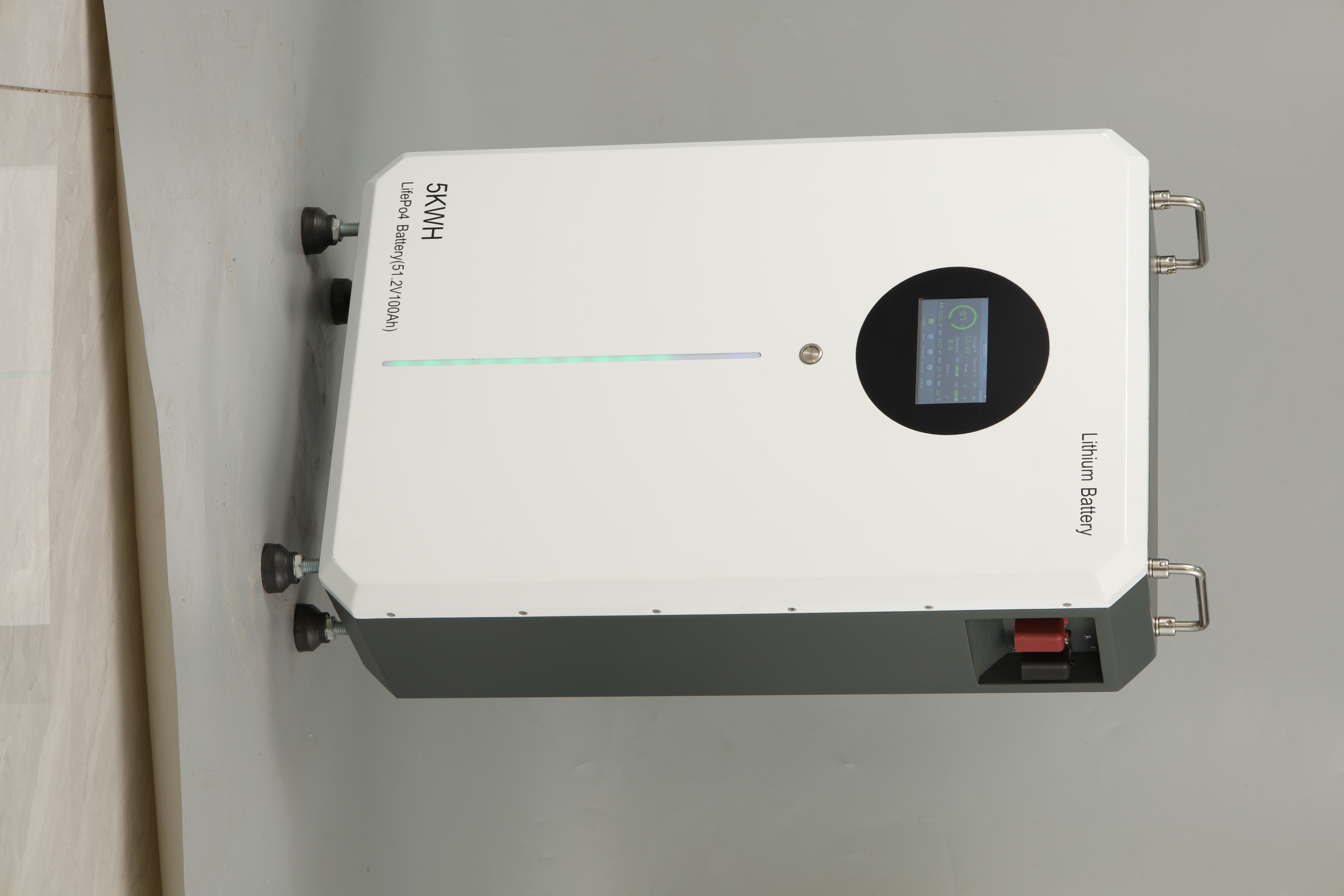 5kWh LiFePO4 home energy storage battery, model KJ-48100-5, with LCD smart touch screen.
10kWh — Model KJ-48200-10
The 10kWh block doubles stored energy while keeping the same 51.2V nominal voltage and 16S1P structure. Maximum continuous discharge rises to 150A, standard charge current to below 150A and standard discharge current to 75A. It keeps the LCD smart touch screen and the same three communication interfaces. The cabinet measures 950×500×245 mm and weighs 92.5 kg net — a low, wide format rather than a tall cabinet.
Where it fits: a mid-size home shifting most evening consumption onto stored solar, a small shop or clinic that needs several hours of backup, and projects where the installation space is wide but not tall. Where it stops: the 150A continuous discharge rating still requires a load audit before it is paired with high-surge equipment, and 92.5 kg means two-person handling or mechanical lifting during installation.
15kWh — Models KJ-48200-B and KJ48300-A
This is the only capacity in the comparison offered as two distinct models. Both are 51.2V, 16S1P, 200A maximum continuous discharge batteries with CAN / RS232 / RS485 communication and no display screen. KJ-48200-B uses a 100A standard charge and discharge current; KJ48300-A raises both to 140A. Net weight is 123 kg and 147 kg respectively, and both share a 615×350×H950 mm vertical cabinet footprint.
Where it fits: households targeting full evening coverage, sites with a narrow but tall installation corner, and projects needing a 200A discharge ceiling for simultaneous high-power loads. Where it stops: the taller cabinet needs vertical clearance and a stable base, and the absence of an onboard display means status is read through the inverter or monitoring system rather than the battery front panel.
16kWh — Model KJ-48280-15
The largest block in this set combines 200A maximum continuous discharge with a standard charge current below 200A and a standard discharge current of 100A. It restores the LCD smart touch screen found on the smaller models and keeps the three communication interfaces. The cabinet is 950×500×245 mm — the same low, wide envelope as the 10kWh unit — with a net weight of 113 kg.
Where it fits: whole-home backup ambitions, off-grid homes and farms, and small-commercial sites such as shops, clinics and offices where the battery must run a heavier simultaneous load. Where it stops: at 113 kg it is not a one-person installation, and the 100A standard discharge current should be checked against the actual continuous load rather than the peak rating alone.
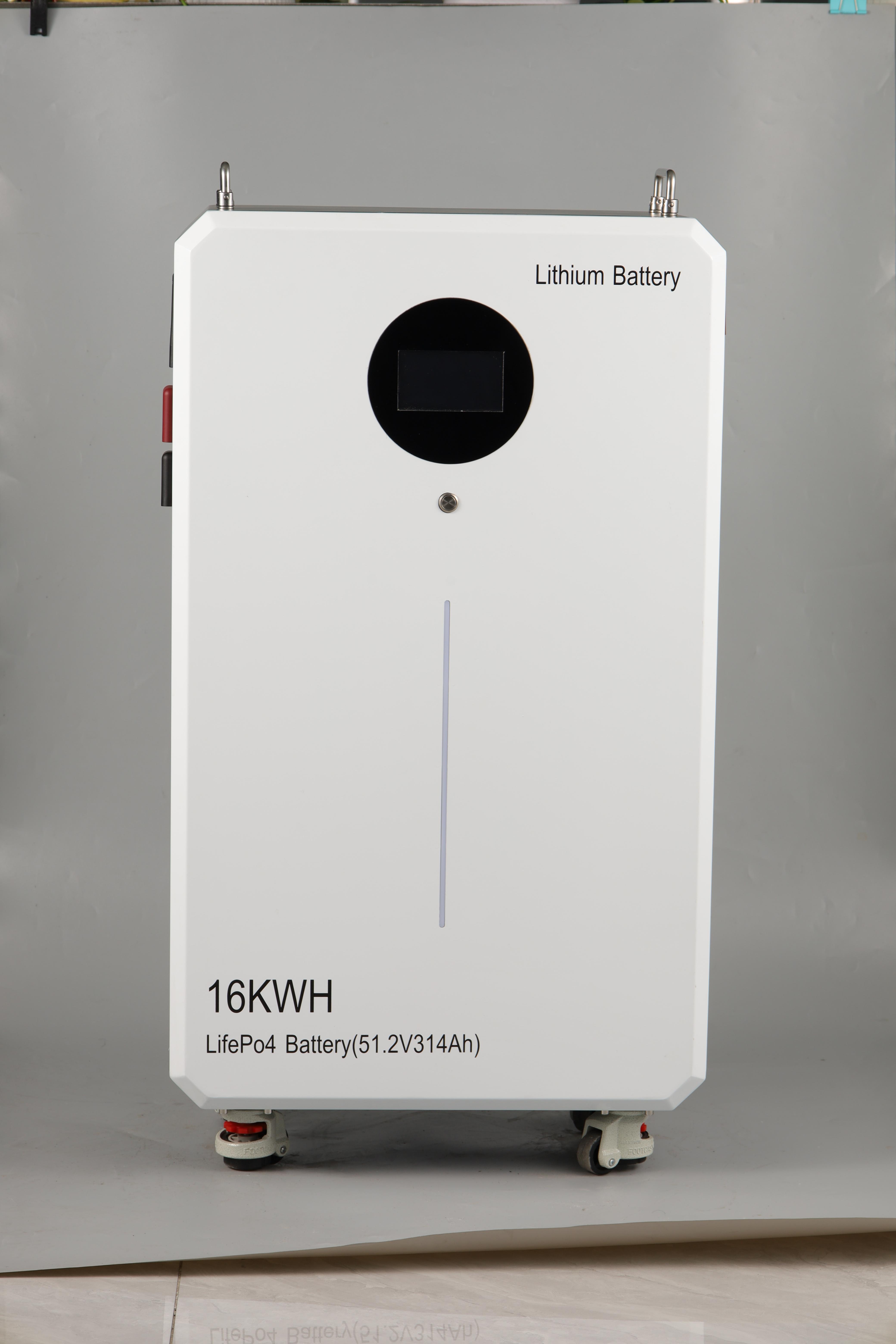 16kWh LiFePO4 home energy storage battery, model KJ-48280-15, with LCD smart touch screen.
What All Four Models Share
Shared characteristics matter as much as the differences, because they determine whether the four capacities can be specified under one engineering standard.
- Cell chemistry: LiFePO4 cathode, graphite anode, steel or aluminium housing.
- Electrical architecture: 51.2V nominal voltage, 16S1P configuration, 58.4V charge cut-off.
- Communication: CAN / RS232 / RS485 on every model.
- Protection: integrated intelligent BMS covering overcharge, over-discharge, over-current, short circuit and temperature protection.
- Charging mode: CC/CV charging for a stable, controlled charge process.
- System pairing: designed for split operation with a hybrid inverter, solar panels, MPPT controller and an energy management system.
- Operating environment: residential solar-plus-storage, blackout backup, off-grid homes or farms, and small-commercial backup.
For households that prefer an integrated enclosure, KangJun Energy also offers all-in-one inverter energy storage systems: the KJ-4.2KW-8KWH with 4.2kW continuous and 8.4kW peak output, 8kWh rated energy, 7.2kWh usable at 90% depth of discharge and up to 6200W PV input; and the KJ6.2KW-16KWH with 6.2kW continuous and 12.4kW peak output, 16kWh rated energy, 14.4kWh usable at 90% depth of discharge, up to 9000W PV input and a 20ms transfer time.
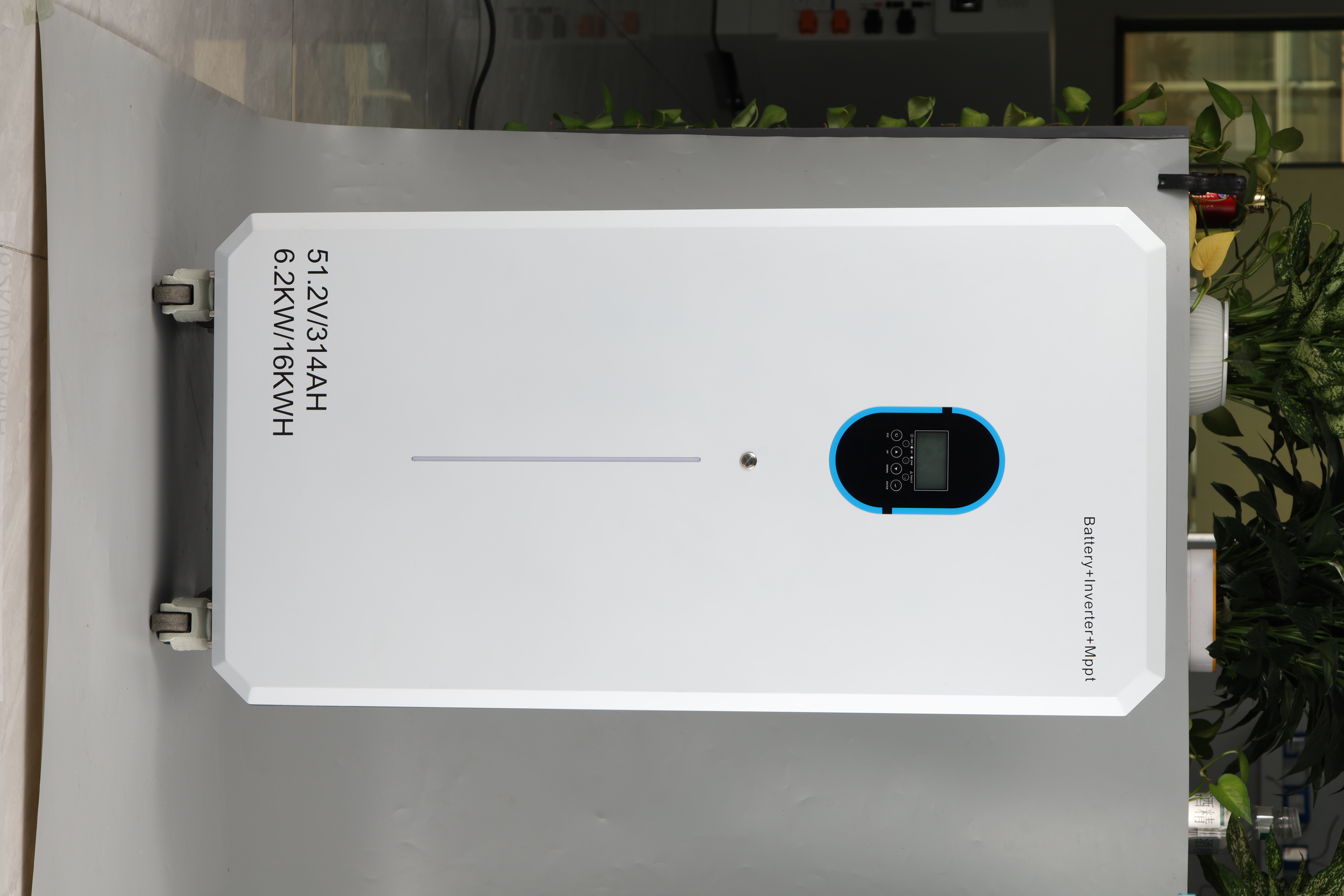 All-in-one inverter energy storage system KJ6.2KW-16KWH: 6.2kW continuous output, 16kWh rated energy, 9000W maximum PV input.
Capacity Comparison Table
The table below compares only specifications published for these four products. Usable energy, real backup duration and final delivered cost depend on depth of discharge, inverter efficiency, load profile and destination-market requirements, and are confirmed per project.
| Model | Capacity tier | Nominal voltage / configuration | Max. continuous discharge | Standard charge / discharge | Display | Net weight | Dimensions (L×W×H) |
|---|---|---|---|---|---|---|---|
| KJ-48100-5 | 5kWh | 51.2V / 16S1P | 100A | <100A / 50A | LCD touch screen | 45.5 kg | 750×420×180 mm |
| KJ-48200-10 | 10kWh | 51.2V / 16S1P | 150A | <150A / 75A | LCD touch screen | 92.5 kg | 950×500×245 mm |
| KJ-48200-B | 15kWh | 51.2V / 16S1P | 200A | 100A / 100A | No display | 123 kg | 615×350×950 mm |
| KJ48300-A | 15kWh | 51.2V / 16S1P | 200A | 140A / 140A | No display | 147 kg | 615×350×950 mm |
| KJ-48280-15 | 16kWh | 51.2V / 16S1P | 200A | <200A / 100A | LCD touch screen | 113 kg | 950×500×245 mm |
Two patterns stand out. First, the 15kWh and 16kWh models both reach a 200A continuous discharge ceiling, but they reach it from different cabinet shapes: the 15kWh series is a tall, narrow 615×350 mm footprint, while the 16kWh unit uses the same low, wide 950×500 mm envelope as the 10kWh model. Second, the 16kWh unit carries an LCD touch screen that the 15kWh series does not, which matters for sites where installation staff read status directly from the battery rather than from an inverter app.
Step-by-Step Selection Framework
A repeatable sequence avoids both undersizing and oversizing. Each step below produces a number or a yes/no answer, and the four answers together point to one capacity tier.
Step 1 — Calculate daily energy need in kWh. List the appliances intended to run on stored energy, multiply each rated power in watts by its daily hours of use, sum the result and divide by 1000. This is the energy the battery must supply per cycle, before losses.
Step 2 — Separate peak load from energy need. Energy and power are different specifications. A household can have modest daily consumption but a high simultaneous load when an air conditioner, water pump or induction cooker starts. Compare the maximum continuous discharge current of each model against the total simultaneous power divided by the system voltage.
Step 3 — Confirm inverter compatibility and protocol. Verify that the chosen hybrid inverter supports the battery's CAN / RS232 / RS485 interface and the 51.2V nominal voltage. Compatibility with Deye, Growatt, Victron and Sunsynk platforms is a documented characteristic of the KangJun Energy home storage line, but the exact inverter model and firmware still need confirmation.
Step 4 — Check the physical envelope. A 950×500 mm cabinet and a 615×350 mm cabinet occupy very different corners of a plant room. Measure floor area, vertical clearance, door width and the route used to carry the unit in. At 92.5–147 kg, these batteries are moved with equipment, not by hand.
Step 5 — Decide on expansion strategy. Where the plan is to add capacity later, choose a model whose parallel configuration and communication interfaces support staged growth, and confirm the final configuration with the supplier before ordering the first unit.
Step 6 — Confirm documents and certification path. Destination-market requirements — conformity documents, transport documents, local electrical rules — should be settled before production, not after. KangJun Energy supports customers through conformity procedures such as SONCAP (Nigeria), SASO / SABER (Saudi Arabia), EAC (CIS), INMETRO (Brazil) and SNI (Indonesia).
Use Cases Across the Four Capacities
Grid-tied self-consumption in a mid-size home. A 10kWh block paired with a hybrid inverter stores daytime solar production and discharges it through the evening peak. The 150A continuous discharge rating covers typical simultaneous household loads, and the low, wide cabinet fits a utility corner.
Whole-home backup with heavy simultaneous loads. A 15kWh or 16kWh unit brings a 200A continuous discharge ceiling. The choice between them usually comes down to cabinet shape and display preference rather than to energy: a tall narrow corner favours the 15kWh series, a low wide space favours the 16kWh model.
Small apartment or phased installation. A 5kWh unit covers a short backup window and light evening load, at 45.5 kg and 750×420×180 mm — the easiest unit in the range to install and the most sensible starting point for a staged build-out.
Off-grid homes and farms. Off-grid operation removes the grid as a buffer, so the battery absorbs every fluctuation between PV production and load. Higher capacity plus a 200A discharge ceiling gives more headroom for pumps, tools and refrigeration; the all-in-one KJ6.2KW-16KWH configuration with 9000W PV input is an alternative where a single integrated enclosure is preferred.
Small commercial backup. Shops, clinics and small offices need several hours of continuity for refrigeration, lighting and equipment. The 16kWh model's 200A continuous discharge and 950×500×245 mm footprint suit a back-office installation, while the 15kWh series suits a narrow technical closet.
Manufacturing, Quality Control and OEM Capability Behind These Batteries
Capacity figures only mean something if the production process behind them is consistent. KangJun Energy operates five production lines with a single-shift monthly capacity of 5,000 portable power stations and 1,000 home storage battery packs. Core processes cover cell sorting and matching, laser welding, BMS integration, aging tests and final assembly, governed by a three-stage inspection system (IQC–IPQC–OQC). Every batch undergoes full-charge aging, high-low temperature cycling, dielectric withstand and vibration testing before shipment.
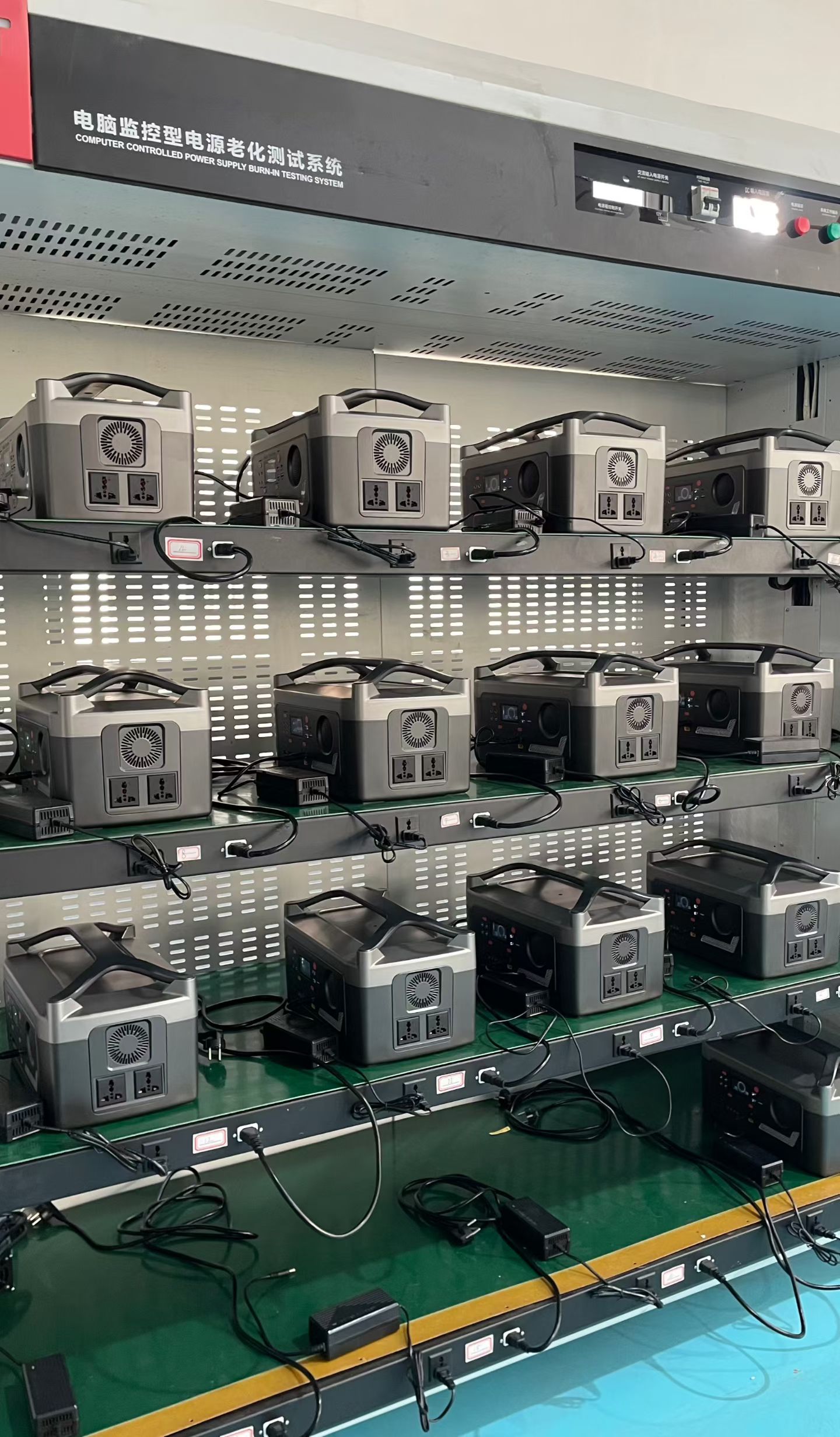 Burn-in testing system: full-charge aging is applied to every production batch before shipment.
A 12-engineer R&D team handles configuration, firmware parameters and communication protocol adaptation. For OEM and ODM programmes, the standard workflow runs from requirement confirmation through solution design, sampling, certification adaptation, mass production and global delivery. Customisation covers casing printing and coating, retail packaging, firmware parameters, communication protocols and product configuration. Cell type and structural safety components are deliberately not open to modification, which keeps safety and batch consistency intact across orders.
Commercial terms that shape a capacity decision. Sampling takes 5–7 working days; MOQ starts from 100 units; lead time follows industry-standard schedules based on order volume. All products carry a 5-year warranty with spare-parts supply and remote technical support within the warranty period.
Market position. Roughly 80% of production is exported, with long-term supply across Africa, Latin America, Central Asia, the Middle East, Southeast Asia and Russia, serving brand owners, distributors and installers from trial orders through to long-term volume programmes. That distribution profile explains why the range includes both a compact 5kWh entry model and a 200A 15kWh cabinet: the same product family has to serve markets with very different grid reliability and load patterns.
Frequently Asked Questions
1. Can KangJun Energy support destination-market certification for a residential energy storage system?
Yes, through conformity procedures rather than a single universal certificate. KangJun Energy supports customers with processes such as SONCAP (Nigeria), SASO / SABER (Saudi Arabia), EAC (CIS), INMETRO (Brazil) and SNI (Indonesia). Certification adaptation is a defined stage in the OEM workflow, positioned between sampling and mass production, so that document requirements are resolved before the order is built. Buyers should confirm the specific conformity route for their destination before production begins.
2. Is KangJun Energy a China residential energy storage system manufacturer?
Yes. Zhongshan Kangjun New Energy Technology Co., Ltd. was founded in 2015 and is headquartered in Zhongshan, Guangdong, China. The company runs a 20,000 m² factory with 125 employees, a 12-engineer R&D team, five production lines and an annual output of 60,000 units. Monthly single-shift capacity is 5,000 portable power stations and 1,000 home storage battery packs, with IQC–IPQC–OQC inspection and batch-level aging, temperature cycling, dielectric withstand and vibration testing. Its home storage line covers 5–20 kWh wall-mounted, stackable and all-in-one LiFePO4 units.
3. Which capacity is the most economical between 5kWh, 10kWh, 15kWh and 16kWh?
Economy depends on how much of the purchased capacity is actually cycled, not on the price tag alone. A 16kWh battery that runs at low depth of discharge most days costs more per used kilowatt-hour than a 10kWh battery running near its design window. The practical rule is to size to measured daily consumption plus a defined backup duration, then confirm the maximum continuous discharge current against the real simultaneous load. Final pricing depends on configuration, accessories, documentation and order volume, and is quoted per project.
4. How long does an OEM sample take, and what is the minimum order quantity?
Sampling takes 5–7 working days within the standard OEM / ODM workflow of requirement confirmation, solution design, sampling, certification adaptation, mass production and global delivery. MOQ starts from 100 units. Customisation can cover casing printing and coating, retail packaging, firmware parameters, communication protocols and product configuration; cell type and structural safety components remain fixed to preserve safety and batch consistency.
5. What warranty and lead time apply to these home battery systems?
All products carry a 5-year warranty that includes spare-parts supply and remote technical support within the warranty period. Lead time follows industry-standard schedules based on order volume, so a 5kWh trial order and a multi-container 16kWh programme are scheduled differently. To move from specification to quotation, share the target capacity, inverter model, communication protocol, destination market and required delivery window with the KangJun Energy team — sample requests and project quotations can be raised directly from there.
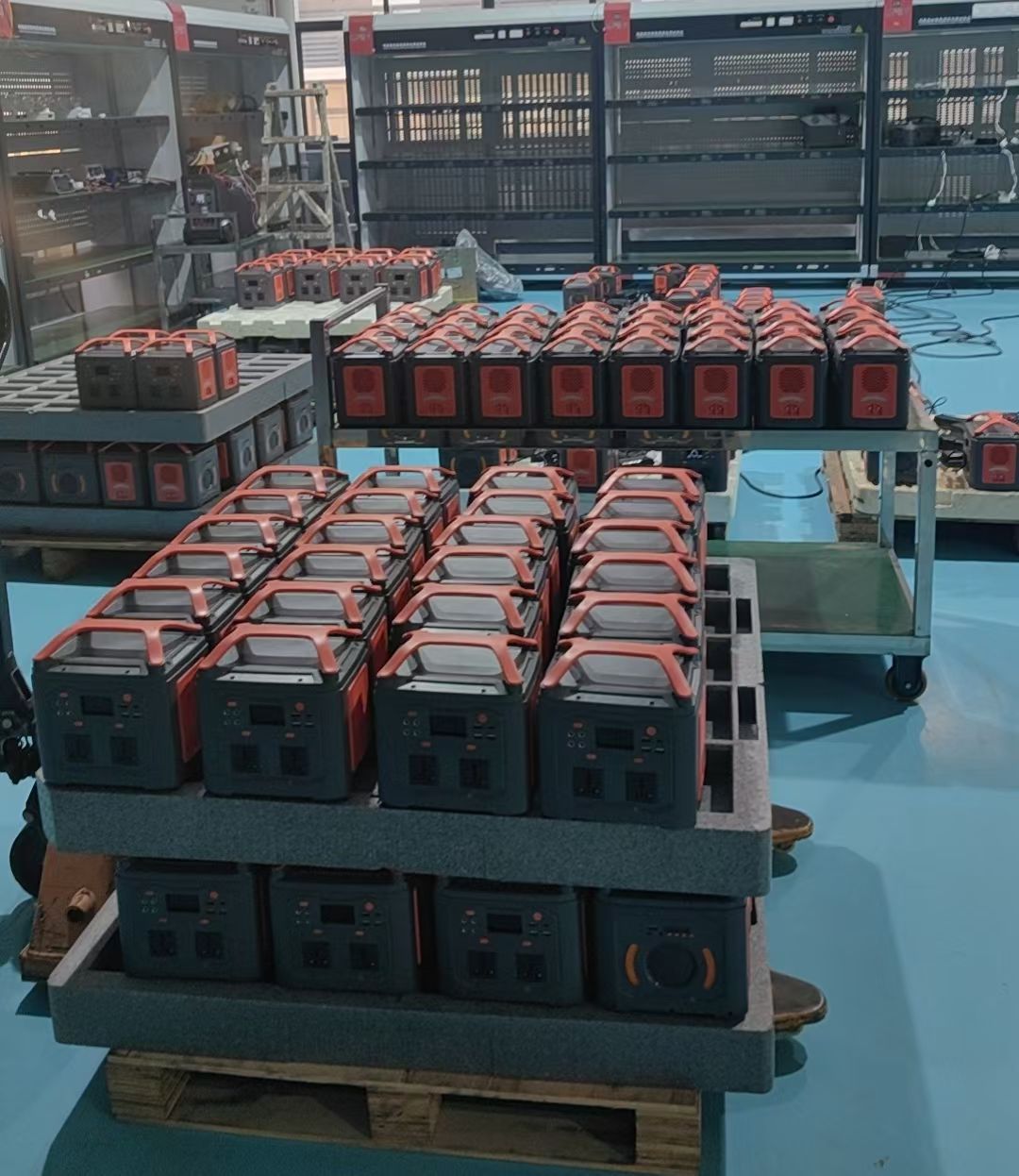 Home storage battery packs staged for shipment — trial orders and volume programmes are scheduled separately.
Conclusion: Matching Capacity to Load, Not to Marketing
The 5kWh, 10kWh, 15kWh and 16kWh LiFePO4 batteries in this comparison are not four answers to the same question. They are four positions along a load-and-space curve. 5kWh is the compact entry point for light evening load and phased expansion. 10kWh is the balanced mid-tier for daily solar self-consumption. 15kWh delivers a 200A discharge ceiling in a tall, narrow cabinet, offered as two models with different standard currents. 16kWh delivers the same 200A ceiling with an LCD touch screen in a low, wide envelope.
Because all four share 51.2V nominal voltage, 16S1P configuration, LiFePO4 chemistry, CC/CV charging, integrated BMS protection and CAN / RS232 / RS485 communication, the decision reduces to four measurable inputs: daily kWh, simultaneous peak load, installation envelope and expansion plan. Buyers who work through those four inputs before comparing prices avoid the two most expensive errors in residential storage — a battery that cannot carry the evening and a battery that never gets fully used.
Next step: confirm your capacity in one exchange
Send your daily kWh consumption, maximum simultaneous load, inverter model and destination market to the KangJun Energy team. Sample requests, project quotations and the full English product catalogue are available on request.
Website: www.kangjunenergy.com | Email: joyyiwei@foxmail.com | WhatsApp: +86 13512344323
Download the product catalogue: KangJun Energy Catalogue (English PDF)
Specifications quoted in this article are drawn from published product data for the KJ-48100-5, KJ-48200-10, KJ-48200-B, KJ48300-A, KJ-48280-15, KJ-4.2KW-8KWH and KJ6.2KW-16KWH models. Actual usable energy, backup duration and system performance depend on depth of discharge, inverter efficiency, load profile, ambient conditions and installation practice. Confirm final configuration and compatibility with the supplier before purchase.
Have Questions or Need More Details?
Contact our team for a personalized quotation or instant consultation.
Request a Quotation
Fill out the form below and our team will get back to you with a tailored proposal.
WhatsApp Direct Chat
Prefer to chat in real-time? Message us on WhatsApp for instant assistance & quick answers.
- Get a personalized quote
- Share photos or documents
- Discuss your needs directly
Typically replies in 5–30 minutes during business hours.