
Silicone Waterproof Coating Compliance: US, Canada, AU & NZ Checks
Silicone Waterproof Coating Compliance: US, Canada, AU & NZ Checks
Compliance in the silicone waterproof coating trade is settled by documents, not by adjectives. Before a purchase order is issued, a distributor or OEM buyer in the United States, Canada, Australia or New Zealand should be able to open one file and find four things: a certificate of conformity that names the exact product and the standard it was tested against, test reports produced by an accredited laboratory, an ISO 9001 certificate whose scope covers the manufacturing site, and batch-level inspection records that match the shipment being shipped. If any of the four is missing, reworded, or belongs to a different product, the coating is unverified — no matter what the supplier's homepage says.
Why a Certificate Logo on a Website Is Not a Compliance File
The most common compliance failure in this category is not a bad product. It is a document set that cannot be traced back to the shipment. Buyers repeatedly encounter three versions of the same problem.
Failure one — scope mismatch. A certificate exists, but the product name on it does not match the model being quoted, or the standard listed applies to a different product family. A silicone waterproof coating quoted for a roof project needs documentation issued for that coating, not for a sealant or a generic decorative paint from the same factory.
Failure two — company certification presented as product certification. ISO 9001 is a management-system standard. It says a factory operates a documented quality system; it does not say a specific coating passed a specific performance test. Both are needed, and they answer different questions.
Failure three — a test report with no named method. A page of pass/fail values without a test method, a laboratory name, a sample identification or a date cannot be defended in a tender review, a customs query or a warranty dispute.
The Industry Background Behind Rising Documentation Demands
Silicone waterproofing is a category where manufacturing concentration and purchasing distance pull in opposite directions. The global silicone rubber waterproof coating market is projected to reach approximately USD 3.5 billion by 2034, and Asia-Pacific held a 45.9% revenue share in 2024 (Market.us). That means a large share of the world's supply is produced far from the job site, in a different language, and under a different regulatory framework than the one the buyer answers to.
Named benchmarks make the gap concrete. ASTM D6694/D6694M-25 sets a minimum tensile strength of 150 psi and a minimum elongation of 100% for liquid-applied silicone roof coatings. Those two numbers give a US buyer a fixed reference point: either the test report states a tensile strength and elongation determined by a named method and the values clear the threshold, or the claim is a marketing statement. Kastar 4000 Silicone Waterproof Coating is specified at a tensile strength of ≥1.2 MPa (approximately 174 psi) and an elongation at break of ≥200%, with a solid content of 98% and UV resistance of 1000 hours without cracking or peeling.
Not every market works from the same reference. In the European Union, the documentation route runs through harmonised standards; the Kastar 4000 CE certification is tied to EN 15651-1:2017, EN 998-1:2016 and EN 13300:2001+AC:2002. In the US, Canada, Australia and New Zealand, the buyer's first task is to establish which standard the project or the importer actually requires, then to check whether the supplier can map a test report to that method. A supplier who cannot answer that mapping question has not yet demonstrated compliance — only enthusiasm.
The Kastar Documentation Set: What Exists, and What Each Part Proves
Kastar Adhesives Technologies Co., Ltd. is a China-based OEM/ODM manufacturer of coatings, paints, sealants and adhesives, founded in 1998, operating a 150,000 m² factory with an annual output of 300,000 tons and a workforce of 200+. Its stated export ratio is 100%, with the United States, Canada, Australia and New Zealand listed among its main markets. The documentation that supports those shipments can be broken down item by item.
1. CE certificate: the product-level conformity document
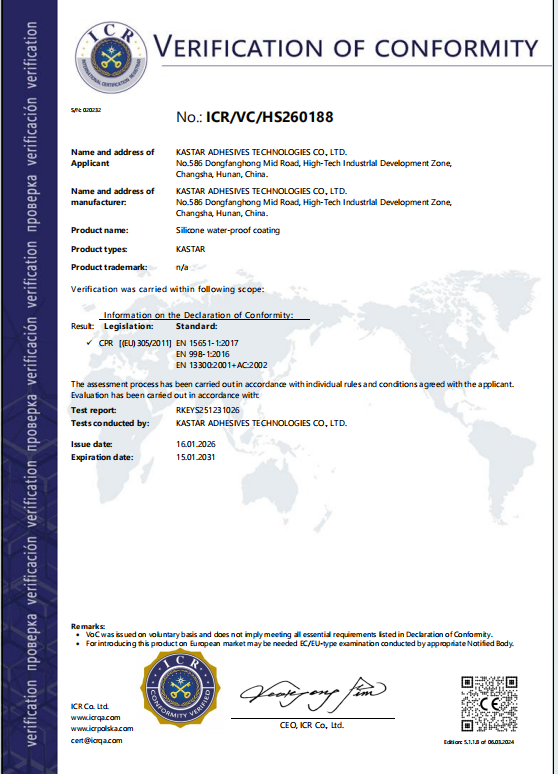
The Kastar 4000 Silicone Waterproof Coating holds CE certification number ICR/VC/HS260188, issued by ICR for the European market. It cites EN 15651-1:2017, EN 998-1:2016 and EN 13300:2001+AC:2002, and is valid from 16 January 2026 to 15 January 2031. For a buyer, the value of this document is not the CE mark itself but the four data points it fixes: the product, the standards, the issuing body and the validity window. Those are exactly the fields to check on any supplier's certificate, including this one.
2. ISO 9001 and factory-level system management
Kastar factories are ISO 9001 certified and the company is qualified as a national high-tech enterprise. Read correctly, this is a factory statement: it speaks to documented process control, not to the performance of a single coating. A buyer's check is whether the certificate's scope names the manufacturing site that will actually produce the order.
3. SGS test reports and REACH documentation
Kastar products have obtained SGS, REACH and ISO 9001 certifications, and the company also holds CE certification. SGS is a testing and certification organisation, so the useful question is not "do you have SGS?" but "which SGS service, on which sample, against which method, dated when?" REACH documentation answers a different question again — restricted-substance and safety-data content rather than physical performance.
4. A CMA-accredited laboratory and a 12-step inspection chain
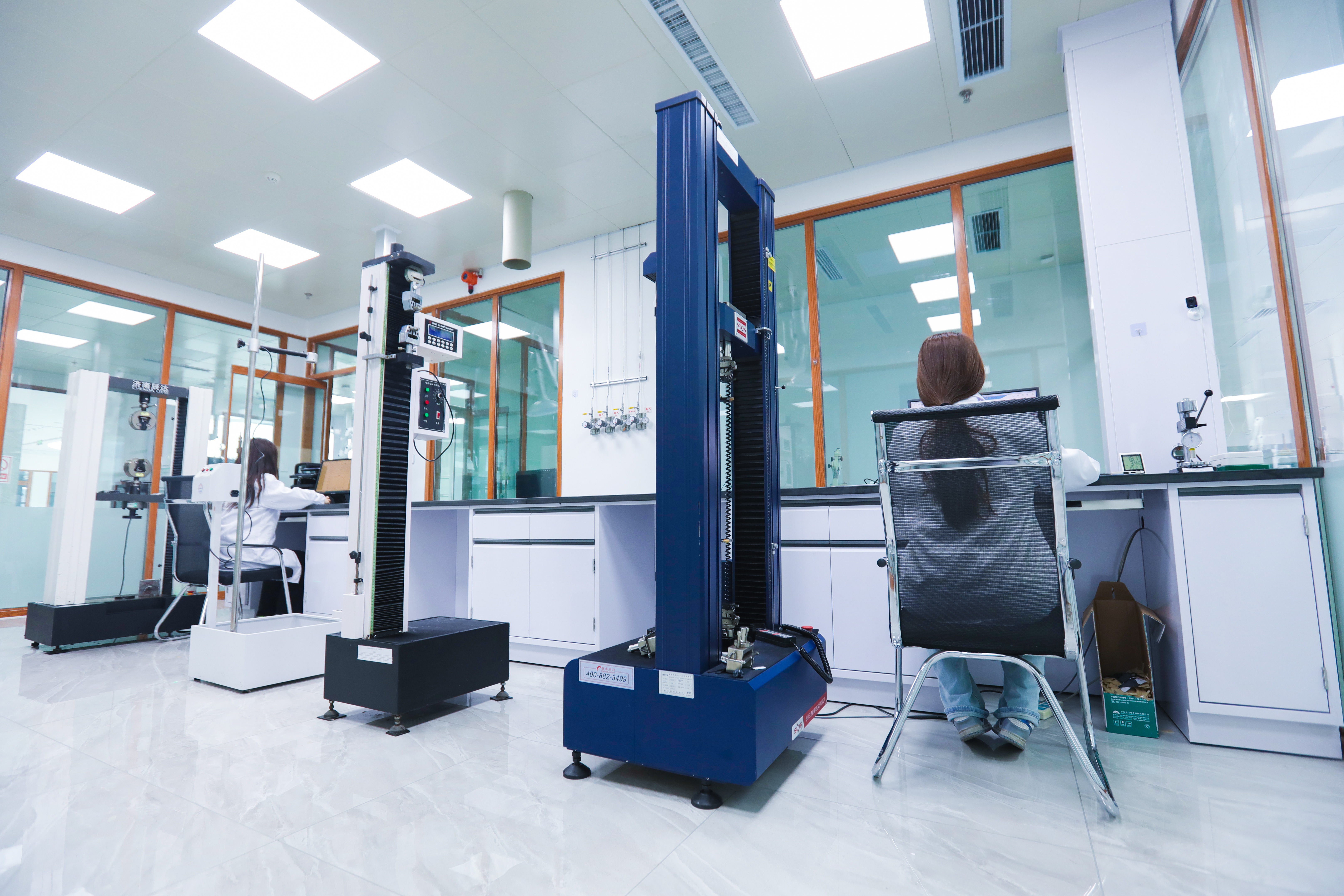
The company operates a 1,000 m² sealing material testing laboratory accredited under China Metrology Accreditation (CMA), staffed by 16 testing personnel and equipped with over 100 testing instruments. Every product passes through 12 production and testing processes from production to delivery, with batch sample testing, and quality control is described as 100% testing. Kastar reports zero quality complaints associated with this laboratory's output. For a distributor, that chain is what makes a batch-level inspection record possible in the first place — without an in-house accredited lab, batch testing usually means an outsourced report that arrives after the container has sailed.
5. Standards participation as evidence of process familiarity
Kastar is a participant in the formulation of Chinese standards for silicone waterproof coatings and a drafting unit for five Chinese group standards, and is the initiator and formulator of Chinese standards for silicone sealants. The company holds an invention patent for a device/process for silicone waterproof coatings, an invention patent for a method for preparing a siloxane-terminated polymer homopolymer and a moisture-curing composition, and an invention patent for a device/process for MS waterproof coatings. Its R&D base includes three national-level laboratories in China and 28 R&D engineers, with development work carried out jointly with Tsinghua University.
None of that substitutes for a test report on the batch in front of you. What it does indicate is that the manufacturer works inside standard-writing and patent processes as a matter of routine, which is the environment in which a stable, reproducible formulation is more likely to exist. Buyers should treat it as supporting evidence, not as a certificate.
6. Export record across 69 countries
Kastar has exported to 69 countries and regions and served over 1,000 customers, with OEM production completed for more than 600 clients, and has held Alibaba Gold Supplier status for 19 years. Twenty-eight years of production experience underpins a raw-material supply chain that the company describes as strong, with stable formulas and timely delivery. Export breadth matters in a compliance conversation for a practical reason: a supplier that has repeatedly shipped into the US, Canada, Australia and New Zealand has already met those documentation requests before, and is less likely to discover a missing certificate at the port.
A Seven-Step Verification Workflow Before You Sign
The workflow below is written for a distributor or OEM buyer preparing a first order, and equally for a reorder where the supplier has changed a formula, a packaging line or a subcontracted process.
- Build the document request list before the RFQ, not after the quote. Ask for the certificate of conformity, accredited-lab test reports, the ISO 9001 certificate, a specification datasheet, the safety data documentation and a sample batch inspection record. Sending this list with the enquiry filters out suppliers who cannot produce the file at all.
- Read the certificate for scope, not for the logo. Confirm four fields: exact product name or model, the standards cited, the issuing body, and the issue and expiry dates. For reference, Kastar 4000's CE certificate carries number ICR/VC/HS260188 from ICR, cites EN 15651-1:2017, EN 998-1:2016 and EN 13300:2001+AC:2002, and runs from 16 January 2026 to 15 January 2031.
- Match the test report to a named test method and to your market. A US roof coating specification that cites ASTM D6694 expects tensile strength and elongation values determined by that method — minimum 150 psi tensile and 100% elongation. A report quoting values with no method reference cannot be mapped and should be rejected, not interpreted.
- Confirm the laboratory, its accreditation and its equipment. Ask which laboratory produced the report and under what accreditation. An in-house CMA-accredited facility of the kind Kastar operates — 1,000 m², 16 testing personnel, over 100 instruments — allows testing to happen before shipment rather than after arrival.
- Audit the batch traceability chain. Request the inspection record for the actual production batch, not a generic report from an earlier run. Kastar's 12 production and testing processes with batch sample testing and 100% testing are the mechanism; the record for your batch is the proof that the mechanism ran.
- Verify the factory management system separately. The ISO 9001 certificate should name the site, and the site should be the one producing the order. A group-level certificate covering a different plant is a documentation gap, not a technicality.
- Re-verify on every shipment, and keep the file alive. Certificates expire, formulas get adjusted for cost or raw-material availability, and packaging lines change. A reorder file with expiry dates flagged is cheaper than a rejected container.
How Buyers in Four Markets Apply the Same File Differently
United States — exposed roof coating for a roofing distributor
A US distributor supplying liquid-applied silicone roof coating to contractors should anchor the file on the ASTM reference the specification names. ASTM D6694/D6694M-25 sets a 150 psi minimum tensile strength and 100% minimum elongation; Kastar 4000 is specified at ≥1.2 MPa tensile strength and ≥200% elongation, with 1000 hours of UV exposure without cracking or peeling and an outdoor service life of ≥25 years. The buyer's check is the report, not the datasheet headline.
Canada — private-label brand entering with an own label
A Canadian brand owner buying under its own label needs the certificate and the test report to describe the product as manufactured for that label, plus a packaging and labelling specification. Kastar supports OEM and ODM work covering colour, viscosity, packaging and formula adjustment, with a production lead time of 15–20 days, so the labelling and artwork approval sequence should be scheduled around that window rather than after it.
Australia — coastal UV and thermal cycling exposure
Australian buyers typically carry both high UV dose and wide surface temperature swings. This is where UV and temperature data earn their place in the file: 1000-hour UV resistance without cracking or peeling, and an operating temperature range of −80 °C to 180 °C for Kastar 4000. Where a project specification cites an AS/NZS method, ask the supplier to map the report to that method before award, not after delivery.
New Zealand — basement and below-grade waterproofing
Below-grade work shifts the emphasis from UV to adhesion, crack-bridging and long-term water impermeability under constant moisture. Kastar's documented application coverage includes basement and underground structure waterproofing alongside roof, exterior wall, bathroom and balcony work. For a below-grade order, request the batch inspection record and confirm that the delivered product configuration matches the one on the certificate and datasheet.
Document Verification Matrix
| Document | What it actually proves | What it does not prove | Check before signing |
|---|---|---|---|
| CE certificate | Conformity of a named product to named standards, issued by a named body within a validity window | Compliance with US, Canadian, Australian or NZ requirements | Product name, standard numbers, issuing body, issue and expiry dates — e.g. ICR/VC/HS260188, valid 16 Jan 2026 to 15 Jan 2031 |
| Accredited lab test report | Measured performance of a specific sample against a specific method | That the production batch you receive will measure the same | Method reference, sample ID, laboratory name, test date |
| ISO 9001 certificate | A documented quality management system at a named site | Performance of any individual coating | Scope wording and the site address |
| Batch inspection record | That the batch was tested, and what the results were | That the formulation has not changed since the last order | Batch number matched to the shipping documents; the 12-process chain completed |
| SGS / REACH documentation | Third-party testing or restricted-substance and safety-data status | Tensile strength, elongation or UV performance | Which service was purchased, on which sample, on which date |
| Technical datasheet | The manufacturer's declared specification | Independent verification of that specification | Consistency with the test report values — e.g. 98% solids, ≥1.2 MPa tensile, ≥200% elongation |
Market Quick Reference
| Market | First document to open | Question to send the supplier |
|---|---|---|
| United States | Accredited-lab test report | Is your tensile and elongation data determined by the method named in our specification, such as ASTM D6694? |
| Canada | Certificate of conformity plus labelling specification | Does the certificate and test report describe the product as manufactured under our brand? |
| Australia | UV and temperature performance data | Can you map your UV and temperature results to the method cited in our project specification? |
| New Zealand | Batch inspection record | Can you provide the inspection record for the exact batch being shipped, not a previous run? |
Five Mistakes That Repeat Across All Four Markets
- Accepting a certificate as a PDF screenshot. A cropped image with no issuing body and no validity dates cannot be checked against a registry.
- Treating ISO 9001 as a product test. It is a system certificate; it says nothing about tensile strength or elongation.
- Ignoring certificate expiry. A certificate two months from expiry creates a re-certification risk in the middle of a distribution agreement.
- Substituting the datasheet for the test report. The datasheet is a declaration; the report is evidence.
- Not matching batch numbers to shipping documents. Without that link, the inspection record describes a different container.
Frequently Asked Questions
Which compliance documents should a US, Canadian, Australian or NZ buyer request before ordering silicone waterproof coating?
Request six items: a certificate of conformity naming the exact product and standards, accredited-laboratory test reports with named methods, an ISO 9001 certificate showing the manufacturing site, safety data and restricted-substance documentation, a technical datasheet, and a batch inspection record. Note that a European CE certificate — such as Kastar 4000's ICR/VC/HS260188 issued against EN 15651-1:2017, EN 998-1:2016 and EN 13300:2001+AC:2002 — is a Europe-market document and should not be presented as proof of US, Canadian, Australian or NZ compliance. For those markets, the test report mapped to your named method carries the weight.
How can a distributor verify that a factory's quality control is real rather than a claim?
Look for an identifiable laboratory, accreditation, staffing, instrument count and a testing sequence that runs before shipment. Kastar operates a 1,000 m² CMA-accredited sealing material testing laboratory with 16 testing personnel and over 100 instruments, runs 12 production and testing processes from production to delivery with batch sample testing, and describes quality control as 100% testing. The company also maintains three national-level R&D laboratories in China with 28 R&D engineers. The verification step for a buyer is to ask for the record from a specific batch and confirm it was produced inside that chain.
What drives the cost of a compliant silicone waterproof coating order?
Four factors dominate: the solids level and formulation of the coating (Kastar 4000 is specified at 98% solid content), the volume of testing and documentation required per batch, the packaging and labelling configuration, and the quantity per SKU. Private-label and OEM work involves colour, viscosity, packaging and formula adjustment, all of which affect cost structure. Documentation and batch testing add cost to a program, but they are usually cheaper than a rejected container, a tender disqualification or a warranty claim. Ask for the testing and documentation scope to be itemised in the quotation so it can be compared like for like across suppliers.
Can a distributor evaluate a sample before committing to a bulk order?
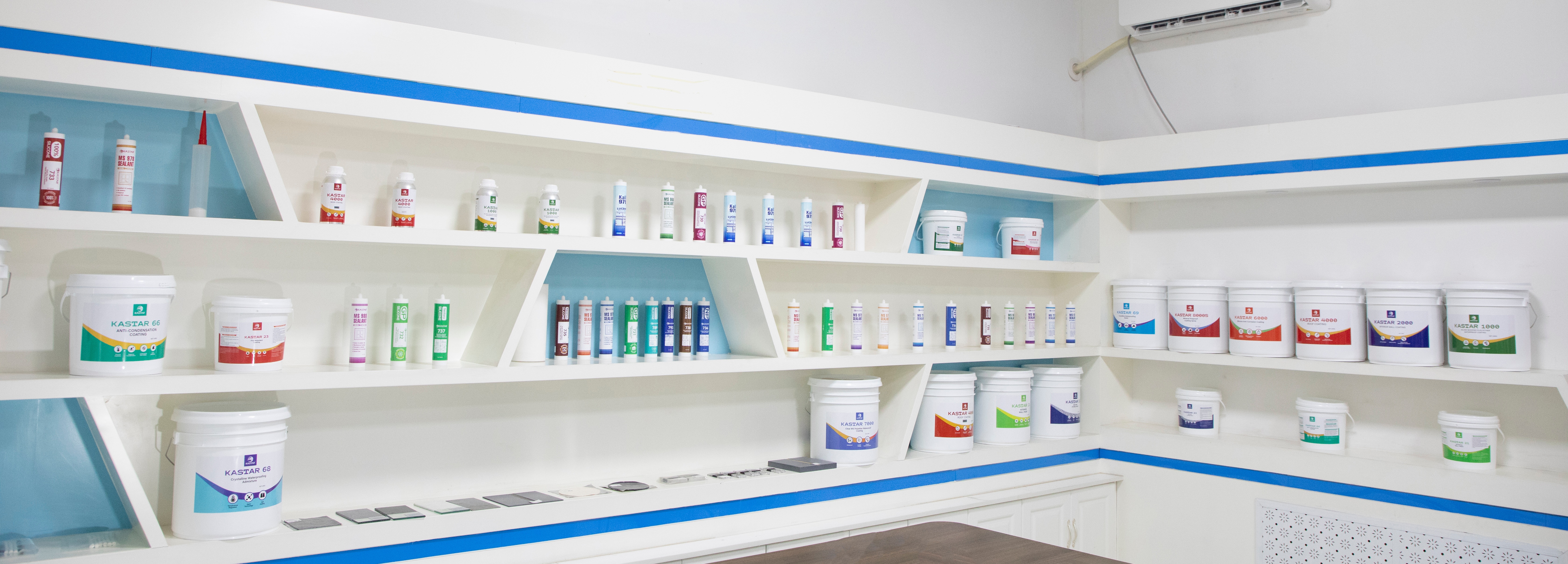
Yes, and a sample should always be evaluated against the buyer's own specification rather than against the supplier's datasheet alone. Kastar maintains a sample room and offers OEM/ODM customisation across colour, viscosity, packaging and formula, so a sample can be prepared in the configuration you intend to sell. Request the batch inspection record alongside the sample, test it under your own site conditions — particularly UV and temperature exposure for Australian and New Zealand projects — and only then move to a bulk commitment.
What lead time should a distributor plan for an OEM silicone waterproof coating order?
Kastar's stated production lead time is 15–20 days, with a monthly capacity of 30,000 tons. In practice, plan the compliance workflow as a separate timeline that runs in parallel: certificate verification, artwork and label approval, sample testing and batch inspection records all consume calendar days before production starts. Building two to three weeks of documentation lead time around the production window prevents a shipment from being ready technically but blocked commercially.
Next step: request the documentation file and a sample
Kastar Adhesives Technologies Co., Ltd. supplies silicone waterproof coating, epoxy colour sand floor coating and MS sealant on an OEM/ODM basis to distributors and brand owners in the US, Canada, Australia, New Zealand and 69 other markets. Ask for the certificate set, the test reports and a sample in your target configuration before you commit to a bulk order.
Email: paint4566@kastarpaint.com | Tel / WhatsApp: +86 15974221507 | Website: www.kastarcoating.com
Download the full product and capability brochure: Kastar Coatings Brochure (PDF)
Conclusion: The File Is the Product Promise
For a buyer in the United States, Canada, Australia or New Zealand, silicone waterproof coating compliance reduces to one habit: never accept a claim that cannot be traced to a document that names a product, a method, a laboratory and a date. Kastar 4000 Silicone Waterproof Coating brings a CE certificate ICR/VC/HS260188 valid to 15 January 2031, a 1,000 m² CMA-accredited laboratory with 16 testing personnel, 12 production and testing processes with batch sample testing, ISO 9001 certification, and SGS and REACH documentation — set against 28 years of production experience and exports to 69 countries. Verify each item, match it to your market's named method, and the purchase decision becomes what it should be: a document review, not a gamble.
Have Questions or Need More Details?
Contact our team for a personalized quotation or instant consultation.
Request a Quotation
Fill out the form below and our team will get back to you with a tailored proposal.
WhatsApp Direct Chat
Prefer to chat in real-time? Message us on WhatsApp for instant assistance & quick answers.
- Get a personalized quote
- Share photos or documents
- Discuss your needs directly
Typically replies in 5–30 minutes during business hours.