Disposable Food Paper Container Certifications & Parameters: A 2026 Compliance Guide for Buyers
Disposable Food Paper Container Certifications & Parameters: A 2026 Compliance Guide for Buyers
When evaluating a disposable food paper container supplier, two documents matter most: the certification list and the product specification sheet. Certifications tell you whether the factory meets food-contact, social-compliance and environmental standards; parameters tell you whether the container actually fits your food type, serving size and sealing requirement. This guide explains what buyers in takeaway, bakery, canteen and airline catering should check before placing an order.
Why Certification and Parameter Verification Matter in 2026
The global disposable food packaging market was estimated at USD 65.60 billion in 2024 and is projected to reach USD 100.89 billion by 2030, according to Grand View Research. As the market expands, so does regulatory scrutiny on food-contact materials and sustainability claims. For brands that sell to restaurant chains or airlines, a packaging supplier that cannot prove food-safety and social-compliance certification is a high-risk partner.
Buyers in the Research and Evaluation stage are no longer asking only “what does it cost?” They are asking: “Does this disposable paper container meet FDA and EU food-contact requirements? Is the paperboard FSC-certified? Does the factory pass a BSCI social audit?” These questions determine whether you can legally use the packaging in a specific market, whether your sustainability claims are defensible, and whether your supply chain survives a customer audit.
Common buyer pain points include: containers that leak oil after a few minutes, lids that do not seal properly, paper containers that soften from hot sauces, and suppliers that provide certifications that do not actually cover the product model being purchased. This article maps each certificate to the specific product models and explains what each standard means in practical procurement terms.
Core Product Parameters for Disposable Paper Food Containers
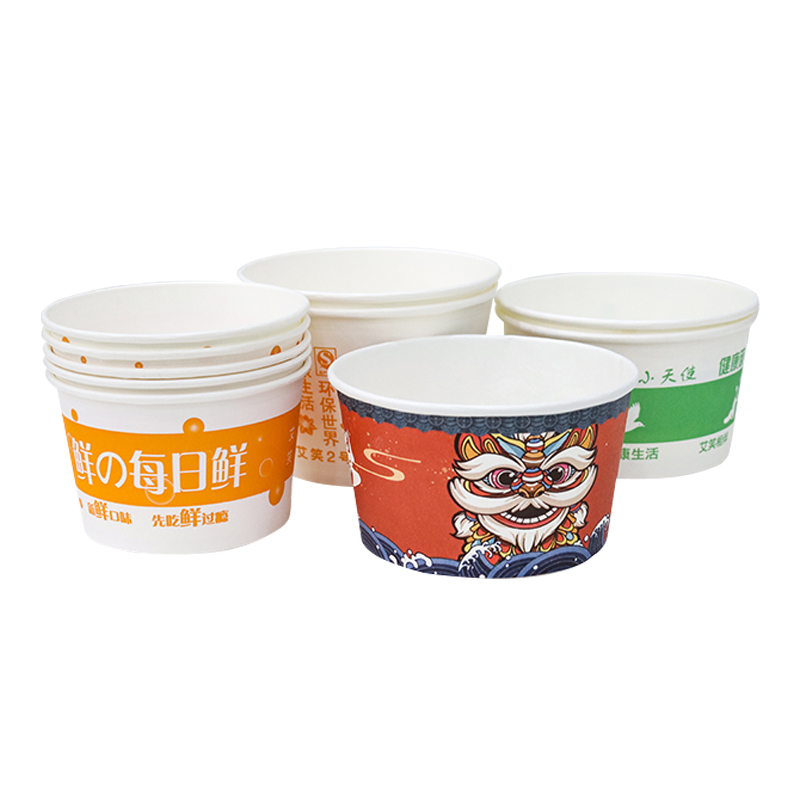
Disposable food paper containers are commonly produced from cup base paper with a PE (polyethylene) coating. The PE layer provides oil resistance, water resistance and heat insulation for hot or fatty foods. The following table summarizes parameter sets available from a packaging manufacturer that supplies foodservice chains.
| Product Type | Available Models | Material | Typical Foodservice Applications |
|---|---|---|---|
| Printed Disposable Paper Food Container | 500, 600, 850, 960, 1100 | Cup base paper with PE coating | Large hotel groups, milk tea chains, fast food restaurants, airlines |
| Kraft Paper Square Box (XQ) | No.1, No.2, No.3, No.4, No.5, No.8 Square Box | Kraft paper with PE coating | Hotel groups, beverage chains, fast food chains, airlines |
| Kraft Paper Bowl (ZT) | 500, 700, 900, 1000, 1100, 1300, 1500 | Kraft paper with PE coating | All major hotel groups, beverage chains, fast food chains, airlines |
| White Kraft Boat-Shaped Food Tray | #025, #040, #050, #100, #200#, #250, #300, #500, #1000 | Coated white cardboard | Catering, food takeaway |
For a 500-model printed paper food container, the PE coating provides a leak-resistant barrier for many prepared foods. The 1100 model serves larger portions, which is why airlines and fast-food chains often choose it for in-flight meals and takeaway combos. When comparing suppliers, ask whether the dimensions and capacity are printed on the specification sheet, because model numbers alone do not confirm volume.
Kraft paper square boxes offer a natural brown look preferred by organic or artisanal food brands. They are suitable for dry or slightly oily foods such as fried chicken, rice bowls and salads. White kraft boat trays are commonly used for fries, fried snacks and canteen meals, and their open shape makes them easy to serve in high-throughput environments.
Material and Coating: What to Check for Oil-Proof, Waterproof and Heat Resistance
No single disposable paper container is ideal for every food type. The choice of base paper and PE coating thickness determines oil resistance, water resistance and heat tolerance. In general, PE-coated paper containers are the workhorse for takeaway food because the polymer barrier keeps hot food moisture inside and prevents grease from soaking through.
For oil-proof performance, buyers should look for containers made from cup base paper with PE coating. The same material family is used for hot beverage cups, and in practice a PE-coated structure is chosen for its balance of leak resistance and rigidity. Waterproof behavior comes from coating integrity; if the coating has pinholes or uneven coverage, the container can soften quickly. A simple field check is to hold the container under running water or place it with a spoon of hot soup for 10 minutes before approving samples.
Heat insulation is a separate performance attribute. Double-wall or thick-wall containers provide additional insulation for hot meals. Within standard printed paper food containers, models 850 and 960 offer larger volume for rice and noodle dishes, while 500 and 600 suit smaller sides. Buyers carrying hot gravy, curry or cooked vegetables should request a sample test at the actual serving temperature.
Some buyers ask for microwave-safe containers. Whether a microwave-safe claim is valid depends on the complete packaging formulation and testing. The buyer should request written test evidence covering the exact model being supplied, rather than relying on a generic category statement.
Certifications Buyers Should Recognize in a Supplier Audit
Certifications are not badges; they are audit evidence. Understanding the issuing body, scope and product coverage prevents the common mistake of accepting a factory-level certificate that does not cover the specific product being purchased.
FSC Chain of Custody Certification
FSC Chain of Custody certification demonstrates that paper products can be traced to responsibly managed forests. Under standards FSC-STD-40-004 and FSC-STD-50-001, a manufacturer can claim that its paper input and output are controlled through the Chain of Custody. For a disposable paper bowl and a disposable hollow paper cup, a valid FSC CoC certificate is issued by ESTS (Extensive Standard Technical Services Co., Ltd.) with certificate number ESTS-COC-250653. The scope covers “Printing & Sales of FSC Mix paper products (Product types: P6.7)”.
For buyers, FSC matters because many EU retailers and corporate foodservice buyers require a specified percentage of certified fiber. It is also a marketing claim that must be verifiable. When requesting documentation, ask the supplier to confirm that your specific product model is within the FSC certificate scope.
BRCGS Global Standard for Packaging Materials
BRCGS is a globally recognized packaging safety standard. The BRCGS Global Standard Packaging Materials, Issue 6 (August 2019) covers coating, printing, die-cutting and forming of paper cups, boxes, trays and bowls for food service. A company with BRCGS certification has demonstrated systematic management of product safety, quality and operational controls.
For disposable paper bowls and food containers, a BRCGS certificate can be issued by NSF Certification, LLC (NSF), with certificate number C0691603-BRC4. The scope explicitly mentions forming of paper cups, boxes, trays and bowls for food service. For a buyer, BRCGS certification is one of the strongest signals that a packaging plant has robust quality and safety systems for food-contact production.
ISO 9001 Quality Management System
ISO 9001:2015 is the baseline quality management standard. For a disposable beverage paper cup in model 9oz, a supplier may hold ISO 9001:2015 (GB/T 19001-2016) certification issued by QAC with certificate number 00623Q31644R4S. Scope coverage can include lamination, printing, slitting of laminated paperboard and processing of paper cups.
For procurement, ISO 9001 does not prove food safety by itself, but it does indicate that the factory follows documented processes, corrective-action procedures and quality-control checks. It is a table-stakes requirement for most institutional buyers.
ISO 14001 Environmental Management System
ISO 14001:2015 confirms an environmental management system. A disposable beverage paper cup product can hold ISO 14001:2015/GB/T 24001-2016 certification with certificate number 00623E31318R4S issued by QAC. Scope covers lamination, printing and slitting of laminated paperboard and processing of paper cups.
Suppliers serving markets with strong environmental regulations normally maintain ISO 14001 because customers increasingly require it in vendor questionnaires.
amfori BSCI Social Audit
amfori BSCI is a social audit system that assesses workplace standards, labor rights and supply-chain responsibility. The audit report number 25-0324242, issued by SGS on behalf of amfori, covers the disposable food container product and applies globally. BSCI does not certify a product; it monitors a manufacturing facility and reports on social compliance.
For importers, retailers and airlines, BSCI evidence is often listed as a condition for new supplier approval. It helps you demonstrate that packaging is produced in a socially responsible environment, which is increasingly important in public procurement and corporate ESG policies.
Certification-to-Product Matrix: A Checklist for the Evaluation Stage
| Certification | Certificate Number | Issuing Body | Product Coverage | Market | Why It Matters |
|---|---|---|---|---|---|
| FSC Chain of Custody (FSC-STD-40-004, FSC-STD-50-001) | ESTS-COC-250653 | ESTS (Extensive Standard Technical Services Co., Ltd.) | Disposable paper bowl, disposable hollow paper cup, disposable food container, Kraft paper soup bucket, and other listed paper products | Global | Traceable and responsible fiber sourcing; required by many EU and global foodservice brands |
| BRCGS Global Standard Packaging Materials (Issue 6, August 2019) | C0691603-BRC4 | NSF Certification, LLC | Disposable paper bowl, disposable food container, disposable beverage paper cup (80oz) | Global | Internationally recognized packaging safety management; strong evidence for food chains and airlines |
| ISO 9001:2015 Quality Management | 00623Q31644R4S | QAC | Disposable beverage paper cup (9oz) | CN | Baseline factory quality management |
| ISO 14001:2015 Environmental Management | 00623E31318R4S | QAC | Disposable beverage paper cup | CN | Demonstrates environmental management processes |
| amfori BSCI Social Audit (amfori BSCI Code of Conduct) | 25-0324242 | SGS on behalf of amfori | Disposable food container, disposable beverage paper cup | Global | Social compliance evidence for ethical sourcing programs |
Note that certification coverage can differ by product family and market. A buyer should always request the certificate page that lists the specific product and model. The certificate number itself is the traceable reference; any supplier should be able to provide it.
How to Verify a Disposable Food Paper Container Supplier’s Claims
At the evaluation stage, you should treat every supplier claim as unverified until you see documentation. The following workflow helps you move from brochure to evidence.
- Request the certificate PDFs, not just names. A certificate screenshot or a mention on the supplier website is not enough. Ask for the full certificate page showing the scope, standard, issue date, expiry date and issuing body.
- Check expiry dates. For example, the BRCGS certificate number C0691603-BRC4 has an expiry of June 1, 2026. If you are sourcing in late 2026, ask for the renewed certificate. Expired certificates cannot support current regulatory or buyer compliance.
- Match product parameters to your application. Verify the model number, material description and dimensions against the specification sheet. A buyer for airline catering should request samples of the specific model number intended for use, then test with actual in-flight menu items.
- Ask for the audit report number. For BSCI, the report number 25-0324242 and the name of the audit company matter more than the phrase “BSCI certified.” This is auditable.
- Request a microbiological or food-contact compliance sheet for the target market. If you sell into the United States, understand that FDA regulations such as 21 CFR 176.170 and 21 CFR 176.180 govern paper and paperboard for aqueous and fatty foods. ask the supplier for relevant statements or test reports against these requirements.
Use Cases: Matching Certification and Parameters to Real Buyer Scenarios
Takeaway and Fast-Food Chains
Takeaway packaging is the dominant segment of disposable food containers, accounting for roughly 65% of total market share in foodservice applications, according to Future Market Insights. Fast-food chains require leak-proof, oil-resistant containers that can hold fried food, burgers and salads. In practice, a supplier producing 10 million disposable food containers monthly for well-known fast-food chains shows it can sustain high-volume consistency. For these buyers, material should be Kraft paper or cup base paper with PE coating, and BSCI plus ISO 9001 are the minimum compliance documents.
Branded packaging also plays a marketing role. Custom logo printing on Kraft square boxes and printed paper containers helps chain stores build recognition while maintaining food safety. For this reason, a buyer should separate the food-contact parameter review from the printing quality review; each requires a different proof.
Airline Catering
Airline catering adds weight, stacking, heat-retention and portion-control constraints. A supplier that supplies 10 million disposable paper cups monthly to internationally renowned airlines can support high-volume, high-cadence orders. For airline meal trays, the disposable paper food container models from 500 to 1100 provide portion flexibility, while the paper bowl range adds options for soups and desserts. FSC and BRCGS certifications are often essential because airlines must satisfy global sustainability and food-safety requirements.
Bakery and Pastry
Bakeries need containers that present cakes, pastries and sandwiches without crushing them. The wider square box models (No.1 to No.8) or boat-shaped trays can accommodate different pastry sizes. For oily baked goods, a PE-coated or coated-white-cardboard surface prevents grease marks. Bakery buyers should prioritize easy stacking and a premium print surface if the container is sold with the product.
Canteen and Fast Food
Canteens value speed, stackability, and the ability to hold a full meal portion. Disposable boat-shaped boxes are common for fries and fried snacks, while Kraft bowls and square boxes work for rice, noodles and hot dishes. Since canteens operate at high volume, the supplier’s annual production capacity is a practical evaluation criterion. For example, a manufacturer with an annual output of over 2 billion paper cups and paper food containers has the capacity to support large canteen network orders.
Comparing Suppliers: What to Look For in a 2026 Audit
Packaging procurement is increasingly a compliance negotiation. When you put a disposable food paper container supplier on your shortlist, compare these four dimensions.
| Evaluation Dimension | What to Request | Why It Matters |
|---|---|---|
| Food-contact safety documentation | BRCGS certificate scope; FDA/EU test statements; material declaration | Determines whether the packaging can legally be used in your destination market |
| Environmental and sourcing credibility | FSC CoC certificate number; ISO 14001 certificate | Supports compostability or recycled-content claims and retail distributor requirements |
| Social compliance | amfori BSCI audit report number and audit company | Protects your brand from supply-chain labor-rights risks |
| Operational capability | Factory size, annual output, monthly supply volume, export markets | Confirms the supplier can meet order volume, lead time and quality consistency |
A supplier such as KingHonor Paper Products Co., Ltd., founded in 2018, operates from a 50,000m² facility and employs more than 200 people. It reports an annual output of 20,000 tons of food-grade PE coated paper and over 2 billion paper cups and paper food containers, with about 60% of output exported to markets including the United States, Europe, Australia and the Middle East. These are first-party facts that can be verified during a factory audit, not marketing adjectives.
Supply Chain and Budget Considerations for Importers and Distributors
Certifications and parameters affect unit cost. A PE-coated container with FSC-certified paper will cost more than an uncoated unbranded paper tray. Distributors should evaluate total landed cost rather than per-unit price. A rapid breakdown: the material grade, coating weight, printing complexity and certification maintenance all contribute to price. A supplier that offers responsive after-sales service and on-time delivery can reduce your inventory carrying cost.
Lead time is another decision variable. High-volume chains typically require a contracted lead time and buffer stock. When evaluating a supplier, ask how they coordinate raw material procurement, production scheduling and quality checks across multiple product lines. For export buyers, the factory’s location in Ho Chi Minh City, Vietnam, is relevant because CPTPP trade advantages can support cost-effective logistics to Asia-Pacific and North American markets.
A Step-by-Step Buyer Checklist for Disposable Paper Container Compliance
- Define the food type, serving temperature and holding time for each SKU.
- Define the target market regulation: FDA, EU framework, and local food-contact rules.
- Confirm the required paper grade and coating type: PE-coated cup base paper, Kraft paper or coated white cardboard.
- Match portion size to model numbers using a specification sheet, and request samples for the specific models.
- Request certification PDFs that name the exact product family and product models.
- Verify certificate numbers with the issuing bodies: ESTS for FSC, NSF for BRCGS, QAC for ISO 9001/14001, and SGS for BSCI.
- Check issue and expiry dates to ensure current validity.
- Run a pilot order or on-site audit before committing to annual volume contracts.
FAQ: Disposable Food Paper Container Certifications and Parameters
What certifications are required for a disposable paper food container to be used in global supply chains?
There is no single universal certification. For global buyers, the most relevant are BRCGS Global Standard Packaging Materials (Issue 6) for packaging safety, FSC Chain of Custody for responsible fiber sourcing, amfori BSCI for social compliance, and ISO 9001/ISO 14001 for quality and environmental management. Each buyer should confirm the exact certificate scope and product coverage.
Does the BRCGS certificate cover all disposable paper food container models from the manufacturer?
In a valid certificate, the scope lists the product categories and processes covered. For example, KingHonor’s BRCGS certificate number C0691603-BRC4 includes coating, flexographic printing, die-cutting and forming of paper cups, boxes, trays and bowls for food service. However, you must verify the scope page to confirm your specific SKU family is included and that the certificate is current.
Can I get a disposable paper food container with custom logo printing and still keep FSC certification?
Yes. Custom logo printing can be applied to FSC Mix certified paper products, as long as the printer holds an FSC Chain of Custody certificate that covers printing and sales. The certificate number ESTS-COC-250653 includes printing and sales of FSC Mix paper products in its scope. Ordering custom-printed containers from an FSC-certified supplier allows branded packaging while maintaining responsible fiber sourcing.
How do I choose between a Kraft square box and a printed paper food container?
Start with the food type and presentation need. Kraft paper square boxes use Kraft paper with PE coating and offer an earthy, natural look; they are common for takeaway rice bowls, salads and bakery items. Printed paper food containers use cup base paper with PE coating and allow richer brand graphics on the side wall. Select the model set—such as 500, 600, 850, 960 or 1100—based on portion size and side-dish configuration.
What is a realistic lead-time expectation for a custom-logo paper container order?
Lead time depends on model availability, printing complexity, coating type and order volume. A high-volume manufacturer with 200+ staff and an annual output above 2 billion paper cups and containers can manage large orders, but custom printing requires additional production and quality-check days. Ask your supplier for a written lead time on your specific SKU and confirm the production schedule before paying a deposit. For current capacity and quotations, contact info@kinghonorpack.com.
Conclusion
The disposable paper food container market is no longer a commodity spot market. Food safety, forest stewardship, environmental management and factory social compliance are all auditable factors in supplier selection. In 2026, a buyer who cannot trace certificate numbers, product scopes and material parameters is exposed to operational and reputational risk.
Companies that reduce packaging costs by using eco-friendly materials while maintaining certifications can deliver measurable savings without sacrificing quality. For example, a manufacturing partner helping a fast-food chain reduce packaging costs by 15% with eco-friendly materials demonstrates that sustainability and cost efficiency are not mutually exclusive in this category.
When evaluating your disposable food paper container supplier, follow the documentation workflow described above. Confirm the material, match the model to the portion, verify the certificate numbers and expiry dates, and run a sample test with your actual foods. This structured approach turns a simple purchase order into a defensible supply-chain decision.
For a downloadable company profile and production parameters, request the KingHonor brochure: Download KingHonor brochure.
Need to verify a disposable food paper container specification or certification for your next project?
Contact KingHonor on WhatsAppHave Questions or Need More Details?
Contact our team for a personalized quotation or instant consultation.
Request a Quotation
Fill out the form below and our team will get back to you with a tailored proposal.
WhatsApp Direct Chat
Prefer to chat in real-time? Message us on WhatsApp for instant assistance & quick answers.
- Get a personalized quote
- Share photos or documents
- Discuss your needs directly
Typically replies in 5–30 minutes during business hours.