How to Select the Correct PE-Coated Kraft Paper Food Container: Model Dimensions, Material Specs, and Liquid-Resistance Parameters
How to Select the Correct PE-Coated Kraft Paper Food Container: Model Dimensions, Material Specs, and Liquid-Resistance Parameters
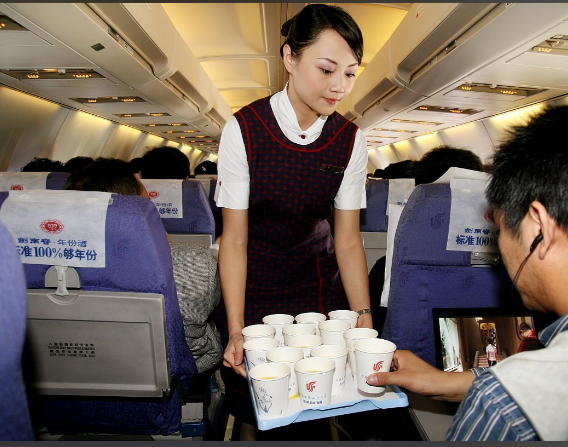
Airline catering is one of the foodservice segments where dimension accuracy and coating integrity decide whether a container performs in service.
Quick answer: a PE-coated kraft paper food container is selected in three passes — match the material base to the fat, water and heat load of the menu; read the full three-dimension size string of the model rather than the model number; and confirm the coating and certification documents for the exact SKU being ordered. The model number is a catalogue identifier, not a capacity figure.
1. The Real Selection Problem: A Model Number Is an Identifier, Not a Specification
A PE-coated kraft paper food container is a disposable foodservice container built on a paper base with a polyethylene (PE) coating applied to the food-contact surface. The paper carries the structure and the hand feel; the coating is the layer that blocks oil and water. Because those two functions sit in different layers, a container can photograph correctly and still fail in service if either the base or the coating is mismatched to the menu.
The mismatch usually starts at the ordering step. Food service managers and packaging specifiers re-order by habit: a 500 bowl, a No.3 square box, a #100 tray. In KingHonor's own published product data, those names are identifiers. Kraft Paper Bowl ZT model 500 is listed at 50 x 128 x 45 mm, model 1000 at 150 x 128 x 75 mm, and model 1300 at 180 x 160 x 65 mm. The model numbers rise, but the three dimensions do not rise evenly or in the same proportion, and two bowls can share one dimension while differing in the others. Specifying by model name alone leaves the fill height, the lid fit and the carrier fit undefined.
KingHonor Paper Products Co., Limited Liability Company is a Vietnam-based manufacturer of disposable paper cups, paper bowls, food containers, soup buckets and boat-shaped food trays. Founded in 2018, the company operates a 50,000 m² factory with more than 200 employees and an annual output of 20,000 tons of food-grade PE coated paper and over 2 billion paper cups and paper food containers, exporting to the United States, China, Europe, Australia and the Middle East.
2. Why the PE Coating, Not the Kraft Paper, Decides Oil and Water Performance
Liquid resistance in a disposable paper container is a coating property. Uncoated kraft paper is a fibre mat: it absorbs water, wicks hot oil along the fibre direction, and loses stiffness once saturated. The PE layer forms a continuous film on the food-contact side, which is why the same kraft paper base appears across KingHonor's liquid-facing lines and is published as kraft paper with PE coating for Kraft Paper Bowl ZT, Kraft Paper Square Box XQ and Kraft Paper Soup Bucket ZT.
The material base is a separate decision from the coating, and the KingHonor catalogue uses three bases across its container lines:
- Kraft paper with PE coating — Kraft Paper Bowl ZT, Kraft Paper Square Box XQ and Kraft Paper Soup Bucket ZT; natural fibre surface.
- Coated white cardboard — the White Kraft Food Tray ZT line; smooth, bright surface positioned for catering and food takeaway.
- Cup base paper with PE coating — the printed Disposable Paper Food Container line, alongside the paper cup lines.
Two external frameworks matter when the coating is specified for export. In the United States, FDA 21 CFR 176.170 and 21 CFR 176.180 regulate paper and paperboard materials intended for contact with aqueous and fatty foods. Where a compostable or biodegradable claim is made, the material must meet EN 13432 (EU) or ASTM D6400 (US) to be labelled that way. Neither framework publishes the coat weight of a specific container, so the practical step for a buyer is to request the coating basis, the base paper grade and the leak or soak test result for the exact SKU being ordered — a waterproof coated paper container claim is only as good as the documented coating behind it.
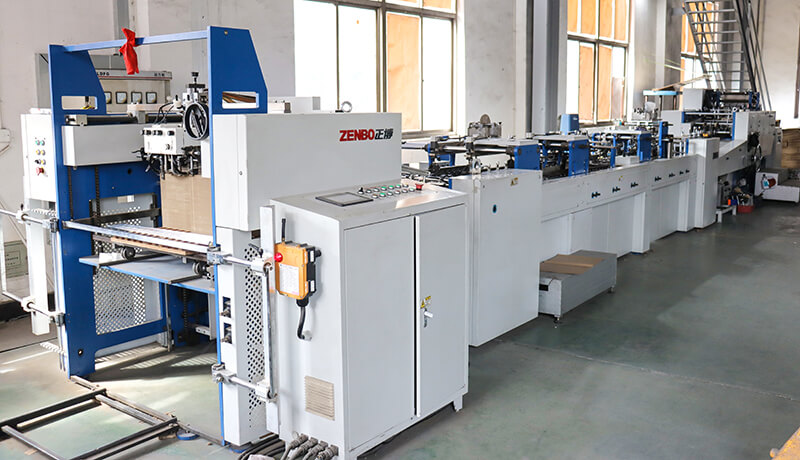
Coating and forming take place in-house, which keeps material base and coating spec traceable to the order.
3. Industry Background: Why Specification Detail Now Decides Re-orders
Disposable food packaging demand continues to expand, and foodservice is the segment driving it. The global disposable food packaging market was estimated at USD 65.60 billion in 2024 and is projected to reach USD 100.89 billion by 2030 (Grand View Research). The broader eco-friendly food packaging market was valued at USD 227.96 billion in 2024 (Grand View Research). Asia Pacific accounted for a 39.8% revenue share of the paper-based containers market in 2024 (Towards Packaging), and foodservice applications hold approximately 65% of the disposable food container market, driven by delivery platforms (Future Market Insights).
Supply is concentrated at the top of the market: key global players in disposable food containers include Huhtamaki, Dart Container Corporation, Pactiv Evergreen and Graphic Packaging International (Market Research Future). For a buyer, that means paper container lines are widely available, and the differentiator in a tender or a re-order is usually the specification sheet rather than availability. KingHonor manufactures in Vietnam and exports 60% of its output, placing its container supply inside the Asia Pacific production region that dominates paper-based container output.
4. Comparison Table: Container Lines, Material Bases and Model Ranges
Selection gets faster once the container family is fixed, because each family carries its own material base and model range. The table below uses KingHonor's published product data only.
| Container line | Material base | Model range | Application per product data |
|---|---|---|---|
| Kraft Paper Bowl ZT (disposable paper bowl) | Kraft paper with PE coating | 500, 700, 900, 1000, 1100, 1300, 1500 | Hotel groups, beverage chains, fast food chains, airlines |
| Kraft Paper Square Box XQ (disposable food container) | Kraft paper with PE coating | No.1, No.2, No.3, No.4, No.5, No.8 Square Box | Hotel groups, beverage chains, fast food chains, airlines |
| White Kraft Food Tray ZT (disposable boat-shaped box) | Coated White Cardboard | #025, #040, #050, #100, #200#, #250, #300, #500, #1000 | Catering, food takeaway |
| Printed Disposable Paper Food Container | Cup base paper with PE coating | 500, 600, 850, 960, 1100 | Hotel groups, milk tea chains, fast food restaurants, airlines |
| Kraft Paper Soup Bucket ZT | Kraft paper with PE coating | 8oz, 12oz, 16oz, 26oz, 32oz | Hotel groups, beverage chains, fast food chains, airlines |
Two patterns are worth noting for specifiers. First, kraft paper with PE coating is the default base for lines that hold hot, oily or wet food directly, while coated white cardboard is reserved for the tray line used in catering and takeaway. Second, the model ranges are long — seven bowl models, nine tray models, five printed container models — which means the family is rarely the constraint; the dimension choice inside the family is.
5. Step-by-Step: Reading Model Dimensions Against Volume and Application
- Define the load before the container. Fat content, water content, serving temperature and expected holding time decide how much coating stress the container will take. A hot oily curry and a dry pastry place different demands on the same kraft paper base.
- Match the base to the load and the presentation. Kraft paper with PE coating for bowls, square boxes and soup buckets; coated white cardboard for trays used in catering and takeaway; cup base paper with PE coating for printed containers.
- Read all three listed dimensions of the model. The three numbers move independently, so each should be checked separately against the carrier, the lid and the fill line (see the table below).
- Do not convert the model number into a volume assumption. The published model data gives dimensions in millimetres. The bowl numbers 500 to 1500 and the printed container numbers 500 to 1100 are catalogue identifiers; confirm the working fill volume with the supplier using the density of the actual food before a fill line is set.
- Confirm the coating and compliance pack per SKU. Ask for the material base, coating type, FSC chain-of-custody reference and management-system certificates for the specific line being ordered.
- Validate with a physical sample using the real food — a hot, oily or wet dish rather than water — before any mass-production commitment.
| Kraft Paper Bowl ZT model | Size (MM) | Material |
|---|---|---|
| 500 | 50x128x45mm | Kraft paper with PE coating |
| 700 | 150x128x60mm | Kraft paper with PE coating |
| 900 | 180x160x51mm | Kraft paper with PE coating |
| 1000 | 150x128x75mm | Kraft paper with PE coating |
| 1100 | 165x145x66mm | Kraft paper with PE coating |
| 1300 | 180x160x65mm | Kraft paper with PE coating |
| 1500 | 185x160x65mm | Kraft paper with PE coating |
The comparison inside this single line makes the point: model 500 and model 1000 share one 128 mm dimension but differ in the other two, and model 1300 and model 1500 share the same listed string. A buyer who specifies by number alone is effectively leaving two of the three fit constraints open. The same discipline applies to the White Kraft Food Tray ZT range, where the tray models run from #025 to #1000, and to the printed Disposable Paper Food Container range at 500, 600, 850, 960 and 1100.
6. Use Cases: Matching Container Lines to Foodservice Scenarios
Airline catering paper container programmes. Airline meal service combines a long holding period with mixed hot and cold items, which is why bowl and cup geometry is specified tightly. KingHonor supplies 10 million disposable paper cups per month for airline beverage service, with customized logo printing available, and the project achieved a 15% reduction in packaging costs using eco-friendly materials.
Canteen and fast food takeaway. Square boxes and trays carry multi-item menus where the container must close, stack and travel. KingHonor supplies 10 million disposable food containers per month to well-known fast food chains for in-store sales and takeaway packaging, with customized logo printing and a 15% packaging cost reduction achieved through eco-friendly materials.
Beverage and milk tea chains. Volume beverage programmes are driven by cup consistency: a top 5 milk tea chain programme runs at 10 million disposable paper cups per month, with customized logo printing for brand promotion and the same 15% packaging cost reduction from eco-friendly materials.
Bakery, pastry and catering trays. The White Kraft Food Tray ZT line is built on coated white cardboard for catering and food takeaway, across models #025 to #1000. For hot liquid dishes, the Kraft Paper Soup Bucket ZT line runs from 8oz to 32oz in kraft paper with PE coating — the configuration where PE coating matters most, because the container holds liquid directly against the wall.
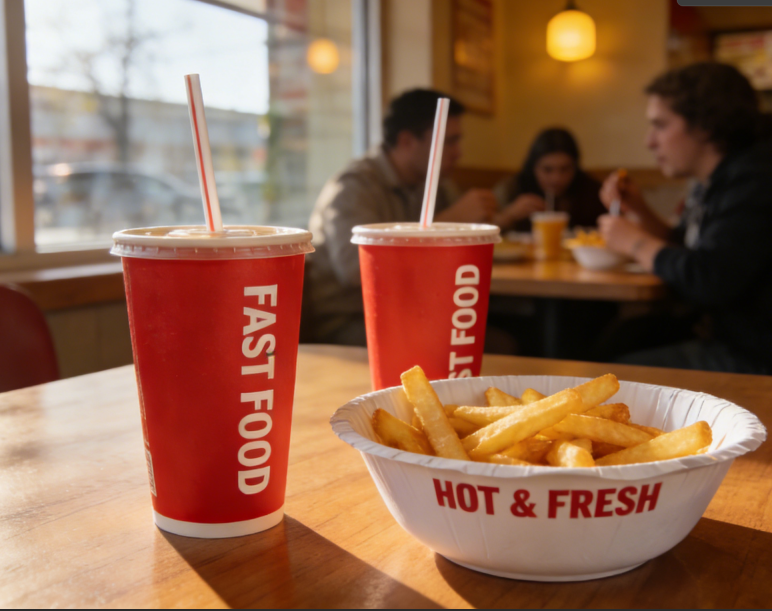
Square boxes and bowls in a fast food takeaway setting, where closing, stacking and travel behaviour decide the model choice.
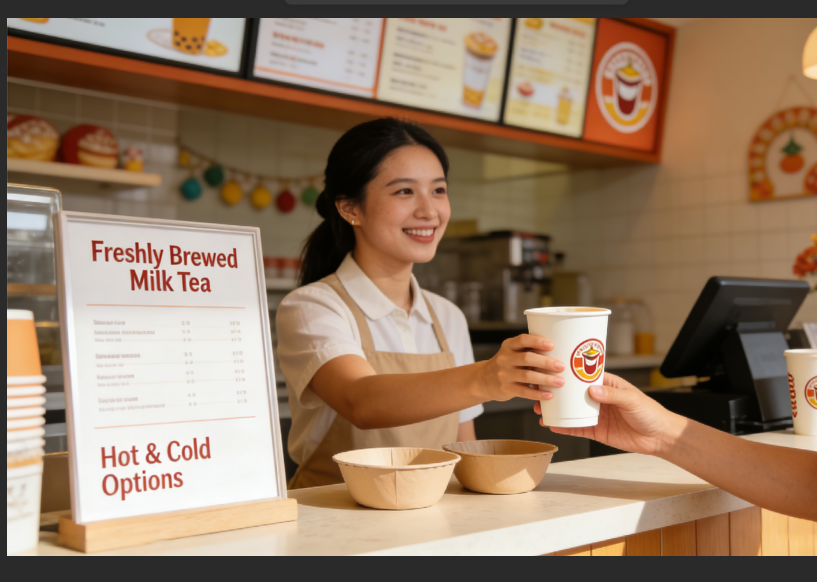
Beverage chain programmes run on cup and bowl consistency at high monthly volumes.
Across these programmes, KingHonor serves clients in the US, Vietnam, China, Australia and EU countries, with operations spanning Asia, Europe and America.
7. Liquid-Resistance Verification Checklist for Buyers
Liquid resistance cannot be judged from a product photo. The checklist below separates what is documented in the published model data from what must be requested per SKU.
| Parameter | Why it matters | Status in KingHonor model data |
|---|---|---|
| Material base | Sets structure, stiffness and surface appearance | Published per line: kraft paper, coated white cardboard, cup base paper |
| PE coating presence | The oil-proof and waterproof barrier layer | Published as kraft paper with PE coating for bowls, square boxes, soup buckets; cup base paper with PE coating for the printed container line |
| Three-dimension size string (mm) | Fill height, lid fit, carrier fit and nesting | Published for Kraft Paper Bowl ZT models 500 to 1500 |
| Model list per line | Determines how much size flexibility exists without tooling change | Seven bowl models, six square box models, nine tray models, five printed container models, five soup bucket sizes |
| FSC chain of custody | Fibre sourcing claim for tenders and retail buyers | FSC Chain of Custody Single Certificate ESTS-COC-250653, issued 2025-06-05, valid until 2030-06-04 |
| Quality and environmental management | Process control behind coating, printing and forming | ISO 9001:2015 / GB/T 19001-2016 certificate 00623Q31644R4S; ISO 14001:2015 / GB/T 24001-2016 certificate 00623E31318R4S |
| Food contact framework (US) | Market access for aqueous and fatty food contact | FDA 21 CFR 176.170 and 21 CFR 176.180 |
| Compostability claim | Legitimacy of an eco-friendly label | EN 13432 (EU) or ASTM D6400 (US) |
| Coat weight, base paper grade, leak or soak test result | The figures that predict real in-service performance | Not published in the model data — request per SKU |
A related caution applies to performance claims. A microwave-safe claim, a heat-resistance claim or a leak-proof sealed claim should be confirmed against the temperature range and closing method of the specific SKU, not inferred from the fact that the line uses PE coating.
8. FAQ: PE-Coated Paper Food Container Selection
Which certification documents should a PE-coated kraft paper food container order include?
KingHonor Paper Products holds an FSC Chain of Custody Single Certificate, ESTS-COC-250653, issued on 2025-06-05 and valid until 2030-06-04, covering the printing and sales of FSC Mix paper products. Quality management is certified to ISO 9001:2015 / GB/T 19001-2016 under certificate 00623Q31644R4S, and environmental management to ISO 14001:2015 / GB/T 24001-2016 under certificate 00623E31318R4S. The company's BRCGS Global Standard Packaging Materials certification covers coating with polyethylene (PE) or poly lactic acid (PLA) resin, flexographic printing, die-cutting of paper board and forming of paper cups and lids, boxes, trays and bowls for food service. For US-bound paper and paperboard in contact with aqueous or fatty foods, FDA 21 CFR 176.170 and 21 CFR 176.180 set the framework, and any compostable claim must meet EN 13432 or ASTM D6400.
Can the container be produced in a custom size and material base beyond the listed models?
Yes. The published range already spans seven kraft paper bowl models (500 to 1500), six kraft paper square box models (No.1 to No.5 and No.8), nine food tray models (#025 to #1000), five printed food container models (500, 600, 850, 960 and 1100) and five soup bucket sizes (8oz to 32oz). KingHonor also offers customization from size and design to logo printing and eco-friendly material selection, supported by an annual output of 20,000 tons of food-grade PE coated paper and more than 2 billion paper cups and paper food containers.
What drives the unit cost of a PE-coated paper food container?
The main cost variables are the material base (kraft paper, coated white cardboard or cup base paper), the PE coating step, printing, the dimension and model chosen, and order volume. Material choice is the lever most clients pull first: in two separate client programmes, switching to eco-friendly materials reduced packaging costs by 15%, a result reported for both a fast food chain container programme and a beverage chain cup programme.
How do we validate dimensions and liquid resistance before mass production?
Request three things: the full size string in millimetres for the model, the material base and coating type, and a physical sample tested with the actual dish rather than water. The published data already provides the first two — for example, Kraft Paper Bowl ZT model 500 at 50x128x45mm in kraft paper with PE coating, or the White Kraft Food Tray ZT range in coated white cardboard from #025 to #1000. Sample and quotation requests can be sent to info@kinghonorpack.com or through WhatsApp at +8618205730716.
What affects the lead time for a custom container order?
Lead time depends on the model selected, whether custom printing or a new size is required, and order volume. Capacity available to support volume programmes includes 20,000 tons of food-grade PE coated paper per year and more than 2 billion paper cups and paper food containers per year, with project-level volumes of 10 million units per month for fast food and beverage chain programmes. Confirm the schedule per order line with the supplier before committing to a launch date.
9. Conclusion: Three Checks Before You Confirm a Container Model
Selecting the correct PE-coated kraft paper food container comes down to three checks. Match the material base to the load: kraft paper with PE coating for bowls, square boxes and soup buckets that hold hot or oily food; coated white cardboard for catering and takeaway trays; cup base paper with PE coating for printed containers. Read the full three-dimension size string of the model, because the Kraft Paper Bowl ZT range shows that model numbers and dimensions do not move together. And verify the coating and compliance pack per SKU, since coat weight, base grade and leak test results sit outside the published model data and must be requested.
KingHonor Paper Products Co., Limited Liability Company is located at BINH TIEN 2 HAMLET, DUC HOA HA COMMUNE, DUC HOA DISTRICT, LONG AN PROVINCE, VIET NAM, and is reachable at info@kinghonorpack.com, +86 13918832889, or WhatsApp +8618205730716. The full product and specification overview is available in the KingHonor product brochure, and the container range is listed on kinghonorpack.com. Buyers evaluating a specific model can request the size string, material base and coating data for a sample before production planning.