Solving Double-Cup Waste with Hollow Paper Cups: A KingHonor Scenario Guide
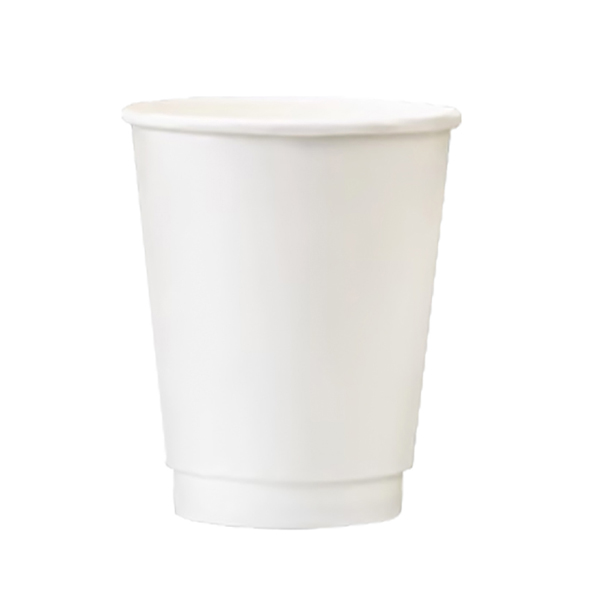
A disposable hollow paper cup: one cup that insulates a hot drink, so a second cup or a sleeve is no longer the standard way to protect a customer's hand.
Coffee shops, milk tea counters and takeaway restaurants share one quiet workaround. When a hot drink is poured into a thin single-layer cup, staff nest a second cup around the first so the customer can hold it. The habit solves a real problem in two seconds, and creates a purchasing problem that repeats all day: two disposable paper cups leave the counter for every drink that only needed one.
The problem is not service quality. It is cup structure. A disposable single-layer paper cup has one wall of PE-coated paper between the hot liquid and the hand, so insulation has to be bought somewhere else — usually as a second cup, sometimes as a sleeve. A disposable hollow paper cup and a disposable double-layer paper cup move that insulation into the cup itself.
This scenario guide is written for café owners, chain procurement teams and food service buyers who are still at the research stage. It covers what double-cupping actually costs, how the Vietnam paper cup market is developing, how KingHonor's hollow and double-layer cups replace the second cup, how to choose between cup structures by beverage type, and what to clarify in writing before the first bulk order.
The Double-Cup Problem: When Two Cups Do One Cup's Job
Double-cupping is a workaround for a structural limitation, not a service standard. It appears where hot drinks meet a thin-walled cup and where nobody has yet tested an insulated alternative. Once it becomes routine, it is rarely measured — it is simply how the bar works.
Why the second cup appears
In a single-layer cup, heat travels through one wall of PE-coated cup paper to the outside surface. Staff have three practical responses: add a sleeve, add a second cup, or use a cup that was built with insulation. The second cup wins during peak hours because it is already at the counter, needs no extra stock-keeping decision at the moment of service, and works with every drink size on the menu.
The workaround also spreads quietly. Once a new team member learns that hot drinks get two cups, the rule gets applied to drinks that never needed it — large black coffees, teas, hot chocolate — and to cold drinks served on the same station.
What the workaround costs
- Cup count per order. Every hot drink consumes two units instead of one, so the volume of cups purchased and reordered follows the number of hot drinks sold, not the number of orders.
- Storage and handling. Double the cup units means double the cartons in the storeroom, more restocking trips to the counter, and more handling per serve.
- Waste stream. Two used cups are discarded per drink, and the second cup is usually clean — it was never in contact with the beverage.
- Customer perception. A stacked double cup is visible to the customer at the moment of handover and reads as a routine rather than a considered choice.
Put simply, a shop that double-cups is buying insulation by volume instead of buying it by design. That is the decision this guide is meant to change.
Where the waste hides
Double-cupping is rarely uniform. It usually concentrates in a few SKUs — the hottest drinks, the smallest cup size, the busiest two hours. That is why the first practical step is not to replace every cup, but to find out which drinks are actually being served in two cups, and then to match those drinks to an insulated structure.
Industry Background: Cup Structure Is Now a Sourcing Question
The shift away from double-cupping sits inside a larger movement in paper cup demand, capacity and regulation. A few figures show the direction of travel for buyers in Vietnam and for brands exporting from it.
- The Vietnam paper cup market reached a value of USD 41.5 million in 2025 and is projected to grow to USD 57.9 million by 2034 (IMARC Group).
- Vietnam's paper cup manufacturing industry has seen annual growth rates of 20–25%, with 2022 domestic consumption estimated at 4.2 billion units and exports at 1.2 billion units (Vietnam Packaging Association, VIPA).
- The global disposable cups market was valued at USD 17.40 billion in 2024, with paper cups accounting for over 61% of total sales (Grand View Research).
- Vietnam's paper and pulp industry recorded export turnover exceeding USD 2.7 billion in 2024, maintaining a growth rate of 10–12% per year (General Department of Vietnam Customs).
- Vietnamese paper cup manufacturers must comply with National Technical Regulation QCVN 12-1:2011/BYT on safety and hygiene for synthetic resin implements and packaging in direct contact with food (Ministry of Health of Vietnam).
- The EU Single-Use Plastics (SUP) Directive requires beverage cups containing plastic to carry a specific ‘Plastic in Product’ label and to transition to plastic-free coatings such as water-based barriers by 2026 (European Commission, Directive EU 2019/904).
For a café or a chain, these numbers are not market trivia. They describe a supply base that is scaling fast, a cup category that dominates disposable drinkware, and a regulatory direction that pushes suppliers toward cleaner coatings and clearer labelling. Double-cupping sits awkwardly against all three: it consumes more units per drink in a market where volume matters, and it doubles the material leaving the store in a period when the material story of every disposable cup is being scrutinised.
The buyer-level takeaway: the cheapest cup is not always the cup with the lowest unit price. When a cup size forces a second cup into every hot serve, the real consumption per drink is two units, and the comparison should be made on that basis.
The Detailed Solution: Insulation Built Into the Cup
KingHonor Paper Products Co., Limited Liability Company is a Vietnam-based manufacturer of disposable paper cups, paper bowls, food containers and paper boat trays, founded in 2018. The company operates a 50,000 m² production facility with 200+ employees, an annual output of 20,000 tons of food-grade PE coated paper and over 2 billion paper cups and paper food containers, supported by a 20-person core technical team. Around 60% of production is exported to markets including the United States, China, Europe, Australia and the Middle East.
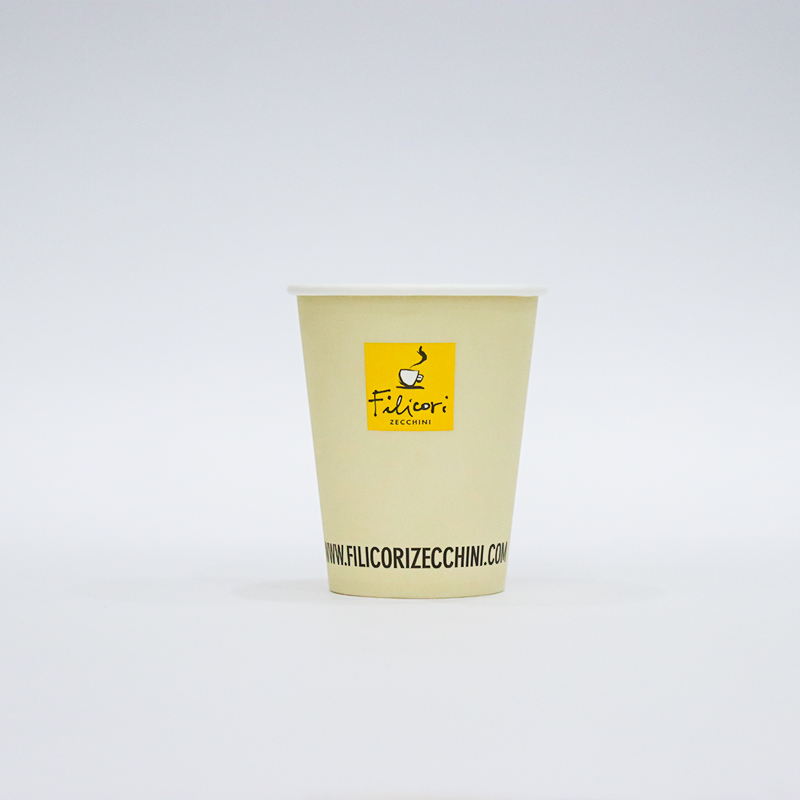
A disposable beverage paper cup from the KingHonor range. Cup structure — not cup count — is what determines how a hot drink feels in the hand.
The company holds BRCGS Packaging Materials certification (Cert. C0691603-BRC4) and produces cups from food-grade, double PE coated, leak-proof cup paper designed for cold and hot beverage compatibility.
Disposable hollow paper cup: insulation without a second unit
A disposable hollow paper cup is built with a hollow-wall construction: the outer layer is separated from the inner wall rather than glued flat against it, so the outer surface of the cup is not in direct contact with the full heat path of the beverage. This is the structural difference that lets one cup do the job that two stacked single-layer cups were doing.
KingHonor's disposable hollow paper cup is produced in 8oz, 12oz and 16oz models, with dimensions of 80×92×56 mm, 90×112×60 mm and 90×135×60 mm, made from cup paper with PE coating. Those three sizes cover the majority of hot coffee, tea and milk tea serves in cafés and quick-service restaurants.
Disposable double-layer paper cup: for larger hot serves
Where the hot drink is larger than the hollow range, the disposable double-layer paper cup covers the gap. KingHonor produces this structure in a 20oz model measuring 90×153×60 mm from double PE coated paper. The second layer is part of the cup, not a separate item to be stocked, counted and discarded.
Disposable single-layer paper cup: still the right cup for cold
Insulation only has to be paid for where insulation is needed. KingHonor's disposable single-layer paper cup is available in 8oz, 10oz, 12oz, 16oz, 20oz, 24oz, 32oz and 44oz models, with sizes from 80×90×56 mm up to 115.5×189×83.5 mm, from cup paper with PE coating. For iced and cold drinks, the disposable cold drink paper cup (A3oz, 62×62×42 mm, PE coated paper) handles the smaller serves. The practical sourcing goal is not to insulate everything — it is to stop insulating with a second cup.
Comparison Table: Single-Layer, Double-Layer and Hollow Paper Cups
For hot drinks served without a sleeve or a second cup, the hollow structure is the one designed for the job. For large hot serves, the double-layer structure covers the capacity. For cold and iced drinks, a single-layer cup is normally sufficient. The table below uses KingHonor's published model, size and material information so that the comparison can be checked against a specification sheet.
| Cup structure | KingHonor models | Dimensions | Material | Insulation approach | Where it fits |
|---|---|---|---|---|---|
| Disposable hollow paper cup | 8oz, 12oz, 16oz | 80×92×56 mm, 90×112×60 mm, 90×135×60 mm | Cup paper with PE coating | Hollow wall — outer layer separated from the inner wall | Hot beverages served in a single cup; replaces double-cupping |
| Disposable double-layer paper cup | 20oz | 90×153×60 mm | Double PE coated paper | Second adhered paper layer built into the cup | Large hot beverages where the hollow range stops at 16oz |
| Disposable single-layer paper cup | 8oz, 10oz, 12oz, 16oz, 20oz, 24oz, 32oz, 44oz | 80×90×56 mm to 115.5×189×83.5 mm | Cup paper with PE coating | Single wall; insulation supplied separately (sleeve or holder) | Cold and iced drinks; hot drinks served with a sleeve |
| Disposable beverage paper cup (9oz) | 9oz | 75×87×53 mm | Double PE coated paper | Single wall, double PE coated | General beverage lines and standard hot or cold serves |
| Disposable cold drink paper cup | A3oz | 62×62×42 mm | PE coated paper | Single wall | Small cold serves, tasting portions and iced drinks |
Model and size data reflects KingHonor's published product specifications. Dimensions are given in millimetres as model width × height × base.
Step-by-Step Breakdown: Moving from Double-Cupping to Single-Cup Insulation
A switch of this kind fails when it is treated as a straight cup-for-cup substitution. It works when it is handled as a small operational project with a measurable end state: no hot drink leaves the counter in two cups.
- Map where double-cupping actually happens. List the drink SKUs served hot, note the cup size used for each, and mark which ones are currently served in two cups. This turns a habit into a list of specific products.
- Match each drink to a cup structure. Hot serves in the 8–16oz range map to the disposable hollow paper cup. Hot serves above that map to the 20oz disposable double-layer paper cup. Cold and iced drinks stay on the disposable single-layer paper cup or the disposable cold drink paper cup.
- Check the fit with everything already on the counter. Cup lids, cup dispensers and custom printing equipment all have to work with the new structure. Confirm lid fit and dispenser compatibility against the model and dimensions before committing to volume.
- Run a controlled trial, not a full switch. Fill the hollow cup with the hottest drink on the menu, let it stand through a normal service interval, and check three things: how the outside surface feels in the hand, whether the lid holds, and whether the cup remains leak-proof with the beverage in normal use.
- Lock the specification before the bulk order. Agree the exact product name, model, dimensions, material and coating, printing requirement, packing configuration and acceptance criteria in writing. These are the terms that determine what arrives and how it is checked.
- Roll out in stages and monitor. Start with the highest-volume hot SKU, keep the old routine available for drinks outside the trial, and track cup units consumed per hot drink served. When the count settles at one, extend the switch to the next SKU.
Use Cases: Matching Cup Structure to Beverage and Venue
KingHonor's cups and food containers are used across branded coffee shops, milk tea and hot drink chains, fast food restaurants, airlines, hotels and business offices, with an operation mode of 24/7 and compatibility with cup lids, cup dispensers and custom printing equipment. The scenario logic below follows the same product facts.
Branded coffee shops
This is where double-cupping is most visible. Hot coffee in the 8–16oz range moves to the disposable hollow paper cup; iced drinks stay on single-layer or cold drink cups. Because coffee shops sell branded experience as much as coffee, the cup that replaces the second cup should also carry the logo — otherwise the shop trades one customer-facing inconsistency for another.
Milk tea chains and hot drink shops
A milk tea menu mixes temperatures and cup sizes on the same order line. The workable rule is temperature first, volume second: hot drinks in 12oz and 16oz go to hollow cups, large hot drinks to the 20oz double-layer cup, and iced drinks to the single-layer or cold drink range. Chains that run this rule remove double-cupping without changing the menu.
Fast food restaurants and takeaway
In fast food service, cup handling has to survive peak throughput. Compatibility with cup lids and cup dispensers is the constraint that decides whether an insulated structure is practical, not the cup's appearance. Food items ordered alongside drinks can be covered from the same supplier — disposable paper bowl, disposable food container, disposable paper food container and disposable boat-shaped box — which reduces the number of delivery streams a store has to manage.

Business offices: hot and cold beverage service where a single insulated cup replaces the two-cup routine.
Airlines and hotels
Airline and hotel beverage service is judged on consistency across many service points. The relevant product requirements are food-grade material, double PE coated construction, leak-proof performance and customizable printing — all of which apply to the hollow, double-layer and single-layer ranges. For hospitality buyers, the gain is simpler cup logistics: one insulated cup per hot serve instead of two plain cups.
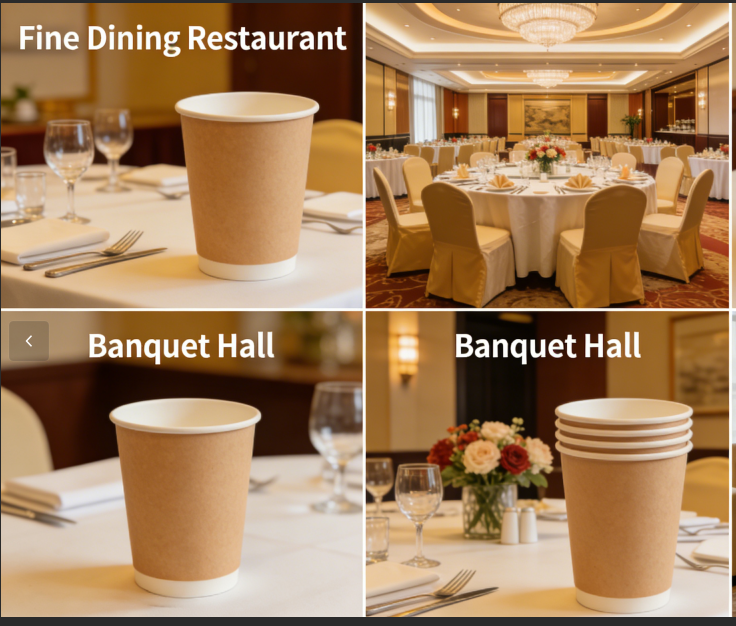
Hotel and group catering service: insulated structures simplify cup counts at high-volume beverage stations.
Offices, catering and events
Catering stations and office pantries usually mix hot and cold beverages in the same area. A practical setup is two insulated hot sizes (12oz and 16oz hollow cups) plus the cold drink and single-layer ranges for iced beverages, with a Kraft Paper Soup Bucket for soup stations and a disposable paper bowl or food container where food is served alongside.
| Scenario | Recommended structure | KingHonor model to quote |
|---|---|---|
| Coffee shop, hot drink 8–16oz | Hollow wall, single cup | disposable hollow paper cup — 8oz, 12oz, 16oz |
| Large hot drink, 20oz | Double layer | disposable double-layer paper cup — 20oz |
| Iced and cold drinks | Single wall | disposable single-layer paper cup or disposable cold drink paper cup |
| Branded and printed cups | Structure chosen by drink, printing added | custom disposable paper cup — 20oz |
| Soup and hot food station | Kraft paper with PE coating | Kraft Paper Soup Bucket ZT — 8oz, 12oz, 16oz, 26oz, 32oz |
| Meal service alongside drinks | Kraft paper with PE coating | disposable paper bowl; disposable food container; disposable paper food container; disposable boat-shaped box |
Sourcing Checklist: Terms and Acceptance Criteria to Settle with KingHonor
Double-cupping usually ends because of a specification change, so the specification is where the result is either secured or lost. The following items should be confirmed in writing before a bulk order is placed.

Custom disposable paper cup: printing, size and structure are specified together, not separately.
- Exact product name and model. “Disposable hollow paper cup — 12oz” is a specification; “hot cup” is not. Model and product name should match the quotation line by line.
- Dimensions and material. Confirm the size in millimetres and the material and coating (cup paper with PE coating, double PE coated paper, or Kraft paper with PE coating for bowls and buckets).
- Structure choice per SKU. State which drinks receive hollow, double-layer or single-layer cups. This is the clause that prevents a partial switch from quietly retaining the second cup.
- Printing and customization. Confirm printed or unprinted, artwork, colour handling and which models in the order carry the logo. KingHonor's customization covers size, design, logo printing and material selection.
- Compatibility. Confirm that lids and cup dispensers used in the outlet fit the ordered models and dimensions.
- Packing and quantity. Agree carton configuration, units per carton and total order quantity, since these affect handling at the store and the delivered unit price.
- Sample approval. Approve a physical sample of the exact model before mass production, and keep the approved sample as the reference for acceptance.
- Acceptance criteria. Define how the shipment will be checked — dimensions, structure, material, print quality and packing — and who signs off.
- Commercial terms. Delivery terms, documentation and order-specific lead time are confirmed per order against the final specification.
FAQ
Do hollow and double-layer paper cups have to meet food-contact regulations?
Yes. In Vietnam, paper cup manufacturers follow National Technical Regulation QCVN 12-1:2011/BYT, which sets safety and hygiene requirements for synthetic resin implements and packaging in direct contact with food. For exports to the European Union, the Single-Use Plastics Directive (EU 2019/904) requires beverage cups containing plastic to carry a ‘Plastic in Product’ label and to move toward plastic-free coatings such as water-based barriers by 2026. KingHonor's Vietnam operation holds BRCGS Packaging Materials certification (Cert. C0691603-BRC4) and produces from food-grade PE coated cup paper, but buyers should still confirm the labelling format required in their own destination market before ordering.
Can one hollow paper cup really replace two stacked single-layer cups for hot drinks?
For the sizes where hollow construction is produced, yes. KingHonor manufactures the disposable hollow paper cup in 8oz, 12oz and 16oz models measuring 80×92×56 mm, 90×112×60 mm and 90×135×60 mm, from cup paper with PE coating. The hollow wall separates the outer surface from the inner wall, so insulation is part of the cup rather than a second unit. Where the hot drink is larger than 16oz, the 20oz disposable double-layer paper cup (90×153×60 mm, double PE coated paper) covers that capacity, and where no insulation is required, the disposable single-layer paper cup range runs from 8oz to 44oz.
Does switching to hollow cups cost more per drink?
The relevant comparison is not the unit price of a hollow cup against the unit price of a single-layer cup — it is the cost of one insulated cup against the cost of two plain cups plus the handling, storage and disposal of the second one. Hair.
Can we test hollow and double-layer cups before committing to a bulk order?
Testing before commitment is the sensible route, and it should be structured. Fill the hollow or double-layer cup with the hottest beverage you serve, let it stand through a normal service interval, and check three things: how the outer surface feels in the hand, whether the lid still seats correctly, and whether the cup remains leak-proof in normal use. Check the same sample against the cup lids and cup dispensers used at your counter, since compatibility is a specification issue rather than a preference. KingHonor supports customization from size and design to logo printing and materials, so the trial sample should be built to the same specification as the intended order. Sample and quotation requests can be sent to info@kinghonorpack.com or via WhatsApp at +8618205730716.
What should be agreed with KingHonor before production starts?
Agree the full specification rather than the product category: exact product name and model, dimensions in millimetres, material and coating, printing and artwork, lid and dispenser compatibility, packing configuration, order quantity and acceptance criteria. Approve a physical sample and keep it as the reference for incoming inspection. Delivery terms and order-specific lead time are then confirmed against that locked specification. Sending a complete specification list is the fastest way to receive an accurate quotation and a realistic schedule — the KingHonor team can be reached at info@kinghonorpack.com or on WhatsApp at +8618205730716.
Conclusion: One Cup Is Enough When the Cup Is Built for It
Double-cupping is not a mistake by baristas; it is what happens when a single-layer cup has to carry a hot drink it was not built to insulate. The fix is structural. A disposable hollow paper cup in 8oz, 12oz or 16oz handles the standard hot serve in one unit; a 20oz disposable double-layer paper cup covers larger hot drinks; single-layer and cold drink cups stay where no insulation is needed. The result is a cup count of one per drink instead of two, with the second cup removed from purchasing, storage, handling and the waste stream.
The practical sequence is short: identify which drinks are being double-cupped, match them to a structure, trial the sample against your hottest beverage and your existing lids and dispensers, lock the specification in writing, and roll out by SKU. KingHonor produces all three structures in Vietnam, with a 50,000 m² facility, over 2 billion units of annual paper cup and food container output, BRCGS Packaging Materials certification (Cert. C0691603-BRC4), and export experience across the United States, Europe, Australia, the Middle East and other regions.
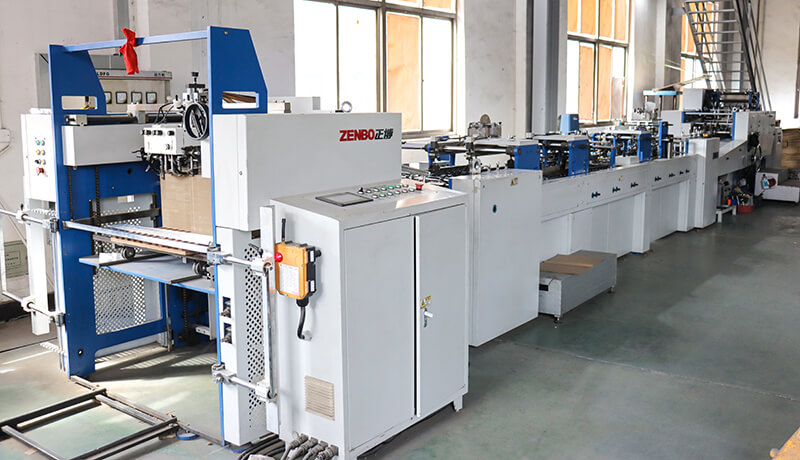
Inside the KingHonor production facility in Vietnam, where single-layer, double-layer and hollow paper cups are produced for export markets.
Next Step: Test the Cup, Then Change the Routine
If your team is currently serving hot drinks in two cups, the fastest way to evaluate the alternative is a sample of the exact model you would order. Send your drink sizes, required structure and printing requirements, and KingHonor will match them to the hollow, double-layer or single-layer range and confirm pricing, packing and delivery terms for your order.
Email: info@kinghonorpack.com | Tel: +86 13918832889 | WhatsApp: +8618205730716
Website: www.kinghonorpack.com | Blog: blog.kinghonorpack.com
Download the full product brochure: KingHonor Product Brochure (DOCX)
KingHonor Paper Products Co., Limited Liability Company — BINH TIEN 2 HAMLET, DUC HOA HA COMMUNE, DUC HOA DISTRICT, LONG AN PROVINCE, VIET NAM.
Have Questions or Need More Details?
Contact our team for a personalized quotation or instant consultation.
Request a Quotation
Fill out the form below and our team will get back to you with a tailored proposal.
WhatsApp Direct Chat
Prefer to chat in real-time? Message us on WhatsApp for instant assistance & quick answers.
- Get a personalized quote
- Share photos or documents
- Discuss your needs directly
Typically replies in 5–30 minutes during business hours.