Ficus Ginseng Bonsai vs. Pachira Money Tree: A Wholesale Buyer's Head-to-Head Decision Guide
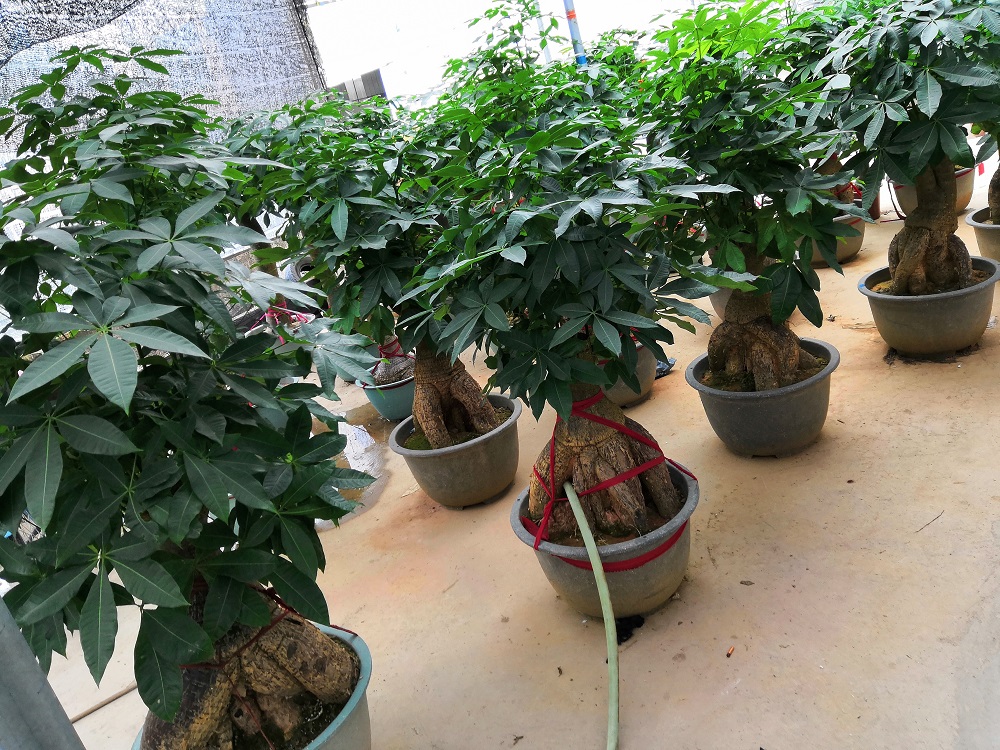
Ficus bonsai in production at KinoFarm, Zhangzhou, China.
Short answer: Ficus ginseng bonsai and Pachira money tree are not ordered the same way, so they cannot be compared on a single "price per plant" line. Ficus ginseng bonsai is specified by root form — grafted or ungrafted — and by net weight, in a range of 50 g to 10 kg, and it is traded into agriculture, horticulture and home furniture stores. Pachira money tree is specified by braid count — 3, 4 or 5 braids — and by height, from 20 cm to 90 cm, with a choice between newly braided and old braided supply, and it is traded into agriculture and horticulture. This guide walks through both programs in the order a first-time buyer actually meets them: order unit, purchase terms, acceptance criteria, container survival and channel fit.
Why This Comparison Happens Before There Is Any Purchase History
A wholesale bonsai program usually starts with two or three catalogue pages and no shipment record. At the awareness and research stage, Ficus ginseng bonsai and Pachira money tree sit next to each other in the same supplier portfolio, look similar in a thumbnail, and are often quoted as "small potted bonsai" with no further detail. That is where the comparison problem begins.
Three things actually differ between the two products, and each one changes the paperwork:
- The order unit. Ficus is graded by weight; Pachira is graded by braid count and height. Two quotations built on different units tell you almost nothing about relative cost.
- The structural choice. Ficus carries a grafting decision (grafted or ungrafted). Pachira carries a braiding decision (3, 4 or 5 braids) and a braiding-age decision (newly braided or old braided). Both are commercial choices, not cosmetic ones.
- The channel signal. Ficus bonsai lists home furniture stores alongside agriculture and horticulture in its stated applicable industry. Pachira money tree is stated for agriculture and horticulture. A buyer with a furniture floor and a buyer with a horticultural trade counter are therefore looking at two different default recommendations.
The working question for a research-stage buyer is not "which plant is better" but "which of these two programs can be specified tightly enough to be inspected on arrival". Everything below is organised around that question.
Industry Background: The Demand Context Behind These Two Programs
Both products sit inside a bonsai category that is expanding, and inside a compliance framework that has become stricter at the same time. The published figures below are third-party estimates, and they should be read as directional rather than precise.
- The global bonsai market is projected to reach approximately USD 18.4 billion by 2035, growing at a CAGR of 8.8% from 2026 to 2035 (Vertex AI Search / Industry Analysis, 2025).
- Asia Pacific held a dominant share of over 48.5% of the bonsai industry in 2025, valued at USD 3.8 billion (Vertex Market Report, 2025).
- China's exports of "Other live plants", the trade category that includes bonsai, reached USD 355 million in 2024, with the United States and South Korea as the top destinations (OEC, 2024).
- Indoor bonsai varieties such as Ficus and Money Tree are reported to be growing at a 10.28% CAGR through 2031, driven largely by the rise in apartment living (Mordor Intelligence, 2025).
- Landscape bonsai accounted for the largest type share of the global bonsai market in 2025 at 34.2% (Dataintelo, 2025).
Read the market size numbers with care. Published estimates for the value of the global bonsai market in 2025 diverge widely between research firms — from roughly USD 1.8 billion (Dataintelo) to USD 7.9 billion (Vertex Research) to USD 10.39 billion (Global Market Statistics). The growth direction is consistent across sources; the absolute size is not. Buyers should treat headline market value as a trend indicator, not as a planning number.
Two structural facts matter more to a buyer than the size of the category. First, the compliance layer is now explicit: the European Union requires phytosanitary certificates for imported bonsai plants under Regulation (EU) 2019/2072, and the United States requires bonsai to be bare-rooted and accompanied by a phytosanitary certificate issued in the country of origin, with different requirements possible for shipments of 12 or fewer (USDA APHIS). Second, demand is tilting toward plants that are easy to keep alive: low-maintenance "living decor" varieties are reported to be gaining share as consumers look for simpler plant care (Horticultural Trades Association / TechSci Research). Both Ficus ginseng bonsai and Pachira money tree sit on the right side of that second trend, which is a large part of why they end up in a head-to-head evaluation.
On the supply side, third-party industry rankings for 2026 list Chinese bonsai manufacturers such as Jiangsu Womei Horticulture, Zhangzhou Jiaying Horticulture and Chunqiu Horticultural Center among the sector's active producers, which reflects how concentrated export-oriented bonsai supply is in China. A practical example of that supply base is Xiamen Perfect Supply chain CO., LTD (KinoFarm), a live plant and bonsai manufacturer established in 2012 and based in Zhangzhou, Fujian.
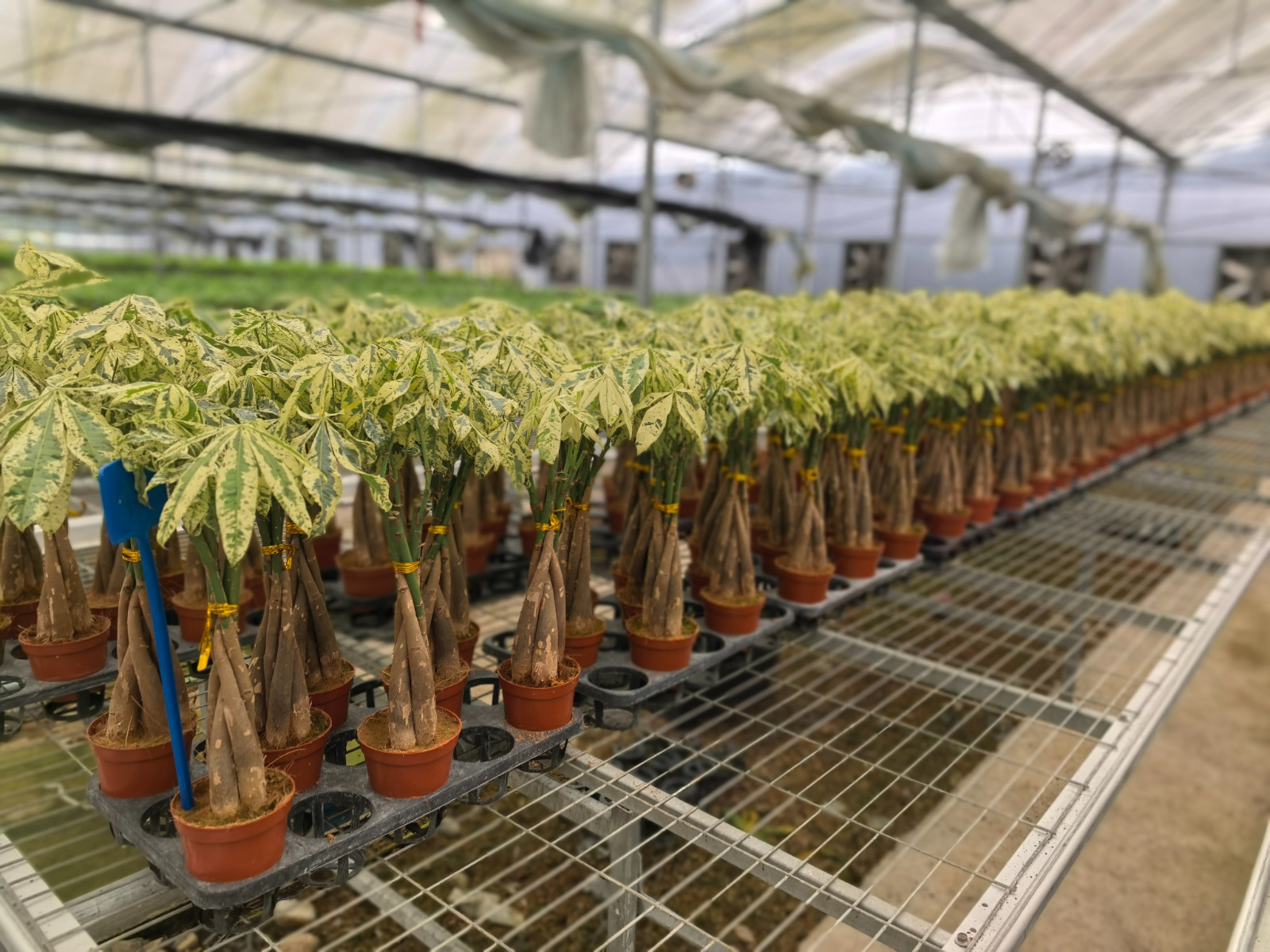
Pachira money tree, braided stem format, in KinoFarm production.
Product Anatomy: What You Are Actually Buying
Before any price discussion, it helps to reduce each product to the fields that will appear in a purchase order. Both of the descriptions below follow the supplier's published product units for these two programs.
Ficus ginseng bonsai (product model: Ficus ginseng roots)
Ficus bonsai is a live plant built from Ficus roots and plants, and its model designation is Ficus ginseng roots. The product is classified as a grafted or ungrafted bonsai, and it is sold by net weight in a range of 50 g to 10 kg. That weight band is the practical reason a single product line can serve several retail formats: a 50 g unit and a multi-kilogram unit are the same item at different grades.
The stated applicable industry for this product is agriculture, horticulture and home furniture stores, and the stated typical application scenario is home furniture stores. The trade description used for it is a small, lovely and easy bonsai. For a buyer, the practical translation is that Ficus ginseng bonsai is a decor-led line: it is specified by graft status and weight band, and it is merchandised where indoor furniture and home accessories are already being sold.
Pachira money tree (product model: 5 braids)
Pachira is a live plant made from a Pachira stem, classified as a Money tree. It is supplied in 3, 4 or 5 braids, at heights from 20 cm to 90 cm, and it can be ordered either newly braided or old braided. The stated applicable industry is agriculture and horticulture.
The braid count and the braiding age are the two specification fields that carry the most commercial weight. Braid count determines the visual density of the trunk and therefore the shelf position the plant can occupy; braiding age determines how established the braided structure is when it leaves the nursery. Because height is specified separately from braid count, a buyer can build a range that runs from a 20 cm counter item up to a 90 cm floor plant without changing product.
Step-by-Step: Running a Head-to-Head Evaluation Before You Commit a Container
The sequence below is written for a buyer who has not yet placed a first order with either program. Each step ends with a decision that can be written into a purchase order or an inspection sheet.
Step 1 — Fix the order unit before comparing any price
Ask for the Ficus quotation in weight bands (within the 50 g to 10 kg range) and the Pachira quotation in braid count plus height (within 20 cm to 90 cm, and stating newly braided or old braided). Until both quotations use those units, the comparison is not meaningful.
Step 2 — Decide the structural option
For Ficus, choose grafted or ungrafted and state it explicitly; the two are different line items in the product description. For Pachira, choose 3, 4 or 5 braids and confirm whether the supply offered is newly braided or old braided. Where both options exist, the deciding factor is usually the retail price point you intend to hold, not the plant itself.
Step 3 — Match the product to the floor it will sit on
If the destination is a furniture or home-decor floor, Ficus ginseng bonsai is the closer fit: home furniture stores are named in its stated applicable industry and as its typical scenario. If the destination is a horticultural trade counter or a garden centre, both programs are stated for agriculture and horticulture, and the choice moves back to the specification fields in Steps 1 and 2.
Step 4 — Write acceptance criteria against the specification, not against appearance
Acceptance criteria only work if they reference a number that appears in the order. For Pachira, that means counting braids against the confirmed 3, 4 or 5 braid specification and measuring height against the agreed band inside 20 cm to 90 cm. For Ficus, it means spot-checking net weight against the agreed band inside 50 g to 10 kg and confirming the graft status matches the order line. Anything that is not written as a number in the purchase order cannot be inspected later.
Step 5 — Confirm the phytosanitary route for the destination market
For EU destinations, the shipment needs to satisfy the phytosanitary certificate requirement under Regulation (EU) 2019/2072. For the United States, the plants must be bare-rooted and accompanied by a phytosanitary certificate from the country of origin, with possible differences for shipments of 12 or fewer. This is the step where a live-plant head-to-head comparison stops being a product question and becomes a documentation question.
Step 6 — Plan the container and the survival checks around it
Both programs are moved in refrigerated containers; greenhouse production and reefer containers are the matched equipment used for these plants. Survival checks should therefore be agreed before loading, not after arrival: confirm the container type and set point in the order, confirm loading density against the weight and height bands you ordered, and agree who inspects the plants and when once the container is opened. An exporter's transport track record is a legitimate part of this check — for example, Xiamen Perfect Supply chain CO., LTD holds invention patents for a long-distance storage and transport method and for pest control in soilless bonsai cultivation, and ships over 100 containers of plants annually.
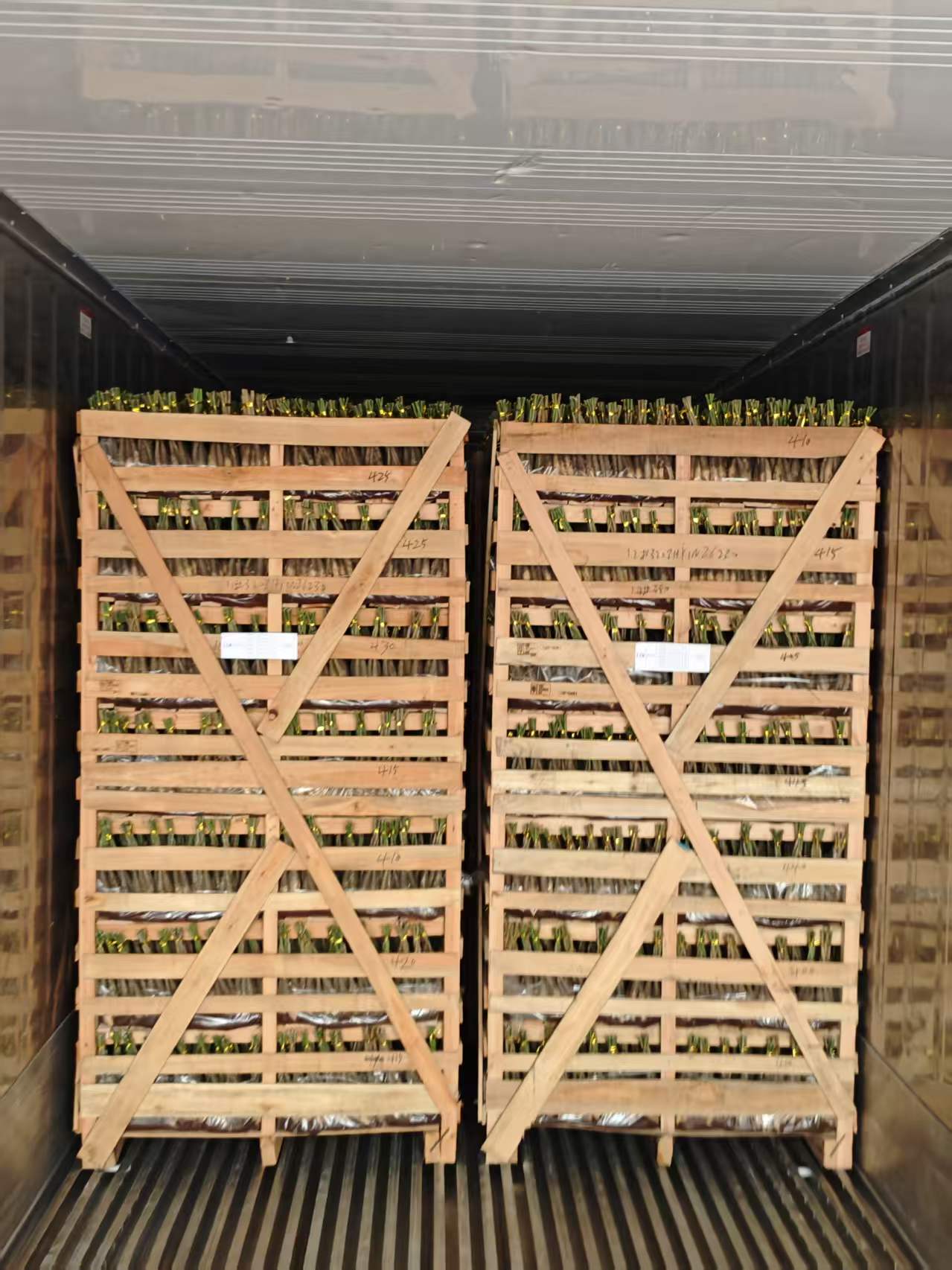
Pachira packed in a reefer container before export loading.
Step 7 — Verify supplier capability before, not after, the trial
For a live-plant program, the supplier's infrastructure is part of the product specification. The checks that matter are the ones that can be documented: CIQ-certified greenhouses built to meet China's Entry-Exit Inspection and Quarantine standards, adherence to the MPS-A (Marketable Plant Safety - A) certification, and greenhouse capacity that can absorb a repeat order. KinoFarm, the brand of Xiamen Perfect Supply chain CO., LTD, operates two nurseries with a total of 65,000 m² of greenhouse space, employs approximately 120 staff including an R&D team of 5 engineers, produces about 5,000,000 units annually, exports approximately 98% of its output, and serves markets in the USA, EU, Asia and Africa.
Use Cases: Where Each Program Earns Its Space
Home furniture and indoor decor retail
Ficus ginseng bonsai is the more direct fit here, because home furniture stores appear in both its stated applicable industry and its typical application scenario. The 50 g to 10 kg weight range allows a furniture retailer to range a small accessory unit and a larger statement unit from one product line, and the grafted or ungrafted option gives a second price tier without changing supplier.
Garden centre and horticultural trade
Pachira money tree is stated for agriculture and horticulture, and its braid-based specification suits a trade counter that sells on visual structure. A range built from 3, 4 and 5 braids across 20 cm to 90 cm covers both a gift-sized item and a floor plant, and the choice between newly braided and old braided supply lets a buyer decide how much of the braiding work is done before export.
Mixed indoor programs and first-time importers
Where a buyer is testing two lines at once, the cleanest approach is to split the trial by order unit: take Ficus in weight bands and Pachira in braid-and-height bands, then compare sell-through by SKU rather than by plant. Both programs are low-maintenance indoor types, which is the segment reported to be growing fastest as apartment living increases.
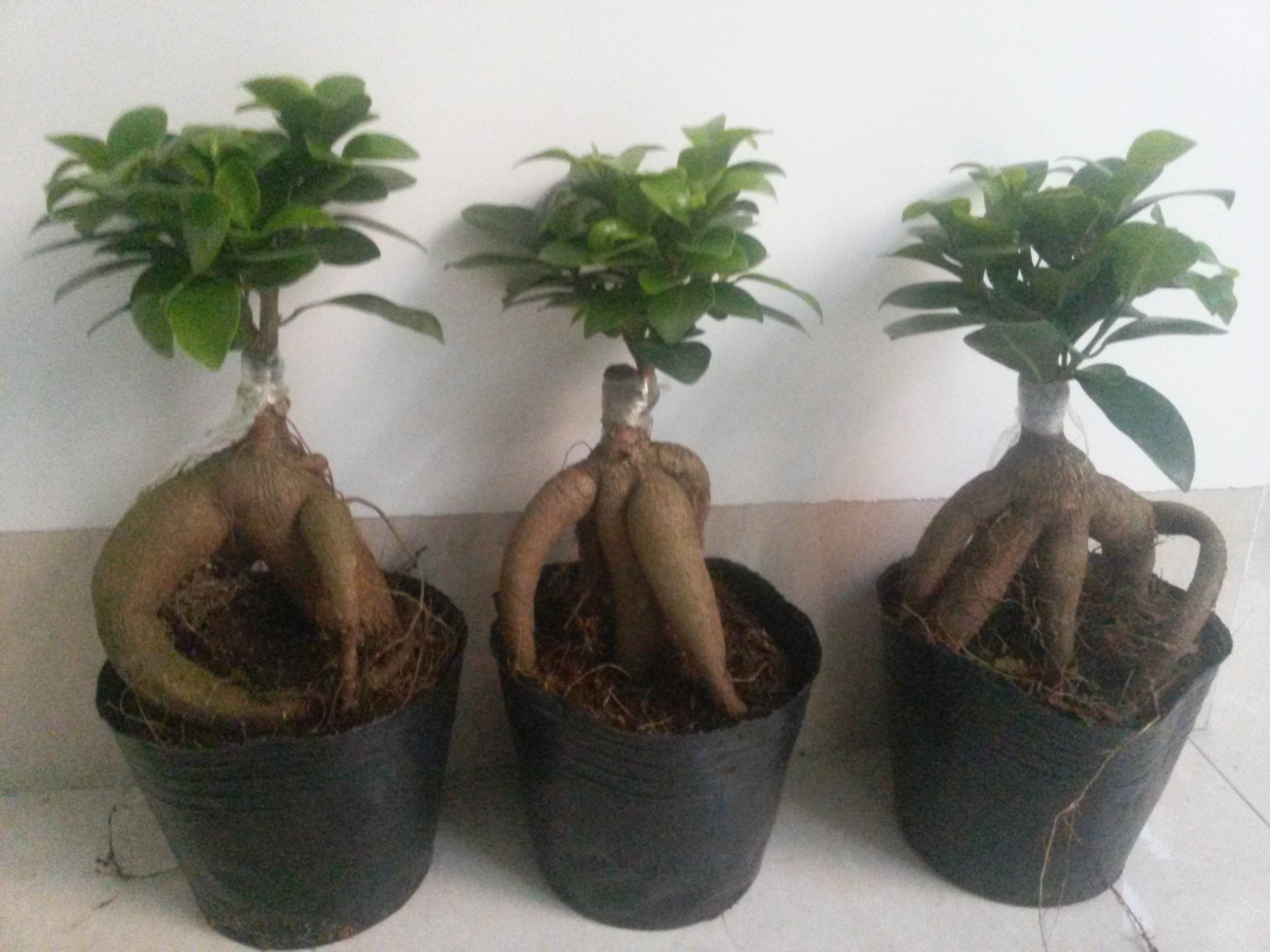
Ficus bonsai, potted specimen grade, in KinoFarm production.
Side-by-Side Comparison: Ficus Ginseng Bonsai vs. Pachira Money Tree
The table below compares the two programs only on specification fields that are published for the products. It is a purchasing table, not a quality ranking.
| Decision criterion | Ficus ginseng bonsai | Pachira money tree |
|---|---|---|
| Product model reference | Ficus ginseng roots | 5 braids |
| Product type description | Live plant; classified as a grafted or ungrafted bonsai | Live plant; classified as a Money tree |
| Material basis | Live plants, Ficus roots and plants | Live plants, Pachira stem |
| Primary specification unit | Net weight: 50 g to 10 kg | Height: 20 cm to 90 cm |
| Structural options | Grafted or ungrafted | 3, 4 or 5 braids; newly braided or old braided |
| Stated applicable industry | Agriculture, horticulture, home furniture stores | Agriculture and horticulture |
| Stated typical application scenario | Home furniture stores; agriculture and horticulture | Agriculture and horticulture |
| Trade description | Small, lovely and easy bonsai | Money tree category; braided stem format |
| What to fix in the purchase order | Graft status, weight band inside 50 g–10 kg | Braid count, height band inside 20–90 cm, braiding age |
| Matched handling equipment | Greenhouse production; reefer container | Greenhouse production; reefer container |
Two practical conclusions follow from the table. First, the only genuinely comparable metric between the two lines is the landed cost of a defined SKU, not the cost of a plant. Second, because the specification units differ, a mixed order should always be written as two separate specification blocks even when it ships in one container.
FAQ: Wholesale Bonsai Plants — Ficus and Pachira Questions Buyers Ask
What phytosanitary requirements apply to wholesale Ficus and Pachira imports into the EU and the USA?
The European Union requires phytosanitary certificates for imported bonsai plants under Regulation (EU) 2019/2072, which exists to prevent pest introduction. The United States requires bonsai to be bare-rooted and accompanied by a phytosanitary certificate issued in the country of origin, and shipments of 12 or fewer may have different requirements (USDA APHIS). Both requirements apply to Ficus ginseng bonsai and Pachira money tree alike, because they are both live plants — the documentation route, not the plant species, is what determines whether a container clears.
How do I specify Ficus ginseng bonsai and Pachira money tree in one purchase order?
Write them as two specification blocks. Ficus ginseng bonsai is specified by graft status (grafted or ungrafted) and by net weight within a 50 g to 10 kg range. Pachira money tree is specified by braid count (3, 4 or 5 braids), by height within a 20 cm to 90 cm range, and by braiding age (newly braided or old braided). Because the two lines use different order units, a single combined price line will not tell you which product is contributing what cost.
Which of the two fits a home furniture store format?
Ficus ginseng bonsai is the closer fit. Home furniture stores are named in its stated applicable industry, and the same scenario is listed as its typical application, alongside agriculture and horticulture. It is described in trade terms as a small, lovely and easy bonsai, and its 50 g to 10 kg net weight range allows a furniture retailer to carry both a small accessory size and a larger floor size from one program. Pachira money tree is stated for agriculture and horticulture; where a furniture retailer does carry it, the specification is built around braid count and height instead.
Wholesale bonsai plants suppliers: what should I verify before committing to a container?
Verify the parts of the supplier that affect plant survival and documentation. For KinoFarm, the brand of Xiamen Perfect Supply chain CO., LTD, the verifiable items are: CIQ-certified greenhouses built to meet China's Entry-Exit Inspection and Quarantine standards; adherence to the MPS-A (Marketable Plant Safety - A) certification; two nurseries totaling 65,000 m² of greenhouse space; approximately 120 employees, including an R&D team of 5 engineers; annual production of about 5,000,000 units; an export share of approximately 98%, serving markets in the USA, EU, Asia and Africa; and shipment of over 100 containers of plants annually. The company was established in 2012 and also holds invention patents covering long-distance storage and transport methods and pest control in soilless bonsai cultivation. For an unfamiliar supplier, ask for the same categories of evidence rather than a price list alone.
Can I review samples or a catalogue before placing a wholesale bonsai order?
Yes — catalogue review and a sample or trial-lot discussion are the normal first steps for a buyer still choosing between Ficus ginseng bonsai and Pachira money tree. The KinoFarm catalogue (PDF) covers the live plant and bonsai range, and the export team can confirm current weight bands for Ficus, braid and height availability for Pachira, and the phytosanitary documentation path for your destination market. Contact: willaim@kinofarm.com, WhatsApp +86 13806003349, or www.kinofarm.com.
Conclusion: Choose the Order Logic First, the Plant Second
Ficus ginseng bonsai and Pachira money tree compete for the same shelf space but are bought through different logics. Ficus runs on a grafting decision and a 50 g to 10 kg weight band, and it is stated for home furniture stores alongside agriculture and horticulture. Pachira runs on braid count, a 20 cm to 90 cm height band, and a newly braided or old braided choice, and it is stated for agriculture and horticulture. Neither specification set is harder to manage — they are simply different, and a mixed container written as one specification block is the most common early mistake.
The evaluation sequence that works is the one followed above: fix the order unit, lock the structural option, match the product to the retail floor, write acceptance criteria as numbers, confirm the phytosanitary route for the destination market, plan the reefer container and the arrival inspection, and verify supplier capability before the trial order rather than after it.
About the Supplier
KinoFarm is the brand of Xiamen Perfect Supply chain CO., LTD, a manufacturer established in 2012 in Zhangzhou, Fujian, China, specialising in the cultivation and export of live plants and bonsai. The company operates 65,000 m² of CIQ-certified greenhouse space across two nurseries, adheres to the MPS-A certification, produces approximately 5,000,000 units annually, and exports about 98% of its output to markets in the USA, EU, Asia and Africa. Product programs in this guide — Ficus ginseng bonsai and Pachira money tree — are part of that live plant range.
Next Step: Request the Specification Sheet or a Quote
Buyers comparing Ficus ginseng bonsai and Pachira money tree can request current weight-band and braid availability, a quotation for their destination market, and the phytosanitary documentation path before booking. Download the KinoFarm catalogue (PDF), or contact the export team directly: willaim@kinofarm.com · Tel / WhatsApp +86 13806003349 · www.kinofarm.com.
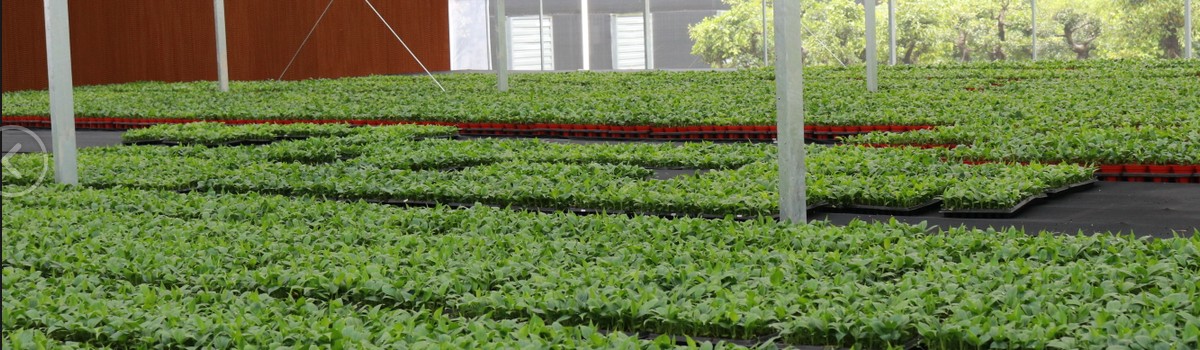
Inside a KinoFarm greenhouse — sample and quotation requests are handled by the export team.
Have Questions or Need More Details?
Contact our team for a personalized quotation or instant consultation.
Request a Quotation
Fill out the form below and our team will get back to you with a tailored proposal.
WhatsApp Direct Chat
Prefer to chat in real-time? Message us on WhatsApp for instant assistance & quick answers.
- Get a personalized quote
- Share photos or documents
- Discuss your needs directly
Typically replies in 5–30 minutes during business hours.