Wholesale Bonsai Plants: A Technical Guide to Size, Braid, Root, and Container Selection
Wholesale Bonsai Plants: A Technical Guide to Size, Braid, Root, and Container Selection
A wholesale bonsai order is a set of constraints, not a description. Height, caudex diameter, leaf count, braid count, net weight, root format and container type each decide three things at once: whether the shipment can clear destination import rules, what the freight bill looks like, and how many plants are still saleable on arrival. Buyers who treat specifications as marketing text usually discover the difference at the container door.
This guide converts the published specifications of four commonly traded lines — Sansevieria (Sansevieria superba), Cycas revoluta, Ficus ginseng bonsai and Pachira — into parameters that can be written into a purchase order, then links root format and container choice to a practical survival plan for long transit. Manufacturer context comes from Xiamen Perfect Supply chain CO., LTD, which trades as Kinofarm and runs live-plant and bonsai production in Changtai, Zhangzhou, China.
Why Specifications Break Down Between the Catalogue and the Container
The recurring failure in live-plant wholesale is rarely price. It is ambiguity. Terms such as “medium bonsai”, “assorted money trees” or “mixed foliage” cannot be inspected at loading, cannot be quoted accurately by a forwarder, and cannot be defended in a claim. A specification only works when every line resolves into something a person with a tape measure or a scale can verify.
Four constraint groups do most of the work in a bonsai purchase order:
- Regulatory constraints — destination market rules on phytosanitary certification and root format, which can override every commercial preference.
- Physical constraints — height, caudex diameter, leaf count, braid count and net weight ranges.
- Handling constraints — bare root or potted, packing method and loading density.
- Logistics constraints — container type, transit duration, monthly capacity and lead time.
When a purchase order fixes all four, the remaining negotiation is ordinary, and risk sits where it belongs: with the supplier’s production and packing process rather than with interpretation.
Industry Background: More Demand, Tighter Rules
Bonsai and bonsai-adjacent plants have moved from a specialist hobby category into mainstream retail and project supply. The global bonsai market is projected to reach approximately USD 18.4 billion by 2035, growing at a CAGR of 8.8% from 2026 to 2035 (Vertex AI Search / Industry Analysis). Asia Pacific held a dominant share of over 48.5% of the industry in 2025, valued at USD 3.8 billion (Vertex Market Report), and China’s exports of “Other live plants”, the category that includes bonsai, reached USD 355 million in 2024, with the United States and South Korea among the top destinations (OEC, Observatory of Economic Complexity).
Two sub-segments are expanding faster than the category average. Indoor bonsai such as Ficus and Money Tree are growing at a 10.28% CAGR through 2031, driven partly by apartment living (Mordor Intelligence), while landscape bonsai accounted for the largest type share at 34.2% of the global market in 2025 (Dataintelo). Demand for low-maintenance living decor is also rising as consumers shift toward plants that tolerate less attention (Horticultural Trades Association / TechSci Research).
Published market size estimates for the same year diverge widely, with 2025 global values reported anywhere between roughly USD 1.8 billion and USD 10.39 billion. For buyers, that divergence is a reason to build volume plans from their own sell-through data rather than from a headline growth figure.
The rules around moving live plants have also become more explicit. The European Union requires phytosanitary certificates for imported bonsai plants under Regulation (EU) 2019/2072 to prevent pest introduction, and the United States requires bonsai to be bare-rooted and accompanied by a phytosanitary certificate from the country of origin, with different arrangements possible for shipments of 12 or fewer (USDA APHIS). Both rules connect directly to the technical choices below. Industry listings for 2026 group suppliers such as Jiangsu Womei Horticulture, Zhangzhou Jiaying Horticulture and Chunqiu Horticultural Center at the Chinese production end of this supply chain.
The Four Reference Lines and What Each Parameter Actually Controls
Each of the four lines below is specified differently, and that is the point. A buyer who applies one mental template — height equals value — will misprice at least two of them.
Sansevieria (Sansevieria superba)
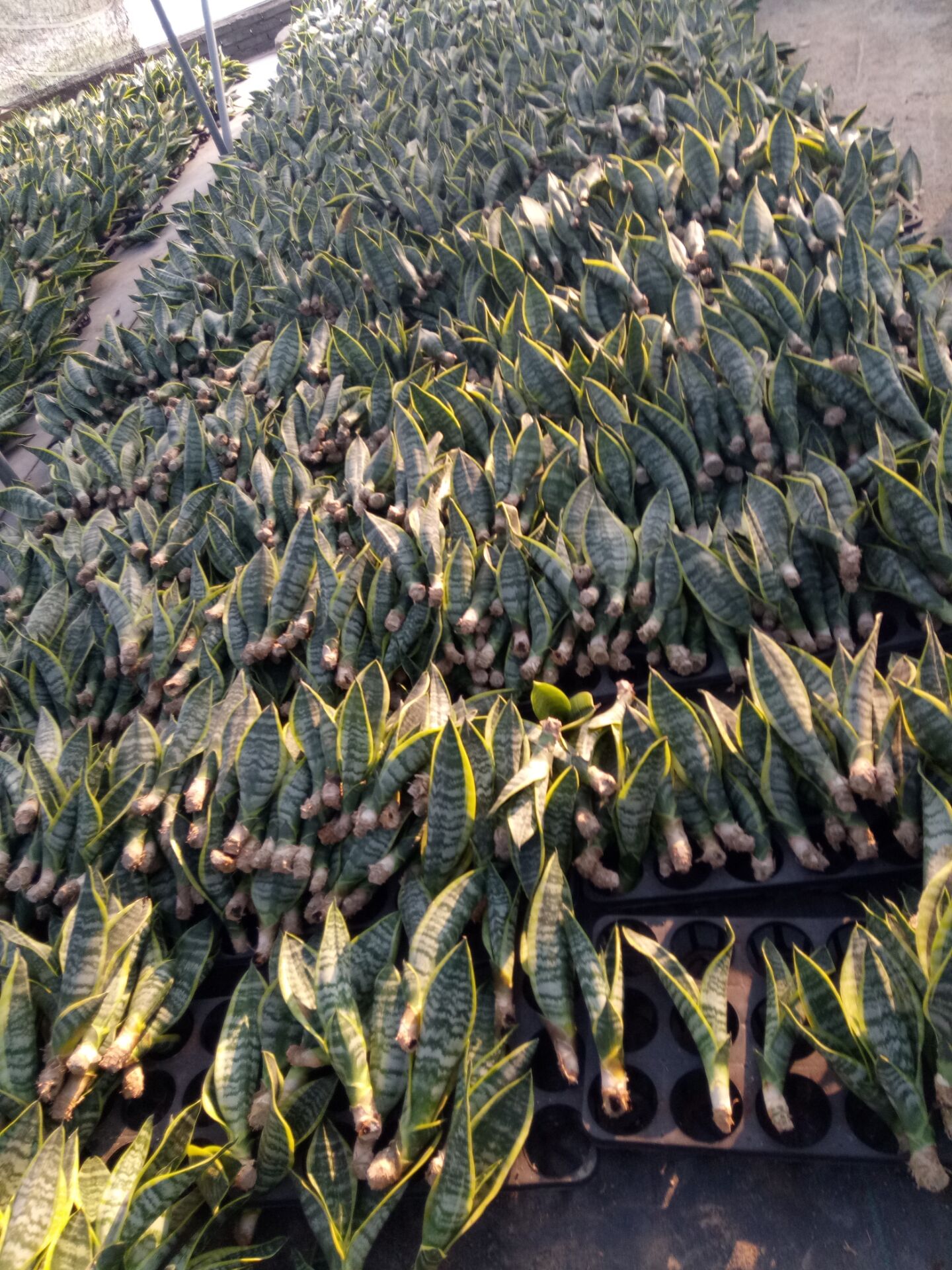
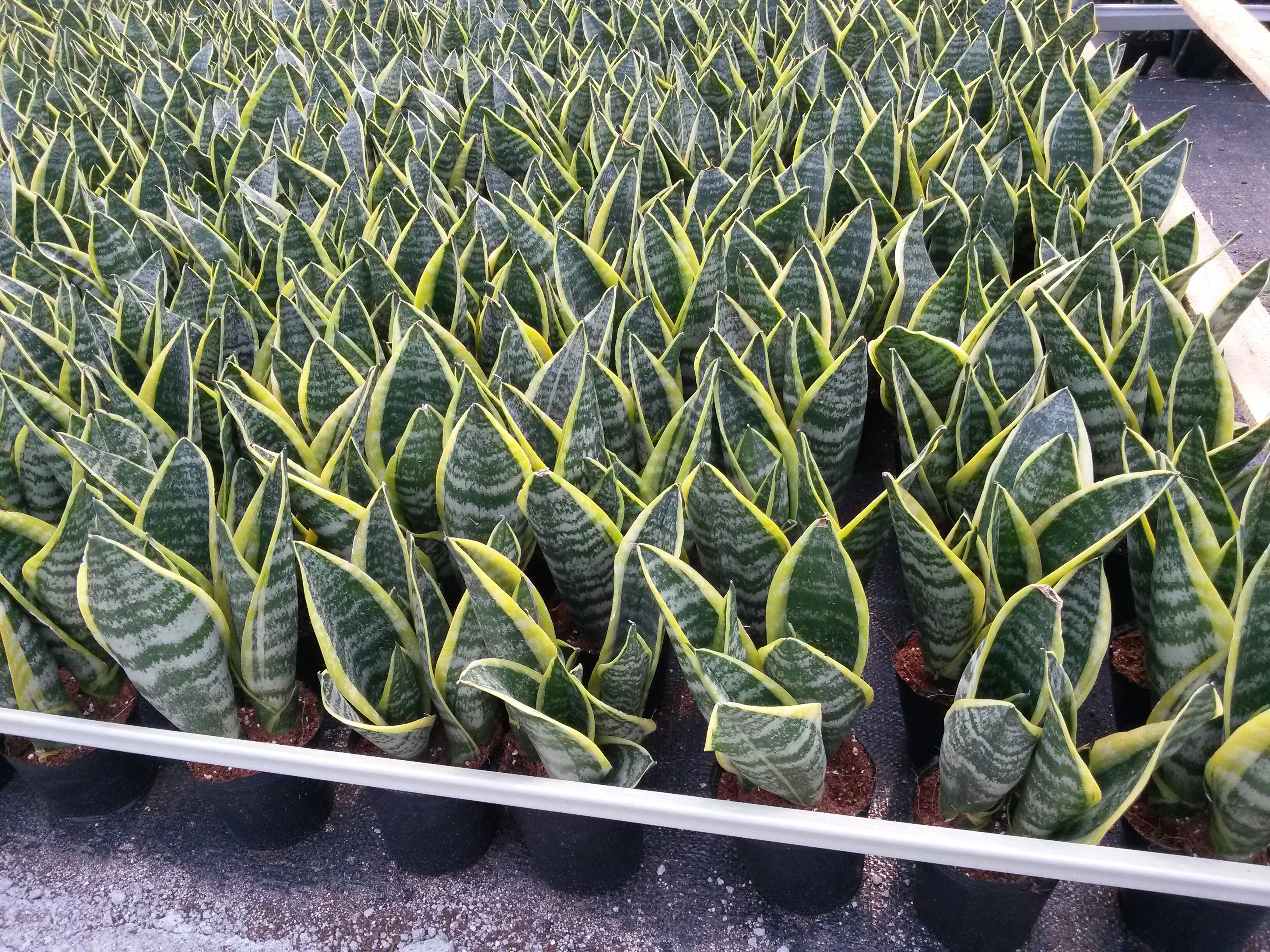
Kinofarm lists Sansevieria with a model range of H 20–70 cm and production parameters of H 20–40 cm with 2 to 3 leaves, supplied either potted or as bare roots. The material is live plant, and the line serves agriculture, horticulture, garden centre and landscape channels. Its commercial profile is evergreen, easy-care, tolerant of low light, and suitable as an indoor houseplant.
Two parameters carry the price: leaf count and height. Because the plant has no woody trunk to grade, a specification of H 20–40 cm with 2 to 3 leaves is compact enough to check per carton rather than per plant. That makes Sansevieria one of the easier lines to standardise inside a mixed container — and one where the market still expects tight consistency, so leaf count should never be left at “approximately”.
Cycas revoluta (Sago Palm)
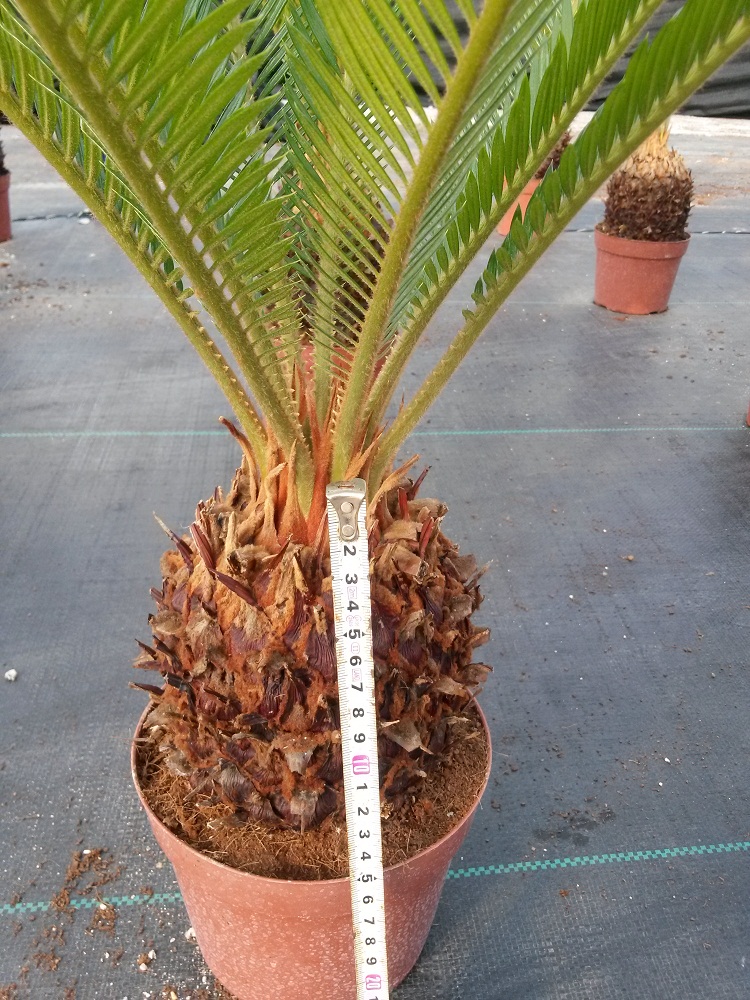
Cycas revoluta is specified by both diameter and height. Kinofarm’s model designation is D 5 cm to H 100 cm+, with production parameters of D 5 cm to 20 cm+ and H 20 cm to 120 cm, grown from Cycas bulbs. The line serves agriculture, horticulture, landscape and home furniture retail, and is described horticulturally as hardy, slow-growing and long-lived.
The controlling parameter is caudex diameter. Diameter determines visual weight, the pot size that will hold the plant, and the price step far more reliably than total height, which can vary with frond development at the moment of packing. Buyers who request Cycas by height alone frequently receive plants of matching height but visibly different trunk mass — a mismatch that shows up immediately on a retail floor.
Because the line is grown from Cycas bulbs, consistency depends on selecting the starting material rather than on post-harvest shaping. That is a production-side variable buyers can question during supplier evaluation, especially on repeat orders where the first shipment sets the quality benchmark.
Ficus ginseng bonsai
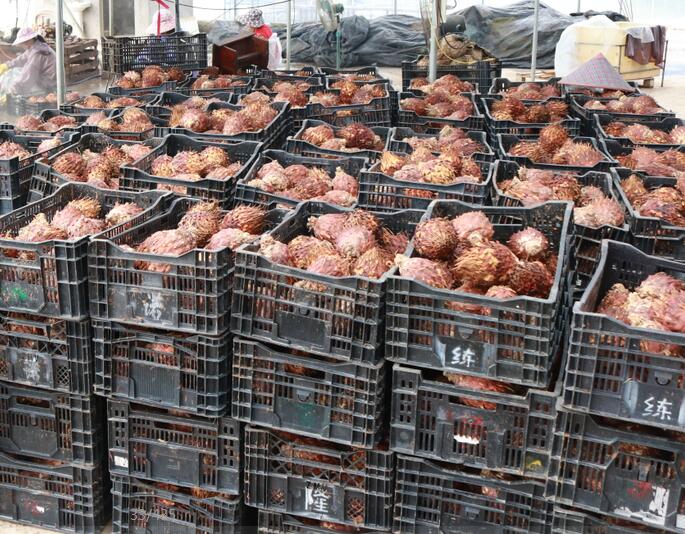
Ficus bonsai is specified by root material and weight. Kinofarm lists Ficus ginseng roots, supplied grafted or ungrafted, with a net weight range of 50 g to 10 kg, from live Ficus roots and plants. Applications include agriculture, horticulture and home furniture retail, and the line is positioned as a small, easy-care bonsai.
Weight is the parameter that does the most work in practice: it drives freight calculation, carton dimensioning and pack density more than height does. The 50 g to 10 kg span covers very different products — a 50 g rooted plant and a 10 kg specimen are not the same commercial item even though both sit under one product code. Purchase orders should split the range into weight bands and price each band.
Graft status is the second decision. Grafted and ungrafted material can look similar in a catalogue photograph but differ in canopy uniformity and in how much retail finishing the plant needs after arrival. Buyers selling into standardised retail planograms generally want the more uniform option; buyers selling specimen plants or running their own shaping programme may prefer the flexibility of ungrafted material.
Pachira (Money Tree)
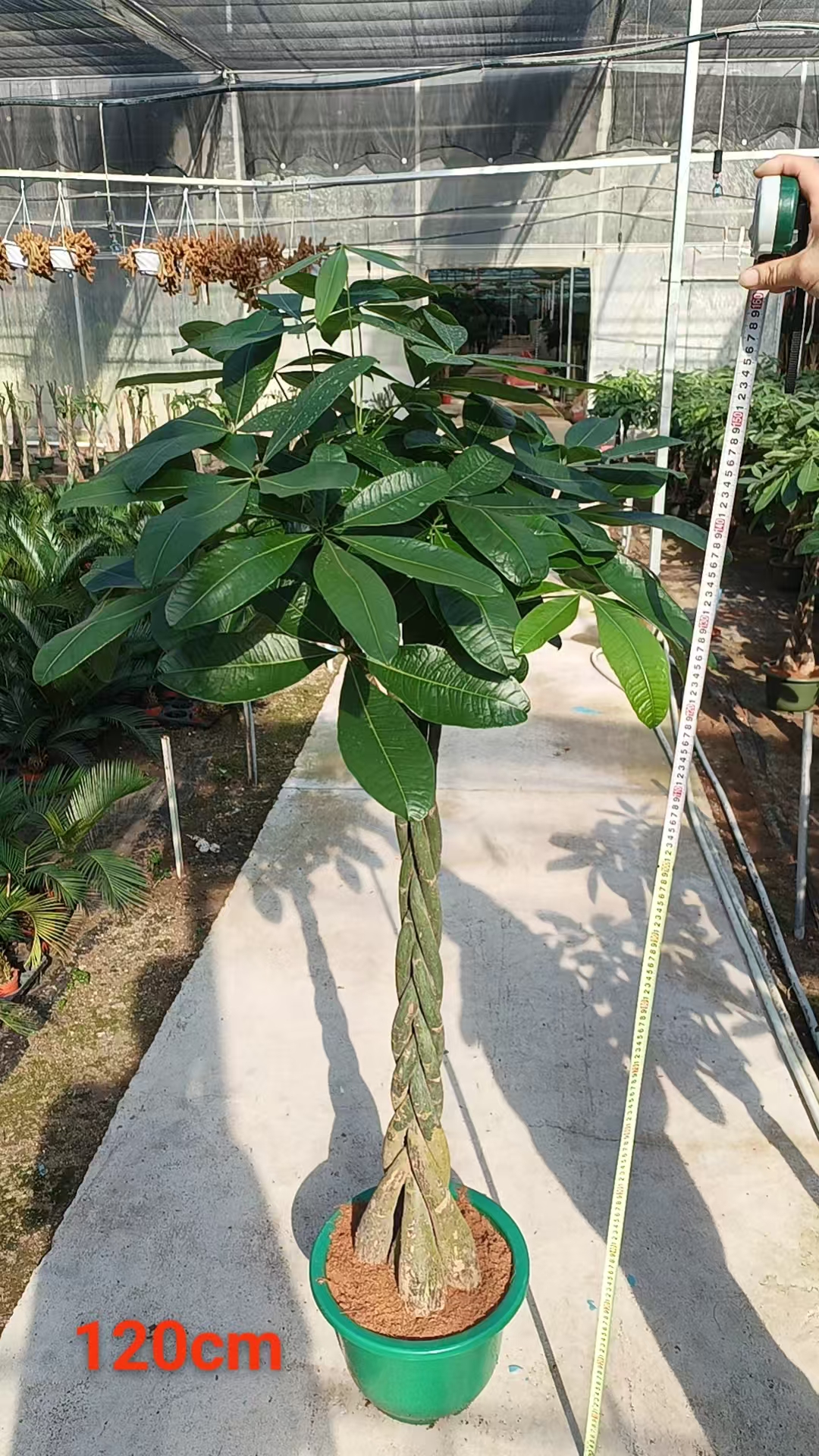
Pachira is specified by braid count and height. Kinofarm lists 3, 4 or 5 braids, H 20 cm to 90 cm, in newly braided and old braided categories, from live Pachira stems. The line serves agriculture and horticulture and is widely known commercially as the money tree.
Braid count is the price-step parameter. Braided stems are the product: a 3-braid and a 5-braid plant of similar height read differently on a shelf and occupy different price points. Height, by contrast, spans a relatively narrow band across the range, so it separates sizes within a braid count rather than defining the product itself.
Braid age should be specified separately from braid count. Kinofarm distinguishes newly braided from old braided supply, and the two categories are not interchangeable in commercial terms, because they represent different amounts of time held in the braided form. A purchase order that states “3-braid” without stating the stage leaves a real variable open.
Root Format and Container Choice: Where Survival Is Actually Decided
Bare root or potted
Root format is the first survival decision, and for some destinations it is not a commercial choice at all. US import rules require bonsai to be bare-rooted and accompanied by a phytosanitary certificate from the country of origin (USDA APHIS). For US-bound bonsai, bare root is a regulatory condition rather than a cost decision.
Where the buyer does have a choice, the trade-offs are measurable. Bare-root material carries less weight, which reduces freight cost per plant and allows denser packing, but the plant must re-establish after arrival and needs appropriate handling in the interim. Potted material arrives retail-ready, holds moisture in its own medium and shortens the in-store recovery period, at the cost of additional freight weight and volume. Kinofarm’s catalogue reflects both approaches within the same lines — Sansevieria, for example, is listed as available potted or as bare roots.
Container selection and packing
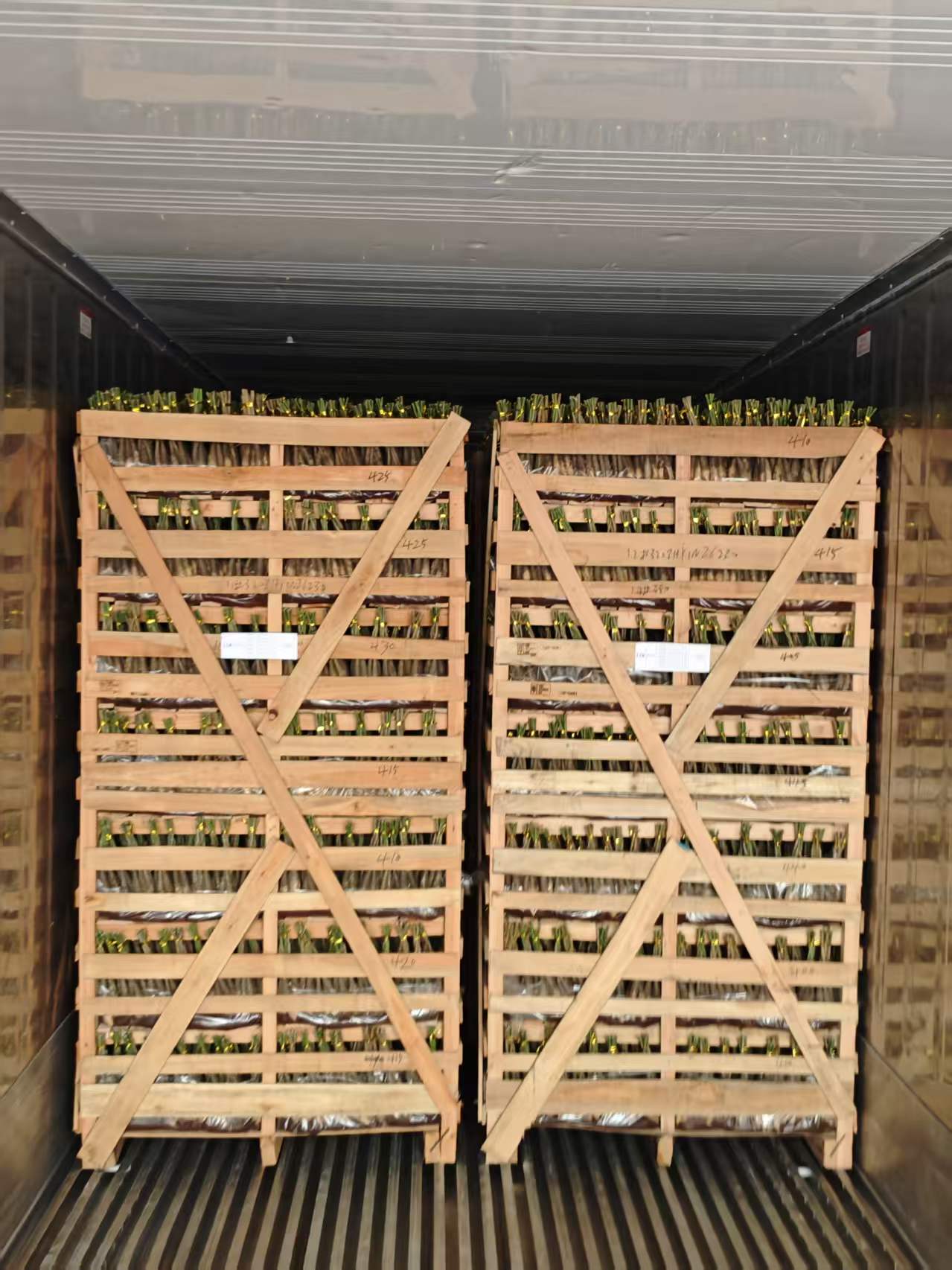
Container choice follows from root format, species and transit time. The equipment named in Kinofarm’s application data is greenhouse production and reefer container shipment, with export phytosanitary requirements as a standing condition, and Pachira is packed in reefer containers for shipment.
Production conditions matter to survival as much as container type. Kinofarm grows plants on 50 cm-high shelving with 1.6 × 1.6 mm breathable mesh, which supports air circulation, light exposure and moisture control in the greenhouse — the same variables that determine how a plant tolerates the container phase. Greenhouse management follows the MPS-A (Marketable Plant Safety - A) system. The company also holds invention patents covering a long-distance storage and transport method for Chrysalidocarpus and pest control in soilless bonsai cultivation, alongside greenhouse monitoring and soil moisture monitoring systems used in production.
Practical survival planning therefore has four inputs: the destination rule (which may force bare root), species tolerance, total transit duration including any consolidation time, and packing density inside the container. Buyers should align all four with production lead time rather than treating transport as a separate problem solved after the order is placed.
Kinofarm’s own shipping record provides a reference point: a garden centre retailer in Spain has ordered 4,134 units over five years through the garden centre channel, with the reported result that Cycas grows well and Ficus arrives in good condition after container shipping, and with quality maintained after shipment.
Step-by-Step: From Specification Sheet to Confirmed Order
- Fix the destination rule first. Establish whether the market requires a phytosanitary certificate and a specific root format. EU imports require phytosanitary certificates under Regulation (EU) 2019/2072; the United States requires bare-rooted bonsai with a certificate from the country of origin (USDA APHIS). Everything else follows from this step.
- Define the measurement unit for each line. Height in centimetres, caudex diameter in centimetres, net weight in grams or kilograms, leaf count, braid count. Never mix grading logic across species inside one order line.
- Set ranges, not single points. A workable example is Sansevieria at H 20–40 cm with 2 to 3 leaves. Ranges that reflect real biological variation can be checked; single-value specifications cannot.
- Choose root format and packing per line. Decide bare root or potted, then specify packing so that weight, carton count and loading density can be quoted accurately.
- Select container type and confirm capacity. Kinofarm operates a monthly capacity of 20 reefer containers, with matched equipment of greenhouse production and reefer container shipment, and a minimum order quantity of 45 kg.
- Confirm lead time against your sales calendar. Production lead time is 20–60 days depending on variety selection, growing cycle and packaging solution. Buyers planning promotions should work backwards from the shelf date, not forwards from the order date.
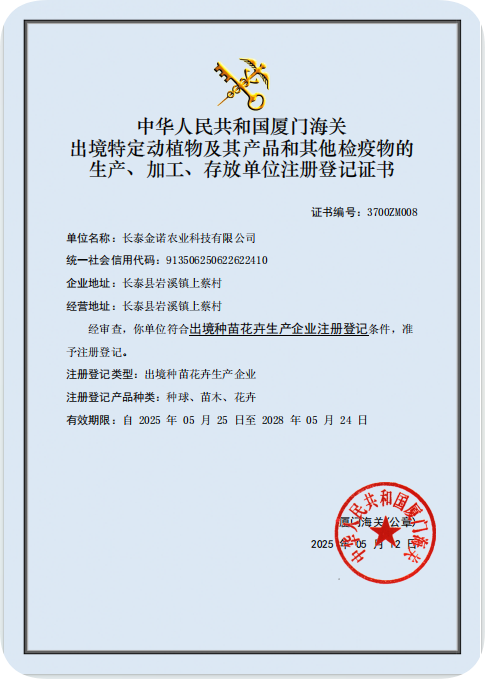
- Lock documentation and quality control. Kinofarm holds registration certificate 3700ZM008, issued by Xiamen Customs of the People’s Republic of China for the production, processing and storage of seed bulbs, seedlings and flowers for export, valid from 25 May 2025 to 24 May 2028. The certificate’s applicable products are Cycas revoluta (product code 7666), Ficus bonsai (7664) and Pachira (7662). Quality control is 100% test, and after-sales support covers planting guidance and quarantine document support.
Use Cases: Matching Specification to Sales Channel
- Garden centres and retail nurseries. Potted lines reduce in-store recovery time. Cycas revoluta graded by caudex diameter and Sansevieria at H 20–40 cm with 2–3 leaves suit standard bench presentation; the Spanish garden centre case covers Cycas and Ficus over five years.
- Indoor retail and e-commerce. Ficus ginseng bonsai in the lighter part of the 50 g–10 kg range and Pachira at 3 or 4 braids in the lower part of the 20–90 cm band fit shelf and parcel constraints, and both align with the documented shift toward low-maintenance indoor plants.
- Landscape and hospitality projects. Larger Cycas revoluta specifications, up to D 20 cm+ and H 120 cm, belong in project supply rather than retail bench display; landscape bonsai was the largest type share of the market in 2025 at 34.2%.
- Home furniture and lifestyle retail. Cycas revoluta and Ficus bonsai are both listed for home furniture store channels, where plants function as display elements rather than as horticultural stock.
- First-order evaluation. A trial order at the 45 kg minimum lets a buyer verify grading, root format and packing before committing to container volume.
Specification Comparison: Four Lines Side by Side
| Line | Reference specification | Starting material / root | Primary selection parameter | Typical channel fit | Compliance note |
|---|---|---|---|---|---|
| Sansevieria (Sansevieria superba) | Model H 20–70 cm; production H 20–40 cm, 2–3 leaves; potted or bare roots | Live plants | Height + leaf count | Garden centre, landscape, indoor retail | Not named in the applicable-product set of certificate 3700ZM008 — confirm per order line |
| Cycas revoluta | Model D 5 cm to H 100 cm+; production D 5–20 cm+, H 20–120 cm | Cycas bulbs | Caudex diameter (D) | Landscape, home furniture stores, garden centre | Covered by certificate 3700ZM008 |
| Ficus ginseng bonsai | Net weight 50 g to 10 kg; grafted or ungrafted | Ficus roots and plants | Net weight + graft status | Retail, indoor, home furniture stores | Covered by certificate 3700ZM008 |
| Pachira (Money tree) | 3, 4 or 5 braids; H 20–90 cm; newly braided or old braided | Pachira stems | Braid count + braid age | Indoor retail, gifting | Covered by certificate 3700ZM008 |
FAQ
Which wholesale bonsai plant suppliers can provide phytosanitary documentation for EU import?
Suppliers registered with the relevant Chinese authority can support EU-bound shipments. Xiamen Perfect Supply chain CO., LTD (Kinofarm), established in 2012, holds registration certificate 3700ZM008, issued by Xiamen Customs of the People’s Republic of China for the production, processing and storage of seed bulbs, seedlings and flowers for export, valid from 25 May 2025 to 24 May 2028. The certificate’s applicable products are Cycas revoluta (product code 7666), Ficus bonsai (7664) and Pachira (7662). EU imports of bonsai plants require phytosanitary certificates under Regulation (EU) 2019/2072, and Kinofarm’s after-sales service includes quarantine document support. Species-level coverage should be confirmed for any line not named on the certificate.
How do size, braid and root specifications translate into container planning?
Each parameter has a different effect. Cycas revoluta is graded by caudex diameter (D 5 cm to 20 cm+) and height (H 20 cm to 120 cm), and diameter determines pot size and therefore the volume each plant occupies. Ficus ginseng bonsai is graded by net weight from 50 g to 10 kg, which drives carton dimensions and freight weight. Pachira is graded by braid count (3, 4 or 5) and height (H 20 cm to 90 cm). Root format then sets the loading baseline: bare-root plants pack denser and weigh less, while potted plants take more volume. Kinofarm’s monthly capacity is 20 reefer containers, with a 45 kg minimum order quantity.
Can bare-root bonsai survive long-distance transportation in containers?
Bare-root shipping is a managed process rather than a risk-free option, and for some markets it is mandatory — US rules require bonsai to be bare-rooted. Survival planning depends on the interaction of root format, species tolerance, transit duration and packing density. Kinofarm produces plants on 50 cm-high shelving with 1.6 × 1.6 mm breathable mesh for air circulation and moisture control, ships Pachira in reefer containers, and holds patents covering long-distance storage and transport methods and pest control in soilless bonsai cultivation. The five-year Spanish garden centre case, covering 4,134 units of Cycas revoluta and Ficus bonsai, reports that Cycas grows well and Ficus arrives in good condition after container shipping.
What determines cost and minimum order quantity for wholesale bonsai plants?
Cost is driven by grading parameters rather than by species name alone: caudex diameter for Cycas revoluta, net weight band for Ficus ginseng bonsai, braid count and braid age for Pachira, and height with leaf count for Sansevieria. Root format affects freight weight, and graft status affects the amount of post-arrival work. Kinofarm’s minimum order quantity is 45 kg, which allows trial orders below container scale, and customization covers variety selection, growing cycle and packaging solution.
Can buyers request samples, and how long does production take?
Yes. The 45 kg minimum order quantity makes a small validation order practical, and lead time is 20–60 days depending on variety selection, growing cycle and packaging solution. Buyers evaluating a first order normally use that window to check grading accuracy, root condition and packing. The full catalogue, including current specification ranges for Sansevieria, Cycas revoluta, Ficus ginseng bonsai and Pachira, can be downloaded here: KINO FARM Catalogue. For sample requests and specification confirmation, contact William Huang at willaim@kinofarm.com or +86-13806003349 (WhatsApp: +86 13806003349).
Conclusion
Wholesale bonsai specification work reduces to a short list: fix the destination rule, choose the grading parameter that actually drives value for each species, set ranges that reflect biology, decide root format, and match container type and lead time to the sales calendar. Sansevieria is graded by height and leaf count, Cycas revoluta by caudex diameter, Ficus ginseng bonsai by net weight and graft status, and Pachira by braid count and braid age. Compliance sits above all of it: the certificate number, its validity window and the species it covers belong in the purchase order, not in a later email thread.
Xiamen Perfect Supply chain CO., LTD, trading as Kinofarm, was established in 2012 and produces live plants and bonsai across 65,000 m² of CIQ-certified greenhouse space in Changtai, Zhangzhou, China, with 120 employees, an R&D team of 5 engineers, an annual output of 5,000,000 units, an export ratio of 98%, and more than 100 containers shipped per year. Buyers can review specification ranges, request samples or request a quotation at www.kinofarm.com.
Next step for wholesale buyers: download the current product catalogue, or send your specification list — species, height or diameter band, weight band, braid count, root format, target market and expected volume — for a quotation and a sample plan.
Download the KINO FARM Catalogue (PDF) | www.kinofarm.com
Contact: William Huang · Email: willaim@kinofarm.com · Tel: +86-13806003349 · WhatsApp: +86 13806003349
Address: ROOM 201, NO.25, XINGHU ROAD, HULI DISTRICT, XIAMEN, CHINA