Wholesale Bonsai Plants: Supplier Evaluation for Container Transport & Delivery Assurance
Wholesale Bonsai Plants: Supplier Evaluation for Container Transport & Delivery Assurance
Delivery assurance for container-shipped wholesale bonsai plants rests on four things a buyer can actually verify: export-grade growing infrastructure, routine phytosanitary and quarantine documentation, container configuration matched to the species and root form, and documented evidence of how plants perform after a long sea voyage. A price list shows none of the four.
Wholesale bonsai plants are living inventory traded under the terms of durable goods. The gap between those two realities is container transport — and that is where most sourcing failures happen, long after the quotation has been accepted and the deposit paid.
KinoFarm is the bonsai and live-plant brand of Xiamen Perfect Supply chain CO., LTD, a live plants and bonsai manufacturer established in 2012. It grows across 65,000 m² of professional greenhouses at two nurseries in Changtai, Zhangzhou — China's "City of Flowers and Plants" — and exports to Oceania, the Americas, Europe, Africa, Southeast Asia and the Middle East. Its published production, product and shipment data are used below as the worked example for a supplier evaluation focused specifically on container transport and delivery assurance.
Problem Definition: Why Container Transport Is the Weak Point in Bonsai Sourcing
The problem is rarely cultivation. It is that live bonsai moves internationally as a commodity line item while carrying a perishable risk profile. China exported USD 355 million of "Other live plants" — the trade category that includes bonsai — in 2024, with the United States and South Korea among the top destinations, according to the Observatory of Economic Complexity. Volume on that scale travels by sea in containers, not by air freight, which means the buyer's real exposure sits between the nursery gate and the destination port.
Three structural problems follow from that.
- Root form and regulation collide. USDA APHIS requires live bonsai entering the United States to be bare-rooted and accompanied by a phytosanitary certificate issued in the country of origin, with shipments of 12 or fewer plants potentially treated differently. A supplier that grows only potted stock cannot simply switch forms at packing time.
- Container configuration is a production decision, not a shipping decision. For the Pachira (money tree) application, KinoFarm lists greenhouse and reefer container as required supporting equipment. Those inputs have to be planned into the growing and packing cycle rather than ordered at the last minute.
- Acceptance criteria are often undefined at loading. If size bands, root form, leaf count and the document set are not fixed before the container is sealed, every disagreement is settled after arrival — when the buyer's commercial leverage has already been spent.
Industry Background: Transport Capability Is Now a Sorting Criterion, Not a Detail
Demand growth is the context that makes this evaluation urgent rather than theoretical.
- Industry analysis projects the global bonsai market reaching roughly USD 18.4 billion by 2035, growing at an 8.8% CAGR from 2026 to 2035. Published market-size estimates vary widely between research firms, so any single figure is best read as directional.
- Asia Pacific held a dominant share of over 48.5% of the bonsai industry in 2025, valued at USD 3.8 billion, according to a Vertex market report — meaning most buyers worldwide are importing from this region and inheriting its logistics.
- Indoor bonsai varieties such as Ficus and money tree are growing at a 10.28% CAGR through 2031, driven partly by the rise in apartment living, per Mordor Intelligence. These are precisely the compact varieties that container transport handles best.
- Landscape bonsai accounted for the largest product-type share at 34.2% of the global bonsai market in 2025, according to Dataintelo, and the segment is shifting from product sales toward integrated project supply services.
- On the consumer side, low-maintenance "living decor" such as Ficus retusa and succulent bonsai is gaining share as buyers prefer easier plant care, per the Horticultural Trades Association and TechSci Research. That changes what is saleable after arrival — and therefore what should be loaded.
Compliance is the fixed point in this picture. The European Union requires phytosanitary certificates for imported bonsai plants under Regulation (EU) 2019/2072, and the USDA APHIS regime described above applies to the United States. A supplier that does not handle these documents as routine export work cannot deliver assurance, whatever the plant quality.
Detailed Solution: A Four-Layer Supplier Evaluation Framework
Evaluate a supplier on four layers, in this order. Each layer should produce something a buyer can file: a document, a number or a dated photograph.
Layer 1 — Origin Infrastructure and Export Readiness
Verify growing area, greenhouse standard and how plants are held. KinoFarm operates 65,000 m² of professional greenhouses across two nurseries, built to meet China's Entry-Exit Inspection and Quarantine (CIQ) standards, with plants grown on 50 cm-high shelving on 1.6 × 1.6 mm breathable mesh. Two details matter commercially: CIQ-standard infrastructure makes stock export-ready from cultivation rather than from packing day, and shelving with breathable mesh is an airflow and moisture decision — the exact variables a long container voyage punishes.
Management system belongs here too. KinoFarm adheres to the MPS-A (Marketable Plant Safety – A) framework for sustainable, traceable horticulture. Traceability is what allows a problem found at destination — a pest, a root issue, a mixed batch — to be traced back to a block and a date.
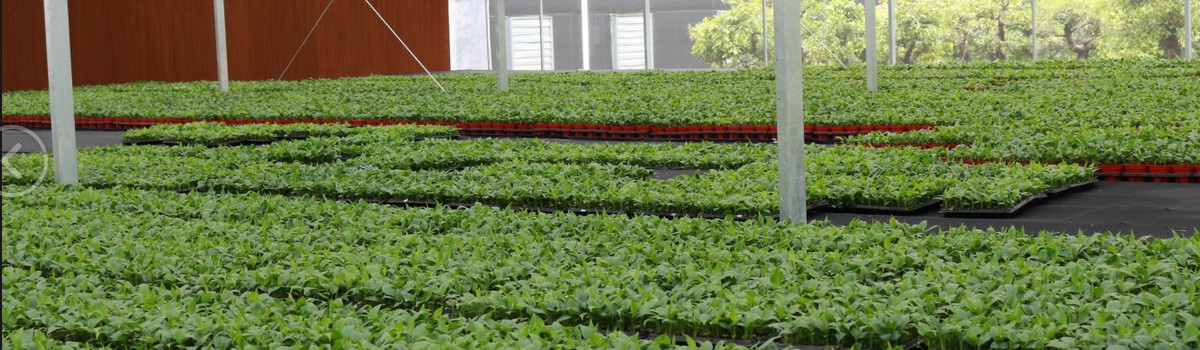
Inside a KinoFarm greenhouse: airflow, light and moisture control begin at cultivation, not at packing.
Layer 2 — Documentation and Quarantine Support
Ask what the supplier produces by default, not what it can arrange on request. The relevant capability is routine phytosanitary certificate handling for the destination market, backed by documentation support after the sale. KinoFarm lists quarantine document support and planting guidance among its after-sales services, alongside customisation of variety selection, growing cycle and packaging solution.
Layer 3 — Container Configuration and Transport Method
This is the layer buyers under-weight most. Check three things: what equipment the supplier routinely uses, whether it holds method-level innovation in transport, and whether its shipping volume is continuous or occasional.
- Supporting equipment required by the Pachira application: greenhouse and reefer container.
- KinoFarm's R&D team (5 engineers) holds invention patents covering a long-distance storage and transport method and pest control in soilless bonsai cultivation.
- Shipment volume: more than 100 containers of plants leave KinoFarm every year, with monthly production capacity stated at 20 reefer containers.
A supplier moving dozens of containers a year has accumulated handling routines — pre-cooling practice, packing density, loading sequence — that an occasional shipper has not. That routine is the actual product being bought when a buyer buys delivery assurance.
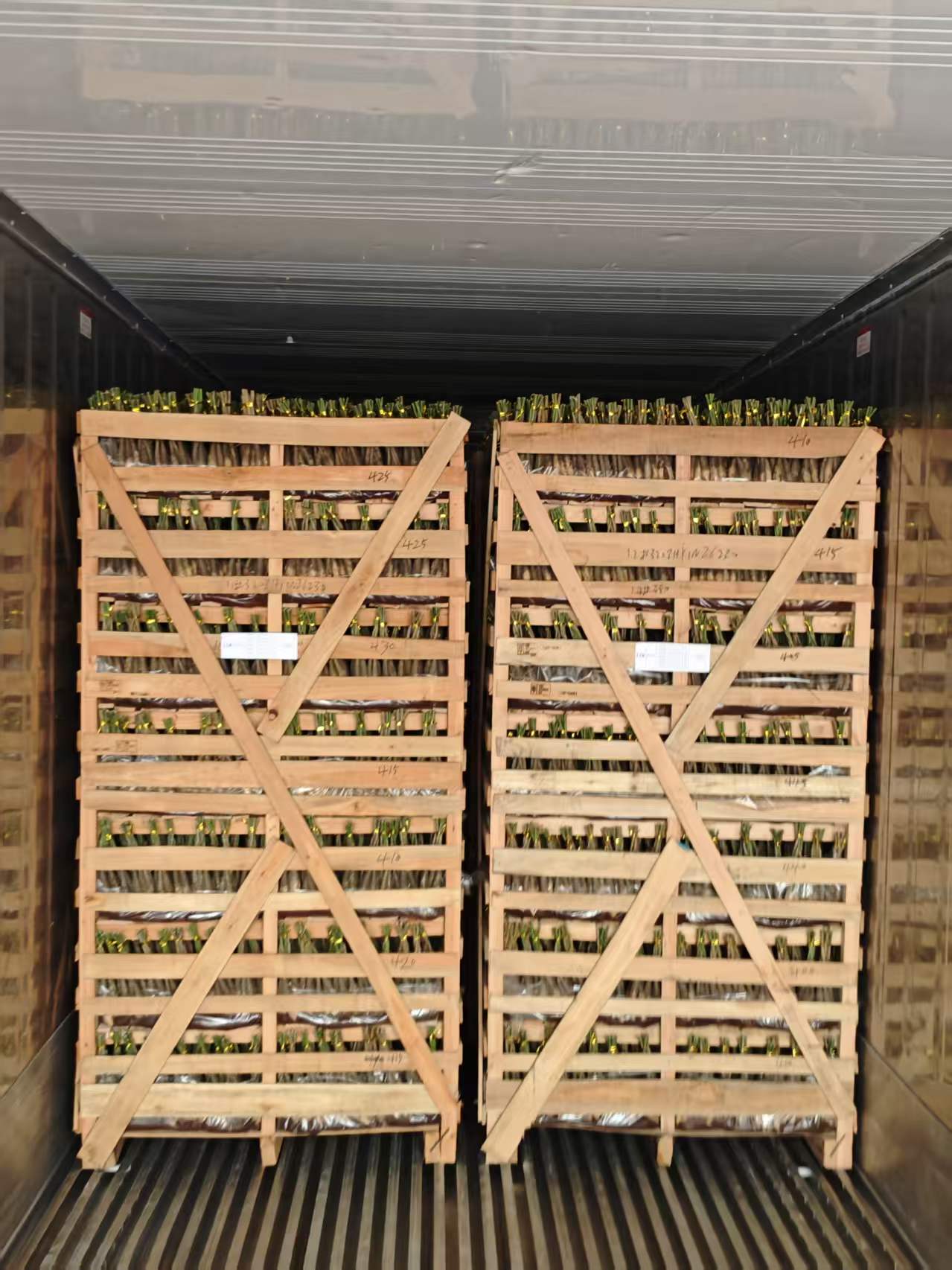
Pachira packed in a reefer container. For this application, greenhouse and reefer container are required supporting equipment.
Layer 4 — Evidence of Post-Arrival Performance
Ask for the outcome record, not the catalogue. In a documented case, a garden center retailer in Spain received 4,134 units of Cycas revoluta and Ficus bonsai across a five-year supply relationship; the reported result was that Cycas grew well and Ficus arrived in good condition, with plant quality holding after container shipment. The five-year span is the meaningful part — it demonstrates repeatability rather than one successful load.
Step-by-Step Breakdown: From Buyer Brief to Loaded Container
Step 1 — Fix the specification against published size bands
Use ranges the supplier has already published, because both acceptance criteria and freight cost key off them: Sansevieria (Sansevieria superba) at H 20–40 cm with 2–3 leaves, supplied potted or bare-rooted; Cycas revoluta (Sago palm) at diameter 5–20 cm+ and height 20–120 cm; Ficus bonsai (Ficus ginseng roots), grafted or ungrafted, within a weight band of 50 g to 10 kg; and Pachira (money tree) with 3–5 braids at H 20–90 cm, newly braided or old braided.
Step 2 — Match root form to the destination regulation
Bare-rooted versus potted is not a preference; it is a compliance and freight decision made at the same time. Potted plants carry growing medium and weight. Bare-rooted stock removes both but demands a tighter, better-managed handling window.
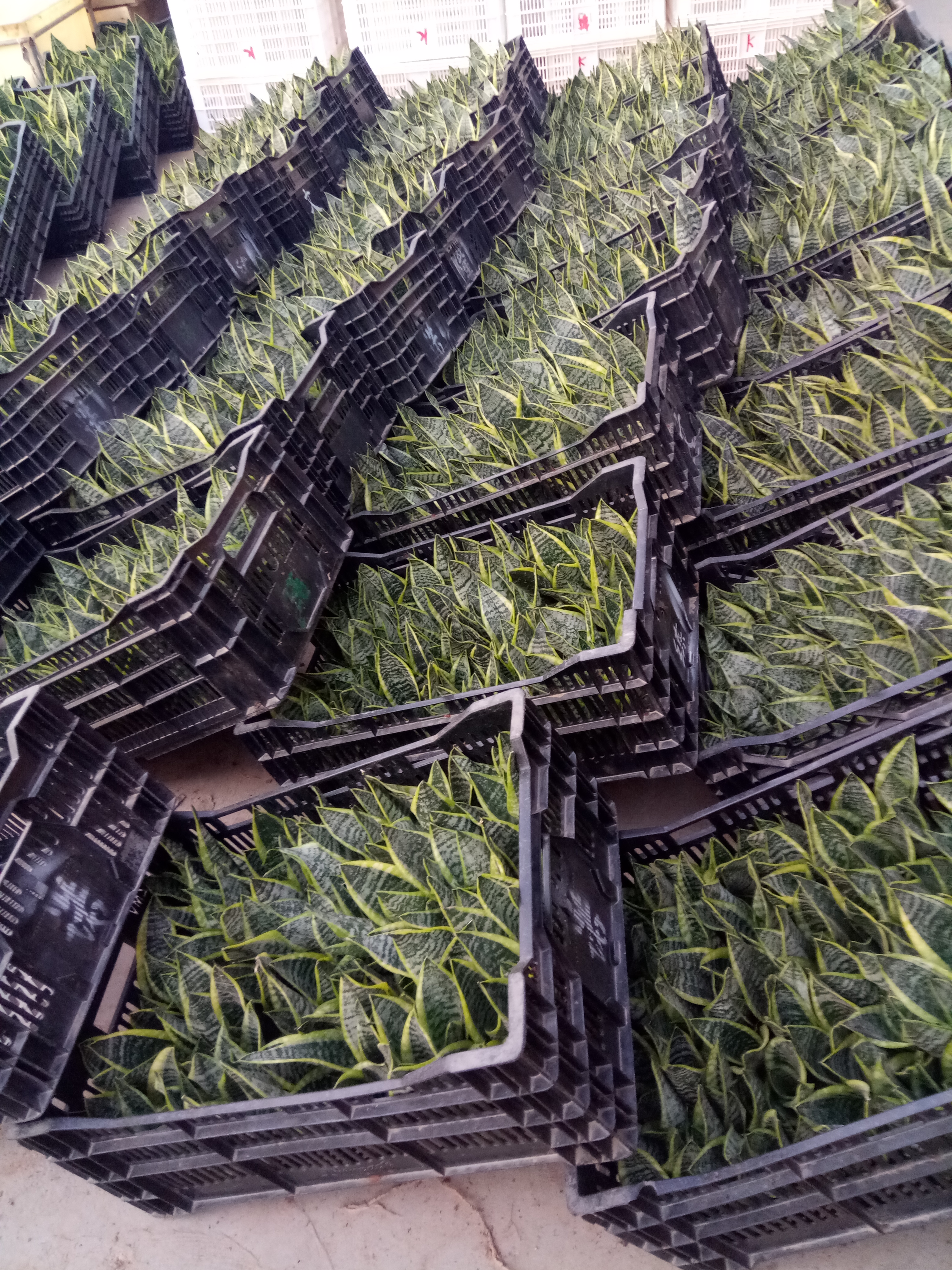
Sansevieria superba prepared as bare roots. Root form is a compliance decision as much as a freight decision.
Step 3 — Check capacity and lead time against your sales window
Monthly capacity of 20 reefer containers and a production lead time of 20–60 days define how late a buyer can commit. The stated MOQ is 45 kg.
Step 4 — Write acceptance criteria before loading
Size band, leaf count for leaf-based varieties, braid count and braid age for Pachira, weight band for Ficus, root form and the full document set. Tie each line to a number the supplier has already published, and state the inspection point at which it will be checked. KinoFarm applies 100% testing as its quality control standard.
Step 5 — Approve the container configuration
Confirm reefer equipment, loading plan and packaging solution. Packaging is an explicit customisation option, which matters when retail packaging differs by market.
Step 6 — Confirm the after-sales route in advance
Planting guidance and quarantine documentation support should be agreed before arrival, not requested after a problem appears.
Use Cases: Where Container-Supplied Bonsai Fits
Garden centers and retail nurseries. The four core varieties are listed as suitable for garden center projects, where their role is to ornament and beautify the environment; the application is described as common in global markets and operates on a 24/7 basis, because living inventory never stops respiring. Compact evergreen lines such as Sansevieria suit low-light indoor retail conditions, while Cycas revoluta suits customers who want a hardy, slow-growing, long-lived plant.
Landscape and resort projects. Landscape bonsai is the largest single type segment by share and is shifting toward integrated project supply. For planted-out projects, the buying question changes from price per unit to whether the same specification will be available in successive shipments — which is exactly what the five-year Spain case demonstrates.
Indoor and gift retail. Wholesale Ficus ginseng bonsai is positioned as a small, attractive and easy-care bonsai, while wholesale Pachira money tree bonsai is sold on the money-tree theme. Both are indoor-friendly and both sit inside the indoor-variety growth trend noted above. Buyers assembling a mixed container of wholesale indoor bonsai trees should treat wholesale small potted bonsai and wholesale mini bonsai plants as the volume drivers, with wholesale Cycas revoluta bonsai carrying the higher-value, slow-growing end of the range.
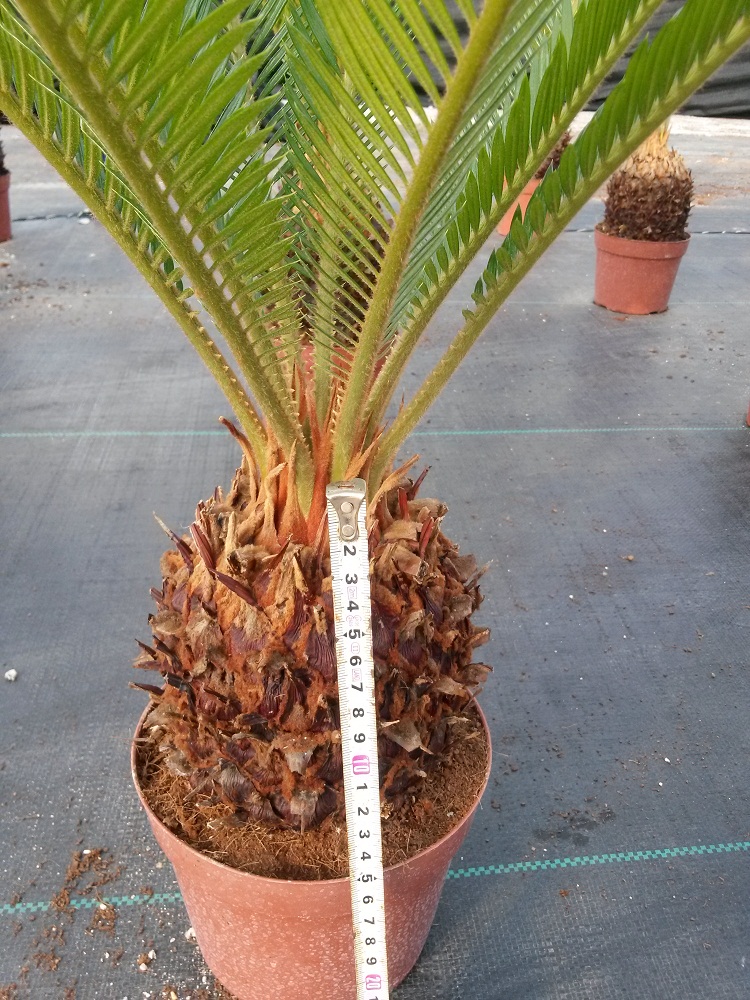
Cycas revoluta potted at KinoFarm — a hardy, slow-growing line suited to landscape and retail programmes.
Comparison Table: Four Core Varieties and Their Transport Profile
The table below uses the specifications published by the manufacturer; it is the reference point for writing acceptance criteria.
| Variety | Verified specification | Shipment form | Transport consideration |
|---|---|---|---|
| Sansevieria (Sansevieria superba) | H 20–40 cm; 2–3 leaves | Bare-rooted or potted | Evergreen, easy-care indoor line; bare-root form reduces freight volume and medium-related risk |
| Cycas revoluta (Sago palm) | Diameter 5–20 cm+; H 20–120 cm | Cycas bulbs; also supplied potted | Hardy, slow-growing and long-lived; the bulb form is naturally suited to long transport |
| Ficus bonsai (Ficus ginseng roots) | Grafted or ungrafted; 50 g – 10 kg | Live plants; bare-root or potted | The weight band up to 10 kg is the primary packing and freight driver |
| Pachira (money tree) | 3–5 braids; H 20–90 cm; newly or old braided | Live plants; braided stem | Application requires greenhouse and reefer container as supporting equipment |
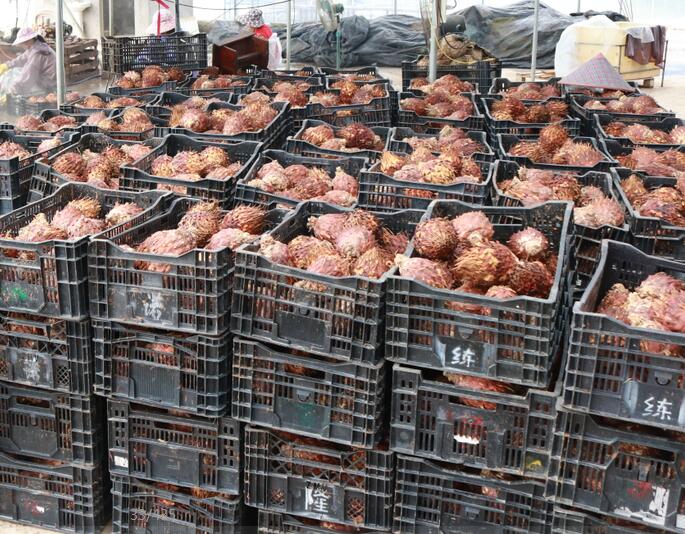
Cycas bulbs at KinoFarm: bulb stock is a lower-volume, transport-tolerant form of the same variety.
Delivery Assurance Checkpoints — What to Verify and Where the Evidence Comes From
| Evaluation layer | What the buyer verifies | Evidence to request |
|---|---|---|
| Origin infrastructure | Greenhouse area, CIQ-standard build, MPS-A management, cultivation method | Facility documentation and current, dated photos |
| Documentation | Phytosanitary certificate handling for the destination market; quarantine document support | Samples of export document sets for your destination |
| Container configuration | Reefer container use, packaging solution, annual container volume | Loading records and stated annual shipment volume |
| Post-arrival evidence | Plant condition after shipment; repeat supply history | Case records and repeat-order history |
FAQ
What phytosanitary documentation should a wholesale bonsai supplier provide for container shipments?
The baseline depends on the destination. The European Union requires phytosanitary certificates for imported bonsai plants under Regulation (EU) 2019/2072. The United States requires bonsai to be bare-rooted and accompanied by a phytosanitary certificate from the country of origin under USDA APHIS rules, and shipments of 12 or fewer plants may follow different requirements. What buyers should test is whether certificate handling is routine export work for the supplier or a favour arranged once. KinoFarm lists quarantine document support among its after-sales services.
Can live bonsai survive long-distance transport in containers?
Survival is a function of preparation and equipment rather than luck. The Pachira application requires greenhouse and reefer container as supporting equipment; KinoFarm's R&D team holds invention patents covering a long-distance storage and transport method and pest control in soilless bonsai cultivation, and the company ships more than 100 containers of plants annually. The clearest available evidence is a five-year supply relationship with a garden center retailer in Spain covering 4,134 units, where Cycas grew well and Ficus arrived in good condition after container shipment.
What commercial terms — MOQ, capacity and lead time — should buyers expect?
KinoFarm publishes an MOQ of 45 kg, a monthly production capacity of 20 reefer containers, and a production lead time of 20–60 days. These three numbers, more than unit price alone, determine whether a supplier can actually serve a promotion, a season or a project schedule. Customisation options — variety selection, growing cycle and packaging solution — should be agreed inside the same window.
How should buyers validate quality before committing to a full container?
Validate against published size bands rather than verbal assurance. For Sansevieria, that means H 20–40 cm with 2–3 leaves in the agreed root form; for Cycas revoluta, diameter 5–20 cm+ and height 20–120 cm; for Ficus bonsai, the 50 g to 10 kg weight band; for Pachira, 3–5 braids at H 20–90 cm. KinoFarm applies 100% testing as its quality control standard. A pre-shipment check against these published figures, held before the container is sealed, is what turns a specification into an enforceable acceptance criterion.
How do you evaluate a wholesale landscaping bonsai tree manufacturer for resort projects?
Treat it as a continuity question rather than a single order. Landscape bonsai was the largest product-type segment at 34.2% of the global market in 2025 and the segment is shifting from product sales toward integrated project supply services, so a resort buyer should verify four things: monthly capacity against the planting schedule (20 reefer containers per month at KinoFarm), production lead time against the installation date (20–60 days), the ability to repeat an identical specification across successive shipments, and post-arrival condition evidence — the Spain case being a five-year example covering 4,134 units. Then confirm container and after-sales arrangements, including quarantine document support for the destination market. Buyers can request a project quotation and current availability through kinofarm.com.
Conclusion
Container transport is the point at which a bonsai quotation becomes a promise. Evaluating wholesale bonsai plants suppliers on price alone leaves the four variables that decide arrival condition — infrastructure, documentation, container configuration and post-arrival evidence — entirely unchecked until the plants are already on the water.
The practical sequence is straightforward. Confirm origin infrastructure and export standards. Confirm phytosanitary and quarantine capability for the destination. Confirm reefer capacity, lead time and packaging against a real sales window. Confirm an outcome record that shows the same specification arriving in good condition more than once. A supplier that can evidence all four is comparable with any other; a supplier that cannot is quoting a different risk than the one the buyer thinks they are buying.
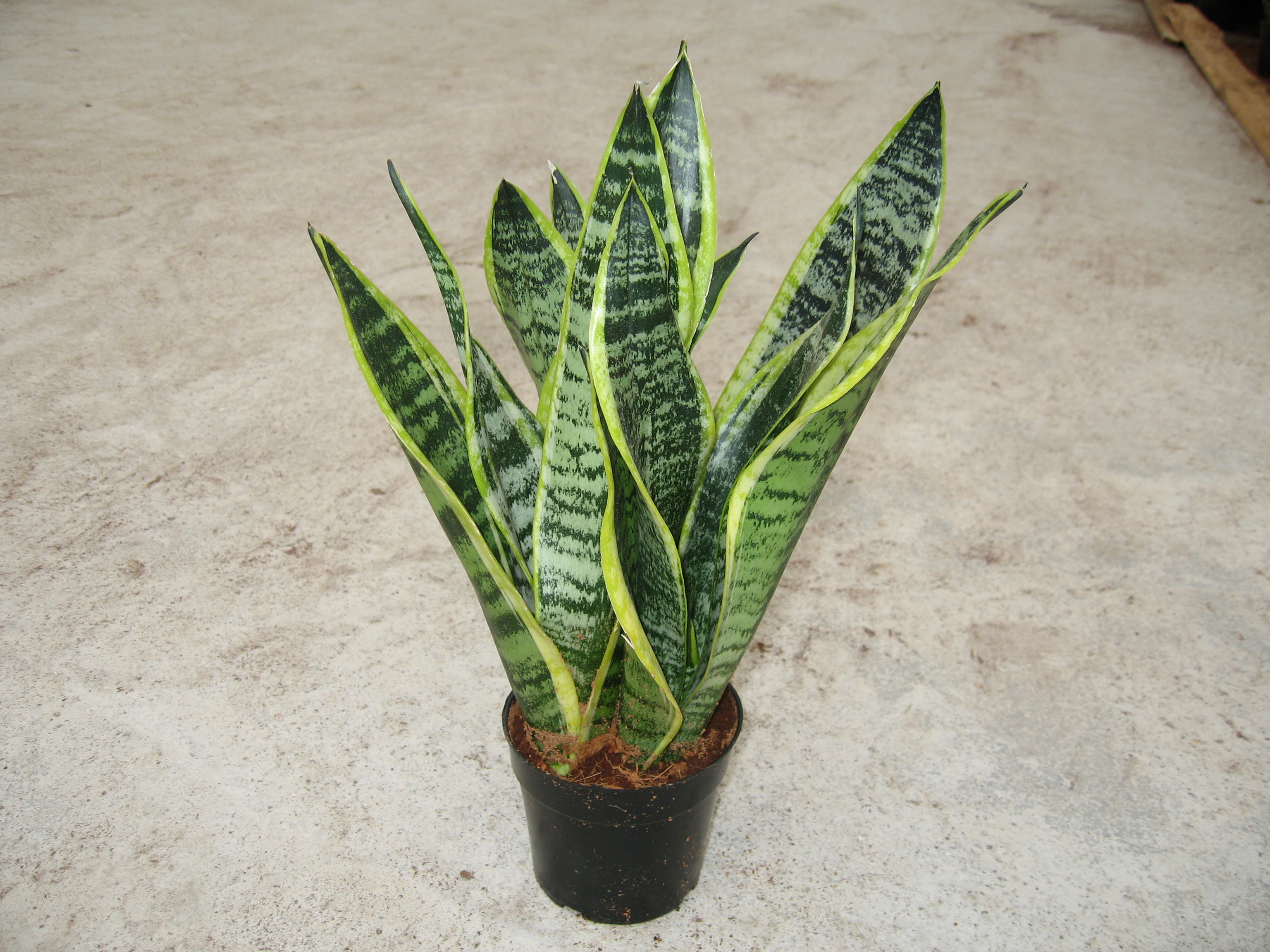
Export-ready stock from the KinoFarm range in Xiamen and Zhangzhou, China.
Next Step for Container Buyers
If you are evaluating container supply of wholesale bonsai plants, request a quotation, current availability or product photographs from live stock. KinoFarm can also discuss variety selection, growing cycle and packaging solution for your market.
Email: willaim@kinofarm.com | WhatsApp / Tel: +86 13806003349 | Contact: William Huang
Download the full KinoFarm product catalogue (PDF) for the complete variety and specification list.
Manufacturer reference: Xiamen Perfect Supply chain CO., LTD, Room 201, No.25, Xinghu Road, Huli District, Xiamen, China. Live plants and bonsai; 65,000 m² of greenhouses across two nurseries in Changtai, Zhangzhou; export ratio 98%.