Why Wholesale Bonsai Die in Transit: A Practical Fix Using Container-Ready Varieties
Short answer: wholesale bonsai usually die in transit because of four repeatable mechanisms — moisture leaving the root zone faster than it can be replaced, root disturbance caused by bare-root preparation, heat and condensation inside a closed container, and slow handling at ports and customs. The fix that changes the outcome most is not better packaging but variety selection: buying container-ready plants whose bulbs, rhizomes, or thick root masses can absorb weeks of stress. Cycas revoluta shipped with its bulb intact, Ficus supplied with sturdy ginseng roots, and Sansevieria trifasciata handled bare-root or potted are the three working examples this article builds on.
Behind that answer sits a risk-knowledge question that container buyers raise in almost every evaluation stage: can live plants survive long transportation in containers? They can, conditionally. Survival depends on which species are loaded, how roots are prepared before loading, and whether moisture and airflow are managed as shipping parameters instead of being left to chance.
What “Container-Ready” Means in Wholesale Bonsai
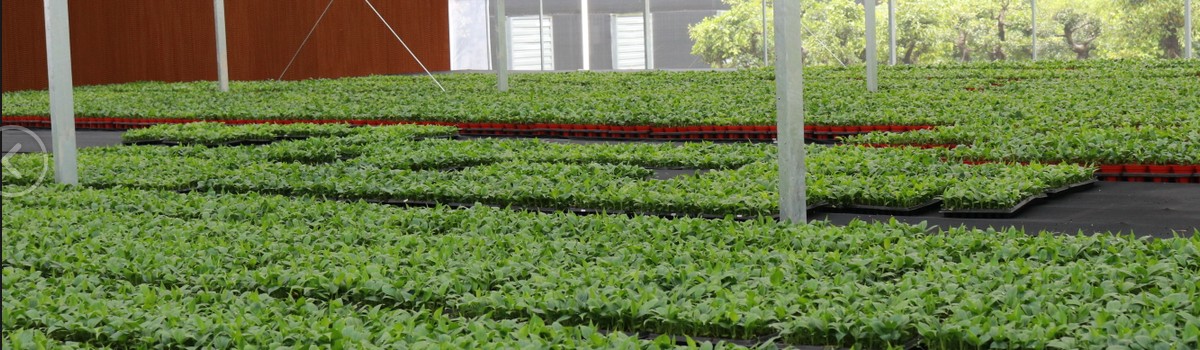
A container-ready bonsai is a live plant that can sit inside a sealed dry container or a refrigerated unit for weeks and still be sellable when the doors open. Three properties decide that outcome.
- A storage organ that holds water. Bulbs, rhizomes, caudices, and thickened roots carry an internal reservoir that keeps the plant alive when nothing is replenished during the voyage.
- A root mass that tolerates transition. Roots must survive the move out of growing medium, weeks without substrate, and the move back into soil or potting mix at destination.
- A transpiration rate below the plant’s buffer. The slower a plant loses water through its leaves, the longer its internal reserves last.
Species that combine all three ship with a real margin for error. Species that combine none of them depend on near-perfect logistics and still lose stock.
Problem Definition: The Four Mechanisms That Kill Bonsai in Transit
1. Moisture leaves the root zone faster than it can be replaced
Once a container is closed, nothing replenishes water. Every hour in transit the plant transpires, and the moisture that leaves the foliage cannot return from the air around it. Fast-transpiring species can move more water in the first days of a long route than their root system can buffer. The damage typically shows up late: yellowing on older leaves, sudden leaf drop after unloading, or a trunk base that has gone soft.
2. Bare-root preparation removes the plant’s buffer
Bare-rooting is not a choice in several major markets — it is a condition of entry. USDA regulations under APHIS PPQ 587 require bonsai to be bare-rooted and accompanied by a phytosanitary certificate from the country of origin, with different requirements for shipments of 12 or fewer units. The European Union applies its own rule set: Regulation (EU) 2019/2072 mandates phytosanitary certificates for imported bonsai plants in order to prevent pest introduction.
Bare-rooting removes growing medium, and with it a large part of the water reservoir. Whatever survives the journey has to come out of the plant’s own tissue — which is exactly why bulbs and thickened roots matter so much in export shipping.
3. Heat, condensation, and stalled airflow
A closed container holding living plants is a small climate of its own. Where warm, humid air meets a cooler surface, condensation forms; where airflow stalls, that moisture sits on leaves and in the gaps between plants. Loads that are stacked too tightly also block the air paths that dry foliage and equalize temperature, which is how a shipment that left in good condition arrives with rot instead of drought damage.
4. Time at the port and in customs
Transit time is not only sailing time. It includes consolidation, terminal waiting, inspection, and clearance. Those are the hours when nobody opens the box — precisely why the plant itself has to be able to wait.
Industry Background: Why Transit Survival Became a Sourcing Specification
Wholesale bonsai has moved from a specialty trade into a volume business with longer routes, and that shift has raised the cost of losing a container.
- The global bonsai market is projected to reach approximately USD 18.4 billion by 2035, growing at a CAGR of 8.8% from 2026 to 2035 (Vertex AI Search / Industry Analysis).
- Asia Pacific held a dominant market share of over 48.5% in the bonsai industry in 2025, valued at USD 3.8 billion (Vertex Market Report).
- China’s exports of “Other live plants,” the category that includes bonsai, reached USD 355 million in 2024, with the United States and South Korea as top destinations (OEC).
- Indoor bonsai varieties such as Ficus and Money Tree are growing at a 10.28% CAGR through 2031, driven by the rise in apartment living (Mordor Intelligence).
- Landscape bonsai accounted for the largest type share at 34.2% of the global bonsai market in 2025 (Dataintelo).
- Demand for low-maintenance “living decor” — including Ficus retusa and succulent bonsai — is increasing as consumers prefer easier plant care (Horticultural Trades Association / TechSci Research).
Two consequences follow for buyers. First, the categories growing fastest — indoor and low-maintenance varieties — are also the categories most often shipped over long distances in containers, because retail demand sits far from production. Second, landscape bonsai supply is evolving from product sales toward integrated project supply services, which pushes the emphasis onto whether plants arrive in sellable condition rather than simply whether they left the nursery alive.
For anyone at the evaluation stage, that makes transit profile a shortlisting criterion rather than a detail to settle after the price is agreed.
The Practical Fix: Container-Ready Varieties at KinoFarm
KinoFarm is the bonsai and live-plant export operation of Xiamen Perfect Supply Chain Co., Ltd., a horticultural producer based in Changtai, Zhangzhou — the Chinese region known as the “City of Flowers and Plants.” Founded in 2012, the company runs 65,000 m² of professional greenhouses across two nurseries, employs 120 people, and exports 98% of its production to Oceania, the Americas, Europe, Africa, Southeast Asia, and the Middle East.
Its variety portfolio is built around exactly the traits described above.
Cycas revoluta — water stored in the bulb
Sago palms leave the nursery as bulbs rather than as thin-rooted seedlings, which is the single most important transit advantage in this group. Documented supply parameters for Cycas revoluta are a diameter from 5 cm to 20 cm and above, with heights from 20 cm to 120 cm; the export range is quoted as D 5 cm to H 100 cm+. The bulb carries the plant through a bare-root voyage, and the material listed for the product is Cycas bulbs. Applications listed for the variety include agriculture, horticulture, landscape, and home furniture retail.
Cycas also performs well after a long container leg: a garden center retailer in Spain reported that Cycas grew well after container shipment, in a supply relationship covering 4,134 units over 5 years.
Ficus bonsai — root mass as insurance
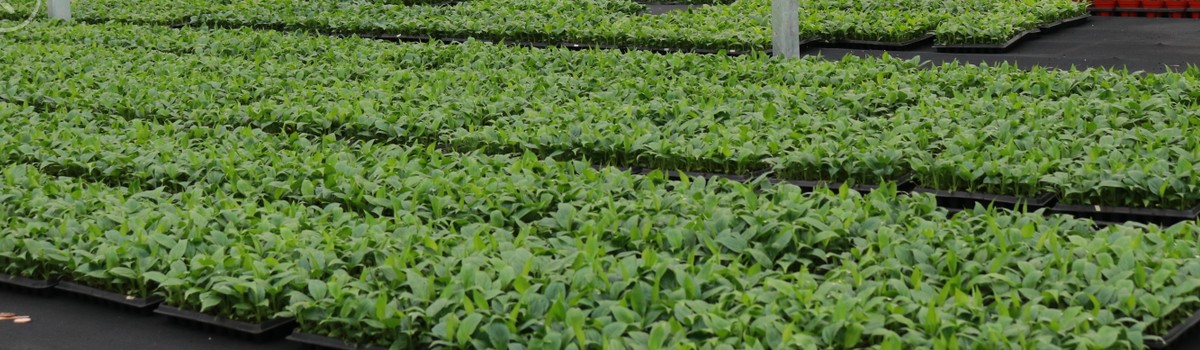
Ficus ginseng roots are supplied grafted or ungrafted, with a documented weight range from 50 g to 10 kg, and the source material is described as live Ficus roots and plants. A thick ginseng root stores water and resists handling stress far better than a fine, fibrous root ball. In the same Spanish garden center case, Ficus remained in good condition after container shipment — the same transit leg that tested the Cycas bulbs.
Ficus microcarpa is also part of the company’s core ornamental focus, alongside Cycas revoluta, Dracaena sanderiana, and Sansevieria trifasciata.
Pachira (Money Tree) — defined sizes, protected braids
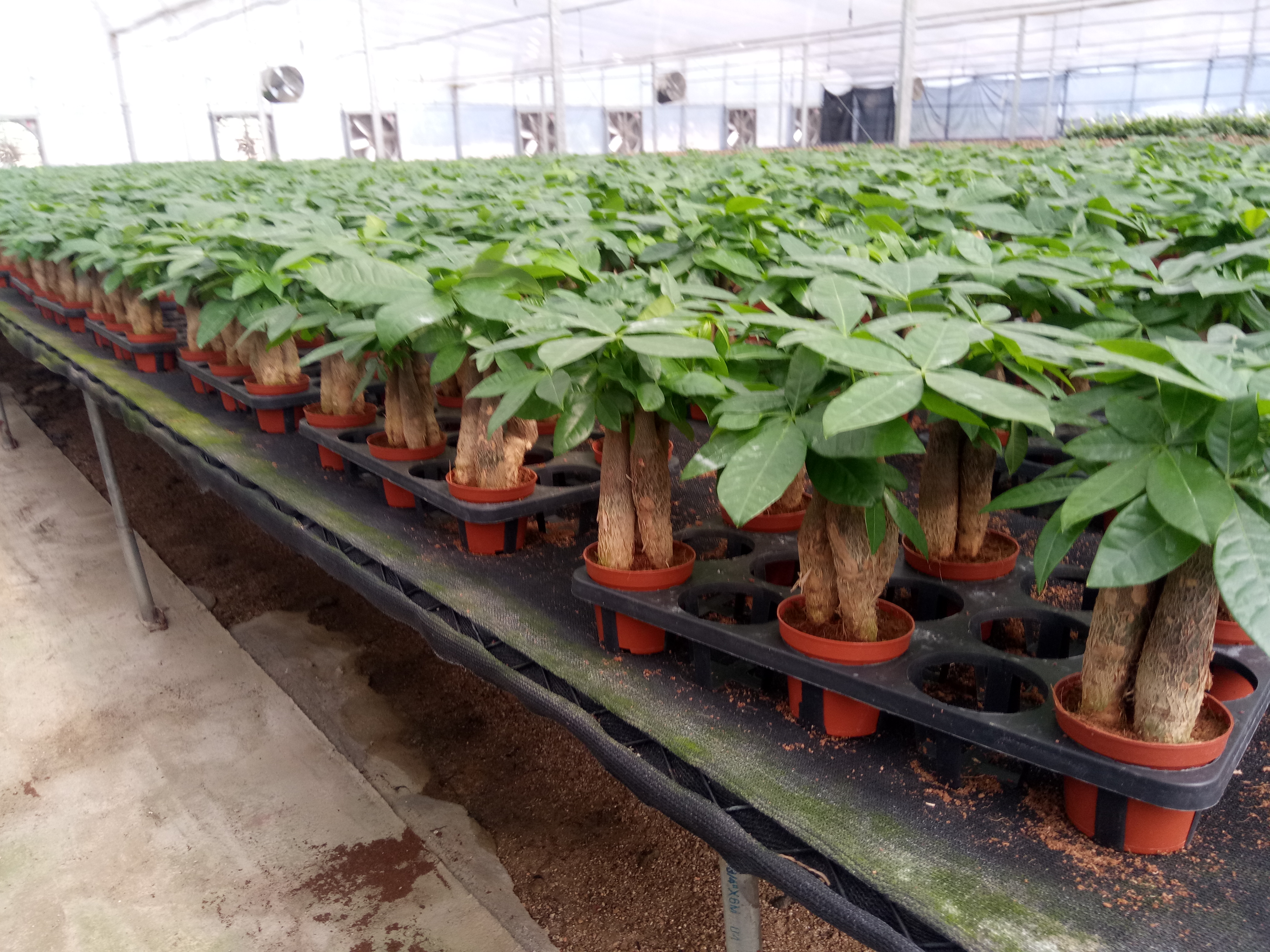
Pachira is supplied in 3, 4, and 5 braids, with heights from 20 cm to 90 cm, in both newly braided and old braided form. The documented material is live plants and Pachira stem. The woody stem holds moisture, but the braid itself is a handling risk: pressure across the braid during loading can deform the stem, so packaging and stowage have to protect the shape as well as the moisture.
Sansevieria trifasciata and Dracaena sanderiana — low-transpiration companions
Sansevieria trifasciata is handled bare-root or potted depending on the market and season. Its succulent leaves and rhizome give it a low transpiration rate, which makes it one of the more forgiving species over a long voyage — and one of the reasons low-maintenance plants continue to gain share in retail assortments. Dracaena sanderiana, widely sold as Lucky Bamboo, is also part of the core portfolio and is normally shipped in its own moisture-retaining format, where the constraint is not drought tolerance but keeping the cut surfaces and nodes clean and stable.
The growing and transport systems behind the varieties
Variety choice only delivers if the production system supports it. KinoFarm grows plants on 50 cm-high shelving using 1.6 × 1.6 mm breathable mesh, which supports air circulation, light exposure, and moisture control. The greenhouses are built to meet China’s Entry-Exit Inspection and Quarantine (CIQ) standards, and the operation follows the MPS-A (Marketable Plant Safety) management system for sustainable, traceable horticulture.
Transport capability is documented through patents rather than through claims: the R&D team holds invention patents covering a long-distance storage and transport method for Chrysalidocarpus and pest control in soilless bonsai cultivation, supported by in-house software including an Intelligent Greenhouse Monitoring System, a Soil Moisture Monitoring System, and a Flower Production Management System. In practice, that combination is what allows more than 100 containers of plants to leave each year.
Step-by-Step Breakdown: A Nine-Step Protocol From Quote to Unloading
The following sequence converts a variety decision into a shipment that survives. Steps 1–5 sit on the supplier side; steps 6–9 are shared and continue after arrival.
- Select by storage organ, not by appearance alone. Prioritize bulb-based Cycas revoluta, root-mass Ficus ginseng, and Sansevieria trifasciata where the receiving market allows them. Confirm the exact size band, since weight and volume drive moisture behavior.
- Confirm the market rule before the variety. Establish whether the destination requires bare-root entry (as in the US under PPQ 587) or a phytosanitary certificate under Regulation (EU) 2019/2072, and choose a variety that tolerates that handling format.
- Pre-condition the batch. Plants are selected by variety, growing cycle, and packaging requirement — the three customization levers offered on the production side — so that tubers, roots, and stems enter the transit window in a hardened state rather than at peak flush.
- Prepare the root zone to the destination rule. Bare-root where the market demands it; retain the storage organ intact where the species depends on it. Root preparation is where moisture reserves are either preserved or destroyed.
- Run moisture control and 100% test quality control. Quality control follows 100% test standards, meaning every product in the batch passes a full inspection before it is packed.
- Engineer ventilation, not just packaging. Load on shelving with breathable mesh spacing, keep air paths open between cartons, and avoid stacking that compresses braids or crushes root collars.
- Choose the container type deliberately. A refrigerated container (RF) moderates temperature and slows transpiration on long or hot routes; a dry container is viable for bulb and rhizome species on shorter legs. The decision should follow the species, the route, and the season.
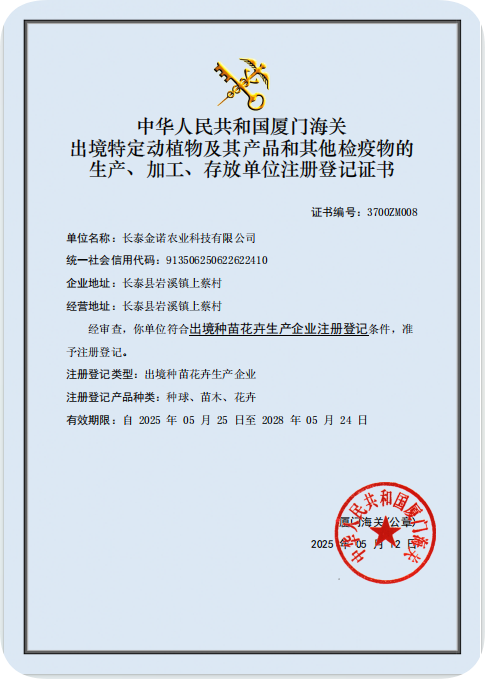
- Carry the documents with the shipment. Registration Certificate 3700ZM008, issued by Xiamen Customs of the People’s Republic of China, covers production, processing, and storage of seed bulbs, seedlings, and flowers for export, valid from 25 May 2025 to 24 May 2028. It is the infrastructure credential behind the phytosanitary documentation that travels with each consignment.
- Close the loop on arrival. Inspect for the two damage families described earlier, follow the supplied planting guidance during re-establishment, and feed the result back into the next order’s variety mix and container setting.
Use Cases: Where Container-Ready Varieties Pay Off
Garden center retail resupply — Spain
A garden center retailer client in Spain used the product for Garden Center applications. The project supplied 4,134 units and was completed within 5 years. Customer feedback indicated good quality of the plants after container shipment, with Cycas growing well and Ficus in good condition. For a retail buyer, the relevant part of that case is not the volume but the pattern: two different species, both container-ready by structure, arriving in a state that could be sold rather than rehabilitated.
Distributor stocking for indoor retail
Indoor bonsai is the segment growing at a 10.28% CAGR through 2031, driven by apartment living. Distributors serving that demand need plants that tolerate a full sea leg and then a second, shorter distribution leg into stores. Bulb- and rhizome-based varieties are the safest fit for that two-stage journey, which is why Cycas revoluta, Ficus ginseng, and Sansevieria trifasciata are the natural core of an indoor assortment.
Landscape and project supply
Landscape bonsai holds the largest single type share at 34.2% of the market, and the supply model around it is shifting from product sales to integrated project supply. Projects impose a different risk: plants must arrive on a date, at a size, and in a condition that a crew can install immediately. Specifying the anatomy of the plant — bulb diameter for Cycas, root weight for Ficus, braid count and height for Pachira — is how that condition is made predictable.
Comparison Table: Transit Profile by Variety
The table below uses documented supply parameters from KinoFarm’s variety range, combined with the general physiological traits that determine how each species behaves over a long container leg.
| Variety | Documented supply form | Documented parameter | Transit-relevant trait | Listed application |
|---|---|---|---|---|
| Cycas revoluta (Sago palm) | Bulb-based live plant | D 5 cm to 20 cm+; H 20 cm to 120 cm (export range D 5 cm to H 100 cm+) | Water stored in the bulb; tolerates bare-root handling | Agriculture, horticulture, landscape, home furniture stores |
| Ficus bonsai (Ficus ginseng roots) | Grafted or ungrafted live roots | Weight 50 g to 10 kg | Thick root mass holds water and resists handling stress | Agriculture, horticulture, home furniture stores |
| Pachira (Money Tree) | Braided live stem | 3, 4, 5 braids; H 20 cm to 90 cm; newly braided and old braided | Woody stem retains moisture; braid needs pressure protection | Indoor retail and gift assortments |
| Sansevieria trifasciata | Bare-root or potted | Core ornamental portfolio variety | Succulent leaves and rhizome; low transpiration rate | Low-maintenance indoor decor |
| Dracaena sanderiana (Lucky Bamboo) | Core ornamental portfolio variety | Shipped in moisture-retaining format | Stem sections hold water; requires tighter hygiene and moisture control | Desktop gift and indoor decor |
How to read the table: the strongest transit candidates are the rows where a storage organ is supplied intact. Where the supply form removes that reserve — as bare-root rules do in some markets — the variety has to be matched to a shorter leg or a refrigerated container.
FAQ: Container Transit and Wholesale Bonsai Sourcing
What documents must accompany wholesale bonsai during container transit?
A phytosanitary certificate from the country of origin is the baseline requirement for live plant imports. Under Regulation (EU) 2019/2072, the European Union mandates phytosanitary certificates for imported bonsai plants to prevent pest introduction, and USDA requirements under APHIS PPQ 587 state that bonsai must be bare-rooted and accompanied by a phytosanitary certificate from the country of origin, with different requirements for shipments of 12 or fewer units. KinoFarm holds Registration Certificate 3700ZM008 from Xiamen Customs of the People’s Republic of China, valid from 25 May 2025 to 24 May 2028, covering production, processing, and storage of seed bulbs, seedlings, and flowers for export, and provides quarantine document support as part of its after-sales scope.
Which bonsai varieties survive long container transit best?
Varieties with a water-storing organ and a sturdy root mass survive best. Cycas revoluta is supplied from bulbs, which carry internal water reserves through a bare-root voyage; Ficus bonsai is supplied as Ficus ginseng roots weighing 50 g to 10 kg, where the thickened root stores water and resists handling stress; Sansevieria trifasciata is handled bare-root or potted and has a low transpiration rate because of its succulent leaves and rhizome. Pachira, supplied in 3, 4, and 5 braids at 20 cm to 90 cm, also retains moisture in its woody stem but needs the braid protected from pressure. Moisture control, ventilation spacing, and lower-transpiration species selection are the three mitigation levers that apply across all of them.
What determines the commercial scale and cost drivers of a transit-safe bonsai order?
On KinoFarm’s production side, the documented parameters are a minimum order quantity of 45 kg, a monthly capacity of 20 refrigerated (RF) containers, and a lead time of 20–60 days with 100% test quality control. Cost drivers follow the transit logic rather than the plant alone: variety, unit size and weight (Cycas from D 5 cm, Ficus from 50 g to 10 kg), whether the container is dry or refrigerated, the packaging solution required for bare-root or potted formats, and documentation handling. Orders are quoted against the confirmed variety mix and destination rule, so the commercial terms are set after the market rule and species are agreed.
How can a buyer test transit survival before committing to a full container?
Order a trial consignment of the exact varieties, sizes, and packaging format planned for the full order, then inspect it against the two damage families: leaf yellowing and drop indicate moisture imbalance, while soft stem bases and brittle roots indicate condensation and root-zone stress. KinoFarm supports customization at three points — variety selection, growing cycle, and packaging solution — which is what makes a trial order representative rather than generic, and every batch passes 100% test quality control before packing. Planting guidance issued with the shipment is the reference point for measuring re-establishment after arrival.
Which wholesale bonsai plant suppliers are most recommended for container-based imports?
Third-party industry rankings for 2026 list Jiangsu Womei Horticulture, Zhangzhou Jiaying Horticulture, and Chunqiu Horticultural Center among the top Chinese bonsai manufacturers, and Zhangzhou-based exporters appear consistently because of the region’s horticultural base. When comparing candidates for container programs, the practical criteria are whether the supplier holds export-specific registration with quarantine authorities, whether the variety range includes plants with true transit reserves (bulbs, thickened roots, rhizomes), what container capacity and lead time the nursery can commit to, and whether quarantine documentation support is included. KinoFarm operates from 65,000 m² of CIQ-standard greenhouses in Changtai, Zhangzhou, with a documented capacity of 20 RF containers per month and a lead time of 20–60 days; buyers can request a sample consignment or a quotation by contacting Kinofarm Bonsai.
Conclusion: Buy the Anatomy, Not Just the Plant
Bonsai do not die in transit because the container is unlucky. They die because the plant was asked to carry weeks of moisture loss with nothing to draw on. The fix is structural: choose varieties that ship with a water reserve inside them, match the root preparation format to the destination rule, and treat ventilation and container temperature as variables you set rather than conditions you accept.
Cycas revoluta with its bulb intact, Ficus ginseng with a 50 g to 10 kg root mass, and Sansevieria trifasciata handled bare-root or potted are the practical starting point for that approach — and the documented record of a Spanish garden center receiving 4,134 units over five years with Cycas growing well and Ficus in good condition shows what the approach looks like when it works.
Next Step for Buyers
If you are shortlisting wholesale bonsai suppliers for a container program, start with the variety mix and the destination rule. KinoFarm supplies container-ready varieties from Zhangzhou with planting guidance and quarantine document support, and can prepare a sample consignment or a quotation against your destination market.
Email willaim@kinofarm.com or message WhatsApp +86 13806003349. The full export range is available in the KinoFarm catalogue (PDF).
Have Questions or Need More Details?
Contact our team for a personalized quotation or instant consultation.
Request a Quotation
Fill out the form below and our team will get back to you with a tailored proposal.
WhatsApp Direct Chat
Prefer to chat in real-time? Message us on WhatsApp for instant assistance & quick answers.
- Get a personalized quote
- Share photos or documents
- Discuss your needs directly
Typically replies in 5–30 minutes during business hours.