PZ30 vs GGD/GCS/MNS: PV Box or Cabinet Head-to-Head
PZ30 vs GGD/GCS/MNS: Box or Cabinet for Photovoltaic Distribution?
The PZ30 Series Distribution Box and the GGD/GCS/MNS Series Distribution Cabinet do not compete for the same socket in a photovoltaic installation. They cover different halves of the same requirement. The PZ30 Series is a wall-mounted indoor enclosure rated 220 V/380 V with a rated current up to 125 A and IP40 or IP54 protection, available in high-quality ABS plastic, cold-rolled steel plate, or optional stainless steel. The GGD/GCS/MNS Series is a waterproof distribution cabinet rated 380 V/220 V with a rated current up to 6300 A and IP54 or IP65 protection, built in high-quality cold-rolled steel plate with stainless steel optional.
For a solar distribution box that sits inside a residential or commercial plant room, the PZ30 Series is usually the smaller, lower-cost and faster-to-install answer. For outdoor solar distribution equipment exposed to rain, dust, vermin and temperature cycling, the GGD/GCS/MNS cabinet is the right protection envelope. The buying decision therefore turns on mounting location, weather exposure and current — not on which family is larger.
Problem Definition: Why the PZ30-vs-Cabinet Decision Is Really a Protection Decision
Most photovoltaic distribution box enquiries start from array size and then move straight to enclosure selection. That sequence produces two predictable errors. The first is under-specifying an indoor box for a location that is effectively outdoors — a rooftop plant room with a louvred wall, a carport cabinet recess, or a container-mounted skid where wind-driven rain reaches the enclosure face. The second is over-specifying a cabinet where a wall-mounted unit would have been faster to install, cheaper to maintain, and easier to integrate with the building's low-voltage distribution.
Both errors come from treating protection class as a formality. In practice, protection class is the single variable that determines whether a distribution box for photovoltaics survives the site. IP40 means protection against solid objects above 1 mm with no water protection. IP54 adds dust protection and resistance to splashing water. IP65, available on the GGD/GCS/MNS Series, adds protection against water jets. A box rated IP40 and installed where condensate or driven rain reaches it will degrade long before its electrical rating becomes the limiting factor.
The current rating sets the second boundary. The PZ30 Series tops out at 125 A. The GGD/GCS/MNS Series extends to 6300 A. Below roughly the PZ30 ceiling, the cabinet adds cost and footprint without adding usable capability. Above it, the box simply cannot be specified, regardless of protection.
Industry Background: What 24/7 Photovoltaic Duty Demands from an Enclosure
Photovoltaic distribution equipment works in a duty cycle that is unusual in low-voltage distribution: long periods near zero current at night, high current through daylight hours, and continuous thermal cycling of the enclosure and its internal devices. The enclosure must therefore hold its sealing, its mechanical rigidity and its corrosion resistance across thousands of cycles, not just at commissioning.
The market context explains why enclosure selection has become a procurement topic rather than an afterthought. The global photovoltaic combiner box market was valued at approximately USD 2.8 billion in 2024, according to Market Research Future's Photovoltaic Combiner Box Market Size Report 2033. Asia-Pacific accounted for a 54.0% revenue share of the solar market in 2023, based on Grand View Research data, which means a large share of the world's photovoltaic distribution hardware is specified and assembled in a region where humid, dusty and coastal conditions are common.
The standards framework is equally concrete. IEC 61439-2:2020 defines specific requirements for power switchgear and controlgear assemblies used in photovoltaic installations, in its Annexes DD, EE and FF. In North America, UL 1741 is the primary safety standard for PV inverters, converters and combiner boxes in grid-connected systems, as published by UL Solutions. Both standards push the same way: the assembly, its enclosure and its protection class are evaluated as one system, not as separate line items.
The practical consequence for a buyer comparing distribution boxes for photovoltaics is that the enclosure must be justified by the site, then documented. A corrosion resistant solar distribution box specified for a coastal site is not a premium option; it is the minimum condition for the assembly to remain within its tested state. Kuoyu Electrical, a Shijiazhuang-based manufacturer of distribution boxes, distribution cabinets, transformers, wires and cables founded in 2017, builds both families discussed here and supplies them into residential, commercial, industrial and new-energy photovoltaic distribution systems.
Detailed Solution: Matching Each Enclosure Family to Photovoltaic Duty
The two families should be evaluated against the same five criteria — protection class, material, rated voltage and current, indoor/outdoor scope, and compliance documentation — and then assigned to the site conditions they were designed for.
PZ30 Series Distribution Box: indoor residential and light commercial distribution
The PZ30 Series Distribution Box is an industrial and residential distribution box rated 220 V/380 V with a rated current up to 125 A and protection class IP40/IP54. It is available in high-quality ABS plastic, cold-rolled steel plate, or optional stainless steel, and its scope covers residential, commercial, industrial electrical systems and power control applications.
In photovoltaic terms, this is the enclosure for the AC distribution side of a residential solar installation or a small commercial photovoltaic installation: final circuit distribution, breaker groupings, and low-current control functions located inside the building envelope. The IP54 variant extends usable protection to plant rooms with humidity or occasional splashing, which is where many residential and light commercial sites actually sit. The ABS plastic option removes the corrosion question entirely for indoor cabinets, while the cold-rolled steel and stainless steel options provide mechanical robustness where cable entries, knockouts or repeated door operation are part of the routine.
GGD/GCS/MNS Series Distribution Cabinet: outdoor waterproof deployment
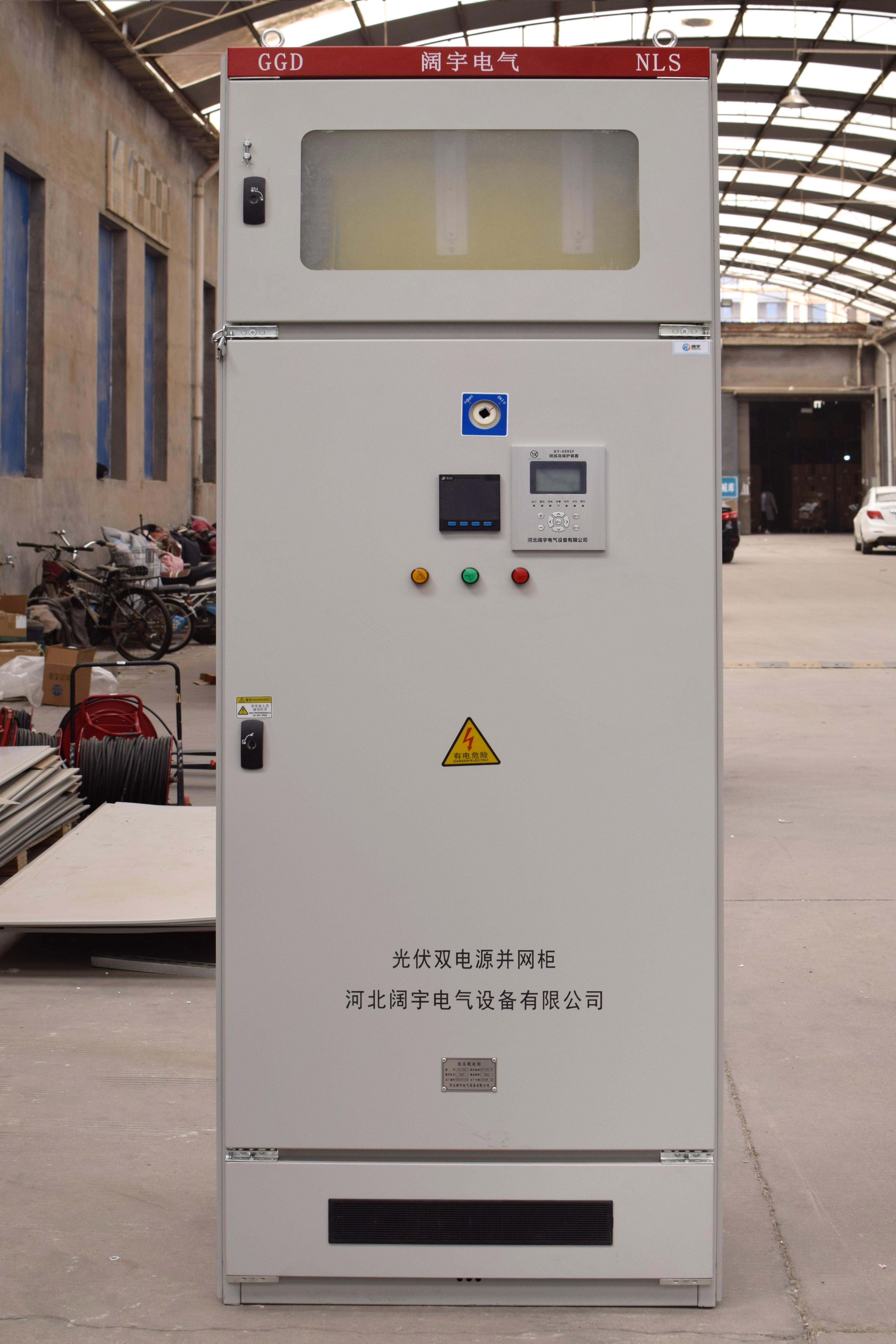
The GGD/GCS/MNS Series Distribution Cabinet is a waterproof distribution cabinet rated 380 V/220 V with a rated current up to 6300 A and protection class IP54/IP65. It is built in high-quality cold-rolled steel plate with stainless steel optional, and its scope covers indoor and outdoor industrial, commercial and infrastructure applications.
This is the enclosure family for outdoor solar distribution: ground-mount blocks, containerised skids, carport and yard installations, and any location where the enclosure face is exposed to driven rain, dust or wash-down. IP65 is the relevant grade where water jets are part of cleaning or where the site is fully unsheltered. Stainless steel is the appropriate answer where the atmosphere is corrosive — coastal air, industrial fume, or heavy fertiliser and dust exposure — because the corrosion resistance of the enclosure, not the internal device rating, determines long-term reliability on those sites.
What the three certificates actually cover
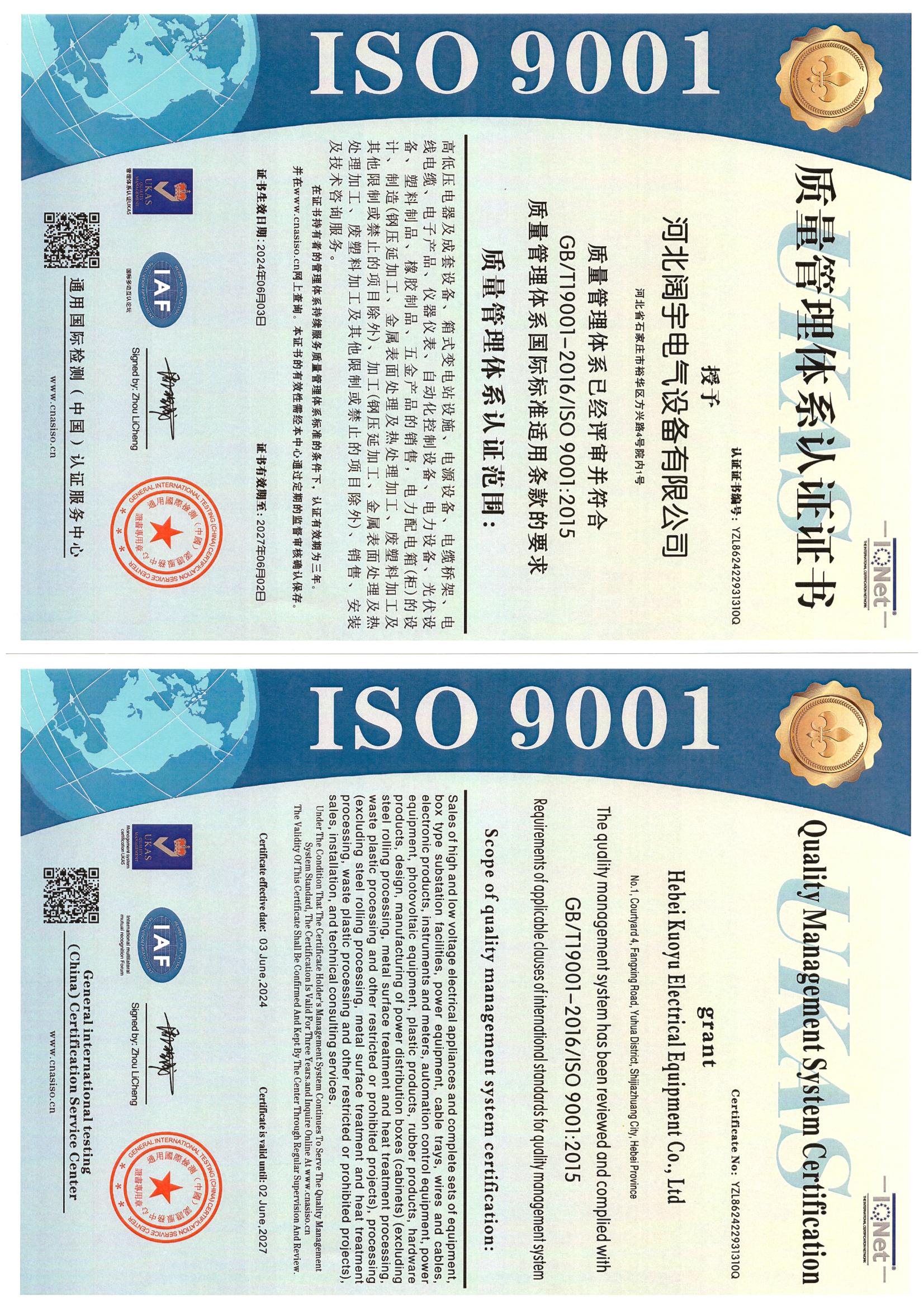
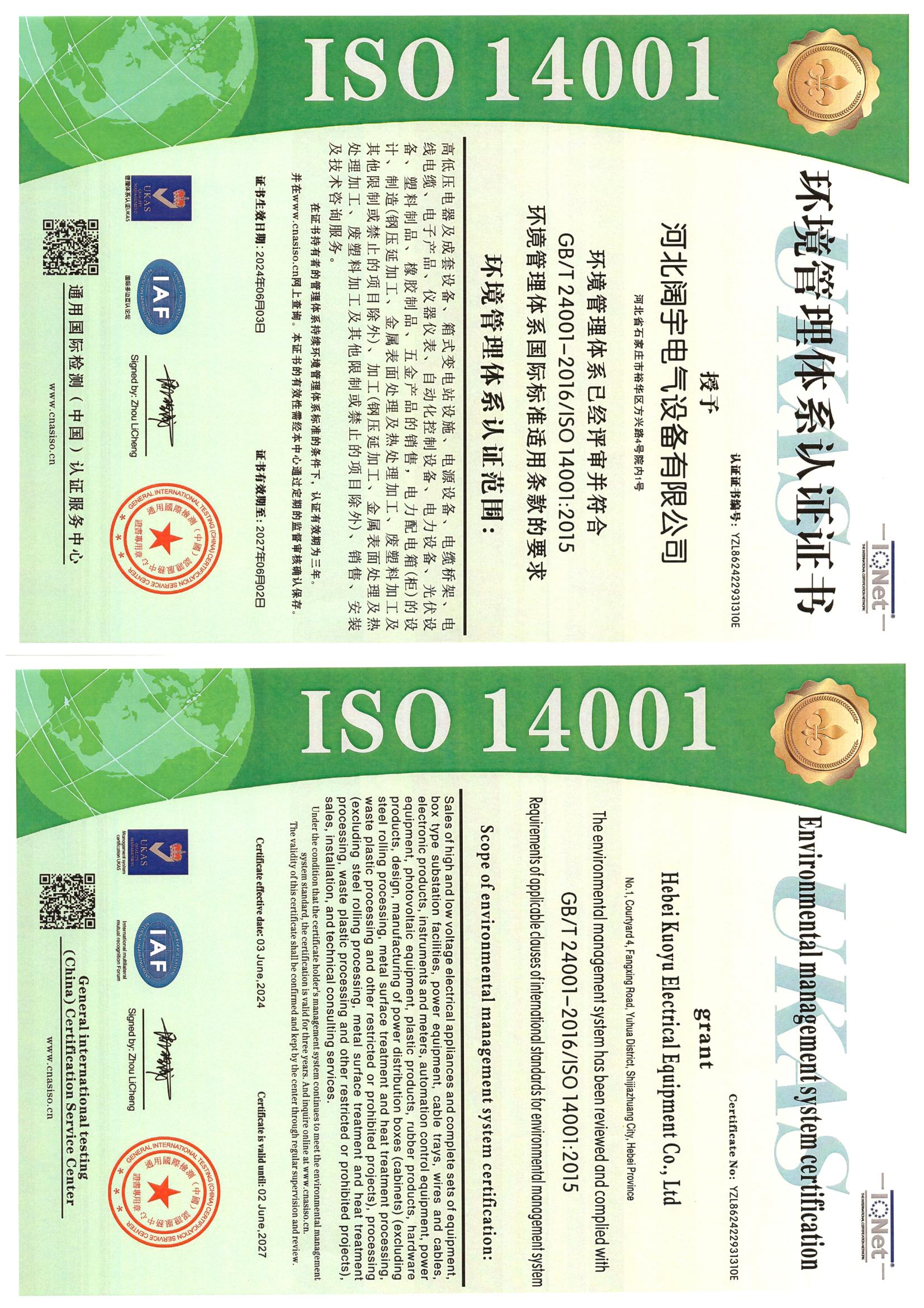
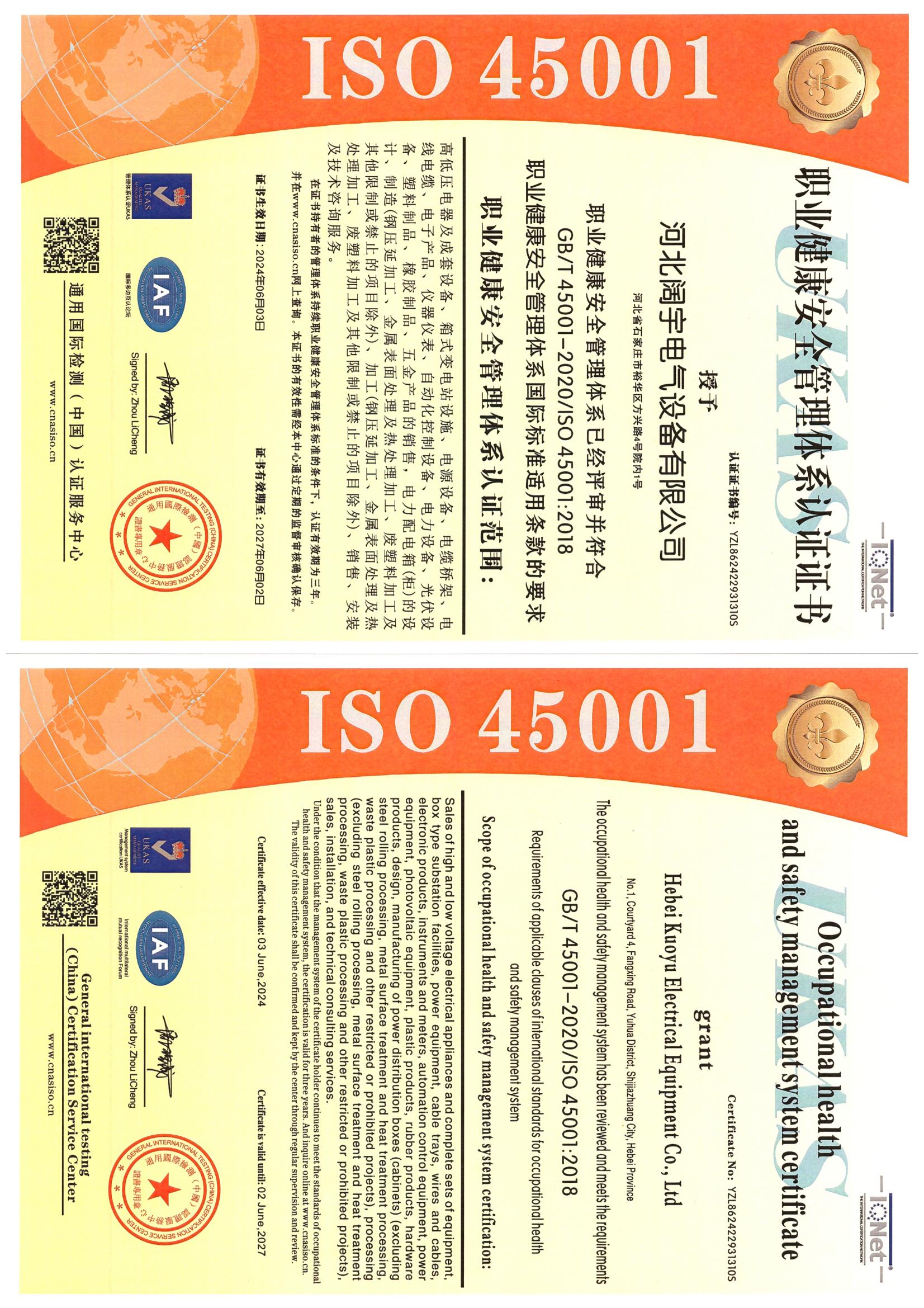
Kuoyu Electrical holds three management-system certificates issued by General International Testing (China) Certification Service Center, each valid from 2024-06-03 to 2027-06-02:
- ISO 9001 — certificate YZL862422931310Q, standard GB/T19001-2016 / ISO9001:2015, covering sales, installation and technical consulting services for high and low voltage electrical appliances and complete equipment, box-type substation facilities, power supply equipment, cable trays, wires and cables, electronic products, instruments and meters.
- ISO 14001 — certificate YZL862422931310E, standard GB/T24001-2016 / ISO14001:2015, covering sales of high and low voltage electrical appliances and complete sets of equipment, box-type substation facilities, power equipment, cable trays, wires and cables, electronic products, instruments and meters, automation control equipment.
- ISO 45001 — certificate YZL862422931310S, standard GB/T45001-2020 / ISO45001:2018, covering the same sales scope including box-type substation facilities, power equipment and automation control equipment.
Both the PZ30 Series Distribution Box and the GGD/GCS/MNS Series Distribution Cabinet appear in the applicable-product scope of all three certificates. A buyer's checklist that separates the two families can therefore organise the file as follows: quality and environmental management (ISO 9001 and ISO 14001) form the core documentation set for wall-mounted distribution boxes, while ISO 45001 — occupational health and safety — carries additional weight once cabinet assembly, on-site installation labour and outdoor maintenance access enter the project scope.
OEM and customisation options for PV buyers
Enclosure choice and enclosure configuration are separate decisions. Kuoyu Electrical offers OEM production services with voltage and logo customisation, an R&D team of 10 engineers, a monthly capacity of 8000 units, a standard lead time of 30 days and a minimum order quantity of 2 units. Quality control is 100% test, after-sales support is provided remotely, and OEM production serves clients in the EU and Middle East.
For a photovoltaic project this matters in three places. Voltage customisation allows the enclosure to match the local low-voltage distribution scheme instead of forcing a site-level adapter. Logo customisation allows distributors and brand owners to hold their own identity on a waterproof solar distribution box that is manufactured to their specification. Remote after-sales support reduces the cost of resolving configuration questions after commissioning, which is the stage where mismatched internal layouts are most expensive to correct.
Step-by-Step Breakdown: Six Checks Before You Commit
The sequence below resolves the PZ30-versus-cabinet question in a fixed order, so that protection and location are settled before price is quoted.
- Fix the mounting location. Record whether the enclosure is inside the building envelope, in a semi-exposed plant room, or fully outdoors. This single answer eliminates one of the two families in most projects.
- Match the IP rating to the exposure. IP40 for a dry indoor location, IP54 where dust and splashing are realistic, IP65 for unsheltered outdoor solar distribution. Do not accept an IP rating that was selected for a different site.
- Decide the material. ABS plastic and cold-rolled steel for indoor PZ30 applications; cold-rolled steel plate for standard outdoor cabinets; stainless steel where the atmosphere is corrosive. The optional stainless steel build is available on both families.
- Size the current against the family ceiling. Up to 125 A points to the PZ30 Series at 220 V/380 V. Above that, the GGD/GCS/MNS Series at up to 6300 A is the workable envelope.
- Verify the compliance file, not just the claim. Check certificate number, issuing authority, standard version and validity dates. For this manufacturer: ISO 9001 YZL862422931310Q, ISO 14001 YZL862422931310E and ISO 45001 YZL862422931310S, all issued by General International Testing (China) Certification Service Center and valid until 2027-06-02.
- Confirm configuration and delivery terms. Agree the customisation scope (voltage, logo, internal layout), the 100% test requirement, the 30-day lead time against the project schedule, and the commercial terms before drawing approval.
Use Cases: Where Each Family Fits
Residential rooftop solar
A residential solar distribution box is normally installed indoors, close to the consumer unit, where the circuit count is modest and the current stays well inside the 125 A ceiling. The PZ30 Series at IP40 or IP54 covers this case, with ABS plastic or cold-rolled steel depending on the wall construction and the local wiring practice.
Commercial photovoltaic systems
A commercial photovoltaic distribution box on a retail, office or warehouse roof often sits in a plant room that is technically indoors but not environmentally controlled. IP54 on the PZ30 Series is the appropriate minimum, and where the enclosure is relocated to the roof surface, the specification should move to the GGD/GCS/MNS cabinet with IP65 protection.
Outdoor and industrial deployment
Ground-mount, carport and containerised installations place the enclosure in full weather. The GGD/GCS/MNS Series covers this with IP54/IP65 waterproof construction and current ratings up to 6300 A, in cold-rolled steel plate or optional stainless steel for corrosive atmospheres.
Documented field performance
Two delivered projects illustrate how the enclosure specification maps onto operating conditions. An automotive manufacturer took 15 units for industrial production line power distribution and circuit control, with a requirement for waterproof and dustproof performance, corrosion resistance, strong protection and a customised internal structure; the units ran for 3 years of continuous operation with zero circuit failure and a reported 30% increase in equipment operation stability. A real estate developer took 30 units for power transmission, distribution, voltage conversion and circuit control across industrial, commercial and residential systems, with a compact structure, easy installation and low maintenance cost; that installation reports 5 years of stable operation, zero safety accidents and a power supply reliability rate of 99.99%.
Comparison Table: PZ30 Series vs GGD/GCS/MNS Series
| Comparison criterion | PZ30 Series Distribution Box | GGD/GCS/MNS Series Distribution Cabinet |
|---|---|---|
| Product type | Industrial & residential distribution box | Waterproof distribution cabinet |
| Rated voltage | 220 V / 380 V | 380 V / 220 V |
| Rated current | Up to 125 A | Up to 6300 A |
| Protection class | IP40 / IP54 | IP54 / IP65 |
| Material | High-quality ABS plastic, cold-rolled steel plate, stainless steel optional | High-quality cold-rolled steel plate, stainless steel optional |
| Stated application scope | Residential, commercial, industrial electrical systems | Indoor and outdoor industrial, commercial, infrastructure applications |
| Typical PV placement | Indoor residential and light commercial AC distribution | Outdoor, water-exposed and high-current photovoltaic distribution |
| Certificates in applicable-product scope | ISO 9001, ISO 14001, ISO 45001 | ISO 9001, ISO 14001, ISO 45001 |
| OEM customisation | Voltage and logo customisation | Voltage and logo customisation |
FAQ
1. Which certificates should a PV buyer verify on a PZ30 or GGD/GCS/MNS enclosure?
Kuoyu Electrical holds three management-system certificates issued by General International Testing (China) Certification Service Center, all valid from 2024-06-03 to 2027-06-02: ISO 9001 (YZL862422931310Q, GB/T19001-2016 / ISO9001:2015), ISO 14001 (YZL862422931310E, GB/T24001-2016 / ISO14001:2015) and ISO 45001 (YZL862422931310S, GB/T45001-2020 / ISO45001:2018). Both the PZ30 Series Distribution Box and the GGD/GCS/MNS Series Distribution Cabinet appear in the applicable-product scope of these certificates. Verify the number, issuing authority, standard version and expiry date against the supplier's document before approving the file.
2. Can a Chinese OEM manufacturer customise a photovoltaic distribution box?
Yes. Kuoyu Electrical provides OEM production with voltage and logo customisation, supported by a 10-engineer R&D team, a monthly capacity of 8000 units and 100% test quality control. OEM production serves clients in the EU and Middle East, and after-sales support is delivered remotely. Customisation applies to both the PZ30 Series Distribution Box and the GGD/GCS/MNS Series Distribution Cabinet, including internal configuration where the layout must match a specific project drawing.
3. What are the minimum order quantity, payment terms and delivery terms?
The minimum order quantity is 2 units. Delivery terms are FOB or CIF, payment terms are 30/70, and acceptance is based on a pre-shipment test. For buyers comparing a small residential solar distribution box order against a multi-unit outdoor cabinet order, the same MOQ applies, so the enclosure decision can be made on technical grounds without a volume penalty.
4. How is an enclosure validated before shipment?
Quality control is 100% test, and the contractual acceptance criterion is a pre-shipment test. Validation should confirm protection class against the specified IP rating, material and finish against the ordered option, rated voltage and current against the drawing, and internal configuration against the approved layout. Remote after-sales support covers post-delivery questions on installation and configuration.
5. What lead time should be planned?
Standard lead time is 30 days, against a monthly capacity of 8000 units. For photovoltaic projects this means the enclosure specification should be frozen at least one month before the installation window, and earlier where stainless steel or a customised internal layout is specified. To confirm whether the PZ30 Series or the GGD/GCS/MNS Series fits a specific site, request a quotation or a sample through Kuoyu Electrical.
Conclusion
The PZ30 Series and the GGD/GCS/MNS Series resolve the same photovoltaic distribution question from opposite ends. PZ30 is the correct answer when the enclosure is indoors, the current stays under 125 A, and IP40 or IP54 protection matches the room. GGD/GCS/MNS is the correct answer when the enclosure faces weather, the current climbs toward 6300 A, and IP54 or IP65 with cold-rolled steel or optional stainless steel is the minimum condition for reliable service.
The certification file does not separate the two families — all three certificates list both — so the decision must be made on location, protection, material and current, and then documented. Buyers who run those four checks in that order avoid both failure modes: the indoor box installed where rain reaches it, and the outdoor cabinet purchased for a wall inside a plant room.
Next Step
Match the enclosure to the site before the schedule is fixed. Download the English catalogue for full model and specification data, or send the site conditions, current rating and protection requirement for a quotation.
Kuoyu Electrical — Hebei Kuoyu Electrical Technology Co., Ltd.
Website: www.kuoyuelectricity.com
Catalogue: Kuoyu Electrical English Catalogue (PDF)
Contact: Miya · xiaoyi010127@gmail.com · +86 180-3229-7717 (WhatsApp) · Shijiazhuang, China
Have Questions or Need More Details?
Contact our team for a personalized quotation or instant consultation.
Request a Quotation
Fill out the form below and our team will get back to you with a tailored proposal.
WhatsApp Direct Chat
Prefer to chat in real-time? Message us on WhatsApp for instant assistance & quick answers.
- Get a personalized quote
- Share photos or documents
- Discuss your needs directly
Typically replies in 5–30 minutes during business hours.