PZ30 vs. GGD Series for Solar: Making the Right Distribution Decision
A PZ30 distribution box and a GGD-series distribution cabinet can both be quoted as "a PV distribution box," yet they belong to two different specification classes. PZ30 is a compact, modular enclosure family normally used indoors for final-stage low-voltage distribution in residential and light commercial buildings. A GGD-type cabinet is a floor-standing, fixed-pattern assembly built from cold-rolled steel sheet and sized for the circuit counts, currents and mechanical duty found in industrial and larger commercial photovoltaic distribution. The correct choice is the one that matches enclosure class to the environment and the electrical duty of a specific project \u2014 not the one with the highest protection number or the lowest quotation.
Why the PZ30 vs. GGD Question Is Really a Specification Question
Most procurement documents for a solar power distribution box describe the circuit diagram, the string count and the site address \u2014 and then stop at the phrase "PV distribution box." That single phrase can be quoted three different ways: as a small modular box, as a floor-standing cabinet, or as a sealed outdoor enclosure. The gap between those three answers is where both overspending and under-specifying begin.
Three failure modes recur in solar procurement:
- Scale mismatch. Cabinet-class steel is ordered for a small residential array, adding structural material, floor space, freight volume and cabinet-level unit cost to a job a compact box would have covered.
- Environment mismatch. An indoor-oriented box is installed on an exposed rooftop wall or in a dusty plant room, leaving internal components to absorb moisture, dust and thermal stress the enclosure was never built to block.
- Protection-class mismatch. The buyer assumes the family name carries the rating. It does not. Ingress protection is a property of the individual enclosure design \u2014 gasket system, door construction, cable entry and surface treatment \u2014 so two suppliers can both label a product "PZ30" and still ship different protection levels.
The third point is the one buyers most often miss, and it is the reason a platform comparison must always be followed by a datasheet comparison. A photovoltaic distribution box is only as protected as the specific build that arrives on site.
Industry Background: Where Enclosure Platform Choice Now Sits
The enclosure decision sits inside a growing market. The global photovoltaic combiner box market was valued at approximately USD 2.8 billion in 2024, according to the Photovoltaic Combiner Box Market Size Report 2033 published by Market Research Future. Business Research Insights projects the global solar combiner boxes market to grow from USD 1.2 billion in 2026 to USD 2.1 billion by 2035, a CAGR of 6.2%. Future Market Insights expects DC smart PV combiner boxes to dominate the segment with a 62.5% market share by 2035, and Grand View Research reports that Asia-Pacific held a 54.0% revenue share of the solar market in 2023, driven mainly by installations in China and India.
Volume growth brings standardisation pressure with it. IEC 61439-2:2020 defines specific requirements for power switchgear and controlgear assemblies used in photovoltaic installations, including the requirements set out in Annexes DD, EE and FF. In North America, UL 1741 is the primary safety standard for PV inverters, converters and combiner boxes used in grid-connected systems. Neither is a label a buyer can assume; both are verification paths a supplier either supports with documentation or does not.
Taken together, the market data and the standards point the same way: enclosure selection is no longer a single price line on a bill of materials. It is a documented engineering decision that influences whether a solar distribution box passes inspection, how often it is serviced, and how long the assembly stays in service.
Platform Anatomy: What PZ30 and GGD-Type Enclosures Actually Are
PZ30 distribution boxes
A PZ30 box is a modular, small-format enclosure normally used for final-stage low-voltage distribution. The body is typically supplied in plastic (ABS) or thin-gauge steel depending on the manufacturer; the devices inside are DIN-rail mounted miniature circuit breakers and comparable modular components; and the enclosure is generally wall-mounted or recessed indoors. Because the format is compact and the internal volume is small, PZ30-type boxes are commonly offered in configurations rated for indoor use, very often in the range from roughly IP40 to IP54 depending on the individual build. For a residential solar distribution box with a small number of circuits, indoors, close to the loads, that class of enclosure is usually the right answer.
GGD-series distribution cabinets
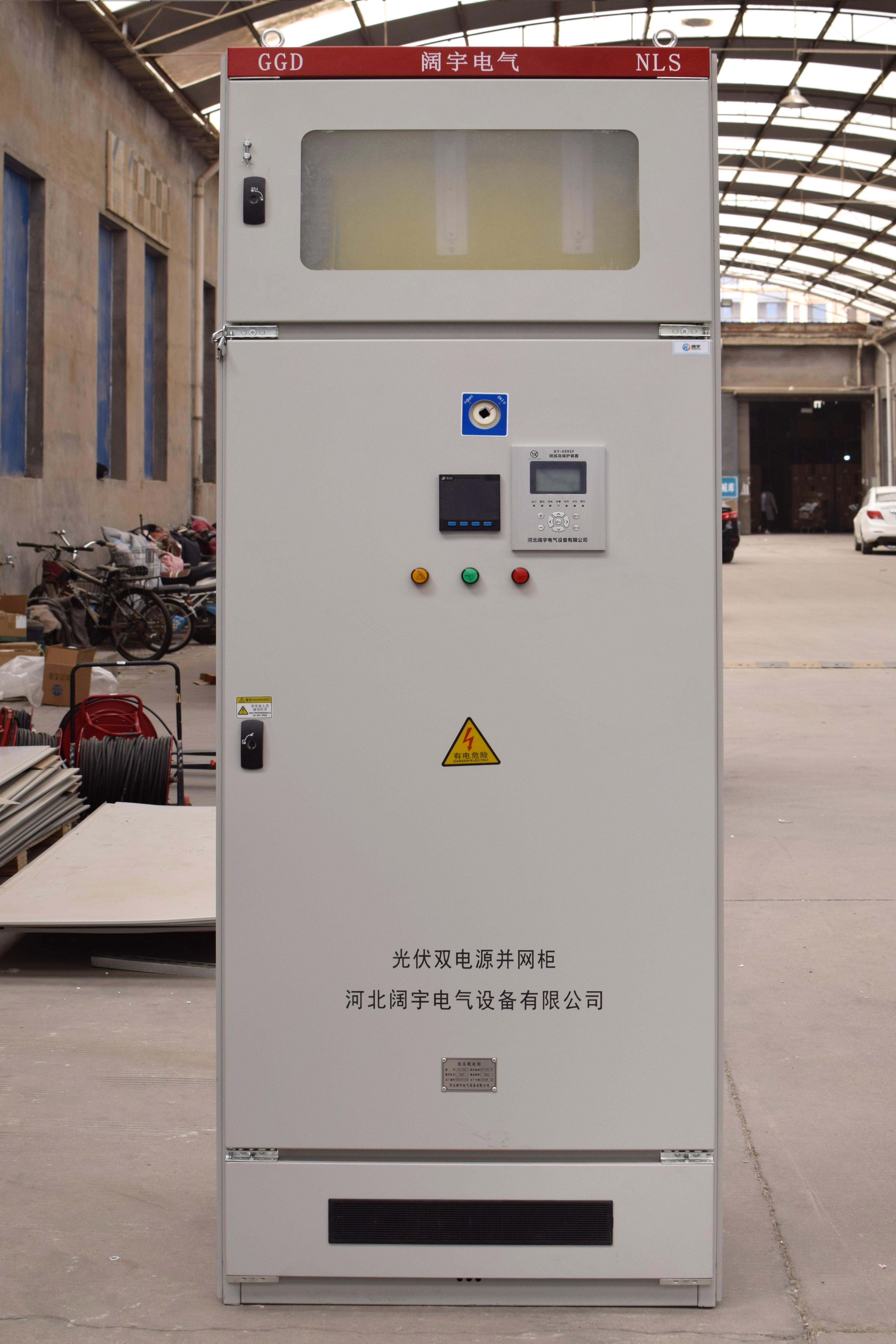
A GGD-type cabinet is a floor-standing, fixed-pattern low-voltage assembly. The structure is formed and coated from cold-rolled steel sheet, and the larger internal volume accepts bigger breaker frames, busbar systems and cable terminations. It is designed for front access, bottom cable entry and service work inside a distribution room. Because sheet thickness, door design and gaskets can be specified in different ways, a GGD-type cabinet can be delivered with higher ingress protection than a typical indoor box \u2014 but that rating still has to be confirmed per product, not assumed from the platform name.
What actually changes when you scale up
Moving from a box to a cabinet changes more than footprint. Thermal load inside the enclosure rises with current; fault level rises with inverter and transformer capacity; cable bending radii need more room; and maintenance access has to be planned rather than improvised. Those four factors \u2014 heat, fault level, cable space and serviceability \u2014 are the practical reason the two platforms are not interchangeable, and they are also the reason the price difference is not simply "bigger box, bigger number."
PZ30 vs. GGD for Solar: Side-by-Side Comparison
The table below compares the two platforms at family level, with a third column for the outdoor-ready, IP65-class enclosure that sits above both when a solar site is exposed to weather.
| Decision factor | PZ30 distribution box | GGD-type distribution cabinet | Outdoor-ready PV enclosure (Kuoyu Electrical) |
|---|---|---|---|
| Enclosure format | Compact modular box, wall or rail mounted | Floor-standing fixed cabinet, front access | Sealed enclosure, wall or floor mounted |
| Typical body material | ABS plastic or thin-gauge steel, varies by supplier | Cold-rolled steel sheet, formed and coated | Thickened anti-corrosion steel plate |
| Ingress protection | Indoor-oriented; commonly around IP40\u2013IP54 depending on build | Confirmed per product; sealed versions can reach higher protection | IP65 waterproof and dustproof design |
| Typical installation environment | Indoor, residential and light commercial | Indoor distribution room, industrial and commercial | Outdoor, humid and dust-prone environments |
| Typical PV role | Small residential final distribution | Larger commercial and industrial distribution | Exposed-site combiner and distribution |
| Internal component family | DIN-rail modular devices | Larger breaker frames and busbar systems | High-temperature resistant internal components, integrated protection |
| Direct weather exposure | Not intended | Depends on build; needs sealing and materials specified for outdoor duty | Engineered for outdoor duty |
| Typical cost position | Lowest enclosure cost | Higher, driven by steel volume and frames | Unit procurement cost 12%\u201320% above ordinary cabinets (Kuoyu Electrical product data) |
| Verification to request | IEC 61439-2:2020 assembly documentation | IEC 61439-2:2020 assembly documentation | IEC 61439-2:2020 assembly documentation |
Detailed Solution: How Kuoyu Electrical Approaches the Box-or-Cabinet Decision
Hebei Kuoyu Electrical Technology Co., Ltd. (Kuoyu Electrical) is a Shijiazhuang, China-based manufacturer of low-voltage distribution boxes, distribution cabinets, transformers, electric wires and cables, founded in 2017. The company operates sheet metal processing workshops together with high-voltage and low-voltage complete equipment assembly workshops, with around 9,000 m\u00b2 of factory space, approximately 80 employees, an annual output of about 30,000 sets, and a 10-engineer R&D team. It has held ISO 9001 three-system certification since 2017, and export business accounts for 30% of total sales, with major markets in Southeast Asia and Africa.
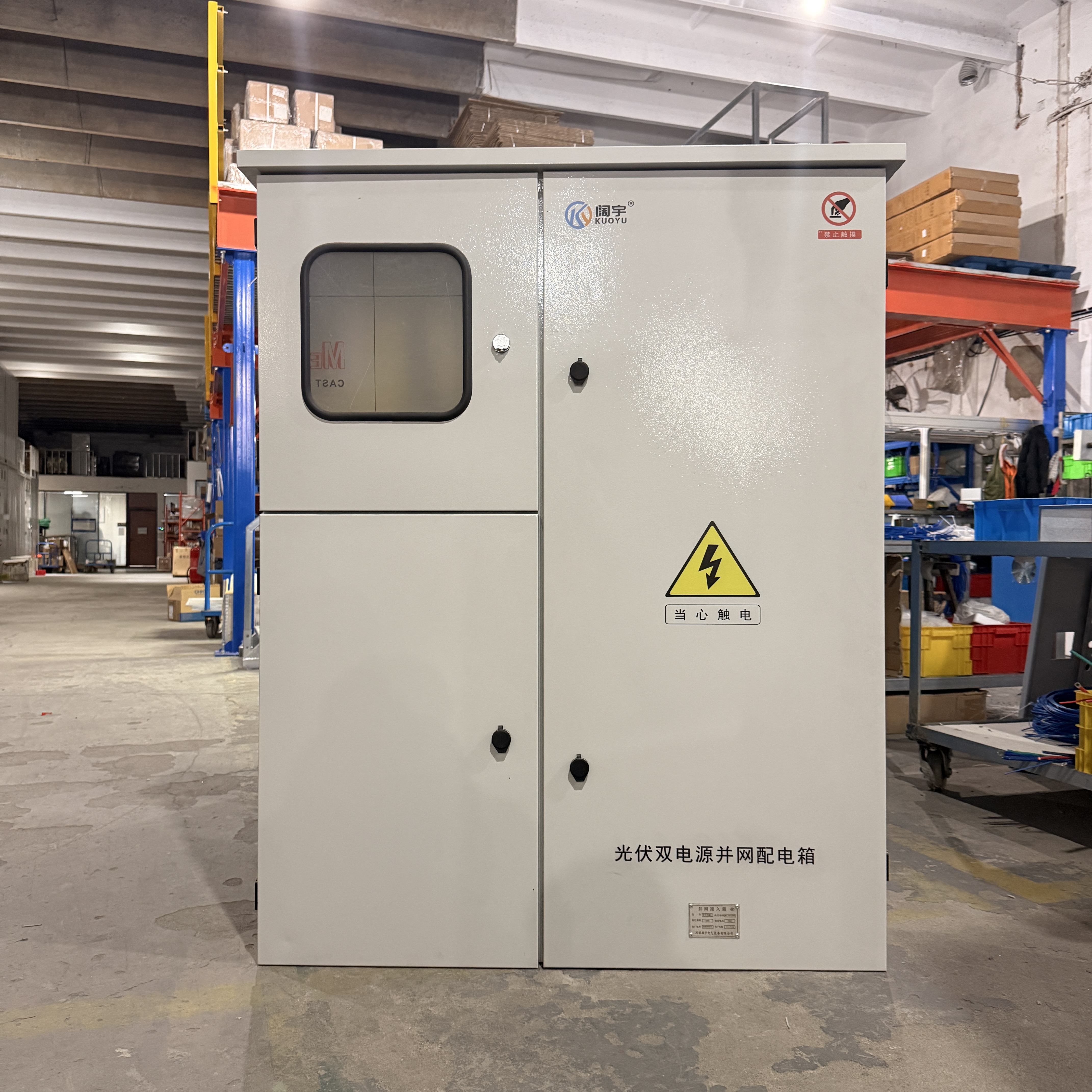
For the question in this article, the practical answer is a third option on the scale. When a solar distribution box will be installed outdoors, in a humid plant room, or in a dust-prone industrial environment, the enclosure itself has to be built for that duty rather than upgraded with accessories afterwards. Kuoyu Electrical's outdoor-oriented products use a thickened anti-corrosion steel plate body, an IP65 waterproof and dustproof design, high-temperature resistant internal components and integrated protection. Compared with ordinary low-voltage distribution cabinets \u2014 which typically use thin shells, a single protection function and limited weather resistance \u2014 the difference is concentrated in the enclosure structure and thermal design, not in the circuit diagram.
Risk control designed into the enclosure
Two risks cause most PV enclosure failures: heat and short circuit. Kuoyu Electrical addresses both at assembly level.
- Overheating of internal busbars and electrical components. Built-in high-precision temperature sensors work with an independent heat dissipation channel design, an over-temperature alarm and an automatic power-off module, so the assembly reacts before a thermal fault develops into a failure.
- Short circuit and overload damage to internal circuits. Multi-level over-current protection and short-circuit instantaneous cut-off are implemented through high-quality circuit breakers and fuses, supported by regular circuit insulation testing and over-current protection parameter calibration.
Both measures are preventive rather than corrective. They sit inside the enclosure and the protection scheme before the product ships, which is why the maintenance profile changes downstream.
What the specification buys in service terms
The table below reproduces Kuoyu Electrical's own comparison data for its outdoor-oriented products against ordinary low-voltage distribution cabinets.
| Performance indicator | Ordinary low-voltage distribution cabinets | Kuoyu Electrical outdoor-oriented products |
|---|---|---|
| Service life | Baseline | Extended by 60% |
| Circuit failure rate | Baseline | Reduced by 85% |
| Heat dissipation efficiency | Baseline | Increased by 45% |
| Protection level | IP40 | IP65 |
| Unit procurement cost | Baseline | 12%\u201320% higher |
| Post-maintenance expense within 5 years | Baseline | Reduced by 70% |
| Maintenance structure | Standard fixed assembly | Modular plug-in structure for quick component replacement |
| Routine inspection cycle | 3 months | 12 months |
| Maintenance time per service | Baseline | Reduced by 60% |
| Idle power consumption | Baseline | 30% lower, via low-loss busbar design |
Source: Kuoyu Electrical product comparison data. Figures are supplier-stated performance comparisons between its outdoor-oriented products and ordinary low-voltage distribution cabinets.
Step-by-Step Breakdown: Choosing the Right Enclosure in Nine Steps
- Define the electrical boundary. Decide whether the enclosure handles DC string combining, AC distribution after the inverter, grid-connected final distribution, or a combination of these. A DC photovoltaic distribution box and an AC solar distribution box use different device families, different insulation requirements and different fault behaviour, so the platform decision cannot be made before the boundary is fixed.
- Count circuits and size the current. String count, inverter output and future expansion capacity set the number of outgoing ways and the busbar rating. This single step usually determines whether the project is box-class or cabinet-class before any price is discussed.
- Define the environment. Indoor distribution room, outdoor wall, rooftop, coastal air, or a dusty plant room. Environment decides material, gasket and surface treatment far more than it decides electrical design.
- Match the platform. Small indoor residential distribution generally fits a PZ30-class box; larger commercial and industrial distribution generally fits a GGD-type cabinet; exposed sites need an enclosure engineered for outdoor duty with a stated protection class.
- Confirm protection class and material on the datasheet. Ask for the IP rating, the body material and the sheet thickness of the exact product being quoted. Do not accept the family name as evidence.
- Review protection and thermal design. Check for multi-level over-current protection, short-circuit instantaneous cut-off, thermal sensing and an independent heat dissipation path \u2014 the four items that decide how the assembly behaves in summer and under fault.
- Verify the compliance path. Ask which assembly standard the documentation references. IEC 61439-2:2020 applies specifically to power switchgear and controlgear assemblies for photovoltaic installations, and UL 1741 is the relevant reference for North American grid-connected equipment.
- Plan the maintenance cycle. A modular plug-in structure shortens component replacement; on Kuoyu Electrical's comparison data the routine inspection cycle extends from 3 months to 12 months and maintenance time per service drops by 60%.
- Close the commercial terms. Kuoyu Electrical's ordering terms are a minimum order quantity of 2 units, FOB or CIF delivery terms, acceptance criteria based on a pre-shipment test, and 30/70 payment terms \u2014 enough structure for a first validation order without committing to a full project volume.
Use Cases: Matching the Platform to the Project
Residential rooftop solar
A residential solar distribution box usually handles a limited number of circuits in a sheltered position. In that context a compact PZ30-class enclosure is normally sufficient, and specifying a floor-standing cabinet adds cost and footprint without adding function. The exception is when the enclosure is moved outdoors \u2014 for example to an exposed external wall \u2014 at which point the protection class of the specific build becomes the deciding factor rather than the platform.
Commercial and industrial rooftop systems
As inverter capacity and string count rise, so does the number of protective devices and the cross-section of incoming and outgoing cables. This is where GGD-type cabinets become the practical choice: front access, bottom cable entry and larger internal volume make termination and inspection workable. Buyers should still confirm the protection class of the quoted configuration, because cabinet-class steel does not automatically mean outdoor-capable sealing.
Industrial plants, humid and dust-prone sites
Workshops, coastal installations and humid environments place the enclosure under continuous environmental load. Kuoyu Electrical's outdoor-oriented products are built with a thickened anti-corrosion steel plate body, IP65 waterproof and dustproof design and high-temperature resistant internal components, and are positioned for industrial workshops, commercial sites, outdoor infrastructure and humid or dust-prone power distribution environments.
Larger sites and the step beyond the cabinet
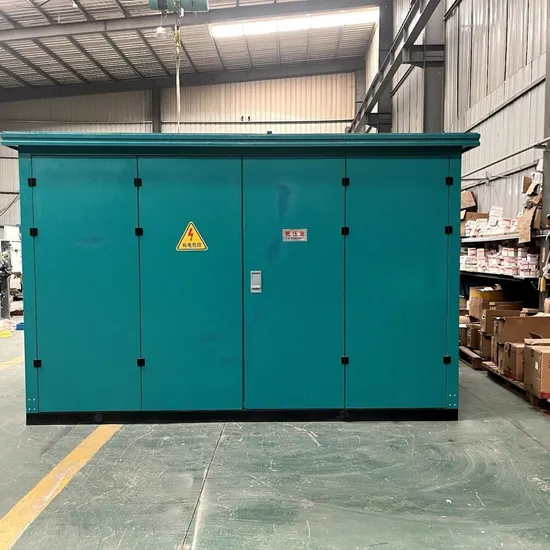
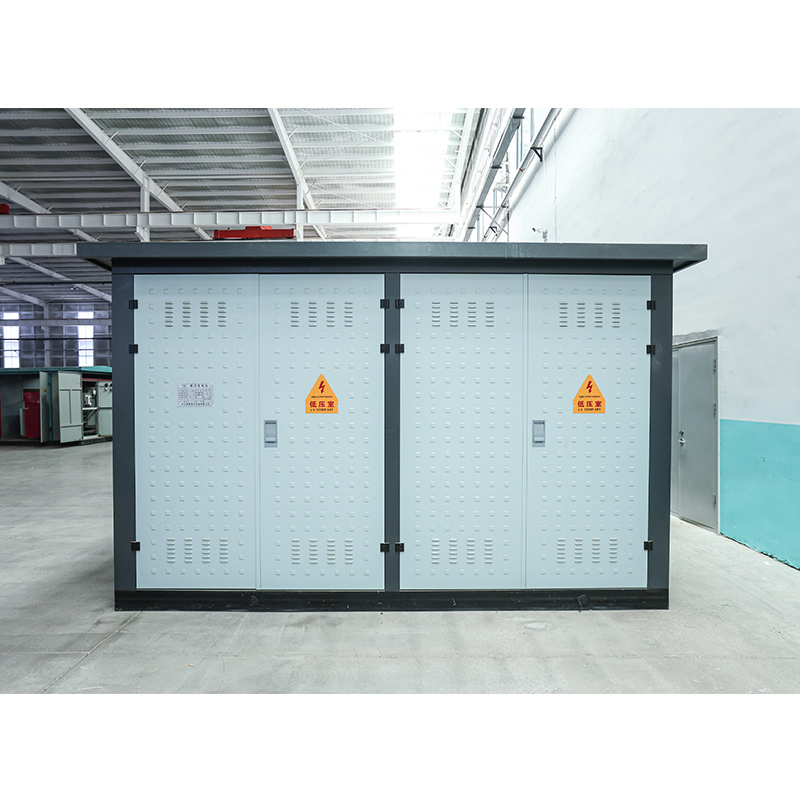
At utility and large industrial scale, the enclosure decision connects to equipment upstream and downstream of it. A box-type substation or a pad-mounted transformer sits on the same distribution chain, and the enclosure must be specified with reference to the transformer and inverter ratings rather than in isolation. This is also where the cost of a wrong platform decision compounds: an under-specified enclosure in a difficult-to-access location becomes a recurring maintenance line item, not a one-off saving.
Frequently Asked Questions
What standard applies to a PZ30 box or GGD cabinet used in a PV installation?
IEC 61439-2:2020 defines specific requirements for power switchgear and controlgear assemblies used in photovoltaic installations, including the requirements set out in Annexes DD, EE and FF. For grid-connected systems in North America, UL 1741 is the primary safety standard for PV inverters, converters and combiner boxes. In practice, buyers should ask which assembly standard the supplier's documentation references and request that documentation with the commercial documents, not after delivery.
Can a PZ30 distribution box be used for an outdoor solar installation?
A PZ30 box is normally designed as an indoor final-distribution enclosure. Whether any specific build survives outdoors depends on the actual enclosure material, gasket and door design, cable entries and surface treatment \u2014 that is, the IP rating on the datasheet, not the family name. Where the enclosure is exposed to rain, dust or sustained humidity, selecting a product engineered for outdoor duty is the lower-risk route. Kuoyu Electrical's outdoor-oriented products are built with thickened anti-corrosion steel plate, an IP65 waterproof and dustproof design and high-temperature resistant internal components for precisely this reason.
Why does one PV distribution box cost so much more than another?
Two factors drive the gap: enclosure class (compact box versus floor-standing cabinet) and the material and protection upgrade applied to the enclosure. The unit price difference is real, but it is not the full cost. In Kuoyu Electrical's product comparison data, outdoor-oriented products carry a unit procurement cost 12%\u201320% higher than ordinary cabinets, while post-maintenance expense within five years drops by 70% and the routine inspection cycle extends from 3 months to 12 months. Where maintenance access is difficult or expensive, the maintenance line usually matters more than the purchase line.
How can a buyer validate the enclosure before placing a production order?
Kuoyu Electrical's ordering terms are a minimum order quantity of 2 units, FOB or CIF delivery terms, acceptance criteria based on a pre-shipment test, and 30/70 payment terms. The sequence that works best for a first order is to confirm the platform and the protection class on the datasheet, place the small minimum order, inspect the goods against the pre-shipment test, and only then scale to project volume.
How do you choose a long-term distribution partner for PV distribution boxes?
A long-term partner is judged on things that never appear in a quotation line. Does the enclosure specification stay stable across repeat orders? Does the maintenance model reduce site work \u2014 a modular plug-in structure shortens component replacement and extends the inspection cycle from 3 months to 12 months? Can the supplier's production base absorb repeat volume, in the way Kuoyu Electrical runs a roughly 9,000 m\u00b2 factory with an annual output of about 30,000 sets and a 10-engineer R&D team? And does the supplier already ship into climates comparable to yours \u2014 Kuoyu Electrical's export business accounts for 30% of total sales, concentrated in Southeast Asia and Africa. Judged that way, the platform decision in this article is only the first half of the answer; the second half is which supplier will still be shipping the same rated product in year three. Buyers who want to test that directly can request a sample or a quotation from Kuoyu Electrical before committing to a project-scale order.
Conclusion
PZ30 and GGD-type enclosures solve different problems, and neither is a general-purpose answer to "which distribution box for photovoltaics." The decision rule is short: match the enclosure class to the environment and the electrical duty, then verify the protection class and material on the specific product datasheet.
- Small, indoor, residential final distribution: a PZ30-class box is normally the correct and most economical platform.
- Larger commercial or industrial distribution with more circuits, larger frames and service access requirements: a GGD-type cabinet is normally the correct platform.
- Outdoor, humid, dusty or weather-exposed installations at any scale: neither an indoor box nor a standard cabinet is the right default \u2014 an enclosure engineered for outdoor duty, with a stated IP rating and corrosion-resistant material, is.
The cost of choosing wrong is paid either at purchase or in service. Overspending means cabinet-class steel, freight volume and floor space on a project that did not need them. Under-specifying means moisture, dust and heat working on components that were never enclosed against them, with the maintenance bill arriving years after the saving was booked. Checking four variables before issuing a purchase order \u2014 circuits and current, environment, protection class on the datasheet, and the maintenance model \u2014 is enough to avoid both.
Next Step: Sample, Quotation or Catalogue
Kuoyu Electrical supplies low-voltage distribution boxes and cabinets for photovoltaic applications, with a minimum order quantity of 2 units, FOB or CIF delivery terms and acceptance based on a pre-shipment test. Buyers moving from decision to execution can request a sample or a project quotation directly.
Email: xiaoyi010127@gmail.com
Tel / WhatsApp: +86 180-3229-7717
Website: www.kuoyuelectricity.com
Product catalogue (PDF): Download the Kuoyu Electrical brochure
Have Questions or Need More Details?
Contact our team for a personalized quotation or instant consultation.
Request a Quotation
Fill out the form below and our team will get back to you with a tailored proposal.
WhatsApp Direct Chat
Prefer to chat in real-time? Message us on WhatsApp for instant assistance & quick answers.
- Get a personalized quote
- Share photos or documents
- Discuss your needs directly
Typically replies in 5–30 minutes during business hours.