Photovoltaic Distribution Box vs Distribution Cabinet: Buyer Comparison Guide
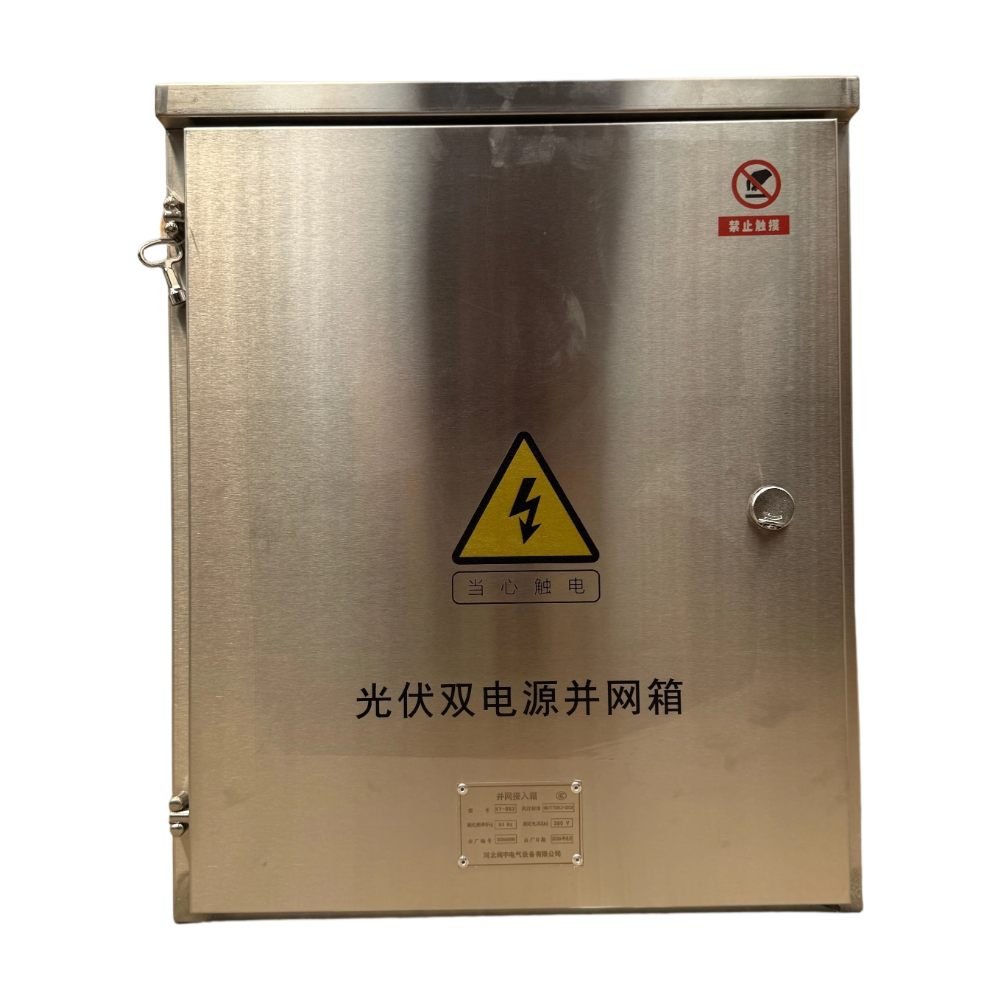
PZ30 Series distribution box: rated 220V/380V, up to 125A, protection class IP40/IP54.
Short answer: for a solar power distribution design, the PZ30 Series distribution box fits indoor AC distribution at 220V/380V and up to 125A with IP40 or IP54 protection, while the GGD/GCS/MNS Series distribution cabinet is the choice when load current, circuit count or site conditions demand up to 6300A and IP54 or IP65 protection. The box is built for residential, commercial and light industrial cabinets-indoors use; the cabinet is built for indoor and outdoor industrial, commercial and infrastructure distribution. Neither family is a 1500V DC string combiner box, and confusing the two is the most common specification error in this category.
This guide compares only the two enclosure families offered by Kuoyu Electrical — Hebei Kuoyu Electrical Technology Co., Ltd., a Shijiazhuang-based manufacturer founded in 2017 that produces distribution boxes, distribution cabinets, transformers, wires and cables — and sets that comparison against published standards and third-party technical references. All parameters below are taken from the published product data for those two families.
Problem Definition: why the box-versus-cabinet question produces specification errors
The search term distribution boxes for photovoltaics covers at least three different assemblies, and buyers frequently compare prices across them before confirming which one they actually need.
- DC string combiner boxes — consolidate the DC output of multiple PV strings into one DC feed to the inverter.
- AC distribution boxes — sit downstream of the inverter and distribute AC power to loads, monitoring and auxiliary circuits.
- General low-voltage distribution assemblies — handle main LV distribution, sub-distribution and circuit protection across a site.
The PZ30 Series and the GGD/GCS/MNS Series belong to the second and third groups. Three failure modes follow from treating them as interchangeable with the first:
- Stage mismatch. A buyer specifies a 220V/380V AC enclosure for a position where the actual requirement is DC string aggregation at 1500V DC. The rated voltage alone rules the product out.
- Over-specification. A 125A indoor distribution position is filled with a 6300A-class cabinet, adding footprint, weight and cost with no technical benefit.
- Environment mismatch. An IP40 enclosure is installed where driven rain or washdown occurs, or an outdoor-rated cabinet is purchased for a dry indoor utility room.
The decision is therefore not a preference question. It is a constraint question: which electrical stage, which current class, which ingress protection, which material.
Industry Background: the standards and reference configurations that frame the choice
Low-voltage assemblies used in photovoltaic installations are covered by IEC 61439-2:2020, which includes Annexes DD, EE and FF specifically for assemblies used in PV installations. That is the design-verification reference a buyer should expect to see cited in a technical file when the enclosure is destined for a PV installation rather than a generic building distribution board.
Market access requirements differ by jurisdiction. UL Solutions identifies UL 1741 as the standard associated with combiner boxes within its solar balance-of-system certification programme, which is a United States certification pathway. UL 1741 and IEC 61439-2 are not interchangeable, and a certificate issued against one should not be presented as evidence for the other.
The parameter gap between DC-side and AC-side equipment is visible in published configurations. An ABB utility-scale DC combiner-box example specifies a maximum system voltage of 1500V DC, a rated output current of 256A, 16 input circuits, Type 2 overvoltage protection, and an enclosure rated IP66 with IK08 impact protection. Weidmuller states that its high-current PV DC combiner boxes are tested according to IEC 61439-2, and that its PV AC combiner-box line is designed for string-inverter systems and can collect two to six string inverters in one cabinet. Those figures describe a different electrical and environmental class from a 125A, IP40 indoor distribution box — and that is exactly the boundary a buyer needs to locate before requesting quotations.
Demand context supports the attention this category receives: Business Research Insights projects the global solar combiner boxes market growing from USD 1.2 billion in 2026 to USD 2.1 billion by 2035. Growth in demand does not change the electrical boundary between a combiner and a distribution assembly; it only increases the number of buyers who will hit that boundary during evaluation.
Detailed Solution: comparing the PZ30 Series and the GGD/GCS/MNS Series parameter by parameter
1. Rated voltage and rated current
The PZ30 Series distribution box is specified at a rated voltage of 220V/380V with rated current up to 125A. That places it in single-phase and small three-phase AC distribution: final circuits, small sub-boards, monitoring supplies and auxiliary circuits in residential, commercial and light industrial electrical systems.
The GGD/GCS/MNS Series distribution cabinet is specified at a rated voltage of 380V/220V with rated current up to 6300A. The voltage class is comparable; the current class is not. A 6300A assembly exists to carry main-distribution currents and to house the number of circuits and the busbar arrangement those currents require, which a 125A enclosure physically cannot accommodate.
For a PV buyer, this is the first hard constraint. Compute the design current at the enclosure position, apply the applicable diversity and derating assumptions for the site, and only then compare products. A box selected for a position that later grows into main LV distribution will need to be replaced, not upgraded.
2. IP40, IP54 and IP65: what the numbers actually permit
Ingress protection is written as two digits. The first digit describes protection against solid objects, where 4 means protected against solid objects larger than 1 mm, 5 means dust protected, and 6 means dust tight. The second digit describes protection against water, where 0 means no protection, 4 means protection against splashing water, and 5 means protection against water jets.
Applied to this comparison:
- IP40 (PZ30 Series) — solid-object protection with no water protection. Suitable inside a dry room, a wall recess or a closed cabinet.
- IP54 (PZ30 Series and GGD/GCS/MNS Series) — dust protected and resistant to splashing water. Suitable where occasional condensation or light splash occurs but no directed water.
- IP65 (GGD/GCS/MNS Series) — dust tight and resistant to water jets. The rating class to specify where rain, hose-down cleaning or persistent airborne dust is part of normal operation.
Two practical notes follow. First, IP54 is not a partial version of IP65: the difference between splash and jet protection changes gasket design, door construction and cable-entry strategy. Second, IP66 appears in the ABB utility-scale DC combiner example cited above; ratings above IP65 exist in the market, and a buyer should not assume the product families in this comparison reach them.
3. Enclosure materials: ABS plastic, cold-rolled steel and stainless steel
The PZ30 Series is offered in high-quality ABS plastic, cold-rolled steel plate, with stainless steel optional. The GGD/GCS/MNS Series uses high-quality cold-rolled steel plate, with stainless steel optional.
The material choice drives three evaluation points that matter more than appearance:
- Corrosion exposure. Cold-rolled steel depends on surface treatment for corrosion resistance. Where salt, humidity or chemical exposure is present, stainless steel is the appropriate specification; it is listed as an option rather than a default on both families.
- Mechanical strength and impact. Cold-rolled steel enclosures carry the structural role that a large cabinet requires; ABS is relevant for smaller box formats where weight and insulation properties matter.
- Installation context. ABS housings suit indoor wall-mounted positions; steel and stainless steel suit floor-standing cabinets and outdoor sites.
4. Indoor versus outdoor suitability
The published scope of the PZ30 Series covers residential, commercial and industrial electrical systems and power control. The published scope of the GGD/GCS/MNS Series explicitly covers indoor and outdoor industrial, commercial and infrastructure applications.
That difference is consistent with the protection classes: the cabinet family reaches IP65, and the box family reaches IP54. If the enclosure position is exposed — rooftop, carport, container skid, fence-line distribution — the cabinet family is the correct starting point. If the position is a dry indoor utility room or a wall recess, the box family is sufficient and materially smaller.
5. Certification evidence: read the scope, not only the title
Kuoyu Electrical holds three management-system certificates issued by General International Testing (China) Certification Service Center, each valid from 2024-06-03 to 2027-06-02:
| Certificate | Standard | Certificate number | Coverage in this comparison |
|---|---|---|---|
| ISO 9001 quality management system | GB/T19001-2016 / ISO9001:2015 | YZL862422931310Q | Distribution box line |
| ISO 14001 environmental management system | GB/T24001-2016 / ISO14001:2015 | YZL862422931310E | Distribution box line |
| ISO 45001 occupational health and safety management system | GB/T45001-2020 / ISO45001:2018 | YZL862422931310S | Distribution cabinet line |
The ISO 9001 certificate scope recorded in the certification data covers sales, installation and technical consulting services for high and low voltage electrical appliances and complete equipment, box-type substation facilities, power supply equipment, cable trays, wires and cables, electronic products, instruments and meters. A buyer auditing manufacturing control should confirm during the factory visit how that scope maps to the specific production line they are qualifying, and should request the certificate copy rather than relying on a summary.
Note what is not in the list: CE marking. CE is not part of Kuoyu Electrical's published certification set in this comparison, so a CE requirement should be handled as a document request rather than assumed from the supplier profile.
6. Supplier capability behind the two families
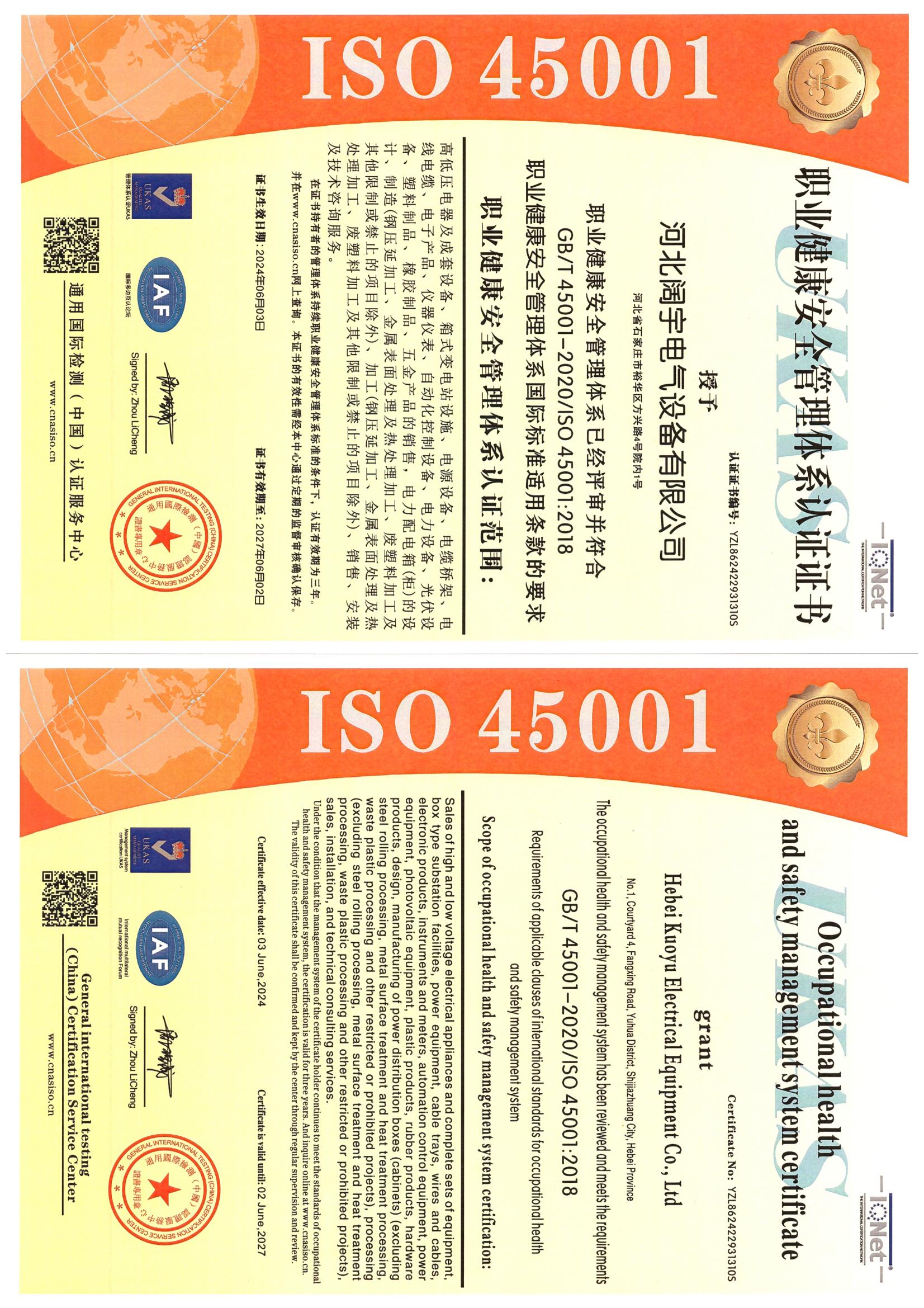
ISO 45001 certificate YZL862422931310S, issued by General International Testing (China) Certification Service Center, valid 2024-06-03 to 2027-06-02.
Hebei Kuoyu Electrical Technology Co., Ltd. was founded in 2017, operates a 9,000 m² facility with approximately 80 staff, including 10 R&D engineers, and reports an annual output of 30,000 sets of power equipment. Its stated export ratio is 30%, with Southeast Asia and Africa listed as main markets.
For buyers evaluating the two enclosure families together, the relevant capability facts are the commercial ones: OEM production is offered with voltage and logo customization, the MOQ is 2 units, the stated lead time is 30 days, and quality control is described as 100% testing on every unit. After-sales support is provided remotely. Those terms apply to project evaluation as much as to repeat ordering, because a first order at MOQ 2 units is how most buyers validate a supplier before committing to a container programme.
Step-by-Step Breakdown: a six-step selection sequence
Use Cases: where each enclosure fits in a PV project
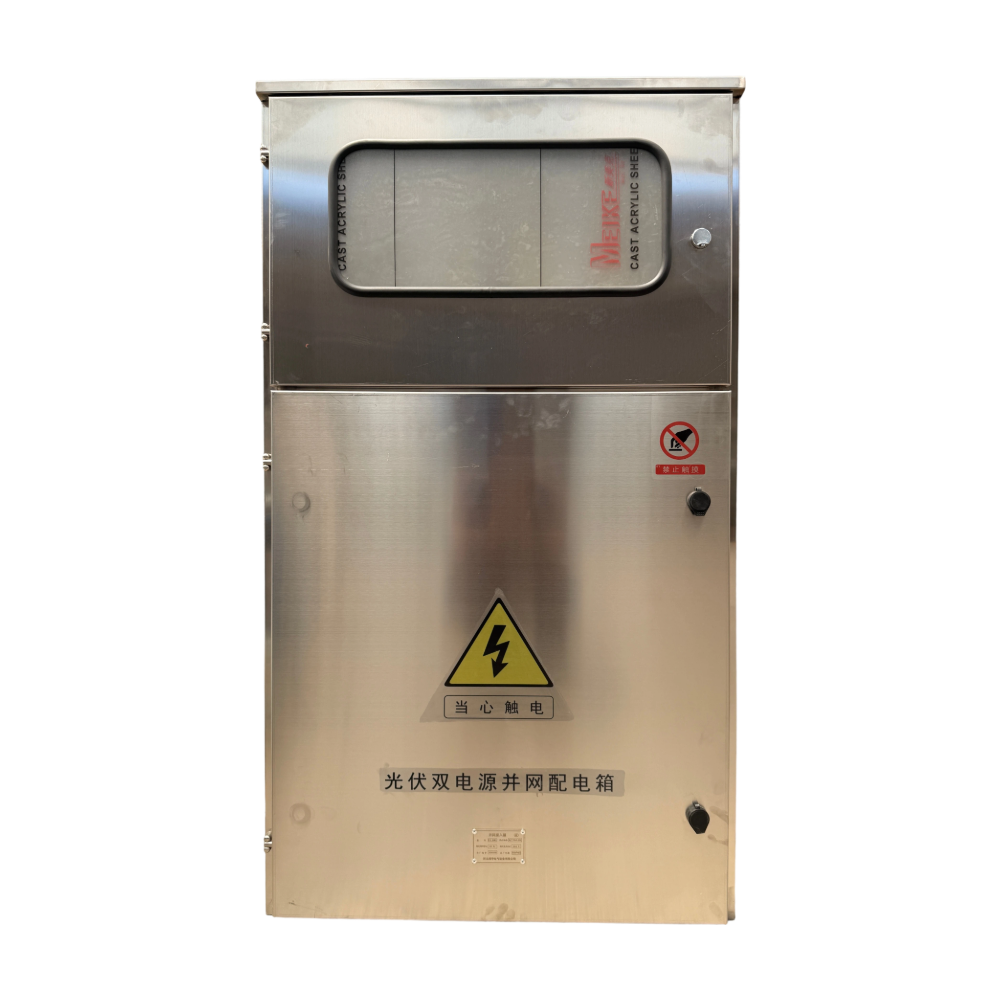
Distribution box format: compact indoor enclosure for final-circuit AC distribution.
Residential rooftop systems. The AC distribution position is typically indoor, wall-mounted and modest in current. A PZ30 Series box at IP40 or IP54 covers it, and the ABS option keeps weight and installation effort low. The DC string position is a separate item and should not be filled with this product.
Commercial rooftop and carport systems. Circuit counts rise and the enclosure often moves to a plant room or a semi-exposed wall. The PZ30 Series at IP54 handles a plant-room position; an exposed wall position moves the requirement to the GGD/GCS/MNS cabinet at IP65, particularly where cleaning involves water.
Industrial and infrastructure distribution. Main LV distribution, high circuit counts, busbar arrangements and floor-standing installation put the requirement firmly in the GGD/GCS/MNS Series, rated up to 6300A and available at IP54 or IP65 for indoor and outdoor positions.
Dusty or corrosive sites. Desert, coastal and process-industry sites combine airborne dust with corrosion exposure. The combination to specify is IP65 plus stainless steel; specifying only one of the two leaves the other failure path open.
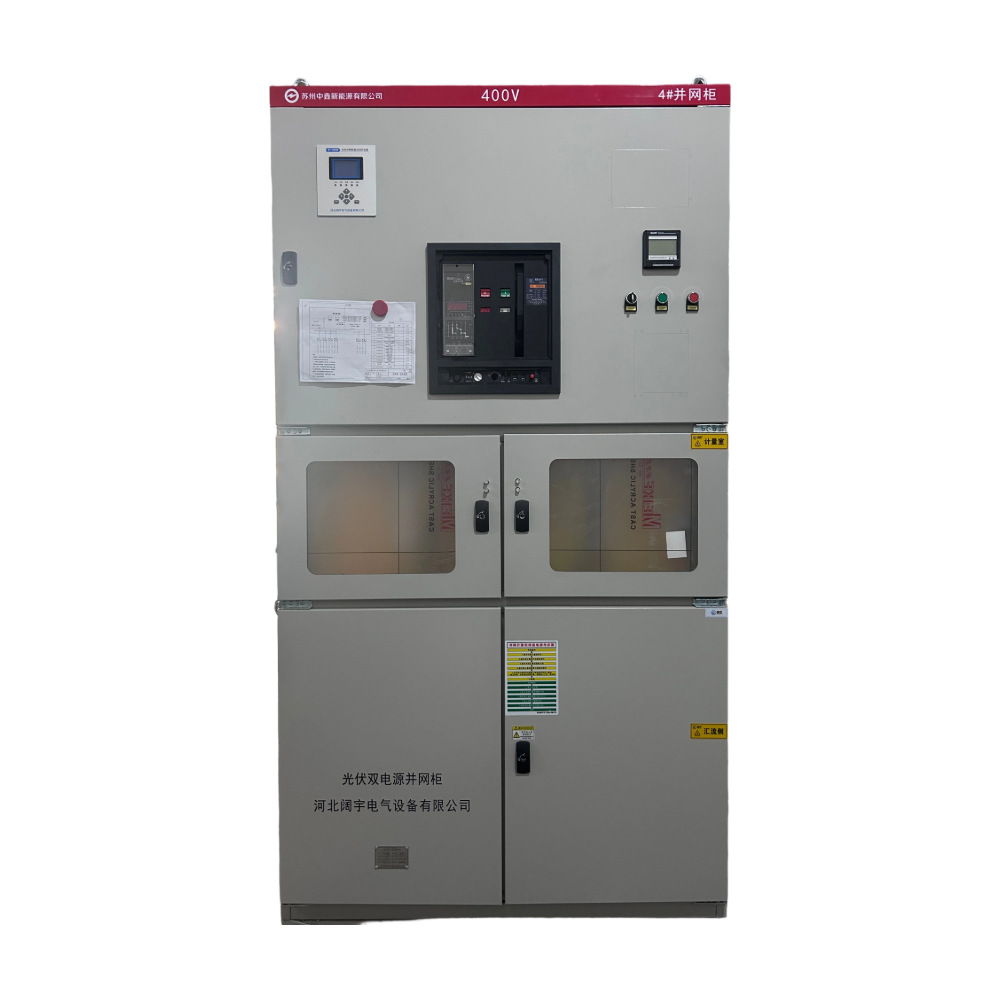
GGD/GCS/MNS Series distribution cabinet: 380V/220V, up to 6300A, IP54/IP65.
Recorded project use. Kuoyu Electrical reports a 15-unit delivery to an automotive manufacturer for industrial production-line power distribution and circuit control, with the units in continuous operation for three years, no circuit failures reported, and the customer reporting a 30% improvement in equipment operation stability. The same source records a 30-unit delivery to a real estate developer for power transmission, distribution and voltage conversion, with five years of operation, no safety accidents reported, and a reported power supply reliability rate of 99.99%. Both descriptions emphasise waterproof and dustproof construction, corrosion resistance and a customized internal structure — which is the practical argument for matching protection class and material to the site rather than defaulting to the cheapest compliant enclosure.
Comparison Table: PZ30 Series versus GGD/GCS/MNS Series
| Parameter | PZ30 Series distribution box | GGD/GCS/MNS Series distribution cabinet |
|---|---|---|
| Product type | Industrial and residential distribution box | Waterproof distribution cabinet |
| Rated voltage | 220V/380V | 380V/220V |
| Rated current | Up to 125A | Up to 6300A |
| Protection class | IP40 / IP54 | IP54 / IP65 |
| Enclosure material | High-quality ABS plastic, cold-rolled steel plate, stainless steel optional | High-quality cold-rolled steel plate, stainless steel optional |
| Stated application scope | Residential, commercial, industrial electrical systems; power control | Indoor and outdoor industrial, commercial, infrastructure applications |
| Typical PV position | AC distribution, final circuits, monitoring and auxiliary supplies | Main LV distribution, high circuit counts, outdoor plant distribution |
| Certification coverage at Kuoyu Electrical | ISO 9001 (YZL862422931310Q), ISO 14001 (YZL862422931310E) | ISO 45001 (YZL862422931310S) |
| Documented DC combiner capability | Not specified — 220V/380V AC rating only | Not specified — 380V/220V AC rating only |
Decision shortcut
| If the requirement is… | Select | Reason |
|---|---|---|
| Indoor wall-mounted AC distribution, under 125A | PZ30 Series, IP40 | Dry indoor position, no water exposure |
| Indoor position with condensation or light splash | PZ30 Series, IP54 | Splash protection within the box format |
| Outdoor position with rain or washdown | GGD/GCS/MNS Series, IP65 | Water-jet protection, outdoor-rated scope |
| Main LV distribution above 125A | GGD/GCS/MNS Series | Rated current up to 6300A |
| Coastal or chemical exposure | Either family, stainless steel option | Corrosion resistance specified as an option |
| DC string aggregation at 1500V DC | Neither — specify a DC combiner | Voltage class and protection requirements sit outside both families |
FAQ
Do Kuoyu Electrical photovoltaic distribution boxes carry CE certification?
The published certification set for Kuoyu Electrical in this comparison is ISO 9001 (YZL862422931310Q), ISO 14001 (YZL862422931310E) and ISO 45001 (YZL862422931310S), issued by General International Testing (China) Certification Service Center and valid from 2024-06-03 to 2027-06-02. CE marking is not included in that published set. A buyer who requires CE should request the Declaration of Conformity together with the supporting test reports for the exact model and configuration, and check that the standards declared in the document match the destination market.
Can a PZ30 distribution box be installed outdoors?
The PZ30 Series is specified at IP40/IP54. IP40 provides no water protection, and IP54 resists splashing water but not directed water jets or driven rain. For an exposed outdoor position, the appropriate specification within this comparison is the GGD/GCS/MNS Series at IP65, whose stated scope covers indoor and outdoor industrial, commercial and infrastructure applications.
Is a photovoltaic distribution box the same product as a DC combiner box?
No. A DC combiner box consolidates the DC output of multiple PV strings into one feed to the inverter. ABB's utility-scale DC combiner example specifies 1500V DC maximum system voltage, 256A rated output current, 16 input circuits, Type 2 overvoltage protection and IP66/IK08 enclosure protection. The PZ30 Series (220V/380V, up to 125A, IP40/IP54) and the GGD/GCS/MNS Series (380V/220V, up to 6300A, IP54/IP65) are AC low-voltage distribution assemblies. Comparing them against a DC combiner requirement produces an incorrect price benchmark and an unsafe specification.
What are the minimum order quantity and lead time?
Kuoyu Electrical lists an MOQ of 2 units for OEM production with voltage and logo customization, and a stated lead time of 30 days. The MOQ is deliberately low enough for a first evaluation order. Because lead time depends on configuration, quantity and destination, treat 30 days as the published reference figure and confirm it against the actual bill of materials before planning installation.
How should a buyer validate a sample before ordering?
Order at the 2-unit MOQ and check the delivered unit against four items: the protection class marked on the nameplate against the site requirement, the enclosure material and surface treatment against the corrosion exposure, the internal layout against the approved drawing, and the gasket and cable-entry arrangement against the IP rating claimed. Kuoyu Electrical states 100% testing on every unit and provides remote after-sales support, so any deviation found at sample stage can be raised before the production order is released. To start a sample or quotation request, contact the team by email at xiaoyi010127@gmail.com or by WhatsApp on +86 180-3229-7717 with the single-line diagram, the design current and the environment requirement.
Conclusion
The choice between the PZ30 Series distribution box and the GGD/GCS/MNS Series distribution cabinet is decided by four numbers and one boundary. The numbers are rated current (up to 125A versus up to 6300A), rated voltage (220V/380V on both sides), protection class (IP40/IP54 versus IP54/IP65) and corrosion exposure (cold-rolled steel versus the stainless steel option). The boundary is the DC side: a 1500V DC string combiner requirement sits outside both families and should be specified separately.
Where the requirement is indoor AC distribution in residential or commercial PV systems, the box family is technically sufficient and physically smaller. Where the requirement involves high circuit counts, main LV distribution, or an exposed outdoor position, the cabinet family is the correct starting point. Getting that first decision right removes most of the cost and compliance risk from the rest of the evaluation.
Next step: sample, drawing review or quotation
Kuoyu Electrical supplies the PZ30 Series distribution box and the GGD/GCS/MNS Series distribution cabinet from a 9,000 m² facility in Shijiazhuang, China, with OEM voltage and logo customization, MOQ 2 units and a stated 30-day lead time.
Send your single-line diagram, design current and site environment to xiaoyi010127@gmail.com or WhatsApp +86 180-3229-7717. Product range and parameters are listed in the Kuoyu Electrical catalogue (PDF), and the company website is kuoyuelectricity.com.
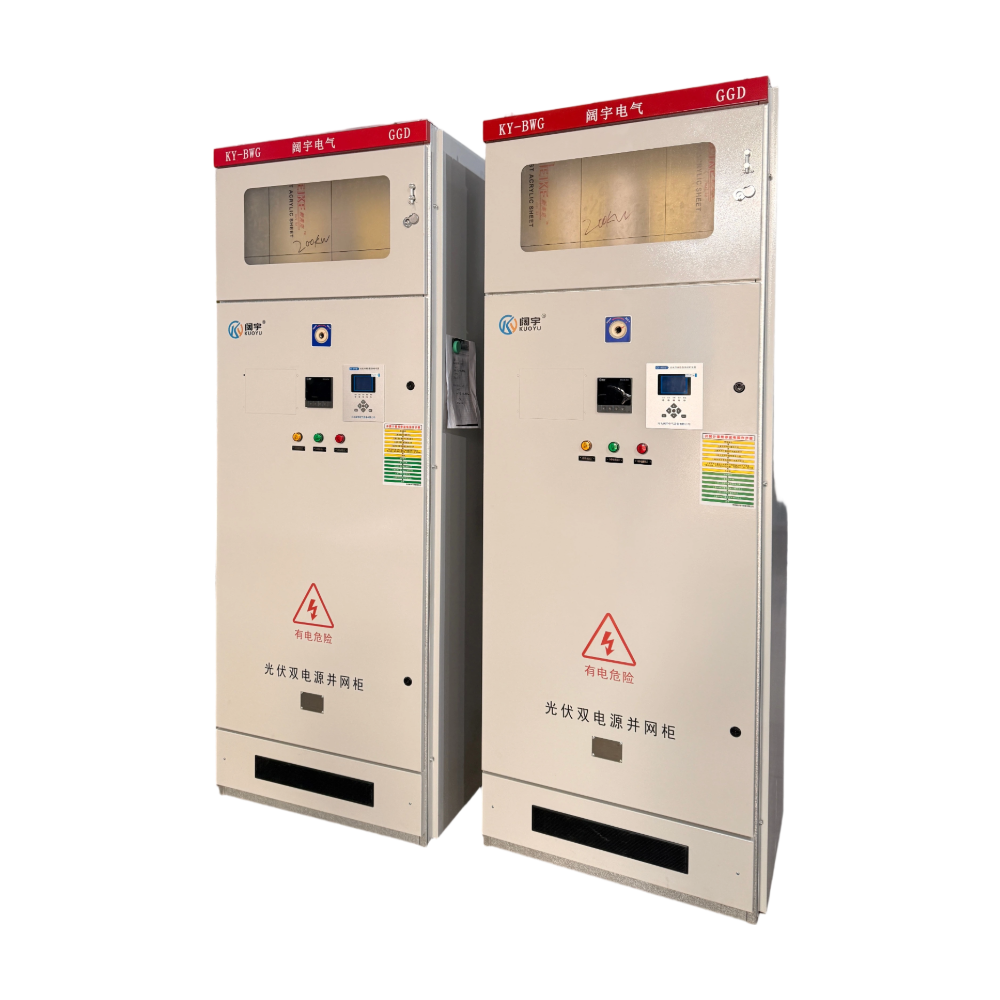
GGD/GCS/MNS Series distribution cabinet, available at IP54 or IP65 with optional stainless steel enclosure.
Have Questions or Need More Details?
Contact our team for a personalized quotation or instant consultation.
Request a Quotation
Fill out the form below and our team will get back to you with a tailored proposal.
WhatsApp Direct Chat
Prefer to chat in real-time? Message us on WhatsApp for instant assistance & quick answers.
- Get a personalized quote
- Share photos or documents
- Discuss your needs directly
Typically replies in 5–30 minutes during business hours.