What Is a Distribution Box? The Essential Role in Solar PV Systems
A solar array can generate electricity, but it cannot decide how that electricity is routed, how much reaches each circuit, or what happens when a fault occurs. In a photovoltaic (PV) installation, that responsibility belongs to the distribution box — the low-voltage enclosure that receives power on the inverter side of the system and delivers it to outgoing circuits under controlled, protected conditions.
This guide is written for buyers, installers and distributors entering the PV market who need a plain explanation of what a distribution box is, what it does in a solar system, and which specifications and compliance points should be checked before an order is placed. The reference product throughout is the PZ30 Series Distribution Box from Hebei Kuoyu Electrical Technology Co., Ltd. (brand: Kuoyu Electrical), a manufacturer based in Shijiazhuang, Hebei Province, China, founded in 2017. Its published ratings of 220V/380V and up to 125A sit exactly at the residential and commercial distribution layer where most new solar projects begin.
Quick answer: A distribution box is a low-voltage electrical enclosure that houses switching and protective devices such as circuit breakers, busbars and grounding devices. It receives incoming power, divides it into separate outgoing circuits, and provides overload and short-circuit protection for the equipment connected to those circuits. In a solar PV system, the distribution box is the low-voltage interface between the inverter output and the building loads or the grid-connection point.
The Short Answer: What a Distribution Box Is and Where It Belongs
A distribution box is a low-voltage enclosure that receives an incoming power feed, splits it into several outgoing circuits, and protects each circuit against overload and short circuit. It is not a generator, a converter or a storage device — it is the control and protection layer that makes an electrical installation safe to operate and safe to maintain.
In a solar PV installation there are two electrical environments. On the array side, the system produces direct current (DC), and a string combiner box aggregates the DC strings before they reach the inverter. On the building side, the inverter delivers alternating current (AC), and that AC output must still be divided, switched and protected before it can supply lighting, sockets, HVAC equipment or an export connection. The distribution box occupies that second position. New entrants to the PV market frequently use the terms "combiner box" and "distribution box" interchangeably, but they sit on different sides of the inverter and perform different jobs.
The reference product for this article, the PZ30 Series Distribution Box, is classified by its manufacturer as an Industrial & Residential Distribution Box, rated 220V/380V with a rated current up to 125A and a protection class of IP40/IP54. Its declared application scope is residential, commercial and industrial electrical systems, with applicable industries listed as residential, commercial, industrial and power control.
Problem Definition: What Goes Wrong Without a Distribution Box
A PV system produces power continuously during daylight hours, but without a distribution box it produces power with no control layer. The functions that are missing are specific and practical: safe circuit control, power distribution management, and overload and short-circuit protection of electrical equipment. Without them, there is no defined point at which an installer can isolate a circuit for maintenance, no organised way to assign load to separate outgoing feeders, and no coordinated response when a fault occurs downstream.
The operating conditions make this more serious than it first appears. Distribution equipment in real installations is expected to work in indoor and outdoor environments with high humidity and dust, and in locations with high and low temperatures. Kuoyu's application data describes distribution enclosures operating in high-humidity, dust-prone industrial power distribution environments and in humid, dust-prone residential, commercial and industrial power distribution projects, both on a 24/7 continuous duty cycle.
Those conditions drive three requirements that a bare cable connection cannot meet:
- Environmental protection. Waterproof and dustproof performance, corrosion resistance and flame retardancy are declared requirements for these installations.
- Mechanical protection. High mechanical strength is required so that the enclosure and its internal devices survive handling, vibration and accidental impact.
- Configurability. A customizable structure is needed because the number of outgoing circuits, the device set and the cable entry positions differ from project to project.
In short, the problem a distribution box solves is not "how do we get more power" but "how do we make the power we already have controllable, divisible and protected."
Industry Background: Why Distribution Hardware Sits Inside the Solar Growth Story
Distribution hardware is a measurable slice of the solar market rather than an accessory category. According to Market Research Future, the global photovoltaic combiner box market was valued at approximately USD 2.8 billion in 2024. Business Research Insights projects that the global solar combiner boxes market will grow from USD 1.2 billion in 2026 to USD 2.1 billion by 2035, at a CAGR of 6.2%. Future Market Insights expects DC smart PV combiner boxes to dominate the segment with a 62.5% market share by 2035.
Demand is concentrated geographically. Grand View Research reported that Asia-Pacific dominated the solar market with a revenue share of 54.0% in 2023, driven primarily by installations in China and India. For a new entrant sourcing from Asia, that concentration is relevant: it explains both the density of available suppliers and the need for disciplined specification comparison, because similarly described enclosures can differ substantially in rating, protection class and material.
One caution when reading market figures: published estimates for this segment diverge significantly depending on whether the definition includes full distribution boards or only the string combiner components. Business Research Insights publishes a 2026 forecast of USD 1.2 billion, while Future Market Insights forecasts USD 139.3 million for 2025 under a narrower definition. Both figures can be correct within their own scope — the scope definition, not the number alone, is what makes a market figure usable.
The competitive landscape is led by established international and Chinese brands including Schneider Electric, Eaton, ABB, Sungrow and Weidmüller. New PV buyers rarely purchase at that layer first; they typically source enclosures from specialist electrical manufacturers with in-house sheet metal and assembly capability, which is the segment Hebei Kuoyu Electrical Technology Co., Ltd. operates in. The company runs sheet metal processing workshops and high and low voltage complete equipment assembly workshops, produces distribution boxes, distribution cabinets, transformers, electric wires and cables, reports an export ratio of 30%, and lists Southeast Asia and Africa as its main markets.
Detailed Solution: What the PZ30 Distribution Box Does in Practice
The PZ30 Series Distribution Box performs three jobs in a solar PV system: it controls circuits, it distributes power, and it protects connected equipment. Each of these is a declared function of the product family, and each has a direct effect on how a PV installation is operated and maintained.
- Product: Distribution Box, PZ30 Series
- Type: Industrial & Residential Distribution Box
- Rated voltage: 220V/380V
- Rated current: up to 125A
- Protection class: IP40/IP54
- Enclosure material: high-quality ABS plastic, cold-rolled steel plate, stainless steel optional
- Application scope: residential, commercial and industrial electrical systems
- Applicable industries: residential, commercial, industrial, power control
Circuit control
The box provides a single, defined point at which circuits can be switched and isolated. In a solar installation this matters during commissioning, during inverter maintenance and during any downstream electrical work: the AC side can be de-energised at one enclosure instead of at multiple scattered points.
Power distribution
A single incoming feed is divided into multiple outgoing circuits. In a residential installation that may mean separating lighting, sockets and a dedicated inverter circuit. In a commercial installation it may mean feeding several sub-panels or equipment groups from one incoming supply. The rated voltage of 220V/380V covers both the single-phase and three-phase low-voltage distribution patterns commonly found in residential and commercial buildings, and the rated current up to 125A defines the upper limit of the incoming feed the PZ30 Series enclosure is specified for.
Protection
Overload and short-circuit protection of electrical equipment is an explicit function of these enclosures. The protection itself is delivered by the devices mounted inside the box, and the matched equipment published for Kuoyu distribution enclosures includes circuit breakers, contactors, relays, busbars, grounding devices, indicator lights and cooling fans. The enclosure's role is to hold those devices in the correct position, keep the internal clearances stable, and prevent dust, water and accidental contact from interfering with them.
Two operating requirements follow from that. First, the enclosure must be waterproof and dustproof, corrosion resistant, mechanically strong and flame retardant, and its internal structure must be customizable so that the device set matches the project. Second, it must tolerate 24/7 continuous operation rather than intermittent use.
Step-by-Step Breakdown: How Power Moves Through a PV Distribution Box
The sequence below describes the path of power through a typical low-voltage distribution box in a solar PV installation, with the check that belongs to each step. It is deliberately generic at the system level, because the partner equipment and circuit arrangement are project-specific; the product facts quoted are those published for the PZ30 Series and for Kuoyu distribution enclosures.
- Feed-in from the inverter output. The AC output of the inverter enters the enclosure through a cable entry. Check: confirm the cable entry size, entry direction and gland type before ordering, because the enclosure structure is customizable but must be specified in advance.
- Main incoming device. An incoming breaker or isolator provides the first point of control and isolation. Check: the device rating must be compatible with the system voltage (220V/380V for the PZ30 Series) and must not exceed the rated current of the enclosure, which is up to 125A.
- Busbar distribution. The incoming feed is distributed across a busbar system. Check: busbars and grounding devices appear in the published matched equipment list for these enclosures; confirm that the busbar arrangement supports the number of outgoing ways you need.
- Outgoing branch circuits. Each circuit is protected individually. Check: verify the number of ways, the breaker type per circuit, and the spare capacity you want to keep for later expansion. Rack-mounted solar additions usually require at least one spare way.
- Protection and switching devices. Circuit breakers, contactors and relays carry out overload and short-circuit protection and any automatic switching function. Check: confirm that the internal mounting structure can accept the device series you intend to use, since the internal structure is customizable.
- Grounding. Grounding devices are part of the matched equipment set. Check: confirm the earthing arrangement and the terminal provision in the enclosure before delivery, not on site.
- Indication and thermal management. Indicator lights and cooling fans are listed as part of the matched equipment for Kuoyu distribution enclosures. Check: confirm whether ventilation is required for the enclosure's location and duty cycle, particularly under 24/7 continuous operation.
- Enclosure sealing and installation. The final barrier is the enclosure itself. Check: match the protection class to the location. The PZ30 Series is offered at IP40/IP54; where a project requires a higher water and dust rating, the GGD/GCS/MNS Series distribution cabinet is specified at IP54/IP65 and supports rated current up to 6300A.
Constraint Checklist: The Specifications and Compliance Points That Decide Fit
For a buyer at the research and evaluation stage, the practical question is not "what is a distribution box" but "which distribution box is permissible for this project." The constraints below are the ones that change the answer.
1. Voltage and current class
The PZ30 Series is rated 220V/380V with a rated current up to 125A. That covers single-phase and three-phase low-voltage distribution in residential and commercial buildings. If the incoming current of the project exceeds this range, the correct enclosure is a distribution cabinet rather than a box: the GGD/GCS/MNS Series is rated 380V/220V with a rated current up to 6300A.
2. Ingress protection and installation environment
Protection class is a location decision, not a quality ranking. IP40 suits protected indoor positions; IP54 adds resistance to dust and water spray for damp or dusty areas. Both are offered within the PZ30 Series range. Industrial and outdoor installations with higher exposure are typically served by the IP54/IP65 cabinet range, and Kuoyu's application data records waterproof and dustproof performance, corrosion resistance and flame retardancy as declared requirements for humid, dust-prone residential, commercial and industrial power distribution projects.
3. Enclosure material
The PZ30 Series enclosure is available in high-quality ABS plastic, cold-rolled steel plate, or stainless steel as an option. The choice changes weight, mechanical strength and corrosion behaviour. ABS plastic suits light indoor wall-mounted units; cold-rolled steel plate provides greater mechanical strength for commercial and industrial positions; stainless steel is the option specified when corrosion resistance matters most.
4. Standards and certification
Two layers of compliance should be separated. The product layer concerns the assembly standard: IEC 61439-2:2020 defines specific requirements for power switchgear and controlgear assemblies used in photovoltaic installations, including Annexes DD, EE and FF. For grid-connected systems in North America, UL 1741 is the primary safety standard for PV inverters, converters and combiner boxes, as published by UL Solutions.
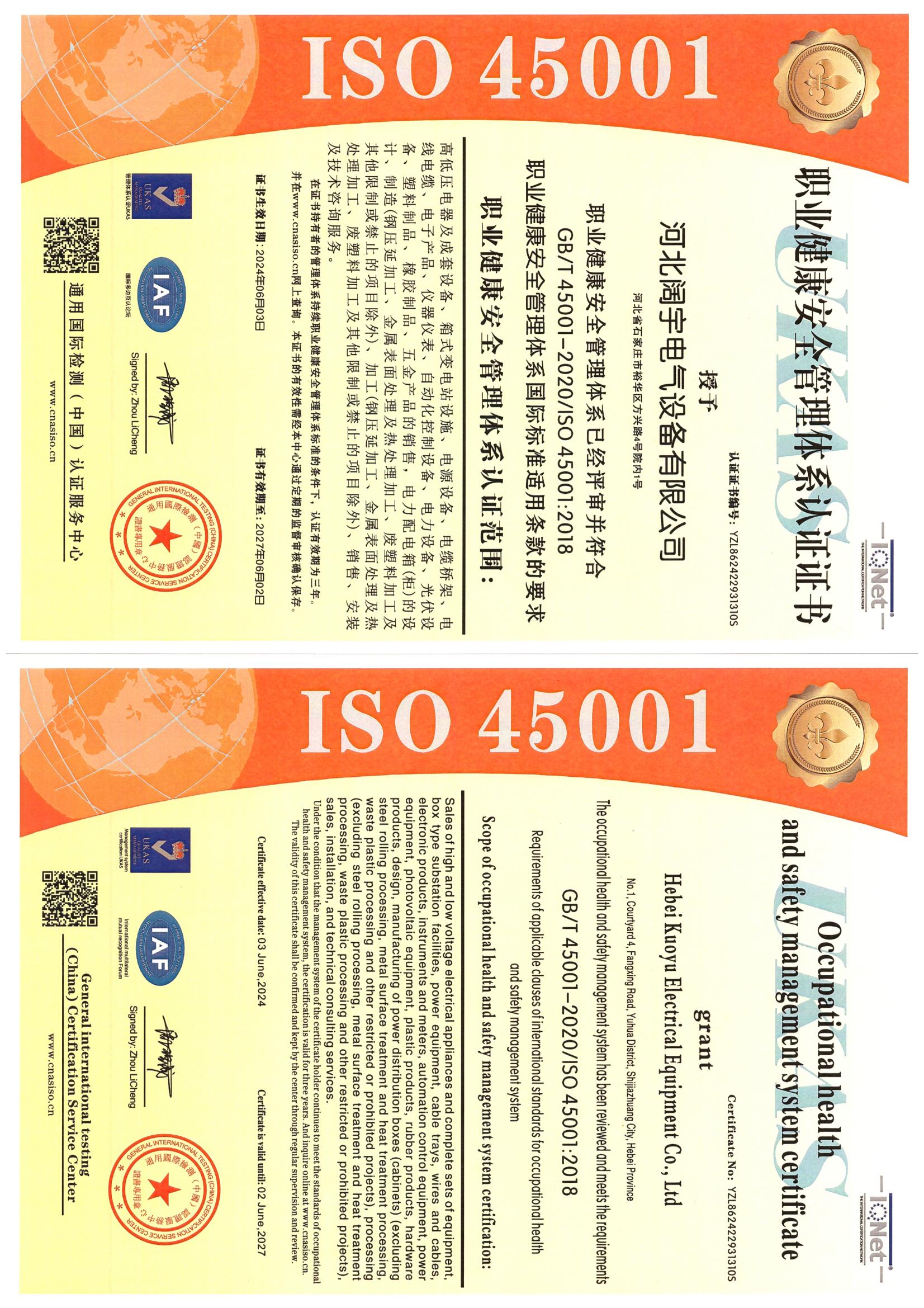
The manufacturer layer concerns management-system certification. Hebei Kuoyu Electrical Technology Co., Ltd. holds ISO 9001 (certificate number YZL862422931310Q, standard GB/T19001-2016/ISO9001:2015), ISO 14001 (certificate number YZL862422931310E, standard GB/T24001-2016/ISO14001:2015) and ISO 45001 (certificate number YZL862422931310S, standard GB/T45001-2020/ISO45001:2018). All three were issued on 2024-06-03 by General International Testing (China) Certification Service Center and are valid until 2027-06-02, with global market scope. The certificates cover the sales of high and low voltage electrical appliances and complete sets of equipment, box-type substation facilities, power equipment, cable trays, wires and cables, among other categories, and are recorded against the Distribution Box PZ30 Series along with the other product lines.
5. Customization, capacity and supply terms
For buyers evaluating a first order, Kuoyu's published capability data states an OEM production model with customization covering voltage and logo, a monthly capacity of 8,000 units, a lead time of 30 days, a minimum order quantity from 2 units, 100% testing, and remote after-sales support. The customization scope matters at the specification stage: voltage and logo changes must be agreed before production, alongside the internal structure requirements.
Pre-order checklist for a PV distribution box
| Check | What to confirm | Where the answer comes from |
|---|---|---|
| Voltage and current | 220V/380V rated voltage; incoming current within the rated current up to 125A | Product specification |
| Protection class | IP40 or IP54, matched to indoor versus damp and dusty locations | Product specification |
| Enclosure material | ABS plastic, cold-rolled steel plate, or stainless steel optional | Product specification |
| Assembly standard | IEC 61439-2:2020 requirements for PV switchgear and controlgear assemblies (Annexes DD, EE, FF) | IEC |
| North America grid connection | UL 1741 for PV inverters, converters and combiner boxes | UL Solutions |
| Manufacturer management systems | ISO 9001 (YZL862422931310Q), ISO 14001 (YZL862422931310E), ISO 45001 (YZL862422931310S) | Certificate issuer |
| Customization scope | Voltage and logo customization; 100% testing | Supplier capability data |
| Supply terms | Minimum order quantity from 2 units; lead time 30 days | Supplier capability data |
Use Cases: Residential, Commercial and Industrial Solar Installations
The same enclosure category is used across three quite different installation types, and the differences are what a new buyer needs to understand.
Residential rooftop systems
A residential installation normally delivers single-phase low-voltage power within the 220V range. The distribution box is wall-mounted, usually indoors or in a sheltered position, with a small number of outgoing circuits — typically lighting, socket outlets and a dedicated inverter circuit. Enclosure weight and mounting convenience matter here, which is where the ABS plastic option applies. The PZ30 Series scope explicitly includes residential electrical systems, and residential power distribution engineering is one of the recorded project types for Kuoyu distribution enclosures.
Commercial buildings and canopies
A commercial installation runs at 380V three-phase and distributes to a larger number of outgoing circuits across more distant loads. Here the rated current ceiling of the enclosure becomes the deciding factor: the PZ30 Series covers incoming feeds up to 125A, and larger commercial projects move to the GGD/GCS/MNS Series cabinet range with rated current up to 6300A and IP54/IP65 protection. Commercial buildings are listed in the application scope of both product families, which means the selection decision is made on rating, not on product category.
Industrial and high-humidity environments
Industrial positions combine a 24/7 duty cycle with high humidity, dust and temperature variation. Kuoyu's application data for these environments records waterproof and dustproof performance, corrosion resistance, high mechanical strength, flame retardancy and a customizable structure as the declared special requirements. Where the location is outdoors or persistently exposed, the cabinet range with IP54/IP65 protection is the appropriate specification.
Field evidence from delivered projects
Kuoyu's published case records include a project for an automotive manufacturer involving 15 units used for safe power distribution and circuit control of industrial production lines, protecting electrical equipment from overload and short circuit, and supporting stable operation of manufacturing equipment. That installation is recorded as running for 3 years with zero circuit failure and a 30% increase in equipment operation stability, with waterproof and dustproof performance, corrosion resistance, strong protection and a customized internal structure listed as highlights. A second record covers a real estate developer project with 30 units used for safe power transmission, distribution and circuit control; it is recorded as running 5 years with zero safety accidents and a power supply reliability rate of 99.99%, with compact structure, easy installation, low maintenance cost and customizable configuration as the highlights.
Comparison Table: Distribution Box vs Distribution Cabinet
Both product families perform control, distribution and protection. They differ in electrical rating, protection class and the scale of installation they serve.
| Item | Distribution Box (PZ30 Series) | Distribution Cabinet (GGD/GCS/MNS Series) |
|---|---|---|
| Type | Industrial & Residential Distribution Box | Waterproof Distribution Cabinet |
| Rated voltage | 220V/380V | 380V/220V |
| Rated current | up to 125A | up to 6300A |
| Protection class | IP40/IP54 | IP54/IP65 |
| Material | High-quality ABS plastic, cold-rolled steel plate, stainless steel optional | High-quality cold-rolled steel plate, stainless steel optional |
| Application scope | Residential, commercial, industrial electrical systems | Indoor and outdoor industrial, commercial, infrastructure applications |
FAQ: Distribution Boxes for Photovoltaics
How do I find a CE-certified photovoltaic distribution box manufacturer in China?
CE marking is applied by a manufacturer as a declaration of conformity with applicable EU requirements, so it is normally verified through the declaration document and its supporting test reports rather than through a third-party "CE certificate." What a buyer can verify independently is the supplier's management-system certification. Hebei Kuoyu Electrical Technology Co., Ltd. holds ISO 9001 (certificate number YZL862422931310Q, standard GB/T19001-2016/ISO9001:2015), ISO 14001 (certificate number YZL862422931310E, standard GB/T24001-2016/ISO14001:2015) and ISO 45001 (certificate number YZL862422931310S, standard GB/T45001-2020/ISO45001:2018). All three were issued on 2024-06-03 by General International Testing (China) Certification Service Center and are valid until 2027-06-02 with global market scope. The practical check is to ask any supplier for the certificate number and the issuing body, then confirm both with the issuer directly.
Which standards apply to a photovoltaic distribution box?
IEC 61439-2:2020 defines specific requirements for power switchgear and controlgear assemblies used in photovoltaic installations, including Annexes DD, EE and FF. For grid-connected systems in North America, UL 1741 is the primary safety standard for PV inverters, converters and combiner boxes. At manufacturer level, ISO 9001, ISO 14001 and ISO 45001 certificates indicate that quality, environmental and occupational health and safety management systems have been audited and certified by an external body.
Can the PZ30 distribution box be customized for OEM solar projects?
Yes, within the published capability scope. Kuoyu Electrical operates an OEM production model with customization covering voltage and logo. Published capability data lists a monthly capacity of 8,000 units, 100% testing, and remote after-sales support. The PZ30 Series enclosure is available in high-quality ABS plastic, cold-rolled steel plate, or stainless steel as an option, and is rated 220V/380V with a rated current up to 125A at protection class IP40/IP54. Structural customization is part of the declared requirement set for these enclosures, so the internal arrangement should be specified at enquiry stage.
What drives the cost of a photovoltaic distribution box?
For the PZ30 Series, the main cost drivers are the electrical rating — rated voltage 220V/380V and rated current up to 125A — the protection class (IP40 or IP54), the enclosure material (ABS plastic, cold-rolled steel plate, or stainless steel), the number of outgoing circuits and the devices fitted inside, and the customization scope covering voltage and logo. Because each of these changes the bill of materials, quotations are only comparable when they are built on the same specification sheet; comparing a bare IP40 enclosure against a fully equipped IP54 unit is not a like-for-like comparison.
What is the minimum order quantity and lead time for a sample order?
Kuoyu Electrical publishes a minimum order quantity from 2 units and a lead time of 30 days, with 100% testing and remote after-sales support. A small first order is normally used to validate enclosure dimensions, material, protection class and marking before a full project quantity is released. To open a sample or quotation request, send your single-line diagram and required ratings to the sales team by email or WhatsApp, or download the company catalogue below.
Next Step: Validate the Enclosure Before You Commit
If you are specifying distribution boxes for photovoltaics for the first time, the lowest-risk path is a small validation order. Confirm the rated voltage and current your project actually needs, decide the protection class from the installation location, choose the enclosure material, and then test one unit before releasing a project quantity.
Contact Kuoyu Electrical: Miya · Email: xiaoyi010127@gmail.com · Tel / WhatsApp: +86 180-3229-7717 · WhatsApp: start a conversation
Download the catalogue: Kuoyu Electrical product catalogue (English)
Company website: www.kuoyuelectricity.com
Conclusion
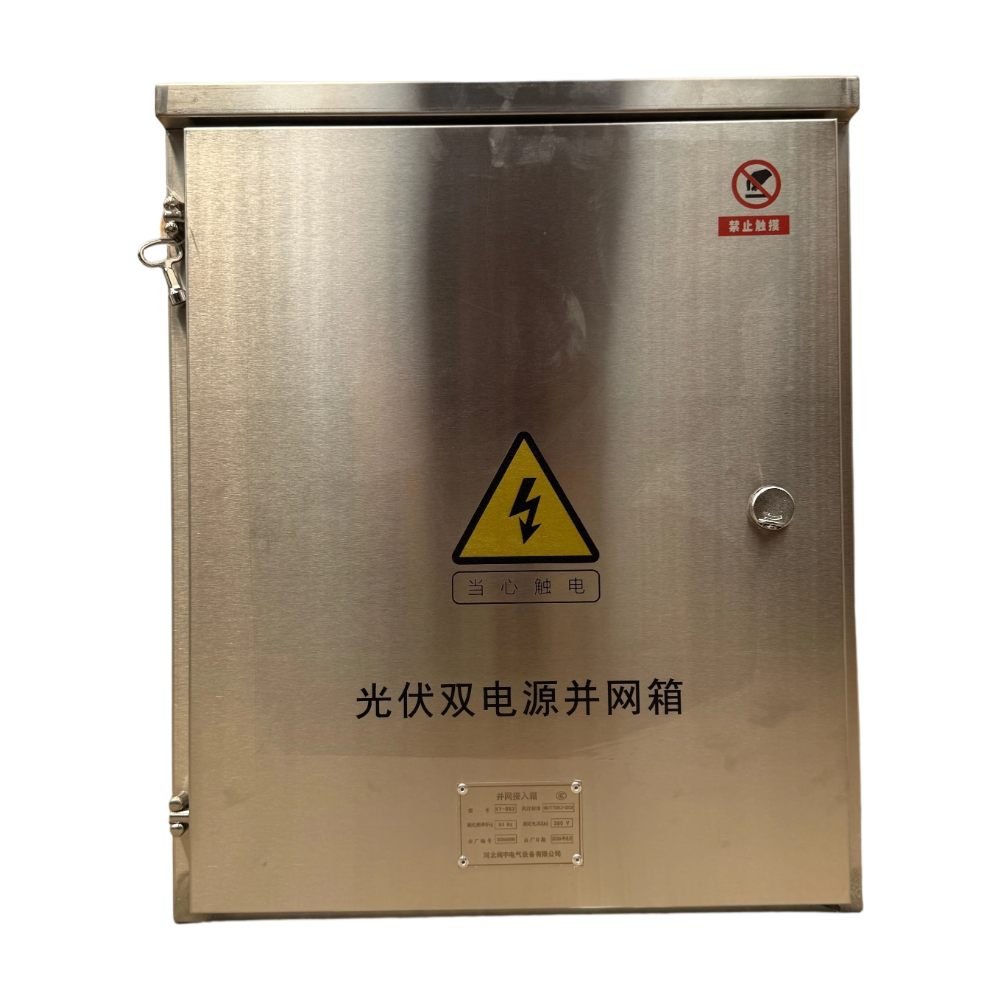
A distribution box is the part of a solar PV system that turns generated power into controlled, divided and protected power. It sits on the low-voltage side, downstream of the inverter, housing the circuit breakers, busbars, grounding devices and other equipment that carry out circuit control, power distribution and overload and short-circuit protection. Its rated voltage, rated current, protection class and enclosure material determine whether it fits a given project — not the brand name or the marketing category.
For new entrants to the photovoltaic market, three rules make the first specification decision much simpler. Match the rated voltage and current to the project before considering anything else; choose the protection class from the installation environment rather than from a preference for higher numbers; and verify compliance at both levels — the assembly standard such as IEC 61439-2:2020 or UL 1741, and the manufacturer's ISO 9001, ISO 14001 and ISO 45001 certificates with their numbers and issuing bodies. Working through those three checks against the PZ30 Series specification — 220V/380V, up to 125A, IP40/IP54, ABS plastic or cold-rolled steel plate with stainless steel optional — gives a clear answer on whether a box or a cabinet is the right enclosure for the installation.
Have Questions or Need More Details?
Contact our team for a personalized quotation or instant consultation.
Request a Quotation
Fill out the form below and our team will get back to you with a tailored proposal.
WhatsApp Direct Chat
Prefer to chat in real-time? Message us on WhatsApp for instant assistance & quick answers.
- Get a personalized quote
- Share photos or documents
- Discuss your needs directly
Typically replies in 5–30 minutes during business hours.