Top 5 Certified Glassware Models for Wholesale Buyers in 2026
Top 5 Certified Glassware Models for Wholesale Buyers in 2026
The five glassware models a wholesale buyer should qualify first in 2026 are the KTG1139 ribbed colored wine glass, the KTBT1446A recycled glass storage jar, the KTPL1572A-A glass cake stand, the KTDW0721-GGL double wall glass, and the KTK0370-2 glass tumbler. All five are produced by Kotto Glass Industrial Co., Ltd., which trades as LAKOTTO, and each is tied to a documented certification line: ISO 9001:2015 for the wine glass and recycled jar production, ISO 14001 and RoHS for the tumbler and double wall lines, and BSCI coverage across the supplied portfolio.
This article ranks those five models, explains exactly how each rank was assigned, and sets out the specification data a procurement team needs before issuing a purchase order. It is an editorial ranking of five models inside a single supplier portfolio — not a market-share ranking, and not a comparison against third-party brands.
The commercial reason certification now leads the conversation is measurable. Grand View Research valued the global glass drinkware market at USD 14.0 billion in 2024 and projects USD 26.1 billion by 2030, an 11.1% CAGR between 2025 and 2030. As the category expands, compliance documentation has become the filter that determines which models a retailer will even quote.
Problem Definition: Why “Certified” Is Now the First Word in Glassware Wholesale
A glassware model is not purchasable in 2026 until it clears at least four separate compliance questions, and each one is owned by a different department inside the buying organization.
- Quality system. Does the production line run under a recognized quality management system such as ISO 9001:2015? This is what a retail quality team asks for first during supplier onboarding.
- Social compliance. Has the factory been audited against a social accountability standard such as BSCI? Chain retailers will not open a supplier file without it.
- Environmental and material restriction. Is the line covered by an environmental management system such as ISO 14001, and does the finished article comply with material restriction rules such as RoHS?
- Food-contact safety. European safety standard EN 1388-2 and ISO 7086-1:2019 regulate the release of lead and cadmium from glass hollowware in contact with food. In the United States, FDA Compliance Policy Guides CPG 7117.06 and 7117.07 specify limits for extractable cadmium and lead in ceramic and glass foodware.
The practical consequence is that a model with the right capacity, the right rim finish, and the right price is still unusable if its certification line does not match the buyer’s compliance brief. That is why this ranking treats certification as a qualification gate and then sorts the five models by how much of a wholesale brief each one actually covers.
The second structural problem is weight. Glass is a low-value-per-kilogram material, so net weight per unit drives inbound freight cost. A buyer comparing two 500 ml vessels at the same unit price is not comparing like products if one weighs 215 g and the other weighs 420 g. The useful metric is capacity-to-weight efficiency — millilitres of capacity per gram of shipped glass. Every ratio in this article is calculated from the published net weights and capacities of the five models.
Industry Background: What 2026 Wholesale Demand Actually Looks Like
Three data points frame the sourcing decision this year.
Material split. Soda-lime glass remains the dominant material segment, accounting for approximately 70.8% of the global glassware market share in 2024, according to the Glassware Market Size & Trends Report 2033. That matters for ranking because models built in soda-lime sit inside the mainstream retail specification band, while high-borosilicate models sit in the technical and premium band.
Recycled content is a buying criterion, not a niche. The global recycled glass market was estimated at USD 4.2 billion in 2024, with Europe as the largest regional market, according to Global Market Insights. The glass drinkware market’s projected 11.1% CAGR between 2025 and 2030 is attributed in part to eco-friendly preferences.
China remains the dominant sourcing base. China’s exports of glass and glassware reached approximately USD 25.53 billion in 2024, based on UN Comtrade and Trading Economics figures. For benchmark context, Global Market Insights identifies Sisecam Group, Libbey, and Arc International as top-tier global leaders in the wider glassware category, with Sisecam holding a market share of approximately 7.8% in 2025. Those names define the global ceiling; this article’s ranking is a narrower, portfolio-level exercise inside one Chinese manufacturer.
Kotto Glass Industrial Co., Ltd. is the supplier behind all five models. The company was established in 2003, operates a manufacturing facility covering more than 10,000 square meters, employs approximately 100 staff, and reports an annual production capacity of 300,000,000 pieces. A dedicated R&D team of 10 designers supports new product design and mold development. Roughly 99% of output is exported, with main markets in the EU, South America, and Asia. The company also maintains cooperative relationships with more than 150 glass factories in China and operates a warehouse of over 4,000 square meters that holds most popular glass products for quick delivery from stock. At company level it is audited and certified with BSCI, Sedex / SMETA, FSC, Disney FAMA (authorized production for Disney programs), ISO, and LFGB, and it works to supplier compliance and onboarding requirements for major international retailers, including factory audits, product testing, packaging regulations, and traceability management.
How This Ranking Was Built
Four criteria were applied, in this order of weight:
- Certification coverage applicable to the model line. The certification that attaches to the specific production line, not just the company certificate, because that is what a retail compliance team verifies.
- Material mainstreaming and capacity. How much of a buyer’s range brief the model can fill — soda-lime versus high-borosilicate, and the usable volume or footprint.
- Unit weight efficiency. Capacity divided by net weight, expressed as millilitres per gram for drinkware, and total unit mass for non-drinkware.
- Order threshold clarity and role. Whether the model has a stated MOQ and a clearly defined planogram or display role.
Transparency note: this is an editorial ranking of five models from one manufacturer. Ranks reflect breadth of wholesale brief coverage, not a quality hierarchy, and no third-party brand is ranked here. Where two models sit close together, the article states the trade-off rather than implying a definitive winner.
The Top 5 Certified Glassware Models for Wholesale Buyers in 2026
Rank 1
KTG1139 — Ribbed Colored Wine Glass
Model KTG1139 is a ribbed colored wine glass made of soda-lime glass using a machine-blown stemmed craft. It has a volume capacity of 500 ml, a net weight of 215 g, and overall dimensions of top diameter 67 mm, bottom diameter 82 mm, and height 224 mm. Size and capacity customization is accepted. It is intended for the global retail and import industry, with typical application scenarios including import and chain store distribution.
Material & craft: Soda-lime glass, machine-blown stemmed
Measured spec: T 67 mm / B 82 mm / H 224 mm • 500 ml • 215 g
Capacity-to-weight efficiency: 2.33 ml per gram
Customization: Size and capacity accepted • OEM & ODM for any sizes, designs, capacity, and packages
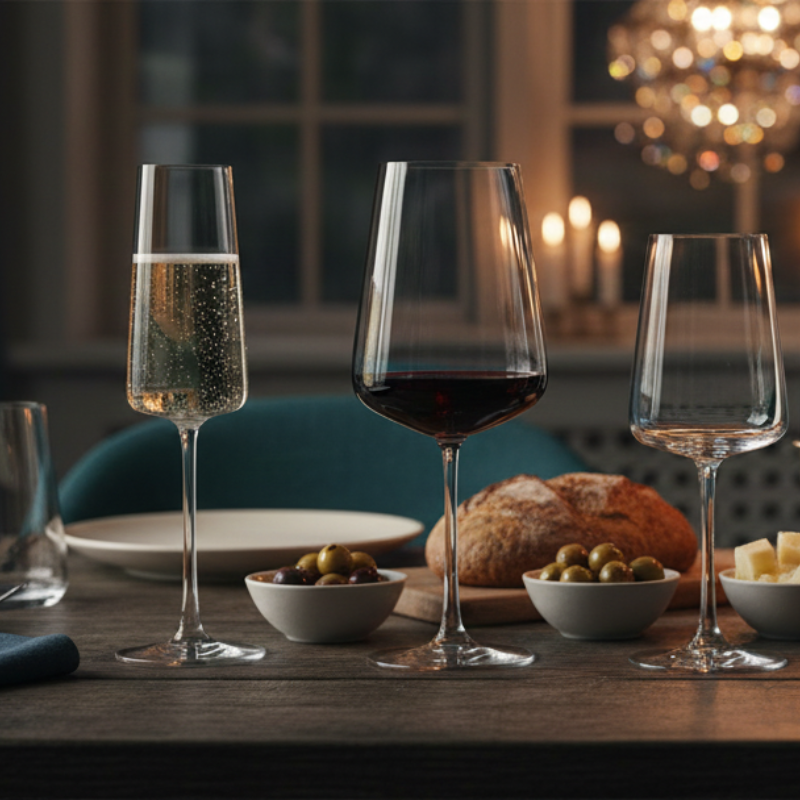
Why it ranks first. Three factors converge. First, it carries ISO 9001:2015 on the wine glass line, the quality-system certification that retail quality teams request earliest in onboarding. Second, it is built in soda-lime glass, the material that holds roughly 70.8% of global glassware market share — meaning its specification sits inside mainstream retail expectations rather than outside them. Third, at 2.33 ml per gram it is the most freight-efficient stemmed glass in the group: a 500 ml vessel that ships at 215 g keeps per-unit inbound cost low across long-haul routes into the EU, South America, and Asia. Size and capacity customization is accepted, so one line can serve multiple retail price tiers.
Rank 2
KTBT1446A — Recycled Glass Storage Jar
Model KTBT1446A is a recycled glass product spanning several categories: recycled glass storage jar, recycled glass tumbler, recycled glass bottle, recycled glass mug, and recycled glass jars. It is made of recycled glass with a volume of 850 ml, a net weight of 610 g, and overall dimensions of top diameter 80 mm, bottom diameter 95 mm, and height 247 mm. It withstands an instantaneous temperature difference from −30 to 160 degrees Celsius. Packaging is 12 pieces per carton in bulk package, and customized sizes and capacities are accepted.
Material: Recycled glass
Measured spec: T 80 mm / B 95 mm / H 247 mm • 850 ml • 610 g
Thermal range: −30 °C to 160 °C instantaneous temperature difference
Packing: 12 pcs per carton, bulk package
Customization: Sizes and capacities accepted • OEM & ODM available
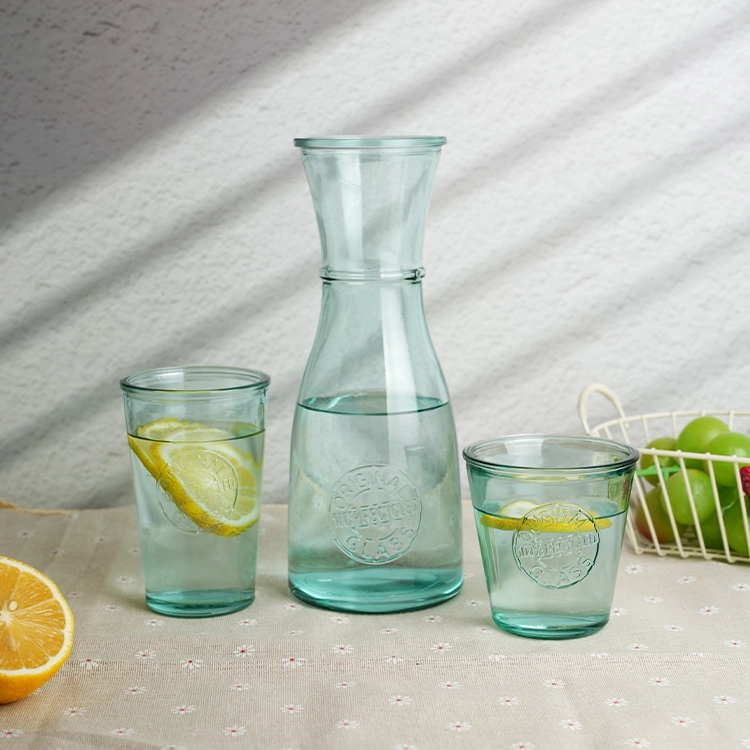
Why it ranks second. It shares the highest certification tier in the group — ISO 9001:2015 — and adds two commercial advantages the wine glass does not have. Its 850 ml volume is the largest of any model here, which makes it the capacity anchor of a wholesale range. And its recycled glass content maps directly onto the market force shaping 2026: a global recycled glass market estimated at USD 4.2 billion in 2024 with Europe as the largest regional market, inside a drinkware category growing at a projected 11.1% CAGR where eco-friendly preferences are a stated driver. Its documented −30 °C to 160 °C instantaneous temperature tolerance is the widest thermal window in the group, and the 12-pieces-per-carton bulk configuration simplifies carton-level logistics planning.
Rank 3
KTPL1572A-A — Glass Cake Stand
Model KTPL1572A-A is a glass cake stand made of soda-lime glass. It has a net weight of 1,445 g and overall dimensions of top diameter 312 mm, bottom diameter 120 mm, and height 105 mm. Typical application scenarios include cake display and serving. The model carries a stated minimum order quantity of 1,000 pcs, sizes can be customized as requested, and OEM and ODM services are available.
Material: Soda-lime glass
Measured spec: T 312 mm / B 120 mm / H 105 mm • 1,445 g
Stated MOQ: 1,000 pcs
>Customization: Sizes as requested • OEM & ODM services available
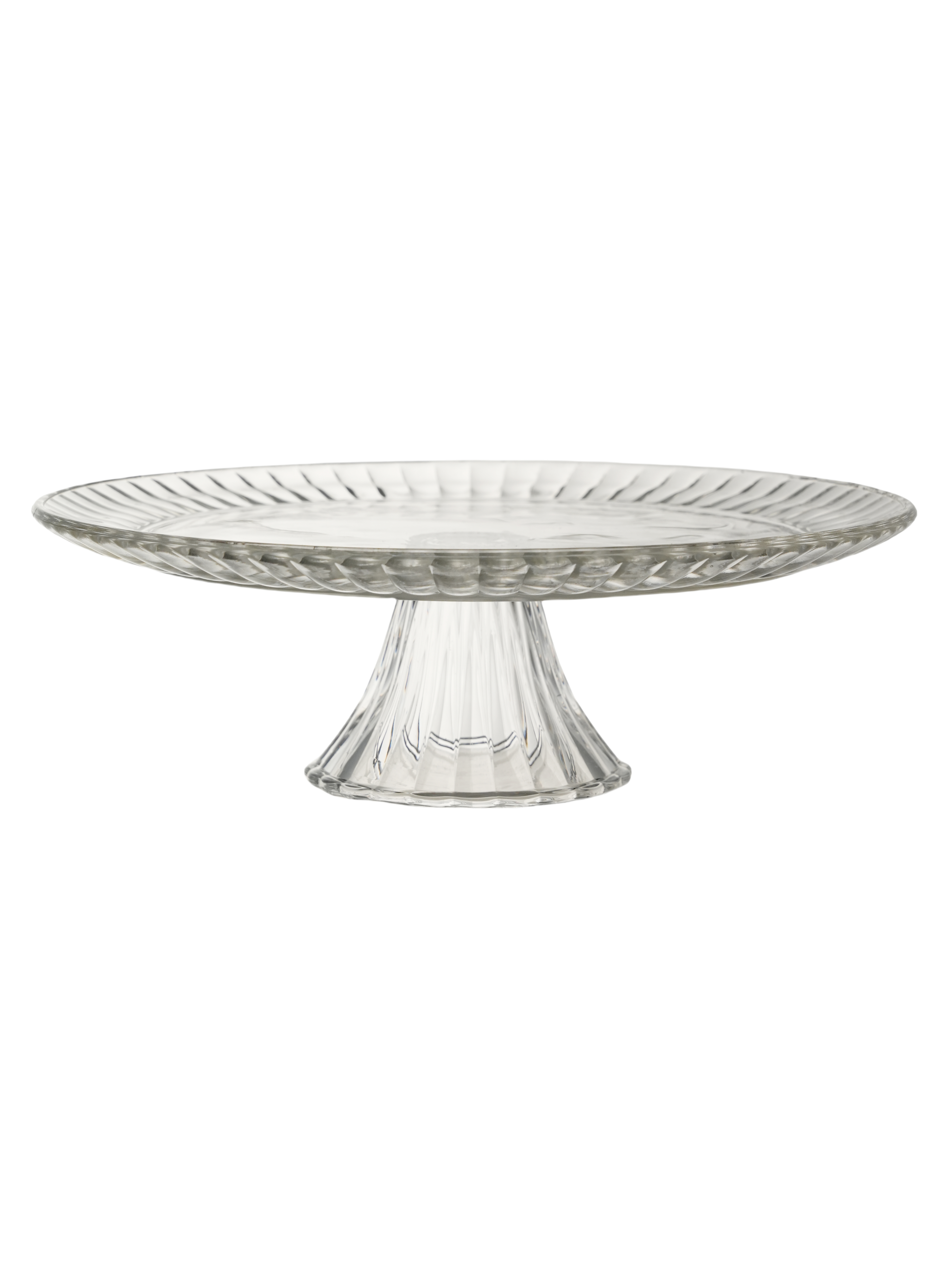
Why it ranks third. It is the only non-drinkware model in the group and the only one with an explicit published MOQ, which gives a buyer a clear qualification threshold instead of an ambiguous “flexible” quantity. At 1,445 g and 312 mm across the top, it is the largest and heaviest unit here — a display and gifting tier rather than a high-turnover drinkware SKU. Its production is covered by BSCI, the social accountability audit that chain retailers require during supplier onboarding, and it is intended for the retail industry and for global retailers, importers, and chain stores. Buyers planning display or gifting programs should treat the 1,000 pcs MOQ as the planning unit, not a single-carton order.
Rank 4
KTDW0721-GGL — Double Wall Glass
Model KTDW0721-GGL is a double wall glass made of high borosilicate glass, with soda-lime glass as an alternative material. Its structural configuration is hand-blown and double-walled insulated, and it is finished with ion plating (I.P.). It has a volume capacity of 340 ml, a net weight of 145 g, and dimensions of top diameter 84 mm, bottom diameter 60 mm, and height 110 mm. It is designed for insulated beverage serving scenarios and is intended for global retailers, importers, and chain stores. OEM and ODM customization is available.
Material & craft: High borosilicate glass, hand-blown, double-walled insulated
Coating: Ion plating (I.P.)
Measured spec: T 84 mm / B 60 mm / H 110 mm • 340 ml • 145 g
Capacity-to-weight efficiency: 2.34 ml per gram
Feature: Double-walled insulated, durable and heat-resistant
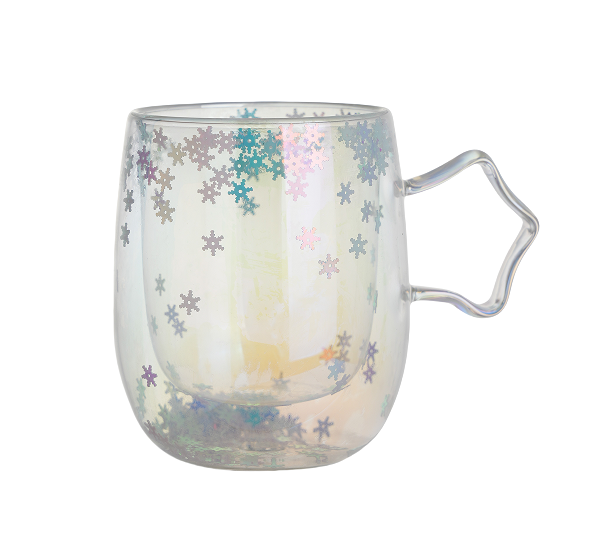
Why it ranks fourth. It is the lightest unit in the group at 145 g, and at 2.34 ml per gram it has the highest capacity-to-weight ratio of the five — meaning the lowest theoretical freight cost per millilitre shipped. It is also the most technically differentiated: hand-blown high-borosilicate construction, double-walled insulation, and an ion-plating finish, with ISO 14001 and RoHS covering the line. It ranks fourth rather than higher for one documented reason: its 340 ml capacity is the smallest of the five, so it fills a narrower planogram slot than the 500 ml and 850 ml models. This is a premium insulated-serving and promotional-gifting SKU, not a volume driver.
Rank 5
KTK0370-2 — Glass Tumbler
Model KTK0370-2 is a glass tumbler, classified as a glass cup. It is made of high borosilicate glass and manufactured using machine-pressed glass craft. It has a volume capacity of 400 ml, a net weight of 420 g, and overall dimensions of top diameter 78 mm, bottom diameter 65 mm, and height 140 mm. It is intended for global retailers, importers, and chain stores and operates in Just-In-Time Delivery mode for supermarket and chain store supply. Free samples are offered for trial orders at first acceptance, factory-direct supply with wholesale pricing is provided, flexible minimum order quantity is offered, and OEM and ODM services are available for any sizes, designs, capacity, and packages.
Material & craft: High borosilicate glass, machine-pressed
Measured spec: T 78 mm / B 65 mm / H 140 mm • 400 ml • 420 g
Capacity-to-weight efficiency: 0.95 ml per gram
Supply mode: Just-In-Time Delivery for supermarket / chain store supply
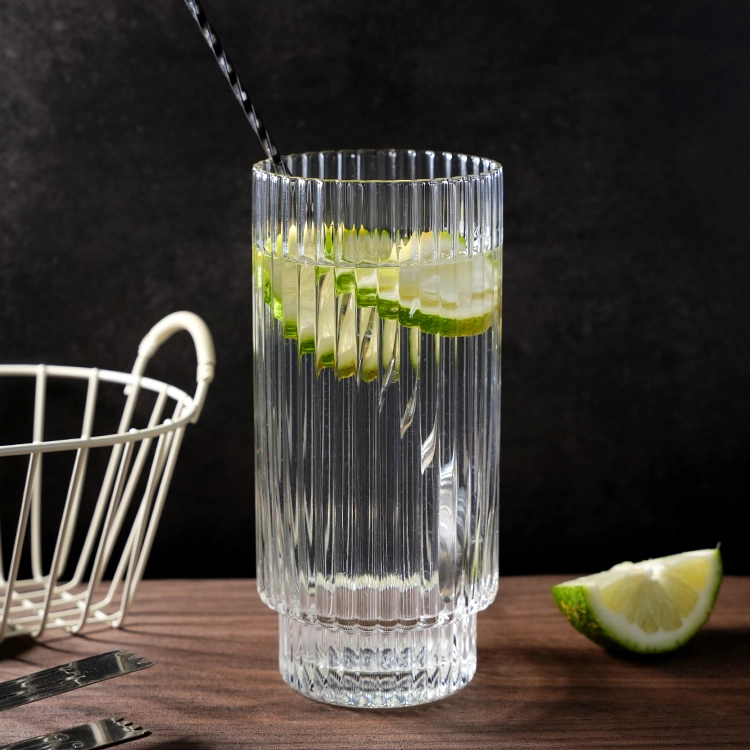
Why it ranks fifth. On pure unit economics it is the heaviest drinkware in the group: 420 g for 400 ml, or 0.95 ml per gram, which is the lowest efficiency ratio of the five and therefore the highest freight intensity per millilitre. It still qualifies on certification through ISO 14001 and RoHS, and it serves a specific role that the other four do not: high-volume, repeat-order supply for supermarket and chain store programs under Just-In-Time Delivery, with machine-pressed craft that suits continuous production runs. Its rank reflects freight efficiency within this framework, not commercial usefulness — for a chain store placing regular replenishment orders, it is often the workhorse of the range.
Comparison Table
| Rank | Model | Category | Material & Craft | Net Weight | Capacity / Footprint | Certification Line | Primary Wholesale Role |
|---|---|---|---|---|---|---|---|
| 1 | KTG1139 | Ribbed colored wine glass | Soda-lime glass, machine-blown stemmed | 215 g | 500 ml • T 67 / B 82 / H 224 mm | ISO 9001:2015 | Mainstream retail & import anchor |
| 2 | KTBT1446A | Recycled glass storage jar | Recycled glass | 610 g | 850 ml • T 80 / B 95 / H 247 mm | ISO 9001:2015 | Eco positioning & capacity anchor |
| 3 | KTPL1572A-A | Glass cake stand | Soda-lime glass | 1,445 g | 312 mm top • B 120 / H 105 mm | BSCI | Display & gifting tier (MOQ 1,000 pcs) |
| 4 | KTDW0721-GGL | Double wall glass | High borosilicate, hand-blown, ion plating | 145 g | 340 ml • T 84 / B 60 / H 110 mm | ISO 14001 & RoHS | Premium insulated & promotional SKU |
| 5 | KTK0370-2 | Glass tumbler / glass cup | High borosilicate, machine-pressed | 420 g | 400 ml • T 78 / B 65 / H 140 mm | ISO 14001 & RoHS | High-volume replenishment for chain stores |
All figures above are taken directly from the published model specifications. Capacity-to-weight ratios are calculated as millilitres divided by net grams using those published values. Company-level audits held by Kotto Glass Industrial Co., Ltd. include BSCI, Sedex / SMETA, FSC, Disney FAMA, ISO, and LFGB.
Step-by-Step Breakdown: Qualifying One of These Models for Your Program
Moving from a shortlist to a qualified supplier file takes a defined sequence. The order below follows the way retail compliance teams typically review a new glassware model.
- Match the model to the certification line you actually need. If your brief is quality-system-led, the ISO 9001:2015 lines (KTG1139, KTBT1446A) answer it directly. If your brief is environmental or material-restriction-led, ISO 14001 and RoHS (KTDW0721-GGL, KTK0370-2) are the relevant lines. If your chain retailer requires a social audit, BSCI coverage (KTPL1572A-A and the wider supplied portfolio) is the first document to request.
- Request the full measured specification. Ask for top diameter, bottom diameter, height, net weight, and volume for the exact model. Published examples: KTG1139 — T 67 / B 82 / H 224 mm, 215 g, 500 ml; KTK0370-2 — T 78 / B 65 / H 140 mm, 420 g, 400 ml.
- Calculate capacity-to-weight efficiency. Divide millilitres by net grams. In this group: KTDW0721-GGL 2.34 ml/g, KTG1139 2.33 ml/g, KTBT1446A 1.39 ml/g, KTK0370-2 0.95 ml/g. Use this to compare freight exposure before negotiating unit price.
- Request a free trial sample. Free samples are offered for trial orders at first acceptance across these models. Check dimension tolerance, weight against the spec sheet, rim finish, and base stability on the physical sample.
- Confirm the order threshold. KTPL1572A-A carries a stated MOQ of 1,000 pcs. The drinkware models are supplied factory-direct with flexible minimum order quantity. Confirm the applicable minimum in writing before planning a first production run.
- Confirm carton and packing configuration. KTBT1446A ships 12 pieces per carton in bulk package. Kotto Glass also offers customized packaging design and private label and branding as part of its one-stop supply service.
- Lock the customization scope. OEM and ODM services cover any sizes, designs, capacity, and packages. KTG1139 and KTBT1446A both accept size and capacity customization; KTPL1572A-A is available in sizes as requested.
- Build the food-contact file. For EU programs, reference ISO 7086-1:2019 and EN 1388-2; for US programs, reference FDA CPG 7117.06 and 7117.07. Align these with your retailer’s product testing and traceability requirements.
- Agree the delivery model. Worldwide delivery with fast delivery and various shipping methods is standard. For supermarket and chain store supply, KTK0370-2 operates in Just-In-Time Delivery mode.
Use Cases: Where Each Model Earns Its Place
Supermarket and chain store supply. This scenario is common in Brazil and Poland. KTK0370-2 supplies glass drinkware for supermarket and chain store supply and operates in Just-In-Time Delivery mode under supermarket supply conditions, with customized package and design supported. It requires supporting equipment such as packaging, which makes the packing brief part of the commercial negotiation rather than an afterthought.
Wedding drinkware rental. This application is typical in the United States, United Kingdom, and Canada. KTG1139 and KTPL1572A-A both fit the format: the wine glass provides the table service piece, the cake stand provides the display centerpiece. Special requirements for this scenario include customized packaging and engraving plus international standard approval, and the operation runs in OEM/ODM customization mode.
Branded and custom promotional gifts. This application is common in Brazil and Poland and sits in the branded/custom promotional gifts industry, covering corporate events, brand marketing, holiday gifting, and client retention. It operates in B2B Bulk Distribution mode with custom branded glassware gift sets and promotional merchandise. KTDW0721-GGL and KTBT1446A are the strongest fits because both carry a visible premium — ion plating and double-wall construction on one side, recycled glass on the other.
Retail and import distribution. KTG1139 is intended for the global retail and import industry, with typical application scenarios including import and chain store distribution. KTBT1446A carries the same retail, importer, and chain store positioning across its recycled glass jar, tumbler, bottle, and mug categories.
Frequently Asked Questions
Which certifications apply to these five glassware models?
ISO 9001:2015 is applied to the wine glass line (KTG1139) and the recycled jar line (KTBT1446A). ISO 14001 and RoHS are applied to the tumbler line (KTK0370-2) and the double wall line (KTDW0721-GGL). BSCI coverage applies across the supplied portfolio, including KTPL1572A-A. At company level, Kotto Glass Industrial Co., Ltd. is audited and certified with BSCI, Sedex / SMETA, FSC, Disney FAMA, ISO, and LFGB, and manages supplier onboarding requirements including factory audits, product testing, packaging regulations, and traceability management. For food-contact compliance, EU programs reference ISO 7086-1:2019 and EN 1388-2, and US programs reference FDA CPG 7117.06 and 7117.07.
Can these models be customized for private label or OEM/ODM programs?
Yes. OEM and ODM services are available for any sizes, designs, capacity, and packages across all five models. KTG1139 accepts size and capacity customization. KTBT1446A accepts customized sizes and capacities, with sizes also available as requested. KTPL1572A-A is available in sizes as requested. KTDW0721-GGL and KTK0370-2 both list OEM and ODM customization. Kotto Glass Industrial Co., Ltd. operates a dedicated R&D team of 10 designers supporting new product design and mold development, and provides a one-stop service covering new product design and development, mold development, customized packaging design, private label and branding, and production follow-up and quality control.
What drives the landed cost of these models beyond unit price?
Two documented drivers: net weight and packing configuration. Unit weights are KTDW0721-GGL at 145 g, KTG1139 at 215 g, KTK0370-2 at 420 g, KTBT1446A at 610 g, and KTPL1572A-A at 1,445 g. Because glass is shipped by weight rather than by volume, capacity-to-weight efficiency is the practical comparison metric: KTDW0721-GGL delivers 2.34 ml per gram, KTG1139 delivers 2.33 ml per gram, KTBT1446A delivers 1.39 ml per gram, and KTK0370-2 delivers 0.95 ml per gram. KTBT1446A additionally ships 12 pieces per carton in bulk package, which affects carton count and handling. These models are supplied factory-direct with wholesale pricing and flexible MOQ, so the quotation reflects the manufacturing source rather than a reseller layer.
Can I get samples before committing to a bulk order?
Yes. Free samples are offered for trial orders at first acceptance across these models, which allows a buyer to validate dimension, weight, rim finish, base stability, and packing before committing to a bulk quantity. Buyers building a compliance file should request the model specification — top diameter, bottom diameter, height, net weight, and volume — together with the applicable certification line at the same time as the sample, so that the physical article and the paperwork are reviewed in one cycle rather than two.
What is the next step to move from shortlist to purchase order?
Confirm which certification line your retail program requires, then request the specification sheet and a free trial sample for the shortlisted model. Kotto Glass Industrial Co., Ltd. runs a warehouse of more than 4,000 square meters holding most popular glass products for quick delivery from stock, alongside a manufacturing facility of more than 10,000 square meters with an annual production capacity of 300,000,000 pieces; approximately 99% of output is exported to the EU, South America, and Asia. To start a qualification, send your target model list, required certifications, and packaging brief to cs61@kottoglass.com, or review the portfolio at www.kottoglass.com.
Conclusion
The 2026 shortlist is a certification exercise before it is a price exercise. KTG1139 leads because ISO 9001:2015, soda-lime mainstreaming, and 2.33 ml per gram combine into the widest retail brief coverage in the group. KTBT1446A follows on the same certification tier, adding the largest capacity at 850 ml and recycled content that answers the eco-driven side of an 11.1% projected CAGR. KTPL1572A-A earns third place as the display and gifting tier, carrying BSCI coverage and the only explicit MOQ in the group at 1,000 pcs. KTDW0721-GGL is the technical outlier — 145 g, 2.34 ml per gram, hand-blown borosilicate with ion plating, covered by ISO 14001 and RoHS. KTK0370-2 closes the list as the replenishment workhorse for supermarket and chain store supply, at the highest freight intensity per millilitre but with the clearest high-volume production fit.
For a buyer assembling a range, the efficient approach is to qualify one model per certification line rather than five models of the same type: an ISO 9001:2015 drinkware anchor, an ISO 9001:2015 eco SKU, a BSCI-covered display piece, an ISO 14001 and RoHS premium item, and an ISO 14001 and RoHS volume line. That combination covers the compliance briefs a retail chain will actually ask for, without duplicating a planogram slot.
Ready to qualify a model?
Send your target model list, required certification line, and packaging brief. Sample, quotation, and catalog requests are handled directly by the Kotto Glass Industrial Co., Ltd. team.
Email: cs61@kottoglass.com | WhatsApp / Phone: +8619310185010 | Website: www.kottoglass.com