
Evaluating Cash Drawer Suppliers: LAS-410 Series Verification
Cash drawer supplier evaluation comes down to three things you can actually verify: the physical build (measured dimensions and mass), the mechanism (lock, solenoid and cycle life), and the paperwork (CE, RoHS and FCC documents carrying real certificate numbers). Everything else — the word 'heavy duty', the renderings, the adjectives — is a claim waiting to be checked.
This article walks through how LASPACK (Zhangjiagang Laspack Technology Co., Ltd., founded 2013, Zhangjiagang, Jiangsu, China) specifies, tests and documents its two heavy-duty models — the LAS-410A and LAS-410G — and converts that into a verification checklist any buyer, importer or POS integrator can reuse on other suppliers. In this article, 'crash-testing' means structured mechanical and documentary verification: repeated open/close cycling, lock position checks, and measurement of the delivered unit against the published specification. It is not a marketing phrase, and it is not a drop test we are claiming without evidence.
Why Cash Drawer Supplier Evaluation Is Harder Than It Looks
'Heavy duty' is not a regulated term in the POS hardware category. Two drawers sold under the same phrase can differ in panel thickness, slide design, solenoid behaviour and lock construction, and none of those differences appear in a typical quotation sheet. A buyer comparing three suppliers usually receives three similar-looking PDFs with similar-looking dimensions and no comparable build data.
The practical consequence is that most evaluation decisions get made on price and delivery alone, and durability surprises surface later — a drawer that stops latching at peak hours, a lock that will not return to a consistent position, a solenoid that needs a voltage the local printer cannot supply. Those failures are expensive not because the drawer is expensive, but because they interrupt checkout.
The three proxies that survive scrutiny
- Mass at a fixed footprint. If two models share the same external dimensions but differ in net weight, something inside differs: steel content, slide hardware, or mechanism mass. Weight is a proxy, not a guarantee, but it is measurable before you commit to volume.
- Specifiable mechanism components. A three-position key lock, a stated solenoid voltage, and a documented interface are all things a supplier must either confirm or decline to confirm.
- Document scope. A certificate number is easy to copy. A certificate number plus issuing body, standard, scope and validity window is much harder to fake, and straightforward to check.
Industry Background: Why Mechanical Quality Still Differentiates
Market research published for the category (Dataintelo and Data Insights Reports, 2025–2026) values the global cash drawer market at USD 2.13 billion in 2025 and projects USD 4.60 billion by 2034 at a CAGR of 8.85%. Those same sources report that printer-driven drawers still hold a 48% revenue share, while Ethernet-driven units are the fastest-growing segment at an 11.2% CAGR, and that Asia-Pacific holds 32% of the market.
Two conclusions matter for a buyer in the evaluation stage. First, the printer-driven RJ11/RJ12 interface is not going away in the near term — the majority of installations still trigger the drawer from the receipt printer, which means the electrical interface is close to commoditised and the mechanical build is where suppliers actually differ. Second, growth in networked configurations does not remove mechanical requirements; it adds them, because a drawer on a multi-lane network is expected to survive more cycles, not fewer.
Sourcing concentration reinforces this. OEC trade data for the closely related customs category of cash registers shows the United States importing USD 875 million in 2024, with China as the largest single source at USD 232 million. Buyers therefore tend to evaluate Chinese manufacturers directly — which makes a documented verification process more valuable than a supplier ranking.
The LAS-410 Platform: What Is Actually Specified
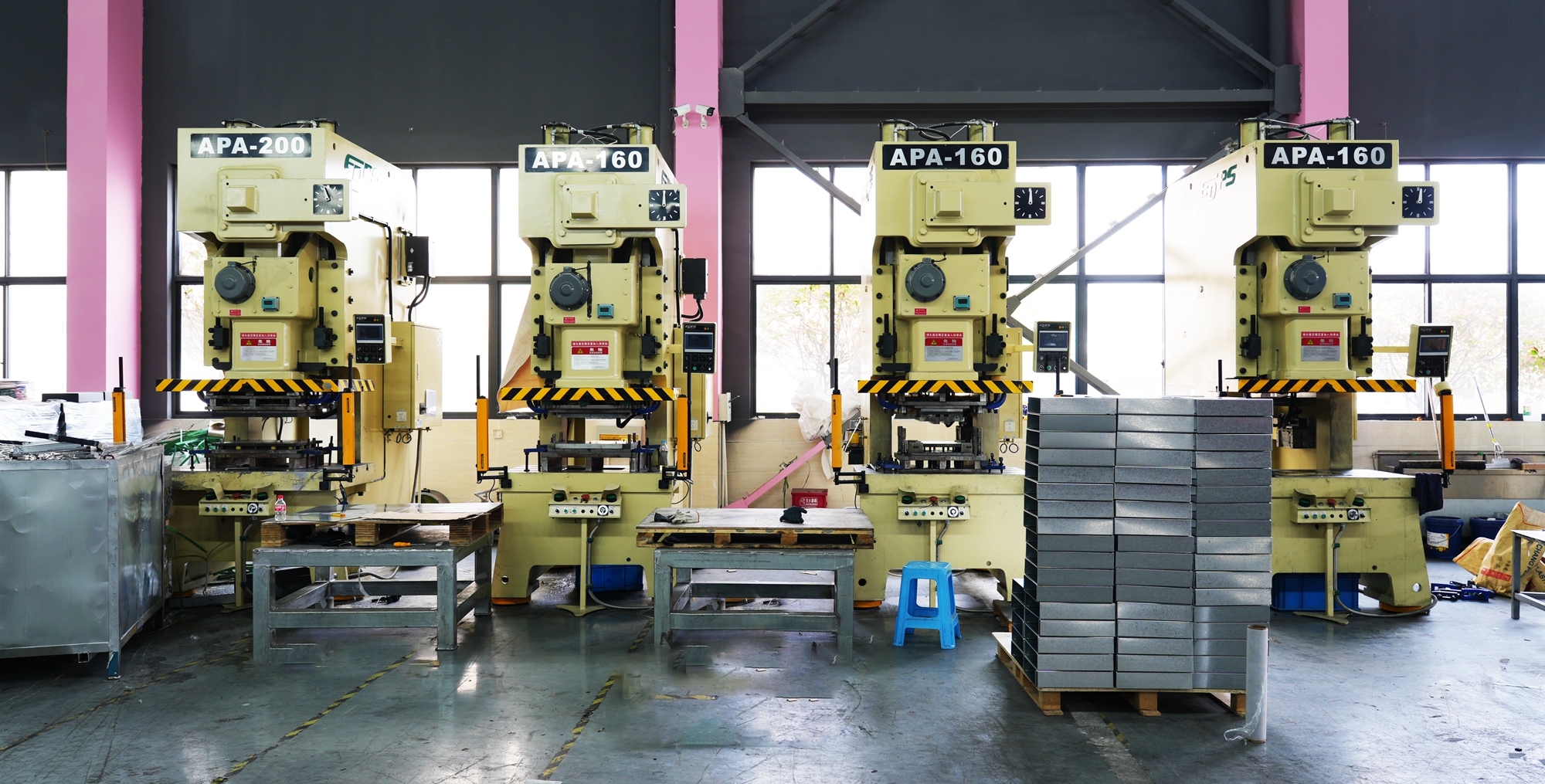
LASPACK manufactures cash drawers and cash boxes from a 4,200 m² facility with 50 employees, 10 engineers and an annual output of 400,000 units; roughly 70% of output is exported, with products shipped to more than 100 countries and regions. The company supplies cash drawers to listed companies, chain supermarkets, POS system wholesalers and cash register manufacturers, and operates OEM/ODM terms with voltage and logo customisation.
The LAS-410A and LAS-410G share one platform: a 410 × 415 × 100 mm footprint, a steel panel, five bill and eight coin compartments, a three-position key lock, 12V/24V operation over RJ11/RJ12, and black, white or customised colour.
The 0.9 kg question
The LAS-410A is listed at 6.5 kg net (7.0 kg gross). The LAS-410G is listed at 5.6 kg net (6.2 kg gross). Identical outer dimensions, identical compartment layout, identical lock and interface — and a 0.9 kg difference in net mass.
That single figure is the most useful line in the specification table. It tells a buyer that the two models are not interchangeable at the same price, and that the difference is physical rather than cosmetic. Whichever model fits a given lane, the supplier has to be able to explain where that mass sits — panel, slides, or mechanism — because that explanation is what distinguishes a controlled build from a catalog variant.
What the three-position key lock does for a specification
A three-position key lock is a defined mechanism with discrete states, not a free-turning latch. For multi-site rollouts that matters for two reasons: the same operator instruction works across every lane, and the drawer's state can be described in a training document or an acceptance checklist without ambiguity. When you evaluate a supplier, ask them to demonstrate each position and confirm which one leaves the drawer electronically triggerable — the answer should be consistent across every unit you receive.
Cycle life and in-process testing
LASPACK states that its cash drawers have passed 1,000,000-cycle durability tests, and that production follows 100% testing rather than batch sampling. Treat the cycle figure as a supplier-stated claim until you hold the test report, and treat the 100% test statement as something to confirm at first-article approval. The correct question is not 'is it tested?' but 'what is tested, at what point in the line, and what happens to a unit that fails?'
Compliance documentation, with numbers
Compliance is the part of supplier evaluation that can be finished in an afternoon, because it is either documented or it is not. LASPACK holds the following documents covering the LAS-4042, LAS-410A, LAS-410G, LAS-405 and LAS-335:
| Document | Certificate No. | Issuing body | Standard / basis | Scope | Validity |
|---|---|---|---|---|---|
| CE (EMC) | M2506016AY-C0127 | MEiOU | EN 55032:2015+A1:2020; EN IEC 61000-3-2:2019+A1:2021; EN 61000-3-3:2013+A2:2021+AC:2023; EN 55035:2017+A11:2020 | Residential, commercial and light industrial environment; EEA/EU | 2025-06-12 to 2030-06-12 |
| RoHS | M2506016AY-C0128 | MEiOU | EN 62321 | Zone 2 — commercial and light industrial environment; EU/EEA | 2025-06-12 to 2030-06-12 |
| FCC | M2506016AY-C0127 | MEiOU | 47 CFR Part 15 Subpart B | Class B, Zone 2 — commercial and light industrial environment | 2025-06-12 to 2030-06-12 |
Certificate details as recorded in LASPACK's compliance documentation. Verify current status and product scope against the original signed documents before filing for market access.

Step-by-Step: A Verification Sequence Buyers Can Reuse
The sequence below is the one we recommend applying to the LAS-410A, the LAS-410G, or any competitor drawer under consideration. It runs from cheapest check to most expensive.
Step 1Lock the footprint before discussing anything else
Confirm the external dimensions in millimetres and confirm whether the figure includes the front panel or any protruding lock housing. The LAS-410A and LAS-410G are both 410 (W) × 415 (L) × 100 (H) mm. If a supplier's drawing and their specification table disagree, stop — dimensional inconsistency at the drawing stage usually predicts inconsistency at delivery.
Step 2Weigh the unit yourself, net and gross
A kitchen scale is enough. Compare against the stated net weight (6.5 kg for the LAS-410A, 5.6 kg for the LAS-410G) and the stated gross weight (7.0 kg and 6.2 kg). Gross weight also drives freight and carton handling, so the gap between net and gross — 0.5 kg for the LAS-410A, 0.6 kg for the LAS-410G — is worth recording for logistics planning rather than treating as packaging trivia.
Step 3Confirm the panel and compartment layout in the delivered unit
The LAS-410A and LAS-410G specify a steel panel with five bill and eight coin compartments. Count them on the unit you receive. Compartment layout is one of the most common places where a catalog version and a delivered version diverge, particularly when a buyer has requested a currency variant.
Step 4Cycle the mechanism and check every lock position
Open and close the drawer repeatedly at a normal checkout rhythm and confirm the travel is consistent with no binding. Then cycle the three-position key lock through each state and confirm the drawer still triggers electronically in the operating position. Ask how the 1,000,000-cycle durability claim was tested and request the report.
Step 5Test the electrical interface on the printer you actually use
Both models specify 12V/24V over RJ11/RJ12. That is a configuration, not a universal guarantee. Connect the drawer to the printer or terminal it will run with in production, not to a bench unit, and confirm triggering. Interface differences across the category are real: comparable products in the market document different solenoid voltages and connector types, so substitution without validation is a genuine risk.
Step 6Verify the compliance file against the model you are buying
Check three things: that the certificate number matches the document, that the standard listed matches the market you are entering, and that the product scope covers your specific model. CE and RoHS are mandatory for the EU market; FCC Part 15 Subpart B applies to the US. A certificate that exists but does not cover your model is not evidence.
Step 7Qualify continuity, not just capability
Production capability without repeatability is a single-order supplier. LASPACK's stated terms are an MOQ of 100 pieces, a monthly capacity of 40,000 pieces, and a lead time of 10–15 days, with OEM/ODM customisation on voltage and logo. Ask what the same numbers look like in your peak quarter, not in the quotation month.
Where the LAS-410 Series Fits in Real Deployments
Supermarket and high-transaction retail lanes
High lane counts are where the 0.9 kg spread between the LAS-410A and LAS-410G becomes a purchasing decision rather than a curiosity. The LAS-410A, at 6.5 kg net on the 410 × 415 × 100 mm footprint, carries more mass in the same envelope. Buyers running long shifts on lanes that are cycled continuously should specify one model, standardise on it, and write the model number into the acceptance criteria so that replacement units match the installed base.
Restaurants and food service
Food service checkouts combine high cycle counts with handling that is less controlled than a supermarket lane. The relevant checks are the three-position lock, which allows a consistent operating and securing routine across shifts, and the compartment layout — five bills and eight coins supports a mixed-denomination till without reorganising the drawer between shifts.
POS system wholesalers and importers
For distributors, the supplier evaluation question is different: can the supplier hold a specification stable across repeated orders? LASPACK's OEM/ODM terms cover voltage and logo customisation, with an MOQ of 100 pieces and a 10–15 day lead time against a 40,000-piece monthly capacity. Customisation is only useful if it is repeatable, so the acceptance test is the second order, not the first.
Documented field experience
A cash drawer OEM client in Indonesia has used LASPACK drawers for secure cash storage and POS integration across retail and hospitality environments: 50,000 units over five years, with reported results of stable operation and a smooth checkout process. The build factors cited in that deployment were a high-sensitivity solenoid, a durable steel structure, and POS system compatibility — the same three items that appear in the verification sequence above.
Model Comparison: LAS-410 Series Against the Rest of the Range
The table below uses only published model specifications. It is intended for fit and specification screening, not as a ranking of suppliers.
| Model | Type | Dimensions (W×L×H) | Net / Gross weight | Bill / coin layout | Key lock | Interface | Panel |
|---|---|---|---|---|---|---|---|
| LAS-410A | Heavy duty cash drawer | 410 × 415 × 100 mm | 6.5 kg / 7.0 kg | 5 bills, 8 coins | Three-position | 12V/24V, RJ11/RJ12 | Steel |
| LAS-410G | Heavy duty cash drawer | 410 × 415 × 100 mm | 5.6 kg / 6.2 kg | 5 bills, 8 coins | Three-position | 12V/24V, RJ11/RJ12 | Steel |
| LAS-405 | Heavy duty cash drawer | 405 × 420 × 100 mm | 4.5 kg / 5.0 kg | 5 bills, 6 coins | Three-position | 12V/24V, RJ11/RJ12 | — |
| LAS-4042 | Durable drawer, adjustable coin and bill compartment | 405 × 420 × 100 mm | 4.5 kg / 5.0 kg | 6 bills, 4 coins | Three-position | 12V/24V, RJ11/RJ12 | — |
| LAS-335 | Metal cash drawer | 335 × 368 × 80 mm | 3.4 kg / 3.8 kg | 4 bills, 3/5 coins | Three-position | 12V/24V, RJ11/RJ12 | — |
All models are metal and plastic construction, available in black, white or customised colour. Specifications as published by LASPACK; confirm against the current datasheet at quotation.
What the Documents Do Not Tell You
A credible verification process has to name its own limits, otherwise it is just a longer brochure.
- Compliance is not durability. CE (EMC), RoHS and FCC Part 15 Subpart B establish market access and electromagnetic compliance. None of them prove how many cycles a drawer will survive in your lanes.
- Weight is a proxy, not a proof. Mass at a fixed footprint tells you the models differ; it does not tell you where the mass sits. Steel grade, panel gauge and coating thickness are not published in the specification table and should be requested in writing if they are decision-critical.
- Cycle figures need a method. A 1,000,000-cycle statement is only comparable when the test conditions are stated. Ask for the report rather than accepting the number.
- Interface compatibility must be tested. Published voltage and connector formats across the category vary, and the same nominal RJ12 connector can carry different pinouts. Bench triggering on your own printer is the only reliable check.
- Commercial terms are quotation-specific. MOQ, lead time and customisation terms in this article reflect LASPACK's published capability, not a binding offer for a specific project.
Frequently Asked Questions
Which compliance documents should be verified before a heavy-duty cash drawer is shipped into the EU or the US?
For the EU market, CE marking and RoHS compliance are the baseline requirements. LASPACK's files show CE (EMC) certificate M2506016AY-C0127 issued by MEiOU against EN 55032:2015+A1:2020, EN IEC 61000-3-2:2019+A1:2021, EN 61000-3-3:2013+A2:2021+AC:2023 and EN 55035:2017+A11:2020, covering residential, commercial and light industrial environments in the EEA/EU. RoHS certificate M2506016AY-C0128 covers EN 62321 for the same markets. For the US, FCC certificate M2506016AY-C0127 references 47 CFR Part 15 Subpart B, Class B, Zone 2 environments. All three are dated 12 June 2025 and valid to 12 June 2030, and cover the LAS-4042, LAS-410A, LAS-410G, LAS-405 and LAS-335. Verify the original signed documents and confirm that the scope names the exact model you are importing.
How can the build quality of the LAS-410A and LAS-410G be judged without destructive testing?
Measure and weigh. Both models share a 410 × 415 × 100 mm footprint and a steel panel, with five bill and eight coin compartments, a three-position key lock and 12V/24V operation over RJ11/RJ12. The difference is mass: the LAS-410A is specified at 6.5 kg net and 7.0 kg gross, the LAS-410G at 5.6 kg net and 6.2 kg gross. A 0.9 kg spread inside an identical envelope is a measurable build difference, and the supplier should be able to explain where it sits. Add mechanism cycling at checkout rhythm, a lock position check on all three positions, and a request for the 1,000,000-cycle durability test report that LASPACK states its drawers have passed.
What commercial terms should be fixed before comparing cash drawer quotations?
Fix the model number, the MOQ, the lead time and the customisation scope, then compare. LASPACK's published terms are an MOQ of 100 pieces, a monthly capacity of 40,000 pieces and a lead time of 10–15 days, with OEM/ODM customisation available on voltage and logo, plus colour and packaging options. Gross weight belongs in the same comparison because it drives freight: 7.0 kg per unit for the LAS-410A and 6.2 kg for the LAS-410G. Quotations that differ on MOQ, Incoterm or customisation scope are not comparable quotations, even when the unit price line looks similar.
Can a sample be validated before committing to volume?
Yes, and a sample should be validated against the same seven-step sequence used for volume. Measure the external dimensions, weigh the unit net, count the bill and coin compartments, cycle the lock through all three positions, connect the drawer to your own receipt printer, and match the certificate scope to the sample's model number. Request sample arrangements and any associated terms directly from LASPACK — contact Lena at lena@laspack.com or +86 13962212810 — and confirm whether voltage or logo customisation is required on the sample so that it matches the intended production configuration.
What lead time applies to a repeat order, and how is continuity protected?
LASPACK states a lead time of 10–15 days against a monthly capacity of 40,000 pieces, with 100% testing in production. For repeat orders, the continuity questions are whether the same tooling and specification are held between orders and whether capacity is reserved for existing programmes. The Indonesia cash drawer OEM deployment — 50,000 units over five years with reported stable operation and a smooth checkout process — is the relevant reference point, because it demonstrates a specification held across repeated deliveries rather than a one-off shipment. Full model specifications and the company catalogue are available in the LASPACK product brochure.
Conclusion: Verification Beats Description
A cash drawer supplier is only as reliable as the claims it can substantiate. The verification sequence in this article is deliberately unglamorous — measure the footprint, weigh the unit, count the compartments, cycle the lock, test the interface on your own printer, check the certificate scope, and confirm the continuity terms. It takes an afternoon and removes most of the risk that price-only evaluation leaves in place.
LASPACK's LAS-410A and LAS-410G are documented to a level that makes this kind of evaluation possible: a shared 410 × 415 × 100 mm platform with a steel panel, a three-position key lock, five bill and eight coin compartments, 12V/24V RJ11/RJ12 operation, and a 0.9 kg mass difference between the two models that a buyer can measure rather than take on trust. CE, RoHS and FCC documentation is held with certificate numbers, issuing body, standards and validity dates that can be checked independently.
For buyers at the evaluation stage, the practical next step is to run the same checklist on every shortlisted supplier and compare the answers side by side. Suppliers that can answer all seven steps are worth a sample request. Suppliers that cannot have already told you something useful.
Request a LAS-410 Sample or Quotation
Send us your lane configuration, target market and required model, and we will confirm specification, compliance scope, MOQ and lead time in writing.
Email: lena@laspack.com · Tel: +86 13962212810 · WhatsApp: +852 98740600
Website: www.laspack.com · Download the product brochure (PDF)
Zhangjiagang Laspack Technology Co., Ltd. · Room 811, Cathay Oriental Plaza, No. 9 Renmin Road, Yangshe Town, Zhangjiagang City, Suzhou, Jiangsu Province, China
Have Questions or Need More Details?
Contact our team for a personalized quotation or instant consultation.
Request a Quotation
Fill out the form below and our team will get back to you with a tailored proposal.
WhatsApp Direct Chat
Prefer to chat in real-time? Message us on WhatsApp for instant assistance & quick answers.
- Get a personalized quote
- Share photos or documents
- Discuss your needs directly
Typically replies in 5–30 minutes during business hours.