
Aerosol Can Dimensions Decoded: Matching Net Content to Tinplate Sizes
Net content and can size move together in fixed pairs across LAYA's tinplate aerosol range: a 300 ml fill is matched to a ∝52 × 195 mm can, 400 ml to 65 × 158 mm, 500 ml to 65 × 200 mm, and 600 ml to 65 × 240 mm, with a fifth pair of 750 ml / 65 × 300 mm reserved for the insecticide spray line. Those five combinations are the anchor points for every downstream decision a buyer makes — label area, valve and cap fit, shipper carton, pallet pattern and retail shelf presence.
This guide decodes the mapping between net content and tinplate can dimensions for Guangdong Laya New Chemical Technology Co., Ltd. (LAYA), a Chinese aerosol manufacturer established in 1992 whose tinplate lines cover insecticide spray, air freshener, household cleaning, car care, industrial maintenance, aviation and spray paint products. It is written for evaluation-stage buyers: teams that already know their product concept and now need to commit to a physical can format.

Problem Definition: Why “We Need 400 ml” Is Not Yet a Can Specification
A net content target answers a marketing question. It does not answer a manufacturing question, because net content describes how much formulation goes into the can, not the geometry of the can itself. When a request for quotation says “400 ml aerosol, tinplate, insecticide”, the supplier still has to resolve two separate numbers: the body diameter and the body height.
Across LAYA's tinplate aerosol specifications, geometry is handled with two diameter classes and a height ladder. The slim body is 52 mm in diameter; the standard body is 65 mm. Fill volume increases mainly by height inside the standard class, which is why the 400 ml, 500 ml and 600 ml formats share the same 65 mm diameter and separate only by height — 158 mm, 200 mm and 240 mm respectively.
Three practical consequences follow for procurement teams:
- Diameter is a positioning decision, not a capacity decision. Choosing a 52 mm or 65 mm body does not by itself determine how much product the can carries; it determines the proportions of the pack, the printable label surface and the footprint the product occupies on a shelf.
- Net content is not the same as internal can volume. An aerosol can must also accommodate propellant and the headspace above the liquid, so a 400 ml fill is matched to a can whose internal volume is larger than 400 ml. That is why format selection belongs with the filling partner who knows the formulation, not with a generic packaging catalogue.
- Every downstream component is specified against the format. Valve, actuator, cap, label artwork, shipper carton and pallet pattern are all defined by a diameter and a height. Artwork approved for one body diameter does not transfer unchanged to another.
The gap this article closes is therefore a specification gap: it converts a net content request into a specific tinplate format and shows which LAYA aerosol lines already run that format.
Industry Background: A Large Category Where Format Standardisation Still Matters
The format pairs described here sit inside a packaging category that keeps expanding. The global aerosol market was estimated at approximately USD 100.49 billion to USD 100.87 billion in 2025, with projections reaching more than USD 211 billion by 2035 (Precedence Research / Market Research Future). Europe held an estimated 33.88% to 36.3% of 2025 revenue, while Asia-Pacific is expected to record the highest CAGR through 2033 (Grand View Research / Precedence Research).
Material choice is part of that picture. Aluminum-based aerosol cans held a dominant share of roughly 61% to 62% in 2025, a position attributed to recyclability and lightweight properties (Grand View Research / Market Reports World). Tinplate nonetheless remains the specified body across LAYA's insecticide spray, air freshener, household cleaning, car care, industrial maintenance and spray paint lines, with aluminum cans additionally offered on the aviation aerosol line.
Propellant supply is the other half of the filling equation. The aerosol propellants market in China was valued at USD 1,275.71 million in 2024 and is projected to reach USD 2,194.62 million by 2033 at a CAGR of 6.23% (Reed Intelligence). Because propellant occupies internal volume alongside the formulation, a format decision is never purely a can-shop decision — it interacts with what is being filled.
The category also has well-documented participants at both ends of the chain. Major global players in aerosol brand operations and contract manufacturing include Unilever, P&G, SC Johnson, Reckitt Benckiser and Henkel, while specialised can manufacturers include Ball Corporation and Crown Holdings (Custom Market Insights). For an OEM buyer, the practical reading is simple: format standardisation is what allows a mid-sized project to be produced at a competitive cost by a factory whose filling lines are already configured for that geometry.
Regulation adds a second layer of constraint. In the EU, aerosol dispenser construction is governed by the Aerosol Dispensers Directive (ADD), which requires mandatory deformation and burst tests, with resistance requirements of up to 10–15 bar depending on propellant type (CanTech International). In China, the Hazardous Chemicals Safety Law takes effect on 1 May 2026 and introduces whole-lifecycle safety management for the production, storage and transport of chemicals, including aerosols (CIRS Group / NPC China). Format choice therefore cannot be finalised without a compliance view.
Detailed Solution: The LAYA Tinplate Dimension Map
In LAYA's published product specification data, the net content series and the can dimension series are listed in corresponding order. Read that way, the tinplate aerosol range resolves into five format pairs.
| Net content | Can dimension (diameter × height) | Diameter class | LAYA product lines that use it | Documented model |
|---|---|---|---|---|
| 300 ml | ∝52 × 195 mm | Slim, 52 mm | insecticide spray, air freshener, household cleaning, car care, industrial maintenance, aviation, spray paint | ME-0000300 (Air Freshener) |
| 400 ml | 65 × 158 mm | Standard, 65 mm | insecticide spray, household cleaning, car care, industrial maintenance, aviation, spray paint | SM-0000400 (Industrial Maintenance) |
| 500 ml | 65 × 200 mm | Standard, 65 mm | insecticide spray, household cleaning, car care, industrial maintenance, aviation, spray paint | — |
| 600 ml | 65 × 240 mm | Standard, 65 mm | insecticide spray, household cleaning, car care, industrial maintenance, aviation, spray paint | BO-0000600 (Car Care Products) |
| 750 ml | 65 × 300 mm | Standard, tall | insecticide spray only | KB-0000600 (insecticide spray) |
Three details in that table carry real weight for buyers. First, the air freshener line as documented — model ME-0000300 — is specified at a single format: 300 ml in the ∝52 × 195 mm tinplate can. Second, the insecticide spray line, documented as model KB-0000600, is the only tinplate line in the range that extends to 750 ml, in a 65 × 300 mm can. Third, the remaining lines — household cleaning aerosol (QL-0000300), car care products (BO-0000600), industrial maintenance (SM-0000400), aviation aerosol (KB-0000300) and spray paint aerosol (QL-0000450) — all cover the same four-format series from 300 ml to 600 ml.
Material is consistent across the range: every one of these products is specified in tinplate. The aviation aerosol (KB-0000300) is also available in aluminum cans, which is the only alternative material option documented in the LAYA tinplate mapping.
Can size customisation is a listed LAYA customisation service, alongside formula customisation, packaging design, logo printing and fragrance adjustment. The five pairs above are the formats LAYA already runs across multiple product lines; a buyer requesting a non-standard diameter or height moves the project outside that proven series and into a bespoke configuration.

Step-by-Step: Matching a Net Content to a Tinplate Can
Step 1 — Lock the net content first
Net content is the commercial promise printed on the front of the pack, so it should be fixed before any geometry is discussed. Changing it later means changing the can, the label artwork, the carton and often the shelf plan.
Step 2 — Decide the diameter class
Two options exist in the LAYA tinplate range: a 52 mm slim body and a 65 mm standard body. In the documented specifications, 52 mm appears at the 300 ml level — including the air freshener model ME-0000300 and the 300 ml format of every other tinplate line — while the 65 mm body carries the 400 ml to 750 ml formats.
Step 3 — Read the height from the format table
With the diameter fixed, height follows directly: 400 ml = 65 × 158 mm, 500 ml = 65 × 200 mm, 600 ml = 65 × 240 mm, and 750 ml = 65 × 300 mm on the insecticide spray line.
Step 4 — Verify the fill and propellant fit
Confirm with the filling partner that the chosen net content, formulation and propellant combination sits correctly inside the selected can, with the headspace the process requires. This is the step that prevents a format that looks right on a spec sheet from failing on the line.
Step 5 — Match closure components to the body
Valve, actuator and cap are specified against the body diameter and the filling process. A format change is a closure change, so these components should be confirmed before decoration artwork is approved.
Step 6 — Rebuild secondary packaging
Label panel width, shipper carton and pallet pattern all reference the can's diameter and height. Where a project moves between two formats of the same net content, this step is usually where the hidden cost of the change appears.
Step 7 — Map the compliance path
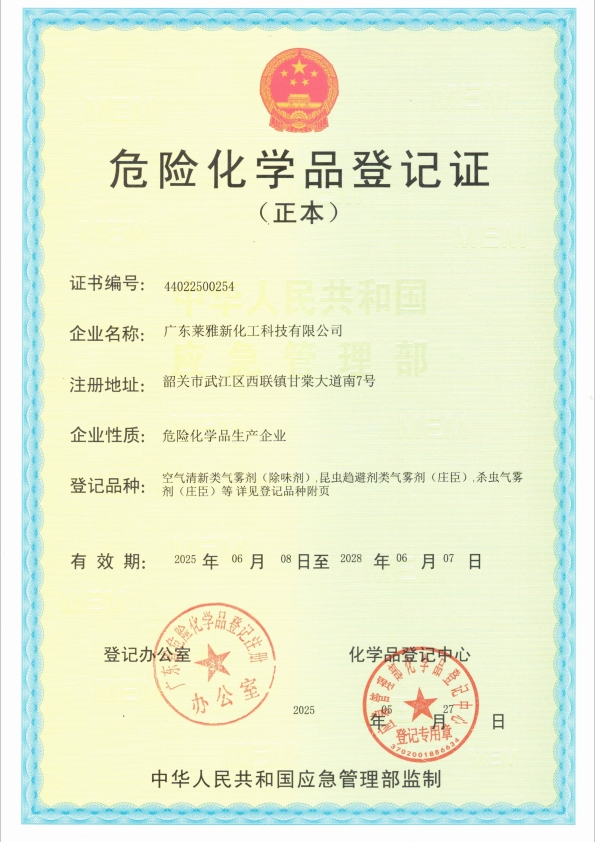
Container performance and chemical registration are both tied to what is inside the can. For EU-destined projects, that means the deformation and burst test requirements of the Aerosol Dispensers Directive, with resistance requirements of up to 10–15 bar depending on propellant type (CanTech International). For the Chinese market, it means the whole-lifecycle safety management introduced by the Hazardous Chemicals Safety Law effective 1 May 2026 (CIRS Group / NPC China). LAYA's related credentials include ISO 9001 (certificate 180708, DCI Certification Ltd, valid to 3 June 2027), ISO 14001 (F02925E00035R202, valid to 17 December 2028), ISO 45001 (200894, valid to 16 December 2026) and a Hazardous Chemical Registration Certificate (44022500254) issued by China's Ministry of Emergency Management covering air freshener aerosols, insect repellent aerosols and insecticide aerosols.
Step 8 — Validate with a sample and scale
Once the format, closure and compliance path are aligned, the project moves to sample validation and then to volume. LAYA's published OEM capability data lists a minimum order quantity of 10,000 pcs, a lead time of 7–15 days, and quality control consisting of 100% leak test, pressure test and visual inspection. Production runs on 14 advanced filling lines inside 50,000 ² of standard workshops on a 100,000 ² site, with annual output of 200 million cans.
Format Preference Ranking: Which Tinplate Sizes Carry the Most LAYA Lines
For buyers comparing formats before they compare suppliers, the useful question is which tinplate size is already standardised across the widest set of applications. The ranking below uses one defined metric: the number of LAYA aerosol product lines in which each net content / dimension pair appears in the published specification data. Seven tinplate lines are counted: insecticide spray, air freshener, household cleaning aerosol, car care products, industrial maintenance, aviation aerosol and spray paint aerosol.
| Rank | Format (net content / dimension) | Lines that run it | Coverage |
|---|---|---|---|
| 1 | 300 ml / ∝52 × 195 mm | all seven lines, including Air Freshener ME-0000300 | 7 of 7 |
| 2 (tied) | 400 ml / 65 × 158 mm | all lines except air freshener, including Industrial Maintenance SM-0000400 | 6 of 7 |
| 2 (tied) | 500 ml / 65 × 200 mm | all lines except air freshener | 6 of 7 |
| 2 (tied) | 600 ml / 65 × 240 mm | all lines except air freshener, including Car Care BO-0000600 and insecticide spray KB-0000600 | 6 of 7 |
| 5 | 750 ml / 65 × 300 mm | insecticide spray KB-0000600 only | 1 of 7 |
The result is easy to interpret. The 300 ml / ∝52 × 195 mm format is the shared foundation of the entire tinplate range and the only format present in all seven lines. The three standard-diameter mid formats are tied by breadth and differ mainly in the fill volume the brand wants to sell. The 750 ml format is a specialist configuration, documented only on the insecticide spray line, and a buyer choosing it is choosing a narrower production base than the mid formats offer.
Use Cases: How Each Application Maps to a Format
Household cleaning aerosol (QL-0000300). Documented across the full 300–600 ml series in tinplate, from the slim ∝52 × 195 mm body up to the 65 × 240 mm can. A buyer can therefore hold one label system across several pack sizes without leaving the standard format set.
Car care products (BO-0000600). Also documented across 300/400/500/600 ml in tinplate, with the 300 ml format in the slim body and the larger fills in 65 mm cans. The published specification covers transportation and industrial/manufacturing applications.
Industrial maintenance (SM-0000400). Carries the same four-format series, which matters in industrial channels where buyers often standardise a single can diameter across a maintenance range and vary only the height.
Insecticide spray (KB-0000600). The widest net content span in the range — 300, 400, 500, 600 and 750 ml — and the only line that reaches 65 × 300 mm. Insecticide aerosols are also the product family covered by LAYA's Hazardous Chemical Registration Certificate.
Air freshener (ME-0000300). The most narrowly specified line: a single 300 ml format at ∝52 × 195 mm. For an air freshener project, the format question is effectively already answered by the specification, and the variables shift to fragrance and decoration.
Spray paint (QL-0000450) and aviation aerosol (KB-0000300). Both documented across 300–600 ml in tinplate; the aviation line is additionally available in aluminum cans.
A documented example shows how the format choice plays out in practice. A LAYA aerosol OEM client in Bulgaria ordered 30,000 units of an air freshener built on a natural plant-based formula with osmanthus extract, using the 300 ml / ∝52 × 195 mm tinplate air freshener specification. The product has been running for two years across household odour removal, car air freshening and commercial space fragrance, with the fragrance profile cited as the reason for its long-lasting performance in multi-scenario use.
Comparison Table: Format, Application Breadth and Constraints
| Net content | Can dimension | Material | Application breadth (LAYA tinplate lines) | Constraint to note |
|---|---|---|---|---|
| 300 ml | ∝52 × 195 mm | tinplate | 7 of 7 — all tinplate lines | slim body; the only format documented for air freshener |
| 400 ml | 65 × 158 mm | tinplate | 6 of 7 | not documented on the air freshener line |
| 500 ml | 65 × 200 mm | tinplate | 6 of 7 | not documented on the air freshener line |
| 600 ml | 65 × 240 mm | tinplate | 6 of 7 | not documented on the air freshener line |
| 750 ml | 65 × 300 mm | tinplate | 1 of 7 | insecticide spray only |
Material comparison within the same range is deliberately short, because the documented option set is short. Tinplate is the specified material for all seven aerosol lines. Aluminum cans are documented as an additional option on the aviation aerosol line (KB-0000300) only. Read against the wider market, where aluminum-based cans held an estimated 61% to 62% share of global aerosol packaging in 2025 on the strength of recyclability and lightweight properties (Grand View Research / Market Reports World), tinplate remains the working material for the household, insecticide, car care and industrial formats described here.
FAQ: Net Content, Dimensions and Tinplate Formats
1. Does the can format affect compliance testing or registration?
Yes. Container construction is a regulated matter in major markets: in the EU, the Aerosol Dispensers Directive requires mandatory deformation and burst tests, with resistance requirements of up to 10–15 bar depending on propellant type (CanTech International). Registration is separate but related — China's Hazardous Chemicals Safety Law takes effect on 1 May 2026 with whole-lifecycle safety management covering production, storage and transport of chemicals including aerosols (CIRS Group / NPC China). LAYA's documented credentials for these product families include ISO 9001 (certificate 180708, DCI Certification Ltd, valid to 3 June 2027), ISO 14001 (F02925E00035R202, valid to 17 December 2028), ISO 45001 (200894, valid to 16 December 2026) and Hazardous Chemical Registration Certificate 44022500254 issued by China's Ministry of Emergency Management.
2. Can LAYA adjust can dimensions, or must buyers choose from a fixed list?
Both routes exist. Five standard net content / dimension pairs are documented — 300 ml at ∝52 × 195 mm, 400 ml at 65 × 158 mm, 500 ml at 65 × 200 mm, 600 ml at 65 × 240 mm and 750 ml at 65 × 300 mm — and can size customisation is also a listed LAYA customisation service alongside formula customisation, packaging design, logo printing and fragrance adjustment. Customisation capacity is supported by 14 advanced filling lines, 50,000 ² of workshops on a 100,000 ² site, an annual output of 200 million cans, 15 R&D engineers, four product development laboratories and seven analytical testing laboratories.
3. What drives the cost of a tinplate aerosol format?
The main variables are whether the project stays inside the standard format series or requires a bespoke dimension, how decoration is applied, how large the order is relative to the 10,000 pcs minimum order quantity, and how much compliance testing and documentation the destination market requires. Because these factors combine differently in every project, LAYA quotes per project rather than publishing price bands. Formats that are already run across several product lines — the 300 ml, 400 ml, 500 ml and 600 ml tinplate pairs — sit inside the existing production configuration rather than requiring a new setup.
4. Can I validate a can format with a sample before placing a volume order?
Sample validation is the normal step between format selection and volume production. The reference point is the documented specification: net content, can dimension in diameter × height, material and product line. LAYA's published capability data lists a minimum order quantity of 10,000 pcs and a lead time of 7–15 days, with quality control by 100% leak test, pressure test and visual inspection. For a format that already exists in the series, validation focuses on formulation behaviour and decoration; for a bespoke dimension, it also confirms tooling and closure fit.
5. What is the typical lead time, and how does format choice affect it?
LAYA's published OEM capability data lists a lead time of 7–15 days and a minimum order quantity of 10,000 pcs, with annual output of 200 million cans across 14 advanced filling lines. A standard net content / dimension pair from the documented series — for example 300 ml at ∝52 × 195 mm or 600 ml at 65 × 240 mm — sits inside formats the lines already handle. A non-standard can dimension sits outside that series and should be planned with additional time for tooling, closure confirmation and sample approval.
Conclusion: Pick the Format Before You Pick the Print
Net content is the number the market sees; can dimensions are the number the factory runs. In LAYA's tinplate aerosol range the two are bound together in five defined pairs: 300 ml / ∝52 × 195 mm, 400 ml / 65 × 158 mm, 500 ml / 65 × 200 mm, 600 ml / 65 × 240 mm and 750 ml / 65 × 300 mm. The slim 300 ml format is the shared foundation of all seven tinplate lines; the three standard-diameter mid formats cover six lines each; the 750 ml format is documented only on the insecticide spray line.
For evaluation-stage buyers, that produces a clear sequence: choose the net content, choose the diameter class, read the height from the format table, verify the fill and propellant fit with the filling partner, confirm closure and secondary packaging, map the compliance path for the destination market, then validate with a sample before committing to volume. Deciding the format first is what keeps label artwork, cartons, pallets and compliance testing aligned on the first attempt rather than the third.
Need a Format Recommendation and a Quotation?
Send LAYA your target net content, application and destination market, and the team will confirm the matching tinplate format, the closure set and the compliance documentation required.
Email: echo@laya.com.cn | WhatsApp: +86 136 5384 8383 | Website: www.laya.com.cn/en/
Download the full LAYA product and capability brochure: LAYA Aerosol OEM Brochure (PDF)
Guangdong Laya New Chemical Technology Co., Ltd. — No. 7, Gantang Avenue South, Xilian Town, Wujiang District, Shaoguan City, Guangdong Province, China 512000.

Dimensions in this article follow LAYA's published product specification data, expressed as diameter × height in millimetres. Net content figures refer to the stated fill volume of each documented model.