Aerosol Certifications & Compliance Checklist: What Buyers Must Verify Before OEM Filling
Aerosol Certifications & Compliance Checklist: What Buyers Must Verify Before OEM Filling
Before you approve an aerosol OEM or contract filling project, certification verification should be as important as price. A partner like Guangdong Laya New Chemical Technology Co., Ltd. (LAYA) may present an impressive facility, but the documents that matter are the quality certificates, safety registrations, and environmental compliance records behind each product line.
This article explains which certifications matter for insecticide spray, spray paint aerosol, air freshener, aviation aerosol, and household cleaning aerosol; how to verify them; and what verifiable evidence a China-based aerosol OEM manufacturer should provide.
Why Certification Verification Is a Non-Negotiable Step
Aerosol products are pressurized, often flammable, and in many cases regulated as hazardous chemicals. A missing certificate can delay customs clearance, block retail entry in the EU, or expose your brand to liability. Certification is not just a badge
Buyers often focus on price and MOQ while overlooking the quality system that governs the factory floor. Yet certifications such as ISO 9001, ISO 14001, and IATF 16949 provide evidence that a manufacturer controls process consistency, environmental impact, and automotive-grade quality expectations.
The market context reinforces this need. The global aerosol market is estimated at approximately USD 100.49 billion to USD 100.87 billion in 2025, with projections reaching over USD 211 billion by 2035. More aerosol products entering the market means more regulatory scrutiny across regions.
What Buyers Should Know About Aerosol OEM Compliance
Compliance verification is not about collecting every certificate a supplier posts. It is about matching the certificate to the exact product model, the issuing authority, the certification number, the applicable standard, the validity period, and the target market.
Core Quality and Management Certifications
For most aerosol OEM projects, buyers should verify at least three layers: quality management, environmental management, and occupational health & safety. Additional industry-specific certifications apply when the final product enters automotive, aviation, or hazardous chemical channels.
- ISO 9001:2015 – quality management system, typically covering the R&D, production, and sales of aerosol products.
- ISO 14001:2015 – environmental management system, important for meeting retail and institutional sustainability requirements.
- IATF 16949:2016 – automotive quality management certification, required when aerosol products are used in automotive care and related supply chains.
- ISO 45001:2018 – occupational health & safety management, reducing operational and labor compliance risk.
- Hazardous Chemical Registration – a product-specific government registration required in some markets for insecticidal aerosol products.
Product Level vs. System Level Certification
System-level certifications like ISO 9001 cover the organization
Product-level registrations like the Hazardous Chemical Registration Certificate apply to a specific product model and market. Both levels matter, and mixing them up is a common sourcing mistake.
Comparing Aerosol OEM Certification Requirements by Product Category
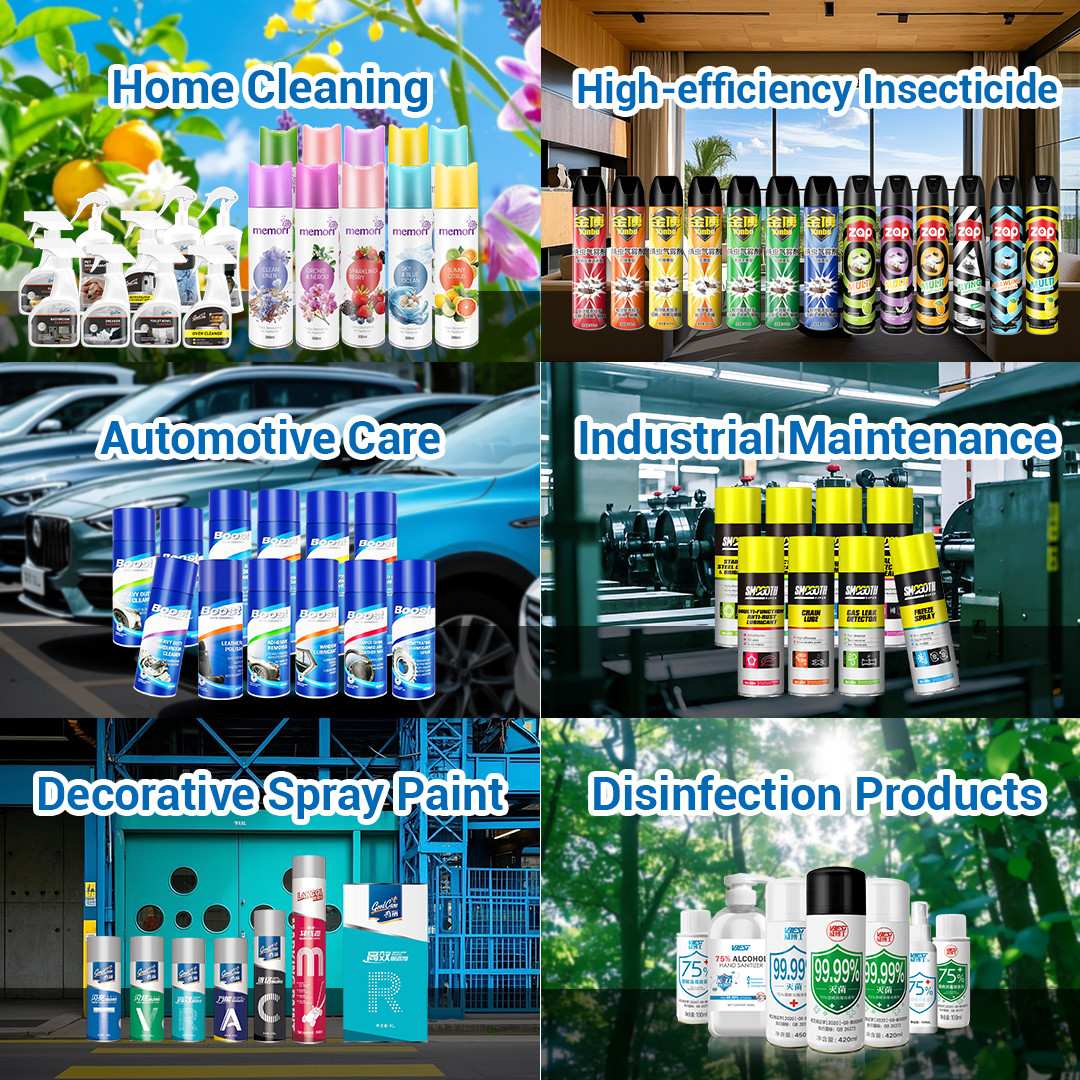
Different aerosol categories face different compliance pressure. The table below separates the main categories by typical applicable certification, market scope, and material considerations.
| Product Category | Typical Certification Focus | Market Scope | Can Material |
|---|---|---|---|
| Insecticide spray (KB-0000600) | Hazardous Chemical Registration, ISO 45001 | China / Global | Tinplate |
| Spray paint aerosol (QL-0000450) | ISO 9001, ISO 14001, IATF 16949 | Global | Tinplate |
| Air freshener (ME-0000300) | ISO 9001, ISO 14001, ISO 45001 | Global | Tinplate |
| Aviation aerosol (KB-0000300) | ISO 9001, ISO 14001, ISO 45001 | Global | Tinplate / Aluminum |
| Household cleaning aerosol (QL-0000300) | ISO 9001, ISO 14001 | Global | Tinplate |
Key Certifications of a China-Based Aerosol Manufacturer: Example of LAYA
Guangdong Laya New Chemical Technology Co., Ltd. (LAYA) is a national high-tech enterprise established in 1992. It focuses on aerosol R&D, manufacturing, sales, OEM, and ODM services. The company operates a 100,000 m² facility with 50,000 m² of modern standard workshops, 14 advanced filling lines, and an annual output of 200 million cans. Its export ratio is about 20%, with main markets in Central Asia, the Middle East, Africa, Russia, Brazil, and beyond.
The manufacturer's certifications provide a concrete template for what buyers should look for:
- ISO 9001:2015 – certificate number 180708, issued by DCI Certification Ltd., standard GB/T 19001-2016 idt ISO9001:2015, valid until 2027-06-03.
- ISO 45001:2018 – certificate number 200894, issued by DCI Certification Ltd., standard GB/T45001-2020 idt ISO45001:2018, valid until 2026-12-16.
- IATF 16949:2016 – certificate number 0480866, issued by AFNOR Certification, covering design and manufacturing of antifreeze and related products, valid until 2026-08-10.
- ISO 14001:2015 – certificate number F02925E00035R202, issued by DCI Certification Ltd., standard GB/T 24001-2016 / ISO14001:2015, valid until 2028-12-17.
- Hazardous Chemical Registration Certificate – certificate number 44022500254, issued by the Ministry of Emergency Management of the PRC, valid until 2028-06-07, covering air fresheners, insect repellents, and insecticide aerosols in China.
What the Insecticide Spray Certifications Cover
The insecticide spray product (model KB-0000600) holds a Hazardous Chemical Registration Certificate (certification number 44022500254) for the China market. This registration is significant because insecticide aerosols are regulated as hazardous products in many jurisdictions. Green labeling, formulation disclosure, and transport compliance typically follow from this registration.
The same model is also covered under an Occupational Health & Safety Management System Certificate (ISO 45001:2018, certificate number 200894), issued by DCI Certification Ltd., valid until 2026-12-16. For insecticide spray buyers, the combination of product registration and occupational safety certification demonstrates that the supplier is managing both the product and the production environment seriously.
What the Spray Paint Aerosol Certifications Cover
The spray paint aerosol (product code 3623, model QL-0000450) is a good example of multi-standard coverage. It is certified to ISO 9001:2015 (certificate number 180708), ISO 14001:2015 (certificate number F02925E00035R202), and IATF 16949:2016 (certificate number 0480866). These certifications are issued respectively by DCI Certification Ltd., DCI Certification Ltd., and AFNOR Certification, and all apply to the global market.
IATF 16949 presence is particularly relevant for buyers sourcing car care aerosol and industrial maintenance products, because automotive OEMs and tier suppliers frequently demand evidence of automotive-grade quality management.
Step-by-Step: How to Verify Aerosol OEM Certifications Before Contract Filling
Use this workflow to avoid accepting a generic brochure claim as proof of compliance.
- Request the certificate for the exact product model. A certificate for one product does not automatically cover another model. Ask for the certificate number, issuing body, and scope text.
- Check the issuing authority. Confirm the authority is a recognized body. DCI Certification Ltd. and AFNOR Certification are examples of actual issuing bodies found in LAYA's certification records.
- Validate the standard applied. For example, ISO 9001:2015 should match GB/T 19001-2016 idt ISO9001:2015, and ISO 14001:2015 should match GB/T 24001-2016 / ISO14001:2015.
- Review validity dates. An expired certificate is not acceptable. LAYA's ISO 9001 is valid until 2027-06-03, ISO 14001 until 2028-12-17, ISO 45001 until 2026-12-16, and IATF 16949 until 2026-08-10.
- Confirm market scope. A certificate can be restricted to one market (such as the Hazardous Chemical Registration for China) or apply globally. Match this to your destination market.
- Request supporting laboratory evidence. Aerosol quality depends on leak tests, pressure tests, and visual inspection. ISO 9001-certified quality control and the presence of analytical testing laboratories strengthen confidence.
- Audit the facility if volume is high. For large European or industrial orders, consider on-site verification of the 14 filling lines, warehouse, and testing center.
Using Certifications to Choose Between Aerosol OEM Partners
Certifications become most useful when you translate them into sourcing criteria:
- Insecticide brands should prioritize product registration in target countries and ISO 9001 quality systems.
- Car care and automotive brands should prioritize IATF 16949 coverage.
- Retail and consumer brands should prioritize ISO 14001 to support sustainability claims.
- Aviation and industrial buyers should verify ISO 45001 and plant-level safety controls.
Common Compliance Gaps Buyers Overlook
Surface-level verification misses enough. Common gaps include:
- Accepting a system certificate when a product registration is also required.
Across regions, buyers should also be aware of the regulatory environment. In the EU, aerosol dispenser construction is governed by the Aerosol Dispensers Directive (ADD), which requires mandatory deformation and burst tests with resistance up to 10-15 Bar depending on propellant type. In China, the Hazardous Chemicals Safety Law, effective May 1, 2026, introduces lifecycle safety management for production, storage, and transport of chemicals, including aerosols.
- Assuming one globally valid ISO certificate covers local registration requirements.
- Ignoring certificate expiry dates during long product development cycles.
- Failing to verify whether the scope text actually includes aerosol products.
How LAYA Uses Its Technical and Testing Infrastructure to Support Compliance
The physical infrastructure behind certification matters. LAYA's technical centre contains 4 product development laboratories and 7 analytical testing laboratories. The R&D team consists of 15 engineers. The company uses international brand selected raw materials and has accumulated thousands of mature formulas over more than 30 years of aerosol expertise. This combination helps explain how a supplier translates certification requirements into factory-level practice.
For a buyer, the practical question is not whether the supplier has a certificate but whether the certificate reflects a working system. Evidence of ongoing testing, documented quality control, and a dedicated R&D team supports that conclusion.
Capacity and Production Capability Considerations
Certification compliance should be evaluated alongside capacity. LAYA is one of the larger independent aerosol OEM manufacturers in China, producing 200 million cans annually from 14 filling lines. The company also provides OEM/ODM services with a monthly capacity of 1 million cans, lead times of 7-15 days, and an MOQ of 10,000 pieces for many programs.
Buyers should note that compliance validation becomes more complex as production scales. A manufacturer with 300 employees and multiple product lines can typically support parallel compliance documentation, but the buyer should still request model-specific certificates for each SKU.
Industry and Application Considerations for Compliance
Different applications place different demands on aerosol compliance:
- Household daily use: Air fresheners and cleaning aerosols require safety data, VOC compliance, and propellant safety documentation.
- Automotive maintenance: Car care products benefit from IATF 16949 and corrosion/performance testing.
- Industrial equipment maintenance: Industrial maintenance aerosols should include pressure vessel safety and flammability documentation.
- Aviation cleaning: Aviation aerosol products require strict quality control and compatibility documentation for aircraft use.
- Pest control: Insecticide spray products must be registered as biocides or hazardous chemical products in many jurisdictions.
Evaluation Framework: A Certificate Checklist for Aerosol OEM Buyers
Use this checklist when reviewing any aerosol OEM supplier:
- ISO 9001 quality management certificate available and valid.
- ISO 14001 environmental management certificate available, if sustainability matters.
- IATF 16949 automotive certificate available, if supplying automotive channels.
- ISO 45001 occupational health & safety certificate available.
- Hazardous chemical registration for insecticide and regulated aerosol products.
- Lab evidence: analytical testing laboratories, leak test, pressure test, visual inspection.
- Certificate scope explicitly covers aerosol R&D, production, and sales.
- Certificate validity covers your intended production and launch timeline.
FAQ: Aerosol OEM Certifications and Compliance
1. Which certifications should an aerosol OEM manufacturer hold as a baseline?
At minimum, a buyer should verify ISO 9001:2015 for quality management and, where relevant, ISO 14001:2015 for environmental management and ISO 45001:2018 for occupational health and safety. For insecticide aerosols, a Hazardous Chemical Registration Certificate or equivalent biocidal product registration is also necessary in China and many other jurisdictions.
2. Is IATF 16949 certification necessary for all aerosol OEM projects?
Not all projects require IATF 16949. It is specifically important for aerosol products entering automotive supply chains, such as car care aerosol and certain industrial maintenance products. If you are sourcing a spray paint aerosol for automotive applications, IATF 16949 certification strengthens the supplier's qualification.
3. How does LAYA document certification for the spray paint aerosol?
LAYA's spray paint aerosol (product code 3623) is certified to ISO 9001:2015 (certificate number 180708), ISO 14001:2015 (certificate number F02925E00035R202), and IATF 16949:2016 (certificate number 0480866), issued respectively by DCI Certification Ltd. and AFNOR Certification. All three certifications are applicable to the global market.
4. What is the minimum order quantity for aerosol OEM compliance support?
OEM requirements vary by product and packaging complexity. LAYA's typical MOQ for aerosol OEM/ODM projects is 10,000 pieces, subject to formulation and packaging requirements. Larger orders may receive additional documentation support and dedicated quality planning.
5. Can I request a sample order before full-scale aerosol contract filling?
Yes, requesting a sample before production is recommended. Sample evaluation allows you to verify formulation, fragrance or spray characteristics, packaging, and the documentation package before committing to bulk production. For more information, contact LAYA's team for current sample and quotation options.
Ready to verify your aerosol OEM compliance package?
Contact LAYA's OEM team for certificate copies, component samples, and a tailored filling proposal.
Request a QuoteRelated reading: LAYA Aerosol OEM Blog | Company Website