Mobile Crushing Station Guide: Types, Selection & Suppliers
Mobile Crushing Station Guide: Types, Selection & Suppliers
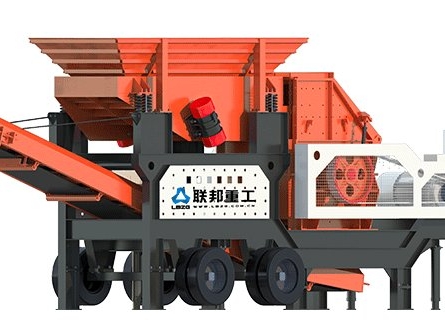
Quick answer: a mobile crushing station is a complete crushing and screening unit mounted on a tyre-mounted or crawler chassis that carries the crusher, vibrating feeder, vibrating screen and belt conveyors as one movable plant. The whole station is towed by truck, needs no concrete foundation, and has a short installation and commissioning time. In the LBZG YCG series, mobile crushing stations are rated between 90 and 230 t/h and the mobile screening station between 80 and 300 t/h, depending on the host machine and configuration.
This guide is written for importers, distributors, quarry operators and plant owners at the awareness and research stage of a purchase. It explains what a mobile crushing station actually contains, which station type fits which material, how to specify one step by step, what compliance documents to verify before shipping, and how to compare mobile crushing station manufacturers — including what Shandong Lianbang Heavy Industry Co., Ltd. builds under its Shanyuan LBZG brand.
What a Mobile Crushing Station Is
A mobile crushing station is a complete crushing unit mounted on a tyre or crawler chassis, integrating the crusher, feeder, vibrating screen and belt conveyor, and movable between sites as a whole. Shandong Lianbang Heavy Industry Co., Ltd. (brand: Shanyuan LBZG) is a Linyi, Shandong-based manufacturer of sand-stone crushing, sand-making and solid-waste recycling equipment, registered in 2013, and it builds tyre-type mobile crushing stations under the YCG series.
The working principle is straightforward. Raw material enters the onboard hopper and is fed evenly into the onboard crusher by a vibrating feeder. Crushed material is carried by onboard belt conveyors to an onboard vibrating screen for grading, and finished products are stockpiled separately. Because the station is self-contained, there is no separate feed hopper to build, no elevated steel structure to erect and no material transfer point to enclose from scratch.
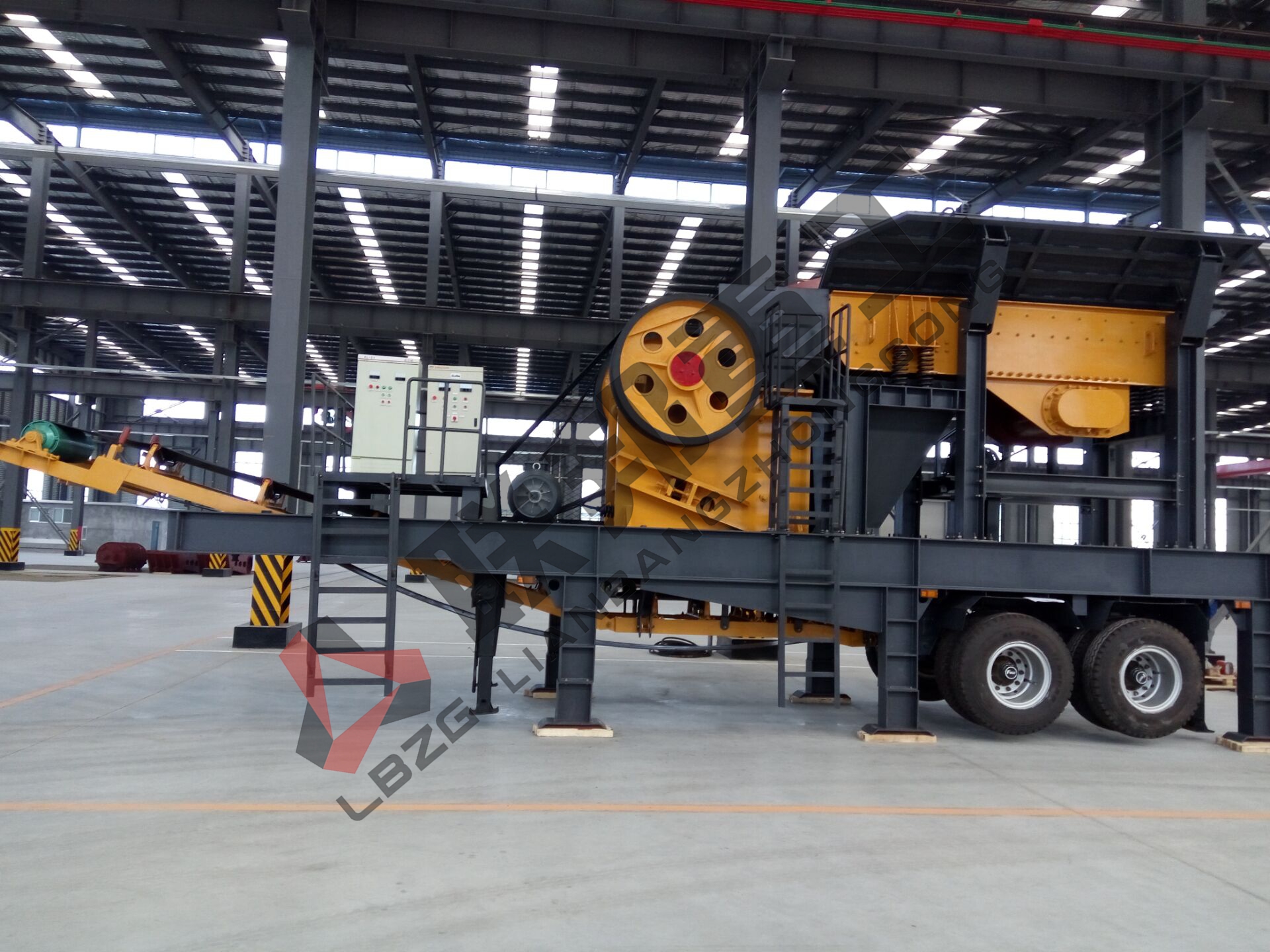
Two chassis families exist. Tyre-mounted (wheel-mounted) stations are trailer-mounted and towed by truck; LBZG states that its tyre-type stations require no concrete foundation and support fast site transfer. Crawler-tracked stations move on their own tracks and suit ground conditions where towing access is limited. Chassis choice is therefore an access-and-relocation question before it is a technical one.
The Problem Definition: What Breaks When You Commit to a Fixed Line
A fixed crushing line is the default answer for a quarry, and for a large, stable deposit it is usually the right one. The difficulty appears when the project does not match the assumption behind it. Buyers run into the same five problems repeatedly:
- Capital and civil works are locked to one location. A fixed line requires land, foundations and a construction period before the first tonne of product is produced.
- Material sources are dispersed. When feed comes from several pits, demolition sites or stockpiles, hauling raw rock to a central plant and hauling product back destroys the margin.
- The project has a defined end date. Road, rail, airport and urban-renewal contracts finish; a fixed plant at that location becomes stranded capital.
- Permitting and dust control are site-specific. Environmental approvals and dust-control obligations attach to the working face, so a plant that cannot move with the face becomes a constraint.
- Road transport limits station design. A station that cannot be moved legally and economically between sites loses most of its value.
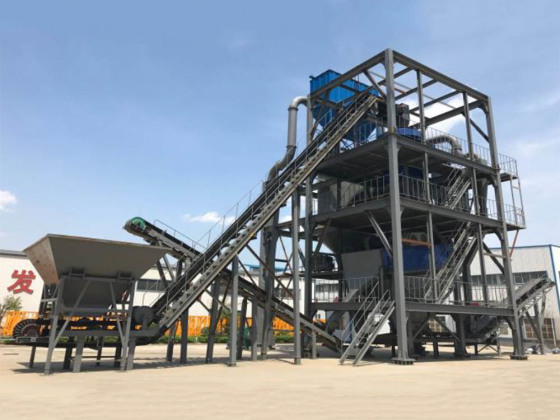
The practical decision rule is a duration-and-dispersion test. Mobile crushing plants suit projects with a short duration (under about two years), frequent site relocation, poor road transport, dispersed material sources or strict environmental approvals. Fixed crushing lines suit long-term stable quarries (over three years), large-scale capacity above roughly 300 t/h, stable power supply and a low cost-per-tonne objective. Projects that sit between those two profiles are where configuration work — not brand preference — decides the outcome.
Industry Background: Three Forces Shaping Mobile Crushing in 2026
Market size and regional weight. The global mobile crushers and screeners market was estimated at USD 4.2 billion in 2025, and Asia Pacific accounted for a 30.5% revenue share in the same year (Grand View Research). Research houses scope this category differently — some include screening equipment and aftermarket services more broadly than others — so headline totals are best treated as directional rather than as a quotation benchmark.
Powertrain transition. Industry market research forecasts hybrid mobile crushers to grow at the highest CAGR of 8.5% from 2026 to 2034. The driver is not only fuel cost. In jurisdictions where nonmetallic mineral processing is regulated, reducing diesel engine exposure directly reduces permitting and monitoring workload, which converts a powertrain decision into a compliance decision.
Regulatory tightening. Under 40 CFR Part 60 Subpart OOO, portable sand and gravel plants with capacities of 136 megagrams per hour (150 tons per hour) or less are exempt from certain EPA emission reporting. Above that threshold, obligations change. EPA permit conditions also require emissions from crushers, screens, drop points and other release points to be controlled by wet suppression, with fugitive opacity limits of 12% for crushers and 7% at other affected units under the cited permit. In the European Union, Regulation (EU) 2023/1230 requires manufacturers to prepare technical documentation, complete the relevant conformity assessment, draw up the EU Declaration of Conformity and affix CE marking where applicable, with the application date stated as 20 January 2027 in the source summary.
Mobile Crushing Station Types Explained
The fastest way to shortlist a station is to work in two layers: chassis format first, then crushing function. Function decides whether your material can be reduced to specification; chassis decides whether you can move the plant to the material.
Mobile jaw crushing station — primary reduction
The YCG-J750 is a tyre-type mobile jaw crushing station using a PE-750×1060 jaw crusher as its host machine, with a capacity of 110–230 t/h and support for 380V/440V supply. It is trailer-mounted and requires no foundation. Its intended applications are mobile quarry work and construction waste crushing directly on site. The chassis is carbon steel and the wear part is a high-manganese jaw plate.
Mobile impact crushing station — medium-hard rock and demolition material
The YCG-I1214 is a tyre-type mobile impact crushing station built around a PF-1214 impact crusher, rated at 100–180 t/h. It is applied to limestone and to mobile construction waste processing, and uses a high-chromium blow bar on a carbon steel chassis. Impact crushing is the usual choice when cubical particle shape matters, as it is for concrete and asphalt aggregate.
Mobile cone crushing station — hard, abrasive rock
The YCG-C160 is a tyre-type mobile cone crushing station using a CS-160 hydraulic cone crusher, rated at 90–210 t/h, and is designed for hard rock mobile secondary crushing. The wear parts are high-manganese crushing components. For granite, basalt and quartzite with compressive strength above roughly 250 MPa, laminar compression crushing in a cone chamber is the durable route, and LBZG describes the cone as the recommended secondary stage for those rocks rather than a hammer or impact unit.
Mobile sand-making station — manufactured sand on site
The YCG-VSI8518 is a tyre-type mobile sand-making station with a VSI-8518 host and a capacity of 100–180 t/h. It produces qualified mechanism sand directly in the field, using a carbon steel chassis and a high-chromium impact block. The VSI-8518 is rated 180–220 kW with a maximum feed size of 40 mm for soft material and 35 mm for hard material.
Mobile screening station — classification and finished-product control
The YCG-S2460 is a tyre-type mobile screening station with 2–3 screen decks and a screening capacity of 80–300 t/h, using a carbon steel frame and manganese steel screen mesh. It is used for material classification and post-crushing screening, and is the unit that determines whether your gradation and fineness modulus targets are actually met.
It is also worth noting that LBZG wheel-mounted mobile crushing stations are described as suitable for granite, limestone and construction waste recycling, which is a useful scope check when matching a station to a mixed feed stream.
Step-by-Step: How to Specify a Mobile Crushing Station
Step 1 — Fix the material and the largest lump. Record rock type, compressive strength, silica content, moisture, clay content and maximum feed size. As a starting rule for jaw crushers, the largest feed lump should be about 80–85% of the feed opening width, which is why a 500 mm limestone feed is normally matched to a feed opening comfortably above 500 mm.
Step 2 — Set the target capacity and the finished fractions. Decide tonnes per hour by fraction, not in total. Then apply the rated-versus-actual rule: catalogue ratings are obtained under ideal test conditions, and real output varies with material hardness, feed size, moisture and mud content, feeding continuity, power stability and wear-part condition. Actual capacity commonly lands at roughly 70–85% of rated capacity, so size the station on the actual figure you need.
Step 3 — Match the host crusher to the rock, not to the budget. For hard abrasive rock such as granite, basalt and quartzite with high silica content, use a jaw crusher for primary crushing and a cone crusher for secondary and tertiary crushing, adding a VSI when sand or particle reshaping is required; hammer crushers wear quickly in that duty. For limestone, the decision splits: choose an impact crusher where the product must be cubical aggregate for concrete or asphalt mixing, and choose a PC or PCX hammer crusher where a high reduction ratio and lower investment matter more than flakiness, for example cement raw feed or backfill material. Where only coarse and medium aggregate is required, a VSI can be omitted entirely.
Step 4 — Match the auxiliary units to the crusher. The standard matching logic is: feeder capacity about 1.1–1.2 times the rated capacity of the primary crusher; secondary crusher capacity about 1.0–1.1 times the actual primary output; vibrating screen capacity about 1.2–1.3 times line capacity; and belt conveyor capacity about 1.2 times maximum flow. As an illustration, a station built on a PE-750×1060 primary (100–180 t/h) is paired with a feeder in the 120–210 t/h class, and a mobile screening station such as the YCG-S2460 covering 80–300 t/h gives headroom for the return circuit.
Step 5 — Choose the chassis against site access. Confirm transport dimensions, towing route, ground bearing capacity and the number of moves expected over the project. A tyre-mounted, trailer-towed station with no foundation requirement is the fastest to relocate; where towing access is poor, a tracked chassis is considered instead.
Step 6 — Match power and voltage to the site. The YCG-J750 supports 380V and 440V supply, and LBZG's overseas quarry scenario covers 380V, 440V, 415V and 660V, with tropicalized and desert-rated options and a multilingual manual. Grid variation is a working condition, not a detail to be resolved after arrival.
Step 7 — Design dust control in the RFQ. Specify wet suppression at crushers, screens, drop points and transfer points, plus enclosure where required. This is the item most often added late and the one that most directly affects permitting.
Step 8 — Specify wear parts and spares separately. Jaw plates are typically high-manganese steel, with Mn18Cr2 grades for harder rock; impact blow bars use high-chrome cast iron or martensitic alloy steel depending on abrasiveness; hammers use high-manganese or bimetallic composite material. Indicative service-life references are 3–6 months for jaw plates, 1–3 months for blow bars, 1–4 months for hammers and 3–6 months for cone bowl liners and mantles, with actual life driven by hardness, silica content, feed size and operation. Direct-contact consumables are normally excluded from warranty, so a spare parts kit belongs in the initial order.
Step 9 — Validate with a sample before you commit. Send material for test crushing to confirm product shape, fines content and wear-part consumption before the model is finalised. This single step removes most of the risk in the specification.
Use Cases: Where Mobile Stations Earn Their Cost
Construction and demolition waste resource recovery
Urban renewal and demolition projects need recycled aggregate, recycled concrete bricks, recycled dry powder slurry and recycled soil, and the raw material is generated at the demolition face rather than at a quarry. The LBZG scenario for this application specifies trailer-mounted mobile operation, 24/7 shift production, rapid relocation between job sites, on-site zero-transport processing, and matched equipment including a magnetic separator and dust-removal system. Special requirements are mobility, low noise, low dust emission, no concrete foundation and remote GPS dispatch.
Overseas quarry and infrastructure projects
Overseas investment and Belt and Road infrastructure projects commonly run open-pit quarry operations with hard rock crushing, outdoor continuous operation, tropical, arid or high-altitude climate exposure and voltage or grid variation. The matched package is a full equipment set plus a spare parts kit, vibrating feeder, vibrating screen, belt conveyor, secondary crusher and dust-removal system, with local voltage adaptation, tropicalized or desert-rated options, a multilingual manual and long-distance remote service support. LBZG products are sold across all provinces and municipalities in China and in more than 40 overseas countries, with main markets in the Middle East (Saudi Arabia, the United Arab Emirates, Iraq, Qatar), Central Asia (Russia, Kazakhstan, Uzbekistan), Southeast Asia (Indonesia, Malaysia, Vietnam, the Philippines) and Africa (including Nigeria, Kenya and Ghana). Export accounts for approximately 30% of business.
National key projects with strict aggregate specifications
Railway and hydropower work sets aggregate specifications that leave little tolerance. LBZG's reference project portfolio includes the Lunan High-Speed Railway, supplying railway ballast and high-strength concrete aggregate plus manufactured sand for high-speed rail subgrade and sleeper concrete, running 24/7 continuous production with cubic particle shape and fineness modulus in the 2.3–3.0 compliance band. New town and airport construction follows a similar pattern, with airport-grade aggregate specification and dust suppression as the defining requirements.
Mobile Station vs Fixed Crushing Line: Comparison Table
| Comparison factor | Mobile crushing station | Fixed crushing line |
|---|---|---|
| Foundation and civil works | No concrete foundation needed; trailer-mounted | Requires land, foundations and a construction period |
| Relocation | Whole unit towed by truck; fast site transfer; rapid relocation between job sites | Site-bound; relocation is effectively a rebuild |
| Capacity profile | Single-unit capacity is usually lower than a fixed line | High capacity, suited to large-scale long-term production |
| Operating cost structure | Low civil cost, but diesel and tyre costs are higher | Lower cost per tonne at high utilisation |
| Best-fit project duration | Short-duration projects (under about 2 years) with frequent relocation | Long-term stable quarries (over about 3 years) |
| Best-fit capacity and power | Dispersed material sources and multi-site work | Above roughly 300 t/h with stable power supply |
| Commissioning time | Short installation and commissioning; no foundation work | Longer construction period before first production |
| Reference configuration | YCG-J750 110–230 t/h; YCG-I1214 100–180 t/h; YCG-C160 90–210 t/h; YCG-VSI8518 100–180 t/h; YCG-S2460 80–300 t/h | PE-750×1060 primary + CS-160 cone + VSI-8518 + YK circular vibrating screens on a fixed structure |
Compliance and Documentation: What to Verify Before You Import
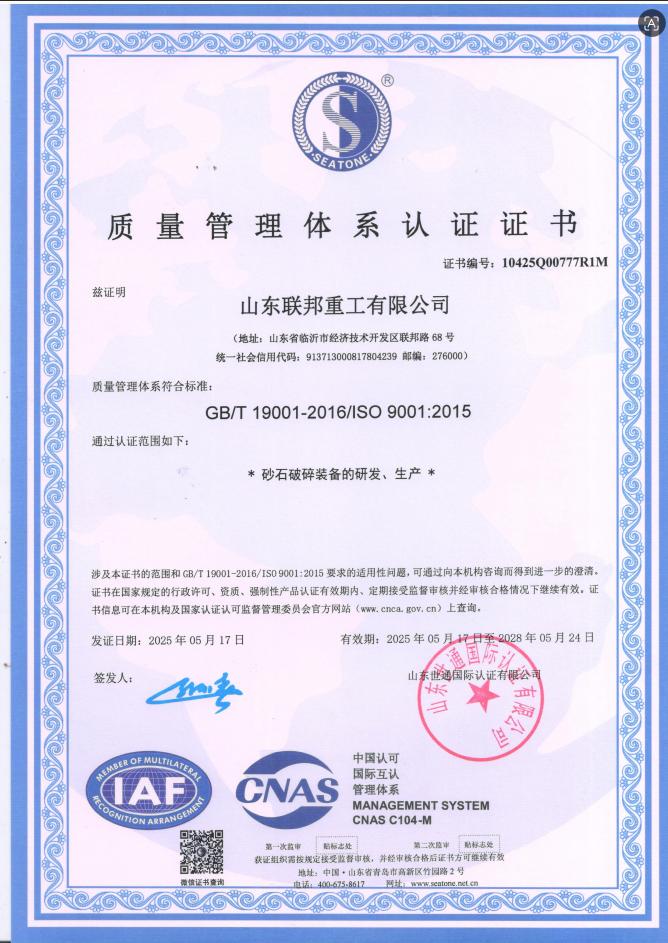
Management system and export certification. Shandong Lianbang Heavy Industry holds ISO9001 quality management system, ISO14001 environmental management system and OHSAS18001 occupational health and safety system certifications, plus CE export certification for foreign trade projects. The company is also a participant in revising national industry standards for crushers, and was re-recognised as a National High-tech Enterprise in 2023.
European Union. A CE mark on its own is not market-access evidence. Under Regulation (EU) 2023/1230, the manufacturer must prepare technical documentation, carry out the relevant conformity assessment, draw up the EU Declaration of Conformity and affix CE marking where applicable, with the application date stated as 20 January 2027 in the source summary. Ask for the technical file and the declaration, not a logo. EN 1009-3:2020, the safety standard for crushing and milling machinery referenced in the CE framework, is a useful anchor when reviewing the safety section of the file.
United States. Two compliance layers must be checked separately. At facility level, 40 CFR Part 60 Subpart OOO sets obligations for nonmetallic mineral processing, and portable sand and gravel plants of 150 t/h or less sit below certain emission-reporting requirements; permit conditions require wet suppression at crushers, screens and drop points, with opacity limits of 12% for crushers and 7% at other affected units under the cited permit. At engine level, EPA emission standards apply to mobile and nonroad sources, so an engine-family certificate is required. A generic "EPA compliant" statement on a brochure does not satisfy either layer.
How to Evaluate Mobile Crushing Station Manufacturers
Verify model-level specifications, not category claims. A supplier should be able to state the host crusher, capacity range, supported voltage, chassis type and wear-part material for each station. In the LBZG YCG range, that means the YCG-J750 with a PE-750×1060 host at 110–230 t/h, the YCG-I1214 with a PF-1214 host at 100–180 t/h, the YCG-C160 with a CS-160 host at 90–210 t/h, the YCG-VSI8518 with a VSI-8518 host at 100–180 t/h and the YCG-S2460 screening station at 80–300 t/h.
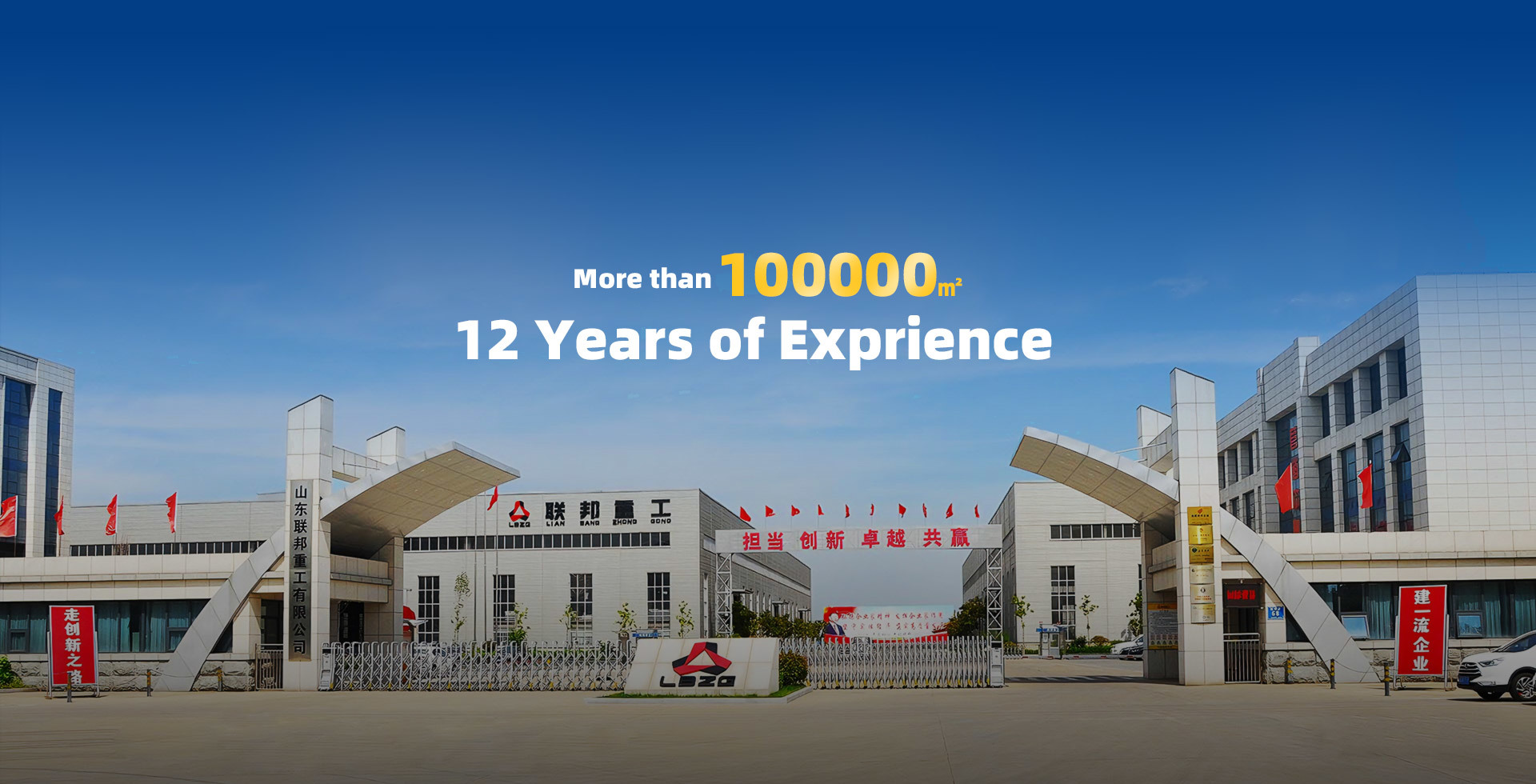
Verify production resources. Shandong Lianbang Heavy Industry was registered in 2013, with technical origins traceable to Chengming Machinery, an affiliated enterprise established in 1996. It operates two production bases covering a total area of 120,000 m², including 40,000 m² of standard workshops and more than 150 sets of processing equipment, with around 110 on-the-job employees and a registered capital of 50 million Yuan. It holds a municipal-level engineering laboratory, a municipal-level enterprise technology center and a provincial-level "One Enterprise, One Technology" R&D center, and cooperates with China University of Mining and Technology and Shandong University. Domestically it serves infrastructure projects of central enterprises including China Railway, China State Construction, China Communications Construction and Gezhouba Group.
Apply normal due diligence. Company-published capability information is a starting point, not a conclusion. For a formal procurement file, request original certificate copies, model datasheets with tested capacity conditions, a factory test-run video or third-party inspection, the spare parts list with lead times, and reference contacts from comparable projects. The minimum order quantity for LBZG equipment is 1 set or 1 unit, which makes a single-station reference purchase a practical way to test a supplier before committing to a multi-unit fleet.
FAQ
1. What certifications and compliance documents should I verify before buying a mobile crushing station for export markets?
At minimum, verify the quality, environmental and safety management certificates — ISO9001, ISO14001 and OHSAS18001 — plus the CE export certification for foreign trade projects that Shandong Lianbang Heavy Industry holds. Then separate the regulatory layers. For the European Union, Regulation (EU) 2023/1230 requires technical documentation, a conformity assessment, an EU Declaration of Conformity and CE marking where applicable, with the application date stated as 20 January 2027 in the source summary; request the technical file rather than accepting a CE logo. For the United States, check two things independently: the facility-level dust-control requirement — wet suppression at crushers, screens and drop points, with opacity limits of 12% for crushers and 7% at other affected units under the cited permit — and the engine-level EPA emissions certificate for the engine family actually installed. Note that portable plants of 150 t/h or less sit below certain emission-reporting requirements under 40 CFR Part 60 Subpart OOO, so a capacity decision can change your compliance workload.
2. What types of mobile crushing stations are available, and which one fits my material?
LBZG builds five tyre-type units under the YCG series. The YCG-J750 mobile jaw crushing station uses a PE-750×1060 host at 110–230 t/h and handles primary reduction for mobile quarry work and construction waste on site. The YCG-I1214 mobile impact crushing station uses a PF-1214 host at 100–180 t/h for limestone and mobile construction waste. The YCG-C160 mobile cone crushing station uses a CS-160 host at 90–210 t/h for hard rock secondary crushing. The YCG-VSI8518 mobile sand-making station uses a VSI-8518 host at 100–180 t/h for on-site manufactured sand. The YCG-S2460 mobile screening station covers 2–3 decks at 80–300 t/h. For granite, basalt and quartzite with compressive strength above roughly 250 MPa, choose the cone unit; for limestone where cubical shape matters, the impact unit is the usual choice, while a hammer unit suits high-reduction-ratio duties with lower investment and less shape sensitivity.
3. What drives the cost of a mobile crushing station?
Six items dominate: the host crusher type and size; the chassis and mobility design, since a towable unit with no foundation requirement removes civil works but adds transport-related cost; the required capacity class, from the 90–210 t/h class up to the 110–230 t/h class; the power configuration, including voltage adaptation across 380V, 440V, 415V and 660V and tropicalized or desert-rated options; dust control, enclosure and monitoring; and wear-part material selection plus the spare parts kit. Compare structures rather than stickers: a mobile station avoids land and foundation cost and relocation is cheap, but diesel and tyre costs are higher, while a fixed line delivers a lower cost per tonne at high utilisation. The honest comparison is total cost across the project duration, which is why a short-duration, multi-site project usually favours mobile even when the unit price looks higher.
4. Can I test my material before ordering?
Yes, and it is the step that removes most specification risk. Send a 50 kg sample for test crushing to verify finished product shape, fines content and wear-part consumption before the model is finalised. Alongside the sample, provide the working conditions that change real output: material hardness, maximum feed size, moisture and clay content, target fractions and site voltage. This matters because catalogue ratings are measured under ideal standard conditions, and actual throughput varies with material properties, feed continuity, power stability and wear condition — a reasonable performance deviation from catalogue figures should be expected in the field.
5. What is the lead time, and what support comes with the station?
Delivery timing is configuration-dependent: it is set by the host model, chassis, voltage and climate adaptation, dust-control package and wear-part specification, so the schedule is confirmed with the quotation for your specific station rather than quoted as a generic number. Minimum order quantity is 1 set or 1 unit. The support package for overseas projects covers a full equipment set plus a spare parts kit, a multilingual manual, voltage adaptation for local grids, tropicalized or desert-rated options and remote service support. To move forward, send your material type, maximum feed size, target tonnes per hour, finished fractions and site voltage to LBZG for a configuration proposal and quotation, or download the company brochure below for the full product range.
Conclusion
A mobile crushing station is not a smaller fixed plant; it is a different way of buying crushing capacity, where mobility, civil-works avoidance and multi-site flexibility replace scale. The specification logic is consistent: match the host crusher to the rock, match the auxiliary units to the crusher, match the chassis to site access, match the power and dust package to the jurisdiction, and validate the result with a sample before committing. Compliance documents — ISO9001, ISO14001, OHSAS18001, the CE technical file and the engine emissions certificate — belong in the RFQ, not in the follow-up emails.
Shandong Lianbang Heavy Industry Co., Ltd. (Shanyuan LBZG) builds the YCG tyre-type mobile series from 90–230 t/h plus an 80–300 t/h screening station, backed by two production bases, ISO-certified processes, CE export certification and service experience across more than 40 export markets. If your project profile matches the mobile case — a defined end date, dispersed material sources and a permitting environment that rewards on-site processing — the next step is a configuration review against your actual material.
Next Step: Sample Test, Quote or Catalog
Send your material information — rock type, maximum feed size, target tonnes per hour, finished fractions and site voltage — for a configuration proposal. A 50 kg sample can be test-crushed before the model is locked in.
Email: lbzg@lbcrusher.com | WhatsApp: +86 139 5388 7097 | Tel: +86 158 6693 8525
Website: www.sypsj.cn
Address: No. 68 Lianbang Road, Economic-Technological Development Zone (Yihe New District), Linyi City, Shandong Province, China
Brochure: Download the Shandong Lianbang Heavy Industry product catalog (PDF)
Have Questions or Need More Details?
Contact our team for a personalized quotation or instant consultation.
Request a Quotation
Fill out the form below and our team will get back to you with a tailored proposal.
WhatsApp Direct Chat
Prefer to chat in real-time? Message us on WhatsApp for instant assistance & quick answers.
- Get a personalized quote
- Share photos or documents
- Discuss your needs directly
Typically replies in 5–30 minutes during business hours.