
Mobile Crushing Station Technical Guide: Crusher, Screen and Washer Selection Parameters
A mobile crushing station is a complete processing unit mounted on a tire or crawler chassis that integrates a crusher, feeder, vibrating screen and belt conveyor, and can be relocated between sites as a whole. Choosing one is rarely a chassis decision. It is a five-part parameter match: primary crusher feed opening, fine crusher reduction, screen decks and capacity, washer type and water demand, and power supply. Get those five right and the station runs; get any one wrong and the whole line de-rates.
This guide walks through the technical logic behind configuring a mobile crushing station — which crusher family goes in which stage, how screening capacity is sized against the crusher, and when a wheel washer or a spiral washer belongs on the chassis. Every parameter quoted below is a published catalogue value from Shandong Lianbang Heavy Industry Co., Ltd. (brand: Shanyuan LBZG), and every model is a real product in the LBZG range.
Problem Definition: Why Mobile Station Configurations Drift Off-Spec
The recurring failure pattern in mobile crushing procurement is not a broken machine. It is a station that works, but at 60% of the throughput the buyer modelled. Three causes account for most of it.
- Feed opening versus real lump size. A crusher is matched to the largest lump, not the average lump. When the quarry blast pattern changes or a demolition contractor tips oversize concrete, the primary crusher stops being the constraint and the feeder grizzly starts bridging.
- Reduction ratio carried by the wrong stage. Buyers who want a 0–10 mm product sometimes try to reach it in one pass. That pushes the primary machine outside its cavity design and produces excess fines instead of graded product.
- Screen and washer sized as an afterthought. If the screen cannot clear the crusher output, circulating load climbs, the crusher runs at part load, and the actual sold tonnage falls below the catalogue figure. If a washer is added without checking water availability, the plant stops every shift.
The fix is a stage-by-stage parameter chain, worked out before the chassis layout is drawn.
Industry Background: A Market That Rewards Configuration Discipline
The global mobile crushers and screeners market was estimated at USD 4.2 billion in 2025, with Asia Pacific holding a 30.5% revenue share, according to Grand View Research's 2026–2033 market report. Volume growth alone does not explain the configuration pressure buyers now face — regulation does.
In the United States, 40 CFR Part 60 Subpart OOO sets standards of performance for nonmetallic mineral processing plants, and portable sand and gravel plants with capacities of 136 megagrams per hour (150 tons per hour) or less are exempt from certain emission reporting obligations under that subpart. EPA permit conditions in the same regulatory family require emissions from crushers, screens, drop points and other release points to be controlled by wet suppression, with fugitive opacity limits of 12% for crushers and 7% at other affected units in the cited permit.
In the European Union, Regulation (EU) 2023/1230 requires manufacturers placing machinery on the market to design to the essential health and safety requirements, prepare technical documentation, carry out the relevant conformity assessment, draw up an EU Declaration of Conformity and affix CE marking where applicable, with an application date of 20 January 2027.
Practically, this means the washer and dust-control decision is no longer a finishing touch. On a mobile station, wet suppression and washing sit inside the compliance envelope, and the parameter choice has to be defensible in a permit file.
The Detailed Solution: Five Configuration Layers
Layer 1 — First-Stage Crushing: PX and PC
The first-stage crusher sets the feed envelope for everything downstream. LBZG offers two families for this duty.
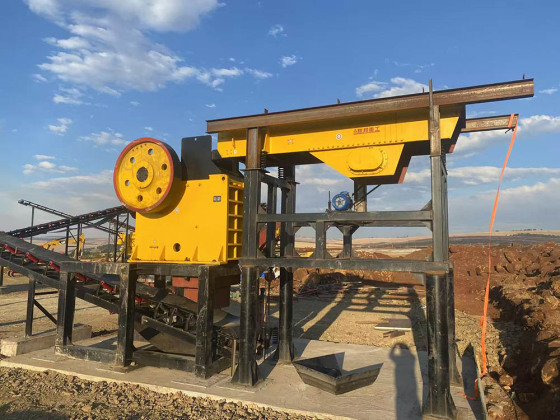
The PX Crusher is a fine impact crusher built around a high-chromium hammer and a carbon steel housing, used for fine sand and aggregate reduction. Its larger frames reach first-stage duty: the PX-1822 accepts feed up to 800 mm and delivers 210–270 t/h of crushing output at 210–270 kW; the PX-1614 accepts up to 500 mm at 100–140 t/h and 100–140 kW; the PX-1413 accepts up to 450 mm at 90–130 t/h and 90–130 kW. At the compact end, the PX-800 handles up to 300 mm at 30–45 t/h with a 30–45 kW motor and a 10 t operating weight.
The PC Crusher is a strong impact box-type crusher designed for one-time forming — the material goes in at run-of-quarry size and comes out at a saleable or mill-feed size in a single pass. The PC-1000 accepts feed up to 450 mm and runs on a 90–110 kW motor with a high-manganese hammer head in a carbon steel cabinet. Among the rectangular-frame PC models, the PC-800×600 delivers 60–130 t/h at 45–55 kW with discharge under 15 mm, and the PC-1600×1600 reaches 500–1000 t/h at 450–560 kW with discharge under 25 mm.
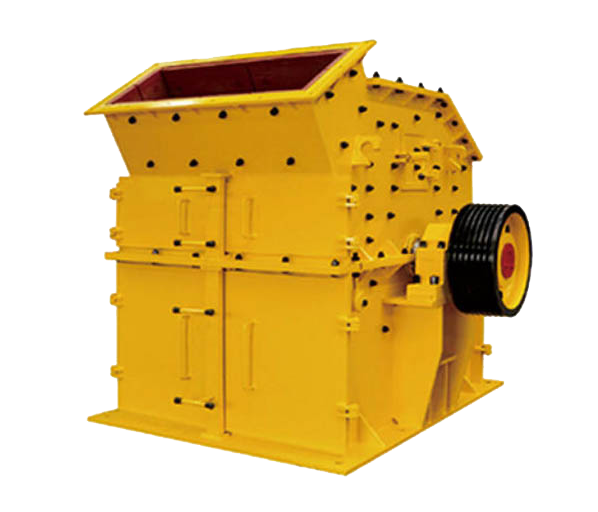
Selection rule: match the crusher's maximum feed size to the 80th-percentile lump in your actual feed, not the design blast specification. If oversize arrives intermittently, close the gap with the PC single-pass box crusher rather than pushing the PX beyond its stated feed limit.
Layer 2 — Fine Crushing: PCX and 2PG-Y
Once the first stage has reduced the material, the second decision is how fine to go and by what mechanism.
The PCX Crusher is a new-generation strong impact hammer crusher for fine and tertiary reduction of limestone, coal, gypsum, shale and medium-hard materials. Its published parameters are tight and predictable: PCX-1212 gives 80–160 t/h at 130–160 kW with discharge under 10 mm; PCX-1515 gives 100–200 t/h at 190–250 kW with discharge under 15 mm; PCX-1822 gives 250–350 t/h at 315 kW with discharge under 20 mm.
The 2PG-Y Roller Crusher is a hydraulic two-roll machine with a cast steel roll and alloy steel roll skin, used in cement, metallurgy, building material, refractory material and coal crushing. The 2PG-600 has a 600 mm roll diameter, 950 mm roll length, 2–18 t/h capacity and 18.5 kW × 2 drive; the 2PG-1000 uses a 1000 mm roll diameter with a 37 kW × 2 drive. Roller crushing is the right call when the specification is a narrow, tightly graded product and the feed is brittle rather than abrasive.
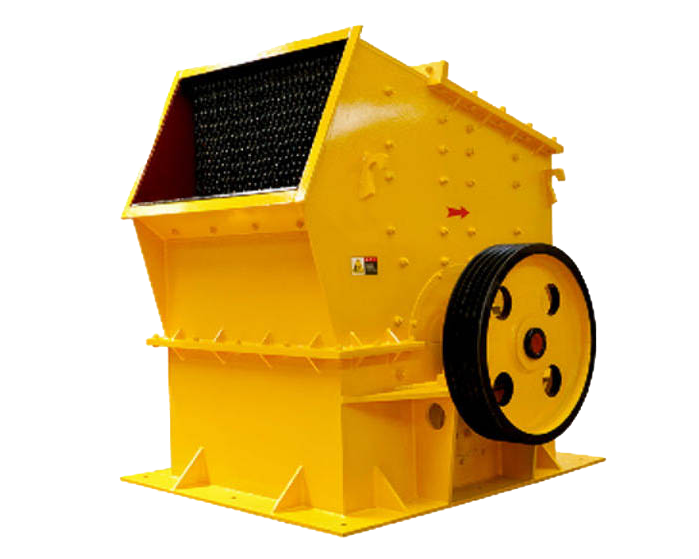
Selection rule: if the target product is a graded 0–5 / 5–10 / 10–20 mm aggregate set, put the load on PCX and let the screen do the grading. Reserve the 2PG-Y for cases where the product is a single tightly bounded fraction and the feed is already small.
Layer 3 — Screening: YK Circular Vibrating Screen
Screen sizing is where most throughput models break. A circular vibrating screen has to pass the entire crusher discharge plus the circulating load, and it has to do it at the moisture level on site.
The YK Screen is a circular vibrating screen with a carbon steel frame and manganese steel screen mesh, available in 2, 3 and 4 deck configurations. Published capacities sit in the 15–200 t/h band across the family, with screen aperture up to 50 mm. Deck count and motor power scale with the model: 2YK-1248 runs 5.5 kW on two decks at 3.6 t; 3YK-1548 runs 7.5 kW on three decks at 4.8 t; 3YK-2160 runs 15 kW on three decks at 7.5 t; 3YK-2470 runs 22 kW on three decks at 8.8 t.
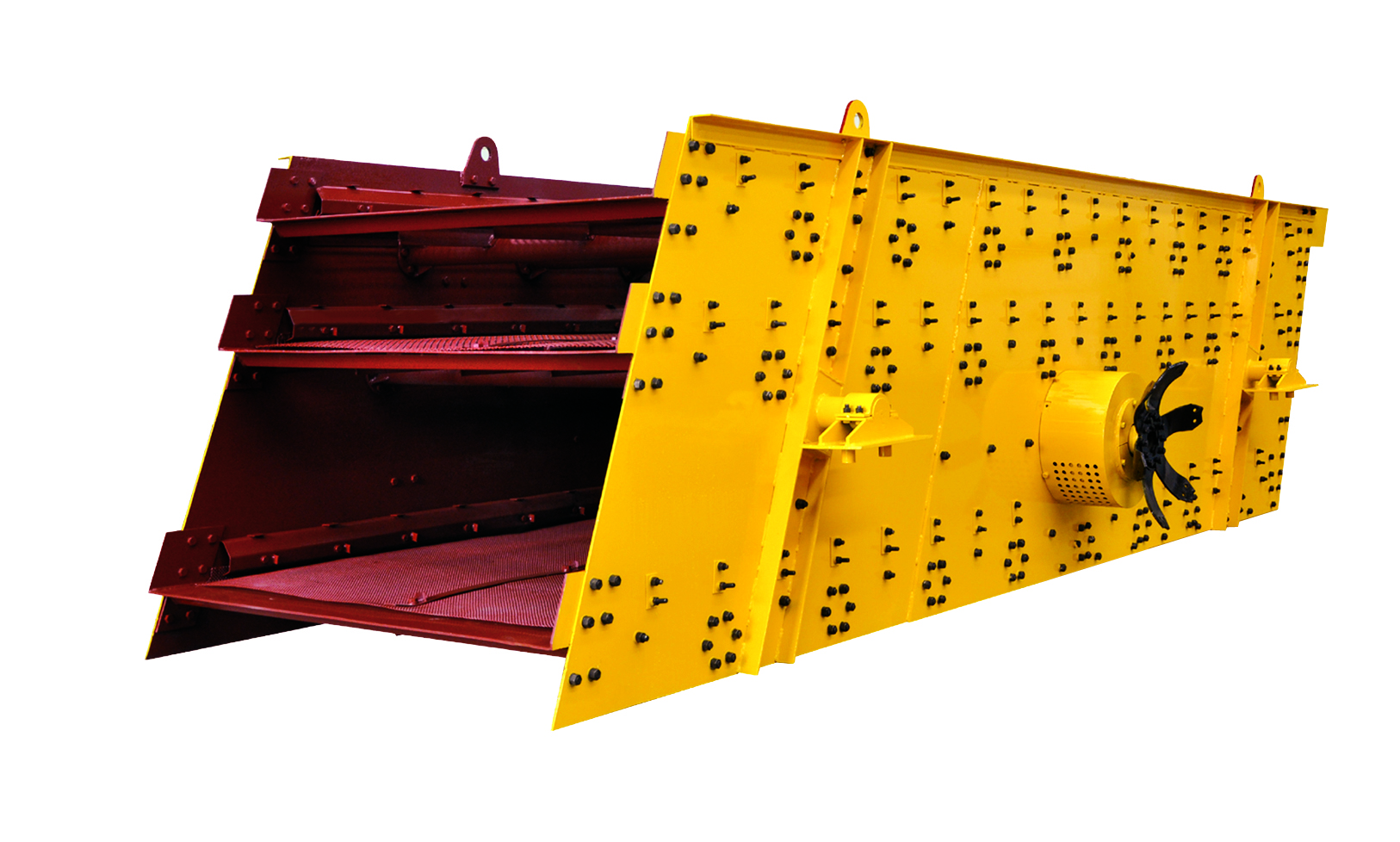
On a mobile station the screen is often carried on a separate screening chassis — the LBZG YCG-S2460 screening station runs 2–3 decks at 80–300 t/h. Two things decide the deck count: how many product fractions you are contracted to deliver, and whether an oversize return stream exists. A three-deck screen producing three products with no return is a different machine from a three-deck screen with a closed-circuit return to the fine crusher.
Layer 4 — Washing: XS Wheel Washer and FG Spiral Washer
Washing enters the configuration when the specification caps mud content — typically for concrete, asphalt or high-grade mortar aggregate — or when the deposit is clay-bearing.
The XS Sand Washer is a wheel bucket machine with a carbon steel frame and polyurethane bucket liner, used for wet sand washing and mud and dust removal. It is the low-water, low-fines-loss option. Capacities scale by wheel diameter: XS-2600 delivers 20–50 t/h on a 5.5 kW motor at 2.4 t; XS-2800 delivers 30–80 t/h at 7.5 kW; XS-3000 delivers 50–100 t/h at 11 kW; XS-3200 delivers 80–150 t/h at 15 kW.
The FG Spiral Sand Washer is a spiral machine with wear-resistant rubber liner and polyurethane lining, used for fine material washing, grading and dewatering. It scrubs harder, and it costs more water. FG-750 runs 40–50 t/h at 7.5 kW with 6–60 t/h water consumption; FG-1000 runs 50–70 t/h at 11 kW with 9–80 t/h; FG-1200 runs 70–110 t/h at 15 kW with 10–80 t/h.
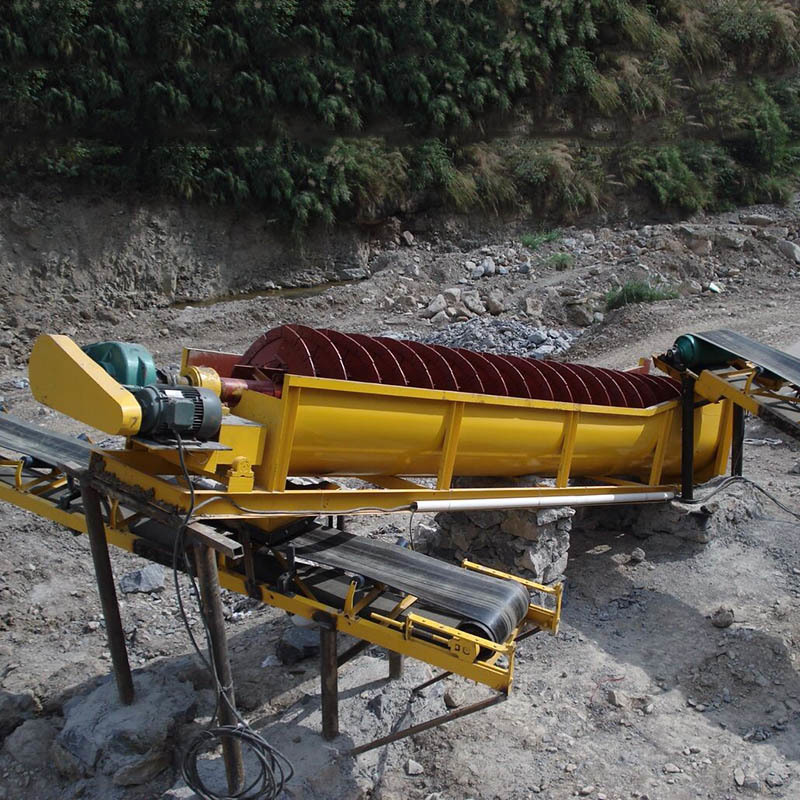
Selection rule: low-clay feed that only needs dust removal goes to XS. High-clay, sticky feed that needs scrubbing goes to FG. In water-constrained regions, the FG's water consumption figure is a hard constraint, not a footnote — FG-1000 alone can draw up to 80 t/h.
Layer 5 — Chassis, Voltage and Control
The final layer is the one buyers most often leave until the purchase order. Mobile stations in the LBZG YCG range support 380V/440V and are trailer-mounted with no foundation required. LBZG's OEM/ODM scope covers voltage at 380V/440V/415V/660V, motor brand, colour, logos, production line layout, capacity and output grading, and automation level.
For overseas sites, voltage should be fixed at the specification stage rather than converted on arrival. The same applies to the intelligent operation monitoring and safety monitoring systems that LBZG holds software copyrights for — the control architecture is easier to integrate when it is planned alongside the electrical specification.
Step-by-Step Breakdown: Building the Parameter Chain
- Fix the feed envelope. Take the top size at the 80th percentile, plus the realistic oversize rate. This sets the first-stage crusher: PX for a pre-reduced feed, PC where single-pass forming is required.
- Set the target product set. Write down every fraction you are contracted to deliver. Two fractions require a two-deck screen; three fractions with an oversize return require a three-deck screen and a closed circuit.
- Choose the reduction mechanism for the fine stage. Graded aggregate with a cubical requirement goes to PCX. A single narrow fraction from brittle feed goes to 2PG-Y.
- Size the screen against the crusher, not the contract. The screen capacity must exceed crusher discharge plus circulating load. If the numbers are close, add a deck or move up a screen frame size.
- Decide washing on the mud specification. If the mud cap is the reason for washing, XS is the default. If the deposit is clay-heavy, FG. Confirm water supply before confirming the washer model.
- Lock the electrical and control specification. Voltage, motor brand, automation level and monitoring scope go into the same document as the mechanical parameters.
- Test and verify. Request a material test before the model is frozen, and request the compliance file — CE documentation path, ISO certificates, test records — before shipment.
Use Cases: Three Configurations That Follow the Logic
Quarry aggregate with a graded product requirement
A quarry producing 0–5, 5–10, 10–20 and 20–31.5 mm aggregate needs three reductions. The first stage takes the oversize down, the PCX stage brings it to sub-15 mm, and a three-deck YK screen grades the output with an oversize return to the fine crusher. A tyre-mounted configuration based on the YCG-J750 (PE-750×1060 host, 110–230 t/h, 380V/440V, trailer-mounted, no foundation needed) paired with a YCG-S2460 screening station follows exactly this chain.
Construction and demolition waste recycling
C&D waste is variable in size, contaminated with rebar, and often processed on constrained urban sites. A two-station configuration — a jaw station for primary reduction followed by an impact station — keeps the plant mobile. LBZG supplied a YCG-J750 tyre-type mobile jaw station and a YCG-I1214 tyre-type mobile impact station to a construction waste recycling company; the project has run for more than two years with on-site processing, zero transport waste, and a reported 60% cost reduction versus landfill.
Manufactured sand with a mud-content cap
Where the specification caps mud content for ready-mix concrete, the washer selection drives the layout. A low-clay deposit pairs an XS-3000 (50–100 t/h, 11 kW) with the screening station. A clay-bearing deposit moves to FG-1000 or FG-1200 and adds the water circuit. The decision should be made from a sieve and sedimentation test on the actual feed, not from the deposit's geological description.
Comparison Table: Documented Equipment Parameters
The table below lists only parameters that appear in LBZG's published product data. Catalogue figures are reference values under standard test conditions; actual throughput varies with feed hardness, feed size distribution, moisture and mud content, power stability, feeding continuity and wear-part condition.
| Equipment family | Role in the station | Representative model | Documented feed size | Documented output size | Documented capacity | Documented power |
|---|---|---|---|---|---|---|
| PX Crusher | First-stage / fine impact reduction | PX-1212 | ≤120 mm | Fine crushing duty | Not published for this model | 110–132 kW |
| PX Crusher | First-stage reduction, large frame | PX-1822 | ≤800 mm | 5–20 mm | 210–270 t/h (crushing) | 210–270 kW |
| PC Crusher | Single-pass forming | PC-1000 | ≤450 mm | One-time forming | Not published for this model | 90–110 kW |
| PC Crusher | Single-pass forming, standard frame | PC-800×600 | Not published for this model | <15 mm | 60–130 t/h | 45–55 kW |
| PCX Crusher | Fine / tertiary reduction | PCX-1212 | Not published for this model | <10 mm | 80–160 t/h | 130–160 kW |
| 2PG-Y Roller Crusher | Tightly graded fine reduction | 2PG-600 | Not published for this model | Roll dia. 600 mm / length 950 mm | 2–18 t/h | 18.5 kW × 2 |
| YK Screen | Grading, 3 decks | 3YK-1548 | Aperture <50 mm | 3 decks | 15–200 t/h | 7.5 kW |
| XS Sand Washer | Wheel-bucket washing, low water | XS-3000 | Not published for this model | Bucket dia. 3000 mm | 50–100 t/h | 11 kW |
| FG Spiral Sand Washer | Spiral washing, high-clay feed | FG-1000 | <10 mm | Spiral dia. 1000 mm | 50–70 t/h | 11 kW; water 9–80 t/h |
| YCG Mobile Station | Integrated mobile unit | YCG-J750 | Host PE-750×1060 | Not published for this model | 110–230 t/h | 380V/440V support |
FAQ
1. What compliance documents should a buyer verify before a mobile crushing station ships?
For the European Union, Regulation (EU) 2023/1230 requires manufacturers to design to the essential health and safety requirements, prepare technical documentation, complete the relevant conformity assessment, draw up the EU Declaration of Conformity and affix CE marking where applicable, applying from 20 January 2027. For United States sites, 40 CFR Part 60 Subpart OOO sets standards of performance for nonmetallic mineral processing plants, and portable sand and gravel plants at or below 136 megagrams per hour (150 tons per hour) are exempt from certain emission reporting under that subpart. Shandong Lianbang Heavy Industry holds ISO9001, ISO14001 and OHSAS18001 certification plus CE export certification for foreign trade projects; buyers should still obtain the certificate numbers and the declaration documents for their specific order, because a CE label alone is not the conformity file.
2. How do the PX, PC, PCX and 2PG-Y crushers divide the work inside one station?
They divide by feed size and by target output size. PX is a fine impact crusher — the large frames handle first-stage duty, with PX-1822 accepting up to 800 mm at 210–270 t/h. PC is a strong impact box-type crusher for one-time forming: PC-1000 accepts up to 450 mm at 90–110 kW and reduces limestone or construction waste in a single pass. PCX is the new-generation strong impact hammer crusher for fine and tertiary reduction, with PCX-1212 delivering 80–160 t/h at discharge under 10 mm. 2PG-Y is a hydraulic two-roll crusher for tightly graded fine reduction of brittle feed, at 2–18 t/h for the 2PG-600. A workable chain is PX or PC first, PCX second, and 2PG-Y only where a single narrow fraction is required.
3. Which configuration decisions move the cost of a mobile crushing station the most?
Three do. The first is the number of crushing stages — each added stage brings a machine, a drive and chassis length. The second is washing: adding an XS or FG unit is only justified where the product specification caps mud content, and an FG washer brings water demand of 6–60 t/h (FG-750) up to 10–80 t/h (FG-1200) that may require a water circuit. The third is the electrical and chassis specification — voltage should be fixed at 380V/440V/415V/660V during specification, not converted after arrival. LBZG's OEM/ODM scope covers voltage, motor brand, colour, logos, production line layout, capacity and output grading, and automation level, so these can be settled in one configuration document.
4. Can the supplier test my material before the model is fixed?
A material test should be a condition of the quotation, because catalogue capacity is measured under standard test conditions and shifts with feed hardness, size distribution, moisture and mud content. The sample needs to represent the real feed — top size, abrasiveness and clay content included. Shandong Lianbang Heavy Industry runs 100% pre-shipment testing plus on-site installation and commissioning, and its wear-part range (jaw plates, blow bars, hammers, liners, screen mesh) can be matched to the tested material. Ask for the test result in writing alongside the model recommendation.
5. What lead time and warranty apply, and which Chinese mobile crushing station manufacturers are worth shortlisting?
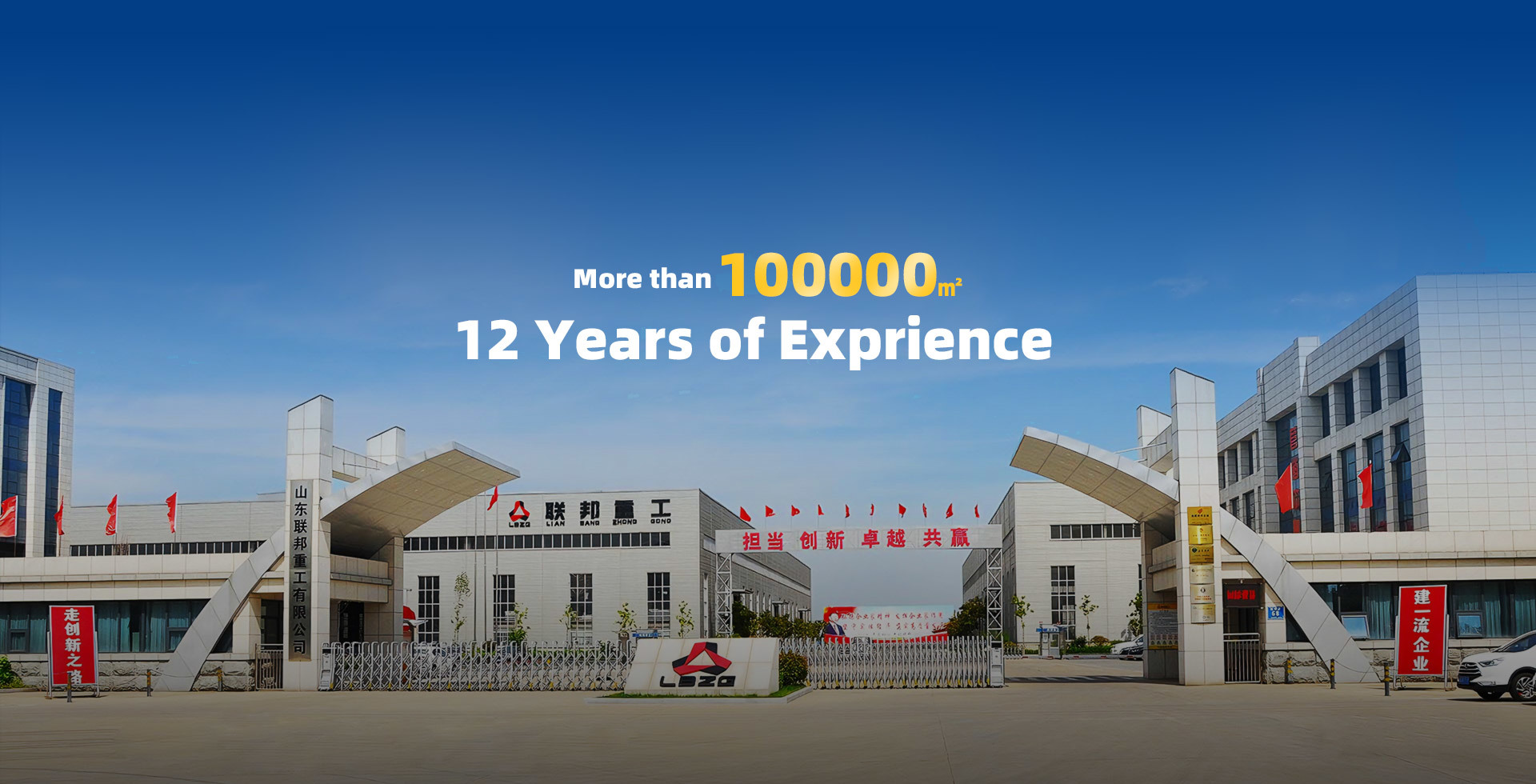
LBZG quotes 15–30 days for regular orders with urgent orders negotiable, a minimum order quantity of one set, a one-year warranty, remote guidance plus on-site repair, and spare parts stocked at its Linyi base. When shortlisting Chinese mobile crushing station manufacturers, screen on verifiable capability rather than brochure claims: production footprint, R&D and standards participation, certification evidence, and traceable mobile projects. Shandong Lianbang Heavy Industry operates two production bases covering a total area of 120,000 ㎡ with 40,000 ㎡ of standard workshops and more than 150 sets of processing equipment, employs around 110 staff including over 40 R&D personnel, holds a municipal-level engineering laboratory and a provincial-level R&D centre, and participates in revising national crusher industry standards. Its YCG-J750 and YCG-I1214 mobile stations have run for over two years at a construction waste recycling project with on-site processing and zero transport waste. Use a material test and the compliance file as the deciding evidence.
Next Step: Turn Your Feed Data Into a Configuration
Send your top feed size, target product fractions, throughput requirement and site voltage, and the LBZG engineering team will return a stage-by-stage configuration with documented model parameters. Samples can be tested before the model is frozen, and the full compliance and wear-part documentation ships with the order.
Shandong Lianbang Heavy Industry Co., Ltd. (Shanyuan LBZG)
Website: www.sypsj.cn
Email: lbzg@lbcrusher.com / selina@lbcrusher.com
Tel: +86 135-0539-8919 / +86 158-6693-8525
WhatsApp: +86 13953887097
Address: No. 68 Lianbang Road, Economic-Technological Development Zone (Yihe New District), Linyi City, Shandong Province, China
Download the full product catalogue: Shandong Lianbang Heavy Industry PDF catalogue
Conclusion
A mobile crushing station is a parameter chain, not a product list. The first-stage crusher sets the feed envelope, the fine crusher sets the product size, the screen sets the realised throughput, the washer sets the mud specification and the water demand, and the chassis and voltage specification decide whether the unit can actually be deployed where it was sold. Work the five layers in order, test the material before freezing the model, and hold the compliance documents to the same standard as the capacity figures. That sequence is what separates a station running at design rate from one that quietly de-rates in its first month.
Shandong Lianbang Heavy Industry Co., Ltd. is a manufacturer of sand-stone crushing, sand-making and solid waste recycling equipment based in Linyi, Shandong, China, registered in 2013 with technical origins traceable to Chengming Machinery (1996). Its brand is Shanyuan LBZG, and its product range covers PE, PEX, PX, PC, PCX, PF, CS, PY, VSI and 2PG-Y crushers, ZSW, CZG and ZDW feeders, YK screens, XS and FG sand washers, BS conveyors, EIS dry sand-making systems and the YCG mobile station series.
Have Questions or Need More Details?
Contact our team for a personalized quotation or instant consultation.
Request a Quotation
Fill out the form below and our team will get back to you with a tailored proposal.
WhatsApp Direct Chat
Prefer to chat in real-time? Message us on WhatsApp for instant assistance & quick answers.
- Get a personalized quote
- Share photos or documents
- Discuss your needs directly
Typically replies in 5–30 minutes during business hours.