
Stone Crushing Production Line Sand Washing: XS vs FG Spiral Washer Comparison Guide
Washing decides whether the sand leaving a stone crushing production line meets the cleanliness specification of its end use. Two machine families cover most of that duty in the Shandong Lianbang Heavy Industry catalogue: the XS wheel-bucket sand washer and the FG spiral sand washer. On a quotation sheet they look like alternatives; inside a circuit they solve different problems.
The short answer: choose the XS wheel washer when the feed is low in clay and the objective is mainly dust and mud removal, because it uses less water, loses less fine sand and is simpler to maintain. Choose the FG spiral washer when the feed is high-clay or sticky and needs genuine scrubbing, and expect higher water consumption and greater fine-sand loss. Four constraints decide which of the two belongs in your circuit: the clay content and consistency of the wash feed, the fines you intend to keep, the water and slurry capacity of the site, and the space the machine needs.
This guide compares the two families model by model using published specification data for the XS-2600 to XS-3200 wheel washers and the FG-500 to FG-1200 spiral washers, and it sets out the selection, sizing and verification steps a buyer or plant engineer should complete before ordering.
What Problem Does Sand Washing Solve in a Stone Crushing Production Line?
A sand washer is a mineral-processing and washing device that removes silt, clay and impurities from sand and gravel by water flushing and mechanical agitation, improving aggregate cleanliness. It is installed after crushing and screening, and it receives a sized sand fraction rather than raw crusher discharge.
The threshold that turns washing into a specification step rather than a cleanup step is the mud-content limit: when the final product is used for concrete, asphalt or high-grade mortar and mud content must be below 3%, a sand washer should be installed. Above that limit, surface dust and clay consume cement, weaken bonding and introduce batch variation at the mixing plant.
Inside the machine, clean water is added to the washing tank. Material is tumbled and scrubbed by an impeller or by a screw, clay dissolves or stays suspended in the water and overflows with the waste stream, and clean sand is lifted by the impeller or pushed by the screw to the discharge end for dewatering.
That description hides the real risk in washer selection, because washing can fail in two opposite directions.
- Under-washing. If scrubbing energy, retention time or water volume is too low for the clay in the feed, mud content stays above specification and the product is rejected downstream.
- Over-washing. If the machine scrubs harder than the feed requires, saleable fine sand leaves with the overflow, water consumption rises, the settling pond and slurry circuit are loaded, and wear parts are replaced sooner.
A third failure is mechanical rather than metallurgical: the washer is sized from the rated capacity of the whole crushing line instead of from the actual throughput of the sand fraction it will receive. Published washer capacity is catalogue data measured with standard sand-stone material under stable water and feeding supply; the real figure moves with material hardness, feed size, mud and moisture content, power supply stability, feeding continuity and the wear condition of the working parts.
Industry Background: Why Washing Sits Inside the Specification Chain
Two figures set the scale of the market these decisions sit in. The global stone crushing equipment market was estimated at USD 8.47 billion in 2024 (Market Research Future), and China was the leading exporter of machines to crush or grind stone, ores and minerals in 2024, with exports valued at USD 1.38 billion (OEC, HS 847420). The supplier base is therefore deep, and the procurement question has shifted from finding a manufacturer to specifying the right circuit.
Attention inside that market is uneven. Jaw crushers alone accounted for a 35.2% share of the crusher market in 2025 (Polaris Market Research), because they sit in the primary stage of almost every stone crushing production line. Screening, conveying and washing are usually specified later, often by a different person, even though cleanliness, gradation and fines balance are the properties an end customer actually tests. In the United States, 1.5 billion tons of crushed stone were produced in 2023, valued at over USD 24 billion (USGS data cited by Research Nester), and much of that volume carries cleanliness and fineness-modulus requirements that no crusher can deliver on its own.
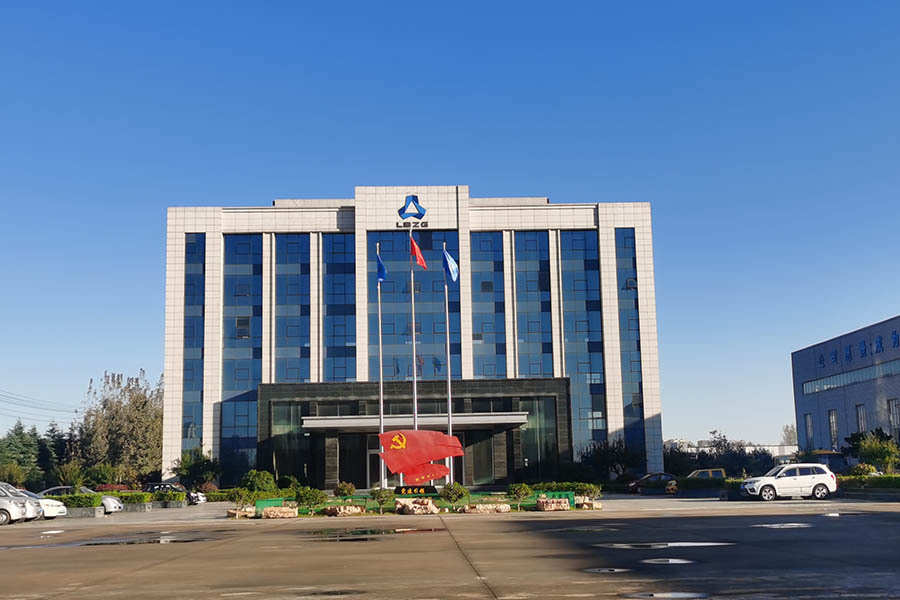
The machines compared in this guide are manufactured by Shandong Lianbang Heavy Industry Co., Ltd. (brand trademark Shanyuan LBZG; website www.sypsj.cn), a Linyi, Shandong-based manufacturer registered in 2013 whose technical origins trace back to Chengming Machinery, established in 1996. The company operates two production bases with 40,000 m² of standard workshops and more than 150 sets of processing equipment, and it supplies standalone equipment, EPC contracting for complete sand-stone production lines, solid waste treatment solutions, and mobile crushing and screening plants. Its products are sold across all provinces of China and to more than 40 overseas countries, backed by ISO 9001, ISO 14001 and OHSAS 18001 system certification and CE export certification for foreign trade projects.
The Two Options: How an XS Wheel Washer and an FG Spiral Washer Actually Work
XS wheel-bucket sand washer: lifting, tumbling and low water use

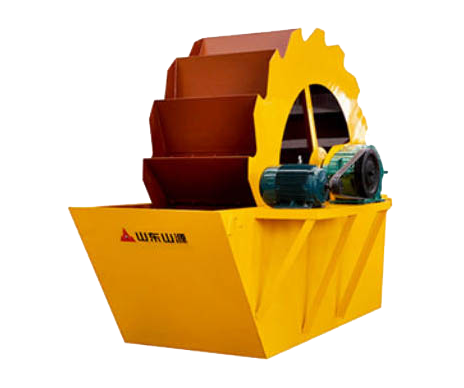
The XS series is a wheel-type washer. A rotating bucket wheel lifts and tumbles the sand through the water bath; the overflow carries suspended clay away, and the lifted material is discharged as dewatered sand. In the manufacturer's own comparison, the wheel type has a simple structure, low water consumption, low fine-sand loss and good cleaning performance on low-clay material, with simple maintenance.
Published models and key parameters:
- XS-2600: wheel-bucket diameter 2600 mm; capacity 20-50 t/h; motor power 5.5 kW; total weight 2.4 t.
- XS-2800: wheel-bucket diameter 2800 mm; capacity 30-80 t/h; motor power 7.5 kW; total weight 3 t.
- XS-3000: wheel-bucket diameter 3000 mm; capacity 50-100 t/h; motor power 11 kW; total weight 5.2 t.
- XS-3200: wheel-bucket diameter 3200 mm; capacity 80-150 t/h; motor power 15 kW; total weight 7.2 t.
All four models run at an impeller rotation speed of 0.8-1.2 r/min and use a carbon steel frame with a polyurethane bucket liner. At series level, published water consumption for the XS range is 5-30 t/h. A related wheel-type model in the same catalogue, the XSD-3016, is published at 11-15 kW and 50-120 t/h with a wear-resistant rubber liner, and is intended for wet sand washing to remove mud and dust.
The XS design trades scrubbing intensity for water efficiency and fines retention. That is precisely why it is not the correct tool for high-clay, sticky feed.
FG spiral sand washer: tank scrubbing for high-clay feed
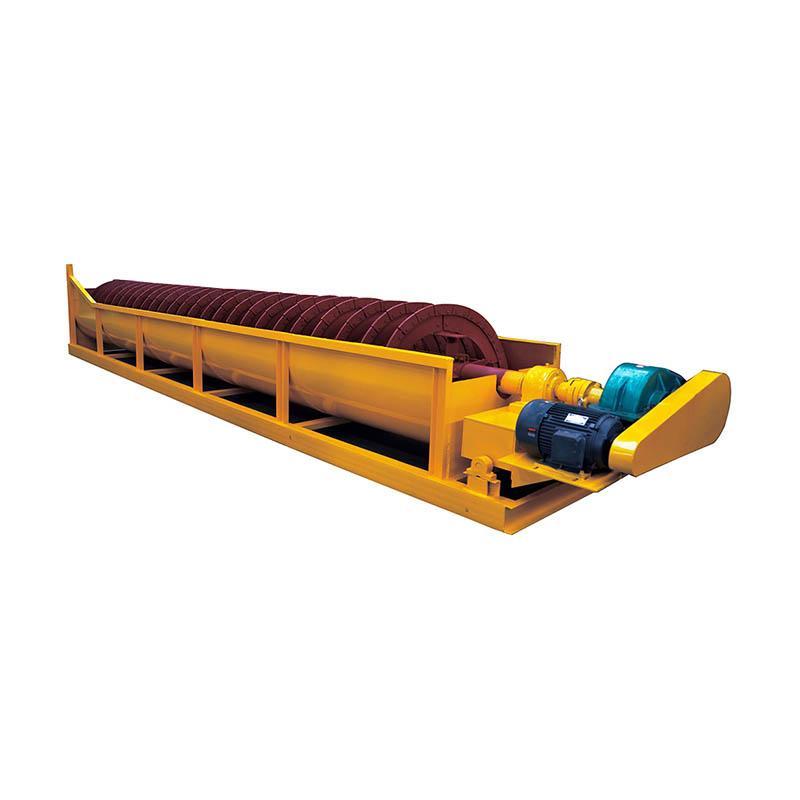
The FG series is a spiral, or screw, washer. Material enters a long tank; the rotating spiral scrubs the sand against itself and against the tank while pushing it up the incline for dewatering, and fine clay leaves with the overflow. In the same manufacturer comparison, the spiral type has strong scrubbing power and suits high-clay sticky material, but consumes more water and loses more fine sand.
Published models and key parameters:
- FG-500: spiral diameter 508 mm; tank length 6700 mm; max feed size below 10 mm; capacity 20 t/h; motor power 3-5.5 kW; water consumption 5-10 t/h; overall dimensions 6800×1247×1430 mm; weight 3.57 t.
- FG-750: spiral diameter 762 mm; tank length 7220 mm; max feed size below 10 mm; capacity 40-50 t/h; motor power 7.5 kW; water consumption 6-60 t/h; overall dimensions 9547×1837×3662 mm; weight 5.23 t.
- FG-1000: spiral diameter 1000 mm; tank length 7620 mm; max feed size below 10 mm; capacity 50-70 t/h; motor power 11 kW; water consumption 9-80 t/h; overall dimensions 9588×1907×4052 mm; weight 8.27 t.
- FG-1200: spiral diameter 1200 mm; tank length 7620 mm; max feed size below 10 mm; capacity 70-110 t/h; motor power 15 kW; water consumption 10-80 t/h; overall dimensions 10920×2097×4720 mm; weight 11.11 t.
FG-1200 is the largest model in the series. All four models use a carbon steel frame with a wear-resistant rubber liner and polyurethane lining, and all four are rated for fine material washing, grading and dewatering in sand and gravel plants.
Two published constraints matter more than the capacity figures. First, the maximum feed size of every FG model is below 10 mm, so the machine must be fed from a screening stage rather than from raw crusher discharge. Second, water consumption scales steeply with model size, from 5-10 t/h on the FG-500 to 10-80 t/h on the FG-1200, so the water and slurry circuit has to be sized together with the washer, not after it.
The four constraints that decide between XS and FG
1. Feed consistency. Feed consistency means how stable the clay content, moisture and feed rate remain from shift to shift, and it is the single most important input. A feed that alternates between clean and sticky material is the hardest case: the XS handles the clean half well and the sticky half poorly, while the FG handles the sticky material but over-scrubs the clean material. If variability cannot be reduced upstream, by blending, stockpiling or pre-screening before the washer, the washer is normally specified for the stickier material and the water settings are adjusted batch by batch.
2. Fines retention goals. The catalogue data states plainly that the spiral type loses more fine sand than the wheel type. Where the product is judged on fineness modulus, that difference is commercially decisive. The Lunan High-Speed Railway aggregate supply project, for example, records a fineness-modulus compliance requirement of 2.3-3.0 together with a cubic particle-shape requirement and stable grain-size control. An oversized or over-watered spiral washer can pull too many fines out of the product and push the modulus outside the acceptance band, so scrubbing intensity has to be balanced against the fines that must stay in the sand.
3. Water use and slurry handling. Published XS water consumption is 5-30 t/h at series level, while FG models are published individually from 5-10 t/h (FG-500) up to 10-80 t/h (FG-1200). Where a settling pond, thickener or recycling loop already exists, the marginal cost of the higher draw is modest; where all water is purchased or trucked, it is not. Where the site has no reliable water at all, neither washer is the answer: a dry-type system such as the EIS-1000 (140-180 kW, feed size up to 45 mm, dry-type production) or the EIS-1200 (160-220 kW, feed size up to 50 mm, fineness modulus 2.3-3.0) removes the water question entirely.
4. Site layout. FG machines are long and heavy: the FG-1200 occupies 10920×2097×4720 mm and weighs 11.11 t, against 7.2 t for the largest XS model. That difference affects foundation design, headroom above the discharge chute, access for wear-part replacement and the layout of the stockpile conveyor. The published machine weight for each model - XS: 2.4, 3, 5.2 and 7.2 t; FG: 3.57, 5.23, 8.27 and 11.11 t - is the figure to hand to the civil designer.
Step by Step: How to Select and Place a Sand Washer in the Circuit
- Write the finished-product specification first. Define the mud-content ceiling (below 3% for concrete, asphalt or high-grade mortar), the fineness-modulus target, and any project-specific requirement such as railway ballast gradation or high-strength concrete aggregate.
- Characterise the washer feed, not the quarry. Record clay content, moisture and maximum lump size for the fraction that will actually enter the washer. If the maximum lump exceeds 10 mm, the FG cannot be fed directly and the screening stage must be adjusted.
- Choose the washing mechanism. A low-clay feed with a dust-removal objective points to the XS wheel washer; a high-clay or sticky feed that needs scrubbing points to the FG spiral washer.
- Size capacity on de-rated throughput. Across a crushing line the usual matching logic is feeder capacity at 1.1-1.2 times the crusher rating, secondary crusher at 1.0-1.1 times actual primary output, screen at 1.2-1.3 times line capacity and conveyor at 1.2 times maximum flow. Apply the same caution to the washer: actual capacity usually runs at 70-85% of rated capacity because of material properties, operation and site conditions, so size the washer on the de-rated hourly flow of the sand fraction.
- Size the water and slurry circuit with the machine. Use the published water consumption of the specific model rather than a series average, then add wash-water make-up, overflow disposal and any recycling volume.
- Check layout, foundation and power. Confirm machine dimensions and weight, installed motor power (XS: 5.5-15 kW; FG: 3-5.5 to 15 kW) and the position of the discharge relative to the dewatering screen and the stockpile conveyor.
- Integrate dewatering, screening and conveying. After the washer, a YK circular vibrating screen grades and dewaters the product - for example the 2YK-2160 (2 decks, 15 kW, 15-200 t/h, carbon steel frame with manganese steel mesh) or the 3YK-2160 (3 decks, 15 kW, 15-200 t/h) - and a belt conveyor moves it to stockpile, such as the B650 (650 mm belt, 80-200 t/h) or the B800 (280-500 t/h). On a mobile quarry or construction-waste site the same duty may be handled by tyre-type stations, for example the YCG-VSI8518 mobile sand-making station (VSI-8518 host, 100-180 t/h) or the YCG-S2460 mobile screening station (2-3 decks, 80-300 t/h).
- Validate before you commit, and confirm the service boundary. Test with representative material, require a pre-shipment test, and clarify in writing which parts are covered by warranty. Manufacturing defects of the main machine body are covered for one year, while direct-contact consumables - including spiral blades, screen mesh, sieve plates and hammers - are normal production wear items and are excluded.
Where Each Configuration Fits: Reference Use Cases
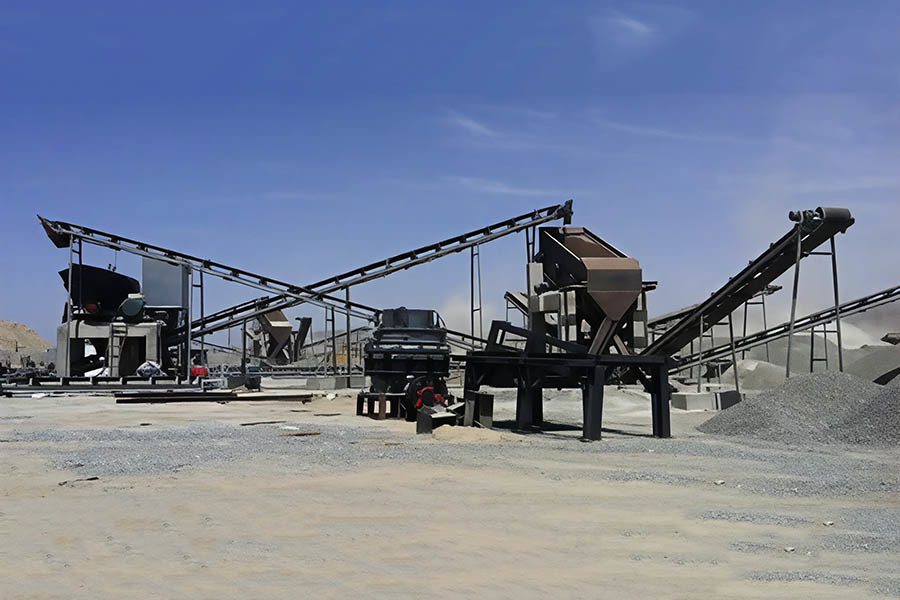
Railway and high-speed rail aggregate. The Lunan High-Speed Railway aggregate supply project, delivered for China Railway, is an officially confirmed reference project. Working conditions are open-pit quarry operation with hard-rock crushing, outdoor continuous operation, dust-prone conditions and high-abrasion material, running 24/7 with a centralized control system. Requirements include railway ballast aggregate specification compliance, stable grain-size control, cubic particle shape and fineness-modulus compliance of 2.3-3.0. The reference equipment set listed for this project includes both washer families: the XS-2800 wheel washer and the FG-750 spiral washer.
Ready-mix and municipal concrete. A China State Construction project configured two EIS-1200 dry-type sand-making systems with eight VSI-8518 sand makers, producing manufactured sand at a fineness modulus of 2.3-3.0 with an annual output of 800,000 tons. Because the EIS system is dry-type, the circuit operates without washing water - the reference case for sites where water supply, not clay content, is the binding constraint.
Hydropower and long-term projects. Hydropower aggregate circuits run long-term continuous production with high-strength concrete aggregate for dam construction, wear-resistant crushing chambers and remote-site serviceability. In these projects the washer is specified for years of duty, so wear-part availability and water-circuit stability matter more than the initial machine specification alone.
Overseas quarries and Belt & Road projects. An overseas distributor project supplied a complete aggregate production line based on 20 units of PE-600×900 jaw crushers, PF-1214 impact crushers, YK screens and BS conveyors, running at 350 t/h of continuous output for more than three years. Overseas lines add requirements that affect washer selection indirectly: voltage adaptation across 380V, 440V, 415V and 660V, tropicalised or desert-rated options, multilingual manuals, and support through a service network covering more than 40 Belt & Road countries.
Construction and demolition waste. Recycling circuits such as a mobile configuration built on the YCG-J750 tyre-type mobile jaw crushing station and the YCG-I1214 tyre-type mobile impact crushing station process demolition material on site with zero transport of waste, low noise and low dust emission. In these circuits the washing requirement depends on the recycled product's end use, and dust-removal systems typically carry the environmental load.
XS vs FG Spiral Washer: Published Parameter Comparison
| Parameter | XS wheel-bucket sand washer | FG spiral sand washer |
|---|---|---|
| Washing mechanism | Rotating bucket wheel lifts and tumbles sand through a water bath | Rotating spiral scrubs material along a long tank and conveys it up the incline |
| Published models | XS-2600, XS-2800, XS-3000, XS-3200 | FG-500, FG-750, FG-1000, FG-1200 |
| Working-part size | Wheel-bucket diameter 2600 / 2800 / 3000 / 3200 mm; impeller speed 0.8-1.2 r/min on all four models | Spiral diameter 508 / 762 / 1000 / 1200 mm; tank length 6700 / 7220 / 7620 / 7620 mm |
| Capacity (published) | 20-50 / 30-80 / 50-100 / 80-150 t/h | 20 / 40-50 / 50-70 / 70-110 t/h |
| Motor power | 5.5 / 7.5 / 11 / 15 kW | 3-5.5 / 7.5 / 11 / 15 kW |
| Water consumption | 5-30 t/h at series level | 5-10 / 6-60 / 9-80 / 10-80 t/h by model |
| Maximum feed size | Not stated in the published XS model data; the washer is applied to a screened sand fraction | Below 10 mm on all four models |
| Structure materials | Carbon steel frame, polyurethane bucket liner | Carbon steel frame, wear-resistant rubber liner, polyurethane lining |
| Machine weight | 2.4 / 3 / 5.2 / 7.2 t | 3.57 / 5.23 / 8.27 / 11.11 t |
| Overall dimensions | Not published per model in the XS specification data | 6800×1247×1430 to 10920×2097×4720 mm |
| Best-fit feed | Low-clay feed where the objective is mud and dust removal | High-clay or sticky feed that requires strong scrubbing |
| Fines behaviour | Low fine-sand loss | Higher fine-sand loss from stronger scrubbing |
| Maintenance profile | Simple structure and simple maintenance | Spiral blades are direct-contact consumables and are excluded from warranty coverage |
All values are published catalogue data for the named models. Catalogue ratings are obtained with standard sand-stone material under stable water and feeding supply; actual throughput varies with material hardness, feed size, mud and moisture content, power supply stability, feeding continuity and the wear condition of working parts.
Frequently Asked Questions
Which certifications and documents should I verify before ordering a stone crushing production line that includes sand washing equipment?
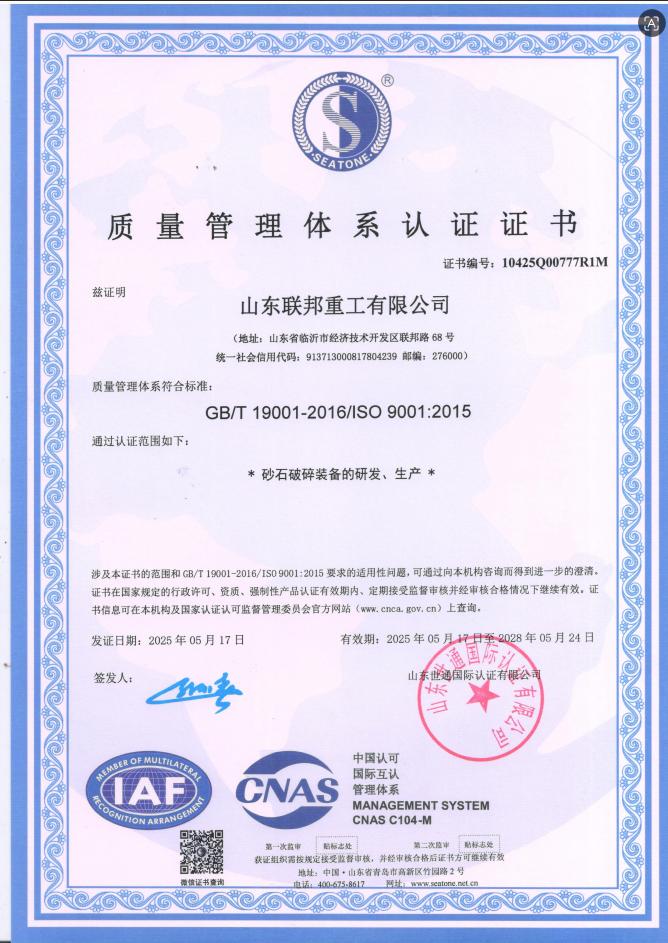
At minimum, verify an ISO 9001 quality management system certificate and confirm that its scope covers the equipment being purchased. Shandong Lianbang Heavy Industry holds ISO 9001 certificate 10425Q00777R1M, issued by Shandong Seatone International Certification Co., Ltd. against the GB/T 19001-2016 / ISO 9001:2015 standard, covering R&D and production of sand-stone crushing equipment, valid from 2025-05-17 to 2028-05-24. The company also holds ISO 14001 environmental management system and OHSAS 18001 occupational health and safety system certification, plus CE export certification for foreign trade projects; the PF-1315 impact crusher, for example, holds ECM CE Mark certificate 3N251002.SLHCS40 for the EU market.
Alongside certificates, confirm the warranty boundary in writing. Manufacturing defects of the main machine body are covered for one year, while direct-contact consumables - including spiral blades, screen mesh, sieve plates and hammers - are treated as normal production wear parts and are excluded from warranty coverage.
Should I choose a wheel sand washer or a spiral sand washer for a stone crushing production line?
Match the washing mechanism to the clay content and the fines-retention goal. For low-clay material that mainly needs dust removal, the XS wheel sand washer is the better fit because it combines low water consumption, low fine-sand loss and simple maintenance. For high-clay or sticky material that needs strong scrubbing, the FG spiral sand washer is the correct choice, and the higher water consumption and greater fine-sand loss should be planned for. Published model ranges run from the XS-2600 (20-50 t/h) to the XS-3200 (80-150 t/h), and from the FG-500 (20 t/h) to the FG-1200 (70-110 t/h).
What impact crusher capacity data should I look for from stone crushing production line manufacturers?
Read capacity together with motor power, rotor size and maximum feed size, because a capacity figure quoted alone does not describe the duty. For the PF series used as a secondary stage, the PF-1214 is published at 132-160 kW, rotor Φ1250×1400 mm, maximum feed size 400 mm and capacity 80-180 t/h, while the PF-1315 is published at 160-200 kW, rotor Φ1320×1500 mm, maximum feed size 500 mm and capacity 100-250 t/h; both are covered by the Chinese utility model patent for a strong-impact crusher with uniform output particle size (ZL 2023 2 1697963.2). Ask whether a quoted figure is a catalogue rating measured under ideal conditions or a site-derived value, since actual throughput is affected by material hardness, feed size, moisture, power supply stability, feeding continuity and wear.
What drives the operating cost of a sand washing circuit?
Four items dominate, and none of them is the machine's list specification. Water consumption differs sharply between the two families and between models: the XS series is published at 5-30 t/h at series level, while FG models run from 5-10 t/h on the FG-500 to 10-80 t/h on the FG-1200. Fine-sand loss is the second driver, because sand that overflows with the waste stream is product that has already been crushed and screened. Wear parts are the third, since spiral blades, screen mesh, sieve plates and polyurethane or rubber liners are consumables outside warranty coverage. The fourth is throughput derating: actual capacity typically runs at 70-85% of rated capacity, so a washer sized on rated figures alone may need to run longer hours to reach the same output.
Can I validate a washer model before ordering, and what is the delivery lead time?
Yes. Validation normally starts with material data from your own site - clay content, moisture, maximum lump size and the target mud content of the finished sand - followed by a test and inspection sequence. Shandong Lianbang Heavy Industry applies a 100% pre-shipment test plus on-site installation and commissioning, and the minimum order quantity is one set. Regular lead time is 15-30 days, with urgent orders negotiable. After delivery, equipment carries a one-year warranty with remote guidance and on-site repair support, and spare parts are stocked at the Linyi location; overseas customers are supported through eight overseas offices, six domestic branches and ten local offices staffed by more than 60 service professionals covering over 40 Belt & Road countries.
Conclusion: Decide the Mechanism First, the Model Second
Sand washing in a stone crushing production line is a constraint problem before it is a product problem. The XS wheel-bucket washer and the FG spiral washer both remove mud and dust, but they sit at opposite ends of the trade-off between scrubbing power on one side and water use, fines retention and simplicity on the other. A low-clay feed with a dust-removal objective and a fines-retention requirement points to the XS series; a high-clay, sticky feed that has to be scrubbed clean points to the FG series, with its higher water draw and greater fine-sand loss accepted as the cost of cleanliness.
Once the mechanism is decided, the sequence is predictable: fix the product specification, measure the real washer feed, de-rate the capacity, size the water and slurry circuit with the machine, check layout and power against published dimensions and weights, integrate dewatering screens and conveyors, and confirm the certification and warranty boundary in writing. Where water is the binding constraint rather than clay, a dry-type system such as the EIS-1200 changes the question entirely.
Next Step: Sample Data, Model Selection and Quotation
Send the clay content, moisture, maximum lump size and target mud content of your sand fraction, and the engineering team at Shandong Lianbang Heavy Industry will confirm whether an XS wheel washer, an FG spiral washer or a dry-type alternative fits your circuit, and return a model recommendation with capacity, water consumption and layout data.
Download the full product catalogue: Shandong Lianbang Heavy Industry brochure (PDF).
Contact: email lbzg@lbcrusher.com | WhatsApp +86 13953887097 | website www.sypsj.cn | No. 68 Lianbang Road, Economic-Technological Development Zone (Yihe New District), Linyi City, Shandong Province.
Have Questions or Need More Details?
Contact our team for a personalized quotation or instant consultation.
Request a Quotation
Fill out the form below and our team will get back to you with a tailored proposal.
WhatsApp Direct Chat
Prefer to chat in real-time? Message us on WhatsApp for instant assistance & quick answers.
- Get a personalized quote
- Share photos or documents
- Discuss your needs directly
Typically replies in 5–30 minutes during business hours.