
Pillow Block Units: SSUCP2..A vs SSUCF2..A vs SSUCFL2..A
Direct answer: the choice between SSUCP2..A, SSUCF2..A and SSUCFL2..A is not a performance ranking. All three share the same material platform — a stainless steel 304 housing and a stainless steel 440 insert bearing, food grade grease, silicon rubber seals, a −35°C to 102°C range and a 20–60 mm (3/4″–2-7/16″) bore span. What separates them is the mounting interface: a two-bolt solid-base pillow block, a four-bolt solid-base flange, or a two-bolt solid-base flange. The decision is geometric, and it should be made before a model code is written.
This guide decodes the three families side by side, then places the related options — SSUCT2, SSUCPA, SSUCFB..A and SSUEFB..A — into the same framework, so a buyer can move from “which unit” to “which exact code” without a round of samples to find out.
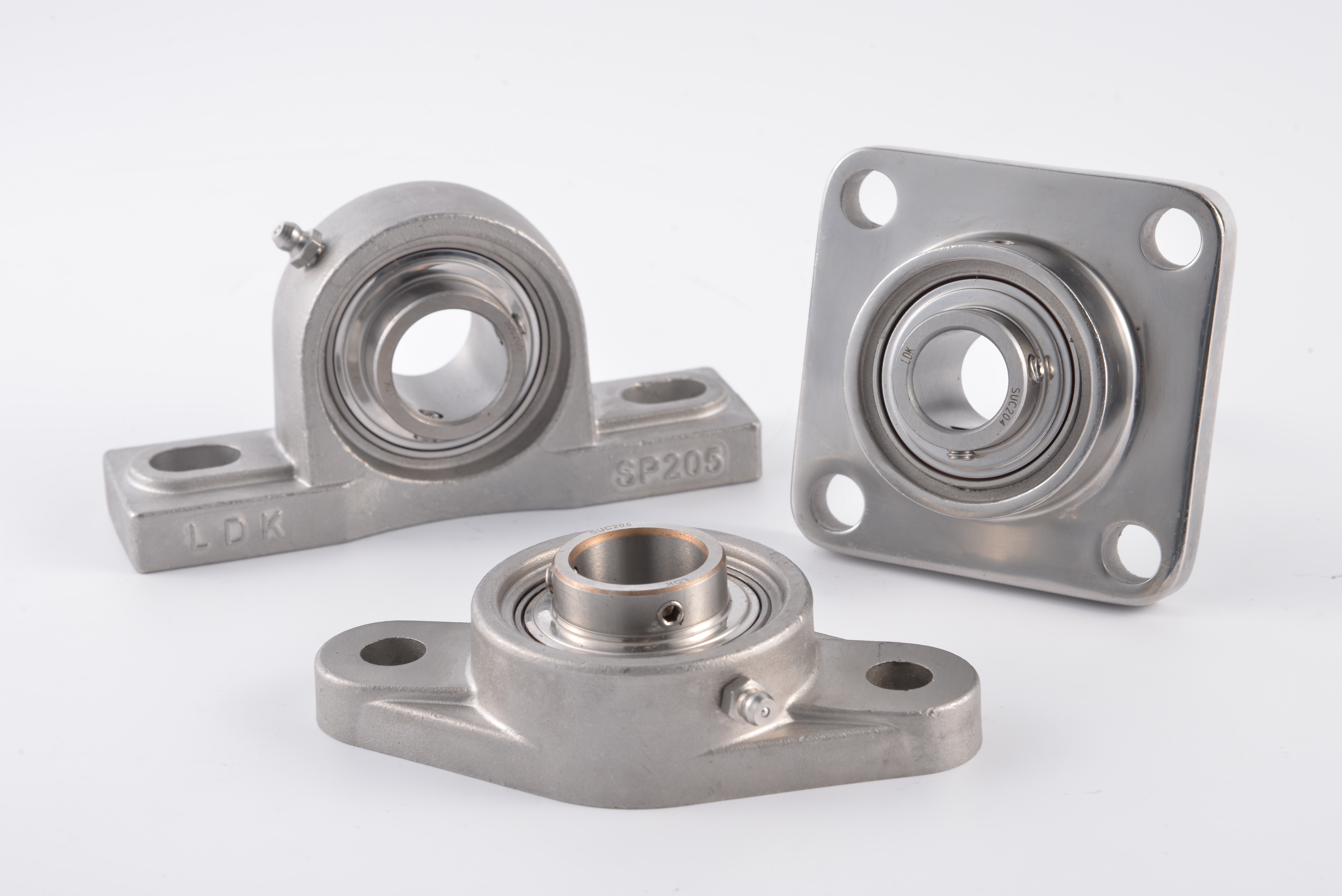
LDK stainless steel bearing units. Housing and insert bearing are both produced in-house by LDK.
Why buyers get this specification wrong
A mounted ball bearing unit is, structurally, an insert bearing seated in a housing that bolts to a support surface. The bearing carries the shaft; the housing carries the mounting. That split is what makes the category easy to under-specify.
Most searches for these parts start from a model code — “UCF204″ or the stainless equivalent. But the code is an output, not an input. It encodes a housing type the buyer has already chosen, and if the housing type is wrong, the code is worthless. Three failure modes account for most of the friction:
- The mounting is chosen from a drawing instead of the machine. A two-bolt flange and a four-bolt flange can appear dimensionally similar in a table but are not interchangeable on a plate that is already drilled.
- The suffix is skipped. In LDK's stainless range, the ..A tail is the marker for an inch-based housing. Units catalogued as ESB or EHB are different housing constructions — the EHB variants are described as hollow base — and will not mount where an ..A unit mounts.
- Bore range is assumed from the model number. Two families sharing a 204–207 model span are still catalogued with different stated bore ranges. The dimensional table, not the model number, settles the bore.
The cost of each mistake is neither the bearing nor the housing — it is the re-machining, the production hold, or the bracket redesign that follows.
Industry background: why housing designations are comparable but not identical
Pillow block and mounted bearing units are organized around shared standard families — ISO, JIS and ANSI/ABMA — which is why a housing style selected from one manufacturer's catalogue usually has a counterpart elsewhere. That comparability is real, but it stops at the designation level. Prefixes, housing letters and suffix codes are proprietary conventions layered on top of the shared geometry, and two suppliers can use the same letters to mean different base constructions.
For stainless units specifically, the sourcing pattern matters too. US customs data for HS 8483.20 in the reference period showed China supplying 89.72% of imports under that heading. Whatever the current tariff environment, that level of concentration is the practical reason supplier evaluation for these parts tends to hinge on factory-level evidence — in-house casting or machining, test rooms, management-system certificates — rather than on distributor stock lists.
LDK (Deyuan Smart Technology (Fujian) Co., Ltd) is a bearing and housing manufacturer established in 1986, operating a 90,000 m² facility with approximately 130 employees and a stated annual output of 15 million units. It produces both insert bearings and housings in-house, holds a stated 60% export share, and lists Europe, North America, Latin America and Oceania as main markets.
The shared platform: what does not change between the three families
Before comparing, it is worth establishing what a buyer is not choosing between. In LDK's catalogue, SSUCP2..A, SSUCF2..A and SSUCFL2..A are specified identically on every parameter other than the housing:
- Housing material: stainless steel 304.
- Insert bearing material: stainless steel 440.
- Duty rating: standard duty, LDK brand.
- Locking: set screw locking on all three.
- Sealing and lubrication: food grade grease with silicon rubber seal.
- Alignment and relubrication: self-aligning and relubricable.
- Temperature: −35°C to 102°C operating range.
- Bore: 20 mm to 60 mm, or 3/4″ to 2-7/16″.
- Accessory: end covers available.
This matters commercially. Because the material, seal and lubrication specification is common, switching between the three families does not restart the material qualification. Food-contact or washdown screening done on one carries across to the others, provided the housing geometry is acceptable for the mounting position.
The detailed comparison: three housing geometries, three different jobs
SSUCP2..A — two-bolt pillow block, solid base, inch-based housing
The pillow block is the default answer when the shaft runs parallel to, and at some height above, a mounting surface. Two bolts into a solid base, a pedestal that raises the shaft centreline, and an adjustment margin along the bolt slots for belt or chain tensioning. Model designations run from SSUCP204A to SSUCP212-39A.
Use it on conveyors, fans and lighter process drives where the bearing sits on top of a frame rail. It is the cheapest housing to machine and the easiest to shim, which is why it is also the most abused — a pillow block bolted to a plate that is not flat will misalign regardless of the unit's self-aligning capability.

SSUCF2..A: four-bolt stainless flange housing, solid base, inch-based housing. End covers shown are an available accessory.
SSUCF2..A — four-bolt flange, solid base, inch-based housing
The four-bolt flange mounts through a plate rather than onto it. The shaft passes through the bore, and the housing is fastened from the face side. On a machine wall, a tank side, or a bulkhead, this is often the only orientation that leaves the bearing accessible for service. Model designations run from SSUCF204A to SSUCF212-39A, with the same 20–60 mm bore span.
Four bolts distribute load better than two and resist the rocking that a two-bolt flange can develop under alternating belt pull. The trade-off is that all four holes must be drilled on a common pattern, and the plate behind them must be stiff enough not to deflect between bolts.
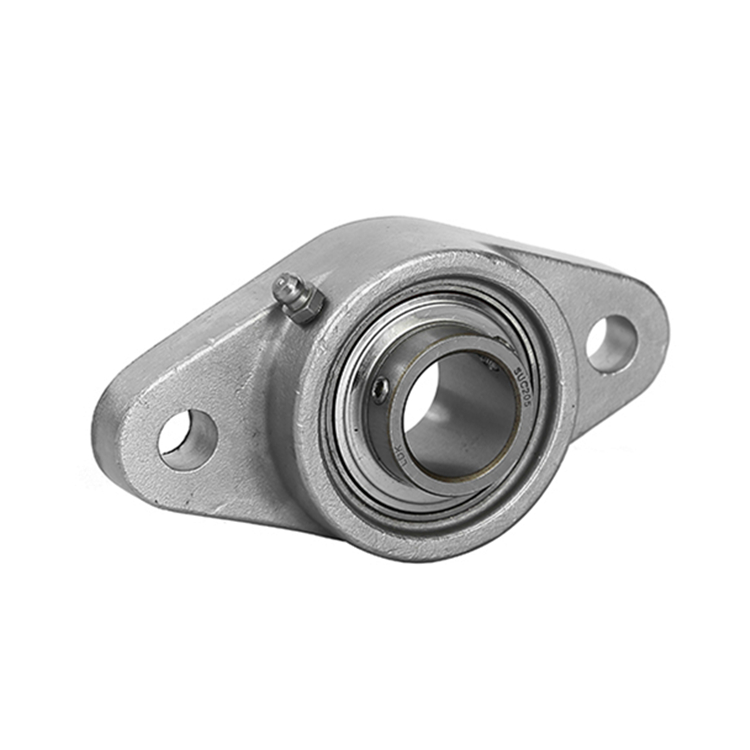
SSUCFL2..A: two-bolt oval flange housing, solid base, inch-based housing, set screw locking.
SSUCFL2..A — two-bolt flange, solid base, inch-based housing
The two-bolt flange is the compact compromise. An oval footprint, two bolts on a narrower pitch, and a lower housing profile than the four-bolt pattern. Model designations run from SSUCFL204A to SSUCFL210-32A. It is the right choice where the bolt circle is constrained by surrounding structure — between frame members, inside a housing, next to an adjacent component — or where the load simply does not justify four fasteners.
The limitation is directional. A two-bolt flange presents its strongest resistance along the bolt axis and its weakest perpendicular to it. Where belt pull or shaft thrust is consistently sideways, the four-bolt pattern is the more honest choice.
Related options in the same stainless platform
The three families above cover most mounting positions, but not all of them. LDK's stainless range extends to take-up units, tapped-base pillow blocks and three-bolt flange brackets, each solving a specific geometric constraint.
SSUCT2 — take-up housing, one bolt. A slide-mounted housing for applications that need the shaft position to move: conveyor tensioning, belt take-up, chain adjustment. It shares the stainless 304 / 440 platform, the 20–60 mm bore span, set screw locking and the end cover option, but its one-bolt sliding frame is a different mounting method entirely, not a variation on a flange.
SSUCPA — tapped-base pillow block, two bolts. Instead of through-bolts, the base carries tapped holes, which allows the unit to be fastened from below or from a position where a nut cannot be reached. The catalogued bore range is 20–50 mm (3/4″–2″), narrower than the P2..A family, with the same set screw locking and end cover availability.
SSUCFB..A — three-bolt flange bracket, set screw locking. A bracket-form flange with a three-bolt pattern that fits between the two-bolt and four-bolt families. Catalogued bore range 20–35 mm (3/4″–1-7/16″).
SSUEFB..A — three-bolt flange bracket, concentric locking. Same bracket geometry and the same ..A inch-based housing suffix, but the insert is concentric-locking rather than set-screw. LDK catalogues the SSUEFB..A at 20–50 mm (3/4″–2″), and does not list an end cover option against this family. The two bracket families share a 204–207 model span but are catalogued with different stated bore ranges, so the bore should be confirmed against the dimensional table for the size in question rather than inferred from the model number.
Locking is a selection criterion, not a default. Set screw locking suits the majority of steady, unidirectional drives. Concentric locking — available on SSUEFB..A and on the SSUEP2, SSUEF2 and SSUEFL2 stainless families — is the better answer where the shaft must not be marked by a screw point, or where reversing loads would work a set screw loose. In food environments where shaft damage leads to shaft replacement, that difference can outweigh the housing choice itself.
Step-by-step: decoding the code before you request a quote
The model code is a sequence of decisions, and reading it in the wrong order is what creates returns. Work through it left to right.
| Code element | Example | What it fixes |
|---|---|---|
| Material prefix | SSUCP204A | Stainless steel 304 housing with stainless steel 440 insert. Confirmed before any dimension is checked. |
| Housing family | SSUCP204A / SSUCF204A / SSUCFL204A / SSUCT204 / SSUCPA204 / SSUCFB204A / SSUEFB204A | The mounting interface. This is the decision that must be made from the machine, not the catalogue. |
| Size number | SSUCP204A → 210A → 212A | Bore size band. Confirm against the dimensional table; do not extrapolate across families. |
| Inch bore suffix | SSUCP204-12A | The suffix after the size number denotes the inch bore equivalent (204-12 = 3/4″). |
| Housing suffix | SSUCP204A — the ..A | Inch-based housing. ESB and EHB variants are catalogued without that description and differ in base construction. |
| Locking letter | SSUCFB..A (set screw) vs SSUEFB..A (concentric) | How the insert grips the shaft. Changing it changes the insert, not the housing. |
Before a specification goes out, three confirmations close the loop: the bolt pattern is measured on the machine and not copied from the previous part; the bore is read from the dimensional table for the exact family and size; and the housing suffix is checked against the original drawing. Anything drawn from memory should be treated as unverified.
Side-by-side comparison
| Family | Housing geometry | Bolts / base | Locking | Stated bore range | End cover |
|---|---|---|---|---|---|
| SSUCP2..A | Pillow block, inch-based housing | 2 / solid | Set screw | 20–60 mm 3/4″–2-7/16″ | Yes |
| SSUCF2..A | Flange, inch-based housing | 4 / solid | Set screw | 20–60 mm 3/4″–2-7/16″ | Yes |
| SSUCFL2..A | Flange, inch-based housing | 2 / solid | Set screw | 20–60 mm 3/4″–2-7/16″ | Yes |
| SSUCT2 | Take-up housing (slide) | 1 | Set screw | 20–60 mm 3/4″–2-7/16″ | Yes |
| SSUCPA | Tapped-base pillow block | 2 / tapped | Set screw | 20–50 mm 3/4″–2″ | Yes |
| SSUCFB..A | Flange bracket, inch-based housing | 3 | Set screw | 20–35 mm 3/4″–1-7/16″ | Yes |
| SSUEFB..A | Flange bracket, inch-based housing | 3 | Concentric | 20–50 mm 3/4″–2″ | Not listed |
All seven families share stainless steel 304 housings, stainless steel 440 insert bearings, food grade grease, silicon rubber seals, self-aligning and relubricable construction, standard duty rating, and a −35°C to 102°C operating range. Model spans and stated bore ranges are quoted as catalogued; confirm the exact bore against the dimensional table for the size required.
Application fit: which housing belongs where
Food processing and washdown lines. SSUCP2..A and SSUCF2..A carry the bulk of this work. The stainless 304 housing and 440 insert are the reason the unit is specified at all; the food grade grease and silicon rubber seal are what make the specification auditable. Choose P where the shaft sits above a frame rail, F where it passes through a machine wall.
Pharmaceutical and cleanroom equipment. SSUCFL2..A is frequently the practical pick because the two-bolt oval footprint fits into the confined frames typical of filling and packaging machinery, where a four-bolt circle would clash with adjacent structure. SSUCPA is the alternative where the fastening has to come from the blind side.
Chemical, sewage and marine environments. SSUCF2..A and the SSUCFC flange cartridge family in the same platform. Four bolts resist the vibration that continuous-duty pumps and mixers transmit, and the solid base keeps the housing square to the plate.
Conveyor tensioning stations. SSUCT2, on the strength of the sliding take-up frame rather than any difference in bearing material.
Space-constrained brackets and reversing drives. SSUCFB..A where the three-bolt bracket pattern saves depth and set screw locking is acceptable; SSUEFB..A where the shaft must not be marked, or where reversing load would loosen a set screw. In both cases, confirm the bore against the dimensional table.
LDK's own application record includes a Canadian ice-machine manufacturer that used a concentric-locking stainless flange cartridge unit to solve insufficient clamping force — the reported result was that the concentric collar delivered the holding force that set screw, eccentric collar and adapter sleeve locking had not, with food grade solid lubricant eliminating the occasional grease-to-product contact path.
Compliance and evidence: what is actually certified
Compliance claims in this category are frequently broader than the certificates behind them, so the scope matters as much as the certificate itself.
RoHS. LDK holds SGS verification against EU RoHS Directive (EU) 2015/863 amending 2011/65/EU, issued by SGS SCTC Standards Technical Services Co., Ltd Xiamen Branch. The verified product scopes include the UCF2 flange family (certificate XMNEC25002659601_1), the UCFC2 flange cartridge family (XMNEC25002179201_1), the UC2 insert bearing family (XMNEC25002179102 and XMNEC25002179101_1), the SB2 insert family (XMNEC2500217900_1), the SBPFT2 stamped steel family (XMNEC25002180202), and the KFL000 Silver Series units (XMNEC25002178701_1). These are EU-market verifications.
Management systems. IATF 16949:2016, issued by BV under certificate reference “IATF 16949 – First Edition”, is recorded against cast iron housed units, and LDK also states that it is IATF 16949 certified as a company. ISO 14001:2015 (CQM, CN-00225E33951R3M) and ISO 45001:2018 (CQM, CN-00225S23739R3M) cover the production and relevant management activities of ball bearing units, bearing housings and spherical plain bearings, and are valid globally.
Food contact. The TÜV Rheinland test report 168263398a 001 addresses thermoplastic bearing housings against U.S. FDA 21 CFR food-contact requirements, for the USA market.
The practical point for a buyer: the stainless ..A families are not individually listed in the RoHS scopes above. If the purchase order requires a compliance declaration per part number, request it for the exact family and size rather than assuming the platform-level certificate transfers automatically.
Frequently asked questions
Are LDK's stainless bearing units covered by RoHS and management-system certification?
LDK holds SGS RoHS verification to EU 2015/863 across several mounted bearing families, and ISO 14001:2015 and ISO 45001:2018 certificates covering the production of ball bearing units and bearing housings. IATF 16949:2016 is recorded against cast iron housed units, and the company states company-wide IATF 16949 certification. The stainless ..A families are not individually itemised in the RoHS scopes, so a per-part declaration should be requested where the receiving market requires it.
Can one stainless family cover both metric and inch shafts?
Within each family, yes to a point. SSUCP2..A, SSUCF2..A, SSUCFL2..A and SSUCT2 are catalogued from 20 mm to 60 mm, or 3/4″ to 2-7/16″, with the inch bore suffix built into the model code. SSUCPA stops at 50 mm (2″) and SSUCFB..A at 35 mm (1-7/16″). Above those limits, the family has to change before the size can.
What order size and commercial terms apply?
LDK quotes the stainless families at a 5,000-unit minimum order quantity, with monthly capacity of 300,000 units and a quoted lead time of 30–90 days. No public price list is issued for these families; commercial terms are quoted per configuration, because housing geometry, bore size, locking method and end cover requirement all change the line item. Buyers budgeting a first order should plan against the MOQ and the lead time rather than against a headline unit price.
Can I validate a housing style before committing to a production order?
Yes. LDK supports sampling and validation, and states prototyping capability in both 2D and 3D together with durability, safety and performance testing, under NDA where intellectual property is involved. LDK also offers DFM input on custom housings and states in-house production of both bearings and housings in one place, which keeps dimensional responsibility with a single supplier. Quality control runs through self-inspection, second-party audit and third-party audit and inspection routes, and the company's test capability covers fatigue life, tensile strength, noise and vibration, and salt spray testing.
What is the typical lead time, and how do I confirm the exact model code?
The quoted lead time is 30–90 days, and around 60% of LDK's output is exported, with Europe, North America, Latin America and Oceania listed as main markets. To confirm a code, send the mounting drawing with the bolt pitch and hole count, the shaft diameter and whether it is metric or inch, the required locking method, and the housing suffix from the original part if one exists. LDK provides technical remote support and can be reached at kzhang@ldk-bearings.com or +86 592-5807618 for a unit-by-unit confirmation before an order is raised.
Conclusion: decide the interface first, then the code
The three families in this comparison are not better or worse than one another. SSUCP2..A answers a pedestal mounting, SSUCF2..A answers a through-plate mounting with better load distribution across four bolts, and SSUCFL2..A answers a constrained bolt circle. They are specified to the same material, seal, temperature and bore standard, so the deciding variable is the machine, not the catalogue.
The sequence that avoids rework is consistent: measure the mounting interface on the machine; select the housing family from that geometry; read the bore from the dimensional table for that family and size; then choose locking (set screw for steady drives, concentric where the shaft must stay unmarked or loads reverse); then confirm the housing suffix, because ..A, ESB and EHB are not interchangeable.
Beyond the geometry, the qualification questions are supplier-side: can the manufacturer produce the housing and the insert in one place, is there a test room that can demonstrate fatigue life and salt spray performance, and is the compliance documentation scoped to the exact part number being ordered. Those are the questions that separate a catalogue claim from a qualified supply.
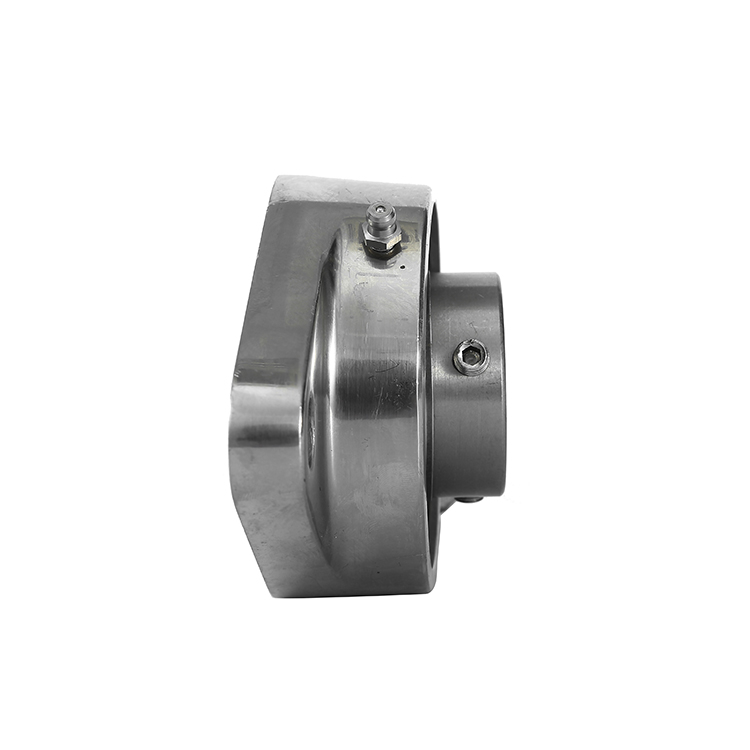
End covers are listed as an available accessory on SSUCP2..A, SSUCF2..A, SSUCFL2..A, SSUCT2, SSUCPA and SSUCFB..A.
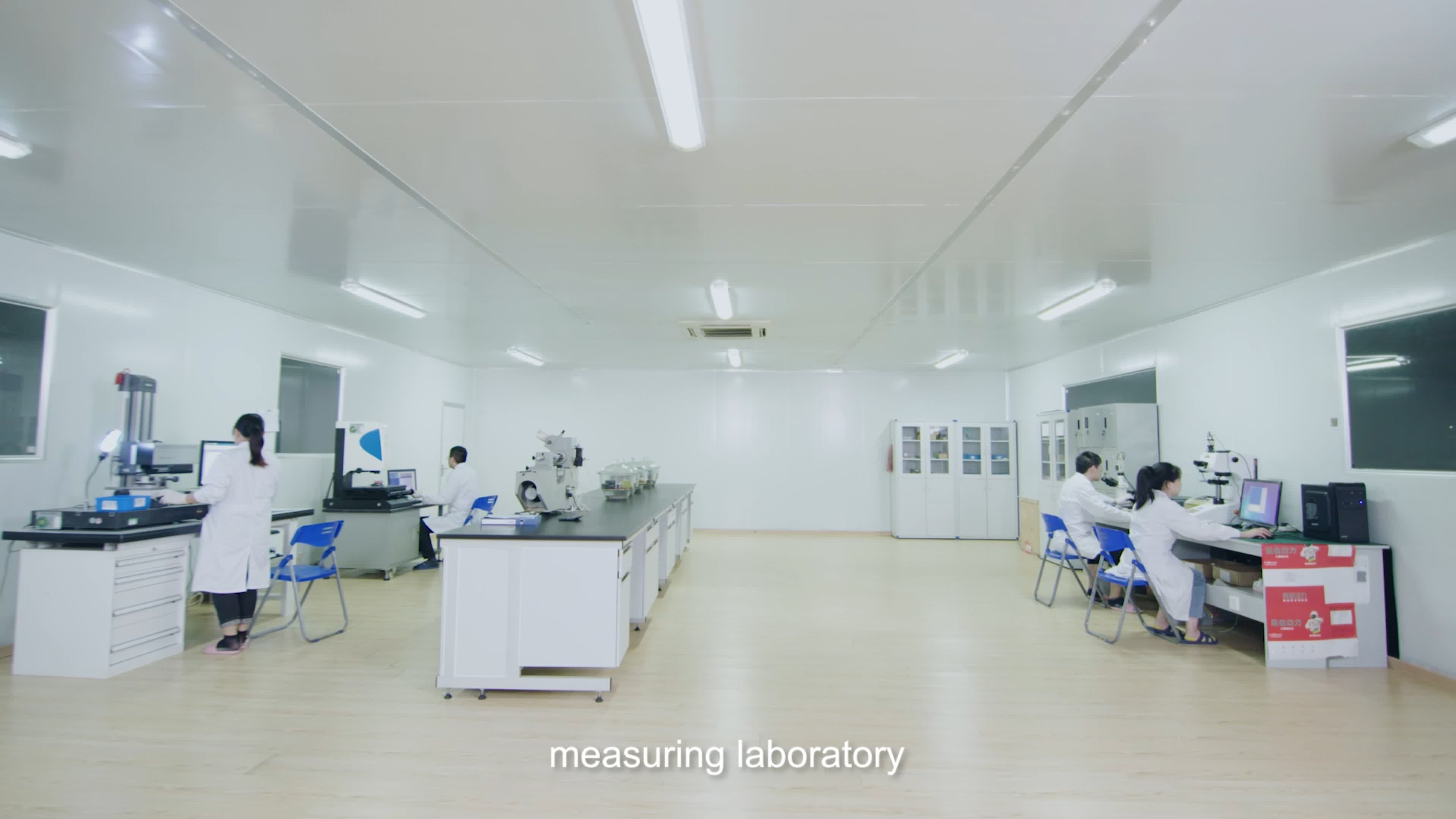
LDK measurement room. Test capability covers fatigue life, tensile strength, noise and vibration, and salt spray testing.
Next step
LDK (Deyuan Smart Technology (Fujian) Co., Ltd) supplies stainless steel mounted bearing units from a 90,000 m² facility in Xi Pu Industry Park, He Shi, Luo Jiang, Quanzhou, Fujian, China, producing both insert bearings and housings in-house, with insert bore sizes from 10 mm to 140 mm across more than 100 material and housing combinations.
To move from comparison to a quoted line item, send the mounting drawing, shaft diameter, bore convention and required locking method. A sample request and a quotation can be raised together, and the full product range is documented in the catalogue.
Download the LDK Bearing Catalogue (PDF)
Technical enquiries: kzhang@ldk-bearings.com | Tel: +86 592-5807618 | www.ldk-bearings.com
Model designations, dimensional data and certification scopes referenced in this article are drawn from LDK catalogue and certificate records. Confirm the exact bore, housing suffix and part-level compliance declaration before purchase.
Have Questions or Need More Details?
Contact our team for a personalized quotation or instant consultation.
Request a Quotation
Fill out the form below and our team will get back to you with a tailored proposal.
WhatsApp Direct Chat
Prefer to chat in real-time? Message us on WhatsApp for instant assistance & quick answers.
- Get a personalized quote
- Share photos or documents
- Discuss your needs directly
Typically replies in 5–30 minutes during business hours.