
Compliance Certification Roadmap for Importing Padel Courts into LATAM and Asia
A steel and glass padel court that clears import and facility approval in an emerging market is almost never approved by one document. Four separate evidence layers usually decide whether the structure can be installed, insured and used for competitive play: FIP court and equipment conformity for tournament use, a European conformity route where EU-linked specifications apply (Verification of Conformity under EN ISO 12100:2010), safety-glass test evidence such as an AS 2208:2023+A1:2024 report, and manufacturer-level system certification covering ISO 9001, ISO 45001, ISO 14001 and CE. No single global certificate replaces these four.
This roadmap is written for importers, club developers and procurement teams sourcing padel courts into Latin America and Asia. It maps each compliance layer to the exact document a buyer should request, lists the numbers that must appear on those documents, and shows how two verified projects navigated the same path: a 16-unit padel club in Chile and a 70-unit padel court programme in Bangladesh, both reported as stable after three years of operation.
Shenzhen LDK Industrial Co., Ltd. (LDK) is an integrated sports equipment manufacturer based in Shenzhen, China, producing padel courts, squash courts, football pitches, basketball courts and pickleball courts, with a 50,000 m² manufacturing base in Cangzhou and a 4,500 m² R&D and production base in Huizhou. Its documentation set is used throughout this guide as a working example of what a complete compliance pack looks like.
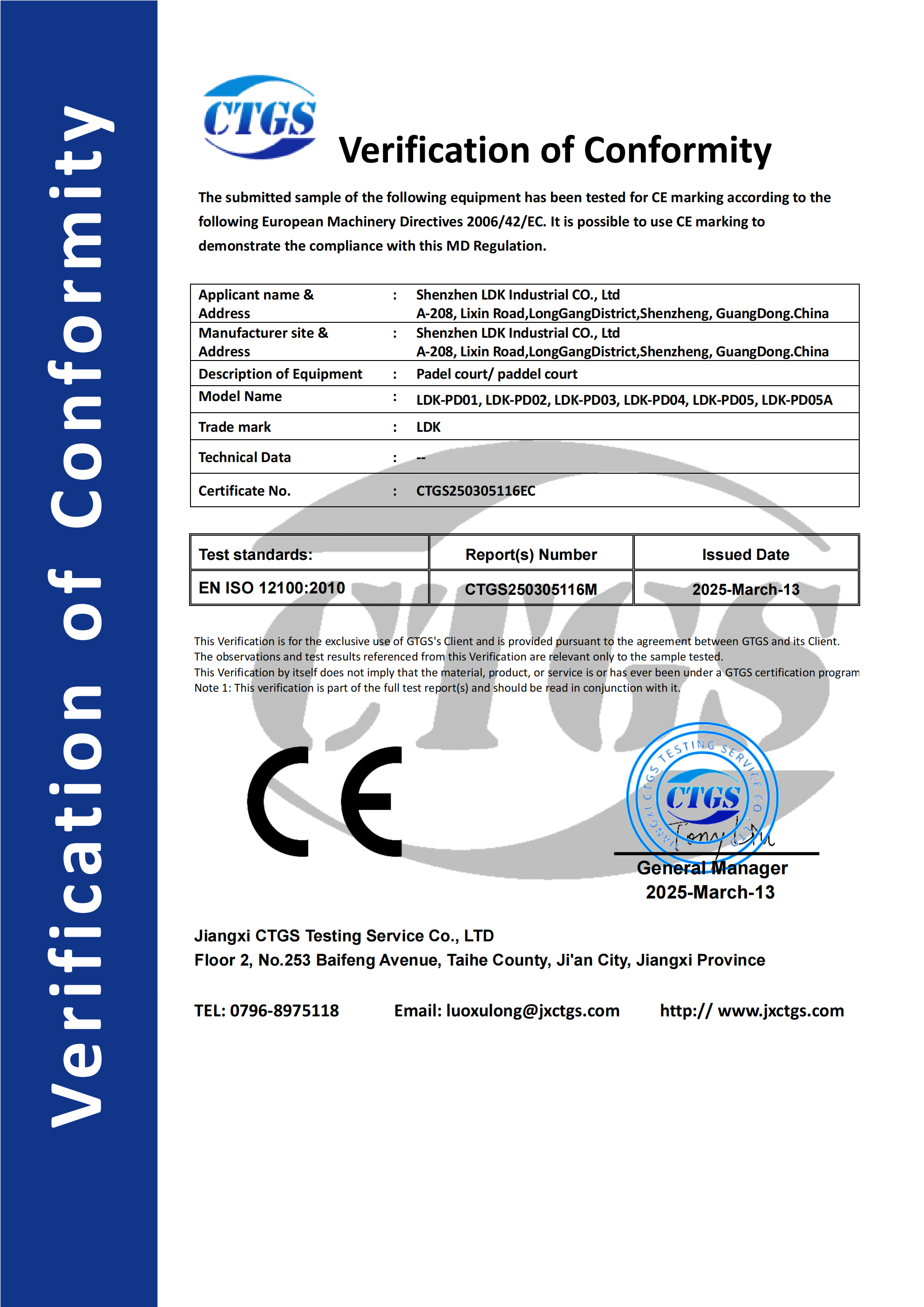
Cover evidence: EU Verification of Conformity No. CTGS250305116EC, issued by Jiangxi CTGS Testing Service Co., LTD, referencing standard EN ISO 12100:2010.
Problem Definition: Why Padel Court Import Compliance Breaks Down in Practice
The core problem is that padel court compliance is not owned by one authority. The International Padel Federation (FIP) defines how the sport is played and what the court must physically provide. A conformity assessment body issues product documents for specific standards. A glass laboratory tests the safety glass. A customs authority classifies the shipment. A local building authority approves the structure on site. Each of these four or five actors wants a different piece of paper, and none of them accepts another actor's document as a substitute.
Where projects stall is not usually at manufacturing stage. It is at documentation review. Buyers in Latin America and Asia frequently receive a certificate that does not state which product model it covers, which market it applies to, which laboratory issued it, or when it was issued. Without those four data points, a certificate is difficult to submit to a customs broker, an insurer or a building inspector.
A second structural issue is shipment format. A complete padel court is normally moved as separate elements: hot-dip galvanized steel framing, tempered safety glass panels, artificial grass, netting, wire mesh and LED lighting. That component split has direct consequences for customs duty assessment, for insurance valuation and for on-site acceptance testing.
The practical decision rule that follows from all of this is simple: verify scope, number, issuer, market and product model on every single document, and do it at quotation stage rather than after the container has sailed.
Industry Background: Why Compliance Scrutiny Is Rising in LATAM and Asia
Demand context explains why certification is being audited more closely than it was a few years ago. The Global Padel Report 2026, published by Playtomic with PwC Strategy&, states that the sport has expanded approximately six times since 2016 and forecasts more than 91,000 courts globally by 2028. Separately, commercial research published by Business Research Insights values the padel court market at USD 0.5 billion in 2026, reaching USD 1 billion by 2035 at a CAGR of 8.1%. Both figures describe the court structure and commercial club segment, and the two sources use different scopes, so they should be read as directional growth signals rather than as a single consolidated dataset.
As that volume moves from mature European clubs into Latin American and Asian markets, the buyer profile changes. More projects are publicly funded, municipally leased, hotel-attached or operated by multi-site club chains. Public and semi-public venues carry a higher duty of care, which is exactly where safety glass documentation, structural wind-load evidence and completed conformity documents become conditions of opening rather than optional extras.
The FIP baseline itself is technical and specific. The FIP Rules of Padel identified in this review specify an interior court rectangle of 10 metres wide by 20 metres long with a 0.5 percent tolerance, a minimum clear height of 6 metres throughout the court with no obstructing elements, a net 10 metres long measuring 0.88 metres at the centre and 0.92 metres at the ends with a maximum tolerance of 0.005 metres, and a requirement that the court be completely enclosed. The document edition reviewed is identified as 2025, and buyers should confirm the currently effective edition with the federation before treating any of these values as a contractual acceptance criterion.
In parallel, glass safety has become the single most scrutinised material issue in outdoor courts. Tempered safety glass is used precisely because it fragments into small blunt pieces rather than large shards, and because the surface can be engineered to carry wind and impact loads in a public environment. Documenting that glass against a recognised standard is the fastest way to close a safety review.
The Four-Gate Compliance Framework for Steel and Glass Padel Structures
Compliance for an imported padel court can be organised into four gates. Each gate has an owner, a required document and a verification question. Passing all four is what makes a court both importable and usable for tournament-level play.
Gate 1 — FIP Court and Equipment Conformity for Tournament Use
FIP conformity is a geometry and equipment question, not a marketing claim. A court intended for competitive play has to match the published playing area, clearance, enclosure and net values, and those values must be checkable on the manufacturer's technical sheet before the order is placed. It is also worth noting that FIP requirements define the playing environment; they do not by themselves issue a structural or electrical approval, which remains a local matter.
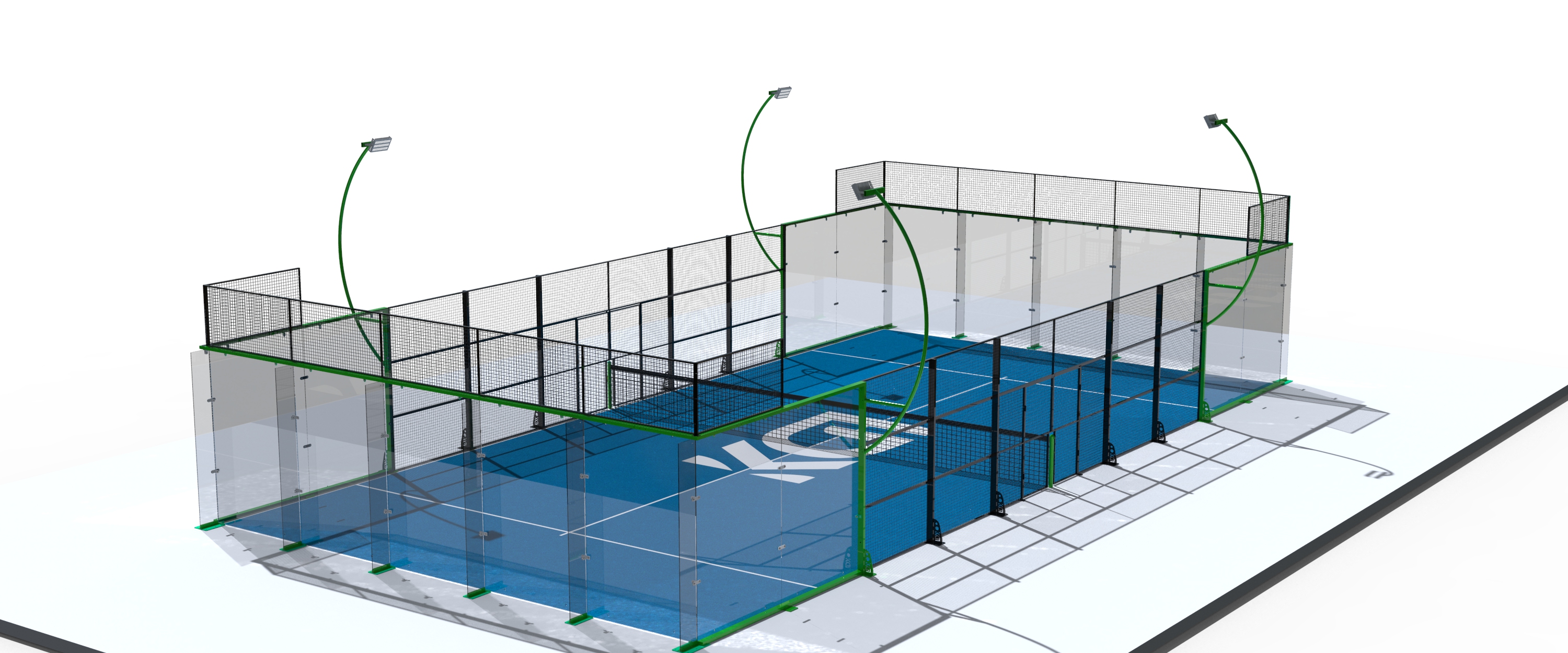
LDK's Padel Court (model LDK-PD01) documents a configuration that can be compared against the FIP baseline value by value. Its perimeter enclosure is built from 12 mm thick, 1,990 × 2,980 mm ultra-clear tempered safety glass panels certified to an extremely low spontaneous breakage rate of 1 in 10,000. The enclosure system uses 4 metre high 100 × 100 × 5 mm corner posts, 100 × 50 × 3 mm intermediate and gate posts, and 100 × 50 × 3 mm horizontal tubing in 4 m, 6 m and 4 m lengths, complemented by 1 × 2 m steel wire mesh panels with 4.0 mm wire diameter and 50 × 50 mm mesh openings. The equipment package includes 940 mm high net posts (120 × 60 × 3 mm) and a 10 metre long, 92 cm high black polypropylene net with 4 mm cord and 45 × 45 mm mesh openings. Lighting uses 100 × 50 × 3 mm light posts fitted with 200 W LED fixtures rated IP65 for ingress protection.
Two of those values map directly onto the FIP net specification: a 10 metre net length and a 0.92 metre end height, which is the FIP end-height value expressed in centimetres. That kind of line-by-line alignment is what a federation, an inspector or a technical consultant will look for first.
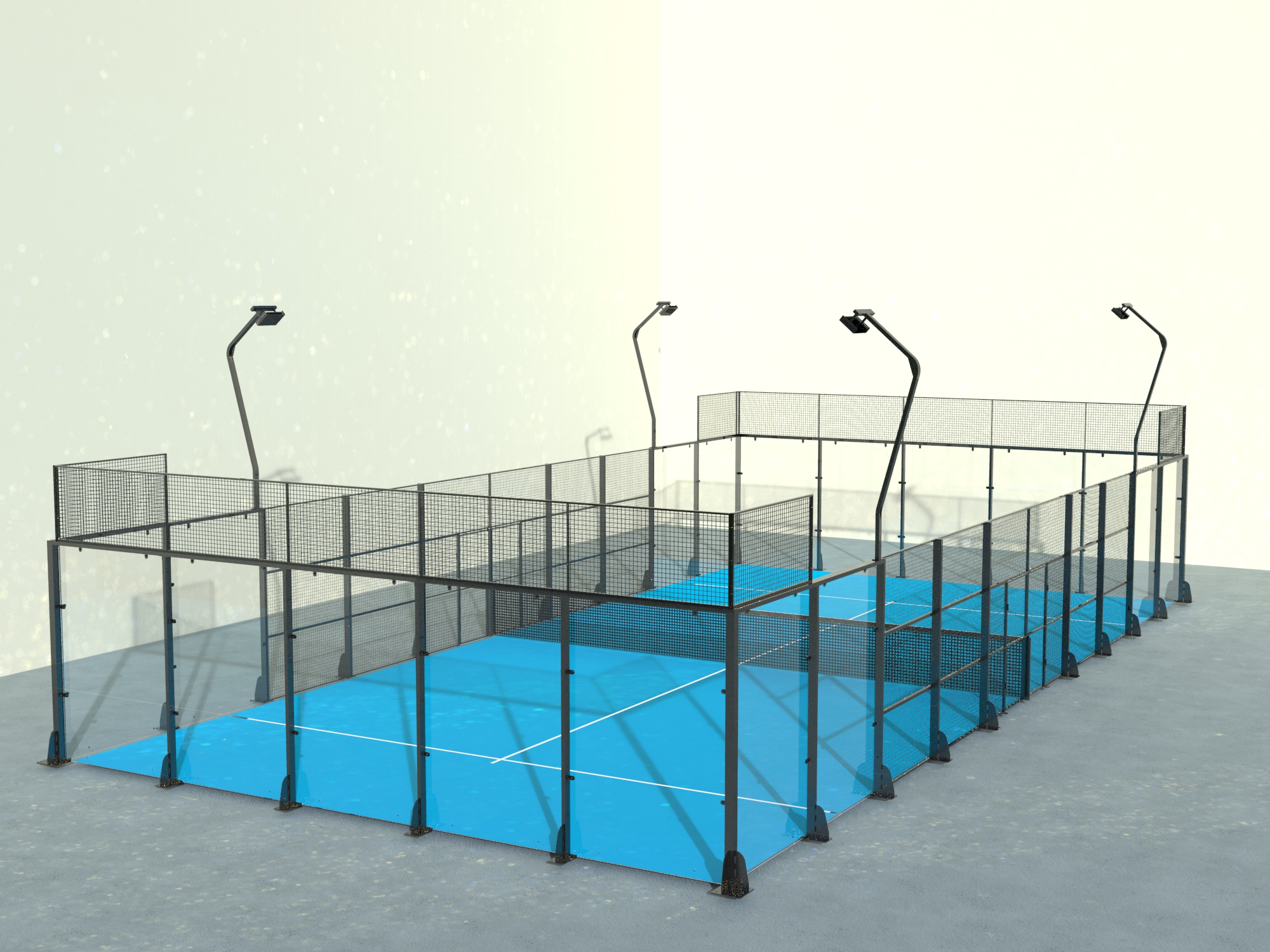
Enclosure configuration: tempered safety glass panels, steel corner and intermediate posts, and wire mesh in a complete perimeter enclosure.
Gate 2 — The European Conformity Route for Export Contexts
Where a project specification references European conformity, the document to look for is a Verification of Conformity tied to a named standard and a named issuing body. LDK's Padel Court (applicable product ID 3712) holds a Verification of Conformity according to standard EN ISO 12100:2010 for the EU market. The certificate number is CTGS250305116EC, and it was issued by Jiangxi CTGS Testing Service Co., LTD. At company level, LDK also holds multiple product certifications including ISO 9001, ISO 45001, ISO 14001 and CE.
One scope caution matters here for buyers in LATAM and Asia. EN ISO 12100:2010 is a general risk-assessment standard for machinery safety. It is a strong signal that the product has been subjected to a structured hazard and risk review, but it is not the same thing as a building-permit structural approval. For a roofed or canopy padel structure, the local authority may additionally require structural calculations, wind and snow load verification, electrical conformity and fire documentation. Buyers should therefore treat the conformity document as one gate among several and confirm the exact document route with the local authority or a licensed engineer.
The correct way to read any conformity document is: what standard, what issuing body, what certificate number, what market, what product model, and what issue date. If a supplier cannot answer all six, the document is not yet procurement-ready.
Gate 3 — Safety Glass Evidence and the 1 in 10,000 Breakage Rate
Glass is where public-facility reviews become concrete. The Padel Court product (applicable product ID 3712) is certified to standard AS 2208:2023+A1:2024 for the Australia and New Zealand market. The certification number is GZIN2602000283CM01_EN, issued by SGS-CSTC Standards Technical Services Co. Ltd. Guangzhou Branch, dated 25 February 2026. A third-party report from an internationally recognised testing organisation, linked to a specific court model and a specific market, is the document format that satisfies a safety reviewer fastest.
The glass itself is 12 mm thick ultra-clear tempered safety glass in 1,990 × 2,980 mm panels, documented with a spontaneous breakage rate of 1 in 10,000. Spontaneous breakage in tempered glass is generally linked to nickel sulphide inclusions inside the glass body, and it is managed at specification level by controlling glass quality, fabrication and heat treatment. Because the failure mode is rare and the fragmentation behaviour of tempered glass is blunt rather than shard-forming, safety specifications for public sports facilities typically focus on fragmentation behaviour, panel support and edge protection rather than on eliminating breakage entirely. A documented 1 in 10,000 rate gives an operator a defensible number to present when a municipality, insurer or school board asks how glass risk is controlled on site.
For importers, the practical instruction is to request the glass test report as a separate file, not as a line inside a brochure, and to confirm that the report names the glass thickness and panel dimensions actually being shipped.
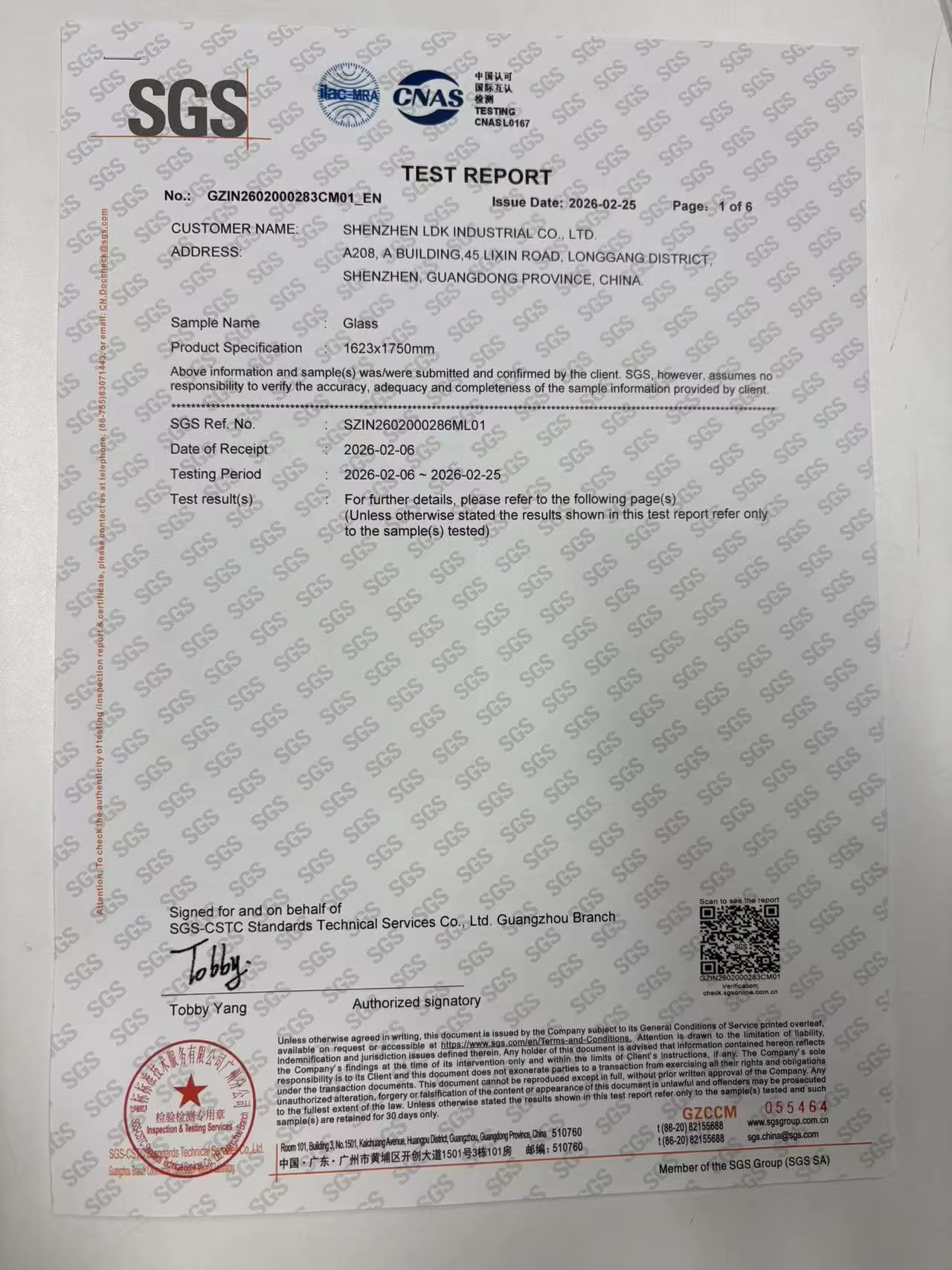
Glass proof document: AS 2208:2023+A1:2024 test report No. GZIN2602000283CM01_EN, issued by SGS-CSTC Standards Technical Services Co. Ltd. Guangzhou Branch.
Gate 4 — Trade Classification and Import Documentation
Customs is the gate that catches buyers by surprise. A useful public reference point is United States Customs and Border Protection ruling NY N336509, effective 30 November 2023, which classifies a complete, unassembled padel court, comprising steel structure, safety glass panels, artificial turf and lighting, under HS code 9506.99.6080. That ruling is a US determination and does not bind authorities in Latin America or Asia, but it demonstrates the principle clearly: a padel court can be treated as a single classified article when it is presented as a complete unassembled set, while shipments presented as separate components may attract different treatment.
The operational consequence for LATAM and Asian importers is that classification should be settled before the proforma invoice is issued. Buyers should ask their customs broker to review the packing list and confirm whether the shipment will be declared as a complete unassembled court, as components, or as a mixed declaration. Invoices, packing lists and technical descriptions should use consistent terminology so that the declaration, the certificate scope and the physical shipment match.
Wind exposure also belongs in this gate because it affects both engineering and duty valuation for roofed models. LDK's Panoramic Padel Court With Roof (model LDK-PADEL-RF01) is specified with hot-dip galvanized carbon steel, a surface treatment of hot-dip galvanizing plus electrostatic epoxy powder coating at 70 to 80 micrometres thickness, and wind resistance at Level 10 to 13 typhoon. For typhoon-exposed markets in Asia, that single specification line is often the difference between an approvable roofed court and an uninsurable one.
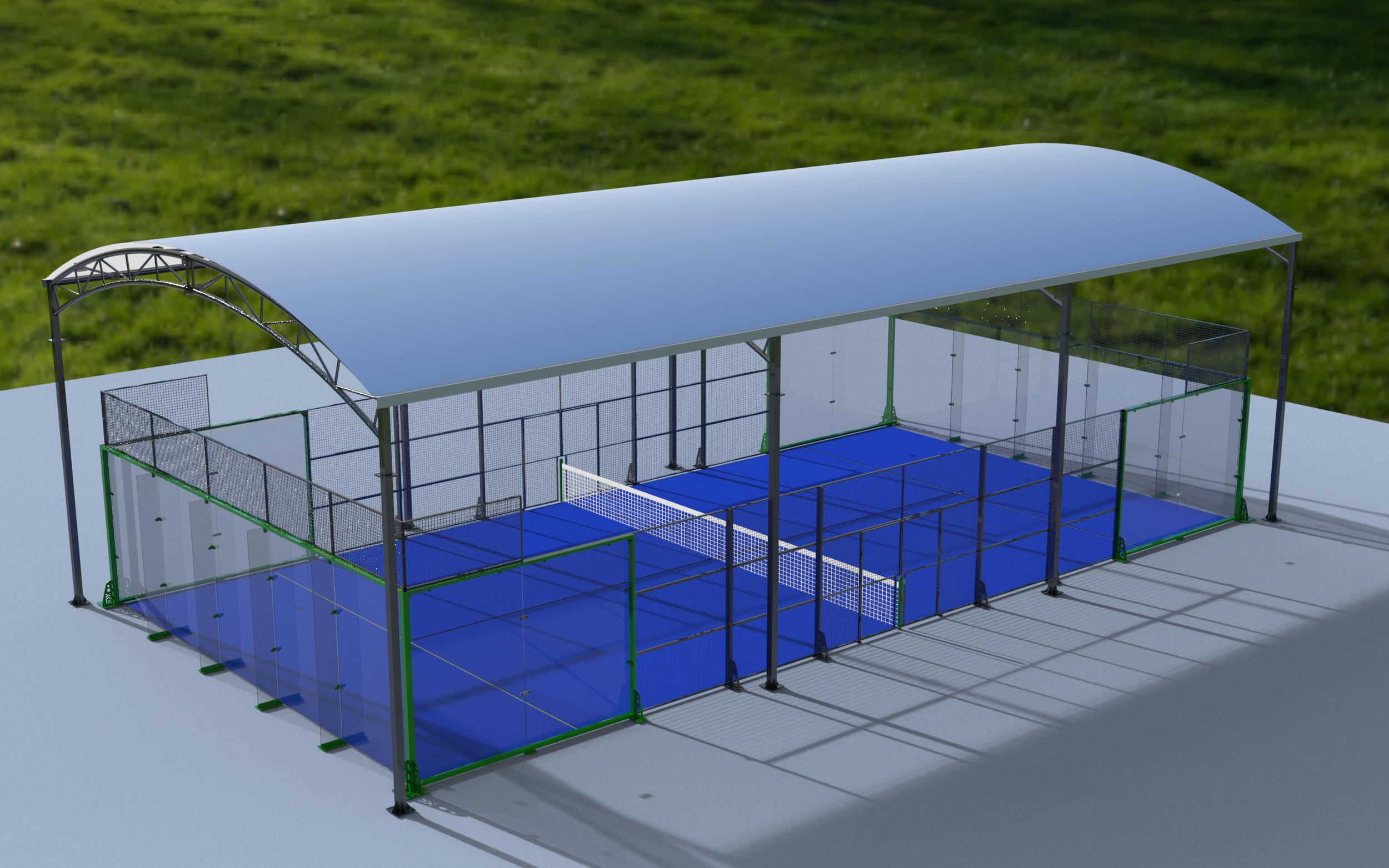
Wind-load compliance asset: roofed panoramic court with a 750 g/m² double PVC-coated PVDF membrane and Level 10 to 13 typhoon wind resistance.
Step-by-Step Certification Roadmap: From RFQ to Site Handover
The roadmap below sequences the four gates into a buying process. It is written so that each step produces a document or a decision, which keeps compliance work visible instead of leaving it to the last week before shipping.
- Define the compliance end-use. Decide whether the court is recreational, club-commercial or intended for tournament play. Tournament use triggers the FIP geometry and equipment check; public or school venues trigger the strongest glass and safety documentation review.
- Build the technical baseline from the FIP rules. Fix the interior court rectangle, minimum clear height, complete enclosure and net dimensions in the RFQ document so that every quotation is answered against the same baseline rather than against different assumptions.
- Map the destination-market document set. For EU-linked specifications, request the Verification of Conformity under EN ISO 12100:2010. For Australia and New Zealand related projects, request the AS 2208:2023+A1:2024 glass report. For LATAM and Asian destinations, confirm with the local authority which structural, electrical and fire documents are required for a covered court.
- Request the document pack with six fields complete. Standard name, issuing body, certificate number, market scope, product model linkage and issue date. LDK's pack, for example, shows EN ISO 12100:2010 with certificate CTGS250305116EC from Jiangxi CTGS Testing Service Co., LTD, and AS 2208:2023+A1:2024 with report GZIN2602000283CM01_EN from SGS-CSTC Standards Technical Services Co. Ltd. Guangzhou Branch.
- Verify the materials against the certificate scope. Check that the shipped glass is the tested 12 mm thickness in 1,990 × 2,980 mm panels, that steel is hot-dip galvanized with 70 to 80 micrometre epoxy powder coating, and that roofed models carry the stated wind resistance class.
- Lock quality control and commercial terms. Confirm 100 percent testing before shipment, minimum order quantity, production lead time and warranty length in the purchase contract rather than in email correspondence.
- Plan the handover file. Assemble certificates, test reports, packing lists, installation instructions and warranty terms into one handover document for the operator, insurer and local authority.
| Compliance gate | Document to request | Verification question |
|---|---|---|
| Gate 1 — Tournament use | Technical data sheet with court, height, enclosure and net values | Does the net and enclosure match the FIP baseline values? |
| Gate 2 — EU conformity route | Verification of Conformity, EN ISO 12100:2010, No. CTGS250305116EC | Is the standard, issuer and market scope stated on the document? |
| Gate 3 — Safety glass | Glass test report AS 2208:2023+A1:2024, No. GZIN2602000283CM01_EN | Does the report name the shipped thickness and panel size? |
| Gate 4 — Import and site | HS classification advice, structural and electrical documentation | Will the declaration match the certificate scope and packing list? |
Use Cases: Two Emerging-Market Projects That Cleared the Same Path
The value of a compliance roadmap is tested by projects that actually ran. Two verified deployments are relevant because they sit in the two regions this article addresses.
Chile: 16 Padel Courts, Three Years of Continuous Operation
In Chile, a client operating a padel court club installed 16 units that have now been in service for three years with a reported result of three years stable. The operational feedback highlights two things that procurement teams in Latin America care about most: the venue is extremely durable with almost no maintenance required, and it can be used throughout the year. For a Latin American importer, that combination matters because it means the compliance-approved configuration did not trade durability for paperwork. Corrosion control through hot-dip galvanizing and the tempered glass enclosure are the components most directly linked to that outcome.
Bangladesh: 70 Padel Courts with FIP and CE Documentation Cited
In Bangladesh, a 70-unit padel court programme has similarly been reported as stable after three years. The stated highlight from that project is direct: international FIP and CE certification ensured quality and safety. This is a useful Asian reference for two reasons. First, it demonstrates certification documentation functioning as an acceptance basis on a large multi-court rollout rather than on a single showcase court. Second, Bangladesh sits in a high wind-exposure belt, which makes the roofed model specification line on wind resistance at Level 10 to 13 typhoon directly relevant to project approval. A 70-court programme also validates production scale, which for LDK is supported by a monthly capacity of 200 units.
Reference Configuration: Outdoor Sports Facility with FIP, CE and AS 2208 Glass
A documented application profile for sports facilities and venues in Australia, New Zealand and the United States shows how the four gates combine in a single specification. The operating conditions are outdoor, high traffic and all-weather, with 24/7 availability. Matched equipment covers court lighting, fencing, the net system and padel grass. The stated special requirement is compliance with FIP standards, CE certification to EN ISO 12100, and AS 2208 certified safety glass from SGS. That profile is effectively a template for any buyer writing a compliance-first specification in an emerging market.
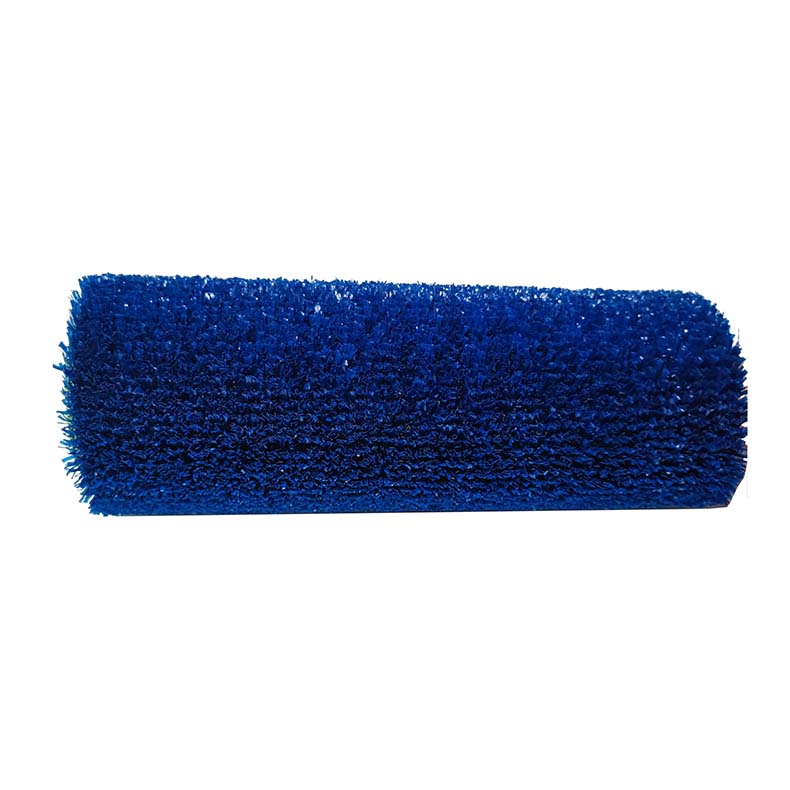
Surface component: padel artificial grass, 12 mm pile height, 9,000 Dtex yarn, 3/16 inch gauge, double PP and PU latex backing.
Comparison Table: Compliance Documents and Court Specifications
The two tables below consolidate the verifiable compliance data points discussed above. The first lists document-level evidence with reference numbers and market scope. The second compares court parameters against the FIP baseline values.
| Document | Standard or rule | Issuing body | Reference number | Market scope |
|---|---|---|---|---|
| Verification of Conformity | EN ISO 12100:2010 | Jiangxi CTGS Testing Service Co., LTD | CTGS250305116EC | EU |
| Glass Test Report | AS 2208:2023+A1:2024 | SGS-CSTC Standards Technical Services Co. Ltd. Guangzhou Branch | GZIN2602000283CM01_EN | Australia / New Zealand |
| Management system and product certifications | ISO 9001, ISO 45001, ISO 14001, CE | Multiple certification bodies (company-level) | On request | Global |
| FIP playing baseline | FIP Rules of Padel (2025 edition identified) | International Padel Federation | Rules document | Competition use, international |
| Customs classification example | HS 9506.99.6080 (CBP ruling NY N336509) | United States Customs and Border Protection | NY N336509 | United States |
| Parameter | FIP Rules of Padel baseline | LDK verified configuration |
|---|---|---|
| Interior playing rectangle | 10 m wide × 20 m long, 0.5% tolerance | Padel Court LDK-PD01 laid out on a 20 m × 10 m court; roofed model LDK-PADEL-RF01 measures 20 m (L) × 10 m (W) |
| Minimum clear height | 6 m throughout the court, no obstructing elements | Roofed panoramic model: 7 m eaves height, 9.2 m ridge height |
| Complete enclosure | Court must be completely enclosed | 12 mm ultra-clear tempered safety glass, 1,990 × 2,980 mm panels, plus 1 × 2 m wire mesh panels with 4.0 mm wire and 50 × 50 mm openings |
| Net | 10 m long; 0.88 m centre, 0.92 m ends; max tolerance 0.005 m | 10 m long, 92 cm high black PP net, 4 mm cord, 45 × 45 mm mesh openings, on 940 mm net posts |
| Lighting | Not specified in the cited rules document | 200 W LED fixtures rated IP65 on 100 × 50 × 3 mm light posts |
Frequently Asked Questions
Which certification documents should a LATAM or Asian importer request from a padel court manufacturer?
The procurement-ready set has four parts. First, a European Verification of Conformity: LDK's Padel Court holds one under EN ISO 12100:2010, certificate number CTGS250305116EC, issued by Jiangxi CTGS Testing Service Co., LTD for the EU market. Second, a safety glass test report: the same Padel Court product holds AS 2208:2023+A1:2024 report number GZIN2602000283CM01_EN issued by SGS-CSTC Standards Technical Services Co. Ltd. Guangzhou Branch for the Australia and New Zealand market. Third, company-level system certification: ISO 9001, ISO 45001, ISO 14001 and CE. Fourth, a technical data sheet showing FIP-aligned court, height, enclosure and net values, plus customs classification advice for the destination country. Each document should state the product model, the market scope and the issue date.
Can a certified padel court still be customised for a specific site?
Yes. LDK operates an OEM and ODM production model and customises court size, colour, logo printing, surface material, fencing design and lighting configuration. Customisation sits on top of the certified base configuration rather than replacing it: the enclosure remains 12 mm thick, 1,990 × 2,980 mm ultra-clear tempered safety glass documented at a 1 in 10,000 spontaneous breakage rate, and the artificial grass remains 12 mm pile height with 9,000 Dtex yarn, 3/16 inch gauge and double PP plus PU latex backing. LDK's R&D team of 17 engineers supports this work, and new product development can be completed in as few as 10 days.
What drives the cost of a compliant padel court?
In a compliance-first purchase, cost is driven by the specification that the certificate covers rather than by a headline unit figure. The main drivers are the 12 mm tempered safety glass with its test documentation, hot-dip galvanized steel with a 70 to 80 micrometre epoxy powder coating, wire mesh and netting, 200 W LED IP65 lighting, and the artificial grass build. Roofed panoramic models add a 750 g/m² double PVC-coated PVDF membrane with a 10 to 15 year service life and a wind resistance rating of Level 10 to 13 typhoon. Buyers should ask for a line-item quotation tied to the same specification that appears on the certificate and test report, so that no certified element is quietly substituted at contract stage.
Can a buyer validate one court before committing to a multi-court rollout?
Yes. The minimum order quantity for LDK padel courts is 1 unit, and every unit is 100 percent tested before shipment. A single-court validation is a practical way to confirm glass alignment, net height against the FIP baseline, lighting coverage and drainage behaviour on the actual site before scaling. Two larger references support this approach: a 16-unit padel club in Chile and a 70-unit padel court programme in Bangladesh, both reported as stable after three years of operation.
How long does a certified padel court order take to produce and ship?
Standard production lead time is 30 to 45 days, with a monthly capacity of 200 units and annual output of 223,750 sets across LDK's product range. LDK was founded in 2014, operates on a 100 percent export ratio with over 11 years of export experience, and serves markets worldwide with a particularly strong presence in North America, South America, Europe and Southeast Asia. Products are backed by a 1 to 5 year warranty. To move forward, buyers can request the compliance document pack or a sample court review by contacting Anna at anna@ldkchina.com or by WhatsApp on 15219504797.
Conclusion: Build the Document Pack Before the Container
Importing padel courts into Latin America and Asia is a documentation exercise as much as a manufacturing one. The four gates are stable and predictable: FIP court and equipment conformity for tournament use, a European conformity route referencing EN ISO 12100:2010, third-party safety glass evidence such as AS 2208:2023+A1:2024, and manufacturer system certification. Around those gates sit two non-negotiable practicalities: correct customs classification for a shipment that may arrive as components, and wind-load documentation for any roofed structure in a high-exposure market.
The efficient sequence is to fix the FIP technical baseline first, request every certificate with its standard, issuer, number, market, product model and date, verify that the shipped materials match the certified scope, and only then release production. Buyers who follow that order reach site handover with a file that satisfies a club operator, an insurer and a building inspector at the same time, which is exactly what the Chile and Bangladesh projects demonstrate.
Next Step: Request the Compliance Pack or a Sample Review
Ask for the full document set for the Padel Court (LDK-PD01) and the Panoramic Padel Court With Roof (LDK-PADEL-RF01), including the EU Verification of Conformity No. CTGS250305116EC and the AS 2208:2023+A1:2024 glass report No. GZIN2602000283CM01_EN, or arrange a single-unit validation ahead of a multi-court rollout.
Download the product catalogue: LDK Padel Court Brochure (PDF)
Contact: Anna — Email: anna@ldkchina.com — Tel / WhatsApp: 15219504797 — Website: www.ldkchina.com
Shenzhen LDK Industrial Co., Ltd. (LDK) manufactures padel courts, panoramic padel courts with roof, squash courts, football pitches, basketball courts and pickleball courts, with a 50,000 m² manufacturing base in Cangzhou, a 4,500 m² R&D and production base in Huizhou, and 100 percent export orientation.
Have Questions or Need More Details?
Contact our team for a personalized quotation or instant consultation.
Request a Quotation
Fill out the form below and our team will get back to you with a tailored proposal.
WhatsApp Direct Chat
Prefer to chat in real-time? Message us on WhatsApp for instant assistance & quick answers.
- Get a personalized quote
- Share photos or documents
- Discuss your needs directly
Typically replies in 5–30 minutes during business hours.