Decoding Padel Court Technical Specifications: How Manufacturing Processes Define Quality and Performance
Introduction
When investing in a padel court, buyers face a complex maze of technical parameters — from steel tube dimensions to artificial grass density. The real challenge lies not in reading the numbers, but in understanding how each parameter directly influences playability, durability, and safety. This article decodes the core technical specifications of padel court systems and explains how padel court manufacturing processes — such as hot-dip galvanizing, powder coating, and glass tempering — determine the final quality. By the end, you will be equipped to evaluate suppliers based on engineering substance, not marketing hype.
Problem Definition: Why Technical Parameters Matter to Procurement Professionals
Many purchasers assume that all padel courts are essentially the same. However, a 0.5mm difference in steel wall thickness, a 10% variation in grass density, or the absence of a proper anti-corrosion coating can shorten the court’s lifespan by years and increase maintenance costs dramatically. The core problem is the lack of a standardized framework to interpret specifications and link them to real-world performance.
Procurement teams need to answer: What is a padel court’s structural integrity indicator? How does surface treatment affect corrosion resistance? Which parameters guarantee FIP tournament compliance? This guide bridges the knowledge gap.
Industry Background: The Global Push for Higher Quality Standards
The global padel court market has expanded rapidly, with installations growing across Europe, the Americas, Asia, and Oceania. As the sport professionalizes, regulatory bodies like the International Padel Federation (FIP) and national standards (e.g., AS 2208:2023+A1:2024 for safety glass in Australia/New Zealand) are raising the bar. Suppliers must now provide CE certification (EN ISO 12100:2010) for EU markets and SGS-tested glass reports for compliance. This creates a clear distinction between commodity-grade courts and premium, certifiable systems. Leading manufacturers like SHENZHEN LDK INDUSTRIAL CO., LTD. (brand: LDK) have invested heavily in in-house R&D, automated production lines, and third-party certifications to meet these demands.
Detailed Solution Explanation: Decoding Key Technical Parameters
1. Steel Structure – The Skeleton of the Court
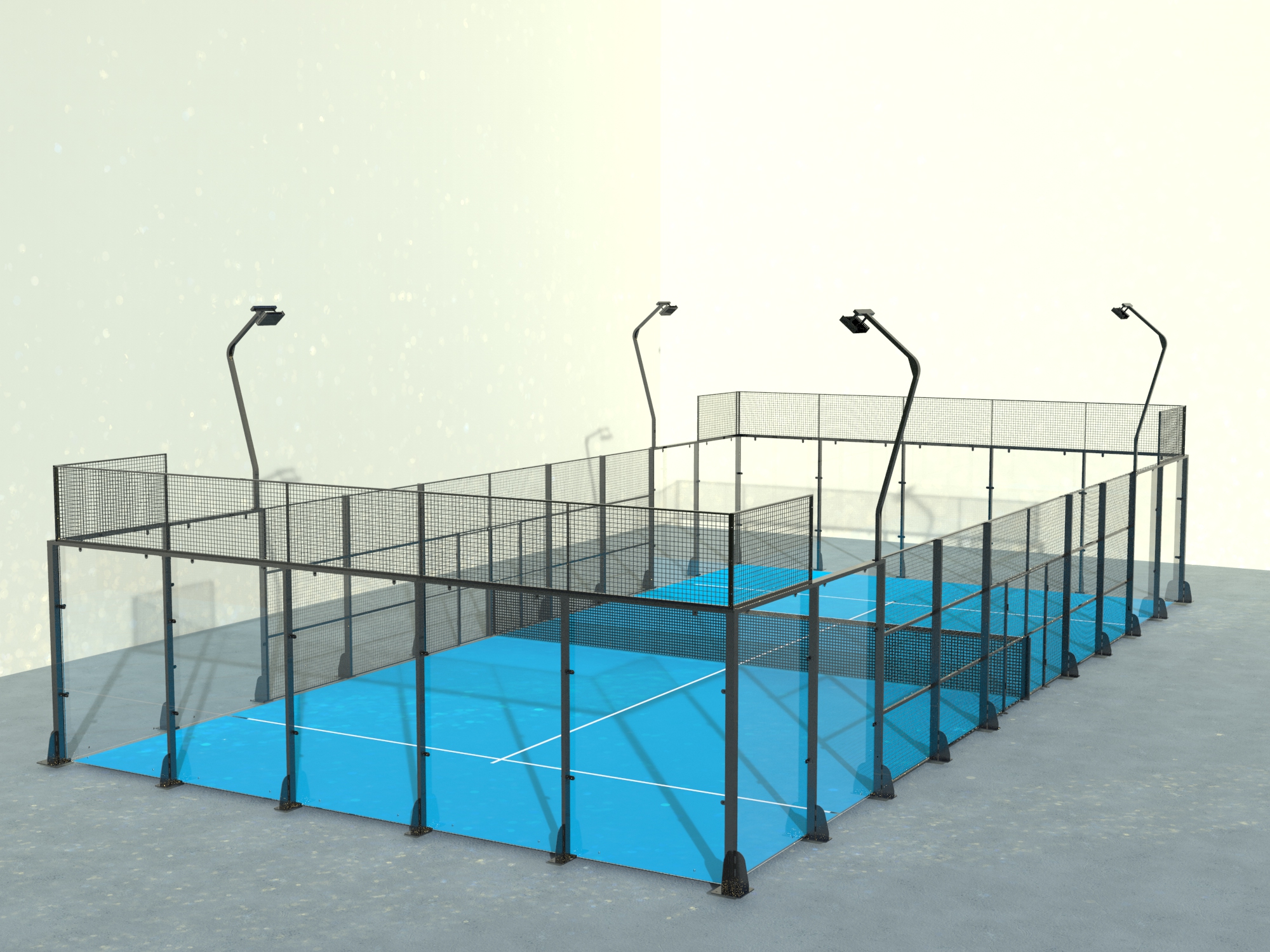
The most critical differentiator is the steel tube specification. A typical premium padel court (model LDK-PD01) uses 150×200×4mm hot-galvanized steel tube for corner columns and 100×50×3mm for intermediate posts. Compare this to budget courts that may use 2.0mm or 2.5mm walls. The extra thickness (0.5–1.0mm) directly translates to higher wind load resistance (up to Typhoon Level 13 for roofed models) and longer structural life.
| Parameter | LDK Premium Court (LDK-PD01) | Typical Budget Court | Impact |
|---|---|---|---|
| Corner column (mm) | 150×200×4 | 100×100×2.5 | 3x stronger against bending |
| Horizontal tube (mm) | 100×50×3 | 80×40×2 | Better load distribution |
| Surface treatment | Hot-dip galvanizing + electrostatic powder coating (70–80 μm) | Cold galvanizing or painting | Corrosion resistance >20 years |
| Connection method | High-strength bolts | Welded | Easy assembly, no rust at joints |
Hot-dip galvanizing creates a metallurgical bond that prevents rust even when the coating is scratched. LDK’s extra polishing and deburring process eliminates sharp edges, reducing injury risk — a feature often overlooked.
2. Enclosure Glass and Mesh
Safety is paramount. LDK uses 12mm ultra-clear tempered safety glass (1990×2980mm panels) with a certified spontaneous breakage rate of 1 in 10,000. This glass is tested to AS 2208:2023+A1:2024 by SGS (report No. GZIN2602000283CM01_EN). The wire mesh features 4.0mm wire, 50×50mm openings, ensuring ball containment without obstructing view. Budget alternatives often use thinner glass (8mm) or lower-grade mesh that deforms over time.
3. Artificial Grass – The Playing Surface
The padel grass specification directly affects ball bounce and player comfort. LDK’s model LDK1231625.4-ST3 offers: pile height 12mm, yarn 9000 Dtex, gauge 3/16", density 58,800 stitches/m² (±10%), with double PP + PU latex backing. A higher density (58,800 vs. typical 50,000) provides a more consistent surface and better shock absorption. The PU backing improves dimensional stability and drainage. Available colors include blue, red, green, pink, and black for branding.
4. Roof System (for Panoramic Courts)
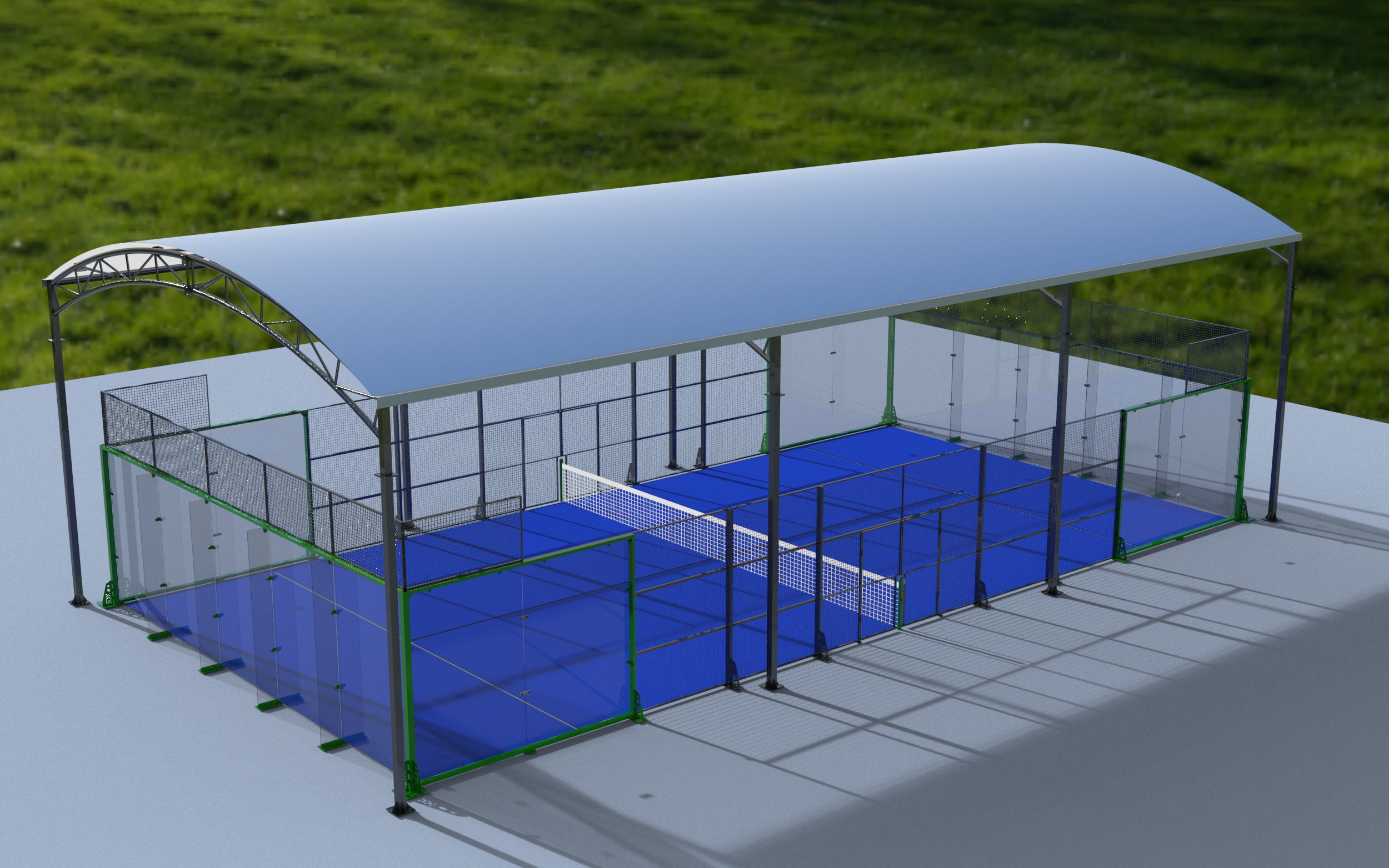
For panoramic padel courts with roof (model LDK-PADEL-RF01), the key parameters are: PVC-coated PVDF fabric 750g/m² (service life 10–15 years), steel frame designed for wind up to Level 13 typhoon, and eaves height 7m for ample clearance. The roof eliminates weather interruptions, making the court usable 365 days a year.
Step-by-Step Breakdown: How to Evaluate a Manufacturer’s Technical Data
- Request full material specifications – including steel grade, wall thickness, coating type and thickness, glass certification number, and artificial grass test reports.
- Verify certifications – look for CE (EN ISO 12100), AS 2208 (SGS) for glass, and ISO 9001/14001/45001 factory management. LDK holds all these certifications.
- Inspect sample components – if possible, visit the factory or request a product sample to check weld quality, coating adhesion, and edge finishing.
- Compare production capacity and lead time – a reliable manufacturer like LDK (monthly capacity: 200 units, lead time: 30–45 days) can handle medium to large projects.
- Review after-sales warranty – LDK offers 1–5 years warranty and 100% pre-shipment testing.
- Ask about customizations – court size, logo, colors, lighting configuration. LDK supports OEM/ODM with MOQ as low as 1 unit.
Use Cases: Real-World Application of Technical Specifications
Case 1: Automotive OEM in Chile – 16 Units
A major automotive company in Chile selected LDK for a padel club project. The client required a court that could operate year-round with minimal maintenance. LDK supplied 16 units of its standard padel court (LDK-PD01) with 12mm tempered glass and hot-dip galvanized steel. After 3 years of continuous use in an outdoor, high-traffic environment, the courts reported zero structural issues and near-zero maintenance. The client highlighted the exceptional durability and the ability to use the facility 24/7 without concerns.
Case 2: Automotive ODM in Bangladesh – 70 Units
An automotive ODM in Bangladesh procured 70 units for a large-scale sports complex. The key requirement was compliance with international FIP standards and CE certification. LDK delivered courts with full CE documentation (CTGS250305116EC) and SGS glass reports. The project has been running for over 3 years with stable performance, and the client praised the rigorous certification that ensured safety and quality across all installations.
Frequently Asked Questions (FAQ)
What is the most important technical specification in a padel court?
The steel structure (tube dimensions and surface treatment) is the backbone. Look for wall thickness ≥4mm for corner posts and hot-dip galvanizing + powder coating for corrosion resistance.
How does artificial grass density affect gameplay?
Higher density (≥58,000 stitches/m²) provides a more uniform ball bounce, better durability, and reduced wear. Lower-density grass may develop bald spots quickly.
Why is glass certification important?
Uncertified glass can have a higher spontaneous breakage rate, posing safety risks. Certification like AS 2208 (SGS) guarantees the glass meets strict impact and thermal stress standards.
Can I customize the court size or colors?
Yes, reputable manufacturers like LDK offer full customization — court layout, steel color, grass color (blue, red, green, pink, black), logo printing, and lighting setup.
What warranty should I expect from a reliable padel court supplier?
Typically 1–5 years for steel structure and components. LDK provides a dedicated warranty on all products, with after-sales support via WhatsApp (+86 15219504797) and email (anna@ldkchina.com).
Conclusion
Understanding padel court technical specifications and their relationship with manufacturing processes is essential for making an informed procurement decision. Key factors — steel thickness, surface treatment, glass certification, artificial grass density — determine not only initial cost but also long-term durability, safety, and player satisfaction. By partnering with a certified padel court manufacturer like LDK (visit www.ldkchina.com), you gain access to globally compliant products backed by real certifications and proven case studies. With a factory spanning 50,000 m², 107 employees, and annual output of 223,750 sets, LDK delivers engineering excellence from Shenzhen to the world.
📥 Download our full company brochure for detailed product specifications, certifications, and project references: LDK Corporate Brochure (PDF)