
Padel Court Long-Term Partnership FAQ: Acceptance, Maintenance, and Multi-Project Support
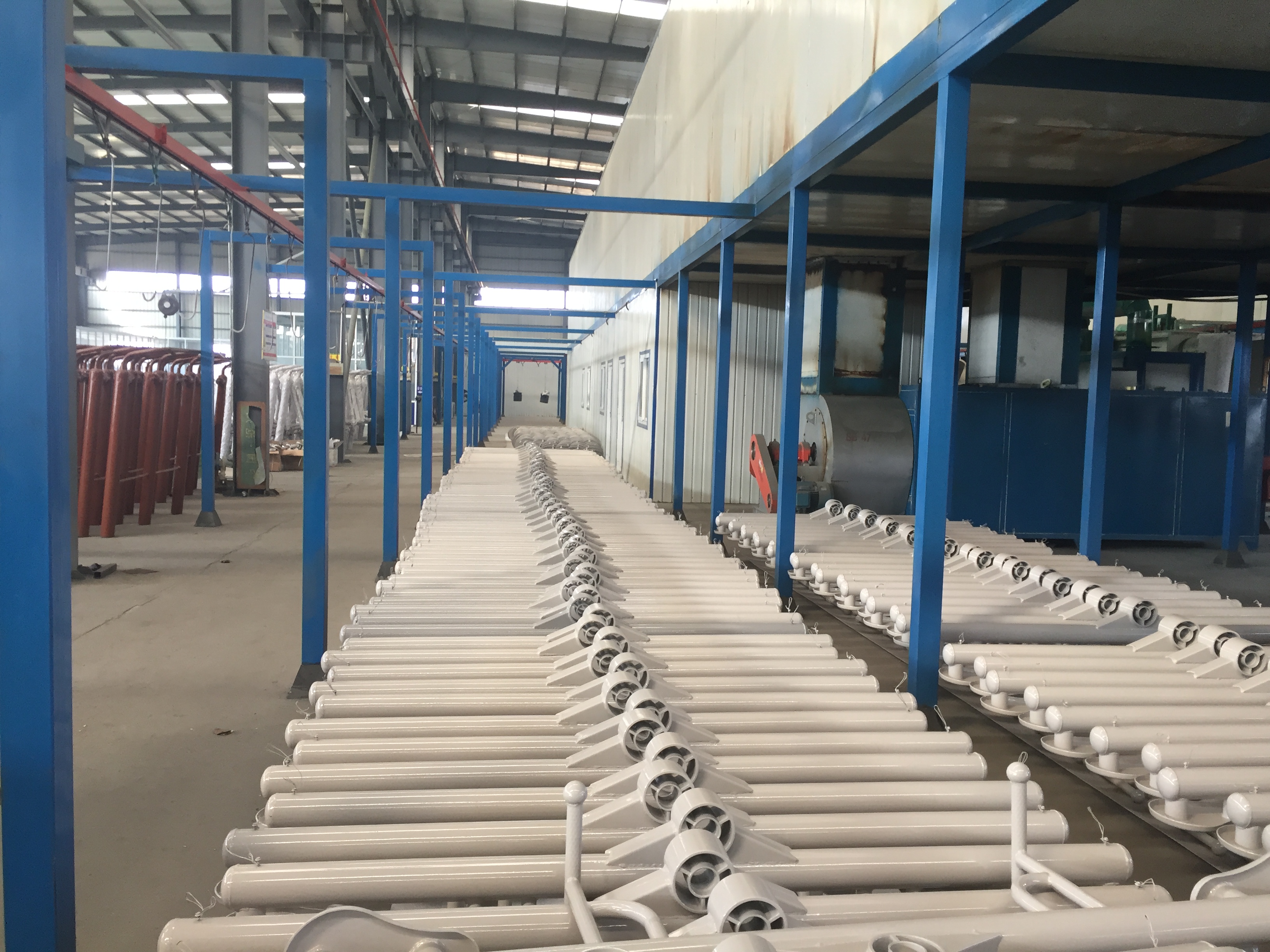
Short answer: a long-term padel court partnership is a documented package, not a goodwill promise. It covers fixed purchasing terms (minimum order quantity, delivery terms, payment split, acceptance criteria), a maintenance baseline built from the components you actually bought, a certification file that travels with the product, and a supply plan that lets the same court be repeated on later sites. Shenzhen LDK Industrial Co., Ltd. (LDK) — a sports equipment manufacturer founded in 2014, headquartered in Shenzhen with a 50,000 m² manufacturing base in Cangzhou — supplies these as standard parts of its padel court offer rather than as optional extras.
This FAQ answers the questions buyers actually raise once the first purchase order is behind them: what acceptance looks like in practice, what maintenance has to be planned before handover, which spare parts are worth holding, and how a supplier supports project two, project three and project ten. Every answer below is tied to documented specifications, certification records or reference projects, so it can be checked rather than taken on trust.
The Problem: A Court That Passes Inspection Can Still Fail the Partnership
Most padel court procurement effort is spent before the order. After it, three gaps tend to appear — and all three are partnership issues rather than product issues.
Gap 1 — acceptance is agreed as a feeling rather than a criterion. When a buyer and a supplier never define what is being tested before shipment, the handover becomes a negotiation. In LDK's standard terms the acceptance criterion is a pre-shipment test, and that is a term that can be written into the order instead of debated afterwards.
Gap 2 — maintenance cost is decided at order stage but paid later. A court is a system of glass, steel, mesh, net, lighting, and surface. Whether the operator can plan maintenance depends on whether the supplier documented those components clearly enough to specify replacements. A 12 mm tempered glass panel, a 200 W IP65 LED fixture, a 750 g/m² PVDF roof fabric, and a 12 mm padel grass surface each carry different inspection priorities and different replacement logic.
Gap 3 — the specification does not survive repetition. A buyer who opens one club and then a second one six months later needs the same court, not a re-engineered one. If the first order was not documented down to frame sections, glass dimensions, and lighting configuration, the second project starts from zero and the operator ends up with a mixed estate.
In short: the first order proves a supplier can deliver a court. The partnership proves the supplier can repeat it, support it, and keep it serviceable.
Industry Background: Multi-Court Growth Changed What Buyers Ask For
Padel's expansion is now a portfolio story rather than a single-venue story. The Global Padel Report 2026, published by Playtomic and PwC Strategy&, reports that the sport has expanded approximately six times since 2016 and is forecast to exceed 91,000 courts globally by 2028. Buyers who once ordered one court are now ordering clusters, and clusters create requirements that single courts do not: specification consistency, delivery sequencing, spare-part provisioning, and a maintenance model that works across sites.
At the same time, the technical baseline has become clearer, which makes acceptance easier to define. The FIP Rules of Padel specify an interior playing rectangle of 20 m × 10 m with a 0.5% tolerance, a minimum clear height of 6 m throughout the court with no obstructing elements, complete enclosure of the court, and a net 10 m long, 0.88 m high at the centre and 0.92 m at the ends with a maximum tolerance of 0.005 m. These are useful yardsticks for incoming inspection because they describe the playing environment rather than a particular supplier's product.
What has changed in buyer behaviour is the level of detail requested in a quotation. Glass thickness, wind resistance class, roof fabric weight, LED ingress protection, and surface specification now sit alongside price on the comparison sheet. That is a healthier conversation, but it only produces a better outcome if the same numbers are carried into acceptance, maintenance planning, and the next project.
What a Long-Term Padel Court Partnership Covers
Commercial Terms Fixed Before the First Order
A partnership needs numbers that do not move. LDK's documented terms are deliberately narrow: minimum order quantity of 1 unit, delivery terms of FOB, CIF or DDP, payment terms of 50/50, and pre-shipment test as the acceptance criterion. Production lead time is typically 30–45 days, monthly production capacity is 200 units, quality control covers 100% testing of products, and after-sales support runs on a 1–5 year warranty.
The minimum order quantity matters more than it appears. A one-unit minimum lets a buyer validate a single court — the actual delivered product, not a catalogue rendering — before committing a multi-court budget. That single unit then becomes the reference specification for everything that follows.
A Product Baseline You Can Repeat
Repeatability depends on specifications precise enough to be re-ordered. LDK's padel range is documented at component level, which is what allows a second or tenth project to be built to the same blueprint.
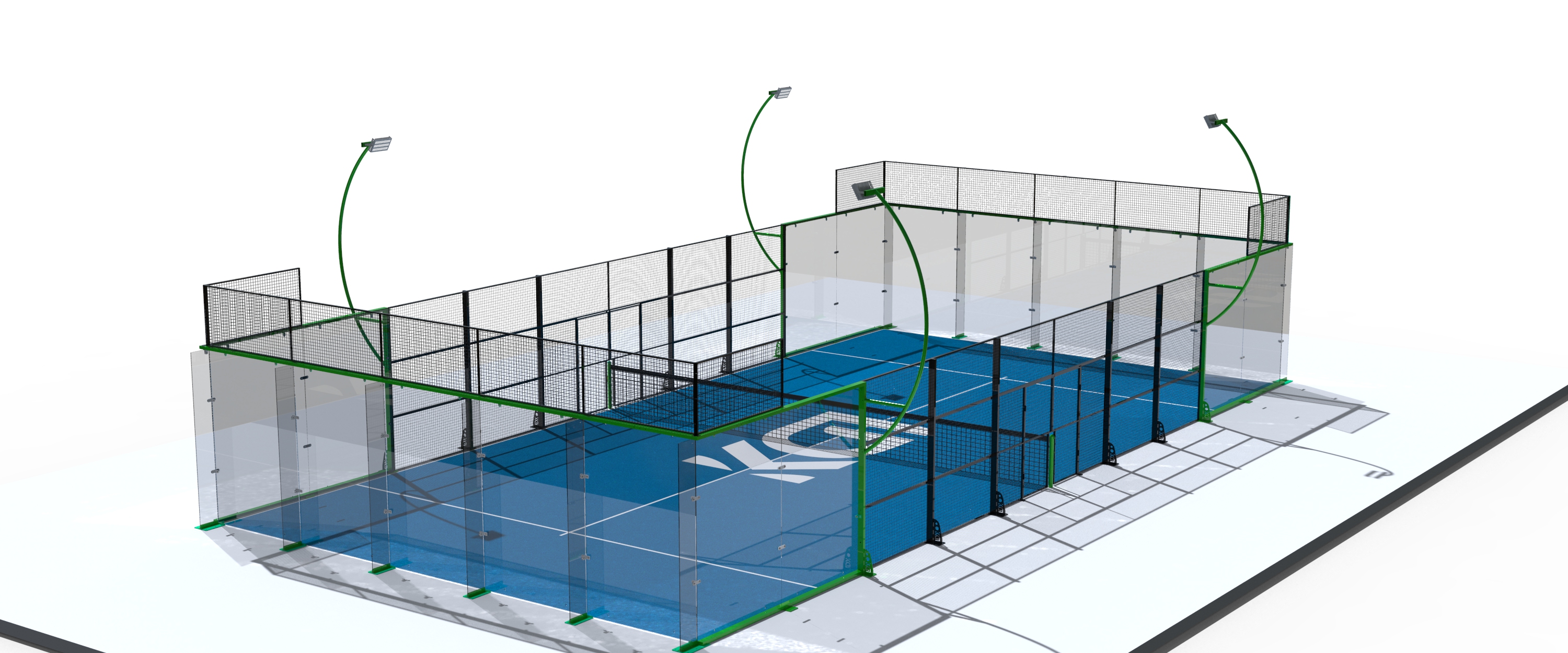
The LDK-PD01 is a steel-and-glass court. Its perimeter enclosure uses 12 mm thick ultra-clear tempered safety glass in 1990 × 2980 mm panels, with a certified spontaneous breakage rate cited at 1 in 10,000. The frame is built from 4 m-high 100 × 100 × 5 mm corner posts, 100 × 50 × 3 mm intermediate and gate posts, and 100 × 50 × 3 mm horizontal tubing in 4 m, 6 m and 4 m lengths, closed with 1 × 2 m steel wire mesh panels of 4.0 mm wire and 50 × 50 mm openings. The equipment package includes 940 mm-high (120 × 60 × 3 mm) net posts and a 10 m long, 92 cm high black polypropylene net with 4 mm cord and 45 × 45 mm mesh. Lighting uses 200 W LED fixtures rated IP65 on 100 × 50 × 3 mm light posts.
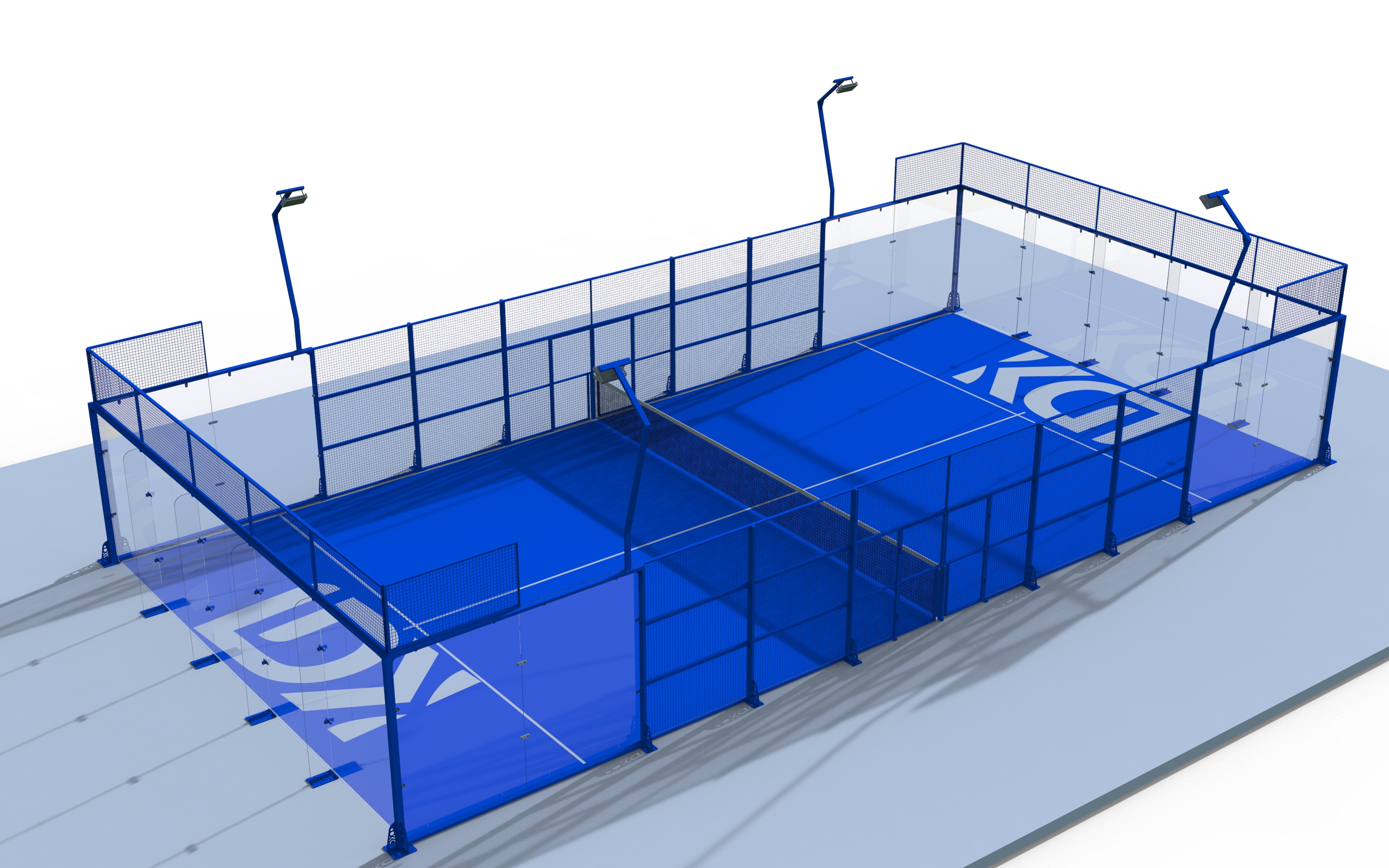
The LDK-PADEL-RF01 is the panoramic court with roof. Its playing area is 20 m × 10 m, with a 7 m eaves height and 9.2 m ridge height — comfortably above the 6 m minimum clear height referenced in the FIP rules. The steel structure uses 150 × 200 × 4 mm hot-galvanized corner columns (8 pieces), 100 × 50 × 3 mm middle columns (12 pieces), Φ102/Φ89/Φ40 × 3 mm hot-galvanized beams and 100 × 50 × 3 mm cross tubes (16 pieces), bolted with high-strength fasteners and finished with hot-dip galvanizing plus electrostatic epoxy powder coating at 70–80 μm. Wind resistance is rated at Level 10~13 typhoon. The roof is 750 g/m² double PVC-coated PVDF fabric with a stated service life of 10–15 years. The enclosure uses 12 mm tempered safety glass in 1990 × 2980 mm panels (18 pieces) and 1 × 2 m wire mesh with 4 mm wire and 50 × 50 mm openings (46 pieces), with stainless steel electro-polished hardware and 200 W IP65 LED lighting.
The surface range is anchored by the LDK1231625.4-ST3 padel grass: 12 mm pile height, 9000 Dtex yarn, 3/16" gauge, double PP + PU latex backing, density of 58,800 stitches/m² (±10%), available in blue, red, green, pink and black. Colour choice is a genuine operational decision, not a cosmetic one — club branding, court numbering and surface visibility all depend on it, and it has to be repeatable on the next site.
Certification Continuity Across Orders
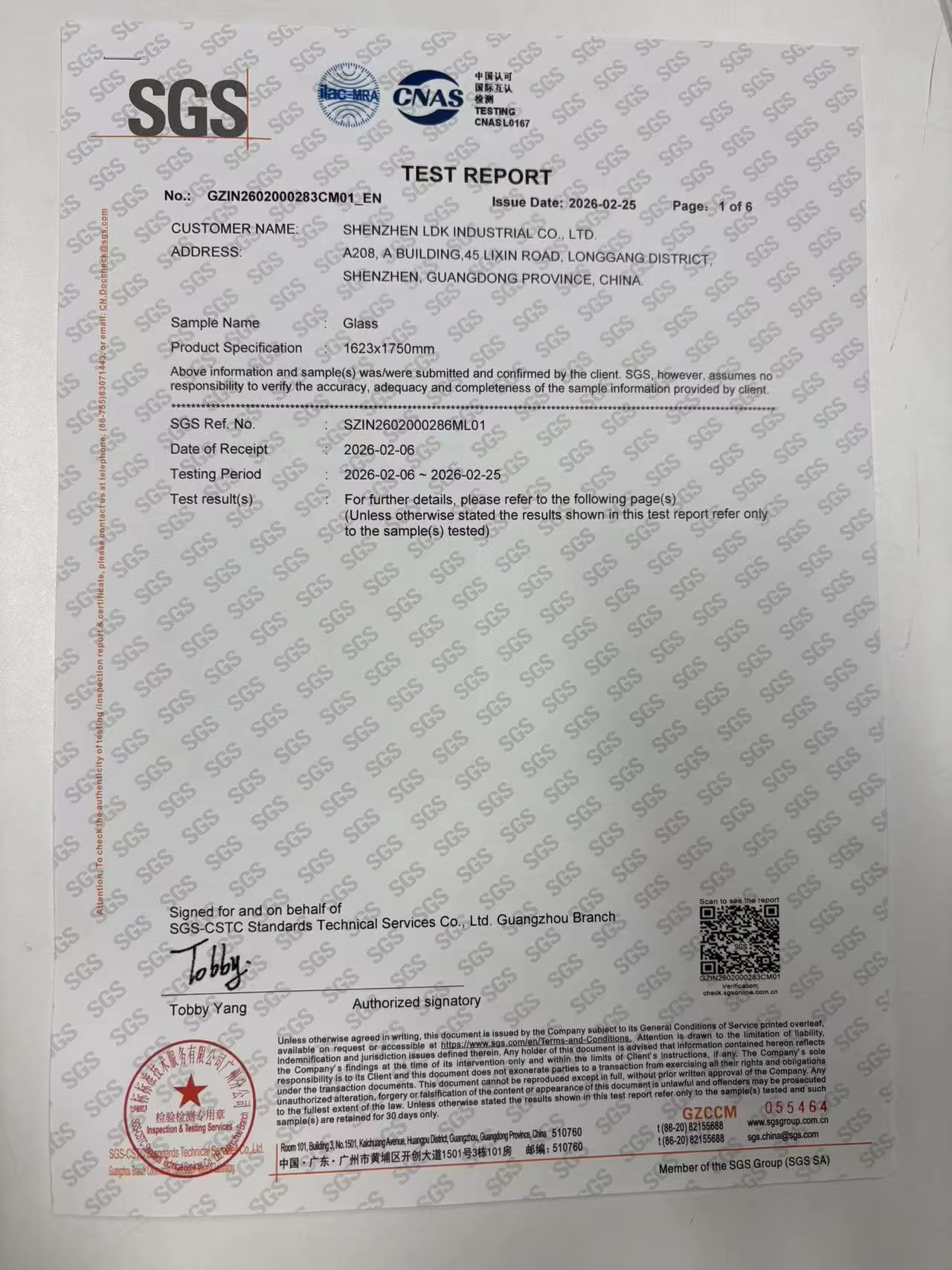
Certification is only useful if it is still traceable when the second order is placed. LDK's padel courts are supported by a CE Verification of Conformity (certificate CTGS250305116EC, issued by Jiangxi CTGS Testing Service Co., LTD under EN ISO 12100:2010, EU scope) and a glass test report to AS 2208:2023+A1:2024 (certificate GZIN2602000283CM01_EN, issued by SGS-CSTC Standards Technical Services Co. Ltd. Guangzhou Branch on 25 February 2026, Australia/New Zealand scope). At company level, LDK holds ISO 9001, ISO 45001 and ISO 14001 in addition to CE, and operates as a verified Alibaba.com Gold Supplier.
Spare Parts and Customization Continuity
A partnership also means the supplier can still match the original build. LDK's customization scope covers court size, colour, logo printing, surface material, fencing design and lighting configuration, and OEM/ODM production is available. In practice this is what makes a mixed estate manageable: the same supplier can reproduce a retired court's specification, supply a matching replacement panel, or extend an existing colour scheme into a new location without visual mismatch.
The spare-part logic follows directly from the specification. The parts that wear or arrive damaged in transit are the ones worth holding: glass panels at 1990 × 2980 mm, 1 × 2 m wire mesh panels, the 10 m polypropylene net, LED fixtures, and — for roofed courts — the PVDF fabric. Because these are defined dimensions rather than bespoke items, they can be re-ordered from the original specification instead of being re-measured on site.
Step-by-Step: From Pre-Shipment Acceptance to Project Five
Step 1 — Freeze the Specification Before Deposit
Write down court type, enclosure dimensions, glass thickness, lighting configuration, surface colour and — where relevant — roof and wind rating. For a roofed court, confirm the eaves and ridge heights (7 m and 9.2 m on the LDK-PADEL-RF01) against the site's clear-height requirement and the 6 m FIP reference. For an open court, confirm the enclosure height (4 m posts on the LDK-PD01) and gate position. This document becomes the acceptance reference and the re-order reference.
Step 2 — Run the Pre-Shipment Test as a Documented Event
The agreed acceptance criterion is a pre-shipment test, supported by 100% product testing in production. In practice the buyer should receive: the component list against the frozen specification, the glass documentation (AS 2208:2023+A1:2024 report), the CE Verification of Conformity, and confirmation of the net and lighting specification. Check the playing-area baseline — 20 m × 10 m interior with a 0.5% tolerance — and the net dimensions of 10 m length, 0.88 m at the centre and 0.92 m at the ends. Discrepancies are cheapest to resolve at this point, before freight.
Step 3 — Plan the Handover, Not Just the Delivery
Handover should capture what the site actually contains: as-built enclosure dimensions, glass panel count and positions, mesh panel count, light positions and fixture rating, roof fabric tensioning for covered courts, and the surface colour and batch. Photographs and a signed component list turn a delivery into a maintenance baseline. For roofed courts, confirm the hot-dip galvanized and powder-coated steel finish at 70–80 μm and the stainless steel hardware set at the same time.
Step 4 — Set the Maintenance Rhythm Around Real Components
Maintenance planning should be component-led rather than calendar-led. Four items drive most of the workload:
- Glass: 12 mm tempered panels with a cited spontaneous breakage rate of 1 in 10,000; inspection focuses on impact damage and edge condition, with replacement matched by dimensions rather than by fabricating on site.
- Roof fabric (covered courts): 750 g/m² double PVC-coated PVDF with a stated 10–15 year service life; tension and surface condition are the items to watch, and the fabric is the single largest long-term replacement item on a roofed court.
- Surface: 12 mm padel grass with double PP + PU latex backing; colour and pile condition determine both playability and the visual consistency across a multi-court site.
- Lighting: 200 W LED fixtures rated IP65; the ingress protection rating is what makes outdoor and coastal installations practical, and it is also what makes fixture replacement a like-for-like swap.
The warranty term of 1–5 years should be mapped against these items at handover, so it is clear which components are covered during which period.
Step 5 — Use Capacity and Lead Time to Sequence Projects
Multi-project support is a scheduling question as much as a manufacturing one. LDK's monthly capacity is 200 units with a typical lead time of 30–45 days and annual production capacity of 223,750 sets across the company's product lines, supported by a 17-engineer R&D team and 107 staff. For a phased rollout, that means the buyer can book capacity per phase instead of ordering everything at once — and can keep the same specification across phases rather than redesigning for each delivery window.
Use Cases: What Three Years of Operation Actually Shows
Chile — 16 courts, club application, three years stable. An automotive OEM client deployed 16 units for a padel court club. The installation has operated stably for three years, and the client's reported experience is that the venue is extremely durable, requires almost no maintenance, and can be used throughout the year. For partnership evaluation, the relevant point is not the durability claim itself but what it implies: an estate of 16 courts ran for three years without a component-level maintenance crisis, which is only possible if the original specification was documented well enough to be serviced.
Bangladesh — 70 courts, three years stable, FIP and CE referenced. An automotive ODM client used the product to construct 70 padel courts. The project has been stable for three years and holds international FIP and CE certifications for quality and safety. This is the more instructive reference for multi-project buyers: 70 courts is a portfolio-scale delivery, and the certification file travelled with it rather than being reconstructed afterwards.
Neither project is presented as a guarantee of future performance. What they demonstrate is process: a documented specification, a certification trail, and a supplier able to deliver at club scale and at portfolio scale without changing the product underneath.
Comparison Table: Standard Steel/Glass Court vs Panoramic Court With Roof
The two configurations answer different site requirements. The comparison below uses only documented model data.
| Attribute | LDK-PD01 (steel/glass court) | LDK-PADEL-RF01 (panoramic court with roof) |
|---|---|---|
| Enclosure glass | 12 mm ultra-clear tempered safety glass, 1990 × 2980 mm panels; certified spontaneous breakage rate cited at 1 in 10,000 | 12 mm tempered safety glass, 1990 × 2980 mm, 18 panels |
| Steel structure | 4 m-high 100 × 100 × 5 mm corner posts; 100 × 50 × 3 mm intermediate and gate posts; 100 × 50 × 3 mm horizontal tubing (4 m / 6 m / 4 m) | 150 × 200 × 4 mm hot-galvanized corner columns (8 pcs); 100 × 50 × 3 mm middle columns (12 pcs); Φ102/Φ89/Φ40 × 3 mm beams; 100 × 50 × 3 mm cross tubes (16 pcs); hot-dip galvanizing + epoxy powder coating 70–80 μm |
| Mesh panels | 1 × 2 m steel wire mesh, 4.0 mm wire, 50 × 50 mm openings | 1 × 2 m wire mesh, 4 mm wire, 50 × 50 mm openings, 46 panels |
| Lighting | 200 W LED, IP65, on 100 × 50 × 3 mm light posts | 200 W LED, IP65, on 100 × 50 × 3 mm columns |
| Roof / canopy | Roof is not part of the documented LDK-PD01 configuration | 750 g/m² double PVC-coated PVDF fabric; stated service life 10–15 years |
| Documented height | 4 m enclosure height | 7 m eaves height; 9.2 m ridge height |
| Wind resistance | Not stated in the model specification | Level 10~13 typhoon |
| Net and surface | 10 m × 92 cm black PP net (4 mm cord, 45 × 45 mm mesh); 940 mm net posts | 10 m × 970 mm knotted PP net (4 mm rope, 50 × 50 mm mesh); 980 mm posts; blue 12 mm artificial grass |
| Where the specification points | Open-air clubs and projects with no cover requirement | Coastal, high-wind and all-weather venues where cover and wind resistance are specified |
The surface programme sits across both configurations. LDK1231625.4-ST3 padel grass is supplied in blue, red, green, pink and black, at 12 mm pile height, 9000 Dtex, 3/16" gauge and 58,800 stitches/m² (±10%), so a multi-court site can be colour-coded without changing the underlying product.
Commercial terms apply equally to both configurations:
| Partnership term | Documented value |
|---|---|
| Minimum order quantity | 1 unit |
| Delivery terms | FOB / CIF / DDP |
| Acceptance criteria | Pre-shipment test |
| Payment terms | 50 / 50 |
| Typical production lead time | 30–45 days |
| Monthly production capacity | 200 units |
| Quality control | 100% testing |
| Warranty | 1–5 years after-sales support |
| Customization scope | Court size, colour, logo printing, surface material, fencing design, lighting configuration |
FAQ: Long-Term Padel Court Partnership Questions
1. Which certifications and standards should a long-term padel court partner maintain?
Ask for the certificate numbers, the issuing body and the scope. LDK's padel courts are covered by a CE Verification of Conformity (CTGS250305116EC, Jiangxi CTGS Testing Service Co., LTD, EN ISO 12100:2010, EU scope) and by a glass test report to AS 2208:2023+A1:2024 (GZIN2602000283CM01_EN, SGS-CSTC Standards Technical Services Co. Ltd. Guangzhou Branch, 25 February 2026, Australia/New Zealand scope). The Bangladesh project covering 70 courts also references international FIP and CE certification for quality and safety. At company level, LDK holds ISO 9001, ISO 45001 and ISO 14001. Technical acceptance should additionally reference the FIP baseline of a 20 m × 10 m interior with 0.5% tolerance, 6 m minimum clear height, complete enclosure and a 10 m net at 0.88 m centre height.
2. Can a partner support repeat projects with consistent specifications?
Consistency is a documentation question. LDK publishes model-level data for the LDK-PD01 and LDK-PADEL-RF01 down to glass dimensions, steel sections, mesh counts and lighting configuration, offers OEM/ODM production, and customizes court size, colour, logo printing, surface material, fencing design and lighting configuration. Capacity supports repetition: 200 units per month, a typical 30–45 day lead time, and 223,750 sets of annual production capacity across the company's product lines, backed by a 17-engineer R&D team and 100% product testing.
3. How should budget be planned across a multi-court rollout?
Budget planning starts with the payment and delivery structure rather than a headline price. LDK's terms are a minimum order quantity of 1 unit, delivery FOB, CIF or DDP, payment terms of 50/50, and a 1–5 year warranty. The main cost variables inside a fixed budget are the configuration (open steel/glass court versus panoramic court with roof), the glass specification, the roof fabric at 750 g/m² PVDF with a 10–15 year stated service life, the 200 W IP65 LED count, and the surface specification. Because the minimum order quantity is 1 unit, a buyer can commit to a validated single court first and phase the remainder against confirmed capacity.
4. Can a buyer validate a court before committing to a multi-court project?
Yes — through a single-unit order combined with pre-shipment testing. A one-unit minimum order lets the buyer receive and inspect the actual product, with 100% testing in production and a pre-shipment test as the agreed acceptance criterion. That first court then serves as the reference for the rest of the estate, and the same customization scope (size, colour, logo printing, surface material, fencing design, lighting configuration) carries into later orders. The full product catalogue, including padel, football and basketball programmes, is available as a downloadable brochure for comparison against the project brief.
5. What lead time and capacity should a buyer expect for a phased rollout?
Typical production lead time is 30–45 days, with monthly production capacity of 200 units. For phased projects the practical approach is to book capacity per phase against a frozen specification, so each delivery window matches the site's readiness rather than forcing a single bulk shipment. The 70-court Bangladesh installation demonstrates delivery at portfolio scale, and the 16-court Chile installation shows the same product running stably for three years after handover. To plan a specific rollout, contact anna@ldkchina.com, WhatsApp or phone +86 15219504797, and request a phased quotation with the specification sheet and current lead-time confirmation.
Conclusion: The Partnership Is the Documented Part
Long-term padel court support is not a relationship claim; it is a set of documents and numbers a buyer can hold a supplier to. Acceptance criteria, component-level specifications, certification files, warranty terms, capacity, lead time and spare-part dimensions are what make a second and third project possible without rebuilding the first one from scratch.
For buyers moving from evaluation into execution, three actions matter most: freeze the specification before deposit, run the pre-shipment test against written criteria, and record the as-built component list at handover. Do those three things and the maintenance plan, the spare-part order and the next project all follow from the same source. Skip them and every future order becomes a new negotiation.
LDK supplies padel courts — standard steel/glass, panoramic with roof, and matching padel grass — from a manufacturer founded in 2014, exporting worldwide with a 1–5 year warranty and 100% product testing. Buyers who want the specification data behind this article can download the catalogue or request the certification pack directly.
Next Step: Validate the Court Before You Scale
Request a single-unit quotation, the current specification sheet, or the certification and test-report pack. Orders start from 1 unit, with FOB, CIF or DDP delivery and a typical 30–45 day lead time.
Email: anna@ldkchina.com | Phone / WhatsApp: +86 15219504797 | Website: www.ldkchina.com
Catalogue download: LDK product brochure (PDF)
Address: Shenzhen LDK Industrial Co., Ltd., A-208, Lixin Road, Longgang District, Shenzhen, Guangdong, China
Have Questions or Need More Details?
Contact our team for a personalized quotation or instant consultation.
Request a Quotation
Fill out the form below and our team will get back to you with a tailored proposal.
WhatsApp Direct Chat
Prefer to chat in real-time? Message us on WhatsApp for instant assistance & quick answers.
- Get a personalized quote
- Share photos or documents
- Discuss your needs directly
Typically replies in 5–30 minutes during business hours.