
Structural Engineering of Padel Enclosures: Steel Thickness and Glass Load Parameters
An enclosure stays rigid only when three numbers are specified together: post section, span between posts, and glass panel format. In the structure examined in this guide, corner posts are 100×100×5 mm square steel tube, intermediate posts are 100×50×3 mm rectangular tube, horizontal tubing is laid out in 4 m / 6 m / 4 m bays, and the walls are closed with 12 mm ultra-clear tempered glass panels measuring 1990×2980 mm, protected by hot-dip galvanizing plus electrostatic epoxy powder coating at 70~80 μm. Those parameters — not turf colour or net brand — decide whether the glass is still intact after a season of wind, impact and thermal cycling.
Problem Definition: The Frame, Not the Surface, Governs Failure Risk
Almost every part of a padel court can be replaced after handover: turf, net, lighting, even individual glass panels. The enclosure frame cannot. Base plates, post sections and welded connections are anchored into the foundation and covered by finishes; once the court is commissioned, the load capacity of the structure is fixed for the life of the facility. That is why the specification conversation should start with steel and glass rather than with surface materials.
Wind is the dominant horizontal action on an open padel enclosure. The perimeter is clad with glass panels to roughly 3 m — the height of a 2980 mm panel. That glazed band forms the largest concentrated solid wind area on an otherwise open structure, so the frame has to transfer wind pressure through the posts into the foundation without rotating the base plates or bowing the wall line inward.
Glass weight is the second load case, and it is heavier than most buyers expect. A single 1990×2980 mm panel covers about 5.9 m²; at the nominal density of tempered glass (around 2,500 kg/m³), 12 mm glass weighs approximately 30 kg/m², so each panel adds roughly 175–180 kg of dead load at the glazing supports. Multiplied along a full court perimeter, that is a substantial permanent load carried in addition to wind.
Deflection, not stress, usually governs the design of a glazed enclosure. A post or horizontal tube can sit well inside its allowable stress while still bending enough to distort the glazing gaskets, load the glass edges in point contact, and cause chipping or cracking at the corners. Structural checks for padel enclosures are therefore serviceability checks, expressed as a limit on horizontal movement relative to the span rather than as a percentage of yield.
Impact is the third case. Recorded risks for padel courts include impact injury and glass breakage, which is why the control approach combines certified 12 mm tempered glass, reinforced frames and impact-tested construction instead of treating glazing as a decorative add-on.
Industry Background: Why Enclosure Specifications Are Being Re-Examined in 2026
The installed base of padel courts is growing quickly, and a large share of new capacity is outdoors. As of early 2025, the global total reached approximately 58,334 courts across nearly 20,000 clubs, a 16% year-over-year increase (Playtomic & Strategy&, Global Padel Report 2026 Preview). The padel court operator market was valued at approximately USD 3.8 billion in 2025 and is projected to reach USD 9.6 billion by 2034 (Dataintelo). In the United States alone, the market is projected to grow from about 650 courts in early 2025 to 30,000 courts and more than 10 million players by 2030 (United States Padel Association).
The playing envelope itself is standardised: official padel court dimensions are 20 m × 10 m with a 0.5% tolerance, and the minimum indoor ceiling height is 6 m, with 9–12 m recommended for professional play (International Padel Federation). Enclosure specifications are not standardised in the same way. They are set by the manufacturer and by the wind exposure of the site.
Glass thickness has already shifted once. Industry construction guidance for 2026 lists 12 mm tempered safety glass as the new industry standard for premium panoramic padel courts, replacing the earlier 10 mm standard for enhanced safety and more consistent ball rebound. The physics behind that shift matters: a heavier panel is stiffer and behaves more predictably under ball impact, but it also adds dead load and increases the wind area the frame must resist.
Together, these two trends create the central enclosure problem of 2026: heavier glazing is being specified onto frames whose post thickness may never have been reviewed for the site. A court designed for a sheltered urban club is not automatically adequate for an exposed coastal or rooftop installation.
Detailed Solution: The Frame Configuration in Practice
SHENZHEN LDK INDUSTRIAL CO., LTD. (LDK) is a Shenzhen-based sports equipment manufacturer founded in 2014, operating a 50,000 m² manufacturing base in Cangzhou and a 4,500 m² R&D and production base in Huizhou. Its product range covers padel courts, football pitches, squash courts, basketball courts and pickleball courts, and 100% of output is exported. The enclosure configuration described below is the frame arrangement used for its premium padel structures.
Corner posts: 100×100×5 mm
Corner posts are specified as 100×100×5 mm square tube. A corner post is biaxially loaded: it receives wind pressure from two perpendicular wall planes at the same time and carries the glass panels of both walls into a single base detail. A square section of equal depth in both directions is the correct geometry for that condition, because the post must be stiff in two orthogonal axes rather than in one.
Intermediate posts: 100×50×3 mm
Intermediate posts are 100×50×3 mm rectangular tube. They work in a single plane — carrying the wind load of one wall line — so the section is oriented with the deeper dimension in the plane of the load, and the thinner wall keeps the post economic where the load path is one-directional. The difference between the two sections is not cosmetic. It reflects two different structural roles, and substituting the lighter section into a corner position removes the biaxial capacity of that corner.
Horizontal tubing: 4 m, 6 m and 4 m bays
The horizontal tubes that tie the posts together are laid out in bays of 4 m, 6 m and 4 m. The end bays are short, so they transfer load quickly into the corner posts. The 6 m middle bay is the longest unsupported horizontal run in the wall, which makes it the governing span for horizontal tube deflection: if the frame line moves too far at mid-wall, the glass panels adjacent to that bay are the first to show edge stress. Frame rigidity in a padel enclosure is therefore decided at the 6 m bay, not at the corners.
Glazing: 12 mm ultra-clear tempered glass, 1990×2980 mm
The walls are closed with 12 mm ultra-clear tempered glass panels at 1990×2980 mm. Ultra-clear glass is selected for visibility — players and spectators see through the enclosure with minimal green tint — while the 12 mm gauge matches the current premium panoramic standard and delivers the safety and ball-rebound behaviour that 10 mm panels no longer represent at the top of the market. Because the panels are large and heavy (roughly 175–180 kg each), the glass-to-frame interface must be detailed for bearing and movement rather than simply clamped tight.
Corrosion protection: hot-dip galvanizing plus electrostatic epoxy powder coating
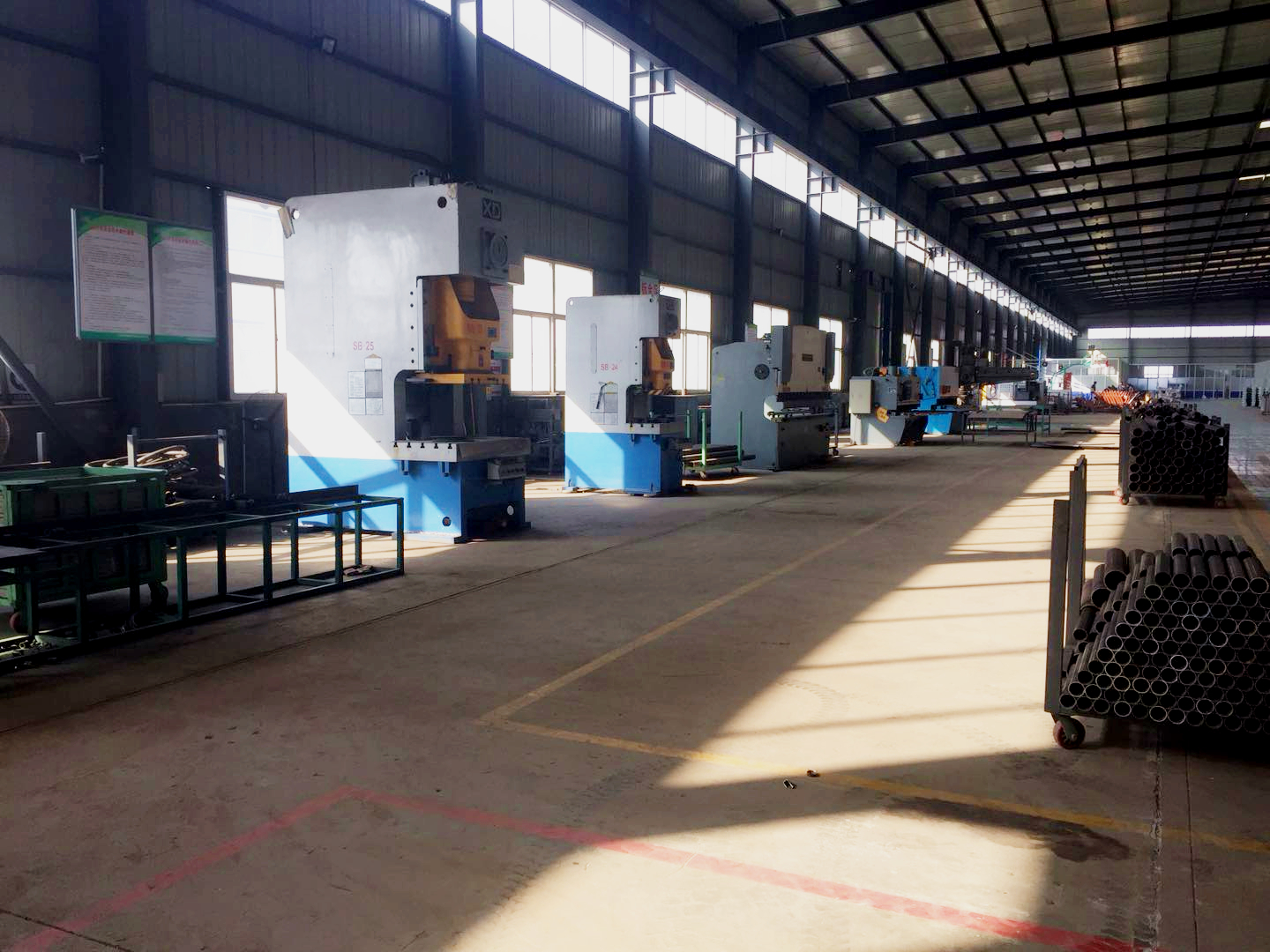
Steel enclosures live outdoors, so the coating system is a structural specification, not a finish choice. LDK applies hot-dip galvanizing followed by electrostatic epoxy powder coating at 70~80 μm. Galvanizing protects the steel sacrificially, including at cut ends and welds; the powder coat then provides a uniform coloured outer surface at a controlled film thickness in the 70~80 μm range — the parameter to verify on the inspection record rather than judging by appearance.
Fabrication discipline
Two manufacturing details separate this frame class from lighter market alternatives. The first is tube gauge: the structure uses tubing 0.5~1.0 mm thicker in wall thickness than other padel court frames, which is what makes a thicker, more stable structure possible. The second is an additional polishing and deburring step, which removes sharp edges from posts and connections — a safety measure that also reduces the risk of damaging glass edges during installation. The combined result is a stated service life of more than 20 years with zero maintenance, at an initial cost around 20% higher than other padel courts. LDK supports this with laser cutting, bending and surface-treatment workshops, a 17-engineer R&D team, and an annual output of 223,750 sets.
Step-by-Step Breakdown: Verifying a Padel Enclosure Specification
Buyers and facility engineers can use the following sequence to check whether a proposed enclosure is specified for the actual site rather than copied from a catalogue.
- Define the design actions. Establish site wind pressure from the applicable local code, add the dead load of the glass (approximately 30 kg/m² at 12 mm), and confirm whether a roof or canopy will be fitted, because a roof adds both vertical load and uplift to the posts.
- Assign the correct post section to each position. Corners require a biaxially stiff section such as 100×100×5 mm square tube; intermediate positions in a single wall line can use a directional section such as 100×50×3 mm rectangular tube.
- Check the longest horizontal bay first. With a 4 m / 6 m / 4 m layout, the 6 m bay governs horizontal deflection of the wall. If the frame line moves excessively at mid-bay, the glazing gaskets and glass edges absorb that movement.
- Verify the glass panel against frame stiffness. A 1990×2980 mm, 12 mm panel must bear on level, correctly detailed supports, and the frame must hold the panel plane under both wind pressure and its own dead load.
- Review connections and base anchorage. Base plates, bolt groups and welds at the post foot are where horizontal wind load enters the foundation; these details decide whether the frame behaves as designed.
- Specify and inspect the corrosion system. Require hot-dip galvanizing plus electrostatic epoxy powder coating at 70~80 μm, and confirm the film thickness on the inspection record before shipment.
- Control installation quality on site. Deburred posts, protected glass edges, correct gasket compression, vertical alignment and base-plate fixing torques are the practical checks that convert the design into a working enclosure.
Use Cases: Where the Heavier Frame Specification Pays Back
- Professional tournament venues. Competition play demands consistent glass behaviour under repeated ball impact; the thicker tubing and 12 mm glazing configuration is aimed specifically at professional tournaments and large venues.
- Large multi-court clubs. Multi-court sites benefit from zero maintenance and a stated service life of more than 20 years, because the enclosure is the component that is hardest to replace once the facility is operating.
- Exposed outdoor and rooftop sites. Where wind exposure is high, the corner post section and the governing 6 m bay are the two parameters to review before the order is placed.
- Panoramic courts with a roof or canopy. Adding a padel court roof or canopy changes the load path: the posts then carry roof loads in addition to wind, so the post specification and base anchorage must be re-checked rather than assumed adequate.
- Mixed multi-sport facilities. Sites combining padel with football pitches, basketball courts or pickleball courts can standardise on the same corrosion protection system across every steel structure on site.
Comparison Table
The table below summarises how each structural element is specified and which check governs it.
| Element | Specification | Structural role | Governing check |
|---|---|---|---|
| Corner post | 100×100×5 mm square tube | Receives wind load from two perpendicular wall planes | Biaxial bending and base anchorage |
| Intermediate post | 100×50×3 mm rectangular tube | Carries wind load from a single wall plane | Deflection in the plane of the load |
| Horizontal tube, end bay | 4 m | Transfers wall load into the corner post | Connection capacity at the corner |
| Horizontal tube, middle bay | 6 m | Longest unsupported horizontal run in the wall | Horizontal deflection of the wall line |
| Glazing | 12 mm ultra-clear tempered glass, 1990×2980 mm | Wind area plus dead load (approximately 30 kg/m²) | Edge bearing, panel support and impact resistance |
| Corrosion protection | Hot-dip galvanizing + electrostatic epoxy powder coating, 70~80 μm | Protects structural steel in outdoor service | Coating film thickness |
The commercial comparison follows the same logic: the extra steel is a cost, and it is also the reason the enclosure can be rated the way it is.
| Comparison point | LDK padel court structure | Other padel courts | Traditional tennis court |
|---|---|---|---|
| Tubing wall thickness | 0.5~1.0 mm thicker tubing | Reference | Not applicable |
| Corrosion treatment | Hot-dip galvanizing plus extra polishing and deburring | Not specified in the reference comparison | Not applicable |
| Initial cost | About 20% higher than other padel courts; about 30% lower than a traditional tennis court | Reference | About 30% higher than the padel configuration |
| Maintenance | Zero maintenance | Not specified | Zero maintenance |
| Service life | More than 20 years | Not specified | Not specified |
| Space efficiency | Higher | — | Lower |
Note: the “other padel courts” and “traditional tennis court” columns report only the comparison points recorded in the manufacturer’s product comparison data. Where a point is not recorded, it is shown as not specified rather than estimated.
FAQ
Does 12 mm tempered glass satisfy the safety requirements for a public padel court?
Industry construction guidance identifies 12 mm tempered safety glass as the current standard for premium panoramic padel courts, replacing the earlier 10 mm standard for enhanced safety and more consistent ball rebound. For impact risk specifically, the control approach is certified 12 mm tempered glass combined with reinforced frames and impact-tested construction, which addresses the two recorded failure modes: impact injury and glass breakage. Buyers should still confirm that the glazing certificate refers to the panel actually supplied, at the stated 12 mm thickness and 1990×2980 mm format.
Can a manufacturer produce a frame with mixed post sections and project-specific spans?
Yes, provided the manufacturer controls its own fabrication. LDK runs laser cutting, bending and surface-treatment workshops across a 50,000 m² manufacturing base in Cangzhou and a 4,500 m² R&D and production base in Huizhou, supported by a 17-engineer R&D team and an annual output of 223,750 sets. Customisation covers logo, packaging, labels, colours and sizes, and new product development can be completed in as few as 10 days — which is what allows a 4 m / 6 m / 4 m bay layout, a 100×100×5 mm corner post and a 100×50×3 mm intermediate post to be produced as one coherent frame order.
How much more does the heavier-gauge enclosure cost?
Recorded comparison data puts this configuration at about 20% higher initial cost than other padel courts, which buys tubing that is 0.5~1.0 mm thicker, hot-dip galvanizing and an additional polishing and deburring step, with zero maintenance and a service life stated at more than 20 years. Against a traditional tennis court, the same padel configuration is about 30% lower in initial cost and about 30% lower in overall cost, with zero maintenance requirements. The trade-off to note is space efficiency: a padel court uses its footprint more efficiently than a traditional tennis court does.
Can the structure be validated on a sample or a single court before a multi-court rollout?
Project-specific configurations are developed from the client’s requirements, and LDK’s new product development cycle can be completed in as few as 10 days, so a frame specification can be engineered and reviewed before a club-wide order is placed. Sample and prototype arrangements are handled case by case by the sales team, since post sections and the glazing format are project-specific. The relevant contact is Anna at anna@ldkchina.com or +86 15219504797 (WhatsApp available).
How should delivery planning work for a structural padel project?
Because the enclosure is manufactured to the project’s drawing set, delivery should be scheduled against the foundation and glazing programme rather than treated as a stock item. LDK produces 223,750 sets annually, exports 100% of its output, and has over 11 years of export experience with clients in North America, South America, Europe and Southeast Asia, so multi-court batches can be planned as a single production run. To start a specification review, download the product catalogue below, or send the site wind data and court layout for a configuration check.
Next step: download the full LDK product catalogue, or send your court layout and site wind exposure for a frame specification review.
Catalogue: LDK Product Catalogue (PDF)
Website: www.ldkchina.com
Contact: Anna — anna@ldkchina.com | Tel / WhatsApp: +86 15219504797
Address: A-208, Lixin Road, LongGang District, Shenzhen, Guangdong, China
Conclusion
Padel enclosure integrity comes down to five specification decisions that must agree with one another: a biaxially stiff corner post (100×100×5 mm), a directional intermediate post (100×50×3 mm), a horizontal bay layout whose 6 m span is checked for deflection, a 12 mm ultra-clear tempered glass panel at 1990×2980 mm whose dead load and wind area the frame can carry, and a corrosion system of hot-dip galvanizing plus electrostatic epoxy powder coating at 70~80 μm. Specifying heavier glass without reviewing the frame — or reviewing the frame without checking base anchorage and coating thickness — leaves the enclosure only partly engineered. LDK supplies this configuration with a stated service life of more than 20 years and zero maintenance, at an initial cost around 20% higher than other padel courts, a premium priced by steel gauge and coating rather than by branding.
Structural parameters quoted in this guide (post sections, bay lengths, glass format and coating thickness) are the manufacturer’s configuration data. Wind load, foundation design and local compliance requirements must be verified by the project’s structural engineer against the applicable code for each site.