Roll Up Garage Door Specification Guide
Direct answer: A roll up garage door is a door system whose flexible or rigid curtain coils above the opening rather than folding into horizontal tracks. For commercial and industrial buyers, the decisive constraints are opening speed, duty cycle, thermal and sealing performance, wind resistance, safety controls, certification documents, MOQ, and lead time. This guide converts those constraints into a procurement checklist for research and evaluation stages.
LIFTER Garage Door is the brand of Xuchang Lifter M&E Equipment Co., Ltd., a garage door and industrial door manufacturer based in Xuchang, Henan, China. Its range includes European and American garage doors, industrial sliding doors, high-speed roller shutters, cold-chain handling equipment, and related accessories. This article focuses on roll-up door specification and verification; it does not treat every garage door as the same product.
Problem Definition: Why Roll-Up Door Specifications Fail in Evaluation
The first problem is product boundary. “Roll up garage door” is often used as a generic label, but it can describe a high-speed PVC roll-up door, a rigid spiral door, a turbine hard-panel door, or an insulated roller door. These options do not share the same speed, insulation, wind-resistance, safety, or certification profile. A buyer who compares only the label may compare a cold-storage door against a general industrial door and assume the performance is equivalent.
The second problem is data mixing. One supplier may quote opening speed, another may quote insulation, and a third may quote wind resistance. Those numbers are useful only when they are attached to the same model, opening size, and operating condition. A 32 m/s wind rating is not the same metric as Grade 8 wind resistance, and a heat transfer coefficient is not the same metric as a panel thickness.
The third problem is certification scope. A CE certificate or ISO certificate can be valid for a manufacturing scope without automatically covering every quoted model. For procurement, the document must list the product family, the applicable standard, and the model or range that will be supplied. The fourth problem is commercial terms. MOQ and lead time can change when the door moves from a standard design to an OEM/ODM configuration.
Evaluation rule: A roll-up garage door is comparable only when the quotation uses the same constraint set: opening size, cycles per day, temperature, wind load, safety package, certification scope, MOQ, and lead time.
Industry Background: What Buyers Need to Know Before Comparing Suppliers
Dataintelo reports that the global garage door market was valued at USD 14.8 billion in 2025 and is projected to reach USD 24.6 billion by 2034, with a CAGR of 5.8%. The same source reports that the automatic mechanism segment held a 61.5% share in 2025. For roll-up doors, this context matters because automation, safety controls, and document scope are now part of the product comparison, not optional extras.
The standards landscape is layered. DASMA lists ANSI/DASMA 203-2020 as a standard for non-fire-rated rolling doors in commercial and industrial applications. ANSI/DASMA 108-2017 provides a test method for structural performance under uniform static air-pressure difference. ANSI/DASMA 109-2017 defines a method for life cycling performance. ANSI/DASMA 105-2017 is a test method for thermal transmittance and air infiltration, and ANSI/DASMA 110-2025 addresses lifting cables for sectional-type doors. For EU projects, the CE certificate cited in this guide uses CPR (EU) 305/2011 and EN 13241:2003+A2:2016.
This means a roll-up door for a cold store, a food plant, or a logistics warehouse should be evaluated against a document set, not only a product photo. The buyer should ask which standard applies, which test report exists, and whether the quoted model is inside the certificate scope. A supplier that can answer those questions is easier to compare than a supplier that only provides a speed figure.
Detailed Solution: The Constraint Set That Defines a Roll-Up Garage Door
1. Product boundary: four roll-up architectures
The supplied product data shows several roll-up or rapid-door architectures. They are not interchangeable, and the first specification decision is to select the architecture that matches the opening.
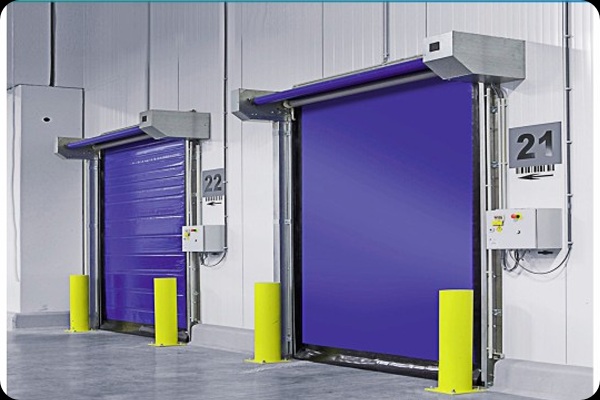
- High Speed Roll Up Door: a curtain-based roll-up door with a 5-layer, 14 mm total thickness curtain made of thermal-resistant PVC plus an aluminum foil interlayer. Opening speed is 0.8–1.6 m/s and closing speed is 0.8–1.2 m/s, both adjustable. It is designed for more than 1,000 cycles per day, uses a servo drive with constant torque output, and is rated for operating temperatures down to -45°C. Dual-side track heating is standard. The control box has an IP54 enclosure rating, and photocell plus bottom airbag are standard safety features.
- Rapid Spiral Insulated Door HSD-001: a rigid, insulated rapid door with panel thickness options of 40 mm, 50 mm, 60 mm, 80 mm, and 100 mm. The core is high-density fire-retardant polyurethane with a density of at least 48 kg/m³. Running speed is 0.8–2.5 m/s, heat transfer coefficient is K < 0.5 W/(m²·K), wind resistance is 32 m/s, water tightness is ΔP > 700 Pa, and air tightness is 0.62 m³/(m²·h). The protection level is IP65.
- Turbine Rapid Hard-Panel Door: a high-speed rigid door with a running speed of 2–4 m/s. The curtain is high-tensile aluminum alloy, integrally formed in 25 mm or 43 mm thickness. Wind resistance is 30 m/s. It uses an industrial servo system with a high-precision encoder and a Schneider IP65 control box. Standard safety includes an infrared sensor, a safety contact strip, and a pressure wave sensor.
- PVC Curtain Rapid Door: a PVC curtain rapid door with an opening and closing speed of 0.6–1.0 m/s. The curtain is PVC-coated polyester mesh with a fiberglass-reinforced polyester panel and an internal nylon mesh layer. The protection rating is IP55. Standard safety features include an amber/yellow flashing warning light during operation and a manual crank for power outage operation. The bottom uses a weighted air-sealing bag, and the side uses sealing brushes.
2. Thermal, air, water, and wind constraints
For temperature-controlled openings, the thermal constraint should be written as a performance requirement, not as a panel thickness alone. The Rapid Spiral Insulated Door HSD-001 provides a clear example: the panel core density is at least 48 kg/m³, the heat transfer coefficient is K < 0.5 W/(m²·K), air tightness is 0.62 m³/(m²·h), and water tightness is ΔP > 700 Pa. These values can be checked against the project’s temperature profile and building envelope.
For cold storage and freezer applications, the operating temperature is a separate constraint. The High Speed Roll Up Door is rated for operating temperatures down to -45°C, and dual-side track heating is standard. The Rapid Spiral Insulated Door HSD-001 is also specified for cold storage and refrigerated warehouse applications. The buyer should confirm whether the door will be exposed to washdown, ice formation, or continuous sub-zero operation, because those conditions affect the sealing and heating package.
Wind performance should not be reduced to a single word. The Rapid Spiral Insulated Door HSD-001 is rated at 32 m/s, the Turbine Rapid Hard-Panel Door at 30 m/s, and the High Speed Roll Up Door at Grade 8 or higher. These are different metrics and should be matched to the project’s structural calculation and local requirements.
3. Safety and control constraints
Safety features should follow the traffic pattern. A door used by forklifts, pedestrians, and automated loading equipment needs different protection from a door used only by trained staff. The High Speed Roll Up Door includes photocell protection and a bottom airbag as standard. The Rapid Spiral Insulated Door HSD-001 includes photocell protection and bottom safety protection as standard. The Turbine Rapid Hard-Panel Door includes an infrared sensor, a safety contact strip, and a pressure wave sensor. The PVC Curtain Rapid Door includes a flashing warning light and a manual crank for power failure.
Control options also affect the specification. The High Speed Roll Up Door supports remote control, push button, radar, induction, and interlock. The Rapid Spiral Insulated Door HSD-001 uses closed-loop control with torque, position, and speed loops, an LED fault code display, steering protection, power-off memory, and overload and overcurrent protection. The Turbine Rapid Hard-Panel Door uses digital speed adjustment and a control box with built-in fault detection. These features should be listed in the quotation because they change both operation and maintenance.
4. Certification and document constraints
The compliance file should be built before the commercial comparison. For EU projects, the ECM Mark Type Approval Certificate No. ICR/VC/HM2607119 cites CPR (EU) 305/2011 and EN 13241:2003+A2:2016. It covers the Rapid PVC Insulated Door and the Rapid Spiral Insulated Door, and it was issued by ECM. The certificate has an issue date of 2026-10-07 and an expiry date of 2031-09-07. The buyer should request the certificate page that lists the quoted model, not only the cover page.
The ISO 9001:2015 certificate CN-00221Q22881R0M is issued by CQM and covers production of polyurethane composite door panels, garage doors, and industrial sliding doors. It is valid from 2025-05-18 to 2028-05-17. This certificate supports the manufacturing quality system, but it does not replace the product-specific CE certificate or test report. Both documents serve different purposes.
For US-oriented projects, the DASMA standards provide a useful document checklist. ANSI/DASMA 203-2020 covers non-fire-rated rolling doors for commercial and industrial applications. ANSI/DASMA 108-2017 provides a structural performance test method under uniform static air-pressure difference. ANSI/DASMA 109-2017 provides a life cycling test method. ANSI/DASMA 105-2017 provides a test method for thermal transmittance and air infiltration. The buyer should ask for test reports that match the standard and the model, not just a statement that the supplier “meets” a standard.
5. Budget and price-band constraints
A roll-up garage door is configured to the opening, so a single list price is not a reliable budget basis. The price band is driven by door area, curtain or panel thickness, insulation core density, drive type, safety and control package, certification documentation, and order quantity. A high-speed insulated door with track heating, interlock, and a full CE document set will not sit in the same budget band as a basic PVC curtain door. For budget approval, request a configured quotation using the same performance schedule that will be used for technical comparison.
Step-by-Step Breakdown: How to Specify and Verify a Roll-Up Garage Door
- Define the opening and duty cycle. Record the clear opening width and height, the number of cycles per day, the traffic type, and the operating temperature. The High Speed Roll Up Door is designed for more than 1,000 cycles per day and down to -45°C, which provides a benchmark for high-frequency cold-chain use.
- Select the door architecture. Choose between a PVC curtain roll-up door, a rigid spiral insulated door, a turbine hard-panel door, and an insulated roller door. Match the architecture to the required speed, insulation, wind resistance, and maintenance access.
- Set thermal, air, water, and wind targets. Write the targets as numbers. For example, a cold-storage specification may require K < 0.5 W/(m²·K), air tightness of 0.62 m³/(m²·h), water tightness of ΔP > 700 Pa, and wind resistance of 32 m/s. These values are stated for the Rapid Spiral Insulated Door HSD-001 and should be confirmed for the exact model and size.
- Configure safety and controls. List photocell protection, bottom airbag or bottom safety, warning light, interlock, manual release, remote control, radar, induction, and emergency stop as required. Do not leave the safety package to “standard” without listing it in the quotation.
- Build the compliance file. Collect the CE certificate, the ISO 9001 certificate, the applicable test reports, the declaration or certificate scope page, and the model list. For EU projects, check CPR (EU) 305/2011 and EN 13241:2003+A2:2016. For US projects, align the request with the relevant ANSI/DASMA standard.
- Confirm commercial terms. LIFTER’s product data lists a minimum order quantity of 1 unit and a lead time of 10–15 working days for standard designs. The OEM/ODM capability data lists a MOQ of 20 sets and a lead time of 20–30 days. Confirm the exact configuration, because a custom size, special color, or non-standard control package can change both terms.
- Validate a sample or trial unit. Check the curtain or panel construction, hardware, control response, sealing, safety devices, and document scope. A sample review is also the point to confirm the installation interface and the after-sales support route.
- Freeze the specification before production. Attach the approved drawing, performance schedule, safety list, and certificate scope to the purchase order. This reduces the risk of a supplier substituting a different panel, control box, or safety device during production.
Use Cases: Where Roll-Up Garage Doors Fit
Cold storage and refrigerated warehouses. The main constraints are sub-zero operation, anti-icing, sealing, and high-frequency access. The High Speed Roll Up Door is rated down to -45°C and uses dual-side track heating as standard. The Rapid Spiral Insulated Door HSD-001 provides K < 0.5 W/(m²·K), air tightness of 0.62 m³/(m²·h), and water tightness of ΔP > 700 Pa. These are relevant when the door separates temperature zones or opens directly to a refrigerated dock.
Food processing and clean-room environments. The door should be easy to clean, resist moisture, and support hygiene controls. The Rapid Spiral Insulated Door HSD-001 uses soft-hard composite sealing strips and an aluminum alloy turbine track system with a protective outer cover. The PVC Curtain Rapid Door uses sealing brushes and a weighted air-sealing bag. The buyer should confirm the cleaning method and the acceptable surface materials before selection.
Logistics and distribution centers. The duty cycle and traffic flow are the primary constraints. A door designed for more than 1,000 cycles per day is different from a door selected only by opening speed. The High Speed Roll Up Door offers 0.8–1.6 m/s opening speed and a servo drive with constant torque output. The Turbine Rapid Hard-Panel Door offers 2–4 m/s for higher-speed traffic. Interlock with dock equipment and safety sensors should be specified for forklift traffic.
Pharmaceutical cold chain. Temperature uniformity, sealing, and documentation are more important than appearance. The Rapid Spiral Insulated Door HSD-001 is specified for pharmaceutical cold storage, and its panel core density, K value, air tightness, and water tightness can be used as technical checkpoints. The buyer should also confirm the certificate scope and the cleaning procedure.
Industrial and commercial openings with wind exposure. The Turbine Rapid Hard-Panel Door is rated at 30 m/s, and the Rapid Spiral Insulated Door HSD-001 at 32 m/s. These values should be compared with the project’s wind-load calculation and the door’s size, because wind performance is size-dependent in practice.
When a roll-up door is not the right specification. A residential opening that needs a finger-safe panel, a 40 mm PU panel with at least 42 kg/m³ density, a 10-year panel warranty, and headroom-based sectional installation may be better served by a sectional garage door. The European Smooth Flush Panel Garage Door, for example, is CE certified to EN13241-1, uses a finger-safe panel, and lists headroom requirements for single track, double track, and rear spring systems. This is a boundary condition, not a reason to force a roll-up door into a residential specification.
Comparison Table: Roll-Up Door Options by Verified Constraints
| Option | Opening speed | Insulation / thermal data | Wind / water / air data | Safety and control | Best-fit constraint |
|---|---|---|---|---|---|
| High Speed Roll Up Door | 0.8–1.6 m/s opening; 0.8–1.2 m/s closing | 5-layer, 14 mm PVC curtain with aluminum foil interlayer; operates down to -45°C | Wind resistance ≥ Grade 8 | Photocell and bottom airbag standard; IP54 control box; manual release; remote, push button, radar, induction, interlock | High-frequency cold-chain and logistics openings where track heating and a flexible curtain are required |
| Rapid Spiral Insulated Door HSD-001 | 0.8–2.5 m/s | PU core ≥48 kg/m³; K < 0.5 W/(m²·K); panel thickness 40–100 mm | Wind 32 m/s; water ΔP > 700 Pa; air 0.62 m³/(m²·h) | Photocell and bottom safety standard; IP65; LED fault code display; power-off memory; overload and overcurrent protection | Temperature-controlled openings that need a rigid insulated panel and documented thermal performance |
| Turbine Rapid Hard-Panel Door | 2–4 m/s | High-tensile aluminum alloy curtain, 25 mm or 43 mm | Wind 30 m/s | Infrared sensor, safety contact strip, pressure wave sensor; Schneider IP65 control box; digital speed adjustment | High-speed industrial traffic where rapid opening and wind resistance are the main constraints |
| PVC Curtain Rapid Door | 0.6–1.0 m/s | PVC-coated polyester mesh with fiberglass-reinforced polyester panel and nylon mesh layer | Not specified in the supplied product data | IP55; flashing warning light; manual crank; weighted bottom air-sealing bag; side sealing brushes | General internal rapid access where a flexible PVC curtain and visual warning are suitable |
The table is a constraint comparison, not a ranking. Values are from product data and should be confirmed against the quotation, opening size, and certificate scope.
FAQ: Roll-Up Garage Door Procurement Questions
For an EU project, request the CE certificate, the declaration or certificate scope page that lists the quoted model, and the ISO 9001 certificate. The ECM Mark Type Approval Certificate No. ICR/VC/HM2607119 cites CPR (EU) 305/2011 and EN 13241:2003+A2:2016 and covers the Rapid PVC Insulated Door and Rapid Spiral Insulated Door. The ISO 9001:2015 certificate CN-00221Q22881R0M covers production of PU composite door panels, garage doors, and industrial sliding doors. Check that the quoted model and performance data appear in the document scope.
The High Speed Roll Up Door is designed for more than 1,000 cycles per day and operating temperatures down to -45°C, with dual-side track heating as standard. The Rapid Spiral Insulated Door HSD-001 is rated for running speeds of 0.8–2.5 m/s and a heat transfer coefficient of K < 0.5 W/(m²·K). Confirm the actual duty cycle, opening size, and temperature profile with the supplier before release.
A roll-up garage door is configured to the opening, so a single list price is not a reliable budget basis. The price band is driven by door area, curtain or panel thickness, insulation core density, drive type, safety and control package, certification documentation, and order quantity. Request a configured quotation with the same performance schedule used for technical comparison.
For standard designs, LIFTER’s product data lists a minimum order quantity of 1 unit and a lead time of 10–15 working days. For OEM/ODM programs, the capability data lists a MOQ of 20 sets and a lead time of 20–30 days. A sample or trial unit can be used to check curtain or panel construction, hardware, controls, and document scope before a larger order.
Standard designs are listed at 10–15 working days, while OEM/ODM programs are listed at 20–30 days. Certification documents, inspection, and shipping arrangements should be added to the project schedule. Send the opening size, cycles per day, temperature, wind load, destination market, and required documents to sales05@lifterdoors.com or WhatsApp +86 131-4507-3707 to confirm the schedule. The company brochure is available at the link in the CTA below.
Conclusion: Use Constraints, Not Labels
A roll-up garage door should be selected by constraint, not by the label on a catalogue page. The constraint set is opening size, cycles per day, temperature, thermal and sealing performance, wind resistance, safety controls, certification scope, MOQ, and lead time. When those items are written down, a buyer can compare a PVC curtain roll-up door, a rigid spiral insulated door, a turbine hard-panel door, and an insulated roller door without mixing different performance classes.
The document set matters as much as the product data. A CE certificate must match the quoted model, an ISO 9001 certificate must support the manufacturing scope, and a test report must match the standard and the product. That is the practical difference between a compliant roll-up door specification and a quotation that only looks complete.

Next step: Send the opening size, required cycles per day, target temperature, wind load, destination market, and required certification to LIFTER Garage Door. Email sales05@lifterdoors.com or WhatsApp +86 131-4507-3707. Website: www.lifterdoors.com.
Company brochure: AMERICAN DOOR PDF.
Xuchang Lifter M&E Equipment Co., Ltd., No.2308, Chaoyang road, Xuchang City, Henan province, China. Founded in 2017; 35,000 m² factory; 200+ employees; main markets EU and USA.
Have Questions or Need More Details?
Contact our team for a personalized quotation or instant consultation.
Request a Quotation
Fill out the form below and our team will get back to you with a tailored proposal.
WhatsApp Direct Chat
Prefer to chat in real-time? Message us on WhatsApp for instant assistance & quick answers.
- Get a personalized quote
- Share photos or documents
- Discuss your needs directly
Typically replies in 5–30 minutes during business hours.