Window Cleaning Robot Compliance Guide: Safety, EMC, and Battery Shipping Questions to Ask
Compliance problems on a window cleaning robot order rarely appear as a dramatic failed safety test. They appear as a missing document — a battery test summary nobody can locate, a label that no longer matches the certified configuration, or a certificate that turns out to describe a different model than the one inside the shipping carton.
This guide is written for OEM buyers, importers, distributors and brand owners who need to know what to ask a supplier before a production order is placed. It is deliberately a question set, not a claim set. It does not tell you which certifications any supplier holds, and it does not tell you what any specific market requires. It shows you how to force a supplier to produce evidence, and how to check that evidence against the market where you actually sell.
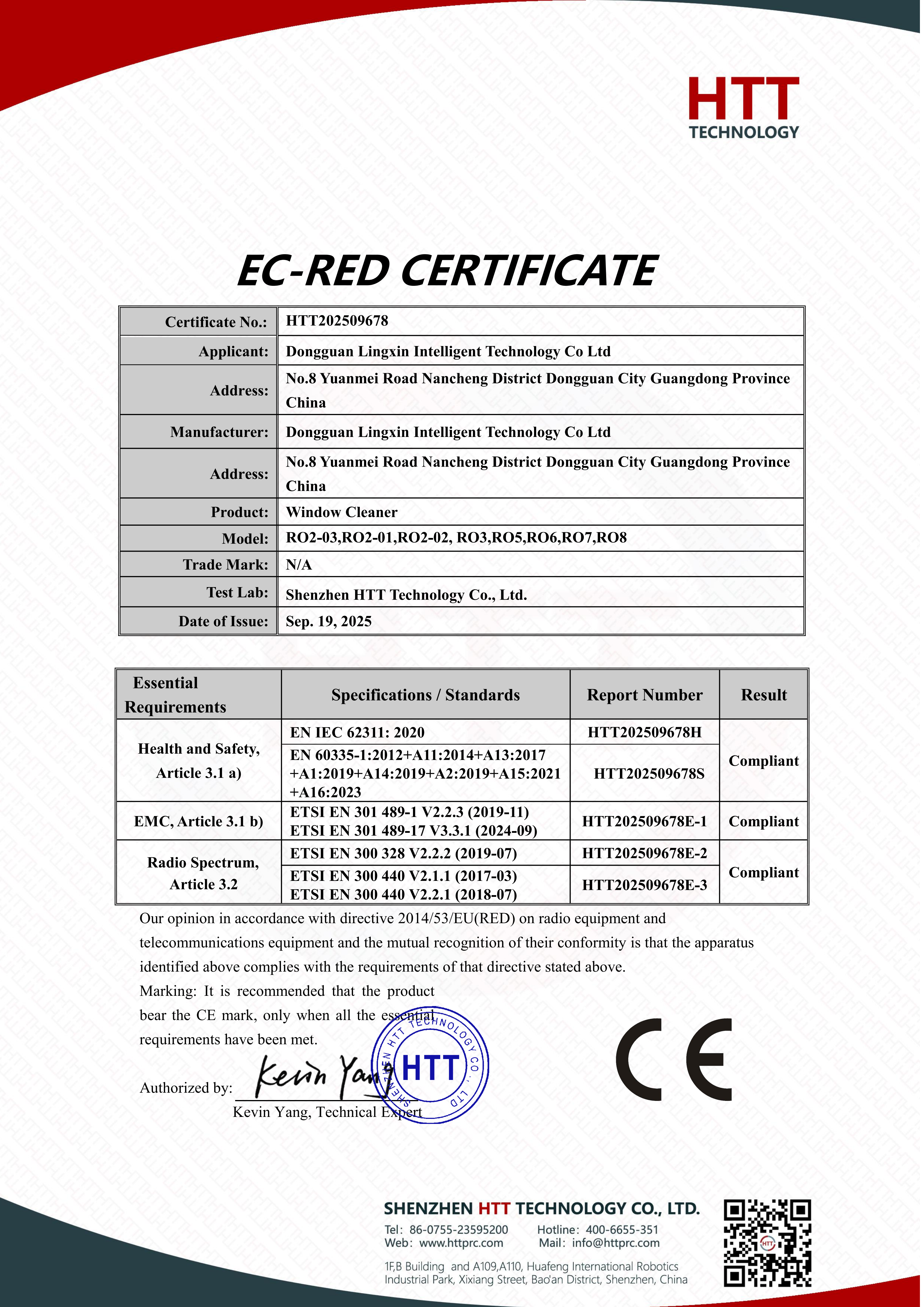
Lincinco (Dongguan Lingxin Intelligent Technology Co., Ltd.) is a smart cleaning robot manufacturer founded in 2018. Its product lines cover robot vacuums, wet-dry vacuums, window cleaning robots, pool cleaning robots, hair dryers and lawn mowers, and its provided documentation set includes CE-RED and ROHS certificates. That single sentence is exactly the kind of statement this guide teaches a buyer to interrogate: which model, which configuration, which market, and what is not covered.
Problem Definition: A Certificate Is Not a Market Clearance
Most buyers begin sourcing with a list-shaped question: which certifications does a window cleaning robot need? The honest answer is that it depends on three variables, and none of them can be resolved by a generic list copied from a forum, a marketplace listing or a competitor's packaging.
- The market where the product will be placed on sale, because regulatory frameworks are defined market by market.
- The classification of the product inside that market, because a battery-powered appliance with wireless connectivity can sit inside more than one regulatory family at the same time.
- The exact shipping configuration — radio module, battery pack, charger, packaging and label — because approvals are attached to a configuration, not to a brand or a product family name.
Two failure modes account for most compliance surprises. The first is treating a supplier's certificate as a market clearance. The second is copying a compliance claim from a competitor's listing and assuming it transfers to a different bill of materials.
The practical consequence is not abstract. It is usually measured in delayed containers, re-labeling runs, re-testing, retail onboarding rejections and return handling. The question set below exists to move the conversation away from "do you have certificates?" and toward "show me the document that covers this model, in this market, in this configuration, and tell me what it does not cover."
Industry Background: Why a Window Cleaning Robot Sits in Several Tracks at Once
A window cleaning robot is not a single-risk product. It combines a mains-connected charger, a lithium battery pack, a suction and drive system, a water spray function, and — on most current models — a wireless connection for app or remote control. Each of those elements pulls the product toward a different verification track.
Electrical safety, electromagnetic compatibility and radio approval belong to the product itself. Battery transport documentation belongs to the shipment. Labeling and technical documentation belong to the commercial package that travels with the goods. These three areas are handled by different people inside a factory, and a buyer who asks only one question usually obtains only one third of the picture.
Manufacturing context matters here for a different reason: documentation is only maintainable when the factory controls its own change process. Lincinco operates two production bases in China — a 50,000 square meter facility in Dongguan focused on robot vacuum and wet-dry vacuum series, and a 25,000 square meter facility in Hengyang, Hunan, primarily producing window cleaning robots, pool cleaning robots, hair dryers and lawn mowers. The company reports more than 600 employees across both sites, a professional R&D team of 65+ technical experts, over 100 product patents, in-house mold rooms, hundreds of injection molding machines and standardized production lines, with annual production capacity reaching 5 million units per year. Those are capability facts. They are useful because a factory that owns tooling, molding and assembly can usually answer a compliance question with a document rather than a promise.
Capability and compliance are still two different questions. Buyers should never treat production capacity as evidence that a particular approval exists, and should never treat a certificate as evidence that the production process is under control. Both must be verified separately.
The Four Verification Tracks: Questions That Force an Answer
The question set below is organized into the four tracks that most often create friction in window cleaning robot programs. None of these questions asks a supplier to be compliant. Each one asks the supplier to demonstrate something specific and checkable.
Track 1 — Electrical Safety
- Q1. Which market and which product classification does this safety document cover?
- Q2. Which exact model numbers, BOM revision and charger or adapter are named on the document?
- Q3. Is the external power supply or charger certified together with the unit, or handled as a separate component?
- Q4. Which laboratory issued the document, and what is its current validity status?
- Q5. Who is the certificate holder — the factory itself, or a trading intermediary?
Track 2 — EMC and Radio
- Q1. Does the unit contain a radio module, and is that module approved on its own, or is the finished product approved as a whole?
- Q2. Does the approval scope include the antenna and firmware configuration actually being shipped?
- Q3. What happens to the approval if we change the wireless module, the antenna layout, or the app-controlled feature set?
- Q4. Are the EMC results from tests on the finished product, or carried over from a component datasheet?
- Q5. Which markets does this radio document actually address, and which markets would need a separate submission?

Lincinco's provided documentation includes CE-RED certificates, which belong to the radio equipment framework used in the European Union. Buyers sourcing for other regions should ask the equivalent structural questions about whatever local framework applies, rather than assuming a European document answers a non-European question.
Track 3 — Battery Shipping and Transport
- Q1. Can you provide the battery test summary for the exact cell and pack being shipped, not for a predecessor model?
- Q2. Is the battery shipped installed in the device, packed with the device, or shipped separately?
- Q3. Which transport documents accompany the shipment, and who prepares them?
- Q4. What is the packaging configuration and the declared state of charge for transport?
- Q5. Can we review a sample document set before freight is booked, so that a documentation gap does not appear at the airport?
Lithium batteries are treated as dangerous goods in transport, which means they travel with their own documentation stream that is separate from product certification. A buyer who assumes the factory's product certificate also covers the shipment will usually discover the gap at the cargo desk, when it is most expensive to fix.
Track 4 — Labeling and Documentation
- Q1. Can you send the label artwork for this market and confirm it matches the certified configuration?
- Q2. Who is named on the label as manufacturer and, where applicable, as importer?
- Q3. What exactly is inside the documentation pack — declaration, test reports, certificates, manual, and safety instructions in the required language?
- Q4. What is the change-control process when a component, supplier or firmware version changes?
- Q5. How are documents versioned, and who re-issues them after a change?

Verification rule: a compliance document is only usable when three things line up at once — the model on the document, the configuration in the carton, and the market on the label. If any one of the three does not match, treat the document as unverified until the supplier explains the difference in writing.
Step-by-Step Breakdown: A Seven-Step Compliance Verification Workflow
- Define the market and the classification before you contact anyone. Write down where the product will be sold, through which channel, and how you believe it is classified. A supplier cannot answer a question you have not framed, and a vague brief invites a vague certificate.
- Request a certificate-to-model map. Ask for a short table listing each document, the exact model numbers it covers, the configuration it was tested with, and the market it addresses. A supplier who cannot produce this table usually does not have the mapping under control.
- Verify the issuing laboratory and the scope of the report. Check who issued the document and whether the report covers the finished product or only a sub-assembly. Both are legitimate, but they answer different questions.
- Match the label artwork to the certified configuration. Ask for the current label file and compare it against the model and configuration named in the certificate. Label drift is one of the most common causes of retail onboarding delays.
- Build the battery transport pack as a separate deliverable. Treat battery documentation as its own workstream with its own owner, its own deadline and its own review step before freight booking.
- Name the legal manufacturer and importer of record. Confirm in writing who is responsible for placing the product on the market, and make sure the answer matches what appears on the label and in the documentation pack.
- Lock change control into the commercial agreement. Any component, module, firmware or supplier change should trigger a documented review before shipment, with a defined owner and a defined re-issue process.
Steps 1 through 3 are usually completed during the evaluation stage. Steps 4 through 7 continue into production and repeat for every configuration change and every new market entry. A supplier who treats compliance as a one-time deliverable will create work for you later.
Comparison Table: What Each Document Actually Confirms
Buyers are frequently shown a folder of documents and asked to accept them as a package. The table below separates what each document type typically confirms from what it does not, so that a document folder can be read structurally rather than as a single yes-or-no answer.
| Document type | What it generally confirms | What it does not confirm | Question to ask |
|---|---|---|---|
| Product safety certificate | That a defined product configuration passed an electrical safety evaluation under a named framework | That the shipped model, charger or BOM revision is identical to the tested one | Which model numbers and BOM revision appear on this document? |
| EMC / radio approval | That a defined radio and antenna configuration was evaluated for electromagnetic compatibility and radio performance | That a later module, antenna or firmware change remains covered | Does this approval cover the configuration we are shipping today? |
| Restricted-substance test report | That sampled materials or components were assessed against restricted-substance limits | That every production lot uses identical materials from the same sub-suppliers | What is your process when a material supplier changes? |
| Battery test summary | That a specific cell and pack type was tested for transport purposes | That the pack being shipped uses the same cells, protection board or firmware | Is this summary issued for the exact pack in our order? |
| Declaration / conformity statement | That the manufacturer formally takes responsibility for the product under a stated framework | That independent testing took place, or that the market-specific scope is correct | Who signs this, and what scope does it declare? |
| Label artwork | That the identification, warnings and responsible party shown to the end user are defined | That the content matches the certificate, the market or the shipped configuration | Does this artwork match the certified model and the destination market? |
Read this way, a document folder stops being a reassurance and becomes a set of specific claims that can be checked one by one. Lincinco's provided documentation set, for example, includes CE-RED and ROHS certificates. The correct next question is not "is that enough?" but "which window cleaning robot models, configurations and markets do those documents cover?"
Use Cases: Where These Questions Change the Outcome
Case 1 — Launching a Wi-Fi controlled model in a new market
The buyer has an approved-looking radio document from a previous generation. The question that matters is whether the antenna layout, module and firmware in the new generation fall inside that document's scope. If the answer is unclear, the buyer should budget for a fresh submission rather than discover the gap at customs.
Case 2 — Retail or marketplace onboarding
Retail onboarding teams request a documentation pack and check the label against the product listing. The failure point is rarely the certificate itself; it is label artwork that was designed for a different configuration or a different market. Requesting label artwork early, and matching it to the certificate, removes most of this friction.
Case 3 — Air freight with installed lithium batteries
Transport documentation is prepared by the factory or by the freight forwarder, and responsibility is often unclear until the shipment is booked. Assigning a single owner for the battery documentation pack — and reviewing it before booking — converts an airport problem into a desk task.
Case 4 — Private label and OEM branding
When the buyer becomes the brand on the label, the question of who holds the certificate and who is the responsible party becomes commercial rather than technical. Buyers should confirm in writing whether they receive a certificate in their own name, a letter of authorization to reference the factory's documentation, or a shared document arrangement.
FAQ: Compliance Questions Buyers Ask Most Often
1. Which certifications should we expect to see for a window cleaning robot, and how do we verify them?
There is no single answer that applies to every market and every configuration, because requirements depend on where the product is sold, how it is classified and which radio, battery and charger combination is shipped. What buyers can verify is whether a supplier can map each document to an exact model, configuration and market. Lincinco's provided documentation includes CE-RED and ROHS certificates; a buyer evaluating any supplier should ask for the model-to-document mapping before accepting a certificate at face value, and should confirm market-specific requirements with their own compliance advisor.
2. How can we tell whether a factory can keep compliance documentation current?
Look at how much of the process the factory controls internally. Lincinco operates two production bases — a 50,000 square meter Dongguan facility for robot vacuum and wet-dry vacuum series, and a 25,000 square meter Hengyang facility primarily producing window cleaning robots, pool cleaning robots, hair dryers and lawn mowers — with over 600 employees, in-house mold rooms, hundreds of injection molding machines and standardized production lines, and an annual capacity reaching 5 million units per year. Vertical control of tooling and assembly makes it easier to document a component change than to explain it away. The verification step is to ask, in writing, what triggers a document review and who owns it.
3. What drives compliance-related cost in a window cleaning robot program?
Cost is driven less by the initial evaluation than by changes made after it. A new radio module, a new battery pack, a new charger or a new market entry can each require a fresh evaluation and fresh documentation. Buyers who lock change control into the commercial agreement — with a defined review before shipment — usually spend less than buyers who discover changes after the goods are packed. Requesting a written scope statement for each document helps keep later changes visible and budgetable.
4. How should compliance be validated at the sample stage?
Use the sample as a documentation test, not only a performance test. Request the sample together with the label artwork, the document list and the model mapping, then compare the sample configuration against what the documents describe. If the sample carries a different charger, battery pack or antenna layout than the documents name, resolve that difference before the sample is approved. This turns sample evaluation into an early compliance checkpoint rather than a purely functional review.
5. How long does compliance verification take, and what is the fastest legitimate path?
Timelines depend on the market, the product classification and the scope of what already exists, so no responsible supplier should quote a fixed number before understanding the configuration. The realistic way to shorten the process is sequencing: confirm the model-to-document map first, confirm label artwork second, and confirm the battery documentation pack before freight is booked. Buyers who want to start that sequence on a specific window cleaning robot configuration can review the product range at cleverobot.com and request a sample and quotation with the target market stated, so that the documentation scope is defined from the first reply.
Conclusion: Ask for Evidence, Not Assurance
A compliance conversation with a window cleaning robot supplier should never end with the sentence "we are certified." It should end with a document list, a model map, a label file, a battery transport pack and a named owner for each item. That is a far less comfortable conversation to have at the evaluation stage, and a far cheaper one than having it after a container has been booked.
The questions in this guide do not create requirements and do not replace legal advice. They do something more practical: they convert a vague assurance into checkable evidence, and they make the gap visible while it is still small. Verify every claim against market-specific evidence, keep the mapping current, and re-run the checks whenever a component, module or market changes.
Next Step: Request a Sample and a Document Overview
If you are evaluating an automatic window cleaning robot program and want to start from the documentation side, contact Lincinco with your target market and configuration so the scope is defined from the outset.
Website: www.cleverobot.com | Email: molly@cleverobot.com | Mobile / WhatsApp: +86 13424841625
Dongguan Lingxin Intelligent Technology Co., Ltd. (Lincinco) — smart cleaning robot manufacturer, founded 2018.

Have Questions or Need More Details?
Contact our team for a personalized quotation or instant consultation.
Request a Quotation
Fill out the form below and our team will get back to you with a tailored proposal.
WhatsApp Direct Chat
Prefer to chat in real-time? Message us on WhatsApp for instant assistance & quick answers.
- Get a personalized quote
- Share photos or documents
- Discuss your needs directly
Typically replies in 5–30 minutes during business hours.