Window Cleaning Robot Technical Guide: Mapping Specs to Purchasing Terms & Acceptance Criteria
Window Cleaning Robot Technical Guide: Mapping Specs to Purchasing Terms & Acceptance Criteria
Most window cleaning robot disputes are not discovered on the glass — they are discovered at the incoming inspection table. The cause is rarely a defective robot. It is a specification sheet written to describe a product and a purchase order written to enforce an obligation, with nothing connecting the two documents.
This technical guide maps window cleaning robot specifications into concrete purchasing terms and acceptance criteria. The organizing idea is simple: every claim on a supplier's data sheet should become a parameter, every parameter should become a contractual term, and every term should become a test with a defined pass/fail rule and a defined remedy. When that chain is complete, procurement stops being a negotiation about adjectives and becomes a discussion about evidence.
The one rule that governs everything below: a specification without a test condition is not a specification — it is a marketing statement. Define the condition first, then the limit, then the remedy.
Problem Definition: Why Spec Sheets Cannot Be Used as Purchasing Documents
A window cleaning robot specification sheet serves the sales process, while a purchasing term serves the contract. They are produced by different people for different purposes, and the gap between them produces three recurring failure modes.
1. Missing test conditions. A sheet may state a performance level without stating the surface, the power mode, the water setting, or the number of cleaning cycles used to obtain it. Two suppliers can quote the same figure while testing under completely different conditions, which makes the number unusable as a contractual threshold.
2. Non-measurable language. Terms such as “quiet operation”, “smart navigation”, “strong suction” or “premium finish” cannot be inspected. They can only be argued about, and the argument always happens after the goods are produced.
3. No pass/fail rule and no remedy. Even a measurable parameter fails as a purchasing term if the contract does not state the sample size, the acceptance band, the inspection stage, and what happens when a unit falls outside the band — rework, replacement, credit, or rejection of the lot.
The commercial consequence is predictable. Buyers only discover the ambiguity at incoming inspection, when the goods already exist, the production slot is already consumed, and the only remaining lever is a chargeback negotiation that neither side enjoys.
Industry Background: How Window Cleaning Robot Specifications Are Presented Today
A window cleaning robot is a vertical-surface device that holds itself against glass using a suction or vacuum adhesion system and moves across the pane while applying a cleaning medium — typically a microfiber pad, squeegee element, or sprayed water delivery — to remove dust, water spots, and film.
Because the category is hardware-led, supplier documentation tends to describe the same broad parameter families. These are the fields a buyer will normally find on a data sheet, and each one is a candidate for conversion into a purchasing term:
- Adhesion and retention system — how the device holds to glass and what keeps it there if power is interrupted.
- Cleaning path and coverage — the movement pattern, overlap, and edge treatment applied to the pane.
- Water delivery — spray configuration, nozzle count, and reservoir capacity.
- Power and runtime — corded versus battery configuration, runtime per mode, and charge behaviour.
- Control interface — remote, app pairing, and display functions.
- Physical characteristics — chassis geometry, dimensions, weight, materials, and colour.
- Documentation and compliance — the certificate set and manuals supplied with the goods.
- Packaging and labeling — retail packaging structure and artwork.
Configuration variety within the category is real and it directly affects what can be standardized in a contract. In Lincinco's window cleaning robot range, the documented product configurations include round-chassis and square-chassis robot window cleaners, square four-nozzle and dual-nozzle water delivery variants, dual-spray and double-water-spray display models, display-equipped units, and OEM display variants. A buyer standardizing on one configuration is effectively choosing which parameters become fixed contract values and which remain open to change.
The practical takeaway from the background is that window cleaning robot specification sheets are informative but incomplete. They tell a buyer what a product is. They do not, by themselves, tell a factory what will be accepted or rejected.
Detailed Solution: The Spec → Purchasing Term → Acceptance Criterion Framework
The translation works through three columns. Each column has one job, and a parameter is not procurement-ready until all three are filled in.
Column 1 — The Measurable Specification
Take the parameter exactly as the supplier states it, then add the conditions that make it reproducible: the surface type, the power mode, the water setting, the ambient condition if relevant, and the number of cycles. A suction or adhesion figure measured on dry glass in a controlled room is not the same requirement as one measured on a wet, soiled pane. Both may be legitimate; only one of them should appear in a contract.
Column 2 — The Purchasing Term
Rewrite the specification as an obligation with a limit and a direction. “Suction” becomes a minimum retention requirement under a named condition. “Runtime” becomes a minimum runtime per mode measured on a sampled unit. “Colour-matched” becomes a reference to an approved colour standard and the approved drawing. The term must name the parameter, the limit, the condition, and the reference document that controls it.
Column 3 — The Acceptance Criterion
Finally, state how compliance is demonstrated: the test method, the inspection stage, the sample size, the pass/fail rule, and the remedy for non-conformance. This is the column that converts a good intention into an enforceable requirement. Without it, the first two columns describe a hope.
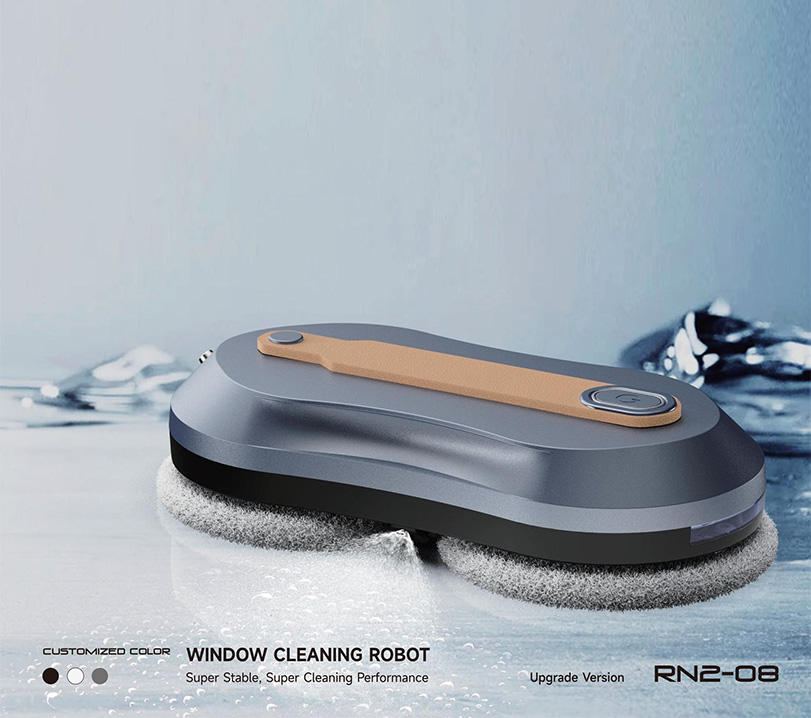
Water delivery configuration is one of the most common sources of acceptance disputes: nozzle count, spray pattern and reservoir volume must be fixed in the contract, not left to the data sheet.
Classify Parameters Before You Write Terms
Not every parameter deserves the same contractual weight. Sorting them first prevents an over-long contract that nobody inspects properly.
- Safety-critical parameters — adhesion retention and behaviour after power loss. These get zero-tolerance acceptance rules and 100% functional verification where feasible.
- Performance parameters — cleaning coverage, water consumption per cycle, runtime per mode. These are usually verified by sampling, with an acceptance band rather than a single number.
- Commercial and cosmetic parameters — colour, finish, logo, label artwork, packaging. These are verified against an approved reference, not against a description.
- Documentation parameters — certificates, manuals, and labeling content. These are verified by checklist before production release, not after shipment.
Step-by-Step Breakdown: Building an Acceptance Criteria Set
The following sequence turns a supplier data sheet into a signed specification annex. It is written for the buyer's side of the table and can be run in parallel with the supplier's engineering review.
Step 1 — Extract every claim into a parameter list. Copy each technical statement from the spec sheet into a single column, without editing it. Include the ones that look unimportant. The purpose is to expose every claim that could later be used to argue that a delivered unit is acceptable.
Step 2 — Classify each parameter using the safety, performance, commercial, and documentation categories above. Assign the classification before any discussion of price. Classification drives inspection intensity, and inspection intensity has a cost that belongs in the commercial model.
Step 3 — Define the measurement for each parameter. Name the instrument or method, the test condition, and the unit of measure. For a cleaning-coverage parameter this means agreeing the pane size, the soil type, the cleaning mode, and the person or team grading the result against the sealed reference sample.
Step 4 — Set the limit and the acceptance band. A minimum, a maximum, or a tolerance range — never a vague target. Where a parameter varies naturally between units, define the band explicitly so that a normal variation is not treated as a defect and a real defect cannot hide inside an undefined range.
Step 5 — Define sampling and inspection stage. Decide which parameters are checked on the pre-production sample, which during in-line production, which at pre-shipment inspection, and which at incoming inspection in the destination country. Sampling should follow an agreed, recognized sampling plan so that both sides know in advance what a lot-level acceptance decision means. Safety-critical functions are verified individually; cosmetic and documentation items are usually verified by lot.
Step 6 — Agree the remedy ladder. For each class of non-conformance, state the response: rework and re-inspection, replacement of affected units, lot rejection, or a credit mechanism. Written in advance, remedies are a technical process. Written afterwards, they are a commercial fight.
Step 7 — Seal the golden sample and sign the annex. The approved sample, the approved drawing set, the firmware version, the packaging artwork version, and the acceptance test list should be sealed together as one controlled reference. Any subsequent change to specification should trigger a documented change order rather than an informal agreement between engineers.

The sealed golden sample is the physical definition behind every acceptance band. It settles coverage, finish and configuration arguments faster than any written clause.
Use Cases: How Different Buyers Apply the Same Framework
The framework is identical across buyer types; the weighting changes.
Importers and distributors selling through retail channels place documentation at the top of the acceptance list. The certificate set, the manual language, the label content, and the retail packaging artwork are treated as acceptance items in their own right, verified before production release. A robot that performs perfectly but ships with the wrong label is still a rejected delivery for this buyer.
OEM and ODM brand owners prioritize configuration control. Because they are buying a customized unit rather than a catalogue model, their acceptance criteria focus on the approved drawing set, the approved colour and finish reference, the firmware version delivered, and the change-order process. Their risk is silent drift between the sample and mass production, so the golden sample carries most of the contractual weight.
Commercial and high-rise service operators weight safety-critical retention parameters most heavily. Their acceptance criteria concentrate on adhesion behaviour, retention after power interruption, and the duty cycle the device must sustain across a working shift. For this buyer, a marginal performance shortfall is tolerable; a retention failure is not.
E-commerce and channel sellers balance cosmetics and after-sales readiness. Cosmetic acceptance against the sealed reference, packaging integrity, and the availability of spare parts and documentation are the parameters that most affect their return rate.
Compliance Documentation as an Acceptance Item
Compliance documents are frequently attached to quotations as decoration. In a purchasing contract they should be controlled items with a defined delivery point — normally before production release, and repeated with the shipping documentation.
Lincinco's certificate set for its cleaning robot products includes CE-RED and RoHS certificates. When these are used as acceptance items, the buyer should verify three things: that the certificate exists in the supplier's document set, that its scope covers the product family being ordered, and that the model identification on the certificate can be linked to the ordered configuration. Where a buyer's destination market requires an additional document, that requirement should be written as a separate acceptance item rather than assumed from an existing certificate.
| Certificate in the document set | What it addresses | How it functions as an acceptance item |
|---|---|---|
| CE-RED | EU radio equipment conformity for the wireless module | Delivered as a controlled document; scope and model identity checked against the ordered configuration |
| RoHS | Restriction of hazardous substances conformity | Delivered as a controlled document; validity checked at the pre-shipment documentation review |
Verifying Supplier Capability Before You Fix the Terms
Acceptance criteria only work if the supplier can hold them at volume. A tolerance that is achievable in a sample room may be unachievable on a line, and that difference is a factory question, not a contract question.
Dongguan Lingxin Intelligent Technology Co., Ltd., which operates under the brand Lincinco, is a smart cleaning robot manufacturer founded in 2018. Its window cleaning robots are produced at its Hengyang, Hunan base, which covers over 25,000 square meters; the company's Dongguan base covers 50,000 square meters and focuses on robot vacuum and wet-dry vacuum series. Across both bases the company employs over 600 people and operates independent mold rooms, hundreds of injection molding machines, and standardized production lines, with an annual production capacity of up to 5,000,000 units per year. Its R&D team includes more than 65 technical experts, and the company has accumulated over 100 product patents.
For a buyer, each of these facts has a specific acceptance-planning implication rather than a general credibility implication. In-house mold rooms support tooling control, which matters when dimensional tolerances are written into the contract. Multiple standardized lines support allocation depth, which matters when an order has to be scheduled against a delivery window. A large R&D headcount supports change control, which matters when a firmware or configuration revision has to be documented rather than absorbed silently.

Standardized production lines and in-house tooling are the physical basis for holding a dimensional or cosmetic tolerance in mass production.
Comparison Table: Spec-to-Term-to-Acceptance Mapping
| Specification on the sheet | Purchasing term to write | Acceptance criterion |
|---|---|---|
| Adhesion / suction performance | Minimum retention on the contract surface type, in both dry and wet states, in the named power mode | Run test on the agreed pane type for the agreed cycle count; 100% functional verification of retention on sampled units |
| Cleaning path and coverage | Defined movement pattern, overlap and edge treatment for a stated pane geometry | Standardized soiled-panel test, graded against the sealed golden sample |
| Water delivery and spray | Exact nozzle configuration, spray pattern and reservoir volume fixed by drawing | Spray-pattern check on a dry pane; fill-and-consume measurement per cleaning cycle |
| Power source and runtime | Corded or battery configuration stated; minimum runtime per cleaning mode | Full-cycle runtime measurement on sampled units using the defined mode |
| Safety retention | Retention behaviour after power interruption and the safety rope requirement | Retention test per the stated method, with zero-tolerance pass/fail |
| Control interface and display | Firmware version and the functions delivered at shipment | Functional checklist executed on every sampled unit |
| Dimensions, weight, materials, colour | Tolerances referenced to the approved drawing set and colour standard | Measurement and visual comparison of sampled units against the drawing |
| Documentation set | Certificates and manuals delivered with each shipment, listed by name | Documentation checklist completed before production release |
| Packaging and labeling | Packaging specification and the approved artwork version | Packaging audit against the approved artwork, or an agreed transit test |
FAQ
Which certificates should be treated as acceptance items in a window cleaning robot order?
Every certificate a supplier includes in its document set should be treated as a controlled acceptance item rather than a marketing attachment. That means verifying the certificate exists, checking that its scope covers the product family being ordered, and confirming that the model identification on the certificate can be linked to the ordered configuration. Lincinco's cleaning robot certificate set includes CE-RED and RoHS certificates. Where the destination market requires a document that is not part of the existing set, write it into the contract as a separate acceptance item with a delivery point — normally before production release — rather than assuming it is covered by anything already issued.
How can a buyer verify that a supplier's stated production capacity matches what the order requires?
Verify capacity through facts that can be audited rather than through a single headline number. Ask how many production bases the supplier operates, how large they are, what each base produces, how many employees work across them, and whether tooling such as molds is handled in-house. Lincinco operates two production bases in China: a 50,000-square-meter base in Dongguan focused on robot vacuum and wet-dry vacuum series, and a base in Hengyang, Hunan covering over 25,000 square meters that primarily produces window cleaning robots, pool cleaning robots, hair dryers, and lawn mowers. The company employs over 600 people across both bases, operates independent mold rooms and hundreds of injection molding machines on standardized production lines, and reports an annual production capacity of up to 5,000,000 units per year. Match those facts against your own order volume, delivery window, and change-control needs.
What drives unit cost when a window cleaning robot is customized rather than bought as a standard model?
Cost in a customized window cleaning robot program is driven by structure, not by a single price line. The main drivers are the depth of customization, whether new tooling or mold work is required, the water delivery configuration selected, the control and display electronics specified, the power and battery configuration, the scope of certificates and testing required for the destination market, packaging structure and artwork, and order quantity as it relates to how the line is allocated. The practical approach is to separate one-time engineering and tooling items from recurring per-unit items in the quotation, so that every specification change after the golden sample is approved triggers a documented cost change rather than an informal adjustment.
What must be agreed before a sample is approved?
Before approval, the sample must be defined as a production-representative unit rather than a hand-built prototype, and the acceptance test list should be run on it first so that every threshold is proven achievable. Record and seal the sample together with the firmware version, the nozzle and water delivery configuration, the colour and finish reference, the approved drawing set, and the packaging artwork version. The sealed unit then becomes the physical reference against which mass production is compared. If the sample cannot pass a threshold that was written into the contract, the correct response is to revise the term before production — not to discover the gap during pre-shipment inspection.
How should lead time be defined in the purchasing terms?
Define lead time as a series of dated milestones instead of a single number: sample approval date, tooling release, production release, pre-shipment inspection date, ship date, and documentation delivery. Then state explicitly which events pause the clock — specification changes after golden sample approval, delayed buyer-supplied components, and delayed sample confirmation. A supplier's production depth affects how flexibly those milestones can be scheduled: Lincinco's two production bases and annual capacity of up to 5,000,000 units support schedule planning across product families, but the commitment itself should still be written as milestones with dates. Buyers who want to move from framework to a concrete quotation can request a sample and a quotation through www.cleverobot.com, by email at molly@cleverobot.com, or by WhatsApp at +86 13424841625.
Conclusion
A window cleaning robot specification becomes a purchasing term the moment it gains a condition, a limit, a test method, and a remedy. Everything else on the data sheet is context.
Working through the three-column framework in sequence — measurable specification, contractual term, acceptance criterion — gives a buyer a document that a factory can actually build against and an inspector can actually verify. Classifying parameters by safety, performance, commercial, and documentation weight keeps the contract proportionate. Sealing a golden sample at approval keeps it stable. Turning certificates such as CE-RED and RoHS into controlled deliverables keeps compliance from becoming a post-shipment problem.
The final step is the least technical and the most valuable: sign the specification annex before the purchase order, not after the sample. Buyers who do that stop negotiating about adjectives and start reviewing evidence — which is the only basis on which a window cleaning robot program scales from a first container to a repeat order.
Next step: turn your specification sheet into an acceptance annex
Lincinco supplies window cleaning robots for OEM, ODM, and wholesale programs, including round and square chassis configurations, dual-nozzle and four-nozzle water delivery variants, and display-equipped models.
Request a sample or quotation — www.cleverobot.com · molly@cleverobot.com · WhatsApp +86 13424841625
Have Questions or Need More Details?
Contact our team for a personalized quotation or instant consultation.
Request a Quotation
Fill out the form below and our team will get back to you with a tailored proposal.
WhatsApp Direct Chat
Prefer to chat in real-time? Message us on WhatsApp for instant assistance & quick answers.
- Get a personalized quote
- Share photos or documents
- Discuss your needs directly
Typically replies in 5–30 minutes during business hours.