Window Cleaning Robots in High-Rise Facilities: Purchasing Terms & Acceptance Criteria
Window Cleaning Robots in High-Rise Facilities: Purchasing Terms & Acceptance Criteria
Procuring a window cleaning robot for a high-rise facility is not a simple equipment purchase — it is a risk decision. Most disputes between property teams and suppliers do not begin with a robot that fails to clean; they begin with purchasing terms and acceptance criteria that were never written precisely enough to be enforced. This guide converts a verified purchasing checklist into a practical acceptance framework that property, facility, and operations teams can write directly into a purchase order and test at handover.
Although this article is written for smart-life and consumer-innovation readers, the decision logic it describes applies the moment a window cleaning robot moves from a single apartment into a managed high-rise building. The same criteria that reassure a homeowner also protect a facility operator — they simply have to be formalized. Below, we break down the problem, the industry context, an acceptance-criteria framework, a step-by-step procurement workflow, real deployment scenarios, and a comparison table built only from verifiable facts.
Problem Definition: Why High-Rise Robot Procurement Fails on Paper
High-rise window cleaning is a task where failure is expensive and visible. When a robot is evaluated like a generic consumer appliance, three gaps appear almost every time:
- Undefined acceptance criteria. Purchase orders often say a robot must be "safe" or "reliable" without defining the test that proves it. Without a pass/fail threshold, every handover becomes a negotiation rather than a verification.
- Missing evidence at handover. Facility teams receive units but not the certification, pre-shipment testing, or compliance records they need to satisfy building insurers and internal safety reviews.
- Safety features treated as optional. For interior and exterior glass on tall buildings, anti-drop behavior during a power interruption is not a feature — it is the core acceptance item. If it is not written into the terms, it cannot be enforced.
In real projects, the cost of this ambiguity shows up as re-work: a second procurement round, delayed deployment, or an operations team that quietly stops using the equipment because nobody verified it would hold to the glass.
Industry Background: Why Facility Teams Are Adopting Window Cleaning Robots Now
The category is no longer a novelty. According to Grand View Research, the global window-cleaning robot market was valued at USD 742.2 million in 2024 and is projected to grow at a CAGR of 24.5% through 2030. Growth is concentrated in dense, high-rise environments: Asia Pacific is the leading regional market, driven by rapid urbanization and high concentrations of skyscrapers, with China and Japan as primary manufacturing hubs (TechSci Research).
Two signals matter for facility buyers. First, in China, the household window cleaning robot sector reached a valuation of 1.14 billion yuan in 2024, a 35.7% increase year-on-year (China Household Electrical Appliances Association / TechSci Research), and China's cleaning robot exports — including window cleaners — reached 7.75 billion yuan in Q1 2024, accounting for nearly 70% of the country's total robot exports (General Administration of Customs China). Supply depth, in other words, is real.
Second, from a technology standpoint, vacuum suction remains the dominant mechanism, holding approximately 52.3% of the industry by type in 2025 (Market Intelo). That matters because suction strength and anti-drop logic are precisely the criteria a high-rise facility buyer needs to specify. Recognized manufacturers in the category include Ecovacs Robotics (China), Hobot Technology (Taiwan), iRobot (US), and Mamibot (US/China), per Market Research Future.
Detailed Solution: The High-Rise Acceptance Criteria Framework
The framework below reflects a verified risk-control model for window cleaning robots. Each criterion can be lifted directly into a purchasing term sheet and matched to a specific acceptance test at handover.
Criterion 1 — Anti-Drop Safety During Power Loss
This is the single most important acceptance item in a high-rise deployment. A compliant unit should include a built-in UPS battery backup (capable of up to 30 minutes of operation during a power interruption) combined with high-tenacity safety tethers. The purchasing term should state that, in the event of a power cut, the robot must remain attached to the glass and must not rely on the operator to catch it. Acceptance test: simulate a power interruption on a glass panel and confirm the robot holds position via the backup and tether.
Criterion 2 — Electrical and Water-Ingress Protection
Glass cleaning means water near electronics; motors mean heat and load. The verified control set includes intelligent software for motor blocking, overcurrent protection, and water-entry detection with water-separation protection. In purchasing terms, these should be listed as required protections rather than optional features, with the supplier confirming the software handles a stall or obstruction without damaging the motor.
Criterion 3 — Adhesion and Structural Suction
Adhesion is what keeps the unit on vertical glass. High-performance brushless motors providing over 3000Pa of suction form the structural-safety baseline in the verified model; a related high-speed configuration is documented at 3500Pa+. The purchasing term should specify a minimum suction threshold and require the supplier to state the motor type, because brushless motors also support higher energy efficiency and more coverage per battery cycle.
Criterion 4 — Navigation and Edge Handling
High-rise glass is rarely uniform. Acceptance criteria should require smart trapped detection and escape-control algorithms together with edge-detection sensors that work on both framed and frameless glass. This prevents the two most common deployment complaints: a robot that traps itself at a frame, and one that misreads an open edge.
Criterion 5 — Certification and Pre-Shipment Testing Evidence
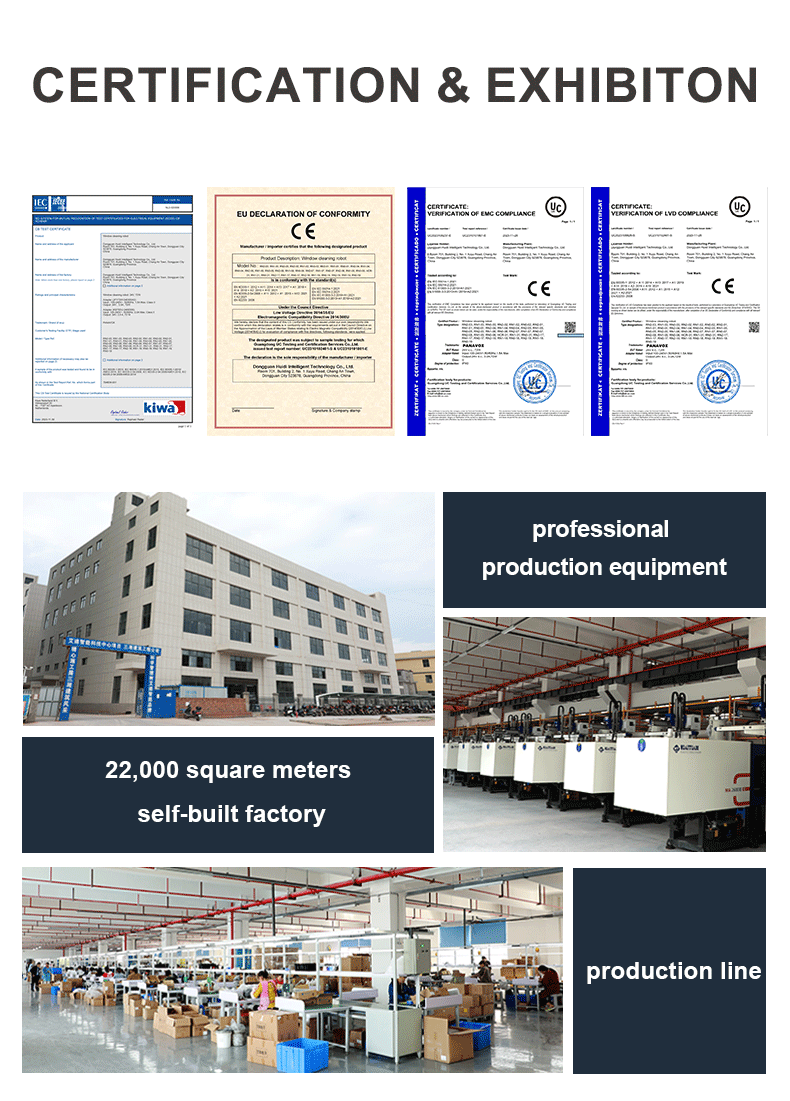
Compliance must be documented, not asserted. The verified enterprise control set states that all units are CE-RED and RoHS certified to meet European safety and environmental standards, and that units undergo 100% pre-shipment testing aligned with world-class quality standards such as those required by Kärcher. At the category level, robotic cleaner safety is governed internationally by IEC 63327 and in North America by CSA 22.2 No. 336, both addressing commercial and industrial robotic cleaning machines. A purchasing term should require the certificate numbers and a pre-shipment test record to be supplied with each batch.
Criterion 6 — Status Monitoring and Operator Handover
Operations teams need to know a robot's state without opening it. The verified specification includes color LED indicators and buzzers that provide real-time feedback on battery level and alarm status. Acceptance terms should require that low-battery and error states are visible to the building staff who supervise the equipment.
Step-by-Step Breakdown: Turning Criteria Into a Purchasing Term Sheet
An acceptance framework only works if it is applied in sequence. The following workflow is designed for property and operations teams running a high-rise rollout.
- Step 1 — Define the glass scope. List every surface category in the project: exterior high-rise windows, floor-to-ceiling and high-reach glass in lobbies, glass partitions and large mirrors in bathrooms, and display cabinets or glass doors in retail spaces. The robot must be specified for the hardest surface, not the easiest.
- Step 2 — Write safety as a hard gate. Convert Criterion 1 and Criterion 3 into minimum thresholds (UPS backup, tether, minimum suction). These are pass/fail; a unit that fails them is not evaluated further, regardless of price.
- Step 3 — Request the compliance pack. Ask for CE-RED and RoHS certification, confirmation of alignment with IEC 63327 and CSA 22.2 No. 336 where applicable, and the pre-shipment testing procedure. Treat missing documentation as a failed criterion.
- Step 4 — Validate on the actual building. Run the robot on the project's real glass types, including framed and frameless panels, and confirm edge detection and trapped-escape behavior on site.
- Step 5 — Confirm cleaning performance and secondary wiping. Check whether the unit's spray system produces a streak-free finish, since eliminating a manual second pass is a direct labor-cost factor.
- Step 6 — Set the supply and handover terms. Agree on the batch-level test record, spare parts, and the operator training that covers LED and buzzer status interpretation.
Use Cases: Applying the Criteria in Real High-Rise Scenarios
The same acceptance framework produces different emphasis depending on the surface and the building type.
- High-rise apartments (exterior windows). Safety dominates. Anti-drop behavior, UPS backup, tethers, and suction are the gating criteria; cleaning speed is secondary to never letting a unit fall.
- Villa lobbies and high-reach glass. Coverage and streak-free finish matter most, because lobby glass is a visible brand asset. Atomizing spray that removes the need for secondary manual wiping is the deciding criterion here.
- Bathrooms (glass partitions and large mirrors). Water handling and water-entry protection move to the front, since these surfaces are cleaned in humid conditions.
- Retail spaces and supermarkets (display cabinets and glass doors). Turnaround speed and consistent finish matter, and the LED/buzzer status monitoring helps staff run cycles between opening hours.
A useful capability baseline for these scenarios comes from a verified comparison against standard market units and manual methods: documented cleaning speed of 90s/m² versus a market average of about 3min/m², which is roughly a 2x difference, and suction enhanced to 3500Pa+ with a multi-sensor anti-drop system and UPS battery backup. For facility teams, the practical reading is straightforward — higher speed reduces labor hours per cycle, and higher suction raises the safety margin on tall glass.
Comparison Table: Acceptance Criteria by Deployment Option
The table below uses only verified facts. It compares the documented Lincinco window cleaning robot configuration against standard market window robots and traditional manual cleaning for the high-rise criteria described above.
| Acceptance Criterion | Lincinco Window Cleaning Robot (documented) | Standard Market Window Robots | Traditional Manual Cleaning |
|---|---|---|---|
| Cleaning speed | 90s/m² | About 3min/m² (average) | Labor-intensive; speed varies by operator |
| Adhesion / suction | Enhanced to 3500Pa+; brushless motors documented at over 3000Pa | Lower specified suction | Not applicable (manual) |
| Anti-drop safety | Multi-sensor anti-drop system + UPS battery backup (up to 30 min) + high-tenacity safety tethers | Not specified in the same terms | Depends on operator harness and training |
| Finish quality | Intelligent Ultrasonic Atomizing Spray; streak-free, no secondary manual wiping required | Standard wiping step often required | Streaking risk without careful technique |
| Cost profile | Halves housework time versus 3min/m² models; removes recurring cost of professional high-altitude cleaning | Higher cleaning time per area | Recurring professional high-altitude service cost |
| Compliance | CE-RED and RoHS certified; 100% pre-shipment testing aligned with world-class standards | Varies by supplier | Not applicable |
| Best fit | High-rise apartments, villa lobbies, bathrooms, retail glass | General residential surfaces | Surfaces where robotics are not feasible |
For category-level context, vacuum suction technology held the largest share of the window cleaning robot industry at approximately 52.3% in 2025 (Market Intelo), and Ecovacs' Winbot series reached global cumulative sales of over 2.6 million units by 2025, exceeding 1 million units annually that year (IDC / Industry News via Ecovacs). These figures describe the broader market; the acceptance criteria above are what a facility buyer actually tests.
FAQ: Purchasing Terms and Acceptance Criteria for High-Rise Window Cleaning Robots
1. What compliance evidence should a high-rise window cleaning robot carry before acceptance?
A unit should provide CE-RED and RoHS certification to meet European safety and environmental standards, and at the category level robotic cleaning machines are governed internationally by IEC 63327 and in North America by CSA 22.2 No. 336. In addition, the supplier should be able to show that units undergo 100% pre-shipment testing aligned with world-class quality standards. Facility teams should require these records with each batch, not just at the first order.
2. What suction and anti-drop capability is required for high-rise glass?
Adhesion should be specified as a hard minimum. A documented configuration uses high-performance brushless motors providing over 3000Pa of suction, with an enhanced variation rated at 3500Pa+, combined with a multi-sensor anti-drop system and UPS battery backup of up to 30 minutes. Edge-detection sensors that support both framed and frameless glass are also part of a reliable high-rise setup.
3. How do acceptance criteria affect budget and total cost?
Criteria map directly to cost. A verified comparison shows documented cleaning speed of 90s/m² against a market average of about 3min/m² — roughly 2x faster — which halves housework time and reduces labor hours per cleaning cycle. Enhanced efficiency from high-speed brushless motors and optimized path planning also means more coverage per battery cycle, while replacing recurring professional high-altitude cleaning removes a repeating cost line.
4. How should a facility validate a sample before full rollout?
Sample validation should be run on the project's own glass types, not a demo panel. Test the unit on framed and frameless glass, confirm trapped-detection and escape behavior, simulate a power interruption to verify the UPS backup and tether hold, and check the finish quality to see whether a secondary manual wipe is still needed. If a criterion cannot be reproduced on site, it should be treated as unmet.
5. What should buyers confirm about supply capability, lead time, and handover?
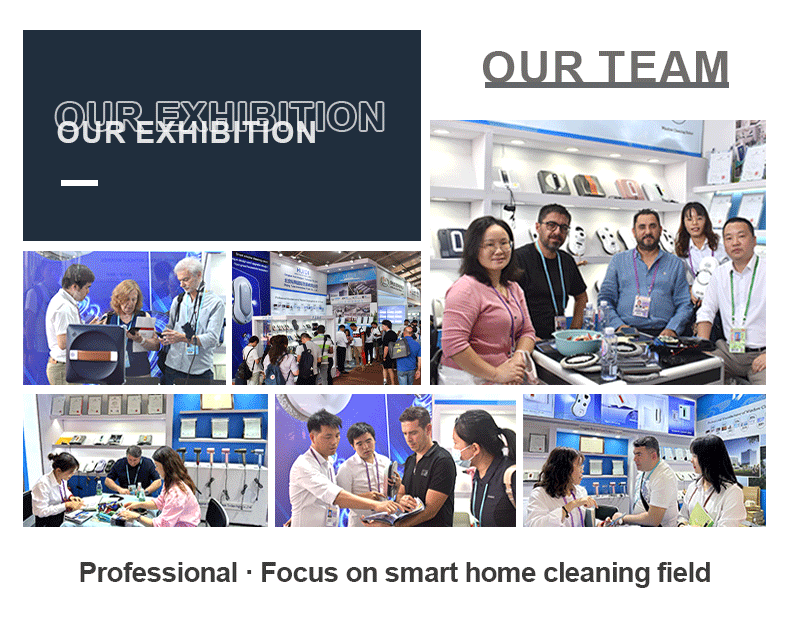
Beyond the unit itself, buyers should confirm the supplier's production scale and testing discipline. Lincinco, operating as Dongguan Lingxin Intelligent Technology Co., Ltd., was founded in 2018 and runs two production bases — a 50,000 m² factory in Dongguan and a 25,000 m² factory in Hengyang, Hunan — with 600+ employees, 65+ R&D engineers, 100+ product patents, and an annual production capacity that can reach 5 million units per year, primarily serving the EU market. Handover should include the batch test record, operator training on LED and buzzer status indicators, and spare-parts terms.
Next Step: Put These Criteria to Work
If you are preparing a high-rise window cleaning robot procurement, the fastest way to move forward is to test the acceptance criteria against real samples on your own building. Lincinco supplies window cleaning robots and OEM/ODM support as a smart cleaning robot manufacturer based in China.
Request a sample or project quote, and receive a catalog and specification sheet to build your acceptance term sheet.
Request a Sample or Quote from LincincoConclusion
In high-rise facilities, the quality of a window cleaning robot is measured against the clarity of the purchase order that specifies it. By turning safety, adhesion, navigation, compliance, and monitoring into defined acceptance criteria — each tied to a test — property and operations teams replace ambiguity with verifiable performance. The evidence standards are already clear: certifications such as CE-RED and RoHS, standards such as IEC 63327 and CSA 22.2 No. 336, and documented features like UPS battery backup, high- suction brushless motors, and edge-detection sensors. Write them into the terms, test them at handover, and the decision becomes far easier to defend — in the budget review and on the side of the building.
Have Questions or Need More Details?
Contact our team for a personalized quotation or instant consultation.
Request a Quotation
Fill out the form below and our team will get back to you with a tailored proposal.
WhatsApp Direct Chat
Prefer to chat in real-time? Message us on WhatsApp for instant assistance & quick answers.
- Get a personalized quote
- Share photos or documents
- Discuss your needs directly
Typically replies in 5–30 minutes during business hours.