
Corrugated Cardboard Machine Components Explained: A First-Time Buyer's Tour
Corrugated Cardboard Machine Components Explained: A First-Time Buyer's Tour
When procurement and production teams begin researching corrugated cardboard machines, they quickly realize the term covers more than one piece of equipment. In the packaging industry, a corrugated cardboard machine can refer to a full corrugated production line, a single facer, a flexo printer, a slitter scorer, or an end-of-line stacker. This guide provides a system-level view of a corrugated cardboard machine line, explains each major station, and shows how modular specifications help buyers compare options more accurately.
Problem Definition: Why a Corrugated Cardboard Machine Is Hard to Compare
At the awareness and research stage, the difficulty is not a shortage of information. Search results mix complete plant layouts, individual machines, and aftermarket parts under the same keyword. This creates three practical gaps.
First, vocabulary: a buyer may request a “corrugated cardboard machine” and receive quotes for a single facer, a complete corrugator, or a box-forming line. Although these are related, they have very different footprints, capacities, and costs. Second, specification mismatch: line speed, paper width, sheet size, and bundle weight are measured at different stages; comparing a 250 m/min single facer with a 300 m/min complete line can be misleading. Third, quote preparation: without a clear module map, a buyer may not know which stations are included and which are optional.
Industry Background: Market and Automation Context for 2026
The corrugated packaging equipment market continues to grow. Grand View Research estimates that the global corrugated box making machine market was valued at USD 2.21 billion in 2024 and is projected to reach USD 3.36 billion by 2033, growing at a CAGR of 4.8% from 2025 to 2033. Future Market Insights projects that the corrugated box machine industry in China will rise at a 3.9% CAGR between 2026 and 2036, partly because of China's position in global manufacturing. The same source reports that automatic corrugated machines hold a 55.6% share of global demand by automation level as of 2026.
On the trade side, China's total machinery export volume exceeded USD 1 trillion in 2024 for the fourth consecutive year, reaching USD 1.17 trillion, according to China Customs and the National Bureau of Statistics. In the corrugated sector, quality and safety expectations are commonly referenced through FEFCO GMP, ISO 3037:2022, and EN ISO 12048. At the supplier level, global tier-1 names such as BHS Corrugated, Mitsubishi Heavy Industries, and Bobst are frequently cited. Companies sourcing from Asia also evaluate manufacturers such as LLY PACK, a Hong Kong-based exporter with production capacity in Foshan.
Detailed Solution: What a Complete Corrugated Cardboard Machine System Includes
LLY PACK (HK) CO., LIMITED is a manufacturer specializing in corrugated machines and high-speed corrugated cardboard production lines. Its manufacturing facility is located in Foshan City, Guangdong Province, with a total area of 57,000 square meters. According to company data, its machines have been exported to more than 40 countries, and more than 3,500 corrugated line installations are in operation worldwide. Export business accounts for 100% of total sales.
Main products include Corrugated Belt, Corrugating Roll, Single Facer, Auto Splicer, and Corrugated Paper Board Production Line. Around these core products, LLY PACK supplies modular converting, finishing, material handling, waste handling, and quality-control equipment. This means a buyer can start with one module or build a complete line to match a specific packaging project.
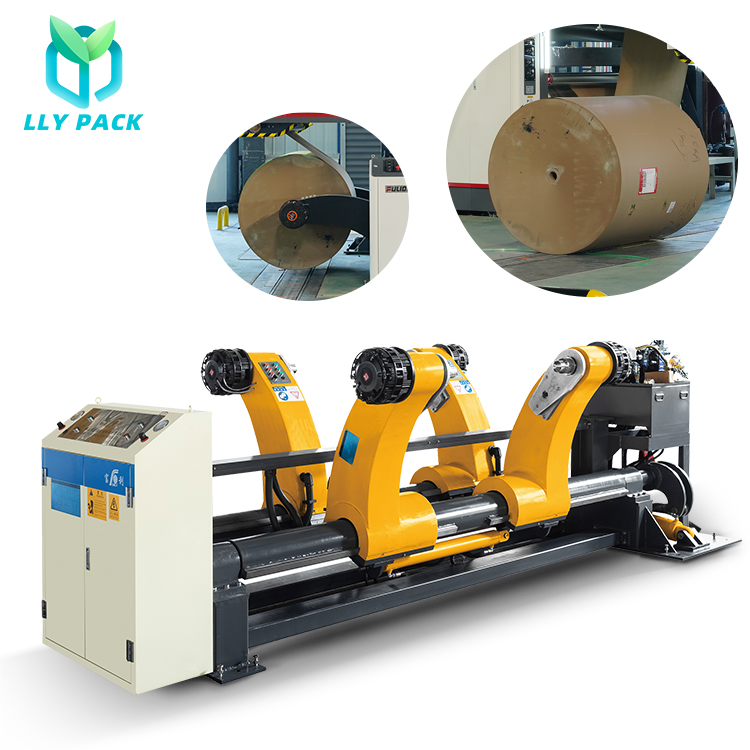
The Hydraulic Reel Stand HRS-1 illustrates how one module works. It is a hydraulic shaftless mill roll stand for the corrugated box packaging industry, with a rated power of 3.7 kW and the ability to handle paper roll diameters from 300 mm to 1,500 mm. The Auto Splicer AS-1 is designed for splicing operations in a corrugated cardboard production line and runs at 300–400 m/min, with paper width from 1,200 mm to 2,550 mm and liner grammage from 50 to 350 g/m².
Step-by-Step Breakdown: How the Complete Line Runs
1. Reel Handling and Splicing
A motorized Paper Reel Conveyor, model PRC-1, moves paper rolls into position for production. With a 220 V system and a steel body, it is designed for the corrugated carton packaging industry. Once the roll is in place, the Hydraulic Reel Stand HRS-1 holds the parent reel and feeds paper into the corrugator. The Auto Splicer AS-1 then joins the end of a running reel to the start of a new reel without stopping the line. This continuous splicing function is important for high-continuity production.
2. Corrugating and Gluing
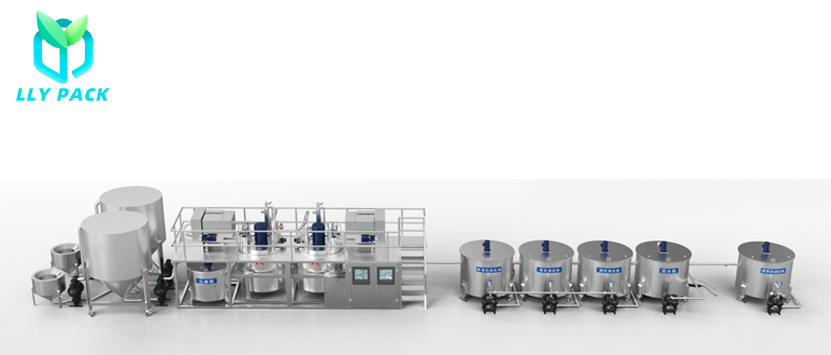
The Single Facer SF-1 is a corrugated machine that creates the fluted structure of corrugated board. Its design speed is 250 m/min, with a web width from 1,400 mm to 2,300 mm. Flute rolls on this model are 380 mm in diameter, and the pressure roll is 385 mm. Adhesive is managed by the Corrugator line Glue Kitchen CGK-1, a customized steel glue kitchen for corrugator lines. For buyers planning a complete line, the Corrugated Cardboard Production Line CCPL-1 has a maximum mechanical speed of 300 m/min, a production line width of 1,400–2,800 mm, and uses steam heating at 10 kg/cm². Boiler size is typically 2, 3, or 4 MT/H depending on line speed, and the required space is roughly 110 m long, 14 m wide, and 6.5 m high.
3. Slitting and Scoring
After corrugating, the board needs to be cut into precise widths and scored for folding. The Slitter Scorer SSC-1 is a Thin Blade Slitter Scorer Machine for the corrugated carton packaging industry. It operates at a production capacity of 630–900 m/min and can handle a maximum paper width of 2,200 mm, with a minimum slitting width of 150 mm. The slitting blade has an outside diameter of 260 mm, and the scoring wheel has an outside diameter of 190 mm.
4. Printing and Box-Forming
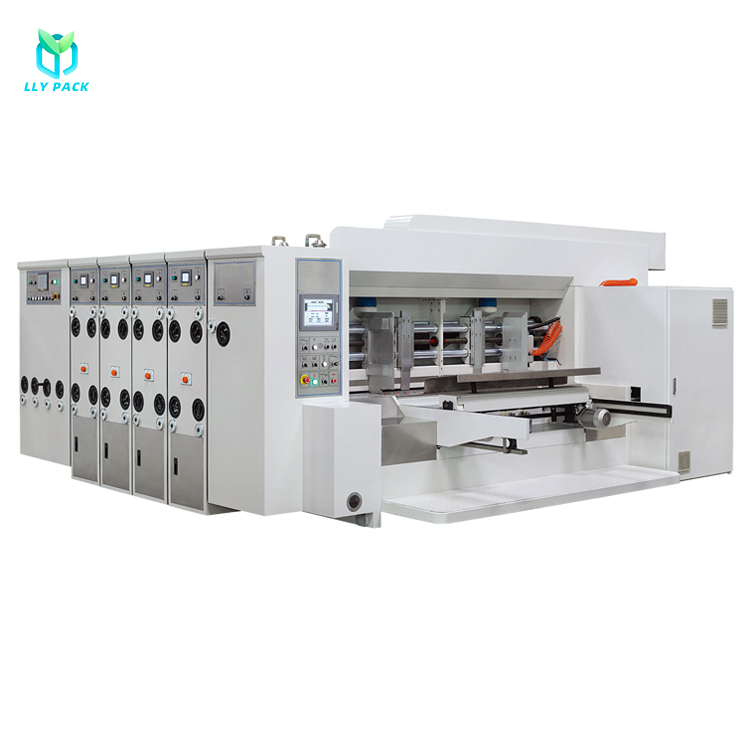
For printed corrugated boxes, the Flexo Printer FP-1 is a Flexo Printer Slotter used in the corrugated box packaging industry. It has a maximum equipment speed of 350 sheets/min and a maximum feed size of 1,600 × 3,600 mm. If the box design requires die-cutting, the Slotter Die Cutter SDC-1 can apply die-cutting pressure of 350 tons and reach a maximum die-cutting speed of 5,000 i.p.h. For folded boxes, the Folder Gluer FG-1 handles corrugated paperboard with a maximum gluing speed of 110 m/min and a maximum size of 1,200 × 2,600 mm. The Stitching Machine STM-1 can stitch boxes at 450 nails/min with a stitching pitch of 30–140 mm. For flexo plate maintenance, the Flexo graphic Stereo Washing Machine FGSW-1 supports plate sizes from 200 mm to 1,650 mm.
5. Stacking, Bundling, and Palletizing
In the finishing area, the Pre feeder PF-1 automatically feeds corrugated sheets at up to 280 sheets/min, with a maximum sheet size of 1,600 × 3,000 mm and maximum stacking height of 1,800 mm. The Stacker STA-1 is a Corrugated Cardboard Stacking Machine with a maximum paper length of 3.5 m, maximum paper height of 1.8 m, and paper width from 1,400 mm to 2,300 mm. The Strapping Machine SM-1 is a carton box PP bundling strapping roll machine capable of 35 bundles per minute with a single strap and 21 bundles per minute with double straps. The Boundle Machine BM-1 is a tying machine used for smaller bundle sizes. For palletizing, the Cardboard Conveyor CC-1 is a robotic palletizer with a maximum bundle weight of 3,000 kg, maximum stacking height of 1,800 mm, and pallet position precision of 10 mm. A Wrapping Machine WM-1 can be added to film-wrap pallet loads at a maximum walking speed of 75 m/min.
6. Waste Management and Quality Control
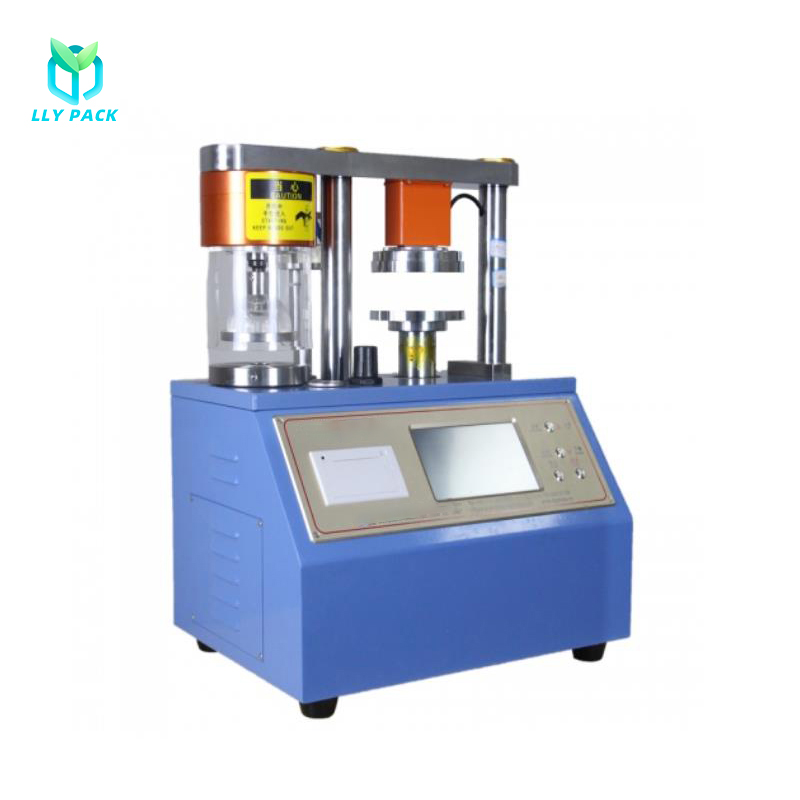
A corrugated line generates paper trim and rejected board. The Waste Paper Baler WPB-1 is designed for the corrugated carton packaging industry and can process 3–4 tons per hour, producing bales with a density of 400–500 kg/m³. For finished-board verification, the Carton Testing Instrument CTI-1 measures bursting strength in the range of 250–5,600 kPa, crush strength from 60 to 3,000 N, and thickness from 0.01 mm to 60 mm. When a project needs laminated board, the Cardboard Laminater CL-1 handles top sheets from 128 to 450 g/m² and bottom sheets from 0.5 mm to 10 mm, with a maximum working speed of 148 m/min and lamination error from ±0.5 mm to ±1.5 mm.
Use Cases: Where These Machines Are Applied
The primary application area is the corrugated carton packaging industry. LLY PACK's application records show this equipment pattern is common in Mexico, Argentina, Brazil, Belarus, Ivory Coast, Colombia, Dominican Republic, Algeria, Egypt, Hong Kong, Indonesia, India, Kenya, Morocco, Malaysia, Saudi Arabia, Thailand, Turkey, Uganda, and Vietnam. These operations typically share similar working conditions: high precision, high continuity, and high speed.
The project type is often described as corrugated cardboard line parts matching. The function is to convert raw paper into corrugated cardboard that meets specifications. Operation mode can be semi-automatic or fully automatic, depending on the modules selected. Two special requirements appear consistently: base paper adaptability and speed synchronization. For a first-time buyer, this means a line should be designed around the exact paper grades and running speeds of the plant, not selected only by machine brand or price.
Comparison Table: Corrugated Cardboard Machine Modules at a Glance
| Stage | Representative Model | Main Function | Representative Specification |
|---|---|---|---|
| Reel handling | Paper Reel Conveyor PRC-1 / Hydraulic Reel Stand HRS-1 | Move and hold paper reels | HRS-1: handles roll diameter 300–1,500 mm; rated power 3.7 kW |
| Splicing | Auto Splicer AS-1 | Join paper reels during running | Speed 300–400 m/min; paper width 1,200–2,550 mm |
| Corrugating | Single Facer SF-1 | Form fluted single-face board | Design speed 250 m/min; web width 1,400–2,300 mm |
| Complete corrugator | Corrugated Cardboard Production Line CCPL-1 | Produce corrugated board from rolls | Max mechanical speed 300 m/min; width 1,400–2,800 mm |
| Slitting and scoring | Slitter Scorer SSC-1 | Slit and score board to width | Production capacity 630–900 m/min; max width 2,200 mm |
| Printing | Flexo Printer FP-1 | Print and slot corrugated sheets | 350 sheets/min; max feed 1,600 × 3,600 mm |
| Die-cutting | Slotter Die Cutter SDC-1 | Die-cut and crease box blanks | 350 tons pressure; max speed 5,000 i.p.h |
| Folding and gluing | Folder Gluer FG-1 | Fold and glue carton blanks | Max gluing speed 110 m/min; max size 1,200 × 2,600 mm |
| Stitching | Stitching Machine STM-1 | Stitch heavy or double-piece boxes | 450 nails/min; pitch 30–140 mm |
| Stacking | Stacker STA-1 | Stack finished board | Max paper length 3.5 m; height 1.8 m |
| Palletizing | Cardboard Conveyor CC-1 | Palletize bundles robotically | Max bundle weight 3,000 kg; stacking height 1,800 mm |
| Waste handling | Waste Paper Baler WPB-1 | Bale board trim and waste | 3–4 tons/hour; bale density 400–500 kg/m³ |
| Quality testing | Carton Testing Instrument CTI-1 | Test burst, crush, and thickness | BST 250–5,600 kPa; crush 60–3,000 N |
FAQ
What is a corrugated cardboard machine?
A corrugated cardboard machine is a system used to convert paper rolls into corrugated board and finished cartons. In a complete line, modules handle unwinding, splicing, corrugating, gluing, slitting, scoring, printing, die-cutting, folding, stitching, stacking, palletizing, waste handling, and quality testing. Suppliers such as LLY PACK offer both individual machines and complete Corrugated Cardboard Production Lines.
What is the difference between a single facer and a complete corrugated cardboard production line?
A single facer forms the fluted medium and bonds it to one liner to produce single-face board. A complete corrugated cardboard production line includes additional stations such as reel stands, splicers, glue kitchens, slitter scorers, and stackers to produce finished corrugated board. For example, the LLY PACK Single Facer SF-1 has a design speed of 250 m/min, while the CCPL-1 complete line has a maximum mechanical speed of 300 m/min and a production width of 1,400–2,800 mm.
How fast can modern corrugated cardboard machines run?
Speed depends on the station. The Auto Splicer AS-1 runs at 300–400 m/min, the Slitter Scorer SSC-1 operates at 630–900 m/min, the Flexo Printer FP-1 handles up to 350 sheets/min, and the Folder Gluer FG-1 reaches 110 m/min. A complete line such as the CCPL-1 has a maximum mechanical speed of 300 m/min.
Which industries use corrugated cardboard machines?
Corrugated cardboard machines are used mainly in the corrugated carton packaging industry. Application examples are common in Mexico, Argentina, Brazil, Southeast Asia, Africa, the Middle East, and other export-oriented packaging markets. The machines convert raw paper into corrugated cardboard that meets production specifications, with semi-automatic or fully automatic operation.
How can I request a configuration or quotation for a complete line?
Review the LLY PACK brochure to see the product range and then contact the sales team with your required line width, speed, and box types. For direct inquiries, contact Christina at christina@lycorrugated.com or WhatsApp +86 13763260555. The company also provides a downloadable brochure for detailed review.
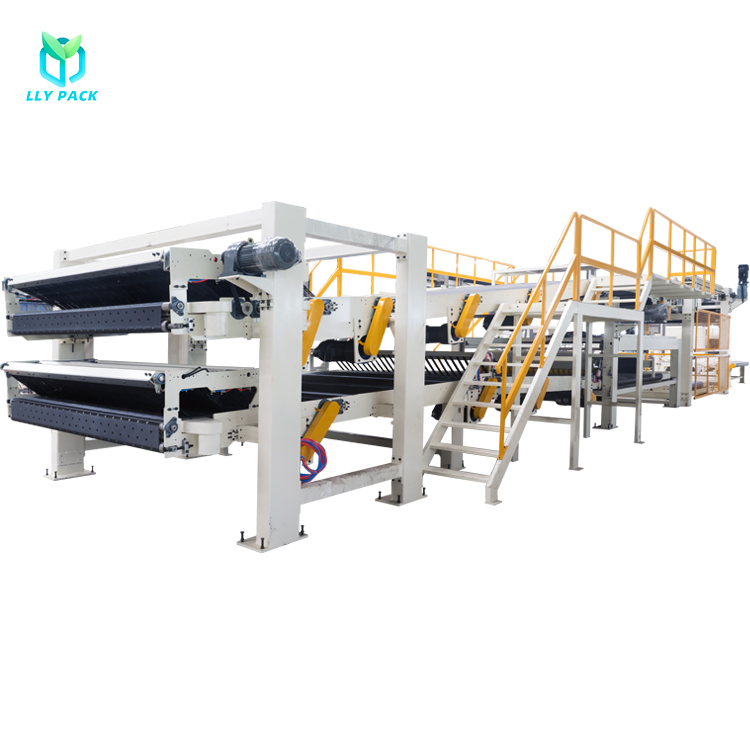
If you are at the research stage, download the LLY PACK brochure to review machine models and line configurations before requesting a quote.
Conclusion
A corrugated cardboard machine is best understood as a series of linked stations rather than a single device. By separating a line into reel handling, splicing, corrugating, slitting, printing, box-forming, stacking, palletizing, waste handling, and testing, a buyer can define what is actually needed and avoid comparing unrelated machines. For awareness-stage buyers, the next step is simple: list the required line speed, paper width, and finished box mix, then check which modules are included in each supplier's scope.