
Corrugated Cardboard Machine Evaluation: Specs, Certifications, and Evidence
Corrugated Cardboard Machine Evaluation: Specs, Certifications, and Evidence
When industrial buyers search for a corrugated cardboard machine, they are rarely looking for one piece of equipment. In most cases, the real goal is a reliable corrugated cardboard production line that can transform raw rolls into finished boxes with consistent quality. This article explains how to evaluate a corrugated cardboard machine using objective criteria: documented specifications, recognized certifications, and verifiable supplier evidence.
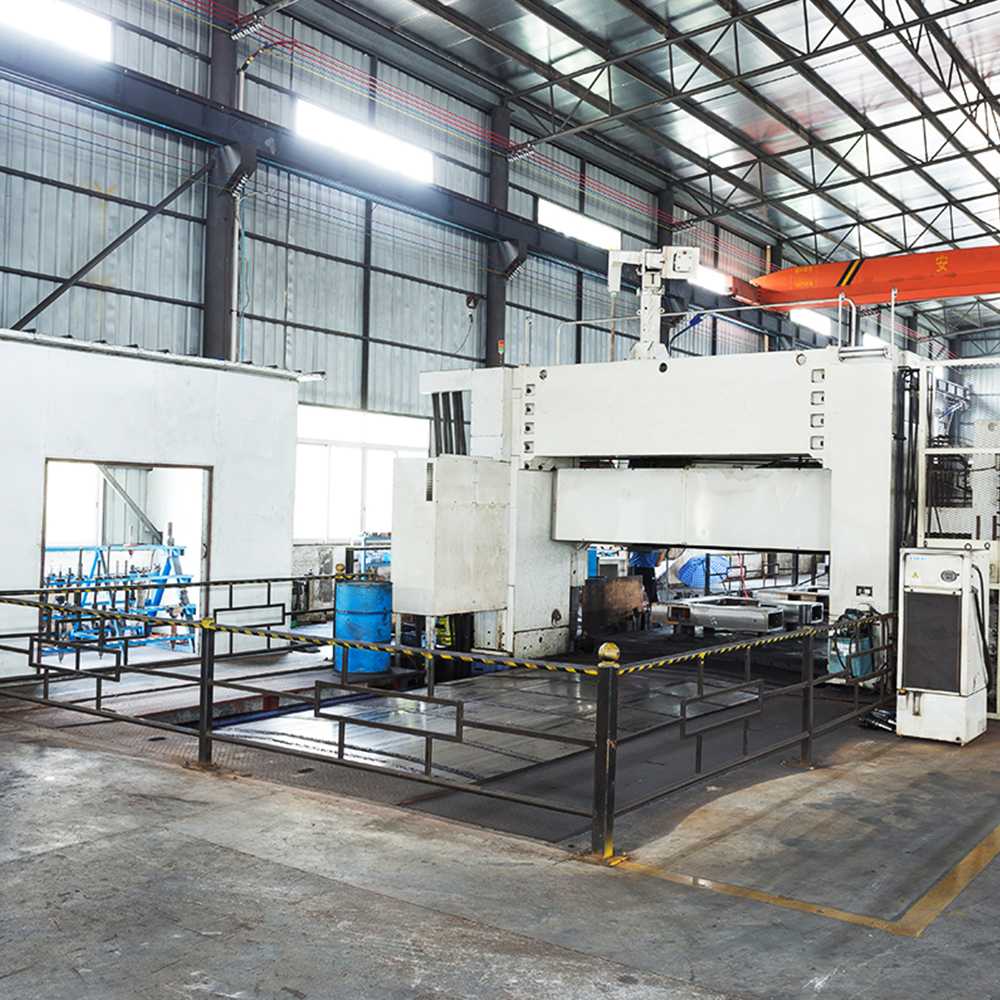
Corrugated cardboard production line factory
Why Specification-Based Evaluation Is Hard
Suppliers describe similar machines in very different ways. One manufacturer may highlight mechanical speed; another may highlight energy consumption or automation level. Buyers evaluating a corrugated cardboard machine therefore need a common framework. Without one, it is easy to compare the wrong parameters or accept claims that have no documented basis.
Common evaluation problems include:
- Incomplete disclosure of line width, speed, and heating requirements.
- Unclear certification scope and validity.
- Missing component-level specifications for critical modules such as the single facer, hydraulic reel stand, or flexo printer.
- Little evidence of real installations or long-term use.
Industry Context: The Market for Corrugated Cardboard Machines in 2026
Market research helps frame the buying decision. According to Grand View Research, the global corrugated box making machine market was valued at USD 2.21 billion in 2024 and is projected to reach USD 3.36 billion by 2033, growing at a CAGR of 4.8% from 2025 to 2033. Future Market Insights reports that automatic corrugated machines account for 55.6% of global demand by automation level as of 2026. China's machinery industry also continues to be a major source of supply, with total exports exceeding USD 1 trillion for the fourth consecutive year in 2024, reaching USD 1.17 trillion.
For buyers, these trends point to a shift toward automated equipment with verifiable performance. Standards such as FEFCO GMP and ISO 3037:2022 also support quality expectations for corrugated board production.
What a Complete Evaluation Looks Like
A practical evaluation of a corrugated cardboard machine should cover four areas: output requirements, component specifications, certified quality systems, and supplier evidence. A full-line supplier should be able to document each area clearly. LLY PACK (HK) CO., LIMITED, a Hong Kong-based supplier with a manufacturing base in Foshan, Guangdong Province, specializes in corrugated machines and high-speed corrugated cardboard production lines.
Certified Quality System
Quality certification is a basic filter. The Corrugated Cardboard Production Line model CCPL-1, for example, is certified to ISO 9001:2015 under the standard GB/T 19001-2016/ISO 9001:2015. The certification number is 60126Q00004R000, issued by Guangdong Zhongjing Testing and Certification Co., Ltd. This ISO 9001 certification applies to the global market and remains valid until January 13, 2029. When you evaluate a supplier, ask for the certificate number, the issuing body, the applicable standard, and the validity period.
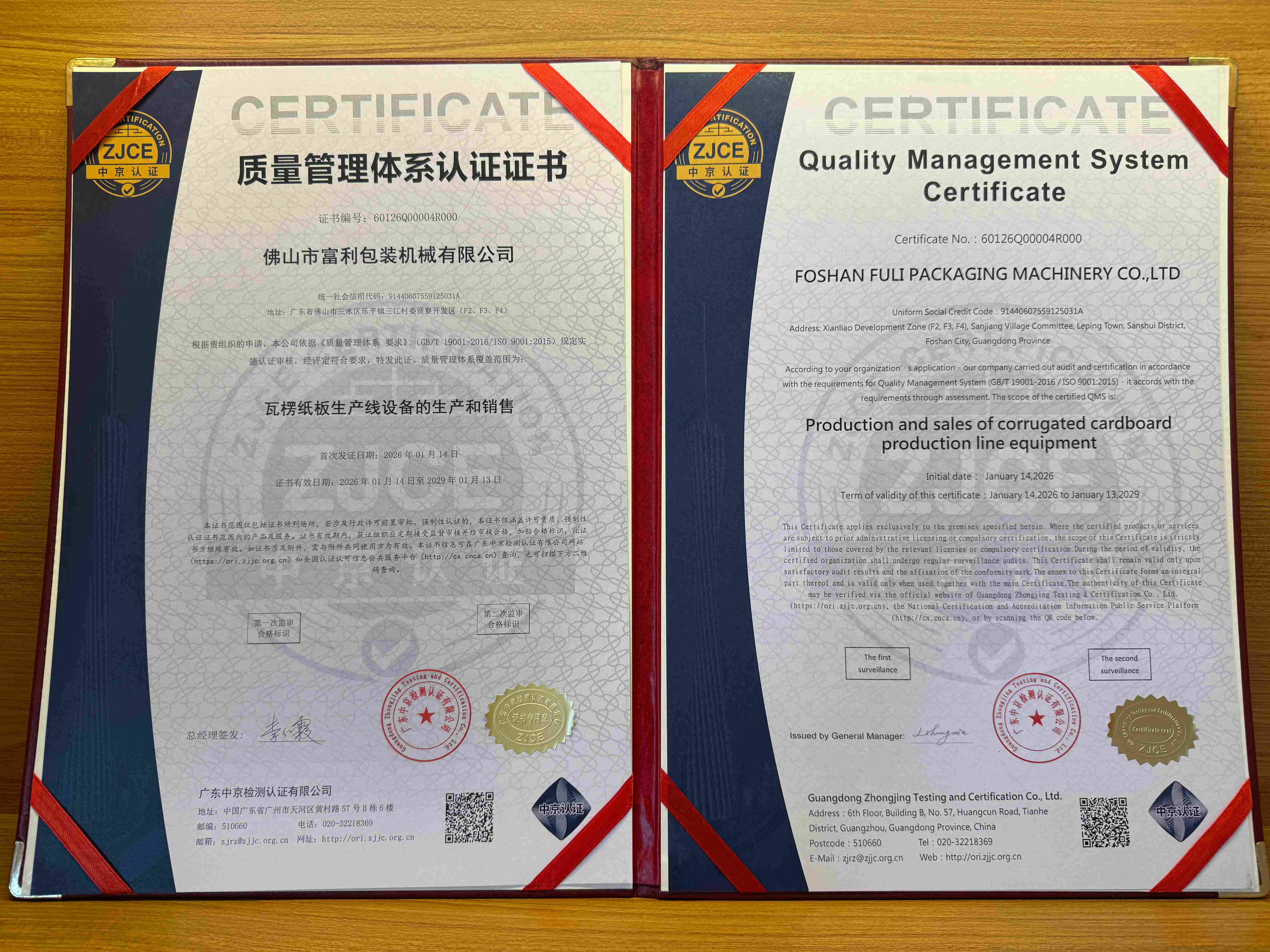
ISO 9001:2015 certification evidence
Line-Level Parameters
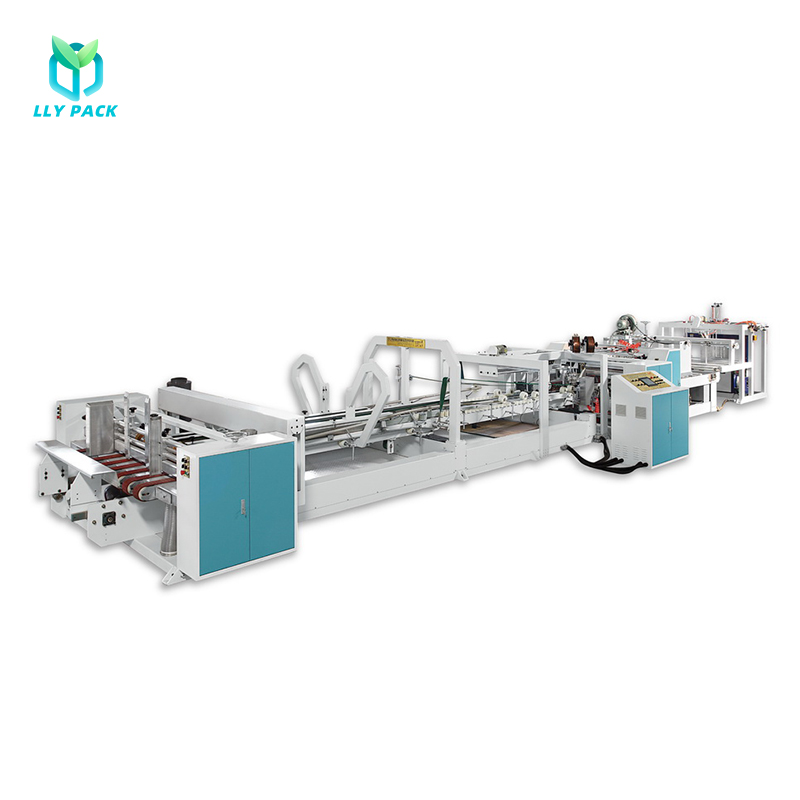
For a complete line, the most important parameters include maximum mechanical speed, production line width, heating method, and required floor space. The CCPL-1 specifies a maximum mechanical speed of 300 meters per minute, a production line width of 1400 to 2800 millimeters, steam heating, and a space requirement of approximately 110 meters in length, 14 meters in width, and 6.5 meters in height. These numbers tell you whether the line can fit your building and meet your output target.
Component-Level Specifications
Because a corrugator line is a system, the performance of each module matters. Key modules include:
- Hydraulic Reel Stand (HRS-1) – supports paper rolls with specifications from 1400mm to 2800mm, handling maximum roll diameters up to 1500mm.
- Auto Splicer (AS-1) – operates at 300–400 m/min and handles paper widths from 1200mm to 2550mm.
- Single Facer (SF-1) – design speed of 250 m/min, with upper and lower flute rolls (corrugating rollers) of 380mm and web sizes from 1400mm to 2300mm.
- Slitter Scorer (SSC-1) – line speed of 630–900 m/min and maximum paper width of 2200mm.
- Flexo Printer (FP-1) – maximum operating speed of 350 sheets/min and a maximum feed size of 1600x3600mm.
- Slotter Die Cutter (SDC-1) – die cutting pressure of 350 tons and a maximum speed of 5000 i.p.h.
- Folder Gluer (FG-1) – maximum gluing speed of 110 m/min.
- Stitching Machine (STM-1) – 450 nails/min.
- Strapping Machine (SM-1) – up to 35 bundles/min with a single strap.
- Waste Paper Baler (WPB-1) – capability of 3–4 tons/hour.
- Carton Testing Instrument (CTI-1) – BST measuring range of 250–5600 kPa.
For plants cutting rolls before lamination, the Paper Reel Slitter (PRC-1) handles paper widths from 2cm to 4m and diameters from 30cm to 1.5m. In addition to machines, operating consumables such as double facer belts can be supplied for the corrugating section.
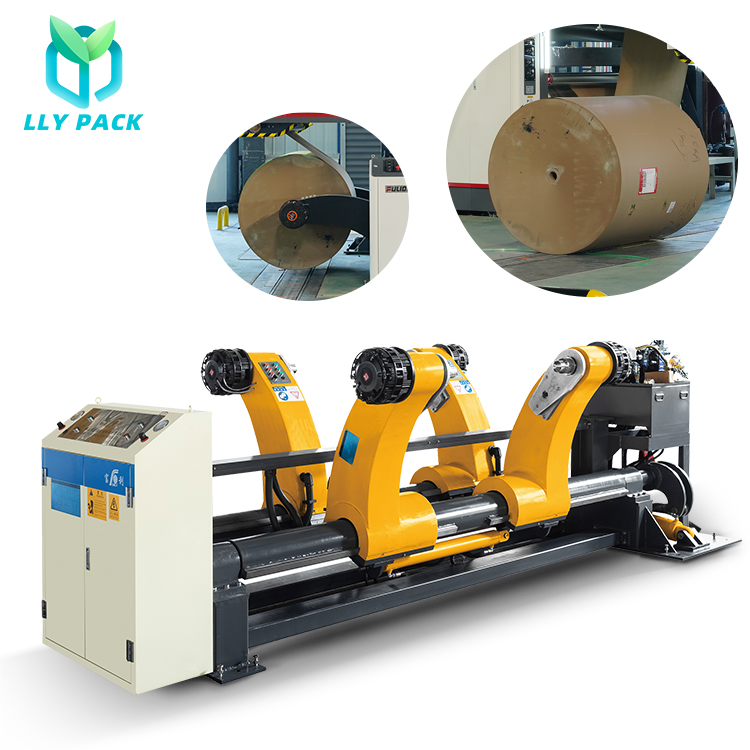
Hydraulic reel stand for the unwinding section
Step-by-Step Evaluation Process
The following process can be used for any corrugated cardboard machine purchase.
Step 1: Define Production Requirements
Define the board width, number of layers, production speed, and finished box types. Every later specification check depends on this definition.
Step 2: Check Line-Level Parameters
Compare line speed, line width, heating requirements, and plant space. For steam-heated lines, check the required steam pressure and boiler capacity—for example, 10 kg/cm² with a boiler selected according to line speed.
Step 3: Inspect Component Modules
Review the specification of each module in the line: unwinding, splicing, corrugating, gluing, slitting, printing, die cutting, folding, stitching, stacking, strapping, and waste handling. Use a checklist similar to the table below.
Step 4: Verify Certifications
Ask for certificates and check the certificate number, standard, issuing body, validity, and market scope.
Step 5: Inspect Manufacturing Capability
Evidence of in-house manufacturing matters. LLY PACK states that its factory is equipped with 4 sets of advanced CNC centers from Japan, and the company holds more than 100 patent rights and certificates from the industry. The manufacturing base in Foshan covers 57,000 square meters, with more than 25 years of experience and exports to over 40 countries.
Step 6: Request Installation References
Ask for examples of complete lines installed for other manufacturers. One documented case involves a corrugated paper carton manufacturer that purchased 9 units over a 10-year period and successfully built a complete corrugated carton production line from scratch with fully automatic production.
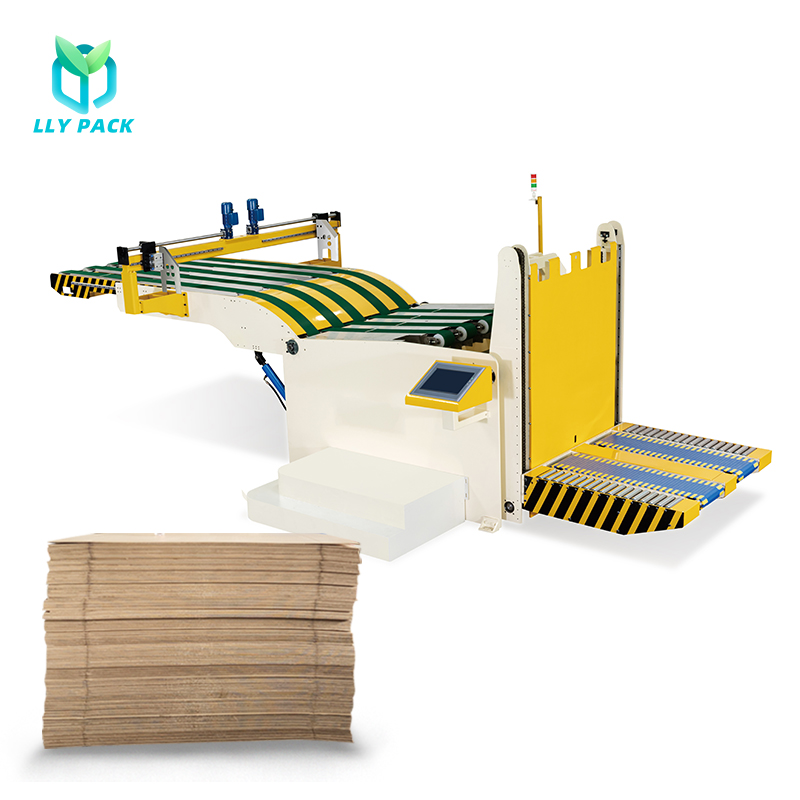
Pre feeder for automatic sheet feeding
Evaluation Checklist: Specs to Request
The following comparison checklist can be used to compare offers from different corrugated cardboard machine suppliers.
| Criterion | What to Verify | Example Evidence |
|---|---|---|
| Quality system | ISO 9001:2015 certificate, certificate number, issuing body | 60126Q00004R000; Guangdong Zhongjing Testing and Certification |
| Line speed | Maximum mechanical speed | 300 m/min (CCPL-1) |
| Line width | Production width range | 1400–2800mm (CCPL-1) |
| Unwinding | Hydraulic reel stand specification | 1400–2800mm; max roll dia 1500mm |
| Splicing | Auto splicer speed and paper width | 300–400 m/min; 1200–2550mm |
| Corrugating | Single facer design speed and flute roll size | 250 m/min; 380mm flute rolls |
| Slitting/scoring | Slitter scorer speed and paper width | 630–900 m/min; max 2200mm |
| Printing | Flexo printer speed and feed size | 350 sheets/min; max 1600x3600mm |
| Die cutting | Die cutting pressure and speed | 350 tons; 5000 i.p.h |
| Folding/gluing | Folder gluer speed | 110 m/min |
| Stitching | Stitching machine speed | 450 nails/min |
| Finishing | Strapping, wrapping, bundling equipment | SM-1 35 bundles/min; WM-1 75 m/min walking speed |
| Waste handling | Waste paper baler capacity | 3–4 tons/hour |
| Quality testing | Carton testing instrument range | BST 250–5600 kPa |
Use Cases
New Plant Built from Scratch
A manufacturer entering the corrugated carton business needs more than a single machine. A complete corrugated cardboard production line should include paper reel conveyors, pre-feeders, a single facer, a slitter scorer, flexo printers, die cutters, folder gluers, stitchers, stackers, strapping machines, and waste handling equipment. The 9-unit installation example shows that a supplier can support this process over many years.
High-Speed and High-Precision Order Mix
Plants serving e-commerce and consumer goods brands need consistent printing quality and high throughput. A flexo printer slotter with 350 sheets/min, a slotter die cutter with 350 tons of pressure, and a folder gluer running at 110 m/min can support mixed order sizes without constant changeovers.
Replacing or Upgrading an Existing Line
If the goal is to raise speed or add multi-layer capacity, component-level specifications matter. A plant can replace an old splicer with an auto splicer rated at 300–400 m/min or add a pre-feeder with a maximum feed speed of 280 sheets/min to increase feeding stability.
FAQ
What certifications should a corrugated cardboard machine have for global export?
For global markets, a supplier should be able to provide ISO 9001:2015 certification with a clear certificate number, issuing body, and validity date. The Corrugated Cardboard Production Line (CCPL-1) from LLY PACK holds ISO 9001:2015 certification under GB/T 19001-2016/ISO 9001:2015, with certification number 60126Q00004R000, applicable globally. For specific board quality requirements, buyers also reference standards such as ISO 3037:2022 and FEFCO GMP.
Can a corrugated cardboard machine be configured to handle different paper widths and speeds?
Most full-line suppliers offer configurable options. As an example, the CCPL-1 production line supports a width range of 1400–2800mm and a maximum mechanical speed of 300 m/min. Component modules also cover different ranges: the Auto Splicer (AS-1) handles paper widths of 1200–2550mm at 300–400 m/min, while the Single Facer (SF-1) has a design speed of 250 m/min and web sizes from 1400–2300mm.
What specifications affect the budget for a corrugated cardboard machine?
Budget depends on the required line width, mechanical speed, number of layers, automation level, and the specific converting modules included. A line with higher speed, wider format, and automatic feeding/stacking will require a different investment than a semi-automatic line. The practical step is to define plant space and target output first, then request a quotation based on the technical configuration.
Can I get a sample or machine demonstration before ordering?
Sample and demonstration policies vary by supplier. For LLY PACK, you can request the company brochure, contact the sales team, and ask for installation references. One documented reference involves a customer that purchased 9 units over 10 years and built a complete production line from scratch, providing practical evidence of the line's reliability.
What is the typical lead time for a complete corrugated cardboard production line?
Lead time depends on the line configuration, component availability, and factory schedule. A supplier should provide a delivery plan after reviewing the project specification. To get an accurate lead time, define the line width, speed, and converting modules, then contact the supplier directly.
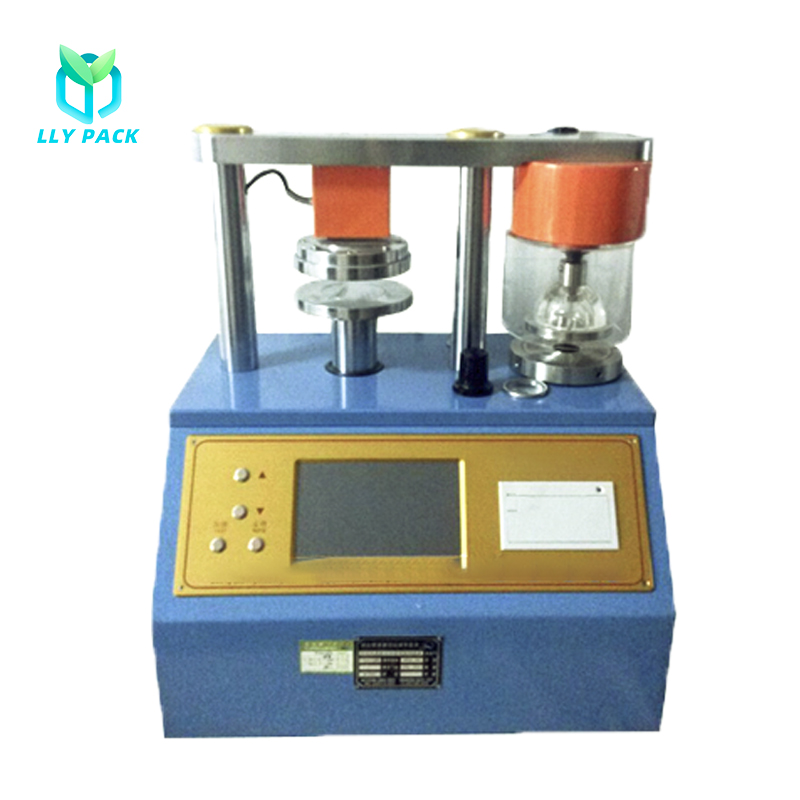
Carton testing instrument for quality verification
Conclusion
A corrugated cardboard machine is a long-term investment. The most reliable purchase decisions are based on documented specifications, certifications, and supplier evidence rather than marketing language. Start with your production requirements, compare line-level and module-level parameters, verify ISO 9001:2015 or other relevant certifications, and ask for installation references. Suppliers such as LLY PACK demonstrate how a full-line manufacturer can provide this evidence.
Need help evaluating a corrugated cardboard machine for your project? Download the LLY PACK brochure for technical details, or contact the team to discuss your line configuration.