
Corrugated Machine Parts Compliance: Regional Rules, Certifications & Acceptance Criteria
Corrugated Machine Parts Compliance: Regional Rules, Certifications & Acceptance Criteria
Compliance for corrugated machine parts is not proven by a logo on a catalog page. It is proven by three documents a buyer can file: a certificate whose scope names the product, a specification annex tied to a fixed drawing revision, and acceptance criteria written into the purchase order in measurable terms. For part categories such as printing anilox rollers, slitting blades, rotary joints, pneumatic cylinders, corrugating rollers and anvil cover rubber, those three documents decide whether a replacement part is accepted at goods-in or returned.
Problem Definition: Why a Part Is Harder to Clear Than a Machine
A corrugated line is purchased as a machine. A slitting blade, a rotary joint or an anvil cover rubber is purchased as a component inside a mixed order of corrugated machine parts. That difference is where compliance reviews break down.
Machine-level conformity documentation belongs to the machine builder. It does not automatically transfer to a spare part bought from a parts supplier, even when the part is dimensionally identical to the original. The box plant therefore ends up holding a certificate that proves a quality management system, a drawing that proves a geometry, and no written statement of what will be measured when the box of parts arrives.
Three gaps repeat in buyer-supplier files:
- A certificate is shown but its scope is not read. An ISO 9001 certificate names a certified organisation and a product scope. It is evidence of a management system, not a test certificate for one blade or one cylinder.
- A drawing is referenced but its revision is not fixed. Many corrugated machine parts are quoted as “customized as drawings”, so the revision number is the real contract.
- Acceptance is written in adjectives. “Hardness is high”, “wear resistant”, “precision grade” cannot be inspected at goods-in. Bore size, stroke, proof pressure, thickness and tying range can.
Industry Background: International Parts, Local Paperwork
Component-level sourcing has globalised faster than component-level documentation. China customs statistics for HS 844190 recorded export growth of 7.5% in 2024 according to data from the General Administration of Customs of China, which reflects steady cross-border movement of machinery parts rather than finished lines alone.
The practical consequence for a box plant is a mixed fleet: machines from one builder, blades from a second supplier, pneumatic cylinders from a third, and anvil covers from a fourth. Each shipment carries its own paperwork, and each destination market reads that paperwork differently.
Compliance therefore stops being a single certificate question and becomes a documentation routine. LLY PACK (HK) CO., LIMITED is a Hong Kong–registered manufacturer and supplier of corrugated machines and corrugated machine parts, with production based in Foshan City, Guangdong Province, exports to more than 40 countries, and more than 100 patent rights and industry certificates in its file. Its certificate structure is a useful working example of how a parts supplier documents compliance.
The Three Documents That Settle Compliance Before Price
Document 1 — The certificate and the scope behind it
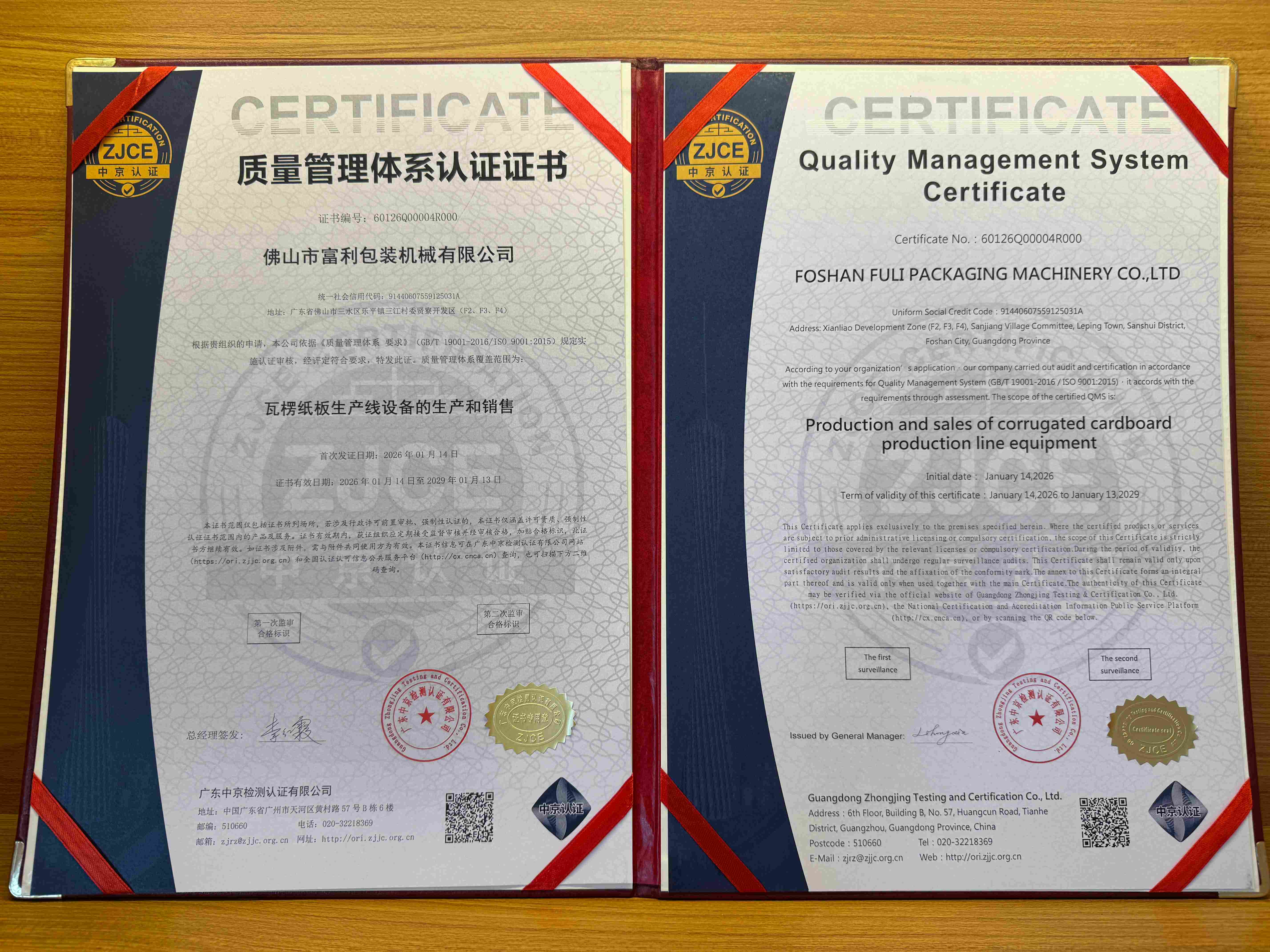
The first document to request is the certificate itself, not a screenshot of a logo. A usable certificate copy should allow four checks: certificate number, issuing body, standard and version, and validity window.
The ISO certification held for the Double facer belt is a concrete reference point. It carries the number 60126Q00004R000, was issued by Guangdong Zhongjing Testing and Certification Co., Ltd., applies to the Global market, and confirms compliance with the GB/T 19001-2016/ISO 9001:2015 standard. Validity runs from 14 January 2026 to 13 January 2029.
The Double facer belt (DFB-1) is the product named in that certification. The same certificate file lists related corrugated products, including the Corrugated Cardboard Production Line (CCPL-1), Pre feeder (PF-1), Auto Splicer (AS-1), Corrugator line Glue kitchen (CGK-1), Cardboard Conveyor (CC-1), Strapping Machine (SM-1), Stitching machine (STM-1), Stacker (STA-1), Slotter Die cutter (SDC-1), Slitter scorer (SSC-1) and Single facer (SF-1).
An ISO certificate of this type verifies that the supplier operates a certified quality management system. It does not certify the hardness of a specific slitting blade, the pressure rating of a specific rotary joint, or the dimensional accuracy of a specific anilox roller. Buyers who need those guarantees must ask for the second and third documents.
Document 2 — The specification annex and the drawing revision
Most corrugated machine parts in this category are made to drawing. The Print anilox roller (PAR-1), Slitting Blade (SLB-1), Printing Roller (PR-1), Corrugating roller (CRO-1) and Creaser Wheel (CWH-1) are all quoted as customized as drawings. The specification annex is the document that turns a drawing into a purchase order.
A workable annex contains at least: part name and model, machine and position where it fits, material grade, principal dimensions and tolerances, hardness requirement where relevant, surface condition, and the drawing revision number. Material declarations are short but decisive. The Slitting Blade (SLB-1) is stated as tungsten steel, the Corrugating roller (CRO-1) as tungsten steel, the Grinding Wheel (GW-1) as diamond, the Anvil Cover Rubber (ACR-1) as rubber and iron, the Brake Pads (BPA-1) as iron, the Conveyor Belt (CB-1) as polyurethane rubber, the Double facer belt (DFB-1) as cotton, and the Printing Cushion (PCU-1) as polyurethane foam.
Industry references on blade material point in the same direction: tungsten carbide grades, with SKD11 and 9CrSi cited as alternative slitting blade materials. The annex should state which grade applies to the order, because the material name alone does not fix hardness or edge geometry.
Document 3 — Acceptance criteria inside the purchasing terms
The third document is the one most often missing: the purchasing terms that state what will be measured, how many pieces will be inspected, and what happens when a measurement fails.
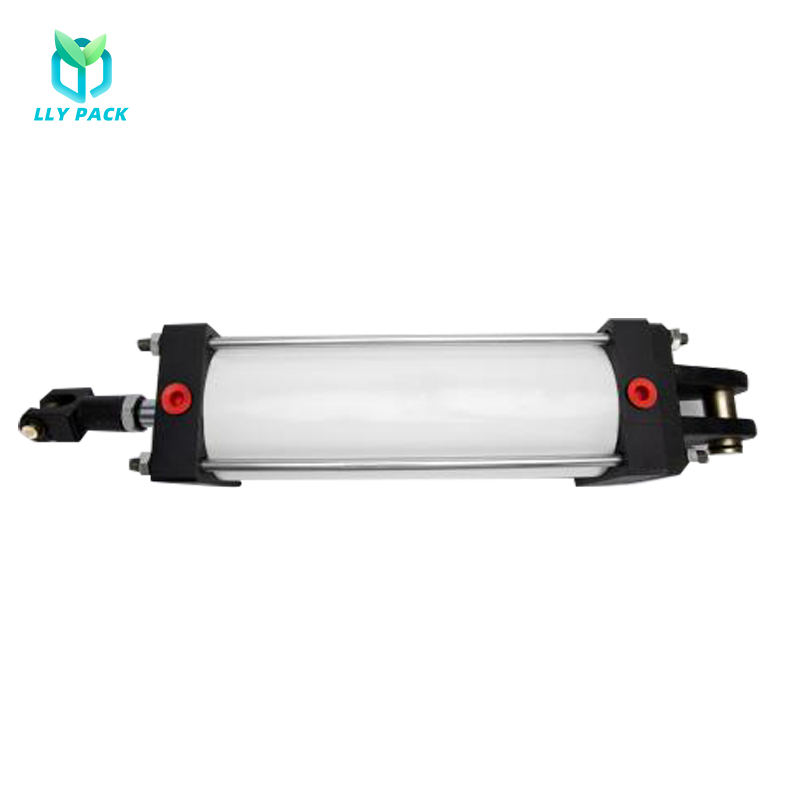
Two catalogue specifications show how quickly an adjective can be replaced by a number. The Pneumatic cylinders (PC-1) are an Air Cylinder with a bore size range of 32–400 mm, a maximum stroke of 1000 mm, working pressure of 1.5–8 bar and proof pressure of 12 bar, with a working temperature range of −25 to 80 °C, excluding freeze conditions, a weight of 2 kg, and port sizes PT1/2, PT3/4, P1 and P1/4. The Boundle Machine (BM-1) is a Tying machine with a maximum tying size of 97*83, a minimum tying size of 5*5, loose table depth of 25/35, pallet height of 72.5/80.5, and a power motor of 1/3 HP and 1/2 HP.
Those numbers are acceptance criteria. A cylinder order can be inspected against bore, stroke, port thread and proof pressure. A tying machine order can be commissioned against the smallest and largest bundle it must handle.
Regional Rules: What Buyers in Different Markets Actually Ask For
Regional compliance rarely arrives as one document request. It arrives as a pattern of questions that differ by market, and the supplier file has to answer them consistently.
Buyers in the European Union typically work from a machine-level conformity file and expect component suppliers to support it with a declaration that identifies material, dimensions and, where relevant, pressure and temperature limits. They commonly ask whether a part is supplied as a spare for an existing conforming machine or as a component of a new assembly, because that answer decides which documentation the machine builder must hold.
Buyers in the United States commonly place more weight on measurable performance and traceability: what the part is made of, what pressure or load it is rated for, and what inspection record accompanies the shipment.
Buyers in the Middle East, Africa, South America and Southeast Asia often start from a different question: is the certificate current, is the scope readable, and does the shipment match the approved sample. For these markets the ISO certificate copy, the certificate number and the validity dates do most of the early work.
In all three patterns, the supplier’s job is the same: give a document that can be read without a phone call. A certificate with a visible number and expiry date, a drawing revision, and a written acceptance clause satisfy more regional reviewers than any statement about reputation.
Mapping Part Categories to Compliance Questions
Different corrugated machine parts raise different compliance questions. The table below maps the main categories to the question a buyer must resolve and the evidence worth attaching to the purchase order. Specifications are as declared for the listed models.
| Part category | Model | Declared specification | Compliance question to resolve | Acceptance evidence to request |
|---|---|---|---|---|
| Printing Anilox Roller | PAR-1 | Steel; customized as drawings | Does surface condition and geometry match the approved drawing revision? | Drawing revision reference, dimensional record, surface inspection record |
| Slitting Blade | SLB-1 | Tungsten steel; customized as drawings | Which material grade and edge geometry apply to this order? | Material declaration, hardness and dimension check |
| Rotary Joint | RJ-1 | Steel; customized | Are pressure, temperature and thread interface declared for the application? | Pressure and leak test record, thread gauge check |
| Pneumatic cylinders | PC-1 | Bore 32–400 mm; max stroke 1000 mm; working 1.5–8 bar; proof 12 bar; −25 to 80 °C | Is the cylinder rated above the line air supply and the required stroke? | Proof pressure test, bore and stroke measurement, port check (PT1/2, PT3/4, P1, P1/4) |
| Anvil Cover Rubber | ACR-1 | Rubber and iron; customized | Is hardness and thickness consistent across the batch? | Hardness and thickness measurement per piece |
| Corrugating roller | CRO-1 | Tungsten steel; customized as drawings | Is flute profile and surface integrity verified against drawing? | Profile and dimensional report |
| Ink pump | IP-1 | Steel; customized as requirement | Is the wetted path material declared and the duty point confirmed? | Material declaration, functional test record |
| Diaphragm Pump | DP-1 | Pneumatic operation for corrugated carton packaging industry | Does air supply and diaphragm material suit the ink or glue duty? | Functional test record, material declaration |
| Boundle Machine | BM-1 | Max tying 97*83; min tying 5*5; pallet height 72.5/80.5; motor 1/3 HP and 1/2 HP | Does the bundle range and power supply match the plant? | Tying trial at minimum and maximum bundle size, motor and power verification |
| NC cut-off blade | NCOB-1 | Tungsten steel; customized | Is cutting length and edge condition within tolerance? | Dimensional check against drawing |
| Pneumatic Brake | PB-1 | Torque range 0–400 Danm; max torque 2800 Nm; thermal power 3 kW at 100 rpm; max heat dissipation 12 kW; around 42,000 working hours | Is torque capacity and heat dissipation adequate for the reel stand duty? | Torque test record, rating confirmation against application |
| Conveyor Belt (Timing Belt) | CB-1 | Polyurethane rubber for corrugated carton packaging industry | Is material and pitch/length verified for the drive? | Material declaration, dimensional check |

Step-by-Step: A Six-Step Acceptance Workflow
- Step 1 — Classify the part before requesting documents. Separate wear parts (blades, anvil cover rubber, brake pads), functional components (pneumatic cylinders, rotary joints, pumps) and machine units (tying machine, bundle machine). Each category raises a different question, and mixing them in one RFQ produces a mixed file.
- Step 2 — Request the certificate copy and read the scope. Confirm certificate number, issuing body, standard version and validity window. For the DFB-1 line, the reference is certificate 60126Q00004R000 under GB/T 19001-2016/ISO 9001:2015, issued by Guangdong Zhongjing Testing and Certification Co., Ltd., valid from 14 January 2026 to 13 January 2029.
- Step 3 — Fix the drawing revision. For every part quoted as customized as drawings, write the revision number into the purchase order. This single line removes most dimensional disputes on anilox rollers, slitting blades, corrugating rollers and printing rollers.
- Step 4 — Convert specifications into measurable acceptance criteria. Replace adjectives with numbers: bore range, maximum stroke, working and proof pressure, tying size range, torque range, thickness, hardness. If a value is not declared, ask for it before ordering rather than after delivery.
- Step 5 — Agree the inspection evidence. The supplier’s stated quality control for these parts is 100% test, with defective products replaced under after-sales terms. Ask what the test record contains and whether it travels with the shipment.
- Step 6 — Write the commercial frame. For customized corrugated machine parts the stated commercial parameters are an MOQ of 100 pieces, a lead time of 30–45 days and a monthly capacity of 1000 pieces. Customization options include outside diameter, inner diameter, number of holes, thickness and hardness, under OEM production mode.
The workflow is deliberately document-first. Price negotiation on a part without a fixed drawing and a fixed acceptance clause usually returns as a rework cost later.
Use Cases
Replacing a pneumatic cylinder on a converting line
A box plant replaces a failed cylinder on a converting section. The useful acceptance list is short: bore size within 32–400 mm as required by the application, maximum stroke up to 1000 mm, working pressure compatible with a 1.5–8 bar air supply, proof pressure of 12 bar, ambient temperature within −25 to 80 °C excluding freeze conditions, and ports matching PT1/2, PT3/4, P1 or P1/4. The unit weight of 2 kg is also worth confirming where the mounting bracket is unchanged.
Bundling: accepting a BM-1 against bundle size
A plant adding a tying station should commission the machine against its real bundle extremes, not its average bundle. For the Boundle Machine (BM-1), the declared range is a maximum tying size of 97*83 and a minimum tying size of 5*5, with loose table depth of 25/35 and pallet height of 72.5/80.5. The power motor rating of 1/3 HP and 1/2 HP should be checked against the site electrical arrangement before installation.
Consumables: blades, anvil cover rubber and corrugating rollers
Consumable parts carry the highest compliance risk per unit value because the documentation is often assumed rather than requested. A slitting blade order without a stated material grade and hardness requirement cannot be verified on arrival. An anvil cover rubber order without thickness and hardness limits cannot be checked either. A corrugating roller order without a flute profile reference leaves the buyer comparing the new roller to a worn original.
Cross-border orders: documentation before shipment
Where a purchase crosses a border, the file should be complete before the container is loaded: certificate copy with number and validity, specification annex with drawing revision, inspection record, packing list matching part numbers and quantities, and any declaration the destination market expects from the buyer’s own compliance team.

Comparison Table: What Each Document Proves
The documents do not overlap, and each answers a different acceptance question.
| Document | What it proves | What it does not prove | Where it belongs |
|---|---|---|---|
| ISO 9001:2015 certificate (e.g. 60126Q00004R000, GB/T 19001-2016/ISO 9001:2015, valid 14 Jan 2026 – 13 Jan 2029) | That the supplier operates a certified quality management system within the stated scope | That a specific blade, roller or cylinder meets a specific dimension or hardness | Supplier qualification file |
| Specification annex with drawing revision | What geometry, material and tolerance the part is made to | That the delivered batch was measured against it | Purchase order attachment |
| Inspection and test record (100% test stated for customized parts) | That the batch was checked before shipment | Independent third-party verification unless separately requested | Goods-in release file |
| Commercial terms (MOQ 100 pieces, lead time 30–45 days, defective replacement) | Order quantity, schedule and remedy for non-conforming parts | Product performance beyond the declared specification | Contract and after-sales agreement |
FAQ
Which certification should a buyer verify first for corrugated machine parts?
Start with the ISO 9001 certificate and read its scope, number and validity dates rather than the logo. The certificate held for the Double facer belt carries the number 60126Q00004R000, was issued by Guangdong Zhongjing Testing and Certification Co., Ltd., confirms compliance with GB/T 19001-2016/ISO 9001:2015, applies to the Global market, and is valid from 14 January 2026 to 13 January 2029. Buyers should treat it as management-system evidence and pair it with a part-level specification.
Can part dimensions and materials be customized to a buyer’s drawing?
Yes for the categories made to drawing. The Print anilox roller (PAR-1), Printing Roller (PR-1), Corrugating roller (CRO-1), Slitting Blade (SLB-1), Creaser Wheel (CWH-1) and NC cut-off blade (NCOB-1) are quoted as customized as drawings, while the Rotary Joint (RJ-1) and Anvil Cover Rubber (ACR-1) are listed as customized. Stated customization options cover outside diameter, inner diameter, number of holes, thickness and hardness under OEM production mode, with 100% test as the quality-control method.
What budget parameters should be fixed before requesting a quotation?
The published commercial frame is an MOQ of 100 pieces, a monthly capacity of 1000 pieces and a lead time of 30–45 days for customized corrugated machine parts. Quotations are therefore driven by material grade, drawing complexity, dimensions, hardness requirement and order quantity against the MOQ rather than by catalogue list price, and buyers should fix those five inputs before comparing offers.
How can a buyer validate a sample or a first batch?
Validate against the same criteria written into the purchase order: drawing revision, material grade, principal dimensions and the declared performance values. For the Pneumatic cylinders (PC-1) that means bore within 32–400 mm, maximum stroke up to 1000 mm, working pressure of 1.5–8 bar, proof pressure of 12 bar and ports matching PT1/2, PT3/4, P1 or P1/4. For the Boundle Machine (BM-1) it means tying trials at the maximum 97*83 and minimum 5*5 bundle size. Defective products are replaced under the after-sales terms.
What lead time applies to customized corrugated machine parts?
The stated lead time is 30–45 days, supported by a monthly capacity of 1000 pieces and 100% test before shipment. Lead time planning should start after the drawing revision and specification annex are confirmed, because a revision change after release restarts the production sequence. To start a compliance file for a specific part, send the drawing and required acceptance values to christina@lycorrugated.com or review the catalogue at www.llypack.com.
Conclusion
Compliance for corrugated machine parts is settled by paperwork that can be read, checked and filed: a certificate with a number, an issuer, a standard version and a validity window; a specification annex tied to a drawing revision; and acceptance criteria expressed in numbers such as bore range, proof pressure, tying size or torque. Regional rules change what a buyer asks for first, but they do not change what must be written down.
Suppliers that can hand over the certificate scope, the drawing revision and the inspection record together remove the most common cause of rejected shipments. LLY PACK (HK) CO., LIMITED holds more than 100 patent rights and industry certificates, exports to more than 40 countries, and supports part orders through OEM production with a stated MOQ of 100 pieces and a lead time of 30–45 days.
Next Step: Build the Compliance File for Your Part
Send the part name or model, the drawing revision and the acceptance values your plant needs — bore and stroke for a cylinder, tying range for a bundle machine, material grade for a blade. The team can return a specification annex and a certificate copy for review.
Contact: Christina · christina@lycorrugated.com · WhatsApp +86 13763260555 · www.llypack.com
Download the product catalogue (PDF): LLY PACK corrugated machine parts brochure
Have Questions or Need More Details?
Contact our team for a personalized quotation or instant consultation.
Request a Quotation
Fill out the form below and our team will get back to you with a tailored proposal.
WhatsApp Direct Chat
Prefer to chat in real-time? Message us on WhatsApp for instant assistance & quick answers.
- Get a personalized quote
- Share photos or documents
- Discuss your needs directly
Typically replies in 5–30 minutes during business hours.