
Brass Valve Certifications by Product Type: NSF 61/372, AB1953, and ASSE 1061 Compliance Map
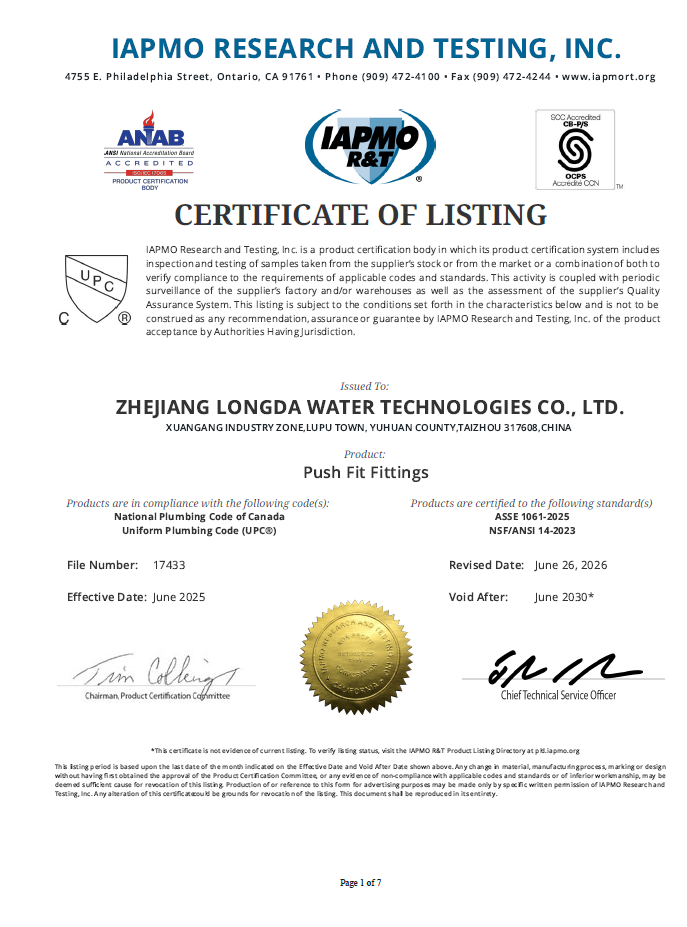
IAPMO cUPC listing 17433 for push-fit fittings, issued against ASSE 1061-2025 and NSF/ANSI 14-2023 for the USA and Canada (valid 2025-06-01 to 2030-06-01).
Short answer: no single certificate covers a brass valve. Compliance is a stack of documents, and the stack changes with the valve family and with the connection. In North America, the lead content of wetted surfaces is addressed by NSF/ANSI/CAN 372 together with the federal Safe Drinking Water Act and California AB1953; the health effects of materials in contact with drinking water are addressed separately by NSF/ANSI/CAN 61; product performance is addressed by a cUPC or UPC listing against the standard for that product family; and the connection itself — push-fit, press, PEX cold expansion, PEX crimp ring or threaded — carries its own standard, such as ASSE 1061, IAPMO/ANSI/CAN Z1117 or ASTM F1960.
Zhejiang Longda Technology Co., Ltd. — trading as LONGDA BRASS VALVE — is a brass valve and brass fitting manufacturer established in 1993 in the Xuangang Industry Zone, Lupu Town, Yuhuan County, Zhejiang Province, China, exporting about 95% of output to the EU, USA, Canada and South America. Its IAPMO listing set is a practical example of how the map is actually built, because the certificates split by scope rather than by catalogue page: certificate 6304 covers lead-free plumbing products, certificate N-5775 covers drinking water system components, certificate 5775 covers plumbing fixture fittings, certificate 5938 covers ball valves, and certificates 17432, 17433, 10232 and 8222 cover press, push-fit, PEX cold expansion and PEX crimp-ring connections respectively.
The compliance problem: four different questions asked of one brass body
Most sourcing errors in this category come from treating certification as a single attribute. A brass valve answers at least four separate questions, and each question has its own issuing body, its own scope statement and its own expiry date.
- Question 1 — Lead content. How much lead is in the alloy that touches the water? This is a materials question, answered by NSF/ANSI/CAN 372 and by the statutory limits behind it.
- Question 2 — Health effects. Do the materials in contact with drinking water leach anything at a level of concern? This is a toxicological question, answered by NSF/ANSI/CAN 61.
- Question 3 — Product performance. Does this specific product type function as the plumbing code requires? This is answered by a cUPC or UPC listing measured against the standard for that family — ASME A112.18.1/CSA B125.1 for fixture fittings, IAPMO/ANSI Z1157 for ball valves, for example.
- Question 4 — Connection integrity. Does the joint hold? This is answered by the connection standard: ASSE 1061 for push-fit, ASTM F1960 for PEX-A cold expansion, IAPMO/ANSI/CAN Z1117 for press.
Three misreadings appear repeatedly in purchase orders. The first is assuming that NSF/ANSI/CAN 372 certification makes a valve legal for potable water — it addresses lead content only, not health effects and not product performance. The second is assuming that a cUPC listing on a fixture fitting also covers the lead-free status of a gate valve in the same shipment; in the LONGDA set those are separate documents with separate scopes and separate validity windows. The third is applying a push-fit connection standard such as ASSE 1061 to a threaded valve, where the relevant reference is the thread standard — ASME B1.20.1 for NPT, or ISO 228-1 for BSP threads where pressure-tight joints are not made on the threads.
Industry background: why the lead-free layer now leads the map
Lead-free brass alloys have moved from a premium option to the mandatory baseline for potable water applications in the United States, under the Safe Drinking Water Act. The requirement is not a marketing preference; it is a statutory condition of sale, and it propagates through every downstream document — the alloy purchase specification, the material test report, the listing certificate and the retail packaging claim.
The commercial weight behind that rule is significant. Dataintelo values the global brass valves market at USD 14.8 billion in 2025, projecting USD 24.1 billion by 2034 at a CAGR of 5.6%, and attributes approximately 26.1% of 2025 revenue to North America — the region where the lead-free and cUPC layers bite hardest. Ball valves alone held the largest product-type share at 38.4% in 2025, which matters for compliance planning because ball valves carry both a lead-free document and a family-specific performance listing.
The regulatory logic also differs by market. The United States combines a federal lead-free statute with state-level rules such as California Health & Safety Code Section 116875 (AB1953) and with plumbing code acceptance through UPC. Canada layers the National Plumbing Code of Canada and CSA standards onto the same product. Mexico adds NOM certification as a separate national requirement. A supplier who can only speak in terms of one of those three regimes is not yet able to support a North American distributor programme.
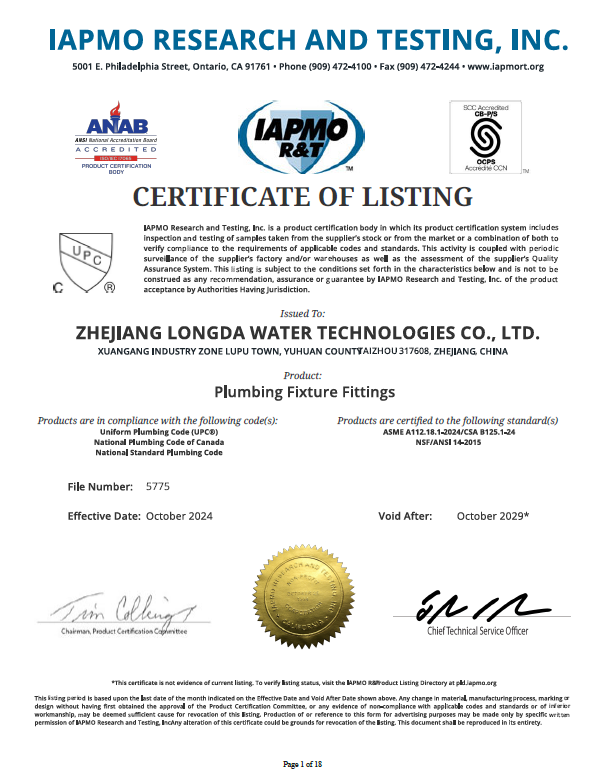
cUPC listing 5775 covers plumbing fixture fittings, including the brass supply stop valve 98023-LF, against ASME A112.18.1-2024 / CSA B125.1-24 and NSF/ANSI 14-2015.
The compliance map: which certificate applies to which brass valve family
Layer 1 — Lead-free: NSF/ANSI/CAN 372, SDWA Section 1417(d) and AB1953
The lead-free layer sets a numeric limit on the wetted surface: lead content must not exceed 0.25%. That figure is the anchor for the whole North American map, and it is referenced to three instruments at once — NSF/ANSI/CAN 372-2024 as the test and certification standard, Section 1417(d) of the Safe Drinking Water Act as the federal basis, and California Health & Safety Code Section 116875 as the state basis behind AB1953.
LONGDA holds IAPMO Certificate of Listing 6304 under the scope “Lead Free Plumbing Products”, issued 2024-08-01 and valid to 2028-08-01. The products named on that certificate are the brass gate valve T-22017A, the brass Y strainer LD.73154, the brass check valve LD 30303, the brass ball valve 8081, the brass supply stop valve 98023-LF and the brass fitting 15111. Read that list carefully: the lead-free document is written at material level, so it covers a spread of valve families and a fitting, but it says nothing about whether a gate valve seats, a check valve closes against reverse flow, or a Y strainer screens debris. Those are separate questions with separate answers.
Layer 2 — Health effects: NSF/ANSI/CAN 61
NSF/ANSI/CAN 61-2023 addresses the health effects of drinking water system components. It is the layer buyers most often confuse with the lead-free layer, and the confusion is costly because the two certificates ask different things. A low-lead alloy can still fail health-effects evaluation if other alloying elements or wetted materials leach above the permitted level; conversely, passing health-effects evaluation does not by itself document the 0.25% wetted-surface lead figure.
IAPMO Certificate of Listing N-5775 covers LONGDA drinking water system components under NSF/ANSI/CAN 61-2023, issued 2024-10-01 and valid to 2029-10-01. Its product scope mirrors the lead-free certificate — gate valve T-22017A, Y strainer LD.73154, brass fitting 15111, check valve LD 30303, ball valve 8081 and supply stop valve 98023-LF. The symmetry is deliberate: for a potable-water valve family, the lead-free document and the health-effects document should name the same models, or the compliance story has a gap.
Layer 3 — Product performance: cUPC and UPC listings by family
This is where the map stops being generic and starts being product-specific. Each family is measured against the standard written for it, and the scope wording on the certificate is what a plumbing inspector, a retailer's quality team or a distributor's compliance officer will actually read.
- Fixture fittings and supply stops. cUPC listing 5775 covers “Plumbing Fixture Fittings” against ASME A112.18.1-2024 / CSA B125.1-24 and NSF/ANSI 14-2015, valid 2024-10-01 to 2029-10-01. This is the document that sits behind the brass supply stop valve 98023-LF used on fixture supply lines.
- Ball valves. UPC listing 5938 covers “Ball Valves” against IAPMO/ANSI Z1157-2014e1(R2019), ASME A112.4.14-2022 and CSA B125.14-22, valid 2024-03-01 to 2029-03-01. The brass ball valve 8081 therefore appears on three documents — 5938 for performance, N-5775 for health effects, 6304 for lead-free — which is what a fully mapped ball valve looks like.
- PEX crimp-ring fittings. UPC listing 8222 covers metal insert fittings utilising a copper or copper alloy crimp ring for SDR 9 PEX tubing, against ASTM F1807-2023, CSA B137.5-2020 and NSF/ANSI 14-2023, valid 2024-10-01 to 2029-09-30, and references both the Uniform Plumbing Code and the National Plumbing Code of Canada.
- PEX cold expansion fittings. cUPC listing 10232 covers cold expansion fittings with PEX reinforcing ring against ASTM F1960-2024 and CSA B137.5-2023, plus NSF/ANSI 14-2023, valid 2024-12-01 to 2029-12-01.
- Press connections. cUPC listing 17432 covers press connections against IAPMO/ANSI/CAN Z1117-2022, valid 2025-06-01 to 2030-06-01.
- Push-fit connections. cUPC listing 17433 covers push-fit fittings against ASSE 1061-2025 and NSF/ANSI 14-2023, valid 2025-06-01 to 2030-06-01.
Layer 4 — Connection standards: ASSE 1061, ASTM F1960, Z1117, NPT and BSP
A brass valve is only as compliant as its joint. ASSE 1061-2025 is the performance reference for push-fit connections and appears on cUPC listing 17433. ASTM F1960-2024, read together with CSA B137.5-2023, governs PEX cold expansion connections and appears on listing 10232; in that joint the pipe end is expanded, the fitting is inserted, and the reinforcing ring contracts to form a permanent connection without reducing the pipe inner diameter. IAPMO/ANSI/CAN Z1117-2022 governs press connections and appears on listing 17432. For PEX crimp-ring joints, ASTM F1807-2023 is the reference on listing 8222.
Threaded ends follow a different logic. NPT threads are dimensioned to ASME B1.20.1, and because thread geometry decides whether a tapered joint seals, thread condition is a compliance issue as much as an installation issue — LONGDA inspects threads with a thread gauge on every lot. BSP threads are governed by ISO 228-1, which covers threads where pressure-tight joints are not made on the threads; the seal is made on an elastomer or gasket face, not on the thread flanks. Specifying NPT where BSP is standard, or the reverse, produces a leak that no certificate can rescue.
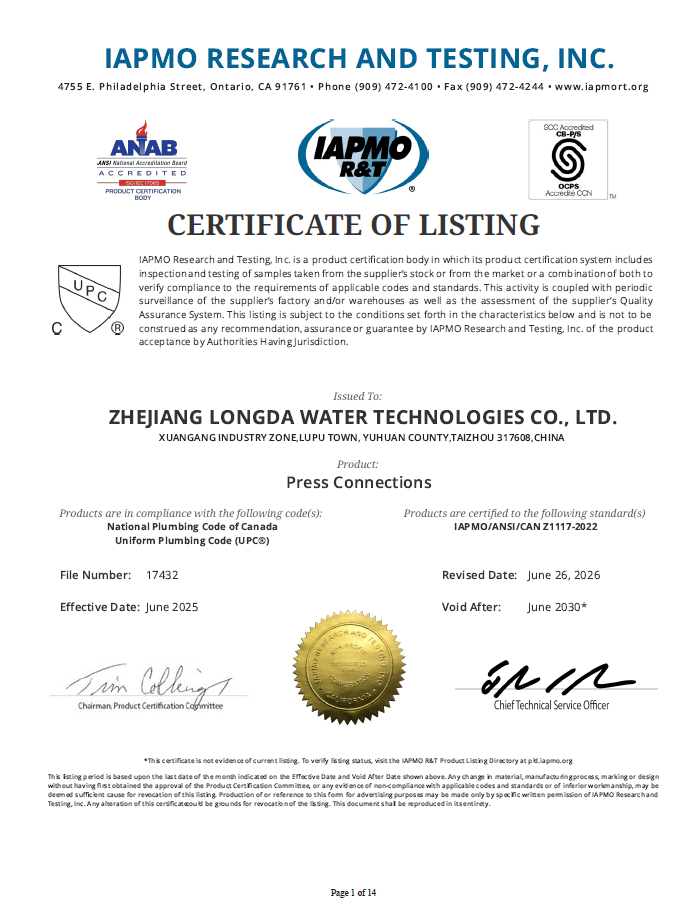
cUPC listing 17432 covers press connections against IAPMO/ANSI/CAN Z1117-2022 for the USA and Canada.
Ranked: brass valve families by documentation load
Ranked by the number of separate listing documents that must line up before a shipment is audit-ready — based on the certificate set described in this article — the families fall into this order. The ranking is a procurement planning tool, not a quality hierarchy: a gate valve with two documents is not a worse valve than a supply stop with three, it simply answers fewer listing questions.
- Brass supply stop / angle valve (98023-LF). Three listings — cUPC 5775, N-5775, 6304 — plus the fixture-fitting standard ASME A112.18.1/CSA B125.1. The heaviest documentation load in the set because a fixture stop is simultaneously a potable-water component and a plumbing fixture fitting.
- Brass ball valve (8081). Three listings — UPC 5938, N-5775, 6304 — with IAPMO/ANSI Z1157, ASME A112.4.14 and CSA B125.14 named on the performance document.
- PEX and press connection products (10232, 17432, 17433, 8222). A connection listing plus the lead-free and health-effects documents for the brass body; the connection standard itself (F1960, Z1117, ASSE 1061, F1807) is the deciding line.
- Brass gate valve, Y strainer and check valve (T-22017A, LD.73154, LD 30303). Two listings — N-5775 and 6304 — covering potable-water suitability. Performance expectations for these families are usually set by the buyer's own specification, since no family-specific cUPC listing is named for them in this certificate set.
- Management-system certificates (ISO 9001:2015, ISO 14001:2015). Ranked last for a reason: they describe the factory, not the product. ISO 9001 certificate CN00124Q37399R2M/3300 is valid to 2027-09-06 and ISO 14001 certificate CN00124E33461R2M/3300 to 2027-09-09, both issued by the China Quality Certification Centre. They support a supplier audit; they do not replace a product listing.
Regional variation: US, Canada and Mexico
The layers stay the same across North America, but the acceptance route changes. In the United States, a potable-water valve needs the lead-free layer (federal statute, plus AB1953 for California) and the health-effects layer, and is accepted into plumbing work through UPC listings; ASME A112.18.1/CSA B125.1 is the fixture-fitting reference. In Canada, the same lead-free and health-effects documents apply, with the National Plumbing Code of Canada and CSA standards named alongside UPC on the connection and fitting listings — CSA B125.1-24 for fixture fittings, CSA B137.5-2023 for PEX cold expansion, CSA B137.5-2020 for crimp-ring fittings, CSA B125.14-22 for ball valves, and IAPMO/ANSI/CAN Z1117-2022 for press. In Mexico, NOM certification is a separate national requirement and is not satisfied by a cUPC listing alone.
For contrast, the European route diverges at the standard level: brass gas valves are referenced to EN 331:2015, and manually operated copper alloy ball valves for drinking water supply to EN 13828:2003. A supplier serving both North America and the EU is therefore maintaining two parallel documentation systems, which is why a single “CE and cUPC” claim on a quotation should always be broken down into named standards.
Step-by-step: verifying the map for a specific purchase order
Six checks turn the compliance map into a decision. Each one produces a document or a written answer that can be filed with the PO.
- Fix the family and the wetted parts. Decide whether the item is a fixture fitting, a ball valve, a gate valve, a Y strainer, a check valve or a connection fitting. The family determines which performance standard applies; the wetted-part list determines whether the lead-free and health-effects layers are triggered at all.
- List the layers, not the logos. For a potable-water supply stop in the US, that means NSF/ANSI/CAN 372, NSF/ANSI/CAN 61, ASME A112.18.1/CSA B125.1, plus the connection standard if the outlet is push-fit, press or PEX.
- Collect certificate number, authority, scope and validity. On the LONGDA set that is IAPMO as authority, scope wording such as “Lead Free Plumbing Products” or “Push Fit Fittings”, and validity windows ranging from 2027 to 2030 depending on the document. A certificate with no scope statement cannot be matched to a model.
- Match the scope wording to the SKU. “Plumbing Fixture Fittings” on listing 5775 does not extend to a ball valve; “Ball Valves” on listing 5938 does not extend to a Y strainer. Cross-check the model number against the product list on each certificate.
- Confirm the thread standard in writing. NPT to ASME B1.20.1, BSP to ISO 228-1, with the thread type printed on the PO and on the carton, since thread mix-ups survive inspection and fail on site.
- Confirm the test regime behind the certificate. A listing describes a type test; shipment quality depends on production testing. LONGDA states 100% air pressure testing under water, 100% pressure testing before shipment, a material test report, and thread gauge inspection on every lot.
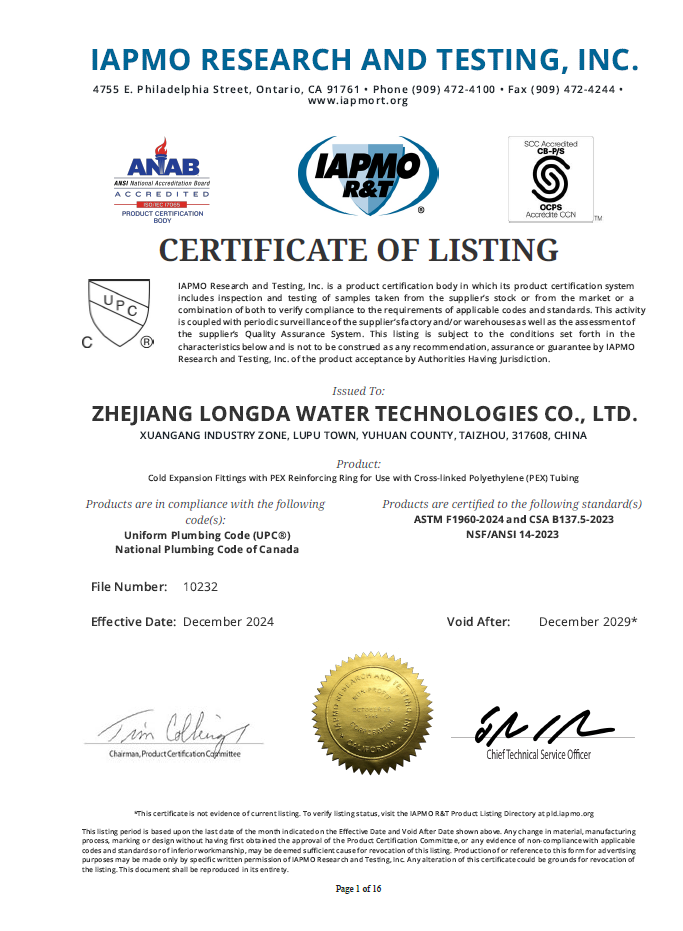
cUPC listing 10232 covers cold expansion fittings with PEX reinforcing ring against ASTM F1960-2024 and CSA B137.5-2023.
Use cases: where the map changes the buying decision
Residential fixture supply lines in the US and Canada
A US manufacturer and a Canadian wholesale distributor have used the brass supply stop valve 98023-LF for bathroom and kitchen fixture shut-off in residential plumbing, at volumes of 8,000,000 pieces per year and 70,000,000 pieces respectively, over three years in each market. The recorded outcome is zero leakage complaints, a 100% pass rate in retail quality audit and monthly repeat orders. The compliance content of that case is specific: cUPC and NSF 61 certification, lead-free brass suitable for potable water, chrome-plated corrosion resistance, quarter-turn operation and retail packaging. The certification map is what made the retail audit pass possible; the valve performance is what kept the repeat orders running.
PEX-A branch lines and whole-house repiping
For PEX-A plumbing, the deciding document is the connection listing, not the valve body certificate. A cold expansion connection to ASTM F1960 is covered by cUPC 10232, with CSA B137.5-2023 alongside it for Canada, and the lead-free and health-effects layers applied to the brass body through 6304 and N-5775. Where the specification calls for a push-fit transition instead, ASSE 1061-2025 on listing 17433 is the reference and applies to the push-fit fitting, not to a threaded valve on the same job.
Multi-family and hospitality fit-out programmes
Projects with hundreds of identical wet walls convert the certification map into a packaging and logistics question. Supply stops behind fixtures sit in confined, humid spaces and are operated frequently; the relevant specifications are lead-free brass with wetted-surface lead at or below 0.25%, NSF 61 and NSF 372 listing, cUPC listing to ASME A112.18.1/CSA B125.1, chrome-plated finish, and NPT with compression, F1807 PEX, F1960 expansion, CPVC, press, push-fit or solder connections depending on the piping system on site. For Mexico the same specification gains a NOM requirement.
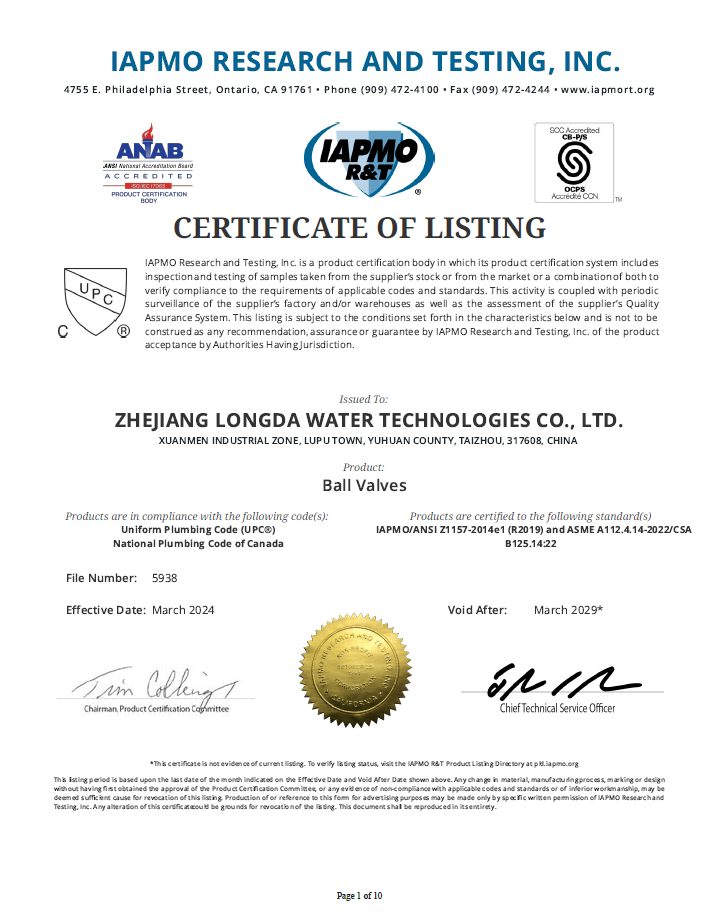
UPC listing 5938 covers ball valves against IAPMO/ANSI Z1157-2014e1(R2019), ASME A112.4.14-2022 and CSA B125.14-22.
Compliance map comparison table
| Brass valve / fitting family (model) | Lead-free listing | NSF 61 listing | Performance / connection listing | Market |
|---|---|---|---|---|
| Brass gate valve (T-22017A) | 6304 — NSF/ANSI/CAN 372-2024 | N-5775 — NSF/ANSI/CAN 61-2023 | Not named on this certificate set | USA & Canada |
| Brass Y strainer (LD.73154) | 6304 | N-5775 | Not named on this certificate set | USA & Canada |
| Brass check valve (LD 30303) | 6304 | N-5775 | Not named on this certificate set | USA & Canada |
| Brass ball valve (8081) | 6304 | N-5775 | UPC 5938 — IAPMO/ANSI Z1157, ASME A112.4.14, CSA B125.14 | USA & Canada |
| Brass supply stop / angle valve (98023-LF) | 6304 | N-5775 | cUPC 5775 — ASME A112.18.1-2024 / CSA B125.1-24, NSF/ANSI 14-2015 | USA & Canada |
| Brass fitting (15111), PEX crimp ring | 6304 | N-5775 | UPC 8222 — ASTM F1807-2023, CSA B137.5-2020, NSF/ANSI 14-2023 | USA & Canada |
| PEX cold expansion fitting | 6304 (brass body) | N-5775 (brass body) | cUPC 10232 — ASTM F1960-2024, CSA B137.5-2023 | USA & Canada |
| Press connection | 6304 (brass body) | N-5775 (brass body) | cUPC 17432 — IAPMO/ANSI/CAN Z1117-2022 | USA & Canada |
| Push-fit connection | 6304 (brass body) | N-5775 (brass body) | cUPC 17433 — ASSE 1061-2025, NSF/ANSI 14-2023 | USA & Canada |
All listing numbers, standards and market scopes as stated on the IAPMO certificates referenced in this article. Validity: 6304 to 2028-08-01; N-5775 and 5775 to 2029-10-01; 5938 to 2029-03-01; 8222 to 2029-09-30; 10232 to 2029-12-01; 17432 and 17433 to 2030-06-01.
Connection standard reference
| Connection type | Governing standard | Listing evidence | What the buyer should confirm |
|---|---|---|---|
| Push-fit | ASSE 1061-2025 | cUPC 17433 | Scope wording states push-fit fittings, not a valve family |
| Press | IAPMO/ANSI/CAN Z1117-2022 | cUPC 17432 | Press tool compatibility and jaw profile |
| PEX-A cold expansion | ASTM F1960-2024, CSA B137.5-2023 | cUPC 10232 | Reinforcing ring supplied with the fitting |
| PEX crimp ring | ASTM F1807-2023, CSA B137.5-2020 | UPC 8222 | SDR 9 tubing compatibility |
| NPT threaded | ASME B1.20.1 | Thread gauge inspection per lot | Thread type printed on PO and carton |
| BSP threaded | ISO 228-1 | Specified per order | Seal made on face or gasket, not on thread flanks |
Connection standards as applied in the certificate set and in the thread specification practice described above.
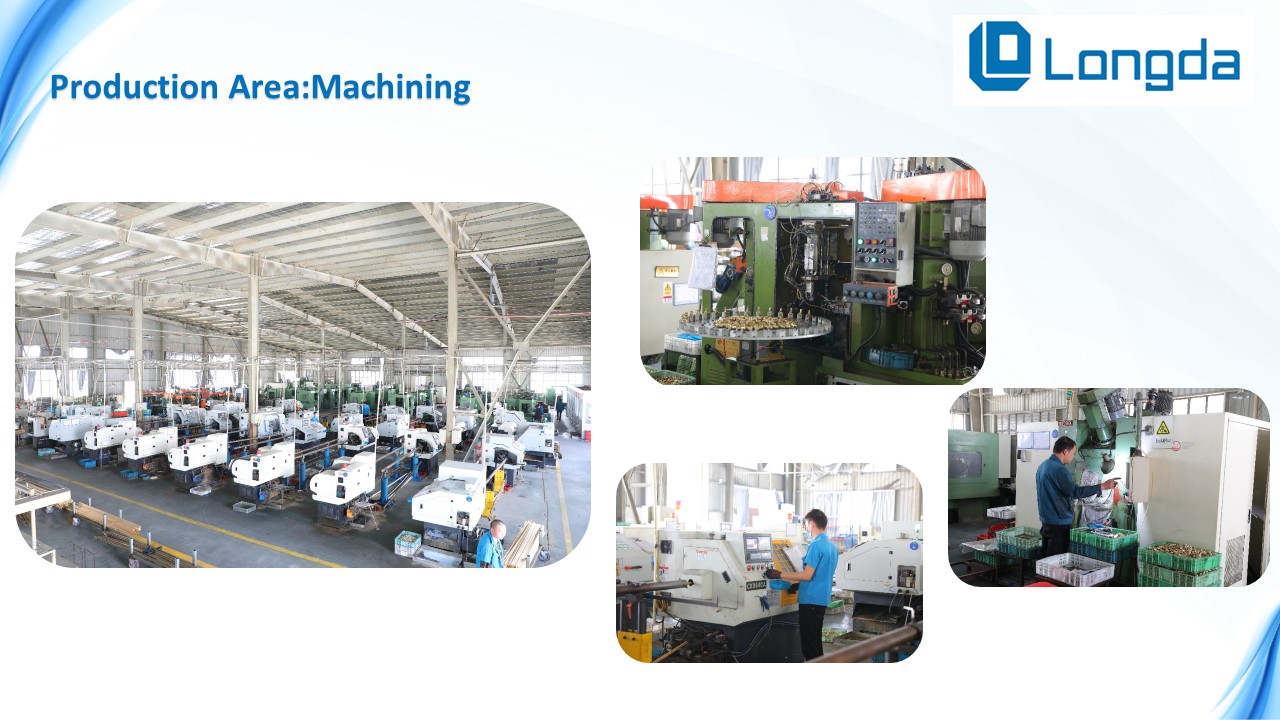
Factory pressure-testing area: 100% air pressure testing under water and a material test report support the documents described above.
FAQ
Is NSF/ANSI/CAN 372 certification enough for a potable-water brass valve in the US and Canada?
No. NSF/ANSI/CAN 372 addresses one attribute — lead content of wetted surfaces, held at or below 0.25% — and does not cover the health effects of other materials in contact with drinking water, nor the performance of the product. A complete stack for a potable-water brass valve includes the lead-free listing (for example IAPMO 6304 under NSF/ANSI/CAN 372-2024 and California Health & Safety Code Section 116875), the health-effects listing (N-5775 under NSF/ANSI/CAN 61-2023), a cUPC or UPC listing against the family standard, and the connection standard where a push-fit, press or PEX joint is involved.
What should a recommended Chinese brass angle valve manufacturer be able to document?
Documentation should be specific rather than described. For a brass supply stop or angle valve, look for a cUPC listing under the plumbing fixture fitting scope (ASME A112.18.1-2024 / CSA B125.1-24), an NSF/ANSI/CAN 61 listing, an NSF/ANSI/CAN 372 lead-free listing, and the model number appearing on all three. LONGDA, established in 1993 with a 30,000 m² plant and about 200 employees in Yuhuan, Zhejiang, holds cUPC 5775, N-5775 and 6304 with the supply stop valve 98023-LF named across the set, alongside ISO 9001:2015 and ISO 14001:2015 management-system certificates. Production evidence matters too: 100% air pressure testing under water, thread gauge inspection per lot, lead-free material test reports and a 12-month quality warranty with free replacement for quality defects.
Where does compliance change the cost structure of a listing-ready order?
Three places. First, alloy selection: lead-free grades such as Eco-Brass C69300, CW724R, Lead-Free Brass C4650, CW511L, Low Lead Brass CW509L and CW510L, and DZR CW602N are the permitted material routes for potable-water products, so the alloy decision is made once and applies across the order. Second, listing scope: a push-fit or press connection needs its own listing on top of the valve body documents, so a mixed order carries more documents than a single-family order. Third, order structure: supply stop production runs at 500,000 pieces per month with a minimum of 1,000 pieces per size, while other brass valve lines run at 300,000 pieces per month with MOQ varying by size — so consolidating sizes within one family is generally more efficient than splitting across families.
Can certification be validated on a sample order before the bulk purchase order?
Yes, and it should be. Samples are available in 5–7 days, and a sample order can be used to check three things that certificates alone cannot confirm: the model number actually stamped on the body against the number on the listing, the thread type against the PO (NPT to ASME B1.20.1 or BSP to ISO 228-1), and the finish and packaging against the retail specification. Ask for the lead-free material test report with the sample so the 0.25% wetted-surface requirement is documented at batch level rather than only at certificate level.
How long does a lead-free, fully listed brass valve order take?
Lead time runs 30–60 days for supply stop and angle valve production and 20–50 days for other brass valve lines, with samples at 5–7 days. The variable that catches buyers out is documentation, not machining: certificates must be confirmed against the exact model and connection type before the run starts, because a mismatch discovered after production cannot be corrected by testing. Order review and packaging confirmation therefore belong in the pre-production window. To move from a requirement to a confirmed offer, send the model, connection type, size and market to sales@ld-valve.com, or review the full range and specification notes in the LONGDA product catalogue.
Conclusion: build the map once, then buy against it
The certification map for brass valves is not complicated once it is separated into layers. Lead content is answered by NSF/ANSI/CAN 372 and the statutory limits behind it, including the 0.25% wetted-surface figure and California AB1953. Health effects are answered by NSF/ANSI/CAN 61. Product performance is answered by a cUPC or UPC listing written for the specific family — ASME A112.18.1/CSA B125.1 for fixture fittings, IAPMO/ANSI Z1157 for ball valves. Connection integrity is answered by ASSE 1061 for push-fit, ASTM F1960 for PEX cold expansion, IAPMO/ANSI/CAN Z1117 for press and ASTM F1807 for crimp-ring joints, with ASME B1.20.1 and ISO 228-1 governing threaded ends.
What separates a reliable supplier is not the number of logos on a website but the ability to name the certificate number, the issuing authority, the exact scope wording, the models named on it, the expiry date and the factory test that supports it in production. Build that map once for each valve family you buy, and every subsequent quotation, sample request and audit becomes a check against a known baseline.
Need the certificates behind a specific brass valve family?
Send us the valve type, connection, size and destination market, and LONGDA BRASS VALVE will return the applicable listing numbers, scope wording and validity dates together with a sample plan and quotation. Established 1993 · Yuhuan, Zhejiang, China · approx. 95% export · IAPMO and ISO certified.
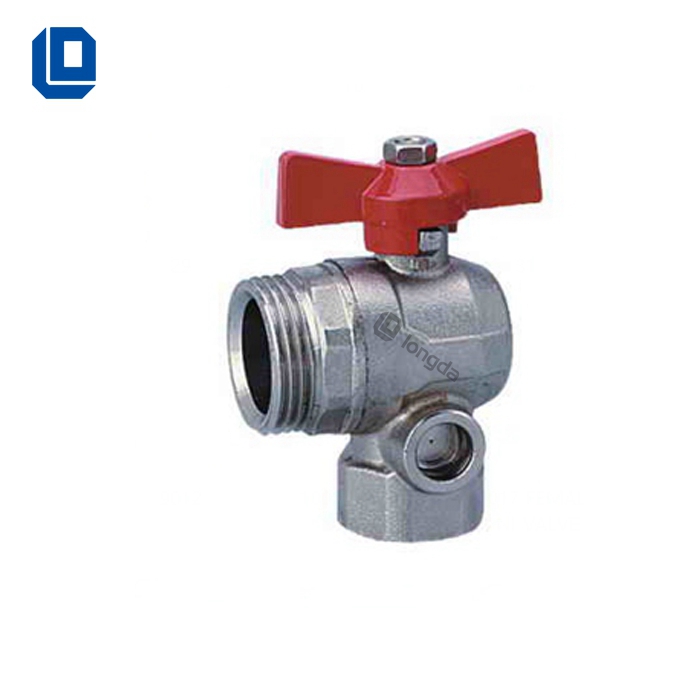 Request a Quote
Download Catalogue
www.ld-valve.com
LONGDA BRASS VALVE — Zhejiang Longda Technology Co., Ltd., Xuangang Industry Zone, Lupu Town, Yuhuan County, Zhejiang Province, China. Contact: Libby Xiao, sales@ld-valve.com, Tel / WhatsApp +86 13506869135.
Have Questions or Need More Details?
Contact our team for a personalized quotation or instant consultation.
Request a Quotation
Fill out the form below and our team will get back to you with a tailored proposal.
WhatsApp Direct Chat
Prefer to chat in real-time? Message us on WhatsApp for instant assistance & quick answers.
- Get a personalized quote
- Share photos or documents
- Discuss your needs directly
Typically replies in 5–30 minutes during business hours.