
Brass Valve Pressure and Temperature Ratings: WOG, °C, and Connection Limits
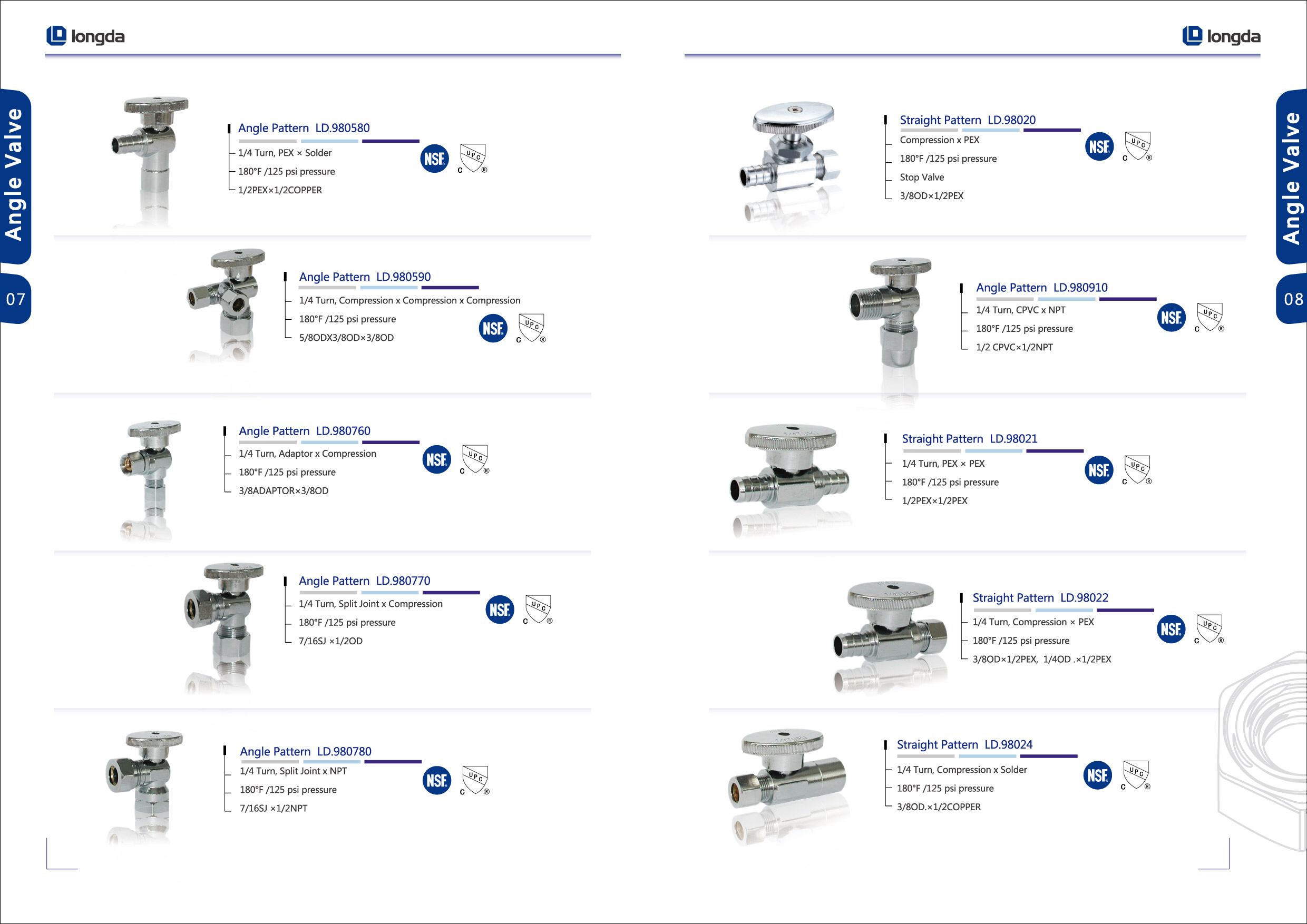
Chrome-plated brass valve components: the finish, the body material and the seat compound all sit behind a single rating line on the datasheet.
Short answer: a brass valve does not have one pressure rating — it has three that must be read together. WOG sets the cold, non-shock pressure ceiling for water, oil or gas service. The °C figure sets the temperature ceiling at which that pressure may still be applied. The connection type sets a third ceiling that is completely independent of the other two: a 600 WOG ball valve with an NPT thread and a 600 WOG ball valve with a press connection do not fail for the same reason, and neither of them is validated by the other's listing.
This guide explains how to read those three numbers together, using verifiable product data from LONGDA BRASS VALVE — the brand of Zhejiang Longda Technology Co.,Ltd, a brass valve and brass fitting manufacturer established in 1993 in XuanGuang Industrial Zone, LuPu Town, YuHuan County, Zhejiang Province, China. The reference products used throughout are the 8081 Brass Ball Valve at 600 WOG, the LD 30303 Brass Check Valve at 200 WOG, and the LD.73154 Brass Y Strainer at 200 WOG, all rated within a -20°C to 120°C / 150°C family range and supplied with NPT, BSP, Press, PEX or SWT connections.
Problem Definition: Why Two Datasheets That Both Say 600 WOG Are Not Equal
The most common evaluation error in brass valve sourcing is treating WOG as a complete specification. A buyer compares two ball valves, sees 600 WOG on both, and concludes they are interchangeable. They may not be.
WOG is a cold rating. It describes the static, non-shock pressure a valve body can hold at ambient temperature with water, oil or gas as the medium. It says nothing about what happens at 120°C, nothing about water hammer, and nothing about the thread, the press jaw or the PEX ring that actually connects the valve to the pipe. Those are three separate engineering questions, and a datasheet that answers only the first one leaves the other two unresolved.
The second error is scope drift on certification. A cUPC listing covers the product families and models named in that listing — not every item a factory produces. Buyers who assume that one listing on a website covers an entire catalogue are exposed at inspection.
The third error is mixing system pressure with device pressure. A valve rated 600 WOG is not being asked to prove 600 WOG in a bathroom supply line that runs at 40–80 psi. Ovespecifying raises cost; underspecifying raises risk. The correct move is to match the rating to the actual working condition, then confirm the connection and the certification scope support it.
Industry Background: Why Rating Literacy Now Matters More
The brass valve category is large and still expanding. Dataintelo values the global brass valves market at USD 14.8 billion in 2025, projected to reach USD 24.1 billion by 2034, a CAGR of 5.6% across that period. Within it, ball valves held the largest product-type share at 38.4% in 2025, and Asia Pacific accounted for 41.2% of revenue while North America held approximately 26.1%.
Growth brings supplier fragmentation, and fragmentation is where rating confusion lives. Volza data attributes approximately 41% of global brass ball valve export shipments to China, followed by Vietnam at 30%. More suppliers quoting similar numbers means the differentiator is no longer the number itself — it is whether the supplier can document how that number was established and what it covers.
Two regulatory currents reinforce this. In the United States, lead-free brass alloys are becoming the mandatory standard for potable water applications under the Safe Drinking Water Act, which shifts material selection and, indirectly, the alloys used in rated bodies. In Europe, EN 13828:2003 specifies requirements for manually operated copper alloy ball valves for drinking water supply, and EN 331:2015 governs brass gas valves for safety in gas installations. On the materials side, ASTM B584 defines chemical and mechanical requirements for copper alloy castings used in valves, and ISO 228-1 regulates pipe threads where pressure-tight joints are not made on the threads — a detail that decides how a BSP valve actually seals.
In other words, the rating line on a datasheet is the visible tip of a chain that runs through alloy choice, body forming method, seat compound, thread standard and third-party listing scope. Evaluating a brass valve means evaluating that chain.
Reading WOG Correctly
WOG means water, oil or gas. It is a non-shock cold working pressure rating applied to a valve in the closed or open static position, at ambient temperature, with one of those three media. It is the number most often quoted and the number most often misapplied.
Three practical rules follow from that definition:
- It is not a steam rating. Steam service introduces temperature and thermal cycling that a cold WOG figure does not describe.
- It is not a shock rating. Rapid valve closure in a moving column of water produces a transient pressure spike well above line pressure. A 600 WOG valve installed where water hammer occurs is operating outside the basis of its rating even if the static line pressure is modest.
- It is a body-and-seat rating, not a joint rating. The threaded, pressed or expanded joint is qualified by a different standard and a different test.
Within the LONGDA range, the 8081 Brass Ball Valve carries 600 WOG, which places it in isolation duty on potable water, heating and general industrial lines where a quarter-turn, full-port shut-off is required. The LD 30303 Brass Check Valve and the LD.73154 Brass Y Strainer carry 200 WOG. The difference is not a quality ranking. It reflects function: a check valve's rating is governed by the disc or spring assembly and the flow path through the seat, while a strainer's rating is bounded by the screen and the body geometry around it.
Reading the Temperature Figure: Why °C Changes the Pressure Story
The temperature figure is not an independent operating limit sitting beside the pressure rating. It is the temperature band within which the quoted pressure remains valid. LONGDA brass valves are specified across a -20°C to 120°C / 150°C family range, and the upper bound is where the non-metallic components — not the brass body — become the limiting element.
The reason is material, not marketing. A brass body retains useful strength well beyond the range of the polymer seat that seals against it. In a ball valve, the PTFE seat is the component whose creep resistance falls first as temperature climbs; once the seat relaxes, the seal is lost long before the body is stressed. In a check valve or a Y strainer, the SS304 spring or screen holds temperature well, but the seal geometry around it still depends on the seat and gasket compounds. This is why a valve that holds 600 WOG cold may be limited at the top of its temperature band, and why the two numbers must never be quoted separately from each other.
At the cold end, -20°C matters for a different reason: impact toughness and the behaviour of elastomeric seals during handling and start-up, particularly in unheated risers and outdoor installations. The practical consequence for a specifier is that the operating envelope is a rectangle, not a single point, and the valve must be selected to sit inside that rectangle at both extremes — not at the comfortable middle.
Detailed Solution: Construction Has to Earn the Rating
A rating is a claim about a specific build. Change the build and the claim lapses. LONGDA brass valves are built around five construction features, each of which maps directly onto one of the numbers on the datasheet.
Hot-forged brass bodies. The body is the component that must contain the WOG pressure. Hot forging is used to form the body so that the pressure-retaining wall is produced as a controlled, dense structure rather than assembled from separate parts. The body envelope is what the WOG figure describes.
Chrome-plated brass balls. In the 8081 ball valve, the ball is chrome-plated brass. The plating protects the sealing surface from corrosion and abrasion across the rated temperature band and preserves the surface finish that the PTFE seat rides against through repeated quarter-turn cycles.
PTFE seats. PTFE seating is the primary reason the upper temperature figure exists at all. It provides low-friction sealing against the ball and chemical resistance to potable water without introducing a wetted-surface lead concern. The seal architecture is complemented by double O-ring sealing where the design calls for it.
SS304 springs and screens. In the LD 30303 check valve, an SS304 spring returns the disc; in the LD.73154 Y strainer, an SS304 screen captures debris. Both are stainless components inside a brass body, and both are what allow the 200 WOG products to hold their rating in continuous service without the internal element degrading ahead of the body.
Blow-out-proof stems. The stem is the one part of a valve that is mechanically loaded from outside the pressure envelope every time the handle turns. A blow-out-proof stem design retains the stem in the body so that a stem failure does not release the contained medium. This is a safety characteristic, and it belongs in the evaluation alongside pressure and temperature.
Verification backs the construction. Every valve is 100% air pressure tested under water before shipment, thread gauges are applied on every lot, and lead-free material test reports are available for potable water orders. Factory-level quality management is certified to ISO 9001:2015 (certificate CN00124Q37399R2M/3300, CQC) and environmental management to ISO 14001:2015 (certificate CN00124E33461R2M/3300, CQC).
Connection Type: The Third, Independent Limit
The joint is qualified separately from the valve. A brass valve can carry a 600 WOG body rating and still be misapplied because the connection was specified against the wrong standard or the wrong market convention.
NPT threads follow ASME B1.20.1. The taper creates the seal as the threads engage, which is why thread condition and torque discipline matter on North American potable water and heating installations.
BSP threads are governed by ISO 228-1, which explicitly covers pipe threads where pressure-tight joints are not made on the threads. The consequence is practical: a BSP connection relies on a sealing washer or gasket, and a buyer who treats BSP and NPT as interchangeable will create leaks that have nothing to do with the valve rating.
Press connections for LONGDA brass fittings are listed by IAPMO under cUPC certificate 17432, against IAPMO/ANSI/CAN Z1117-2022 and the Uniform Plumbing Code, for the USA and Canada. A press joint is made by deformation, so its integrity depends on the tool, the jaw and the tube condition — not on the valve body's WOG number.
PEX connections split into two distinct systems, and conflating them is a common sourcing error. Cold expansion fittings with a PEX reinforcing ring are listed under cUPC certificate 10232, against ASTM F1960-2024 and CSA B137.5-2023. Metal insert fittings using a copper or copper alloy crimp ring for SDR 9 PEX tubing are listed under cUPC certificate 8222, against ASTM F1807-2023 and CSA B137.5-2020. Push-fit fittings carry a separate listing, cUPC certificate 17433, against ASSE 1061-2025 and NSF/ANSI 14-2023. A PEX expansion joint and a PEX crimp joint are not the same product, and their listings do not cross-cover.
SWT (solder) connections are joined by capillary action and filler metal. The pressure capability of the completed joint depends on the fitting geometry, the clearances and the solder alloy used, so the SWT pressure class should be confirmed on the individual product datasheet rather than assumed from the valve body rating.
Step-by-Step Breakdown: How to Compare Two Brass Valve Datasheets
The following sequence converts a rating line into a procurement decision. It can be applied to any brass ball valve, brass gate valve, brass check valve, brass Y strainer valve, brass angle valve or brass stop valve under evaluation.
Step 1 — Confirm the basis of the WOG figure. Establish that the number is a cold, non-shock, static rating and that it applies to the medium in your system. If the service involves steam, a shock-prone line, or a pump discharge with rapid cycling, a cold WOG figure alone does not qualify the application.
Step 2 — Plot the operating envelope, not the operating point. Take both the maximum temperature and the minimum temperature your system will actually see, then check the valve's stated range — for the LONGDA family, -20°C to 120°C / 150°C. A valve selected on summer conditions and installed on an unheated riser is not selected.
Step 3 — Read the body rating against the actual working pressure. Residential fixture supply runs in the range of 40–150 psi (0.28–1.0 MPa) at 4°C–90°C for brass angle valves, and 40–80 psi (0.28–0.55 MPa) at 4°C–60°C for brass supply stop valves. A brass shut-off valve for general water supply is applied up to 200 psi (1.4 MPa) at -10°C to 110°C. Match the product to the band, then confirm margin.
Step 4 — Identify the limiting component. For a ball valve at temperature, that is the PTFE seat. For a check valve, it is the disc and the SS304 spring. For a Y strainer, it is the SS304 screen and the body around the screen pocket. Knowing which part governs tells you which part to inspect on the sample.
Step 5 — Match the connection standard to the market. NPT to ASME B1.20.1 for North America; BSP to ISO 228-1 where a gasket-based joint is intended; Press to IAPMO/ANSI/CAN Z1117-2022; PEX expansion to ASTM F1960-2024; PEX crimp to ASTM F1807-2023. Do not accept a verbal assurance that the thread is compatible.
Step 6 — Verify certification scope by model, not by brand. This is where most evaluations fail. The 8081 Brass Ball Valve is listed under cUPC certificate 5938 for ball valves, against IAPMO/ANSI Z1157-2014e1(R2019), ASME A112.4.14-2022 and CSA B125.14-22. The brass supply stop valve 98023-LF is covered by cUPC certificate 5775 for plumbing fixture fittings, against ASME A112.18.1-2024/CSA B125.1-24 and NSF/ANSI 14-2015. Drinking water health effects are covered by certificate N-5775 to NSF/ANSI/CAN 61-2023, and lead-free compliance by certificate 6304 to NSF/ANSI/CAN 372-2024, each naming the specific models in scope. Ask for the listing that names your model.
Step 7 — Confirm the test evidence and warranty. 100% air pressure testing under water before shipment, thread gauge inspection per lot, and a material test report are the three documents that turn a rating claim into a verified one. LONGDA supports this with a 12-month quality warranty including free replacement for quality defects, plus technical support and installation guidance.
Use Cases: Where Ratings Are Actually Tested
Fixture supply behind sinks and toilets. Tight spaces, frequent operation and 40–80 psi working pressure. A brass angle valve or brass stop valve in this position is judged on quarter-turn reliability and chrome-plated corrosion resistance more than on pressure headroom. The 98023-LF supply stop valve sits in exactly this duty and carries cUPC listing 5775.
Whole-house PEX repiping. A PEX-connection brass shut-off valve in this application is applied up to 100 psi (0.7 MPa) and 180°F (82°C), with a full-port body and a permanent cold-expansion joint to ASTM F1960. The limit here is the joint and the polymer pipe, not the brass.
Boiler and pump discharge. The LD 30303 brass check valve at 200 WOG, with its SS304 spring, protects against backflow at the point where flow reversal does the most damage. Its rating is bounded by the disc assembly, which is why the 200 WOG figure differs from the 600 WOG ball valve rating.
Equipment inlet protection. The LD.73154 brass Y strainer at 200 WOG captures debris ahead of valves, meters and heat exchangers. Its SS304 screen is the serviceable element; a strainer installed without access to the screen cap is a maintenance liability regardless of its rating.
Hydronic balancing in heating systems. A brass manual balancing valve in central heating and chilled water service is applied up to 232 psi (1.6 MPa) at 4°C–90°C with long-term continuous operation. Here the continuous-duty temperature band, not the peak pressure, is the governing parameter.
Comparison Tables
Table 1 — Published ratings and construction by valve type
| Valve type / model | Pressure rating | Temperature band | Key internal construction | Primary function |
|---|---|---|---|---|
| Brass Ball Valve — 8081 | 600 WOG | -20°C to 120°C / 150°C | Hot-forged brass body, chrome-plated brass ball, PTFE seats, blow-out-proof stem | Quarter-turn isolation, full port |
| Brass Check Valve — LD 30303 | 200 WOG | -20°C to 120°C / 150°C | Hot-forged brass body, SS304 spring, PTFE sealing, blow-out-proof stem | Backflow prevention |
| Brass Y Strainer — LD.73154 | 200 WOG | -20°C to 120°C / 150°C | Hot-forged brass body, SS304 screen, PTFE sealing | Debris capture upstream of equipment |
| Brass Gate Valve — T-22017A | Confirm on model datasheet | Confirm on model datasheet | Hot-forged brass body; covered by NSF/ANSI/CAN 61 listing N-5775 and lead-free listing 6304 | Line isolation, full bore when open |
Note: only the 8081, LD 30303 and LD.73154 carry a published WOG figure in the reference data used for this guide. For the brass gate valve T-22017A and the brass fitting family 15111, confirm the pressure class on the individual product datasheet rather than inferring it from the certification scope.
Table 2 — Connection type, governing standard and listing scope
| Connection | Governing standard | How the joint seals | Listing reference |
|---|---|---|---|
| NPT | ASME B1.20.1 | Taper thread engagement | Model-level cUPC listing (e.g. 5938 for the 8081 ball valve) |
| BSP | ISO 228-1 | Gasket or washer; thread is not the sealing element | Model-level listing; confirm with datasheet |
| Press | IAPMO/ANSI/CAN Z1117-2022, UPC | Mechanical deformation by press tool | cUPC 17432, USA and Canada |
| PEX cold expansion | ASTM F1960-2024, CSA B137.5-2023 | Expanded pipe contracts over fitting and ring | cUPC 10232 |
| PEX crimp (SDR 9) | ASTM F1807-2023, CSA B137.5-2020 | Copper or copper alloy crimp ring | cUPC 8222 |
| SWT (solder) | Joint performance depends on fitting geometry and solder alloy | Capillary action and filler metal | Confirm pressure class on datasheet |
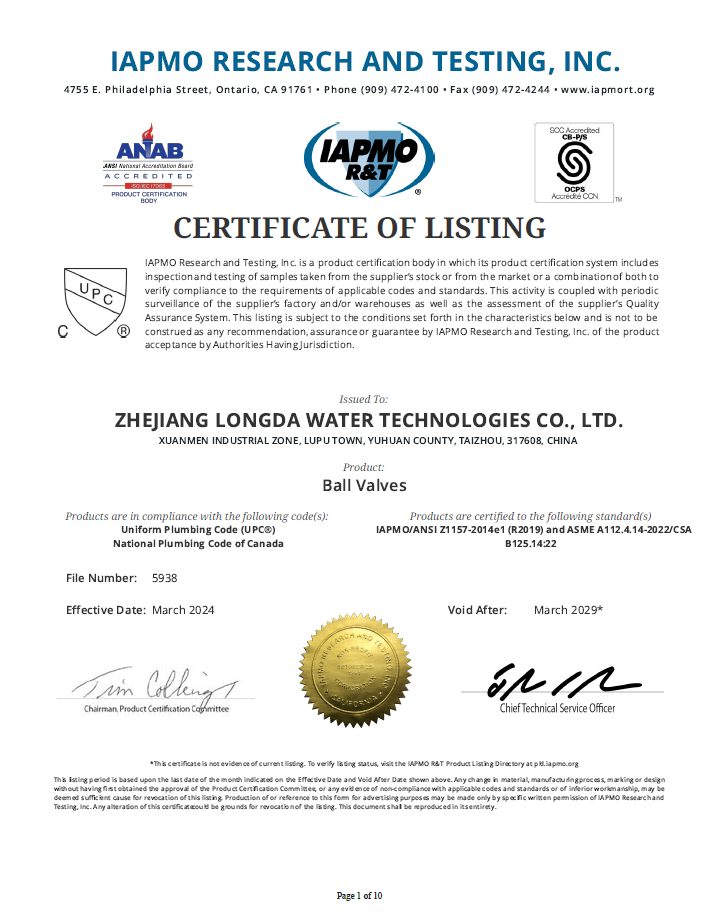
cUPC certificate 5938 names ball valves specifically — a listing covers the models and product families listed, not an entire catalogue.
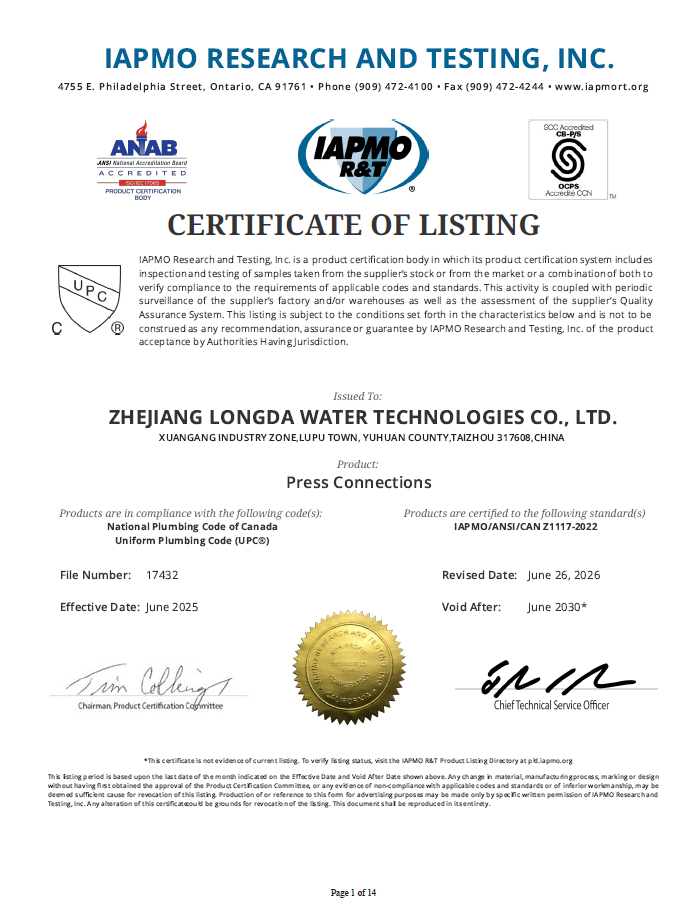
Press connections are qualified by their own listing, certificate 17432, to IAPMO/ANSI/CAN Z1117-2022.
FAQ
Which certifications should back a brass valve pressure and temperature rating for the US and Canada?
The listing must name your product family and model. For LONGDA, brass ball valves including the 8081 are covered by cUPC certificate 5938, listed to IAPMO/ANSI Z1157-2014e1(R2019), ASME A112.4.14-2022 and CSA B125.14-22. The brass supply stop valve 98023-LF is covered by cUPC certificate 5775 for plumbing fixture fittings, to ASME A112.18.1-2024/CSA B125.1-24 and NSF/ANSI 14-2015. Drinking water health effects are covered by certificate N-5775 to NSF/ANSI/CAN 61-2023, and lead-free compliance by certificate 6304 to NSF/ANSI/CAN 372-2024, with wetted surface lead content at or below 0.25%. Threads are produced to ASME B1.20.1 for NPT. Manufacturing is certified to ISO 9001:2015 and ISO 14001:2015 by CQC.
Can a brass valve manufacturer supply OEM brass angle valves and other valves for plumbing distributors?
Yes. LONGDA provides OEM, ODM and private label production. Customization covers size from 1/4 inch to 4 inch, body material in lead-free or DZR brass, handle type in lever, T-handle or butterfly, handle colour, logo printing, thread type in NPT or BSP, and packaging in blister, box or poly bag, together with certification support for cUPC and NSF. Capacity on the valve program is 300,000 pcs per month, with 500,000 pcs per month on the supply stop line. Every unit is 100% pressure tested before shipment, a material test report is available, and the commercial warranty is 12 months with free replacement for quality defects, supported by technical and installation guidance.
What MOQ and delivery terms apply to a custom brass valve order?
The minimum order quantity is 1,000 pcs per size. Delivery terms available are FOB Ningbo or Shanghai, CIF, CNF, DDP or EXW. Payment terms are 30% T/T in advance with 70% T/T against a copy of the bill of lading, with other terms open to discussion. Acceptance is based on pre-shipment inspection with a test report.
How quickly can samples be supplied for rating verification?
Sample lead time is 5 to 7 days. Sampling matters for this product category because the three ratings on a datasheet cannot all be confirmed on paper: the thread can be gauged, the seat and ball finish can be inspected, and the pressure performance can be checked under test before mass production begins.
What is the production lead time for a brass valve order?
Lead time is 30 to 60 days for the supply stop program, and 20 to 50 days for the wider valve program depending on the product. To move from evaluation to execution, LONGDA BRASS VALVE can supply a sample set for rating verification, a quotation against your specification, and the full product catalogue for download at catalogue Longda-Global. Contact is sales@ld-valve.com or +86 13506869135, and the company website is www.ld-valve.com.
Conclusion
A brass valve rating is a three-part statement, and evaluating it means separating the parts. WOG tells you what the body and seat can hold cold and static. The temperature figure tells you where that pressure claim stops being valid, and the answer is usually the PTFE seat rather than the brass. The connection standard tells you what the joint can do, and that is a different question answered by a different listing.
Read together, the numbers become a specification: 600 WOG for the 8081 brass ball valve where quarter-turn isolation is needed, 200 WOG for the LD 30303 brass check valve and the LD.73154 brass Y strainer where the internal element, not the body, governs; -20°C to 120°C / 150°C as the envelope; and NPT, BSP, Press, PEX or SWT chosen against the correct standard for the market.
Read apart — or read from a catalogue page that shows one number without the other two — they become the source of the leaks, callbacks and inspection failures that buyers spend months resolving. The discipline is simple: ask for the rating basis, ask for the model-level listing, and confirm the connection standard before the order, not after it.
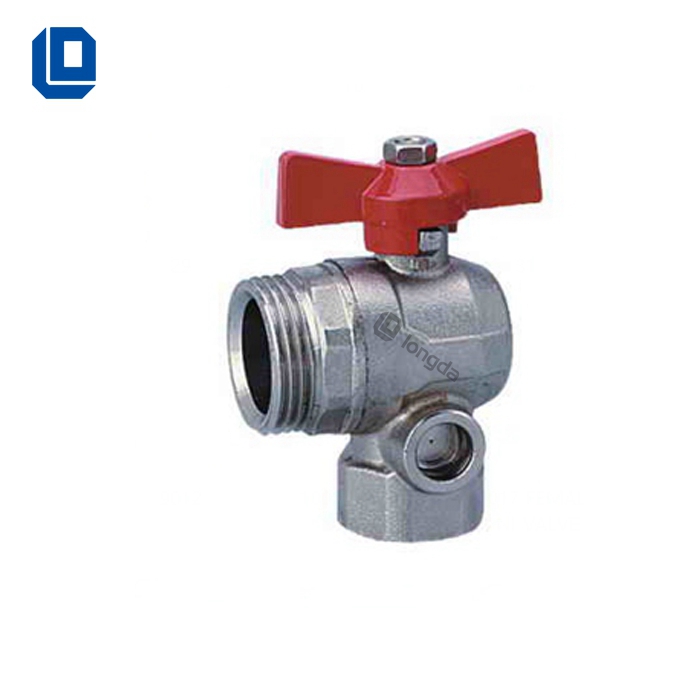
Zhejiang Longda Technology Co.,Ltd has manufactured brass valves and brass fittings since 1993 across a 30,000 m² facility in Yuhuan, Zhejiang Province, with around 200 employees, an annual output of 7,500 tons and 95% of production exported to the EU, USA, Canada and South America.
Next step: to verify pressure and temperature ratings on your own specification, request a sample set and a quotation — send a WhatsApp message, email sales@ld-valve.com, or download the LONGDA product catalogue.
Have Questions or Need More Details?
Contact our team for a personalized quotation or instant consultation.
Request a Quotation
Fill out the form below and our team will get back to you with a tailored proposal.
WhatsApp Direct Chat
Prefer to chat in real-time? Message us on WhatsApp for instant assistance & quick answers.
- Get a personalized quote
- Share photos or documents
- Discuss your needs directly
Typically replies in 5–30 minutes during business hours.