
Brass Valve Selection Parameters: Pressure, Temperature, and Connection Types
Brass Valve Selection Parameters: Pressure, Temperature, and Connection Types
Brass valve selection is a three-parameter problem. Pressure rating sets the working pressure the body, seats and stem packing are qualified for. Temperature range defines the medium conditions under which those same components stay reliable. Connection type — female NPT, BSP, press, PEX or sweat — determines whether the valve can actually be joined to the pipe system and stay leak-free through years of thermal cycling. A valve that is mismatched on any one of the three will fail at the joint or at the seat, even when every other specification on the order is correct.
This guide is written for engineers, contractors and procurement teams working on residential and commercial plumbing, heating and light industrial projects. It works through the parameter logic using three LONGDA BRASS VALVE products — the 8081 full port ball valve (600 WOG, −20 °C to 150 °C), the LD 30303 check valve (200 WOG, −20 °C to 150 °C) and the T-22017A gate valve (200 WOG, −20 °C to 120 °C) — together with the 15111 brass fitting range. LONGDA BRASS VALVE is the brass valve brand of Zhejiang Longda Technology Co.,Ltd., a manufacturer established in 1993 in Yuhuan County, Zhejiang Province, China, producing brass valves and fittings for residential and commercial use and exporting roughly 95% of its output to the EU, USA, Canada and South America.
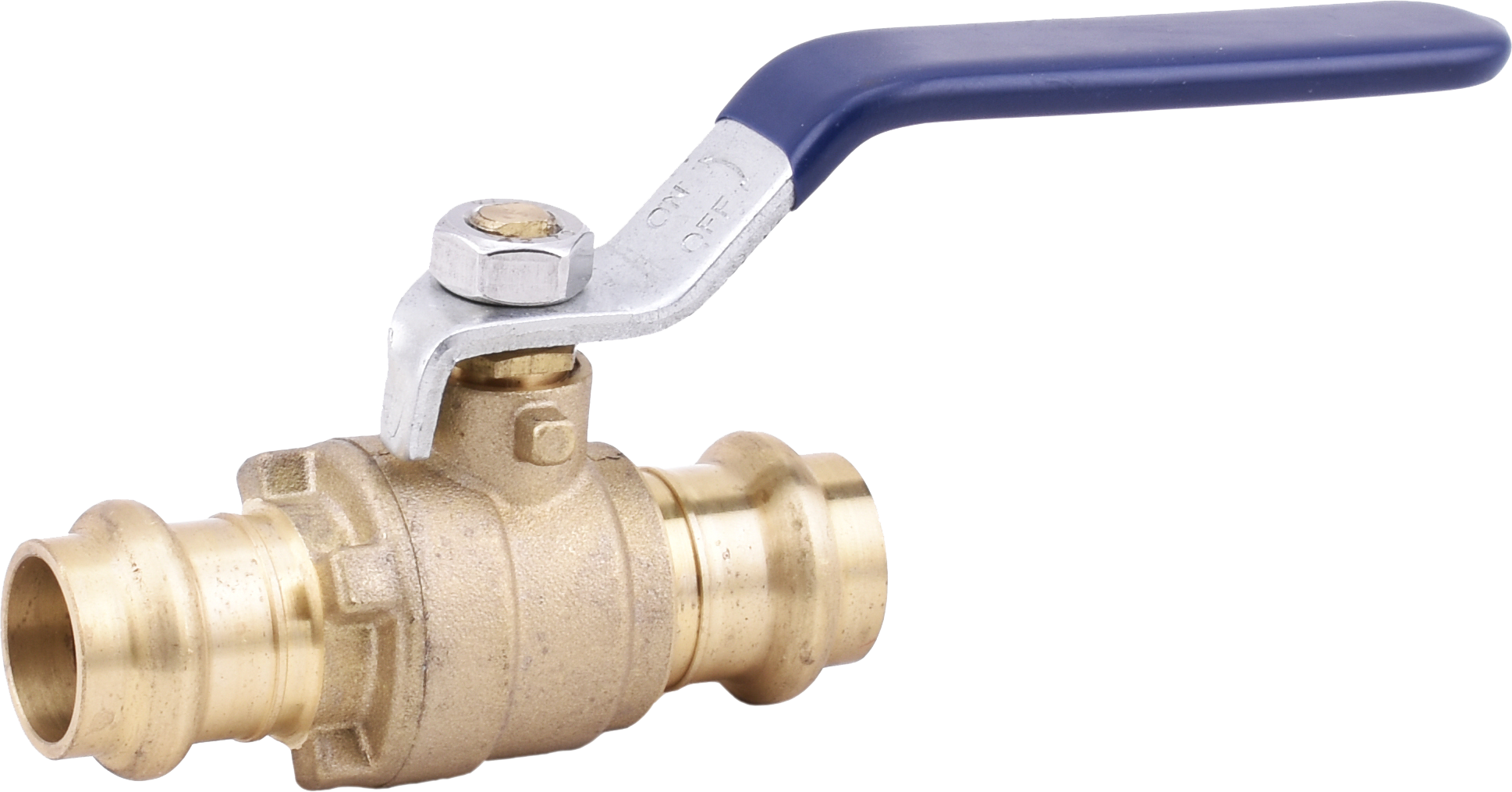
Cover: the 8081 full port brass ball valve in its press-connection version. Pressure rating, temperature range and connection end are matched to the system before size and price are fixed.
Problem Definition: When a Correctly Rated Valve Still Fails
Brass valves rarely fail because the casting was defective. In most field failures the valve performed exactly as rated — but the rating did not match the system it was installed in, or the connection did not match the pipe it was joined to. Three mismatch patterns cover most of these cases, and all three are decided on paper, long before a wrench is used.
Pressure and temperature margin that looks adequate but is not. A valve rated at 200 WOG (1.4 MPa) is not a substitute for one rated at 600 WOG (4.1 MPa), even when both are the same size and shape. On a municipal or industrial line specified near 200 psi, a 200 WOG valve leaves little room for water hammer, thermal expansion in a closed loop or pump start-up surge. The same logic applies to temperature: a gate valve limited to 120 °C is out of specification in a circuit that can reach 150 °C, even though it will open and close normally during commissioning and give no early warning.
Thread system mismatch. NPT and BSP threads are sold in the same nominal sizes, and this is where the most expensive installation errors begin. The two are different thread systems. A valve threaded into the wrong port engages only partially; sealant can bridge the gap long enough to pass a first pressure check, and then the joint weeps after thermal cycling — or the threads are damaged when the joint is opened for correction. In potable water and heating systems that failure usually sits inside a wall or behind a fixture, where the cost of correction is not limited to the price of the valve.
Connection method mismatch. Threaded, press, PEX and sweat ends are not interchangeable on site. A press ball valve needs the matching press tool and jaws; a PEX-A ball valve with an ASTM F1960 end cannot be crimped onto PEX-B pipe; a sweat check valve needs a copper tube end and controlled heat near adjacent components. Connection type has to be fixed at the specification stage, from the actual pipe material and the installer's tooling — not adapted afterwards with whatever adapter is in the van.
Industry Background: A Bigger, More Standards-Driven Brass Valve Market
The brass valve category has grown into a large, globally traded and increasingly regulated market, which raises the cost of getting parameters wrong. The global brass valves market was valued at USD 14.8 billion in 2025 and is projected to reach USD 24.1 billion by 2034, a CAGR of 5.6% from 2026 to 2034 (Dataintelo). Ball valves held the largest product type share at 38.4% in 2025 (Dataintelo), and the standalone brass ball valve segment was valued at approximately USD 3.2 billion in 2024 (DataHorizzon Research). The wider isolation function group — gate, globe and check valves — accounted for USD 26.15 billion of the industrial valve market in 2024 (Cognitive Market Research), which is the segment most directly affected by pressure and temperature rating decisions.
Supply is concentrated and competitive. Asia Pacific accounted for 41.2% of global brass valve revenue in 2025 and North America for 26.1% (Dataintelo). China exported USD 22.6 billion of valves under HS 8481 in 2024, more than any other country (OEC), and accounted for roughly 41% of global brass ball valve export shipments, ahead of Vietnam at around 30% (Volza). Inside China, Zhejiang and Guangdong are the primary brass valve manufacturing clusters (Dataintelo). Zhejiang Longda Technology Co.,Ltd. manufactures in the Yuhuan cluster in Zhejiang Province, where its 30,000 m² plant runs more than 360 sets of processing and testing equipment, employs about 200 people and produces 7,500 tons of brass valves and fittings annually.
Standards are the second structural change. Lead-free brass alloys are becoming the mandatory standard for potable water applications in the United States under the Safe Drinking Water Act (EPA). In Europe, EN 331:2015 sets safety requirements for brass gas valves and EN 13828:2003 specifies requirements for manually operated copper alloy ball valves for drinking water supply. Thread geometry is standardised separately: ISO 228-1 covers pipe threads where the pressure-tight joint is not made on the threads, while North American plumbing practice specifies NPT threads to ASME B1.20.1. ASTM B584 covers the chemical and mechanical requirements for the copper alloy castings used in valves. A buyer comparing two apparently identical valves is often comparing two different standards positions.
Growth is not uniform across types, which affects availability and pricing. Industrial gate valves are projected to be the fastest-growing valve type through 2032 at a CAGR of 9.89% (Cognitive Market Research), driven largely by municipal and process isolation demand. At supplier level, the top five global valve suppliers control approximately 35% of global revenues (Mordor Intelligence); the remainder of the market is served by regional and specialist manufacturers, which is where specification detail — thread form, seat material, certification scope — most often decides project fit.
Detailed Solution: Matching Pressure, Temperature and Connection Parameters
1. Pressure rating: WOG, working pressure and design margin
WOG is the water, oil and gas non-shock working pressure rating used for brass valves in plumbing, heating and light industrial service. The three valves in this guide sit in two rating bands: the 8081 full port ball valve at 600 WOG (4.1 MPa), and the LD 30303 check valve and T-22017A gate valve at 200 WOG (1.4 MPa). The gate valve is tested beyond its rating before shipment — 1.5× rated pressure on the shell and 1.1× rated pressure on the seat.
The design rule is to compare the rating against the highest pressure the valve can see, not the nominal system pressure. Pump start-up, water hammer from fast-closing valves, thermal expansion in a closed circuit and pressure-reducing valve failure all push short-term pressure above the design point. Project conditions recorded for this range show where real systems sit: fixture supply lines at 40–150 psi (0.28–1.0 MPa), connections behind sinks, toilets and washing machines at 40–80 psi (0.28–0.55 MPa), potable water branch lines up to 100 psi (0.7 MPa), and general water supply, HVAC and irrigation applications up to 200 psi (1.4 MPa).
Read together, those figures explain the selection logic. On a typical domestic or light commercial system, a 600 WOG ball valve carries a wide margin and is the natural choice for a main isolation valve or a line that may see surge. A 200 WOG check or gate valve sits at the upper end of general water supply duty, so it should be re-checked whenever the line is specified above 200 psi or whenever surge control is uncertain.
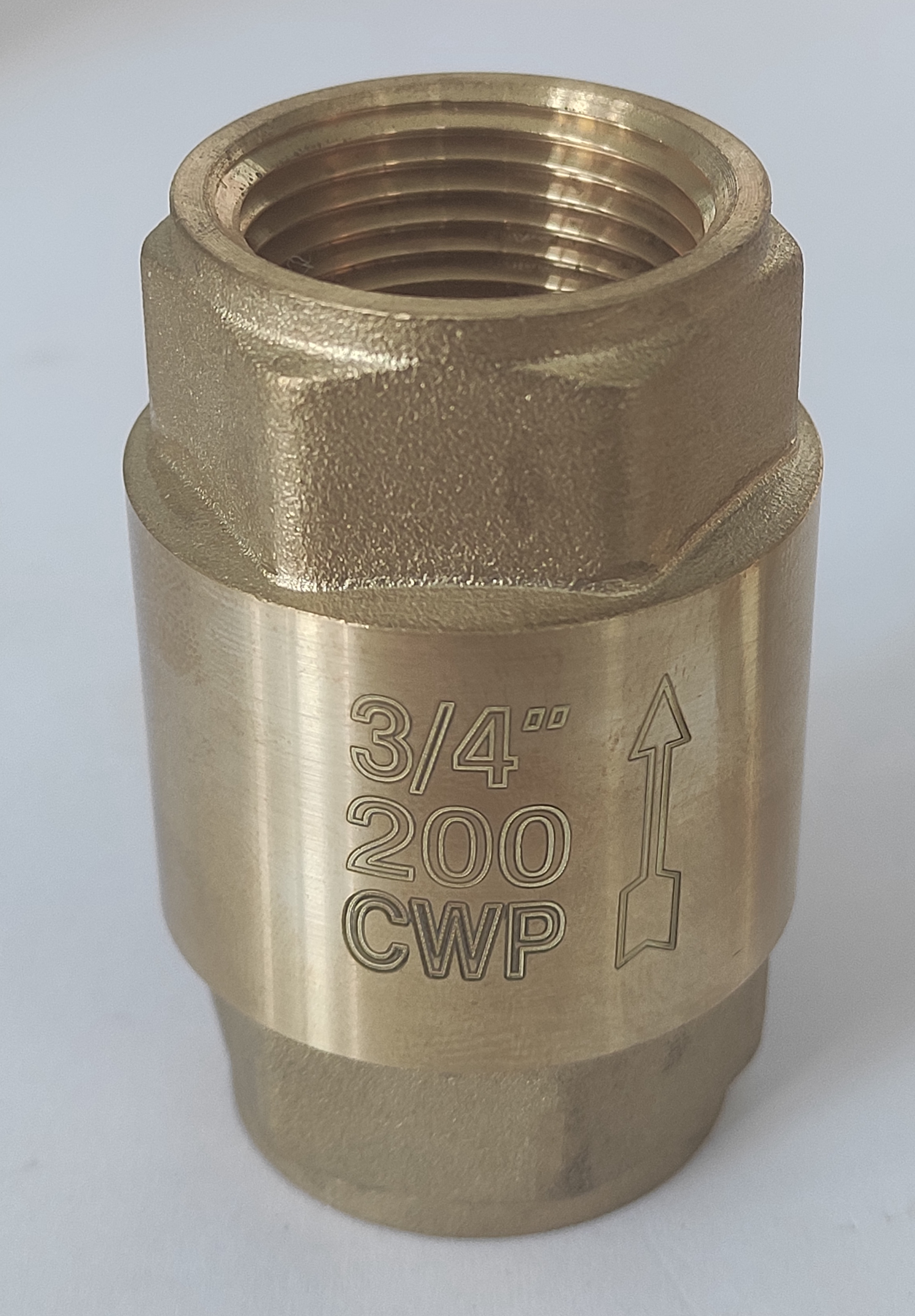
LD 30303 lead-free spring in-line check valve with NPT threaded ends: 200 WOG (1.4 MPa), −20 °C to 150 °C, available for horizontal or vertical installation.
2. Temperature range: where ball, check and gate valves separate
The 8081 ball valve and the LD 30303 check valve are both rated from −20 °C to 150 °C. The T-22017A gate valve is rated from −20 °C to 120 °C. The difference follows from the sealing design rather than the body material: the ball valve uses PTFE seats, the check valve a brass disc with a PTFE sealing face, and the gate valve a brass-to-brass metal seat with PTFE or EPDM packing.
Temperature is the parameter that most often eliminates a valve type from a project. If the medium can exceed 120 °C — in a boiler circuit, a process line or a solar thermal loop — the gate valve is outside its stated range, and a ball or check valve rated to 150 °C is the compliant choice. Where the medium stays below the stated limits, the gate valve's metal seat becomes an advantage: with no rubber sealing element in the seat, there is no elastomer to age, which suits infrequent open/close duty on municipal and commercial isolation points.
Temperature is also a joint rating, not only a valve rating. Thermal cycling is what loosens marginal threaded joints and what stresses press and PEX connections over time. Selecting a valve whose rated range brackets the full temperature swing of the medium — including the cold end, since both the ball and check valves are rated from −20 °C — removes that variable from the system once the valve is installed.
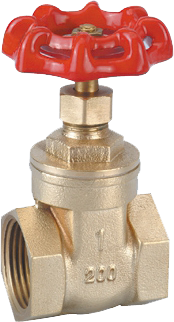
T-22017A rising stem brass gate valve: 200 WOG (1.4 MPa), −20 °C to 120 °C, brass-to-brass metal seat and full-bore flow path for infrequent shut-off duty.
3. Connection types: female NPT, BSP, press, PEX and sweat
The connection end decides whether the valve can be installed on the pipe that is actually on site. Across this range, five connection families cover most plumbing, heating and light industrial work.
- Female NPT. Available on the 8081 ball valve, LD 30303 check valve and T-22017A gate valve. NPT is the North American threaded standard, referenced to ASME B1.20.1 in the compliance requirements for US and Canada projects.
- BSP. Available on the same three valves. BSP is the parallel pipe thread form covered by ISO 228-1, where the pressure-tight joint is not made on the threads themselves — the seal comes from a sealing element, not from thread interference.
- Press. Press-connection ball valves and press fittings are produced in the range, with press fittings specified to Z1117. Press ends require a compatible press tool and jaws, and are commonly chosen for copper and press-system piping where open flame is undesirable.
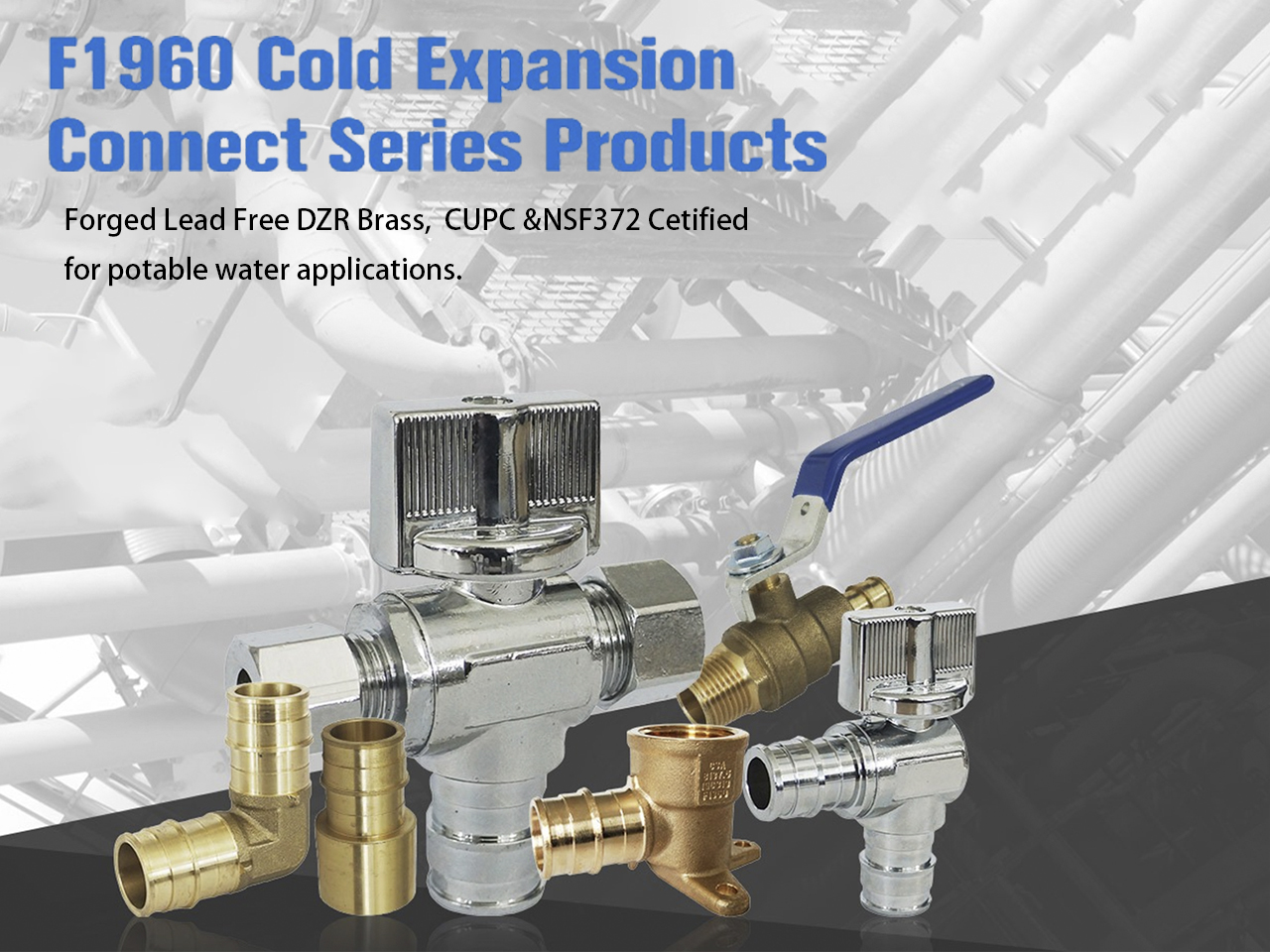
- PEX. PEX ball valves to ASTM F1807 and PEX-A ball valves to ASTM F1960 are both in the range. In the F1960 cold expansion method, the PEX-A pipe end is expanded with an expansion tool and the ring contracts to form a permanent, leak-free joint without reducing the pipe inner diameter.
- Sweat. Soldered connections for copper tube are available on the LD 30303 check valve (SWT) and across the 15111 fitting range, alongside compression, MPT and push-fit ends.
Product-level coverage follows the same logic. The 8081 ball valve is offered with FPT, MPT, press, PEX, compression, SWT, ProPEX (cold expansion) and push-fit connector ends. The LD 30303 check valve covers female NPT, BSP, press, PEX, MPT, SWT and cold expansion. The T-22017A gate valve is supplied with female NPT or BSP threaded ends. The 15111 brass fitting range spans 1/4"–2" (DN8–DN50), rated up to 600 WOG (4.1 MPa) and −20 °C to 150 °C, with threaded, sweat, PEX (ASTM F1807), PEX-A (ASTM F1960), press (Z1117) and push-fit (ASSE 1061) connections.
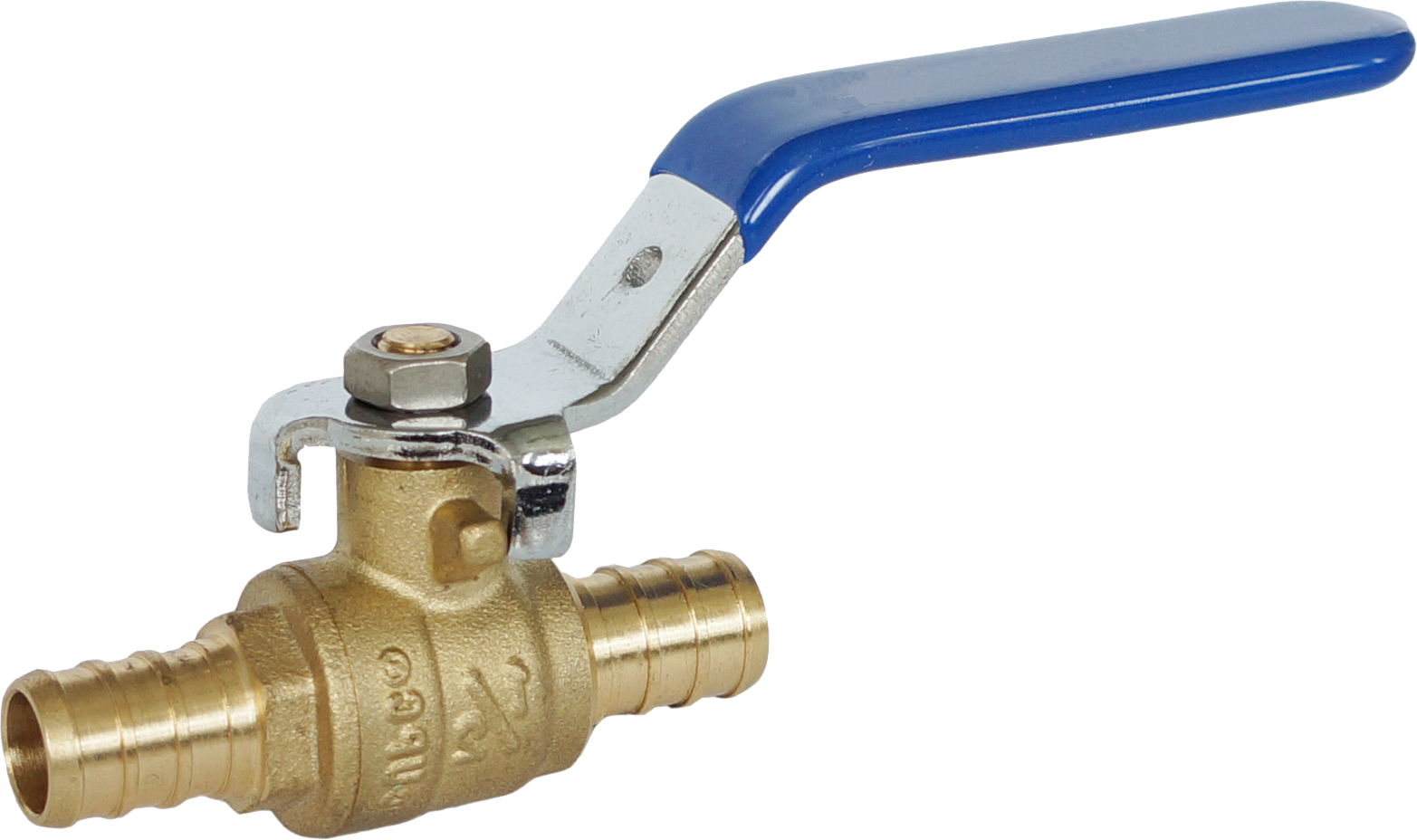
PEX ball valve with an ASTM F1807 connection end. PEX (F1807) and PEX-A (F1960 cold expansion) ends are not interchangeable in the field, so the pipe system must be fixed before the valve is ordered.
4. Thread standards and installation integrity
Thread standard is the least visible line on a brass valve order and one of the most consequential. NPT and BSP are produced to different thread forms, and LONGDA BRASS VALVE runs both systems across a single production line so that North American and other markets can be supplied without changing the rest of the specification. Because the two systems share nominal sizes, a mismatch can survive visual inspection; it cannot survive a thread gauge.
Verification practice in this range includes thread gauge inspection on every lot, 100% air pressure testing under water before shipment and lead-free material test reports. Sealing design carries the rest of the joint: PTFE seal with double O-ring sealing, a quarter-turn ball core and a chrome-plated anti-corrosion finish, backed by a 12-month quality warranty with free replacement for quality defects. On assembly, the rules are consistent across the industry — use the sealing element appropriate to the thread form, since ISO 228-1 parallel threads depend on a sealing element rather than thread interference; tighten threaded joints to the specified engagement rather than to the limit of the wrench; and support the pipe so the valve body does not carry bending load.
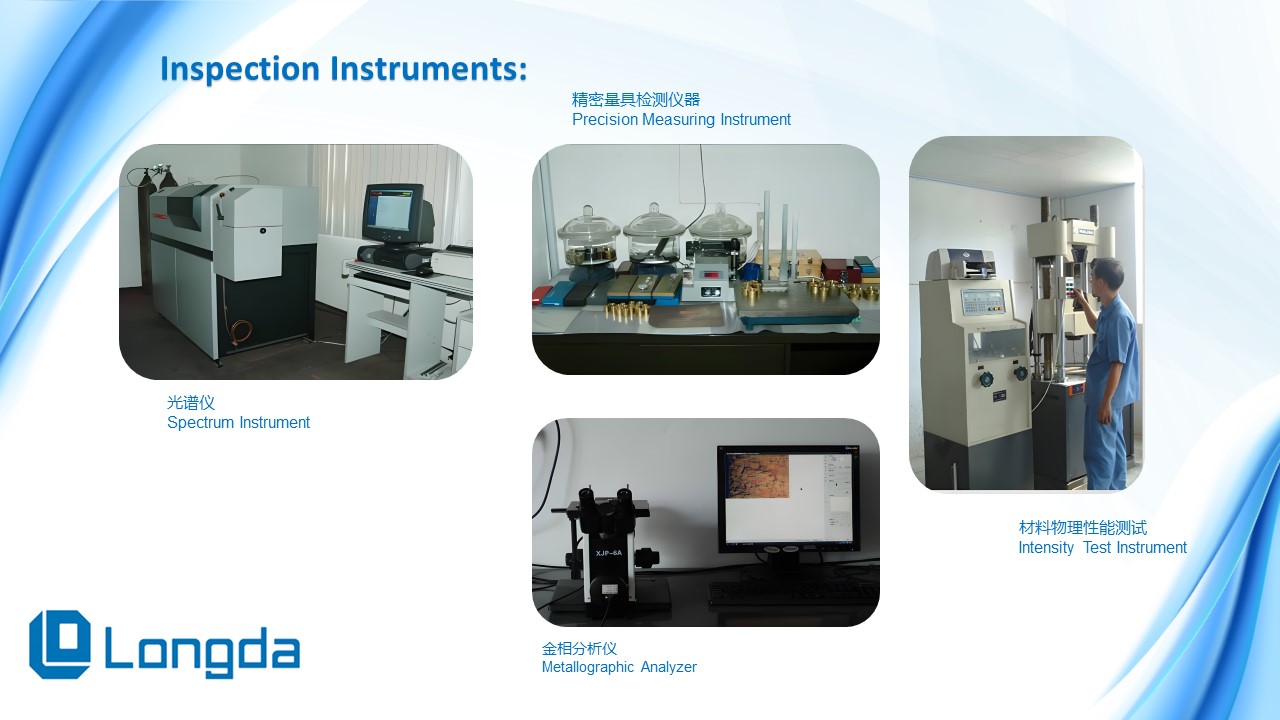
Pressure testing before shipment: the range is 100% pressure tested, with thread gauge inspection on every lot and material test reports available for lead-free versions.
5. Full port design and blow-out-proof stem in the 8081
Two design details of the 8081 affect selection beyond the pressure rating itself.
Full port. The 8081 is a two-piece full port ball valve: at full open, the flow path through the ball equals the pipe diameter, so pressure loss across the valve is minimal. Full-bore construction matters in heating and chilled water circuits, in domestic hot water recirculation loops and anywhere the pump head budget is tight. Reduced-port versions exist elsewhere in the range for applications where some flow restriction is acceptable and a more compact valve envelope is preferred — but reduced port should be a deliberate choice, not a default.
Blow-out-proof stem. The 8081 uses a blow-out-proof stem design, meaning the stem is retained mechanically so that internal pressure cannot eject it if the packing is disturbed or the valve is operated under pressure. Combined with a quarter-turn lever or wing handle, PTFE seats and a body hot-forged in normal brass or lead-free brass, the design targets plumbing and heating service including potable water, water supply, gas and HVAC. Lead-free versions of the 8081 are certified to cUPC and NSF/ANSI 61 & 372.
Step-by-Step Breakdown: A Seven-Step Selection Sequence
- Define the medium and its extremes. Potable water, domestic hot water, heating water, gas, compressed air or irrigation water — and the maximum temperature the circuit can reach. For potable water in the US and Canada, that definition immediately triggers lead-free requirements: wetted surface lead ≤ 0.25% and NSF/ANSI 61 and NSF/ANSI 372 compliance.
- Set the design pressure and compare it with the WOG rating. Take the design pressure from the specification, add the surge allowance the project requires, then compare against 600 WOG (8081) or 200 WOG (LD 30303 and T-22017A). If the required figure is close to 200 psi, the higher-rated ball valve is the lower-risk selection.
- Fix the temperature envelope and eliminate valve types outside it. Ball (8081) and check (LD 30303) valves cover −20 °C to 150 °C; the gate valve (T-22017A) covers −20 °C to 120 °C. This single step usually removes one of the three types from the project.
- Decide the function. Full-port isolation with frequent operation: 8081 ball valve. One-way protection for pumps and boiler circuits: LD 30303 check valve, installed horizontally or vertically. Infrequent shut-off where a metal seat and rising stem suit the duty: T-22017A gate valve. Terminal shut-off at fixtures: the angle valve and supply stop family.
- Choose the connection end from the pipe material and the installer's tooling. PEX-A pipe to ASTM F1960 cold expansion; PEX pipe to ASTM F1807; copper to sweat or press; threaded steel or brass to female NPT or BSP. Confirm press and expansion tooling availability before the order is released.
- Confirm the thread standard for the destination market. NPT for the US and Canada (ASME B1.20.1); BSP where ISO 228-1 threads are the local norm. Write the thread standard on the purchase order next to the size — never just the size.
- Verify compliance, then validate with samples and factory documentation. Potable water: lead-free material, NSF/ANSI 61 & 372, cUPC. Gas in the EU: EN 331:2015 applies. Then confirm fit with samples — sample lead time is typically 5–7 days — and review 100% pressure test records and material test reports before volume production.
Use Cases: Parameter Sets That Fit Real Projects
Whole-house PEX-A repiping and potable water branch lines
For new residential construction, whole-house repiping, potable water branch lines and commercial building plumbing, the 8081 ball valve with an ASTM F1960 cold expansion end matches the pipe system directly. Recorded project conditions for this application include indoor installation in walls and utility rooms, working pressure up to 100 psi (0.7 MPa), water temperature up to 180 °F (82 °C) and long-term continuous service, with cUPC certification, NSF 61 / 372 lead-free compliance and the ASTM F1960 connection standard as the controlling requirements.
Heating, boiler and chilled water circuits
Pumping systems, water supply, heating and boiler systems and industrial fluid lines are the natural fit for the LD 30303 check valve, whose 200 WOG (1.4 MPa) rating and −20 °C to 150 °C range cover the duty and whose horizontal or vertical installation options simplify layout. On the isolation side of the same circuit, the T-22017A gate valve suits infrequent shut-off where the brass-to-brass metal seat avoids elastomer ageing, and its full-bore flow path keeps pressure loss low across the valve.
Municipal water supply and commercial isolation
Municipal water supply, residential and commercial plumbing, HVAC and agricultural irrigation are the listed applications for the T-22017A, whose 1/2"–4" (DN15–DN100) size range covers branch and riser duties. The gate valve is available in lead-free brass with NSF/ANSI 61 and NSF/ANSI 372 certification issued by IAPMO, and the NPT / BSP dual thread system lets one specification serve both North American and international sites without redesigning the bill of materials.
Fixture-level shut-off in residential plumbing
Behind sinks, toilets and washing machines, the requirement shifts to compact local shut-off. The ART.98011 quarter-turn angle valve (125 psi WSP / 600 WOG, temperature up to 90 °C) and the 98023-LF supply stop family (125 psi, −20 °C to 120 °C) cover this duty, with connection options that include FIP, SWT, compression, CPVC, PEX F1807 and F1960, push-fit and press-fit, and cUPC plus NSF/ANSI 61 & 372 certification on the lead-free version.
Documented proof at volume: a North American fixture supply program
A North American program using the supply stop family shows what verified parameters look like at scale. A US manufacturer and a Canadian wholesale distributor used model 7594 for bathroom and kitchen fixture supply shut-off in residential plumbing, at 8,000,000 pieces per year and 70,000,000 pieces respectively, across three-year supply relationships. Reported results were zero leakage complaints and a 100% pass rate in retail quality audits, with monthly repeat orders, on a specification that included cUPC and NSF 61 certification, chrome-plated corrosion resistance, quarter-turn operation, retail packaging and lead-free brass suitable for potable water.
Comparison Table: 8081, LD 30303, T-22017A and the 15111 Fitting Range
| Model | Function | Size range | Pressure rating | Temperature range | Connection options | Design and compliance notes |
|---|---|---|---|---|---|---|
| 8081 Brass ball valve | Quarter-turn isolation; full-port flow | 1/2"–4" (DN15–DN100) | 600 WOG (4.1 MPa) | −20 °C to 150 °C | Female NPT or BSP; FPT, MPT, press, PEX (ASTM F1807), PEX-A (ASTM F1960), compression, SWT, ProPEX cold expansion, push-fit connector ends available | Two-piece full port; blow-out-proof stem; chrome-plated brass ball; PTFE seats; quarter-turn lever or wing handle; 100% factory tested; lead-free version certified cUPC and NSF/ANSI 61 & 372 |
| LD 30303 Brass check valve | One-way flow protection | 1/2"–2" (DN15–DN50) | 200 WOG (1.4 MPa) | −20 °C to 150 °C | Female NPT, BSP, press, PEX, MPT, SWT or cold expansion | Swing or spring-loaded; horizontal or vertical installation; brass disc with PTFE sealing face; SS304 spring; NBR / EPDM seals; lead-free version certified NSF/ANSI 61 & 372 |
| T-22017A Brass gate valve | Infrequent shut-off; full-bore isolation | 1/2"–4" (DN15–DN100) | 200 WOG (1.4 MPa) | −20 °C to 120 °C | Female NPT or BSP threaded | Rising stem; 360° handwheel; brass-to-brass metal seat; test pressure 1.5× rated (shell) and 1.1× rated (seat); lead-free version certified to NSF/ANSI 61 and NSF/ANSI 372 by IAPMO |
| 15111 Brass fittings | Pipe connection and transition | 1/4"–2" (DN8–DN50) | Up to 600 WOG (4.1 MPa) | −20 °C to 150 °C | Threaded (NPT / BSP), sweat, PEX (ASTM F1807), PEX-A (ASTM F1960), press (Z1117), push-fit (ASSE 1061) | Hot-forged brass, no secondary zinc plating; DZR option; lead-free compliant for potable water; 100% factory tested |
Read as a set, the table gives three decision rules. Pressure rating separates the ball valve from the check and gate valves. Temperature rating separates the gate valve (120 °C) from the ball and check valves (150 °C). Connection options separate what can be installed on PEX, copper or threaded pipe — and the check valve has the widest connection coverage of the three valve types, which makes it the most flexible choice when the piping material is still being decided.
Connection Type Reference
| Connection end | Thread or joint standard referenced in the range | Pipe or tube it joins | Selection note |
|---|---|---|---|
| Female NPT | ASME B1.20.1 (NPT) | Threaded brass, steel or galvanised pipe | Not interchangeable with BSP; confirm the mating port standard before ordering |
| BSP | ISO 228-1 | Threaded pipe in BSP markets | Parallel thread form where the pressure-tight joint is not made on the threads — a sealing element is required |
| Press | Press fittings per Z1117 (range specification) | Copper and press-system piping | Requires a compatible press tool and jaws; no open flame at the joint |
| PEX (crimp) | ASTM F1807 | PEX pipe | Standard crimp connection; do not substitute a PEX-A expansion valve |
| PEX-A (cold expansion) | ASTM F1960 | PEX-A pipe | Cold expansion forms a permanent, leak-free joint without reducing the pipe inner diameter |
| Sweat (SWT) | Soldered copper joint | Copper tube | Heat must be controlled near adjacent components and seals |
| Push-fit | ASSE 1061 | Compatible pipe per the fitting system | Confirm the pipe type and manufacturer compatibility before specification |
Two practical checks protect the joint after the connection type is chosen. First, verify the thread form against a gauge — not against a mating part that happens to thread on easily. Second, confirm that the sealing method matches the thread standard: NPT joints are sealed on the threads with an approved sealant or tape, while ISO 228-1 parallel threads depend on a sealing element.
FAQ
Which certifications should be verified on a lead-free brass valve for a North American potable water project?
Three layers should be checked. First, material: lead-free brass with wetted surface lead ≤ 0.25%, in line with NSF/ANSI 372 and the US Safe Drinking Water Act, including California AB1953. Second, health effects: NSF/ANSI 61 for the wetted materials. Third, product listing: cUPC for the applicable performance standard — ASME A112.18.1 / CSA B125.1 for supply stops, ASTM F1960 for PEX-A expansion connections. Lead-free versions in the LONGDA BRASS VALVE range carry cUPC and NSF/ANSI 61 & 372 certification, and the lead-free T-22017A gate valve is certified to NSF/ANSI 61 and NSF/ANSI 372 by IAPMO. Verify the certificate against the exact model and size being purchased, and confirm which markets it covers.
How do I choose between the 8081 ball valve, the LD 30303 check valve and the T-22017A gate valve on the same project?
Use pressure first, then function, then temperature. The 8081 ball valve is rated 600 WOG (4.1 MPa) and covers −20 °C to 150 °C with full port flow, which makes it the choice for main isolation and higher-pressure lines. The LD 30303 check valve is rated 200 WOG (1.4 MPa) and −20 °C to 150 °C and is used for one-way flow protection in pumping, water supply and boiler systems, installed horizontally or vertically. The T-22017A gate valve is rated 200 WOG (1.4 MPa) and −20 °C to 120 °C, and it fits infrequent shut-off duty where a brass-to-brass metal seat and rising stem are preferred. If the medium exceeds 120 °C, the gate valve is out of range and a ball or check valve is required.
Can an NPT brass valve be installed on a BSP threaded port of the same nominal size?
No. NPT and BSP are different thread systems, and shared nominal sizes do not make them interchangeable. NPT threads are specified to ASME B1.20.1 in North American practice, while ISO 228-1 covers the parallel pipe thread form where the pressure-tight joint is not made on the threads themselves. A forced cross-fit engages only partially, can pass a first pressure check with sealant bridging the gap, and then leaks or damages the threads. LONGDA BRASS VALVE produces both NPT and BSP systems across one line, so the practical protection is procedural: state the thread standard on the purchase order next to the size, and rely on thread gauge inspection on every lot rather than on a mating part that threads on easily.
What is the fastest way to validate a pressure, temperature and connection set before committing to a volume order?
Order samples built to the exact parameter set — thread standard, connection end, pressure rating and body material included. Sample lead time in this range is typically 5–7 days. Minimum order quantity is 1,000 pcs per size for the supply stop family and varies by size across other families. Production lead time runs 20–50 days for ball valve programs and 30–60 days for the supply stop family, depending on the product and order volume. Validation should include factory evidence as well as physical fit: 100% air pressure testing under water, material test reports for lead-free versions, and thread gauge inspection records. All products in the range are 100% pressure tested, and quality defects are covered by a 12-month quality warranty with free replacement.
Brass angle valve manufacturer for residential plumbing projects — what should a buyer verify first?
Start with the parameter set of the angle valve itself. The ART.98011 quarter-turn angle valve is rated 125 psi WSP / 600 WOG with a temperature range up to 90 °C, and the 98023-LF supply stop is rated 125 psi over −20 °C to 120 °C with cUPC and NSF/ANSI 61 & 372 certification on the lead-free version. Then verify connection coverage, because fixture shut-off fails at the joint more often than at the body: FIP, SWT, compression, CPVC, PEX F1807 and F1960, push-fit and press-fit options are available across the family. Finally confirm supply capability and support: 500,000 pcs per month capacity, 30–60 day lead time, 5–7 day samples, 100% air pressure testing under water, technical support and installation guidance, and a 12-month quality warranty with free replacement for quality defects. A sample request against your own parameter list is the fastest way to confirm all four points at once.
Conclusion
Brass valve selection is settled by three parameters, and they must be read together rather than one at a time. Pressure rating decides whether the valve can survive the worst pressure the system can produce — 600 WOG for the 8081 ball valve, 200 WOG for the LD 30303 check valve and the T-22017A gate valve, with the gate valve additionally tested at 1.5× rated shell pressure and 1.1× rated seat pressure. Temperature range decides which valve types remain eligible — 150 °C for ball and check valves, 120 °C for the gate valve. Connection type decides whether the valve can be installed at all, and thread standard decides whether the joint will still be sound after a year of thermal cycling.
Documentation closes the loop. Thread gauge inspection on every lot, 100% pressure testing before shipment, material test reports for lead-free versions and certification that matches the exact model and market turn a parameter list into a defensible specification. LONGDA BRASS VALVE, the brass valve brand of Zhejiang Longda Technology Co.,Ltd., manufactures ball, check, gate, angle and supply stop valves plus brass fittings in Yuhuan, Zhejiang Province, with a 30,000 m² plant, about 200 employees, 7,500 tons of annual output and IAPMO and ALS certification, supplying residential and commercial plumbing, heating and HVAC projects.
Ready to validate a parameter set? Samples and the full product catalogue covering 1/2"–4" valves and 1/4"–2" fittings are available on request.
Next Step: Match Your Parameters to a Sample
Send your working pressure, maximum medium temperature, pipe material and required thread standard, and the LONGDA BRASS VALVE team will confirm the matching valve model and connection end. Samples are typically available in 5–7 days.
Download the full product catalogue: LONGDA Global Catalogue (PDF)
Website: www.ld-valve.com | Email: sales@ld-valve.com | Tel / WhatsApp: +86 13506869135