
Decoding Brass Valve Spec Sheets: WOG Ratings, Port Type, Seats and Stem Design
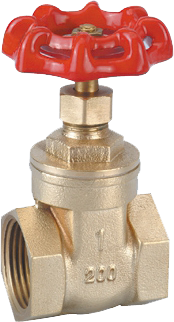
Cover: a brass gate valve with rising stem and handwheel — the stem line on a spec sheet tells you how a valve is operated and how its position is indicated.
A brass valve spec sheet is a compressed engineering decision. Two lines in a catalogue determine whether a valve belongs on a 60 psi fixture branch or a 200 psi distribution main, whether it will still isolate cleanly after years of cycling, and whether it may be installed on a potable water line in the United States or Canada. Most specification-related field failures are not defective valves — they are correct valves applied to the wrong duty.
This guide decodes the four parameters that carry the most weight on a brass valve data sheet — WOG pressure ratings, port type, seat and seal materials, and stem design — across five product families from ZHEJIANG LONGDA TECHNOLOGY CO.,LTD, a brass valve and fitting manufacturer established in 1993 in XuanGuang Industrial Zone, LuPu Town, YuHuan County, Zhejiang Province, China. Each parameter is then tied to a concrete duty: indoor fixture and distribution lines operating at 40–80 psi.
Why Brass Valve Spec Sheets Get Misread
Five reading errors account for most mis-specification in residential and commercial plumbing work.
- Treating WOG numbers as a quality ranking. A 600 WOG (4.1 MPa) ball valve and a 200 WOG (1.4 MPa) gate valve are different pressure classes built for different duties — not a better and a worse product.
- Skipping the port type line. A valve described only as "1/2 inch" says nothing about its internal bore.
- Skimming the seat and seal line. PTFE seats, a brass-to-brass metal seat, and a brass disc with a PTFE sealing face wear differently and age differently.
- Reading the handle instead of the stem. Blow-out-proof stems, rising stems and quarter-turn ball cores imply different operating practices.
- Assuming threads are universal. NPT and BSP threads are governed by different standards and are not interchangeable, even when the nominal size matches.
The outcome is the same in each case: the valve arrives, threads into place, and then behaves differently from what was expected — a throttled gate valve that erodes its seating surface, a reduced-bore valve that starves a fixture, or a standard-thread valve forced into a mismatched port.
The Standards and Market Context Behind the Numbers
Brass valves are a large, standards-governed category, which is why spec sheets read the way they do. Dataintelo valued the global brass valves market at USD 14.8 billion in 2025 and projects USD 24.1 billion by 2034, a 5.6% CAGR from 2026 to 2034; ball valves held the largest product type share at 38.4% in 2025. Asia Pacific accounted for 41.2% of revenue in 2025 and North America approximately 26.1%. OEC trade data shows China exported USD 22.6 billion of valves (HS 8481) in 2024.
Compliance lines on a spec sheet are not decoration. NSF/ANSI/CAN 61 addresses health effects for wetted components, and NSF/ANSI 372 sets the wetted-surface lead limit at ≤ 0.25% — the level referenced by the US Safe Drinking Water Act and California AB1953. cUPC listing brings a product into North American plumbing codes, and supply stops are additionally evaluated against ASME A112.18.1 / CSA B125.1. Threads are governed by ASME B1.20.1 for NPT and by ISO 228-1 for BSP threads, the latter covering threads where the pressure-tight joint is not made on the threads. In Europe, EN 331:2015 applies to brass gas valves and EN 13828:2003 to manually operated copper alloy ball valves for drinking water supply, while ASTM B584 defines chemical and mechanical requirements for copper alloy castings.
ZHEJIANG LONGDA TECHNOLOGY CO.,LTD manufactures the product families referenced in this guide. The company operates a 30,000 m² facility with approximately 200 employees and an annual brass output of about 7,500 tons, supported by more than 360 sets of processing and testing equipment and an R&D team of six engineers. Around 95% of production is exported to the EU, USA, Canada and South America. Its material range includes lead-free and low-lead alloys such as CW724R, C46500, CW511L, CW509L and CW510L, alongside dezincification-resistant CW602N, and its products are IAPMO and ALS certified.
Parameter 1 — WOG Ratings: Pressure and Temperature Travel Together
WOG is the non-shock working-pressure rating for water, oil and gas service at ambient temperature; WSP denotes working steam pressure. A line such as "125 psi WSP / 600 WOG" on the ART.98011 brass angle valve therefore reports two duty envelopes, not two interchangeable numbers.
Within the LONGDA range, ratings separate cleanly by family. The 8081 two-piece full port brass ball valve and the 15111 brass fitting series are rated 600 WOG (4.1 MPa). The LD 30303 brass check valve, the LD.73154 brass Y strainer and the T-22017A brass gate valve are rated 200 WOG (1.4 MPa). The ART.60621 brass water ball valve carries a nominal pressure of 30 bar.
Two habits make a pressure line usable. First, read it only as a pair with the temperature range printed on the same row: -20°C to 150°C for the 8081 ball valve, LD 30303 check valve, LD.73154 strainer and 15111 fittings; -20°C to 120°C for the T-22017A gate valve; -20°C to 140°C for ART.60621; and 0°C to 90°C for ART.98011. Second, look for the test basis. The T-22017A gate valve sheet states a test pressure of 1.5× rated pressure for the shell and 1.1× rated pressure for the seat — that single line describes how the body and the seating element are verified before the valve leaves the plant.
Parameter 2 — Port Type: Full Port vs Standard Bore
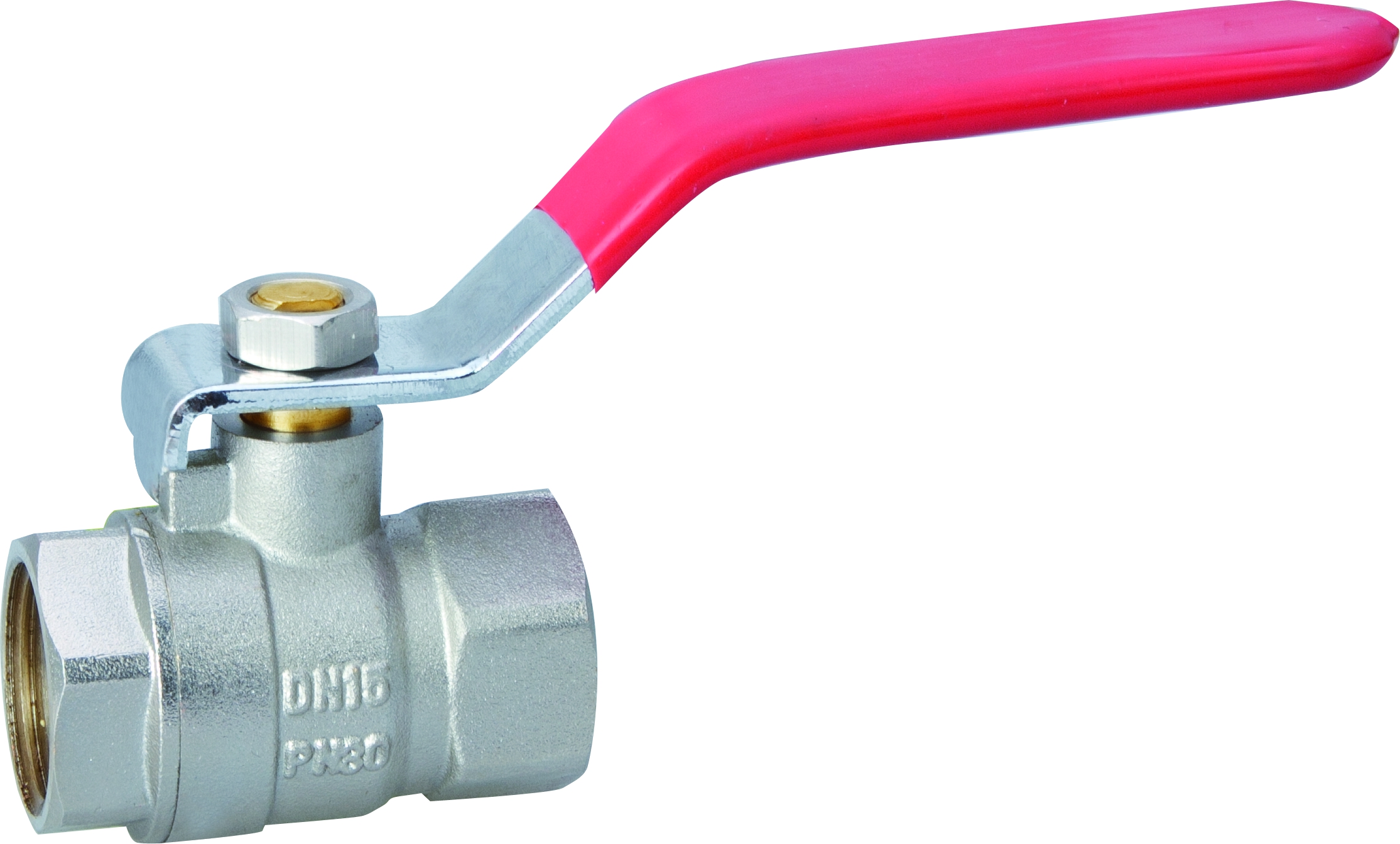
Full port brass ball valve — the bore of a full port body matches the pipe internal diameter, so the flow path is not narrowed at the valve.
Port type describes the internal flow path, and it is the parameter most often missing from a headline specification. In a full port (or full bore) design, the flow path matches the pipe internal diameter and pressure loss across the valve is minimal. In a standard or reduced bore design, the flow path narrows.
Family by family: the 8081 ball valve is a 2-piece full port design; the T-22017A gate valve is a full bore design; and the ART.60621 ball valve is offered in both full port and reduced port versions, which makes the port line mandatory reading on that family. For potable water branch lines and equipment connections where pressure margin is already modest, the port line decides performance more often than the pressure rating does.
Parameter 3 — Seats, Sealing Faces and O-Rings
The seat line answers two questions: how the valve closes, and what the closing element is made of.
- 8081 brass ball valve — chrome-plated brass ball with PTFE seats and NBR or FKM O-rings.
- LD 30303 brass check valve — brass disc with a PTFE sealing face, SS304 stainless steel spring, and NBR or EPDM O-ring and gasket.
- LD.73154 brass Y strainer — NBR or EPDM gasket and seal with a brass blow-down drain plug, plus an SS304 stainless steel screen in 20/40/60/80 mesh.
- T-22017A brass gate valve — brass-to-brass metal seat with no elastomer in the seating path, plus PTFE or EPDM packing and seal.
- ART.60621 brass ball valve — internal leaktightness from two PTFE seats, external leaktightness from a PTFE sealing gland.
The trade-off between these constructions is a duty decision, not a quality decision. A brass-to-brass metal seat has no rubber component to age in the seating path and is described as wear-resistant and long-lasting, ideal for infrequent shut-off duty. Soft-seated designs built around PTFE seats and double O-ring sealing suit valves that are cycled often and must close tightly each time — the sealing architecture used across the supply-stop and ball-valve families, supported by chrome plating for corrosion resistance.
Parameter 4 — Stem Design: What the Handle Hides
- 8081 brass ball valve — blow-out-proof stem design with a quarter-turn lever or wing handle.
- T-22017A brass gate valve — rising stem with a 360° handwheel, giving visible position indication and multi-turn operation.
- ART.98011 brass angle valve — quarter-turn operation with a brass ball or POM stem option.
- 98023-LF brass supply stop valve — available in quarter-turn (ball) or multi-turn versions.
- LD 30303 brass check valve — no stem at all; the equivalent lines to read are installation orientation (horizontal or vertical) and mechanism type (swing or spring-loaded).
The decision rule is cycling frequency. Quarter-turn ball designs are built for frequent on/off operation. Multi-turn rising-stem designs are built for isolation that is set and left alone — which is why the metal-seated T-22017A is specified for shut-off duty rather than throttling.
Parameter 5 — Threads and Connection Types
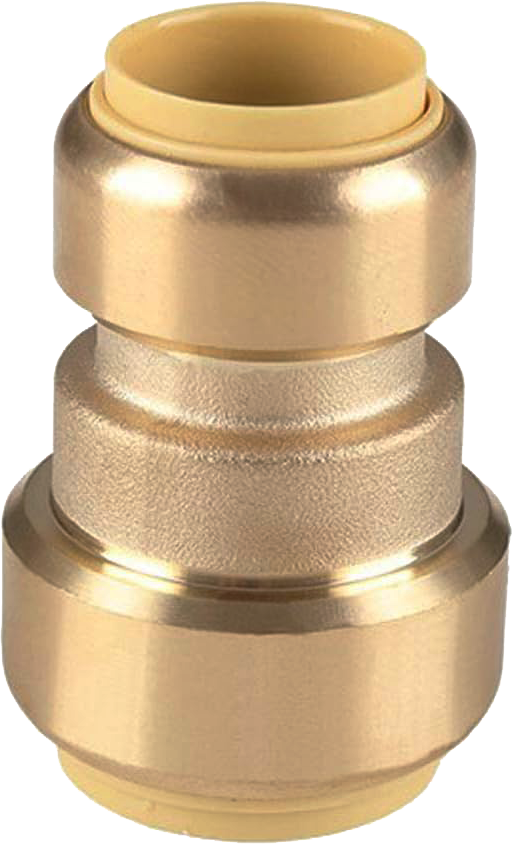
Push-fit brass fitting per ASSE 1061 — the connection method is part of the specification, not an accessory.
NPT threads follow ASME B1.20.1 and rely on thread interference together with a sealant; BSP threads follow ISO 228-1, which addresses threads where the pressure-tight joint is not made on the threads. Mixing the two produces the most common thread-damage scenario in the field.
Connection flexibility is specified explicitly on LONGDA sheets. The 8081 ball valve offers female NPT or BSP connections, with options extending to FPT, MPT, Press, PEX, Compression, SWT, ProPEX (Cold Expansion) and Push-fit. The 15111 fitting series covers 1/4" to 2" (DN8–DN50) in NPT or BSP male and female threads, with threaded, sweat, PEX, PEX-A, Press and Push-fit ends — PEX fittings per ASTM F1807 and F877, PEX-A fittings per ASTM F1960, push-fit per ASSE 1061 and press per Z1117. The LD 30303 check valve can be supplied with female NPT or BSP, PRESS, PEX, MPT, SWT or cold expansion ends, and the LD.73154 Y strainer with FPT, SWT or Press connectors.
The LONGDA Parameter Map: Seven Families Side by Side
| Model / family | Size range | Pressure rating | Temperature | Port and seat | Stem / operation | Connections and verification |
|---|---|---|---|---|---|---|
| 8081 brass ball valve (2-piece) | 1/2"–4" (DN15–DN100) | 600 WOG (4.1 MPa) | -20°C to 150°C | Full port; PTFE seats; chrome-plated brass ball; NBR or FKM O-rings | Blow-out-proof stem; quarter-turn lever or wing handle | Female NPT or BSP; FPT, MPT, Press, PEX, Compression, SWT, ProPEX, Push-fit; 100% factory tested; lead-free version cUPC and NSF/ANSI 61 & 372 |
| LD 30303 brass check valve | 1/2"–2" (DN15–DN50) | 200 WOG (1.4 MPa) | -20°C to 150°C | Swing or spring-loaded; brass disc with PTFE sealing face; SS304 spring; NBR or EPDM O-ring and gasket | No stem; horizontal or vertical installation | Female NPT or BSP, PRESS, PEX, MPT, SWT, cold expansion; lead-free version NSF 61 and NSF 372 certified |
| LD.73154 brass Y strainer | 1/2"–2" (DN15–DN50) | 200 WOG (1.4 MPa) | -20°C to 150°C | SS304 screen, 20/40/60/80 mesh; NBR or EPDM gasket; brass blow-down drain plug | Replaceable screen without pipeline disassembly | Female NPT or BSP; FPT, SWT, Press; 100% factory test; lead-free version certified by IAPMO to NSF/ANSI/CAN 61 and NSF/ANSI 372 |
| T-22017A brass gate valve | 1/2"–4" (DN15–DN100) | 200 WOG (1.4 MPa) | -20°C to 120°C | Full bore; brass-to-brass metal seat; PTFE or EPDM packing and seal | Rising stem; 360° handwheel | Female NPT or BSP; test pressure 1.5× rated (shell) and 1.1× rated (seat); lead-free version certified to NSF/ANSI 61 and NSF/ANSI 372 by IAPMO |
| 15111 brass fittings | 1/4"–2" (DN8–DN50) | Up to 600 WOG (4.1 MPa) | -20°C to 150°C | Hot-forged brass body; DZR option; lead-free compliant for potable water | — | NPT or BSP male/female; threaded, sweat, PEX, PEX-A, Press, Push-fit per ASTM F1807, F1960, Z1117, ASSE 1061; 100% factory test |
| 98023-LF brass supply stop valve | 1/2" × 3/8" and 1/2" × 1/2" (DN15 × DN10/DN15) | 125 psi | -20°C to 120°C | Quarter-turn (ball) or multi-turn; PTFE seats; NBR or EPDM O-rings | Quarter-turn or multi-turn | Compression, FIP, PEX (ASTM F1960), sweat, threaded; lead-free version cUPC and NSF/ANSI 61 & 372 |
| ART.98011 brass angle valve | 1/2" × 1/2" and 1/2" × 3/8" (DN15) | 125 psi WSP / 600 WOG | 0°C to 90°C | Chrome-plated brass ball; PTFE or NBR seats and seals | Quarter-turn; brass ball or POM stem; brass or ABS handle | Residential plumbing, commercial buildings and water supply terminals |
All values as published on LONGDA product specifications for the listed models.
Reading a Brass Valve Spec Sheet in Eight Checks
- Identify the family and function first. Ball, check, gate, angle or strainer — the function determines which lines matter.
- Read the pressure rating with its medium basis. WOG and WSP are different duty envelopes.
- Read the temperature range as a bound pair. A rating at ambient temperature is not a rating at 150°C.
- Check port type before comparing pressure classes. Full port, full bore or reduced bore.
- Check the seat, sealing face and O-ring line against cycling frequency and media.
- Check stem design and operation. Quarter-turn or multi-turn; blow-out-proof or rising stem; no stem at all on a check valve.
- Confirm the thread standard and connection method. NPT per ASME B1.20.1 or BSP per ISO 228-1, plus the end type actually being installed.
- Confirm the compliance and test evidence. cUPC listing, NSF/ANSI/CAN 61 and NSF/ANSI 372 for wetted surfaces, and the stated test basis such as 1.5× shell / 1.1× seat on the T-22017A.
Matching Parameters to 40–80 psi Indoor Fixture and Distribution Duty
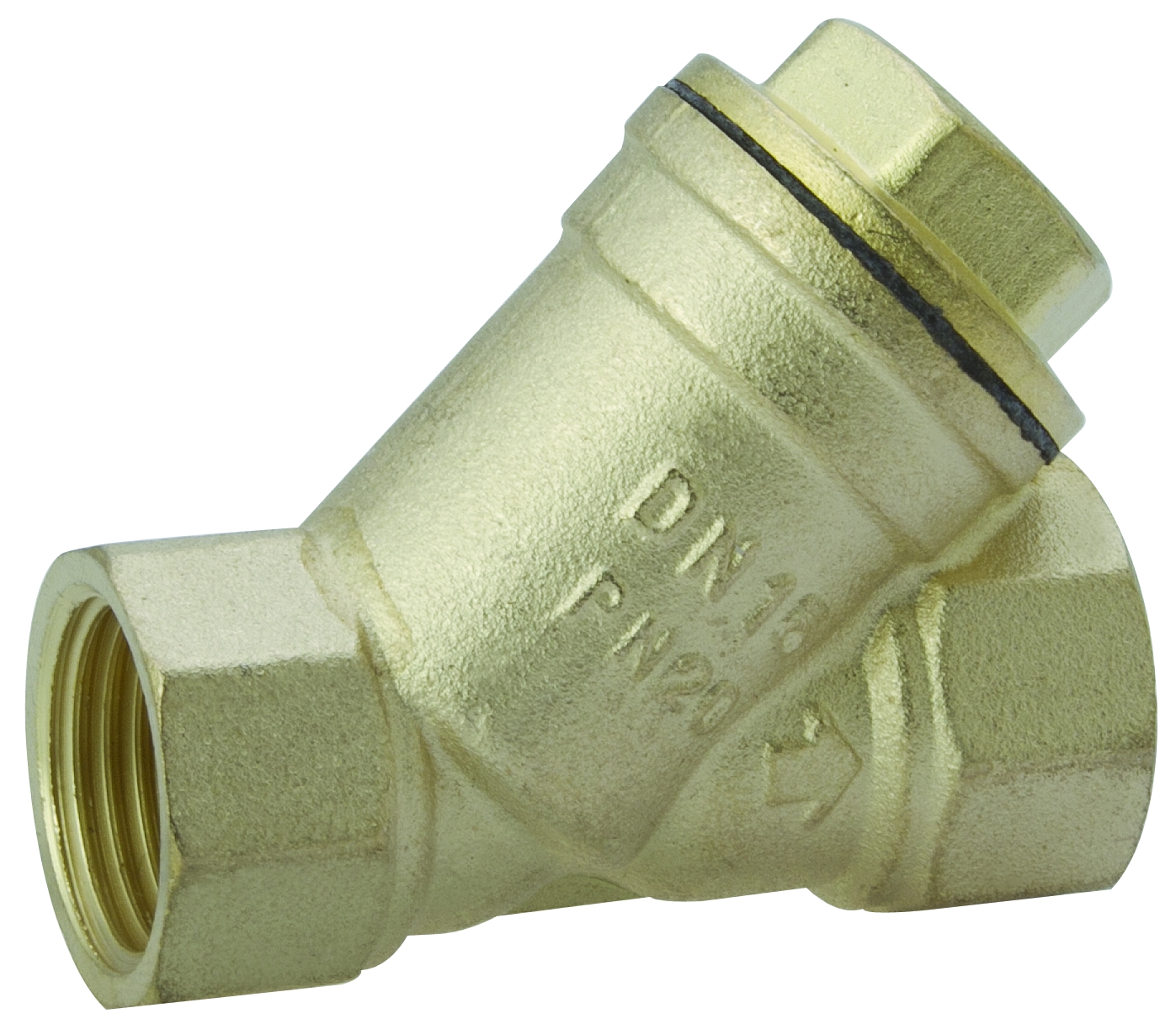
Threaded brass Y strainer — installed ahead of pumps and meters to protect downstream components.
Indoor fixture and distribution work is a low-pressure duty. Fixture supply lines typically run at 40–80 psi (0.28–0.55 MPa) and 4°C–60°C, in confined spaces behind fixtures, with frequent on/off operation. Every LONGDA family discussed here is rated above that envelope, which means the pressure rating is not the selecting parameter at the fixture — port type, seat construction and connection method are.
At the fixture terminal, the practical choices are quarter-turn supply stops and angle valves: the 98023-LF supply stop valve at 125 psi with PTFE seats and NBR or EPDM O-rings, or the ART.98011 angle valve at 125 psi WSP / 600 WOG with a quarter-turn brass ball or POM stem. Both serve the same purpose — local shut-off of a fixture supply for maintenance or emergency stop without closing the building main, which is standard practice behind sinks, toilets and washing machines.
On the distribution side, the parameters shift. The T-22017A gate valve is the full bore, metal-seated isolation choice for lines that are shut off infrequently, with a rising stem that shows position at a glance. The 8081 full port ball valve covers branch isolation where the valve is operated routinely, with a 600 WOG (4.1 MPa) rating. The LD 30303 check valve prevents backflow in pumping and water supply systems, and the LD.73154 Y strainer protects downstream pump impellers, ball valve seats and meter accuracy by filtering sand, sediment and weld debris through an SS304 screen available in 20/40/60/80 mesh. Where any of these components sits on a potable water line in the USA or Canada, lead-free material and NSF/ANSI/CAN 61 and NSF/ANSI 372 certification become mandatory specification lines rather than options.
Four Installation Risks and the Spec Lines That Prevent Them
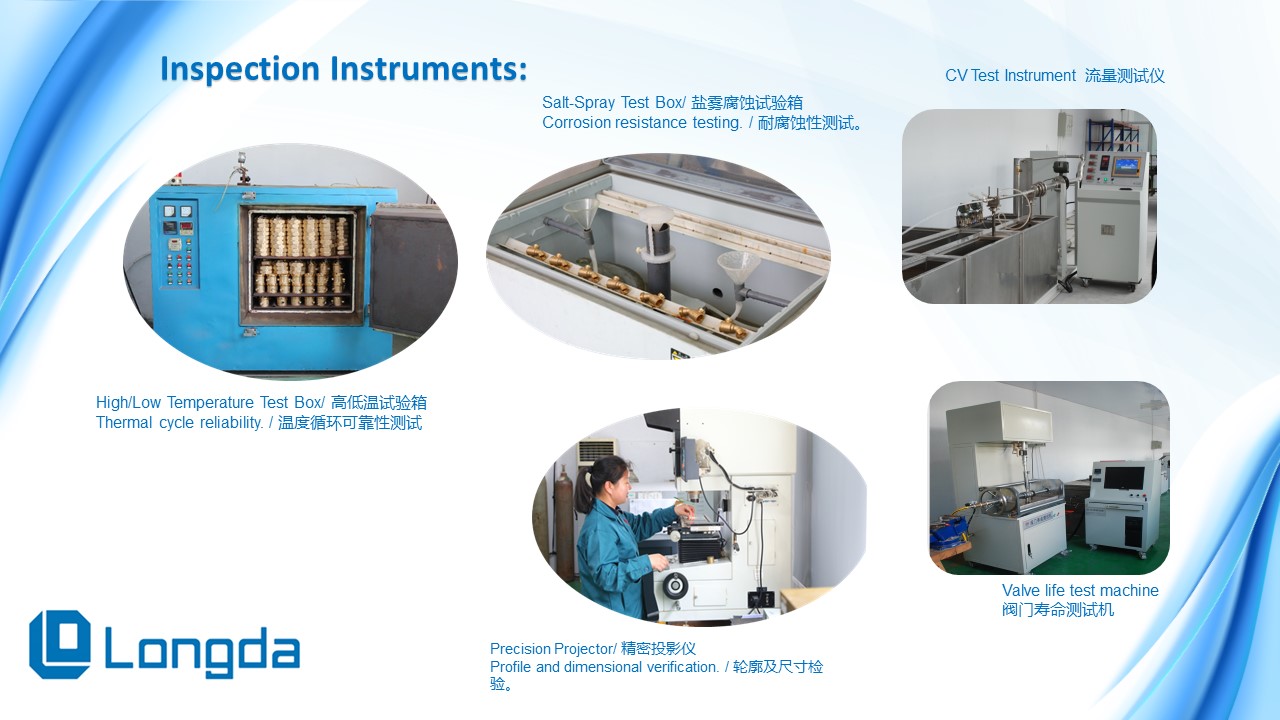
In-house pressure testing — the test record behind the rating printed on the sheet.
| Risk | Where it shows up | Spec line and control that addresses it |
|---|---|---|
| Connection leakage | Threaded joints and end connections on fixture and branch lines | PTFE seal with double O-ring sealing and chrome-plated anti-corrosion finish; correct thread standard (NPT per ASME B1.20.1 or BSP per ISO 228-1); 100% air pressure testing before shipment |
| Stem leakage | Valves cycled repeatedly at the stem | Blow-out-proof stem design on the 8081 ball valve; PTFE sealing gland and two PTFE seats on ART.60621; PTFE or EPDM packing on the T-22017A |
| Thread damage | Cross-threading and forced assembly on site | Thread gauge inspection on every production lot; NPT and BSP options held across the same product families so the correct thread system can be supplied |
| Long-term degradation | Dezincification and elastomer aging in wet or humid locations | Dezincification-resistant CW602N and lead-free alloy options; brass-to-brass metal seat where elastomer aging must be avoided; replaceable SS304 strainer screens |
Supporting evidence for these controls is documented rather than asserted: 100% air pressure testing before shipment, thread gauge inspection on every lot, a lead-free material test report, and a 12-month quality warranty with free replacement on LONGDA brass shut-off valves.
Frequently Asked Questions
What does 600 WOG mean on a brass valve spec sheet?
WOG is the non-shock working-pressure rating for water, oil and gas service at ambient temperature, and on LONGDA sheets it is given with its metric equivalent. The 8081 two-piece full port brass ball valve and the 15111 brass fitting series are rated 600 WOG (4.1 MPa). The LD 30303 check valve, LD.73154 Y strainer and T-22017A gate valve are rated 200 WOG (1.4 MPa). The rating is only meaningful together with the temperature range on the same row — for example -20°C to 150°C on the 8081 ball valve and -20°C to 120°C on the T-22017A gate valve.
Which lead-free and potable-water certifications should a brass valve sheet list for the US and Canada?
For wetted components the key lines are NSF/ANSI/CAN 61 for health effects and NSF/ANSI 372 for the wetted-surface lead limit of ≤ 0.25%, together with cUPC listing where plumbing codes apply; supply stops are additionally evaluated against ASME A112.18.1 / CSA B125.1. Lead-free versions of the 8081 ball valve and the 98023-LF supply stop valve carry cUPC and NSF/ANSI 61 & 372; the LD 30303 check valve lead-free version is NSF 61 and NSF 372 certified; and the lead-free T-22017A gate valve and LD.73154 Y strainer are certified to NSF/ANSI 61 and NSF/ANSI/CAN 372 by IAPMO.
Does port type really change performance on a 40–80 psi fixture line?
It changes flow performance, but not in the way the pressure rating suggests. A 40–80 psi (0.28–0.55 MPa) indoor fixture line operates well below the 600 WOG (4.1 MPa) rating of the 8081 full port ball valve and the 200 WOG (1.4 MPa) rating of the T-22017A gate valve, so the rating is rarely the limiting factor. Port type is: a full port or full bore body keeps the internal flow path equal to the pipe diameter, while a reduced port narrows it. On the ART.60621 ball valve the port type is a selection line, because the model is offered in both full port and reduced port versions.
How do I choose between a PTFE-seated ball valve and a metal-seated gate valve?
Choose by cycling frequency and sealing requirement. The 8081 ball valve gives quarter-turn operation with PTFE seats, NBR or FKM O-rings and a chrome-plated brass ball — a construction suited to valves operated routinely, and available in a full port body rated 600 WOG (4.1 MPa). The T-22017A gate valve uses a brass-to-brass metal seat with no rubber in the seating path, described as wear-resistant with no rubber seal aging, and is intended for infrequent shut-off duty with a rising stem and 360° handwheel. Using a metal-seated gate valve for throttling, or a soft-seated valve where elastomer aging is the primary concern, inverts both designs.
How can a buyer verify brass valve quality before a volume order?
Ask for three verifiable items: the 100% air pressure test performed on every valve before shipment, thread gauge inspection covering every production lot, and a lead-free material test report where potable water contact applies. Certification documents — cUPC, NSF/ANSI/CAN 61 and NSF/ANSI 372 — should be requested alongside the specification, and the 12-month quality warranty with free replacement applies to LONGDA brass shut-off valves. To move from reading parameters to validating a sample, download the LONGDA Global catalogue (PDF) and send the target specification to sales@ld-valve.com or WhatsApp +86 13506869135.
Conclusion: Read the Parameter, Not the Headline
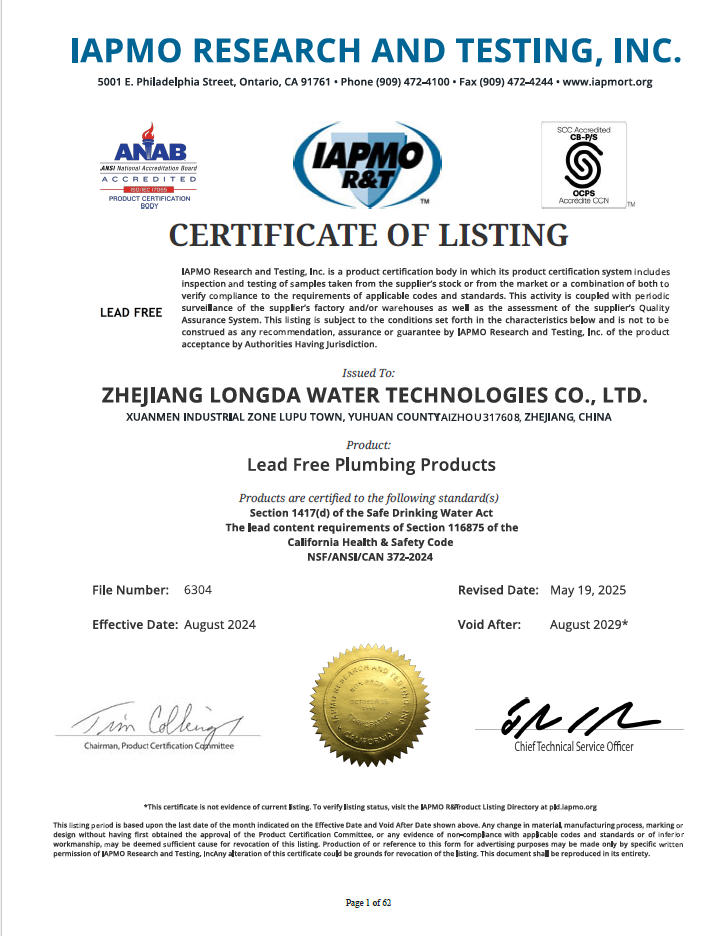
Lead-free wetted surfaces: certification documents belong with the specification, not after it.
Decoding a brass valve spec sheet comes down to a fixed order of reading: family and function, pressure rating with its WOG or WSP basis, temperature bound, port type, seat and seal materials, stem design and operator, thread standard, and finally the compliance and test evidence. Applied to the LONGDA families in this guide, that order resolves most specification questions before a purchase order is raised — a 600 WOG (4.1 MPa) full port ball valve for branch isolation, a 200 WOG (1.4 MPa) metal-seated gate valve for infrequent distribution shut-off, a swing or spring-loaded check valve for backflow prevention, an SS304-screened Y strainer for debris protection, and lead-free options certified to NSF/ANSI/CAN 61 and NSF/ANSI 372 wherever potable water is involved.
ZHEJIANG LONGDA TECHNOLOGY CO.,LTD supplies these families from Yuhuan County, Zhejiang Province, with published size ranges from 1/4" to 4" (DN8–DN100) across the models covered here, NPT and BSP thread systems, and lead-free and DZR alloy options. For specification support, samples or the full catalogue, contact sales@ld-valve.com, WhatsApp +86 13506869135, or visit www.ld-valve.com. The Longda Global catalogue can be downloaded here: catalogue Longda-Global.pdf.